fuel BMW M3 CONVERTIBLE 2001 E46 User Guide
[x] Cancel search | Manufacturer: BMW, Model Year: 2001, Model line: M3 CONVERTIBLE, Model: BMW M3 CONVERTIBLE 2001 E46Pages: 195, PDF Size: 1.96 MB
Page 38 of 195
38n
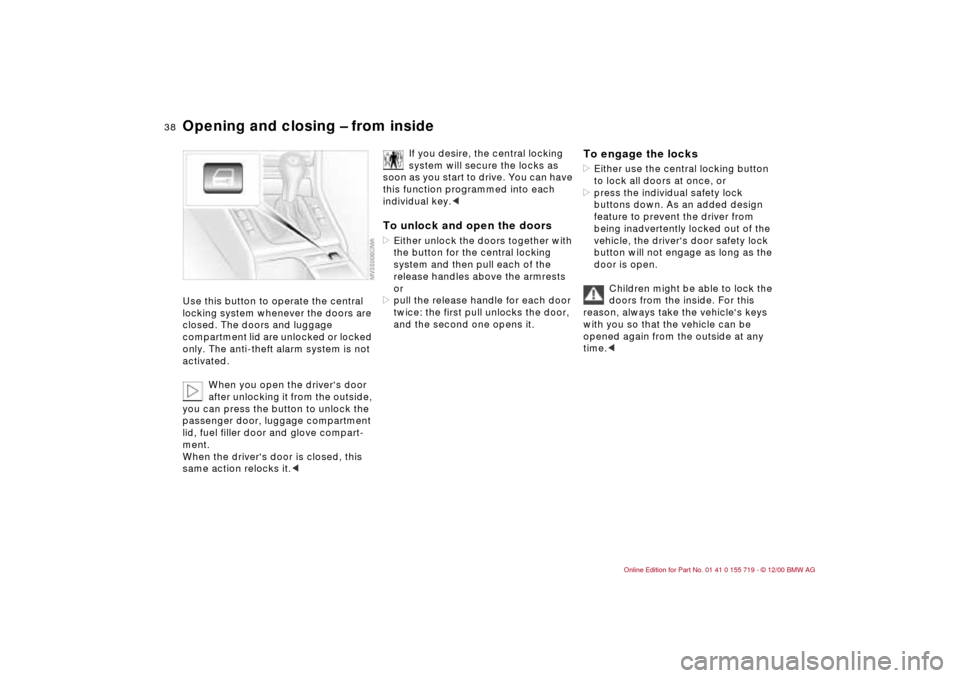
Opening and closing – from inside Use this button to operate the central
locking system whenever the doors are
closed. The doors and luggage
compartment lid are unlocked or locked
only. The anti-theft alarm system is not
activated.
When you open the driver's door
after unlocking it from the outside,
you can press the button to unlock the
passenger door, luggage compartment
lid, fuel filler door and glove compart-
ment.
When the driver's door is closed, this
same action relocks it.<
If you desire, the central locking
system will secure the locks as
soon as you start to drive. You can have
this function programmed into each
individual key.<
To unlock and open the doors>Either unlock the doors together with
the button for the central locking
system and then pull each of the
release handles above the armrests
or
>pull the release handle for each door
twice: the first pull unlocks the door,
and the second one opens it.
To engage the locks>Either use the central locking button
to lock all doors at once, or
>press the individual safety lock
buttons down. As an added design
feature to prevent the driver from
being inadvertently locked out of the
vehicle, the driver's door safety lock
button will not engage as long as the
door is open.
Children might be able to lock the
doors from the inside. For this
reason, always take the vehicle's keys
with you so that the vehicle can be
opened again from the outside at any
time.<
Page 73 of 195
73n
IndexDataTechnologyRepairsCar careControlsOverview
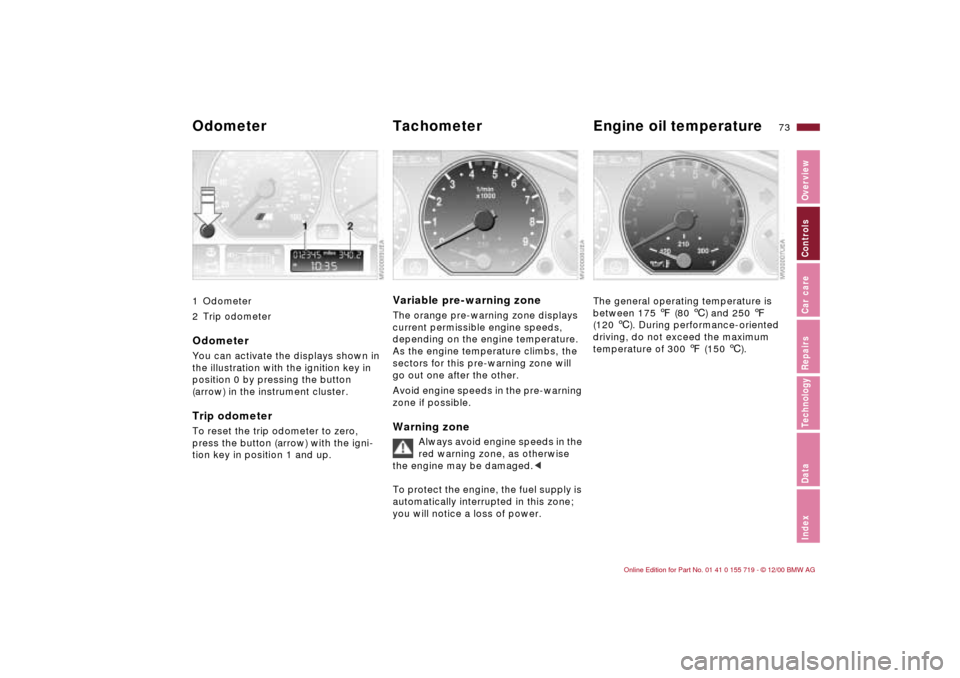
1 Odometer
2 Trip odometerOdometerYou can activate the displays shown in
the illustration with the ignition key in
position 0 by pressing the button
(arrow) in the instrument cluster.Trip odometerTo reset the trip odometer to zero,
press the button (arrow) with the igni-
tion key in position 1 and up.
Variable pre-warning zoneThe orange pre-warning zone displays
current permissible engine speeds,
depending on the engine temperature.
As the engine temperature climbs, the
sectors for this pre-warning zone will
go out one after the other.
Avoid engine speeds in the pre-warning
zone if possible.Warning zone
Always avoid engine speeds in the
red warning zone, as otherwise
the engine may be damaged.<
To protect the engine, the fuel supply is
automatically interrupted in this zone;
you will notice a loss of power.
The general operating temperature is
between 175 7 (80 6) and 250 7
(120 6). During performance-oriented
driving, do not exceed the maximum
temperature of 300 7 (150 6).
Odometer Tachometer Engine oil temperature
Page 74 of 195
74n
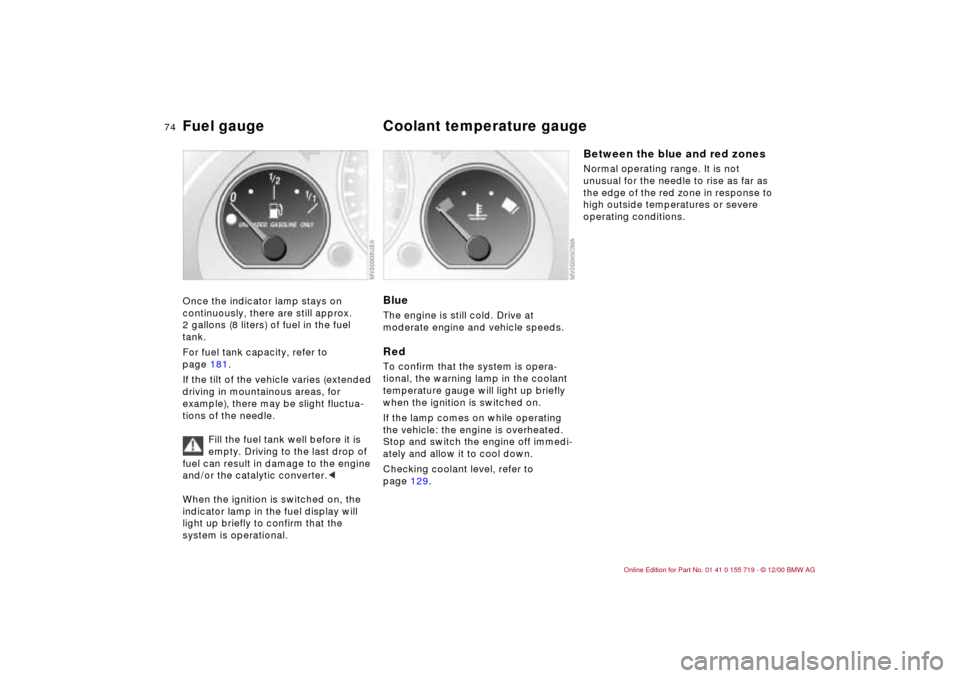
Fuel gauge Coolant temperature gauge Once the indicator lamp stays on
continuously, there are still approx.
2 gallons (8 liters) of fuel in the fuel
tank.
For fuel tank capacity, refer to
page 181.
If the tilt of the vehicle varies (extended
driving in mountainous areas, for
example), there may be slight fluctua-
tions of the needle.
Fill the fuel tank well before it is
empty. Driving to the last drop of
fuel can result in damage to the engine
and/or the catalytic converter.<
When the ignition is switched on, the
indicator lamp in the fuel display will
light up briefly to confirm that the
system is operational.
BlueThe engine is still cold. Drive at
moderate engine and vehicle speeds. RedTo confirm that the system is opera-
tional, the warning lamp in the coolant
temperature gauge will light up briefly
when the ignition is switched on.
If the lamp comes on while operating
the vehicle: the engine is overheated.
Stop and switch the engine off immedi-
ately and allow it to cool down.
Checking coolant level, refer to
page 129.
Between the blue and red zonesNormal operating range. It is not
unusual for the needle to rise as far as
the edge of the red zone in response to
high outside temperatures or severe
operating conditions.
Page 77 of 195
77n
IndexDataTechnologyRepairsCar careControlsOverview
Computer
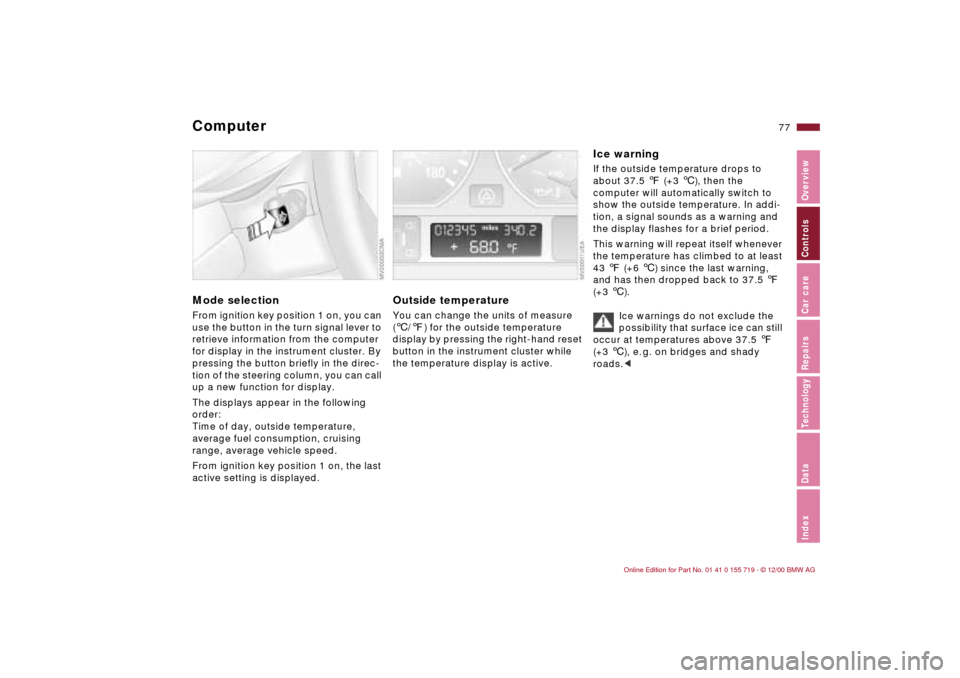
Mode selectionFrom ignition key position 1 on, you can
use the button in the turn signal lever to
retrieve information from the computer
for display in the instrument cluster. By
pressing the button briefly in the direc-
tion of the steering column, you can call
up a new function for display.
The displays appear in the following
order:
Time of day, outside temperature,
average fuel consumption, cruising
range, average vehicle speed.
From ignition key position 1 on, the last
active setting is displayed.
Outside temperature You can change the units of measure
(6/7) for the outside temperature
display by pressing the right-hand reset
button in the instrument cluster while
the temperature display is active.
Ice warning If the outside temperature drops to
about 37.5 7 (+3 6), then the
computer will automatically switch to
show the outside temperature. In addi-
tion, a signal sounds as a warning and
the display flashes for a brief period.
This warning will repeat itself whenever
the temperature has climbed to at least
43 7 (+6 6) since the last warning,
and has then dropped back to 37.5 7
(+3 6).
Ice warnings do not exclude the
possibility that surface ice can still
occur at temperatures above 37.5 7
(+3 6), e. g. on bridges and shady
roads.<
Page 78 of 195
78n
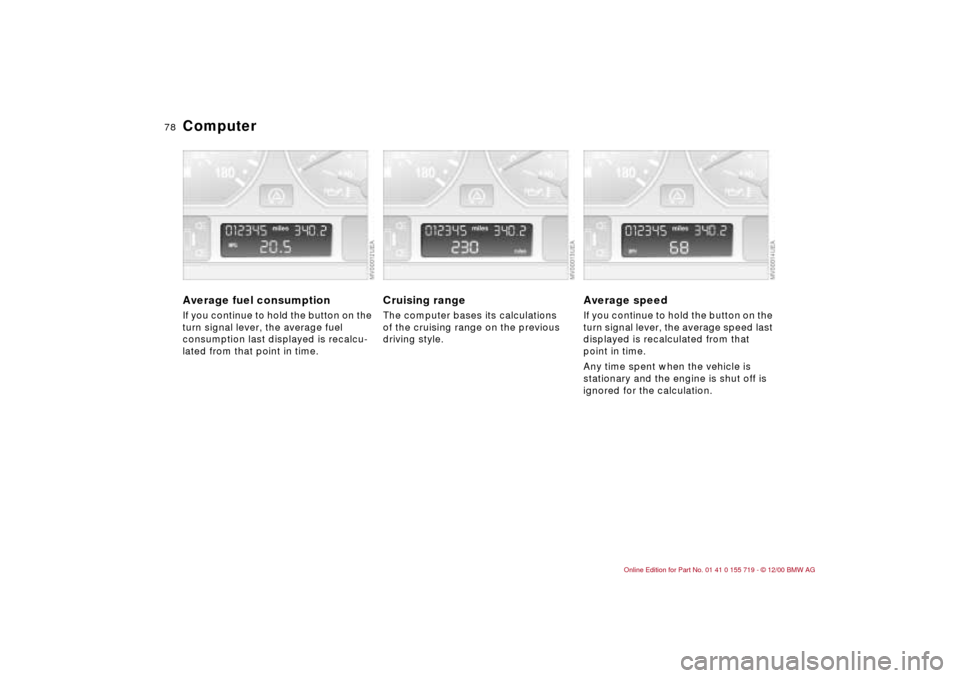
Computer Average fuel consumption If you continue to hold the button on the
turn signal lever, the average fuel
consumption last displayed is recalcu-
lated from that point in time.
Cruising range The computer bases its calculations
of the cruising range on the previous
driving style.
Average speed If you continue to hold the button on the
turn signal lever, the average speed last
displayed is recalculated from that
point in time.
Any time spent when the vehicle is
stationary and the engine is shut off is
ignored for the calculation.
Page 101 of 195
101n
IndexDataTechnologyRepairsCar careControlsOverview
Cargo loading Roof-mounted luggage rack for the hardtop
*
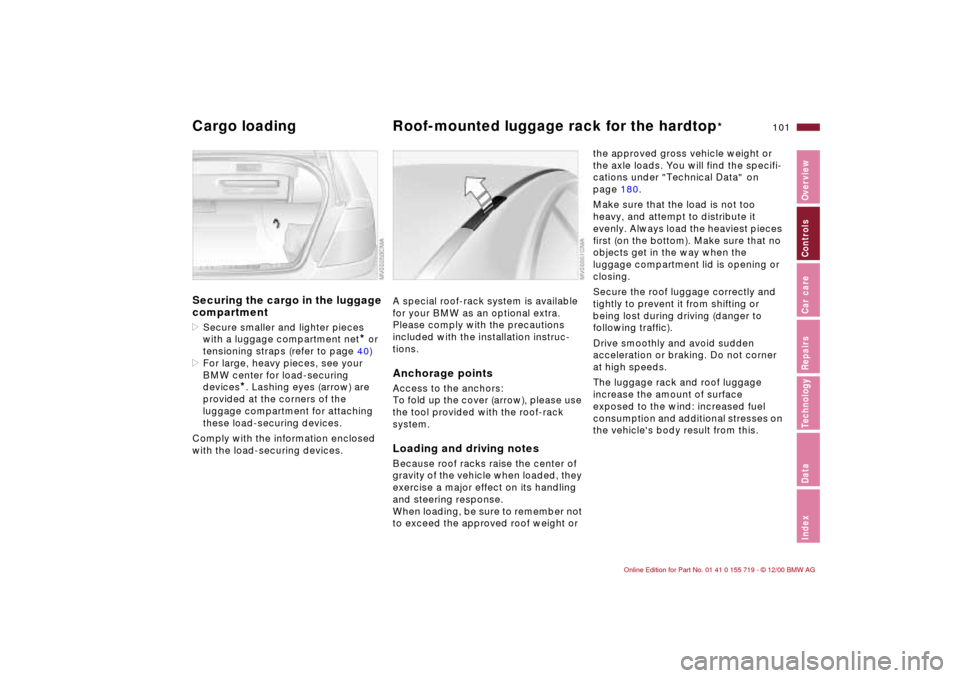
Securing the cargo in the luggage
compartment >Secure smaller and lighter pieces
with a luggage compartment net
* or
tensioning straps (refer to page 40)
>For large, heavy pieces, see your
BMW center for load-securing
devices
*. Lashing eyes (arrow) are
provided at the corners of the
luggage compartment for attaching
these load-securing devices.
Comply with the information enclosed
with the load-securing devices.
A special roof-rack system is available
for your BMW as an optional extra.
Please comply with the precautions
included with the installation instruc-
tions.Anchorage pointsAccess to the anchors:
To fold up the cover (arrow), please use
the tool provided with the roof-rack
system.Loading and driving notesBecause roof racks raise the center of
gravity of the vehicle when loaded, they
exercise a major effect on its handling
and steering response.
When loading, be sure to remember not
to exceed the approved roof weight or
the approved gross vehicle weight or
the axle loads. You will find the specifi-
cations under "Technical Data" on
page 180.
Make sure that the load is not too
heavy, and attempt to distribute it
evenly. Always load the heaviest pieces
first (on the bottom). Make sure that no
objects get in the way when the
luggage compartment lid is opening or
closing.
Secure the roof luggage correctly and
tightly to prevent it from shifting or
being lost during driving (danger to
following traffic).
Drive smoothly and avoid sudden
acceleration or braking. Do not corner
at high speeds.
The luggage rack and roof luggage
increase the amount of surface
exposed to the wind: increased fuel
consumption and additional stresses on
the vehicle's body result from this.
Page 105 of 195

105n
IndexDataTechnologyRepairsCar careControlsOverview
Brakes: do not rest your foot on
the brake pedal while driving.
Even light but consistent pressure on
the brake pedal can lead to high
temperatures, brake wear and possibly
even brake system failure.
Aquaplaning: when driving on wet or
slushy roads, reduce vehicle speed. If
you do not, a wedge of water may form
between the tires and the road surface.
This phenomenon is referred to as
aquaplaning, or hydroplaning, and can
lead to partial or complete loss of
contact between the tires and road
surface, vehicle control and braking
ability.
Driving through water: do not drive
through water on the road if it is deeper
than 1 foot (30 cm), and then only at
walking speed at the most. Otherwise,
the vehicle's engine, the electrical
systems and the transmission may be
damaged.<
The catalytic converter reduces harmful
pollutants in the exhaust emissions.
It is designed for use with unleaded fuel
only. Even minute quantities of lead
would be enough to permanently
damage both the catalytic converter
and the system's oxygen sensor.
To ensure efficient, trouble-free engine
operation and to avoid potential
damage:
>Be sure to comply with the required
scheduled maintenance work and
repair procedures.
>Fill the fuel tank well before it is
empty.
>Tow-start only when the engine is
cold, otherwise unburned, residual
fuel in the catalytic converter could
ignite and cause damage. It is better
to jump-start the vehicle with outside
assistance.
>Avoid other situations where the fuel
is not burned, or burns incompletely,
such as engaging the starter
frequently or for extended periods, or
repeated start attempts in which the
engine does not start (stopping and
restarting an engine which is running
properly does not present a problem).
Never let the engine run with any of
the spark plug cables disconnected. Be sure to observe the instruc-
tions above to prevent unburned
fuel from reaching the catalytic
converter. Otherwise there is danger of
overheating and damage to the cata-
lytic converter.
High temperatures occur in any vehicle
equipped with a catalytic converter.
Heat shields are installed adjacent to
some sections of the exhaust system.
Never remove these shields; do not
apply undercoating to their surfaces.
When driving, standing at idle, and
parking the vehicle, take extra care to
avoid contact between the exhaust
system and flammable materials (grass,
hay, leaves, etc.). Such contact could
start a fire, resulting in personal injury
and property damage.<
Driving notes Catalytic converter
Page 118 of 195

118n
Wheel and tire combinations The right choice
Only use wheels and tires that
have been approved by BMW for
the corresponding vehicle model, as
otherwise body contact and serious
accidents can result despite the use of
the same nominal size, e.g. due to
tolerances. BMW cannot evaluate non-
approved wheels and tires to determine
if they are suited for use, and therefore
cannot ensure the operating safety of
the vehicle if they are installed.<
For wheel and tire sizes approved by
BMW, refer to page 120.
Failure to use the specified wheel
and tire combinatons can have an
adverse effect on the performance of
various systems such as ABS and DSC.
For this reason, use only tires made by
the same manufacturer and that have
the same tread configuration on the
vehicle. And after a flat tire, for
instance, restore the approved wheel
and tire combination as soon as
possible.<
Codes on the tires and wheels The marking on the tire has the
following meaning.
The codes on radial tires:
The speed rating indicates the
approved maximum speed for the tire.
Summer tires:
S = up to 112 mph (180 km/h)
T = up to 118 mph (190 km/h)
H = up to 130 mph (210 km/h)
V = up to 150 mph (240 km/h)
W = up to 167 mph (270 km/h)
Y = up to 187 mph (300 km/h)
ZR = over 150 mph (240 km/h) Example:
Nominal width
in mm
Aspect
ratio in %
Radial tire ID code
Rim diameter in inches
Load rating
(not on ZR tires)
Speed rating
(before R on ZR tires)
225/45 R
1892W
Winter tires:
Q M+S = up to 100 mph (160 km/h)
T M+S = up to 118 mph (190 km/h)
H M+S = up to 130 mph (210 km/h)
Codes stamped on light-alloy wheels:
Protect tire valve from dirt by using
screw-on valve stem caps. Dirt in the
valves frequently leads to slow leaks. Storage Always store tires in a cool, dry place.
Store them away from light whenever
possible. Protect the tires against
contact with oil, grease and fuel. Example:
Rim width
in inches
Code letter for
flange type
Symbol for full-drop
center rim
Rim diameter in inches
Hump on the 2 rim shoulders
8 x 18 H 2
J
Page 127 of 195
127n
IndexDataTechnologyRepairsCar careControlsOverview
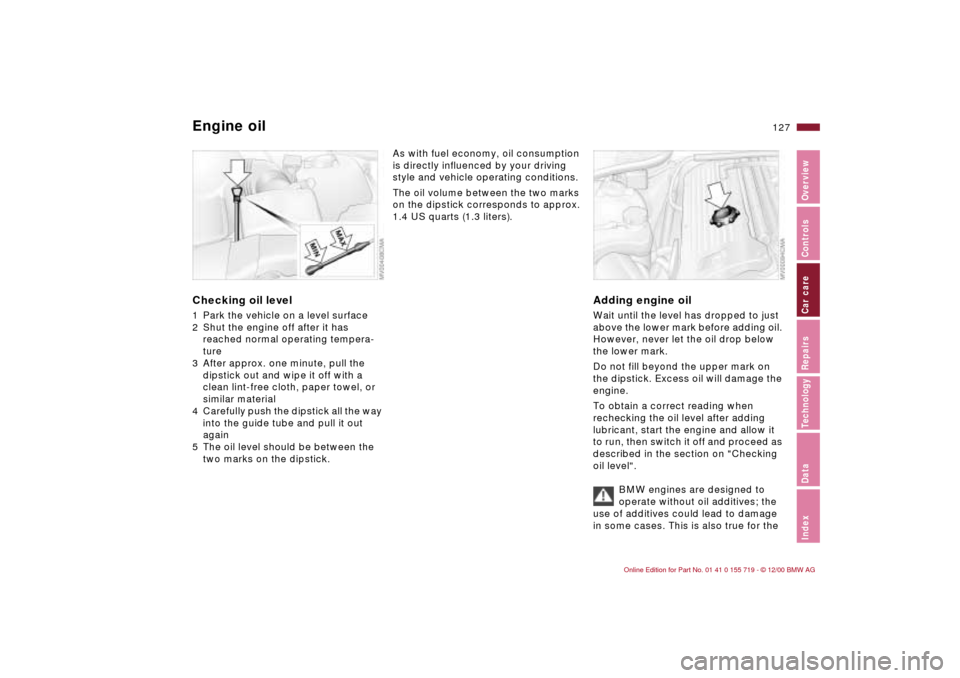
Engine oilChecking oil level 1 Park the vehicle on a level surface
2 Shut the engine off after it has
reached normal operating tempera-
ture
3 After approx. one minute, pull the
dipstick out and wipe it off with a
clean lint-free cloth, paper towel, or
similar material
4 Carefully push the dipstick all the way
into the guide tube and pull it out
again
5 The oil level should be between the
two marks on the dipstick.
As with fuel economy, oil consumption
is directly influenced by your driving
style and vehicle operating conditions.
The oil volume between the two marks
on the dipstick corresponds to approx.
1.4 US quarts (1.3 liters).
Adding engine oil Wait until the level has dropped to just
above the lower mark before adding oil.
However, never let the oil drop below
the lower mark.
Do not fill beyond the upper mark on
the dipstick. Excess oil will damage the
engine.
To obtain a correct reading when
rechecking the oil level after adding
lubricant, start the engine and allow it
to run, then switch it off and proceed as
described in the section on "Checking
oil level".
BMW engines are designed to
operate without oil additives; the
use of additives could lead to damage
in some cases. This is also true for the
Page 133 of 195

133n
IndexDataTechnologyRepairsCar careControlsOverview
Caring for your vehicleExterior finish To provide effective corrosion protec-
tion, multilayer paintwork is applied at
the factory. Cataphoretic immersion
priming techniques are supplemented
with special body-cavity protectants
and application of specially developed
and extensively tested materials.
A layer of flexible PVC is first applied to
the undercarriage. Following this, a
comprehensive undercoating treat-
ment with a wax-based protectant is
applied. Regular maintenance makes
an important contribution to maintaining
the safety and value of your vehicle.
Increasing awareness of the effects of
harmful environmental factors on
vehicle finishes have led paint and
vehicle manufacturers to initiate
ongoing programs designed to further
improve the durability of their finishes.
Despite this, regional environmental
factors can have negative effects on
your vehicle's finish. Consider these
factors in determining the frequency
and extent of your efforts to maintain
the vehicle finish.
Depending upon material and type of
impact (perforation of paint layer), phys-
ical stresses from sand, road salt,
gravel, etc., can cause corrosion to start extending beneath the finish,
starting at the point of impact.
Road dirt, tar spots, dead insects,
animal droppings (strong alkali effect)
and tree excretions (resins and pollen)
all contain substances capable of
causing damage when allowed to
remain on the finish of your vehicle for
any period of time. This includes spots,
etching, flaking, and separations in the
top coat.
In industrial areas, deposits of flue dust,
lime, oily soot, precipitation containing
sulfur-dioxide (acid rain) and other envi-
ronmental pollutants will damage the
vehicle's finish unless adequate care is
provided – even though this is generally
limited to the outside horizontal
surfaces.
In coastal regions, high levels of atmo-
spheric salt and humidity promote
corrosion.
In tropical zones, high humidity and
heavy ultraviolet radiation prevail, in
addition to temperatures of over 105 7
(+40 6) in the shade. Under these
conditions, light paints can reach
temperatures up to 175 7 (+80 6) and
dark ones up to 250 7 (+120 6).
Caring for the vehicle finish Regular washing is a preventive
measure against long-term effects from
substances that are harmful to the
vehicle's finish, especially if you drive
your vehicle in areas with high levels of
air pollution or aggressive natural
substances (tree resins, pollen).
Nevertheless, you should immediately
remove especially aggressive
substances. Failure to do so can lead to
changes in the paint's chemical struc-
ture or to discoloration. Gasoline spilled
during refueling, oil, grease and brake
fluid should always be cleaned away
immediately, as should bird droppings.
Any contamination remaining on the
surface of the vehicle will be especially
conspicuous after washing. Use
cleaning fluid or alcohol with a clean
cloth or cotton pad to remove these
stains. Remove tar spots with tar
remover. After cleaning, the affected
areas should be waxed to ensure
continued protection.
Use the cleaning and car-care
products available at your BMW
center.<