service BMW M3 CONVERTIBLE 2001 E46 Owner's Guide
[x] Cancel search | Manufacturer: BMW, Model Year: 2001, Model line: M3 CONVERTIBLE, Model: BMW M3 CONVERTIBLE 2001 E46Pages: 195, PDF Size: 1.96 MB
Page 130 of 195
130n
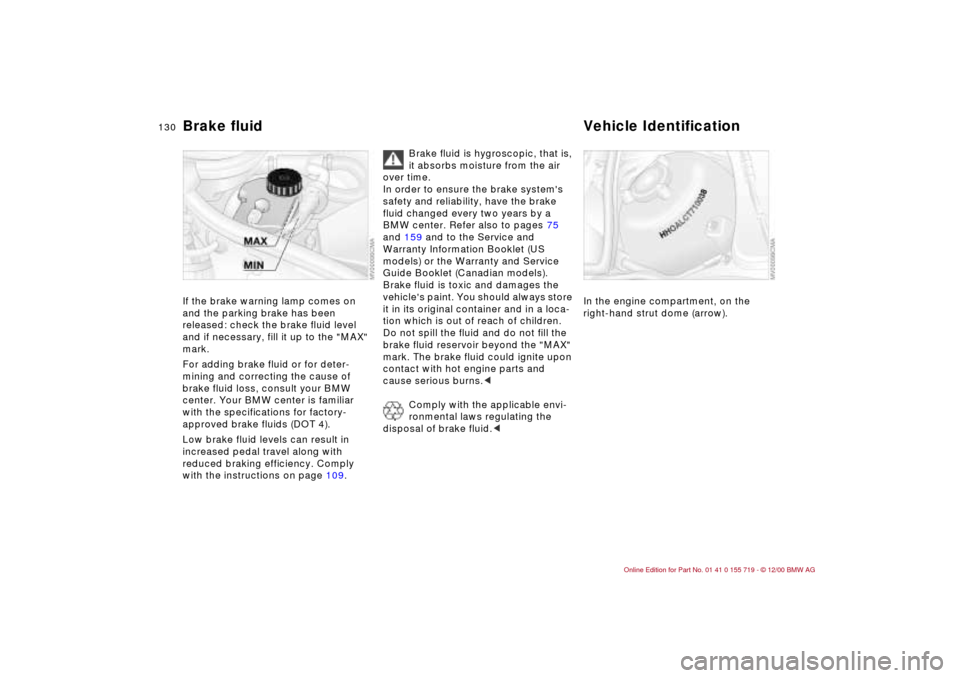
Brake fluid Vehicle Identification If the brake warning lamp comes on
and the parking brake has been
released: check the brake fluid level
and if necessary, fill it up to the "MAX"
mark.
For adding brake fluid or for deter-
mining and correcting the cause of
brake fluid loss, consult your BMW
center. Your BMW center is familiar
with the specifications for factory-
approved brake fluids (DOT 4).
Low brake fluid levels can result in
increased pedal travel along with
reduced braking efficiency. Comply
with the instructions on page 109.
Brake fluid is hygroscopic, that is,
it absorbs moisture from the air
over time.
In order to ensure the brake system's
safety and reliability, have the brake
fluid changed every two years by a
BMW center. Refer also to pages 75
and 159 and to the Service and
Warranty Information Booklet (US
models) or the Warranty and Service
Guide Booklet (Canadian models).
Brake fluid is toxic and damages the
vehicle's paint. You should always store
it in its original container and in a loca-
tion which is out of reach of children.
Do not spill the fluid and do not fill the
brake fluid reservoir beyond the "MAX"
mark. The brake fluid could ignite upon
contact with hot engine parts and
cause serious burns.<
Comply with the applicable envi-
ronmental laws regulating the
disposal of brake fluid.<
In the engine compartment, on the
right-hand strut dome (arrow).
Page 131 of 195
131n
IndexDataTechnologyRepairsCar careControlsOverview
The BMW Maintenance System has
been designed as a reliable means of
providing maximum driving and oper-
ating safety – and as cost-effectively as
possible for you.
Please keep in mind that regular main-
tenance is not only necessary for the
safety of your vehicle, but also plays a
significant role in maintaining the resale
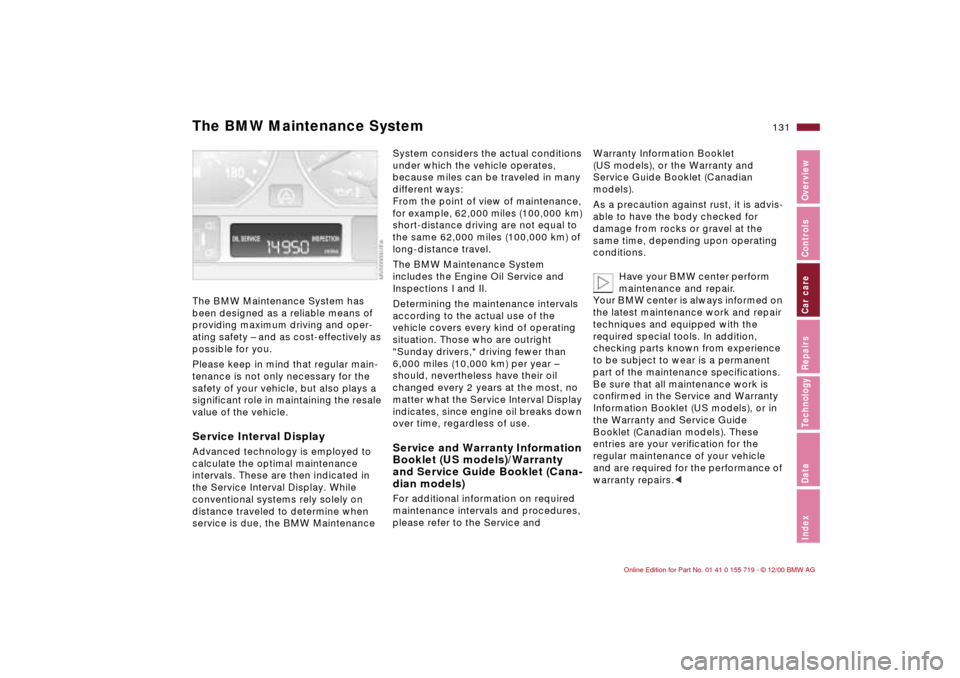
value of the vehicle. Service Interval DisplayAdvanced technology is employed to
calculate the optimal maintenance
intervals. These are then indicated in
the Service Interval Display. While
conventional systems rely solely on
distance traveled to determine when
service is due, the BMW Maintenance
System considers the actual conditions
under which the vehicle operates,
because miles can be traveled in many
different ways:
From the point of view of maintenance,
for example, 62,000 miles (100,000 km)
short-distance driving are not equal to
the same 62,000 miles (100,000 km) of
long-distance travel.
The BMW Maintenance System
includes the Engine Oil Service and
Inspections I and II.
Determining the maintenance intervals
according to the actual use of the
vehicle covers every kind of operating
situation. Those who are outright
"Sunday drivers," driving fewer than
6,000 miles (10,000 km) per year –
should, nevertheless have their oil
changed every 2 years at the most, no
matter what the Service Interval Display
indicates, since engine oil breaks down
over time, regardless of use. Service and Warranty Information
Booklet (US models)/Warranty
and Service Guide Booklet (Cana-
dian models)For additional information on required
maintenance intervals and procedures,
please refer to the Service and Warranty Information Booklet
(US models), or the Warranty and
Service Guide Booklet (Canadian
models).
As a precaution against rust, it is advis-
able to have the body checked for
damage from rocks or gravel at the
same time, depending upon operating
conditions.
Have your BMW center perform
maintenance and repair.
Your BMW center is always informed on
the latest maintenance work and repair
techniques and equipped with the
required special tools. In addition,
checking parts known from experience
to be subject to wear is a permanent
part of the maintenance specifications.
Be sure that all maintenance work is
confirmed in the Service and Warranty
Information Booklet (US models), or in
the Warranty and Service Guide
Booklet (Canadian models). These
entries are your verification for the
regular maintenance of your vehicle
and are required for the performance of
warranty repairs.<
The BMW Maintenance System
Page 134 of 195

134n
Caring for your vehicleWaxing your car Protect the finish using only carnauba
or synthetic-based waxes.
The best way to determine when the
finish needs to be waxed is by noting
when water stops beading on the
surface.
You can use a glass cleaner to remove
any wax or silicone that may have been
left on the windows during waxing.
Use the cleaning and car-care
products available at your BMW
center.<
Paint damageYou can touch up small areas of paint
damage with a BMW spray paint or a
BMW touchup stick.
The paint color code for your vehicle is
provided on a sticker located on the
right hand side under the hood and on
the first page of your Service and
Warranty Information Booklet (US
models) or Warranty and Service Guide
Booklet (Canadian models).
Damage caused by flying stones,
scratches, etc., must be touched up
without delay to prevent rust from
forming.
If corrosion has started to form in an
area with paint damage, remove all rust
and clean the area. Then prime the area
with a BMW Primer Stick. Finally, apply
the finish coat. Wait a few days, then
polish the repaired area. Finish by
applying a wax preservative.
More extensive paint damage should
be repaired professionally in accor-
dance with the manufacturer's instruc-
tions. Your BMW center uses original
BMW finish materials in accordance
with approved repair procedures.
Window careYou can use window and glass cleaner
to clean inside window surfaces and
mirrors without smearing and streaking.
Never use polishing pastes or abrasive
(quartz) cleansers on mirror lenses.
Clean the wiper blades with soapy
water. The wiper blades should be
replaced twice a year – before and after
the cold season. This is especially
important for vehicles equipped with a
rain sensor
*.
Use only wiper blades approved
by BMW.<
Caring for other vehicle
components and materials Light-alloy wheels should be treated
with alloy wheel cleaner, especially
during the winter months. However, do
not use aggressive products containing
acids, strong alkalis or abrasives. Do
not use steam cleaners operating at
temperatures above 140 7 (+60 6).
Follow the manufacturer's instructions.
If your vehicle has chrome parts
* such
as window moldings, door handles or
similar items, clean these parts carefully
with ample clean water, and possibly a
shampoo additive, especially if there is
Page 139 of 195
139n
IndexDataTechnologyRepairsCar careControlsOverview
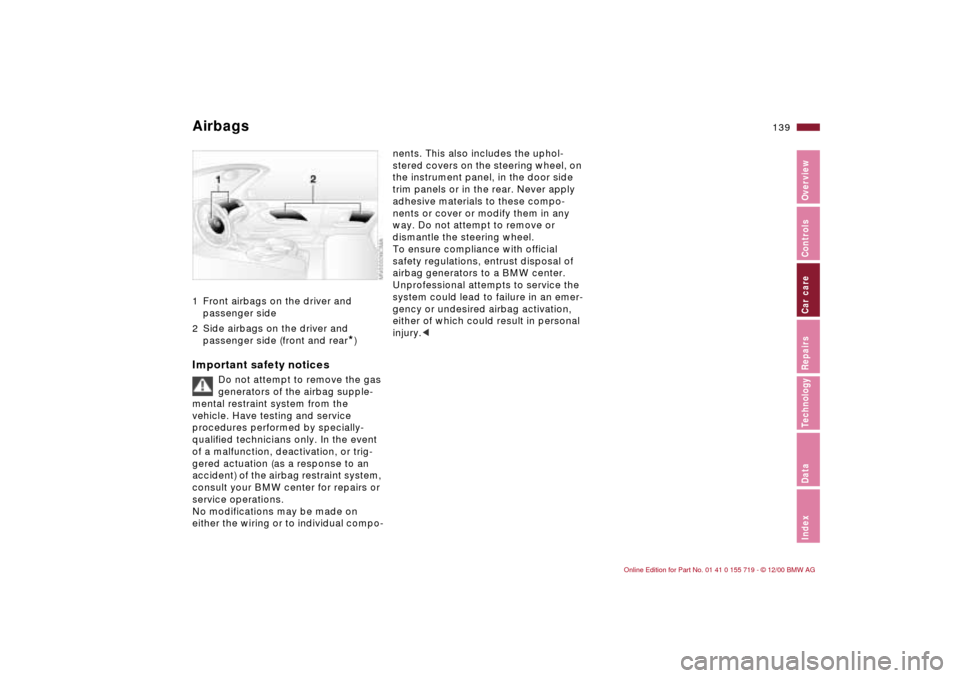
Airbags 1 Front airbags on the driver and
passenger side
2 Side airbags on the driver and
passenger side (front and rear
*)
Important safety notices
Do not attempt to remove the gas
generators of the airbag supple-
mental restraint system from the
vehicle. Have testing and service
procedures performed by specially-
qualified technicians only. In the event
of a malfunction, deactivation, or trig-
gered actuation (as a response to an
accident) of the airbag restraint system,
consult your BMW center for repairs or
service operations.
No modifications may be made on
either the wiring or to individual compo-
nents. This also includes the uphol-
stered covers on the steering wheel, on
the instrument panel, in the door side
trim panels or in the rear. Never apply
adhesive materials to these compo-
nents or cover or modify them in any
way. Do not attempt to remove or
dismantle the steering wheel.
To ensure compliance with official
safety regulations, entrust disposal of
airbag generators to a BMW center.
Unprofessional attempts to service the
system could lead to failure in an emer-
gency or undesired airbag activation,
either of which could result in personal
injury.<
Page 140 of 195

140n
Storing your vehicle
If you intend to store the vehicle
for more than 3 months, be sure to
follow the maintenance instructions on
this page.<
Storage preparationsHave your BMW center perform the
following procedures:
1 Clean and apply a rustproofing agent
or other treatment to the engine,
engine compartment, undercarriage,
axles and major components in
accordance with approved repair
procedures. First wash the vehicle
surface, then clean the interior,
following up with paint- and chrome
care, after which you clean the
rubber seals for the hood and doors.
2 Change the engine oil and oil filter
with the engine warm. As an addi-
tional corrosion protection measure,
an anticorrosive agent can be added
to the engine in accordance with the
manufacturer's instructions.
3 Check the coolant level and concen-
tration, top up if necessary.
4 Check the fluid level of the wind-
shield washer fluid reservoir; top up if
necessary.
5 Fill the fuel tank completely to
prevent the formation of condensa-
tion.
6 Increase the tire inflation pressure to
51 psi (350 Kilopascal).Before parking the vehicle1 To prevent the brake discs and
drums from corroding, dry the
parking and footbrake by applying
the brakes.
2 Park the vehicle in a covered, dry,
and well-ventilated area. Place the
transmission in first gear or, if neces-
sary, chock the wheels to prevent the
vehicle from rolling. Do not set the
parking brake.
3 Remove the battery, charge it
completely and store it in a cool (but
frost-free) room.
4 Remove the hardtop and store it
separately. Refer to page 114.
5 Close the convertible top.During storageRecharge the battery every six months.
If it is not recharged, it will not be
useable. Every time the battery is
discharged, especially over extended
periods, its service life is reduced.
Removing the vehicle from
storageRecharge the battery if the "Magic
Eye
*" turns black. Refer to page 157.
Then have Inspection I performed by
your BMW center, including a brake
fluid replacement if necessary.
Page 142 of 195
142n
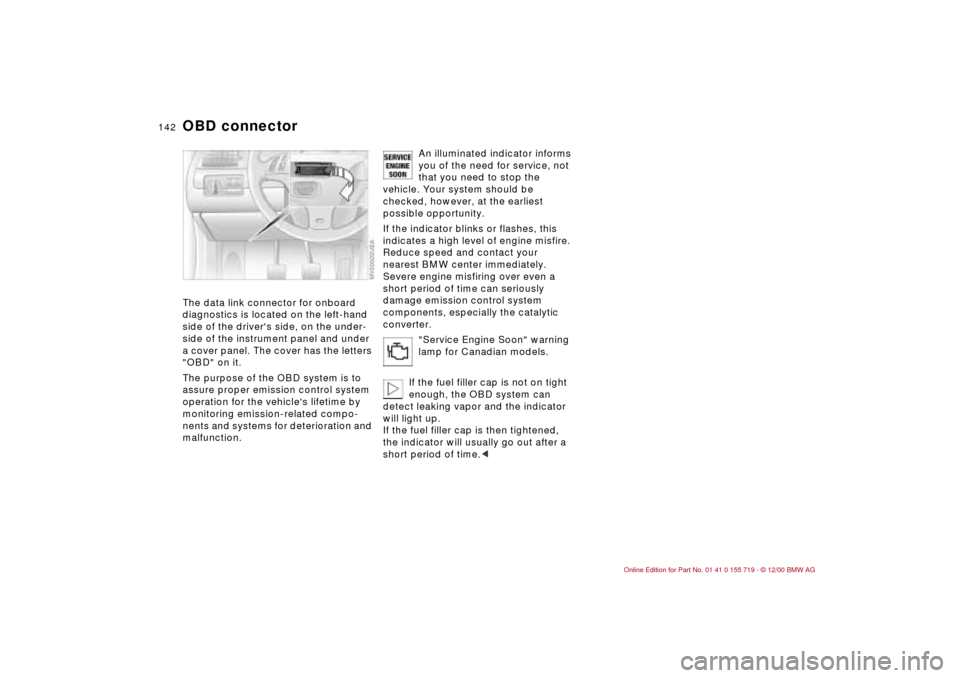
OBD connector The data link connector for onboard
diagnostics is located on the left-hand
side of the driver's side, on the under-
side of the instrument panel and under
a cover panel. The cover has the letters
"OBD" on it.
The purpose of the OBD system is to
assure proper emission control system
operation for the vehicle's lifetime by
monitoring emission-related compo-
nents and systems for deterioration and
malfunction.
An illuminated indicator informs
you of the need for service, not
that you need to stop the
vehicle. Your system should be
checked, however, at the earliest
possible opportunity.
If the indicator blinks or flashes, this
indicates a high level of engine misfire.
Reduce speed and contact your
nearest BMW center immediately.
Severe engine misfiring over even a
short period of time can seriously
damage emission control system
components, especially the catalytic
converter.
"Service Engine Soon" warning
lamp for Canadian models.
If the fuel filler cap is not on tight
enough, the OBD system can
detect leaking vapor and the indicator
will light up.
If the fuel filler cap is then tightened,
the indicator will usually go out after a
short period of time.<
Page 145 of 195
Overview
Controls and features
Operation, care
and maintenance
Owner service procedures
Technical data
Index Advanced technology
145n
IndexDataTechnologyRepairsCar careControlsOverview
Replacement procedures:
Onboard tool kit146
Windshield wiper blades146
Lamps and bulbs146
Repairing a flat tire153
Battery157
Fuses160
Replacing microfilter and
activated-charcoal filter161
In case of
electrical malfunction:
Fuel filler door161
Convertible top162
Assistance, giving and
receiving:
Jump-starting164
Towing the vehicle165
Repairs
Page 146 of 195
146n
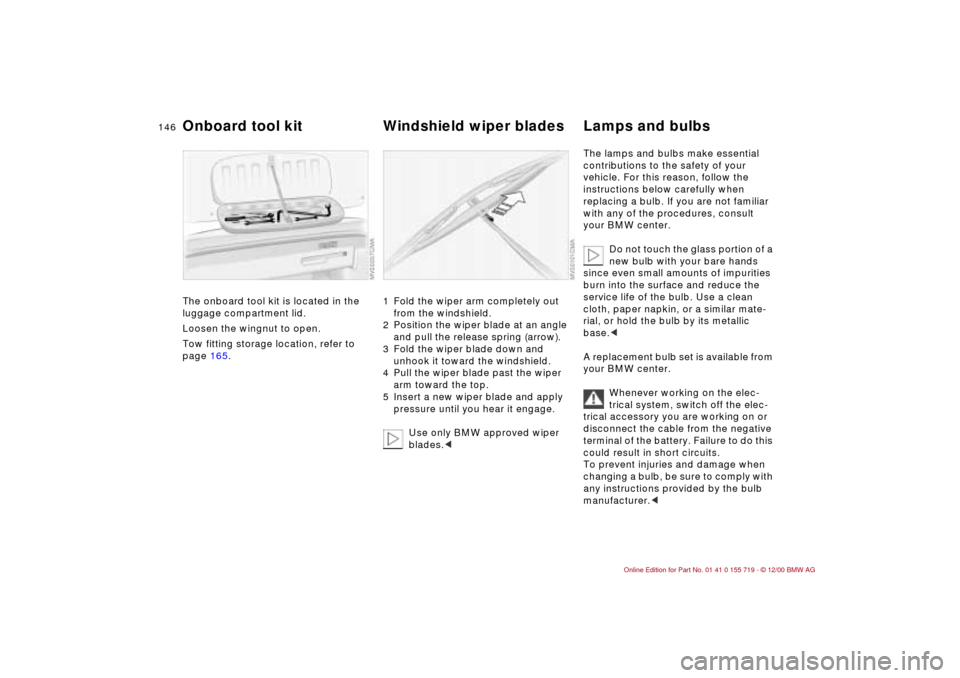
The onboard tool kit is located in the
luggage compartment lid.
Loosen the wingnut to open.
Tow fitting storage location, refer to
page 165.
1 Fold the wiper arm completely out
from the windshield.
2 Position the wiper blade at an angle
and pull the release spring (arrow).
3 Fold the wiper blade down and
unhook it toward the windshield.
4 Pull the wiper blade past the wiper
arm toward the top.
5 Insert a new wiper blade and apply
pressure until you hear it engage.
Use only BMW approved wiper
blades.<
The lamps and bulbs make essential
contributions to the safety of your
vehicle. For this reason, follow the
instructions below carefully when
replacing a bulb. If you are not familiar
with any of the procedures, consult
your BMW center.
Do not touch the glass portion of a
new bulb with your bare hands
since even small amounts of impurities
burn into the surface and reduce the
service life of the bulb. Use a clean
cloth, paper napkin, or a similar mate-
rial, or hold the bulb by its metallic
base.<
A replacement bulb set is available from
your BMW center.
Whenever working on the elec-
trical system, switch off the elec-
trical accessory you are working on or
disconnect the cable from the negative
terminal of the battery. Failure to do this
could result in short circuits.
To prevent injuries and damage when
changing a bulb, be sure to comply with
any instructions provided by the bulb
manufacturer.<
Onboard tool kit Windshield wiper blades Lamps and bulbs
Page 147 of 195
147n
IndexDataTechnologyRepairsCar careControlsOverview
Lamps and bulbsLow beam headlamps and high
beam headlamps
>Low beam headlamps: H7 bulb,
55 watts
>High beam headlamps: H7 bulb,
55 watts
The H7 bulb is pressurized. There-
fore, wear safety glasses and
protective gloves. Failure to comply
with this precaution could lead to injury
if the bulb is damaged during replace-
ment.<
Please contact a BMW center in case of
a malfunction.
Parking lamps5 watt bulb
Please contact a BMW center in case of
a malfunction.
When cleaning the headlamps,
please observe the following:
>Do not clean by wiping with a dry
cloth (scratches). Never use abra-
sives or strong solvents to clean the
covers
>Remove dirt and contamination (such
as insects) by soaking with BMW Car
Shampoo and then rinsing with plenty
of water.
Always use a deicer spray to remove
accumulated ice and snow – never use
a scraper.<
Xenon lamps
*
The service life of these bulbs is very
long and the probability of a failure is
very low, provided that they are not
switched on and off an unusual number
of times. If one of these bulbs should
nevertheless fail, it is possible to
continue driving with great caution
using the fog lamps, provided traffic
laws in your area do not prohibit this.
Because of the extremely high
voltages involved, any work on the
xenon lighting system should be carried
out by technically-qualified personnel
only. Otherwise, there is a risk of fatal
injury.<
Page 157 of 195
157n
IndexDataTechnologyRepairsCar careControlsOverview
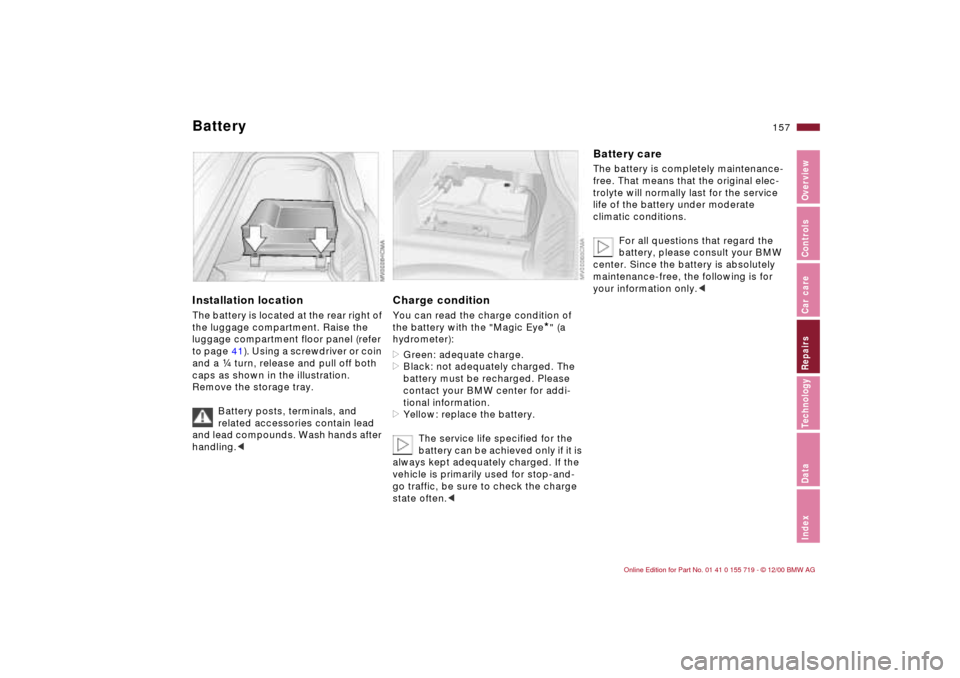
Battery Installation locationThe battery is located at the rear right of
the luggage compartment. Raise the
luggage compartment floor panel (refer
to page 41). Using a screwdriver or coin
and a f turn, release and pull off both
caps as shown in the illustration.
Remove the storage tray.
Battery posts, terminals, and
related accessories contain lead
and lead compounds. Wash hands after
handling.<
Charge conditionYou can read the charge condition of
the battery with the "Magic Eye
*" (a
hydrometer):
>Green: adequate charge.
>Black: not adequately charged. The
battery must be recharged. Please
contact your BMW center for addi-
tional information.
>Yellow: replace the battery.
The service life specified for the
battery can be achieved only if it is
always kept adequately charged. If the
vehicle is primarily used for stop-and-
go traffic, be sure to check the charge
state often.<
Battery careThe battery is completely maintenance-
free. That means that the original elec-
trolyte will normally last for the service
life of the battery under moderate
climatic conditions.
For all questions that regard the
battery, please consult your BMW
center. Since the battery is absolutely
maintenance-free, the following is for
your information only.<