steering BMW M3 CONVERTIBLE 2001 E46 Owner's Guide
[x] Cancel search | Manufacturer: BMW, Model Year: 2001, Model line: M3 CONVERTIBLE, Model: BMW M3 CONVERTIBLE 2001 E46Pages: 195, PDF Size: 1.96 MB
Page 107 of 195

107n
IndexDataTechnologyRepairsCar careControlsOverview
Antilock Brake System (ABS)Antilock Brake System (ABS)/
Cornering Brake Control (CBC) CBC is an advanced engineering
feature of the ABS. When braking while
cornering at high speed or braking
during high lateral acceleration in
curves, or when braking during a lane
change, vehicle stability is improved
and steering response is enhanced.
In the event of a malfunction
If the ABS warning lamp comes
on, refer to page 21. The brake
system will continue to function
the same as on vehicles without ABS.
However, have the brake system
checked by your BMW center as soon
as possible. To prevent undetected
defects and cumulative faults from
adversely affecting the brake system,
refer any problems to your BMW center
at the earliest opportunity.
ABS warning lamp for Canadian
models.
If the brake warning lamp
comes on together with the indi-
cator lamps for ABS and DSC,
refer to page 21: then the entire
ABS, CBC and DSC
control
system has failed. Continue
driving cautiously and defen-
sively. Avoid full brake applica-
tions. This could cause the vehicle to
lose stability and you might no longer
be able to control it.
Have the system checked by your BMW
center as soon as possible.
CBC, ABS and DSC indicator
and warning lamps for Canadian
models.
Page 111 of 195

111n
IndexDataTechnologyRepairsCar careControlsOverview
Winter operationBrakesWinter road conditions substantially
reduce the amount of traction available
between the tires and the road surface;
the resulting increase in braking
distance is considerable and should
always be kept in mind.
ABS is intended to prevent the wheels
from locking during brake applications,
thus helping to maintain vehicle stability
and steering response.
If the ABS does not respond in a critical
braking situation and the wheels lock:
reduce the pressure on the brake pedal
until the wheels just start to roll again
while still maintaining enough force to
continue braking.
Then increase the pressure, reduce the
pressure when the wheels lock, reapply
pressure etc.
Pumping the brakes will reduce braking
distance while helping you maintain
steering control over the vehicle.
You can then attempt to steer around
hazards after you have reduced pres-
sure on the brake pedal. Do not downshift to decelerate on
slick road surfaces. Doing so
could cause loss of traction at the rear
wheels, which could result in the loss of
vehicle control.<
Depress the clutch during hard
braking on road surfaces that
provide only poor or uneven traction.<
Skid control Depress the clutch and release the
accelerator pedal. Countersteer care-
fully and attempt to regain control of the
vehicle.
ParkingEngage either 1st gear or reverse.
Apply the parking brake whenever you
park on inclined surfaces. In order to
prevent the parking brake pads from
locking due to frost or corrosion, dry
them by gently applying the parking
brake as the vehicle is coming to a
stop. Make sure that following traffic is
not endangered.
The brake lamps do not come on
when the parking brake is
applied.<
Page 112 of 195

112n
Power steering Cellular phone
*
Radio reception
If the steering response changes, e.g.
high steering effort:
Consult a BMW center to have it
checked.
If the power steering fails,
increased effort will be required to
steer the vehicle.<
Mobile communications systems
(cellular phone, radio, etc.) are
permitted with an output up to 10 watts
only. Mobile communications devices
not specifically designed for use in your
vehicle may trigger malfunctions while
operating your vehicle. BMW can
neither test nor assume responsibility
for every individual product being
offered on the market. We recommend
that you consult your BMW center
before purchasing any device of this
kind.
To ensure that your BMW continues to
provide reliable and trouble-free opera-
tion, do not use a cellular phone or
other radio device with an antenna
located inside the passenger compart-
ment. The antenna should always be
mounted on the outside of the vehicle.
Before loading the vehicle on a
car-carrier train or driving it
through a car wash, remove the
antenna.<
The reception and sound quality
obtained from mobile radios vary
according to a variety of factors,
including the broadcast range of the
transmitter and the directional orienta-
tion of the antenna. Interference factors
such as high-tension power lines, build-
ings and natural obstructions can all
lead to unavoidable reception interfer-
ence, regardless of how well the
vehicle's sound system is operating.
Climatic factors such as intense solar
radiation, fog, rain and snow can also
interfere with reception.
Car telephones or cellular phones not
approved by BMW can also cause
interference in the radio during a tele-
phone call. This phenomenon assumes
the form of a low-pitched hum
emanating from the speaker system.
Please refer to the separate Owner's
Manual that came with your vehicle for
information on setting and operating
your car radio.
You will find additional details
concerning car radio reception in the
chapter "Advanced technology" on
page 169.
Page 115 of 195
115n
IndexDataTechnologyRepairsCar careControlsOverview
Information for your safetyThe factory-approved radial tires are
matched to the vehicle and have been
selected to provide optimum safety and
driving comfort on your vehicle.
It is not merely the tire's service life, but
also driving comfort and – above all
else – driving safety that depend on the
condition of the tires and the mainte-
nance of the specified tire pressure.
Incorrect inflation pressure is a frequent
cause of tire damage. It also signifi-
cantly influences the roadholding ability
of your BMW.
Check tire inflation pressures on a
regular basis (refer to page 27), at
least every two weeks and before
beginning a longer trip. If this is not
done, incorrect tire pressures can
cause driving instability and tire
damage, ultimately resulting in acci-
dents.<
Tire tread – tire damageInspect your tires frequently for tread
wear, signs of damage and for foreign
objects lodged in the tread. Check the
tread depth.
Tread depth should not be allowed to
go below 0.12 in (3 mm), even though
the legally specified minimum tread
depth is only 0.063 in (1.6 mm). At a
tread depth of 0.063 in (1.6 mm), tread
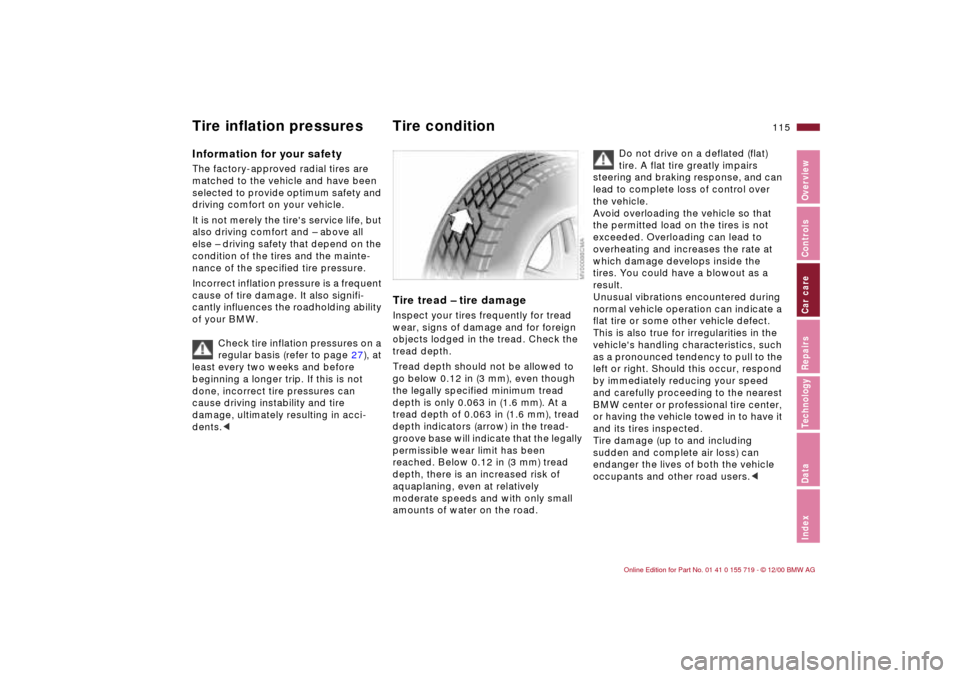
depth indicators (arrow) in the tread-
groove base will indicate that the legally
permissible wear limit has been
reached. Below 0.12 in (3 mm) tread
depth, there is an increased risk of
aquaplaning, even at relatively
moderate speeds and with only small
amounts of water on the road.
Do not drive on a deflated (flat)
tire. A flat tire greatly impairs
steering and braking response, and can
lead to complete loss of control over
the vehicle.
Avoid overloading the vehicle so that
the permitted load on the tires is not
exceeded. Overloading can lead to
overheating and increases the rate at
which damage develops inside the
tires. You could have a blowout as a
result.
Unusual vibrations encountered during
normal vehicle operation can indicate a
flat tire or some other vehicle defect.
This is also true for irregularities in the
vehicle's handling characteristics, such
as a pronounced tendency to pull to the
left or right. Should this occur, respond
by immediately reducing your speed
and carefully proceeding to the nearest
BMW center or professional tire center,
or having the vehicle towed in to have it
and its tires inspected.
Tire damage (up to and including
sudden and complete air loss) can
endanger the lives of both the vehicle
occupants and other road users.<
Tire inflation pressures Tire condition
Page 119 of 195

119n
IndexDataTechnologyRepairsCar careControlsOverview
Use narrow-link BMW snow chains on
winter tires in pairs only and only on the
rear wheels. Comply with all manufac-
turer's safety precautions when
mounting the chains.
Deactivate the Tire Pressure
Warning system (RDW) when
using snow chains. Malfunction warn-
ings and undetected losses in pressure
are a possibility when driving with snow
chains.
For further information, refer to
page 81.<
Tire condition, tire pressureOnce winter tires wear to a tread depth
of less than 0.16 in (4 mm), their perfor-
mance under winter driving conditions
deteriorates noticeably. Worn tires
should therefore be replaced to ensure
continued safety.
Inflate tires to specified pressure and
have the wheels balanced every time
the tires or wheels have been rotated;
re-initialize the Tire Pressure Warning
system (RDW) as well. Refer to page 81
for further information.
Special features of winter tires Snow chains
*
Choosing the right tireBMW recommends winter tires (M+S
radial tires) for driving in adverse winter
road conditions. So-called all-season
tires with the M+S identification mark
do indeed possess better winter trac-
tion than summer tires that have the H,
V, W, Y and ZR speed ratings, but they
generally fail to provide the same levels
of performance as winter tires.
In the interest of safe tracking and
steering response, install winter tires
made by the same manufacturer with
the same tread configuration on all four
wheels. Do not exceed specified
maximum speeds
Never exceed the maximum
speed for which the tires are
rated.
Unprofessional attempts by laymen to
service tires can lead to damage and
accidents.
Have this work performed by skilled
professionals only. Any BMW center
has the required technical knowledge
and the proper equipment and will be
happy to assist you.<
Page 128 of 195
128n
Engine oil manual transmission, the differential,
and the power steering system.<
Recommendation: have the oil changed
by your BMW center only.
Continuous exposure to used oil
has caused cancer in laboratory
testing. For this reason, thoroughly
wash any areas of skin that come into
contact with oil using soap and water.
Always store oils, grease and similar
materials so that they are inaccessible
to children. Comply with warning labels
and information on containers.<
Comply with the applicable envi-
ronmental laws regulating the
disposal of used oil.
of an engine. Based on extensive
testing, BMW approves only certain
types of engine oil.
Use only approved "BMW High Perfor-
mance Synthetic Oil."
If you are unable to obtain "BMW High
Performance Synthetic Oil," you may
use small volumes of other approved
synthetic oils for topping up between oil
changes. Use only oils with the specifi-
cation API SH or higher.
Ask your BMW center for details
concerning the specific "BMW
High Performance Synthetic Oil" or
synthetic oils that have been
approved.<
You can also call BMW of North
America at 1-800-831-1117 or visit this
website: www.bmwusa.com to obtain
this information.Viscosity ratings Viscosity is the oil flow rating as defined
in SAE classes.
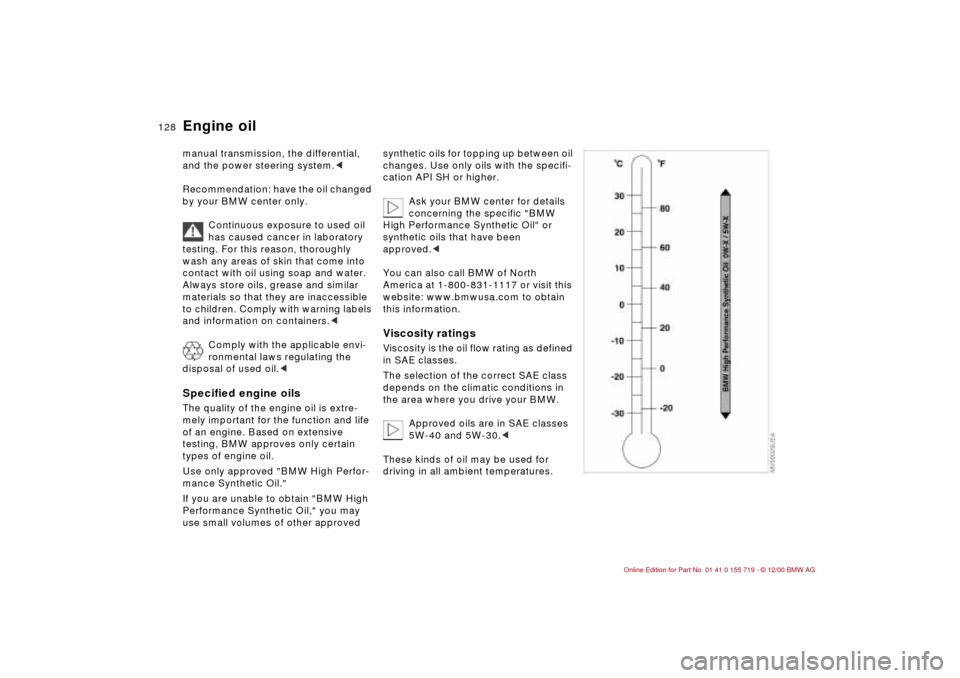
The selection of the correct SAE class
depends on the climatic conditions in
the area where you drive your BMW.
Approved oils are in SAE classes
5W-40 and 5W-30.<
These kinds of oil may be used for
driving in all ambient temperatures.
Page 139 of 195
139n
IndexDataTechnologyRepairsCar careControlsOverview
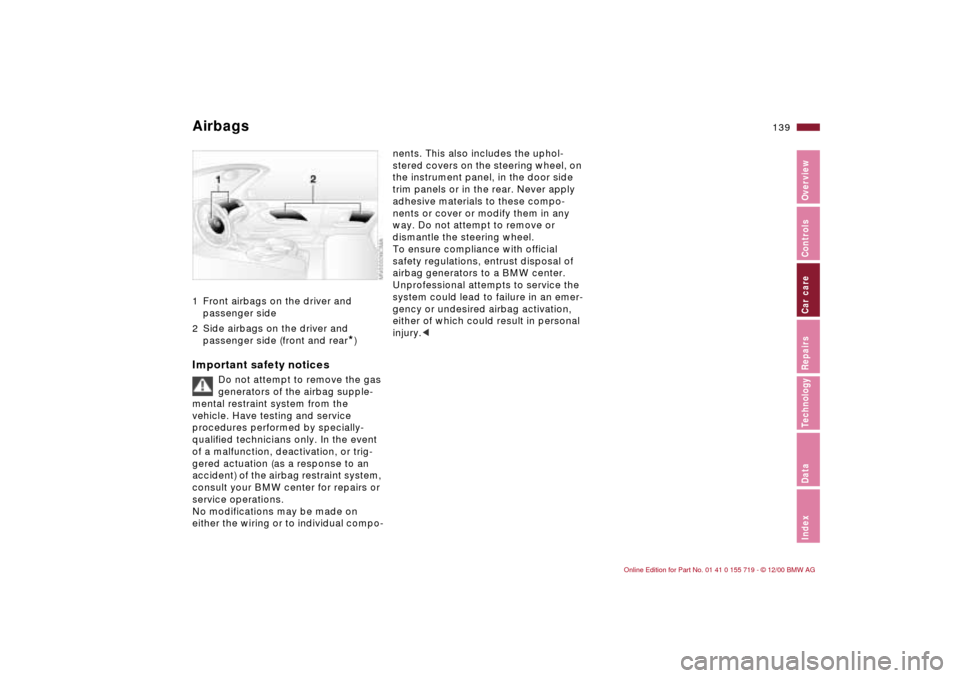
Airbags 1 Front airbags on the driver and
passenger side
2 Side airbags on the driver and
passenger side (front and rear
*)
Important safety notices
Do not attempt to remove the gas
generators of the airbag supple-
mental restraint system from the
vehicle. Have testing and service
procedures performed by specially-
qualified technicians only. In the event
of a malfunction, deactivation, or trig-
gered actuation (as a response to an
accident) of the airbag restraint system,
consult your BMW center for repairs or
service operations.
No modifications may be made on
either the wiring or to individual compo-
nents. This also includes the uphol-
stered covers on the steering wheel, on
the instrument panel, in the door side
trim panels or in the rear. Never apply
adhesive materials to these compo-
nents or cover or modify them in any
way. Do not attempt to remove or
dismantle the steering wheel.
To ensure compliance with official
safety regulations, entrust disposal of
airbag generators to a BMW center.
Unprofessional attempts to service the
system could lead to failure in an emer-
gency or undesired airbag activation,
either of which could result in personal
injury.<
Page 153 of 195
153n
IndexDataTechnologyRepairsCar careControlsOverview
Repairing a flat tire
Precautions in case of a flat tire:
Stop the vehicle as far as possible
from passing traffic; turn on the hazard
warning flashers.
Turn the steering wheel to the straight-
ahead position and engage the steering
lock. Engage the parking brake and
shift into 1st or reverse.
All passengers should be outside the
vehicle and well away from your imme-
diate working area (behind a guardrail,
for instance).
If a warning triangle or portable hazard
warning lamp is available, set it up on
the roadside at an appropriate distance
from the rear of the vehicle. Comply
with all safety guidelines and regula-
tions.<
M Mobility systemAn M Mobility system for fixing flat tires
is included with your BMW M3 convert-
ible. With the aid of this system, you
can apply a liquid sealant to the inside
of the tire, thereby sealing off the
damaged area, and then continue
driving.
The M Mobility system makes trans-
porting a spare wheel superfluous,
thereby reducing the amount of weight
you have to carry around.
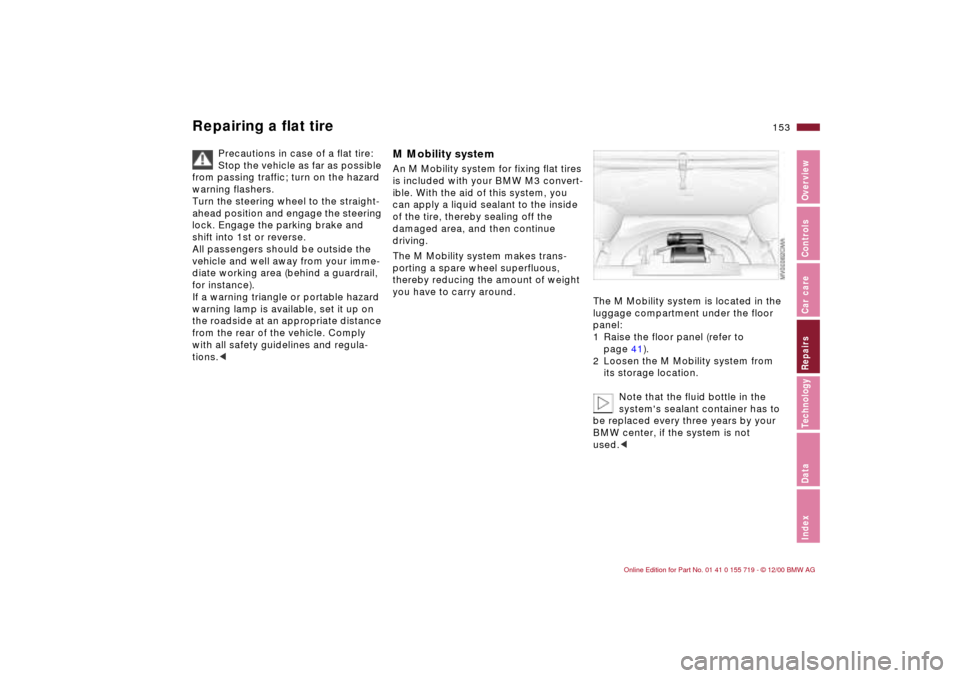
The M Mobility system is located in the
luggage compartment under the floor
panel:
1 Raise the floor panel (refer to
page 41).
2 Loosen the M Mobility system from
its storage location.
Note that the fluid bottle in the
system's sealant container has to
be replaced every three years by your
BMW center, if the system is not
used.<
Page 154 of 195
154n
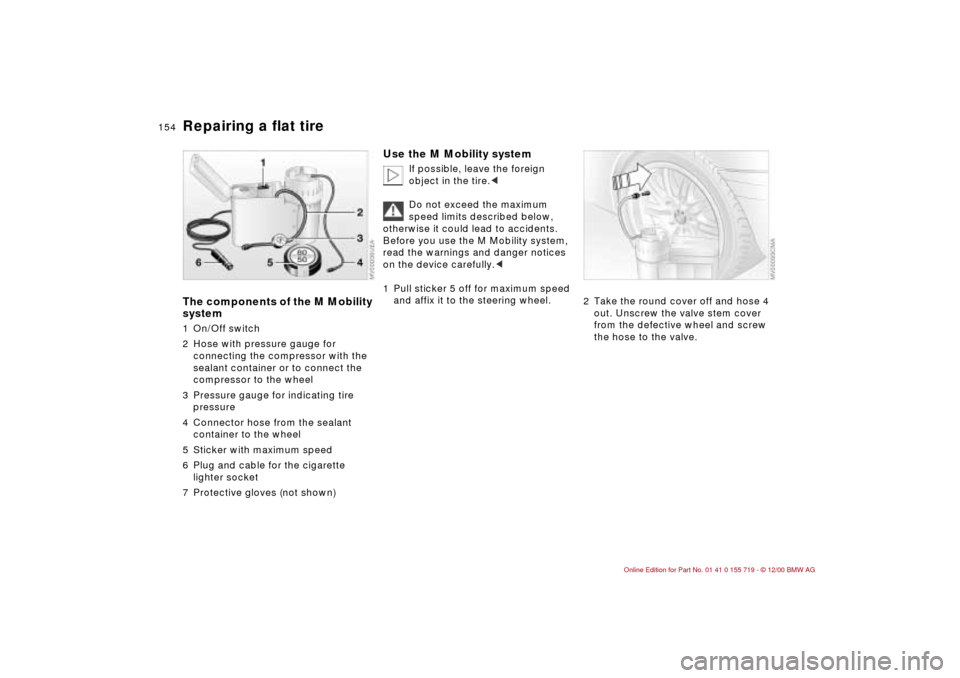
Repairing a flat tireThe components of the M Mobility
system1 On/Off switch
2 Hose with pressure gauge for
connecting the compressor with the
sealant container or to connect the
compressor to the wheel
3 Pressure gauge for indicating tire
pressure
4 Connector hose from the sealant
container to the wheel
5 Sticker with maximum speed
6 Plug and cable for the cigarette
lighter socket
7 Protective gloves (not shown)
Use the M Mobility system
If possible, leave the foreign
object in the tire.<
Do not exceed the maximum
speed limits described below,
otherwise it could lead to accidents.
Before you use the M Mobility system,
read the warnings and danger notices
on the device carefully.<
1 Pull sticker 5 off for maximum speed
and affix it to the steering wheel.
2 Take the round cover off and hose 4
out. Unscrew the valve stem cover
from the defective wheel and screw
the hose to the valve.
Page 170 of 195
170n
Dynamic Stability Control (DSC) Safety belt tensioner
Highly sensitive sensors monitor the
number of revolutions of the wheels,
steering angle, lateral acceleration,
brake pressure and the movement of
the vehicle around its vertical axis.
If differences in wheel speed should
occur, the system will recognize the
potential dangers associated with
wheel spin and will reduce the drive
torque; if necessary, it will do so using
brake intervention at the rear wheels as
well.
When instable vehicle operating condi-
tions are detected, the application of
the brakes with DSC can also act on the
front wheels to stabilize the vehicle.
You may need some time to become
accustomed to this system's interven-
tion. However, it provides optimum
drive force and vehicle stability.
The braking intervention may be
accompanied by a certain degree of
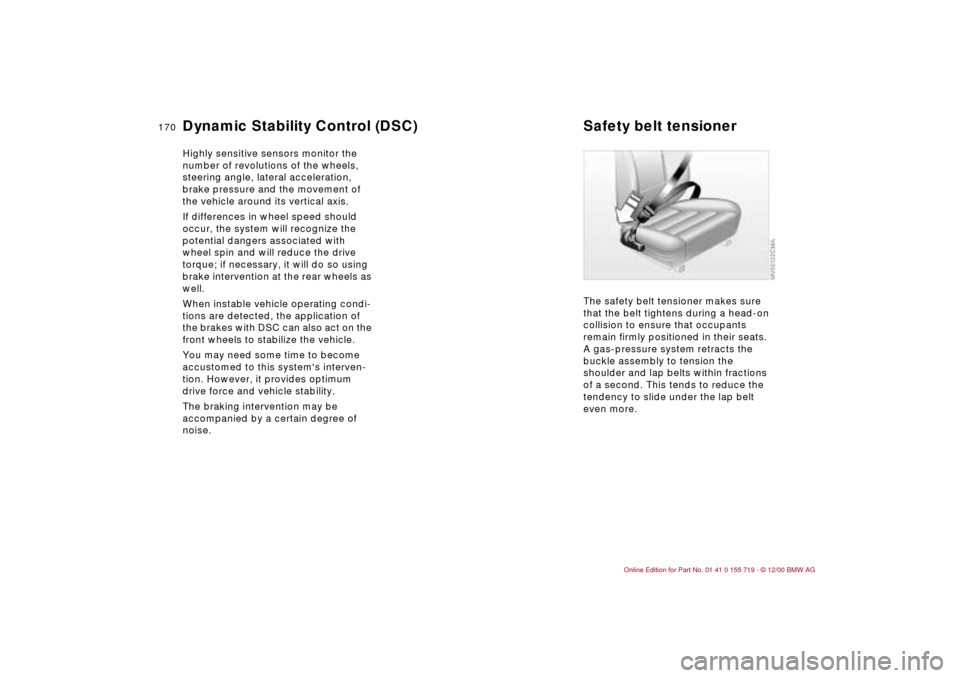
noise.The safety belt tensioner makes sure
that the belt tightens during a head-on
collision to ensure that occupants
remain firmly positioned in their seats.
A gas-pressure system retracts the
buckle assembly to tension the
shoulder and lap belts within fractions
of a second. This tends to reduce the
tendency to slide under the lap belt
even more.