engine BMW M3 CONVERTIBLE 2001 E46 Service Manual
[x] Cancel search | Manufacturer: BMW, Model Year: 2001, Model line: M3 CONVERTIBLE, Model: BMW M3 CONVERTIBLE 2001 E46Pages: 195, PDF Size: 1.96 MB
Page 158 of 195
158n
BatterySymbolsYou will find the following symbols on
your vehicle battery. To avoid injury,
please comply with the corresponding
precautions whenever you work with or
near the battery.
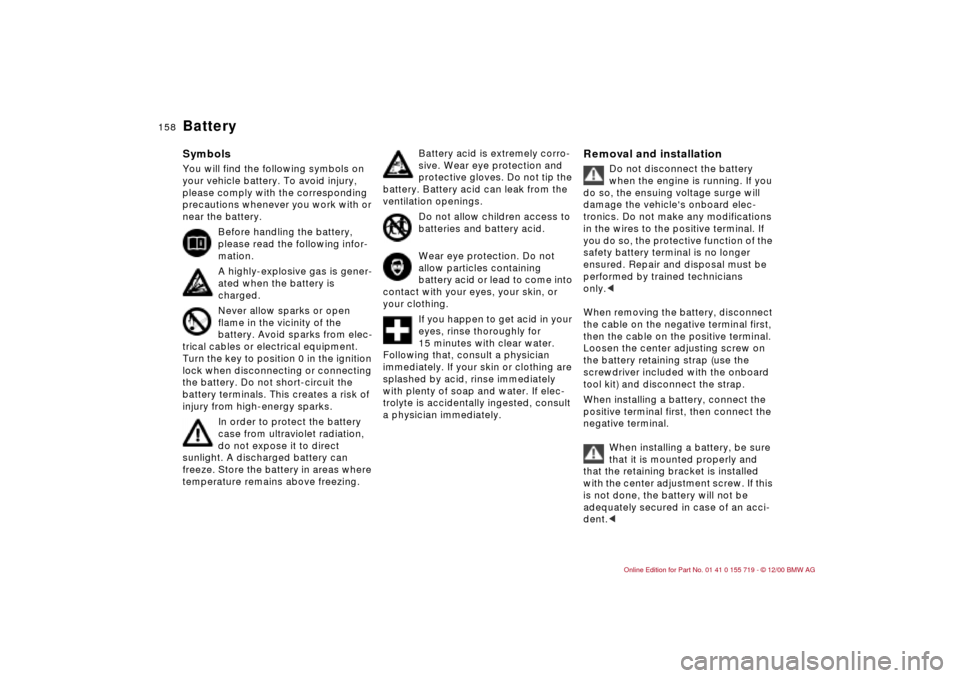
Before handling the battery,
please read the following infor-
mation.
A highly-explosive gas is gener-
ated when the battery is
charged.
Never allow sparks or open
flame in the vicinity of the
battery. Avoid sparks from elec-
trical cables or electrical equipment.
Turn the key to position 0 in the ignition
lock when disconnecting or connecting
the battery. Do not short-circuit the
battery terminals. This creates a risk of
injury from high-energy sparks.
In order to protect the battery
case from ultraviolet radiation,
do not expose it to direct
sunlight. A discharged battery can
freeze. Store the battery in areas where
temperature remains above freezing.
Battery acid is extremely corro-
sive. Wear eye protection and
protective gloves. Do not tip the
battery. Battery acid can leak from the
ventilation openings.
Do not allow children access to
batteries and battery acid.
Wear eye protection. Do not
allow particles containing
battery acid or lead to come into
contact with your eyes, your skin, or
your clothing.
If you happen to get acid in your
eyes, rinse thoroughly for
15 minutes with clear water.
Following that, consult a physician
immediately. If your skin or clothing are
splashed by acid, rinse immediately
with plenty of soap and water. If elec-
trolyte is accidentally ingested, consult
a physician immediately.
Removal and installation
Do not disconnect the battery
when the engine is running. If you
do so, the ensuing voltage surge will
damage the vehicle's onboard elec-
tronics. Do not make any modifications
in the wires to the positive terminal. If
you do so, the protective function of the
safety battery terminal is no longer
ensured. Repair and disposal must be
performed by trained technicians
only.<
When removing the battery, disconnect
the cable on the negative terminal first,
then the cable on the positive terminal.
Loosen the center adjusting screw on
the battery retaining strap (use the
screwdriver included with the onboard
tool kit) and disconnect the strap.
When installing a battery, connect the
positive terminal first, then connect the
negative terminal.
When installing a battery, be sure
that it is mounted properly and
that the retaining bracket is installed
with the center adjustment screw. If this
is not done, the battery will not be
adequately secured in case of an acci-
dent.<
Page 159 of 195
159n
IndexDataTechnologyRepairsCar careControlsOverview
BatteryCharging the battery Charge the battery in the vehicle only
when the engine is not running.
Before doing any work on the
electrical system, be sure to
disconnect the cable from the battery's
negative terminal. Failure to do so can
result in short-circuits, a fire or personal
injury.<
If you plan to park the vehicle for longer
than 4 weeks, disconnect the battery
from the vehicle electrical system by
disconnecting the cable at the negative
terminal. Then recharge the battery with
an appropriate battery charger.
If the vehicle is parked for more than
12 weeks, remove the battery, recharge
it and store it in a cool yet frost- and
dust-free area. During storage, have the
battery recharged every 3 months.
Also, recharge the battery before it is
reinstalled. If this is not done, the
battery will not be serviceable. Every
time the battery is discharged, espe-
cially over extended periods, its service
life is reduced.
Return used batteries to a recy-
cling point or your BMW center.
Maintain the battery in an upright posi-
tion for transport and storage. Secure
the battery to prevent it from tilting
during transport.<
Storage periods during which the
battery is disconnected are not
taken into consideration by the Service
Interval Display for changing the brake
fluid.
For this reason, be sure that the brake
fluid is changed every two years,
regardless of the information displayed.
Comply with the information on this
subject on page 130.<
Page 164 of 195
164n
Do not use spray starter fluids to start
the engine.
If the battery is discharged, the engine
can be started using two jumper cables
and another vehicle's battery. Use only
jumper cables with fully insulated
handles on the terminal clamps.
Do not touch the parts conducting
electrical current while the engine
is running. Failure to comply with this
creates a risk of fatal injury.
Carefully comply with the following
instructions to avoid personal injury or
damage to one or both vehicles.<
1 Ensure that the battery on the
support vehicle is also rated at
12 volts, and that the capacities of
the two batteries (Ah) are roughly
comparable (the rating is printed on
the battery).
2 Leave the discharged battery
connected to the vehicle's electrical
system.
3 Do not allow contact between the
two vehicle bodies – this creates the
risk of a short circuit.
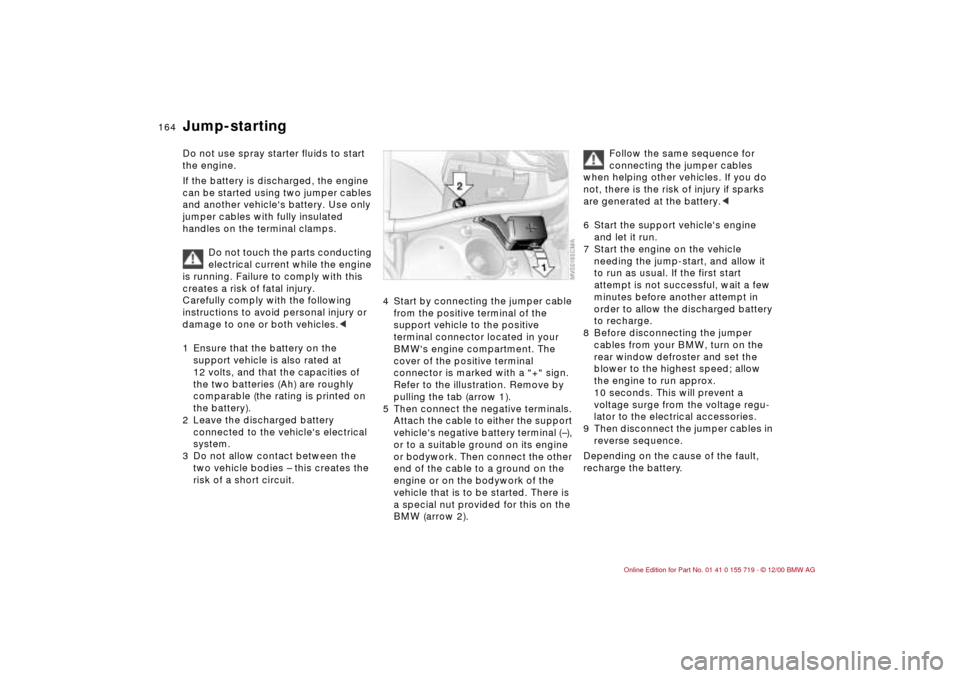
4 Start by connecting the jumper cable
from the positive terminal of the
support vehicle to the positive
terminal connector located in your
BMW's engine compartment. The
cover of the positive terminal
connector is marked with a "+" sign.
Refer to the illustration. Remove by
pulling the tab (arrow 1).
5 Then connect the negative terminals.
Attach the cable to either the support
vehicle's negative battery terminal (–),
or to a suitable ground on its engine
or bodywork. Then connect the other
end of the cable to a ground on the
engine or on the bodywork of the
vehicle that is to be started. There is
a special nut provided for this on the
BMW (arrow 2).
Follow the same sequence for
connecting the jumper cables
when helping other vehicles. If you do
not, there is the risk of injury if sparks
are generated at the battery.<
6 Start the support vehicle's engine
and let it run.
7 Start the engine on the vehicle
needing the jump-start, and allow it
to run as usual. If the first start
attempt is not successful, wait a few
minutes before another attempt in
order to allow the discharged battery
to recharge.
8 Before disconnecting the jumper
cables from your BMW, turn on the
rear window defroster and set the
blower to the highest speed; allow
the engine to run approx.
10 seconds. This will prevent a
voltage surge from the voltage regu-
lator to the electrical accessories.
9 Then disconnect the jumper cables in
reverse sequence.
Depending on the cause of the fault,
recharge the battery.
Jump-starting
Page 167 of 195
167n
IndexDataTechnologyRepairsCar careControlsOverview
Overview
Controls and features
Operation, care
and maintenance
Technical data
Index Advanced technology
Airbags168
Radio reception169
Dynamic Stability Control
(DSC)170
Safety belt tensioner170
M3 Engine concept171
Rain sensor172
Interior rearview mirror
with automatic dimming
feature173
Xenon lamps174
Rollover protection system175
Tech-
Owner service procedures
Page 171 of 195
171n
IndexDataTechnologyRepairsCar careControlsOverview
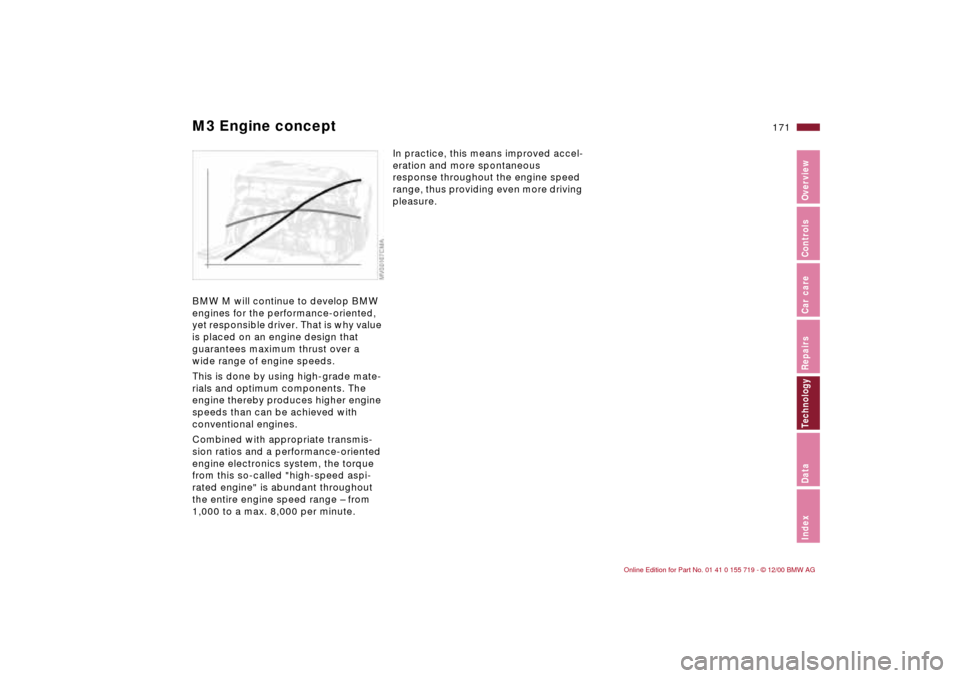
M3 Engine conceptBMW M will continue to develop BMW
engines for the performance-oriented,
yet responsible driver. That is why value
is placed on an engine design that
guarantees maximum thrust over a
wide range of engine speeds.
This is done by using high-grade mate-
rials and optimum components. The
engine thereby produces higher engine
speeds than can be achieved with
conventional engines.
Combined with appropriate transmis-
sion ratios and a performance-oriented
engine electronics system, the torque
from this so-called "high-speed aspi-
rated engine" is abundant throughout
the entire engine speed range – from
1,000 to a max. 8,000 per minute.
In practice, this means improved accel-
eration and more spontaneous
response throughout the engine speed
range, thus providing even more driving
pleasure.
Page 177 of 195
Overview
Controls and features
Operation, care
and maintenance
Owner service procedures
Technical data
Index Advanced technology
177n
IndexDataTechnologyRepairsCar careControlsOverview
Engine data178
Dimensions179
Weights180
Capacities181
Electrical system182
Drive belts182
Data
Page 178 of 195

178n
Displacement
Number of cylinders cu in (cmm) 198.1 (3,246)
6
Max. output
at engine speed hp (kW)
rpm333 (248)
7,900
Maximum torque
at engine speedlb ft (Nm)
rpm262 (355)
4,900
Compression ratioe
11.5
Stroke
Borein (mm)
in (mm)3.58 (91)
3.43 (87)
Fuel-injection system Digital-electronic engine management system
Engine data
Page 181 of 195

181n
IndexDataTechnologyRepairsCar careControlsOverview
Capacities
Notes
Fuel tank
Reserve gal. (liters)
gal. (liters)approx. 16.6 (approx. 63)
approx. 2.1 (approx. 8)Fuel specification: page 27
Windshield washer system/
Headlamp washer system quarts (liters) approx. 5.6 (approx. 5.3) Specifications: page 126
Cooling system including heater circuit quarts (liters) approx. 7.1 (approx. 6.7) Specifications: page 129
Engine oil and filter change quarts (liters) approx. 5.8 (approx. 5.5) BMW High Performance
Synthetic Oil
Specifications: page 128
Manual transmission quarts (liters) approx. 1.9 (approx. 1.8) Changing the oil during the
Break-In Inspection, and at every
Inspection II
Differential quarts (liters) approx. 1.2 (approx. 1.1) Changing the oil during the
Break-In Inspection, and at every
Inspection II
Page 186 of 195

Everything from A to ZAABS (Antilock Brake
System)21, 106
Acceleration181
Accessories6
Activated-charcoal filter92
replacing161t
Adding
brake fluid125t, 130t
coolant129t
engine oil127t
washer fluid126t, 181
Adjusting
clock76
head restraints50
interior temperature90
steering wheel55
thigh support area49
Adjusting seats
lumbar support49
Air conditioner91
Air distribution,
automatic90
Air outlets88
Air pressure115
Air supply91
recirculated air mode91
vents91
Airbags61, 139, 168
warning lamp21, 22Alarm system42
avoiding unintentional
alarms43
indicator lamp43
interior motion sensor42
tilt sensor alarm
system42
Alcantara care136
Antenna112
Antenna, Diversity169
Antifreeze129
radiator110
Antilock Brake System
(ABS)21, 106
Anti-theft alarm system42
Anti-theft protection33
Approved wheel and tire
specifications120
Aquaplaning105, 115
Armrest95
Ashtray
front96
rear97
AUC (Automatic recirculated
air control)91
Automatic climate
control88
Automatic cruise
control71
Automatic recirculated air
control (AUC)91Automatic windshield
washer70
Auxiliary terminal for jump-
starting125t
Average fuel
consumption78
Average speed78
Axle loads180
BBackrest
releasing51
Backup lamps68
replacing bulb149t
Battery157, 182
add distilled water157t
capacity182
charging159t
current check lamp20
removal and
installation158
symbols158
Belts57
Beverage holder95
BMW High Performance
Synthetic Oils128
BMW Maintenance
System131
BMW Sports seat49
Bore178Bottle holder, refer to
Beverage holder
Brake system20, 109
ABS21t, 106
brake faults109t
brake fluid change75
brake fluid level, warning
lamp20, 109
brake lamp, center151
brake lamps, replacing
bulb149t
brake pads, indicator
lamp22, 109
disc brakes108
driving notes105
warning lamp20, 109
Break-in procedure104
Bulbs and lamps146
CCalifornia Proposition
65 Warning141
Can holder, refer to
Beverage holder
Capacities181
Car battery182
Car Memory55
Car radio112
reception113, 169
refer also to the separate
Owner's Manual
Page 187 of 195
Everything from A to Z
187n
IndexDataTechnologyRepairsCar careControlsOverview
Car telephone96
Car wash132
Care
convertible top137
exterior133
interior134
upholstery135
wool velour135
Cargo loading100
Cassette operation, refer to
the radio Owner's Manual
Catalytic converter105
starting problems105
CBC (Cornering Brake
Control)107
warning lamp21
CD operation, refer to the
radio Owner's Manual
Cellular phone96, 112
refer also to the separate
Owner's Manual
Center armrest95
Center brake lamp151
Central locking system33
key38
Check Control76t
Checking brake fluid
level130t
Checking coolant
level129t
Checking engine oil
level127tChild restraint systems58
Child seat security60
Cigarette lighter97
Cleaning headlamps71
Cleaning windshield70
Clock76
refer to the "Radio and
Information Systems"
Owner's Manual or to the
"Onboard Computer"
Owner's Manual
Cockpit16
Code, refer also to the radio
Owner's Manual
Coin holder95
Combination switch69
Compression178
Computer77
refer to the "Onboard
Computer" Owner's
Manual
Configuring settings
car memory, key
memory55
Connecting portable vacuum
cleaner97
Consumption78
Consumption display74
Convertible top
compartment panel41
electrical defect162tfold down convertible top
compartment base41
operation45
Coolant110, 125t, 129
antifreeze110
temperature gauge74
Cooling system181
Copyright4
Cornering Brake Control
(CBC)107
warning lamp21
Cruise control71
Cruising range78
Cup holder, refer to
Beverage holder
Curb weight180
DDash panel lighting84
Dashboard16
Data
dimensions179
engine178
technical178
vehicle performance181
weights180
Data link connector for
onboard diagnosis142
Daylight driving lamps
switch84
Deep water105
Defrost position91tDefrostable rear window92
Defrosting, windows91t
Difficult steering112t
Digital clock76
Dimensions179
Dipstick127
Disarm tilt alarm
sensor43t
Disc brakes108
Displacement178
Display lighting84
Displays18
Disposal of used
batteries159t
Disposal of used engine
oil128t
Distance warning79
Diversity Antenna169
Door locks, care110
Doors
emergency lock
operation34t
keys32
manual opening and
closing34
opening and closing via
remote control35
unlocking and locking35
DOT Quality Grades116
Draft-free ventilation92
Drive belts182
Driving in winter110