child lock BMW M3 CONVERTIBLE 2001 E46 Owner's Manual
[x] Cancel search | Manufacturer: BMW, Model Year: 2001, Model line: M3 CONVERTIBLE, Model: BMW M3 CONVERTIBLE 2001 E46Pages: 195, PDF Size: 1.96 MB
Page 10 of 195

Contents
Overview
Controls and features
Cockpit16
Instrument cluster18
Indicator and warning lamps20
Multifunction steering wheel
(MFL)24
Hazard warning flashers25
Warning triangle25
Refueling26
Fuel specifications27
Tire inflation pressures27
Opening and closing:
Keys32
Electronic vehicle
immobilizer33
Central locking system33
Opening and closing – via the
door lock34
Opening and closing – via the
remote control35
Opening and closing – from
inside38
Luggage compartment lid39
Luggage compartment40
Alarm system42
Electric power windows44
Convertible top45
Adjustments:
Seats48
Mirrors52
Seat and mirror memory54
Steering wheel55
Car Memory, Key Memory55
Passenger safety systems:
Safety belts57
Transporting children safely58
Airbags61
Rollover protection system64
Driving:
Steering/Ignition lock66
Starting the engine66
Switching off the engine67
Parking brake67
Manual transmission68
Turn signal indicator/Headlamp
flasher69
Washer/Wiper system69
Rear window defroster71
Cruise control71
Everything under control:
Odometer73
Tachometer73
Engine oil temperature gauge73
Fuel gauge74
Coolant temperature gauge74
Service Interval Display75
Check Control76
Clock76
Computer77
Technology for safety and
convenience:
Park Distance Control (PDC)79
Dynamic Stability Control
(DSC)80
Tire Pressure Warning (RDW)81
M Engine dynamics control83
Contents
Page 30 of 195
30n
Locks and security systems:
Keys32
Electronic vehicle
immobilizer33
Central locking system33
Opening and closing – via the
door lock34
Opening and closing – via the
remote control35
Opening and closing – from
inside38
Luggage compartment lid39
Luggage compartment40
Alarm system42
Electric power windows44
Convertible top45
Adjustments:
Seats48
Mirrors52
Seat and mirror memory54
Steering wheel55
Car Memory, Key Memory55
Passenger safety systems:
Safety belts57
Transporting children safely58
Airbags61
Rollover protection system64
Controls
Page 35 of 195
35n
IndexDataTechnologyRepairsCar careControlsOverview
Opening and closing – via the remote control The conceptThe remote control gives you an excep-
tionally convenient method for
unlocking and locking your vehicle.
Furthermore, it provides two additional
functions which you can only execute
via the remote control:
>Switch on the interior light. Refer to
page 36
With this function, you can also
"search for" your vehicle – when
parked in an underground garage, for
instance.
>Open the luggage compartment lid.
Refer to page 37
The luggage compartment lid will
open slightly, regardless of whether it
was locked or unlocked.
Whenever you unlock (lock) the vehicle,
you simultaneously deactivate (activate)
the anti-theft system, disarm (arm) the
alarm system
* and switch the interior
lamps on (off).
You can have a signal set to
confirm that the vehicle's locks
have engaged securely.<
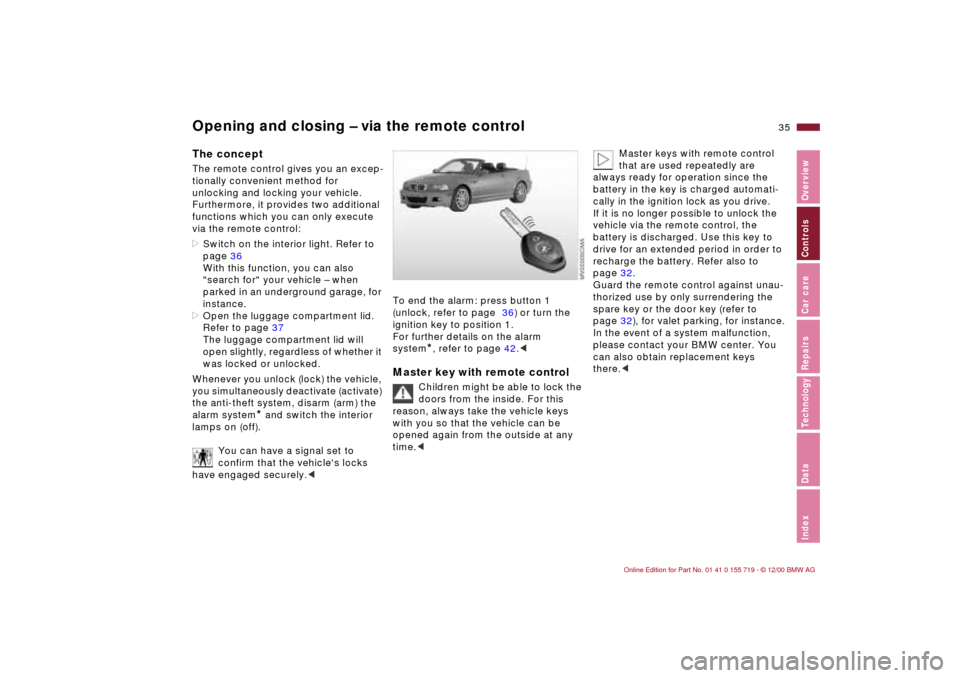
To end the alarm: press button 1
(unlock, refer to page 36) or turn the
ignition key to position 1.
For further details on the alarm
system
*, refer to page 42.<
Master key with remote control
Children might be able to lock the
doors from the inside. For this
reason, always take the vehicle keys
with you so that the vehicle can be
opened again from the outside at any
time.<
Master keys with remote control
that are used repeatedly are
always ready for operation since the
battery in the key is charged automati-
cally in the ignition lock as you drive.
If it is no longer possible to unlock the
vehicle via the remote control, the
battery is discharged. Use this key to
drive for an extended period in order to
recharge the battery. Refer also to
page 32.
Guard the remote control against unau-
thorized use by only surrendering the
spare key or the door key (refer to
page 32), for valet parking, for instance.
In the event of a system malfunction,
please contact your BMW center. You
can also obtain replacement keys
there.<
Page 38 of 195
38n
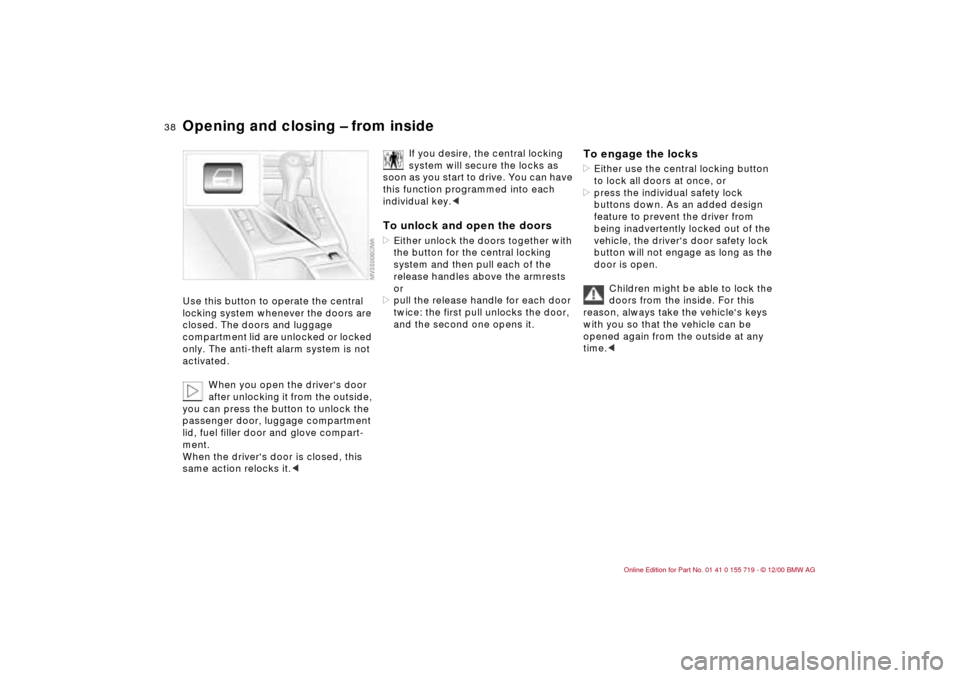
Opening and closing – from inside Use this button to operate the central
locking system whenever the doors are
closed. The doors and luggage
compartment lid are unlocked or locked
only. The anti-theft alarm system is not
activated.
When you open the driver's door
after unlocking it from the outside,
you can press the button to unlock the
passenger door, luggage compartment
lid, fuel filler door and glove compart-
ment.
When the driver's door is closed, this
same action relocks it.<
If you desire, the central locking
system will secure the locks as
soon as you start to drive. You can have
this function programmed into each
individual key.<
To unlock and open the doors>Either unlock the doors together with
the button for the central locking
system and then pull each of the
release handles above the armrests
or
>pull the release handle for each door
twice: the first pull unlocks the door,
and the second one opens it.
To engage the locks>Either use the central locking button
to lock all doors at once, or
>press the individual safety lock
buttons down. As an added design
feature to prevent the driver from
being inadvertently locked out of the
vehicle, the driver's door safety lock
button will not engage as long as the
door is open.
Children might be able to lock the
doors from the inside. For this
reason, always take the vehicle's keys
with you so that the vehicle can be
opened again from the outside at any
time.<
Page 43 of 195
43n
IndexDataTechnologyRepairsCar careControlsOverview
Alarm system
*
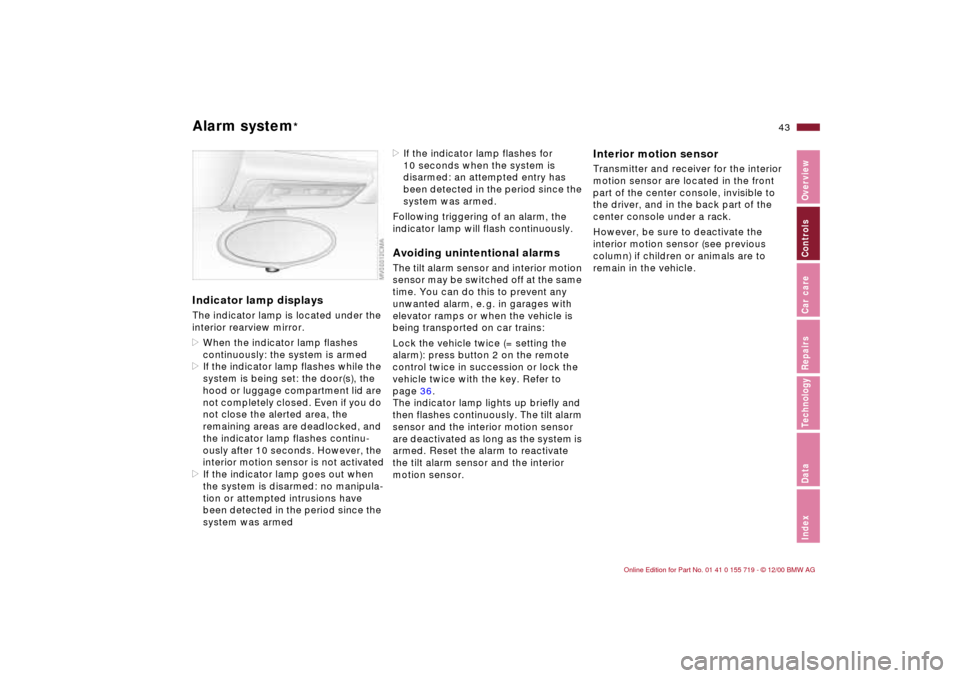
Indicator lamp displaysThe indicator lamp is located under the
interior rearview mirror.
>When the indicator lamp flashes
continuously: the system is armed
>If the indicator lamp flashes while the
system is being set: the door(s), the
hood or luggage compartment lid are
not completely closed. Even if you do
not close the alerted area, the
remaining areas are deadlocked, and
the indicator lamp flashes continu-
ously after 10 seconds. However, the
interior motion sensor is not activated
>If the indicator lamp goes out when
the system is disarmed: no manipula-
tion or attempted intrusions have
been detected in the period since the
system was armed
>If the indicator lamp flashes for
10 seconds when the system is
disarmed: an attempted entry has
been detected in the period since the
system was armed.
Following triggering of an alarm, the
indicator lamp will flash continuously.Avoiding unintentional alarms The tilt alarm sensor and interior motion
sensor may be switched off at the same
time. You can do this to prevent any
unwanted alarm, e. g. in garages with
elevator ramps or when the vehicle is
being transported on car trains:
Lock the vehicle twice (= setting the
alarm): press button 2 on the remote
control twice in succession or lock the
vehicle twice with the key. Refer to
page 36.
The indicator lamp lights up briefly and
then flashes continuously. The tilt alarm
sensor and the interior motion sensor
are deactivated as long as the system is
armed. Reset the alarm to reactivate
the tilt alarm sensor and the interior
motion sensor.
Interior motion sensorTransmitter and receiver for the interior
motion sensor are located in the front
part of the center console, invisible to
the driver, and in the back part of the
center console under a rack.
However, be sure to deactivate the
interior motion sensor (see previous
column) if children or animals are to
remain in the vehicle.
Page 44 of 195
44n
Alarm system
*
Electric power windows
For US owners onlyThe transmitter and receiver units
comply with part 15 of the FCC (Federal
Communication Commission) regula-
tions. Operation is governed by the
following:
FCC ID: LTQSDR2G5
Compliance statement:
This device complies with part 15 of the
FCC Rules. Operation is subject to the
following two conditions:
>This device may not cause harmful
interference, and
>this device must accept any interfer-
ence received, including interference
that may cause undesired operation.
Any unauthorized modifications to
these devices could void the
user's authority to operate the equip-
ment.<
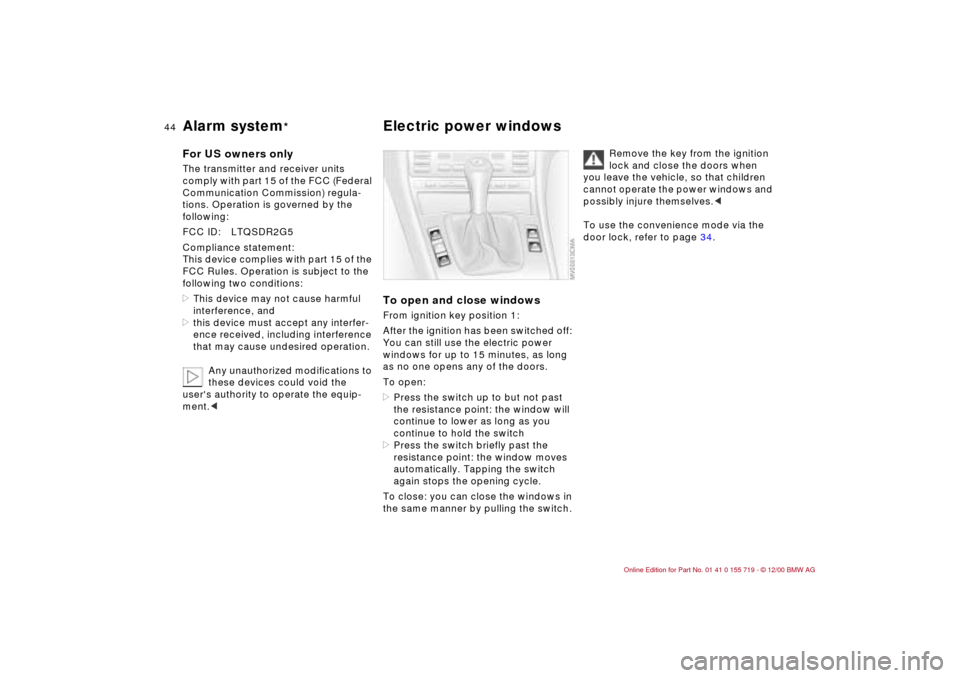
To open and close windowsFrom ignition key position 1:
After the ignition has been switched off:
You can still use the electric power
windows for up to 15 minutes, as long
as no one opens any of the doors.
To open:
>Press the switch up to but not past
the resistance point: the window will
continue to lower as long as you
continue to hold the switch
>Press the switch briefly past the
resistance point: the window moves
automatically. Tapping the switch
again stops the opening cycle.
To close: you can close the windows in
the same manner by pulling the switch.
Remove the key from the ignition
lock and close the doors when
you leave the vehicle, so that children
cannot operate the power windows and
possibly injure themselves.<
To use the convenience mode via the
door lock, refer to page 34.
Page 60 of 195
60n
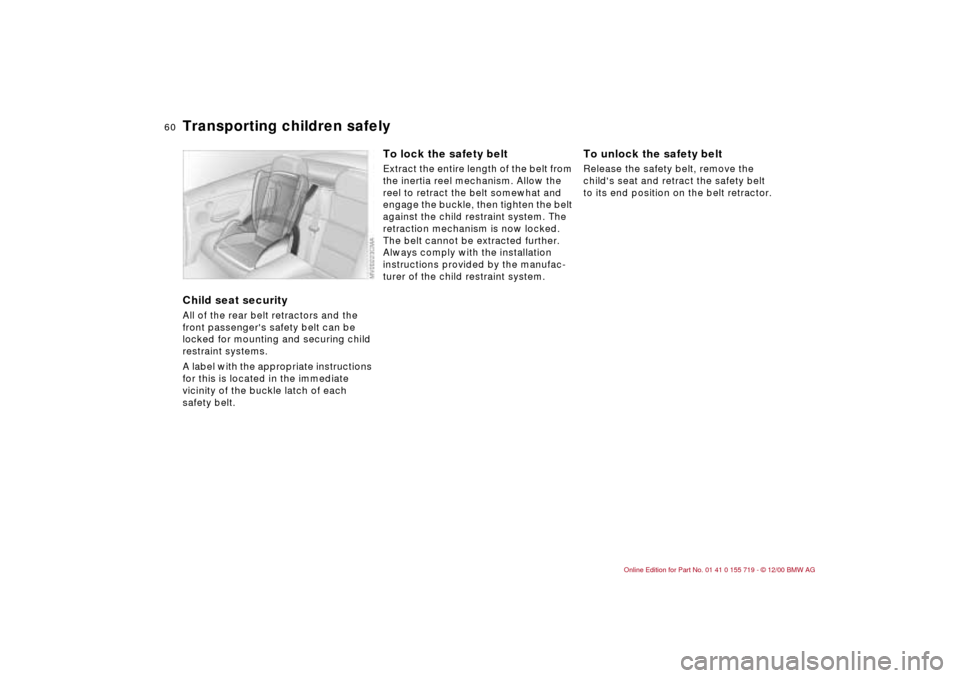
Transporting children safelyChild seat securityAll of the rear belt retractors and the
front passenger's safety belt can be
locked for mounting and securing child
restraint systems.
A label with the appropriate instructions
for this is located in the immediate
vicinity of the buckle latch of each
safety belt.
To lock the safety beltExtract the entire length of the belt from
the inertia reel mechanism. Allow the
reel to retract the belt somewhat and
engage the buckle, then tighten the belt
against the child restraint system. The
retraction mechanism is now locked.
The belt cannot be extracted further.
Always comply with the installation
instructions provided by the manufac-
turer of the child restraint system.
To unlock the safety beltRelease the safety belt, remove the
child's seat and retract the safety belt
to its end position on the belt retractor.
Page 62 of 195

62n
AirbagsSitting correctly with airbags
For your safety, comply with the
following instructions for the
airbags. If you do not, the airbags may
not be able to provide their maximum
protection. All passengers in the vehicle
should be aware of and comply with
this information:
The airbags are supplemental restraint
devices designed to provide extra
protection; they are not a substitute for
safety belts. Wear your safety belt at all
times. The airbags will not be triggered
in the event of a minor accident, a
vehicle rollover, or collisions from the
rear. In these instances, the safety belt
provides optimal protection.
Airbags are located under cover panels
in the steering wheel, in the instrument
panel and in the side trim panels in the
front and rear
*.
Adjust your seat to a position that
provides maximum distance between
you and the steering wheel, the instru-
ment panel and the door while still
allowing comfortable and safe access
to all vehicle controls.
To avoid sustaining hand and arm inju-
ries, always grasp the steering wheel
on the rim with the hands at the 9 and
3 o'clock positions. Do not place your
hands on the center pad.
Never allow any objects to obstruct the
area between the airbag and an occu-
pant.
Do not use the cover panel above the
passenger side airbag as a storage
area.
Do not apply adhesive materials to the
cover panels of the airbags, cover them
or modify them in any other way.
Do not install a rear-facing child
restraint system in the front passenger
seat of this vehicle.
Children under 13 years of age and
children less than 5 feet (150 cm) tall
should ride only in the rear seat.
Infants or small children should never
be held on the lap of a passenger.
If your vehicle is equipped with side
airbags in the rear passenger area
*, be
sure that child restraints are mounted
correctly and provided with the
greatest-possible distance between the
airbags in the side trim panels. Do not
allow children to lean out of the child's
seat in the direction of the side trim
panels. If they do so, serious injuries
can occur if the airbag is triggered.
(infants and small children in appro-
priate child restraint systems; larger
children and adults using the safety
belts). Never let an occupant's head
rest near or on a side airbag because
the inflating airbag could cause a
serious or fatal injury. Please note that
the word "Airbag" imprinted on the door
trim panel indicates the airbag's loca-
tion.
Accident research shows that the
safest place for children in an automo-
bile is in the rear seat. However, a child
sitting in the rear seat and not properly
restrained may place his or her head on
or near the airbag, if so equipped. For
example, a child — even though belted
— may fall asleep with his or her head
against the side airbag. It may be diffi-
cult for a driver to ensure that children
in the rear seat will remain properly
positioned at all times and not place
their heads on or near the side airbag.
Therefore, we recommend that the rear
seat side airbags, if so equipped, be
deactivated if children will travel in the
rear seat.
The rear seat side airbags may already
have been deactivated, either at the
time of manufacture or by a BMW
Page 158 of 195
158n
BatterySymbolsYou will find the following symbols on
your vehicle battery. To avoid injury,
please comply with the corresponding
precautions whenever you work with or
near the battery.
Before handling the battery,
please read the following infor-
mation.
A highly-explosive gas is gener-
ated when the battery is
charged.
Never allow sparks or open
flame in the vicinity of the
battery. Avoid sparks from elec-
trical cables or electrical equipment.
Turn the key to position 0 in the ignition
lock when disconnecting or connecting
the battery. Do not short-circuit the
battery terminals. This creates a risk of
injury from high-energy sparks.
In order to protect the battery
case from ultraviolet radiation,
do not expose it to direct
sunlight. A discharged battery can
freeze. Store the battery in areas where
temperature remains above freezing.
Battery acid is extremely corro-
sive. Wear eye protection and
protective gloves. Do not tip the
battery. Battery acid can leak from the
ventilation openings.
Do not allow children access to
batteries and battery acid.
Wear eye protection. Do not
allow particles containing
battery acid or lead to come into
contact with your eyes, your skin, or
your clothing.
If you happen to get acid in your
eyes, rinse thoroughly for
15 minutes with clear water.
Following that, consult a physician
immediately. If your skin or clothing are
splashed by acid, rinse immediately
with plenty of soap and water. If elec-
trolyte is accidentally ingested, consult
a physician immediately.
Removal and installation
Do not disconnect the battery
when the engine is running. If you
do so, the ensuing voltage surge will
damage the vehicle's onboard elec-
tronics. Do not make any modifications
in the wires to the positive terminal. If
you do so, the protective function of the
safety battery terminal is no longer
ensured. Repair and disposal must be
performed by trained technicians
only.<
When removing the battery, disconnect
the cable on the negative terminal first,
then the cable on the positive terminal.
Loosen the center adjusting screw on
the battery retaining strap (use the
screwdriver included with the onboard
tool kit) and disconnect the strap.
When installing a battery, connect the
positive terminal first, then connect the
negative terminal.
When installing a battery, be sure
that it is mounted properly and
that the retaining bracket is installed
with the center adjustment screw. If this
is not done, the battery will not be
adequately secured in case of an acci-
dent.<
Page 187 of 195
Everything from A to Z
187n
IndexDataTechnologyRepairsCar careControlsOverview
Car telephone96
Car wash132
Care
convertible top137
exterior133
interior134
upholstery135
wool velour135
Cargo loading100
Cassette operation, refer to
the radio Owner's Manual
Catalytic converter105
starting problems105
CBC (Cornering Brake
Control)107
warning lamp21
CD operation, refer to the
radio Owner's Manual
Cellular phone96, 112
refer also to the separate
Owner's Manual
Center armrest95
Center brake lamp151
Central locking system33
key38
Check Control76t
Checking brake fluid
level130t
Checking coolant
level129t
Checking engine oil
level127tChild restraint systems58
Child seat security60
Cigarette lighter97
Cleaning headlamps71
Cleaning windshield70
Clock76
refer to the "Radio and
Information Systems"
Owner's Manual or to the
"Onboard Computer"
Owner's Manual
Cockpit16
Code, refer also to the radio
Owner's Manual
Coin holder95
Combination switch69
Compression178
Computer77
refer to the "Onboard
Computer" Owner's
Manual
Configuring settings
car memory, key
memory55
Connecting portable vacuum
cleaner97
Consumption78
Consumption display74
Convertible top
compartment panel41
electrical defect162tfold down convertible top
compartment base41
operation45
Coolant110, 125t, 129
antifreeze110
temperature gauge74
Cooling system181
Copyright4
Cornering Brake Control
(CBC)107
warning lamp21
Cruise control71
Cruising range78
Cup holder, refer to
Beverage holder
Curb weight180
DDash panel lighting84
Dashboard16
Data
dimensions179
engine178
technical178
vehicle performance181
weights180
Data link connector for
onboard diagnosis142
Daylight driving lamps
switch84
Deep water105
Defrost position91tDefrostable rear window92
Defrosting, windows91t
Difficult steering112t
Digital clock76
Dimensions179
Dipstick127
Disarm tilt alarm
sensor43t
Disc brakes108
Displacement178
Display lighting84
Displays18
Disposal of used
batteries159t
Disposal of used engine
oil128t
Distance warning79
Diversity Antenna169
Door locks, care110
Doors
emergency lock
operation34t
keys32
manual opening and
closing34
opening and closing via
remote control35
unlocking and locking35
DOT Quality Grades116
Draft-free ventilation92
Drive belts182
Driving in winter110