ignition BMW M3 CONVERTIBLE 2001 E46 Owner's Manual
[x] Cancel search | Manufacturer: BMW, Model Year: 2001, Model line: M3 CONVERTIBLE, Model: BMW M3 CONVERTIBLE 2001 E46Pages: 195, PDF Size: 1.96 MB
Page 10 of 195

Contents
Overview
Controls and features
Cockpit16
Instrument cluster18
Indicator and warning lamps20
Multifunction steering wheel
(MFL)24
Hazard warning flashers25
Warning triangle25
Refueling26
Fuel specifications27
Tire inflation pressures27
Opening and closing:
Keys32
Electronic vehicle
immobilizer33
Central locking system33
Opening and closing – via the
door lock34
Opening and closing – via the
remote control35
Opening and closing – from
inside38
Luggage compartment lid39
Luggage compartment40
Alarm system42
Electric power windows44
Convertible top45
Adjustments:
Seats48
Mirrors52
Seat and mirror memory54
Steering wheel55
Car Memory, Key Memory55
Passenger safety systems:
Safety belts57
Transporting children safely58
Airbags61
Rollover protection system64
Driving:
Steering/Ignition lock66
Starting the engine66
Switching off the engine67
Parking brake67
Manual transmission68
Turn signal indicator/Headlamp
flasher69
Washer/Wiper system69
Rear window defroster71
Cruise control71
Everything under control:
Odometer73
Tachometer73
Engine oil temperature gauge73
Fuel gauge74
Coolant temperature gauge74
Service Interval Display75
Check Control76
Clock76
Computer77
Technology for safety and
convenience:
Park Distance Control (PDC)79
Dynamic Stability Control
(DSC)80
Tire Pressure Warning (RDW)81
M Engine dynamics control83
Contents
Page 20 of 195
20n
Indicator and warning lamps
Technology
that monitors itself
Many of the systems in your BMW
monitor themselves automatically, both
during engine starts and while you are
driving. Indicator and warning lamps
identified by "
l
" are tested for proper
operation whenever the ignition key is
turned. They each light up once for
different periods of time.
If a fault should occur in one of these
systems, the corresponding lamp does
not go out after the engine is started, or
it lights up while the vehicle is moving.
You will see how to react to this below.
Red: stop immediately
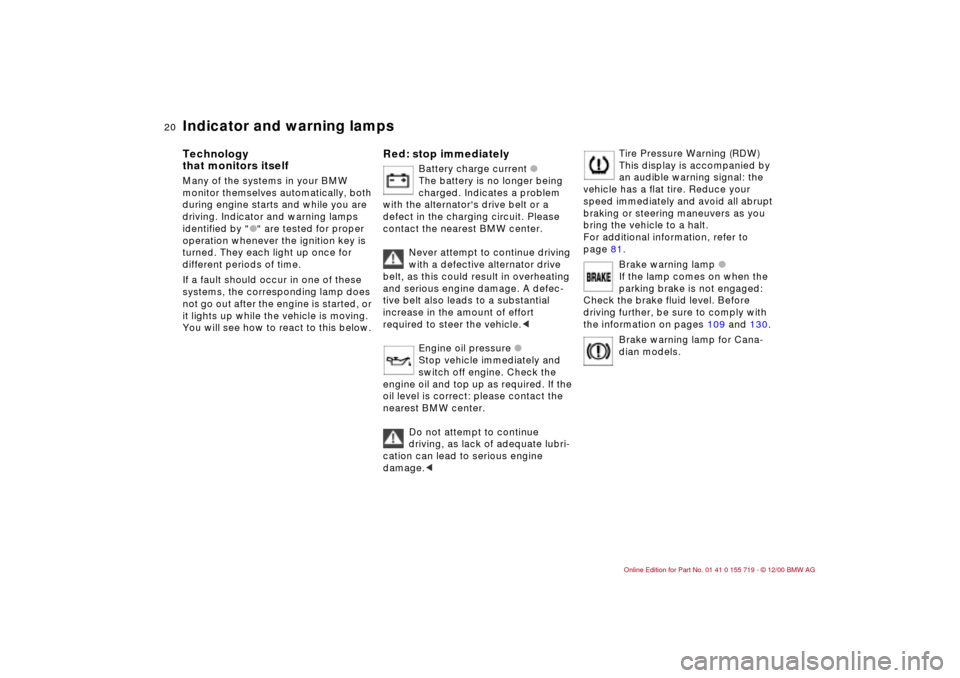
Battery charge current
l
The battery is no longer being
charged. Indicates a problem
with the alternator's drive belt or a
defect in the charging circuit. Please
contact the nearest BMW center.
Never attempt to continue driving
with a defective alternator drive
belt, as this could result in overheating
and serious engine damage. A defec-
tive belt also leads to a substantial
increase in the amount of effort
required to steer the vehicle.
<
Engine oil pressure
l
Stop vehicle immediately and
switch off engine. Check the
engine oil and top up as required. If the
oil level is correct: please contact the
nearest BMW center.
Do not attempt to continue
driving, as lack of adequate lubri-
cation can lead to serious engine
damage.
<
Tire Pressure Warning (RDW)
This display is accompanied by
an audible warning signal: the
vehicle has a flat tire. Reduce your
speed immediately and avoid all abrupt
braking or steering maneuvers as you
bring the vehicle to a halt.
For additional information, refer to
page 81.
Brake warning lamp l
If the lamp comes on when the
parking brake is not engaged:
Check the brake fluid level. Before
driving further, be sure to comply with
the information on pages 109 and 130.
Brake warning lamp for Cana-
dian models.
Page 25 of 195
25n
IndexDataTechnologyRepairsCar careControlsOverview
Hazard warning flashers Warning triangle
*
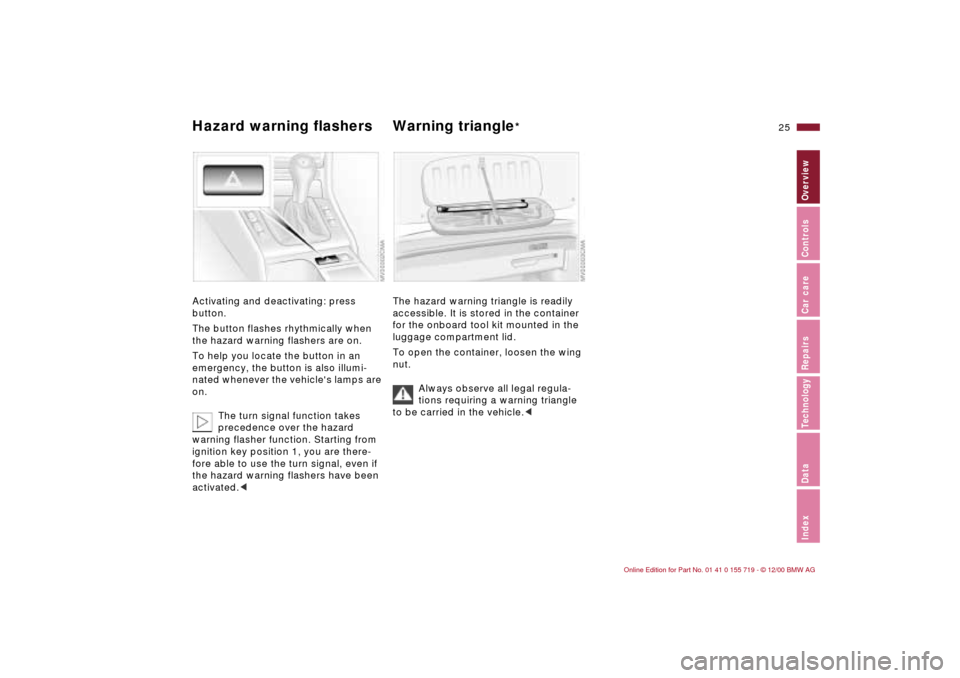
Activating and deactivating: press
button.
The button flashes rhythmically when
the hazard warning flashers are on.
To help you locate the button in an
emergency, the button is also illumi-
nated whenever the vehicle's lamps are
on.
The turn signal function takes
precedence over the hazard
warning flasher function. Starting from
ignition key position 1, you are there-
fore able to use the turn signal, even if
the hazard warning flashers have been
activated.<
The hazard warning triangle is readily
accessible. It is stored in the container
for the onboard tool kit mounted in the
luggage compartment lid.
To open the container, loosen the wing
nut.
Always observe all legal regula-
tions requiring a warning triangle
to be carried in the vehicle.<
Page 31 of 195
Overview
Controls and features
Operation, care
and maintenance
Owner service procedures
Technical data
Index Advanced technology
31n
IndexDataTechnologyRepairsCar careControlsOverview
Driving:
Steering/Ignition lock66
Starting the engine66
Switching off the engine67
Parking brake67
Manual transmission68
Turn signal indicator/Headlamp
flasher69
Washer/Wiper system69
Rear window defroster71
Cruise control71
Everything under control:
Odometer73
Tachometer73
Engine oil temperature gauge73
Fuel gauge74
Coolant temperature gauge74
Service Interval Display75
Check Control76
Clock76
Computer77
Technology for driving comfort
and safety:
Park Distance Control (PDC)79
Dynamic Stability Control
(DSC)80
Tire Pressure Warning (RDW)81
M Engine dynamics control83Lamps:
Side lamps/Low beam
headlamps84
Instrument lighting84
High beams/Parking lamps85
Fog lamps85
Interior lamps86
Reading lamps86
Controlling the climate
for pleasant driving:
Automatic climate control88
Heated seats93
Cabin convenience:
Glove compartment94
Storage compartments95
Cellular phone96
Ashtray, front96
Cigarette lighter97
Ashtray, rear97
Loading and transporting
cargo:
Ski bag98
Cargo loading100
Roof-mounted luggage rack for
the hardtop101
Page 32 of 195
32n
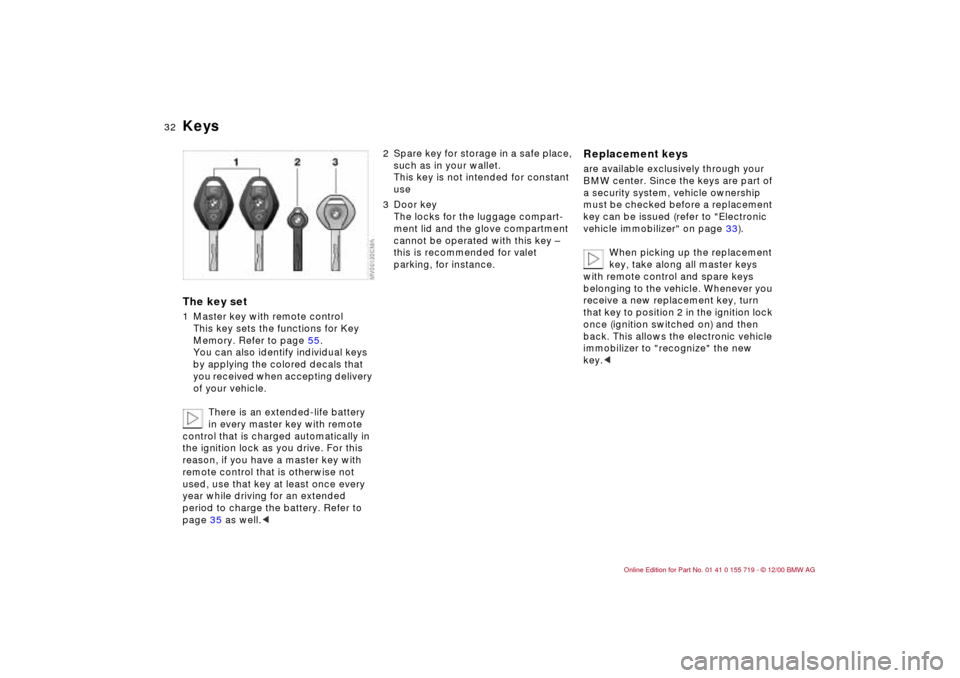
KeysThe key set1 Master key with remote control
This key sets the functions for Key
Memory. Refer to page 55.
You can also identify individual keys
by applying the colored decals that
you received when accepting delivery
of your vehicle.
There is an extended-life battery
in every master key with remote
control that is charged automatically in
the ignition lock as you drive. For this
reason, if you have a master key with
remote control that is otherwise not
used, use that key at least once every
year while driving for an extended
period to charge the battery. Refer to
page 35 as well.<
2 Spare key for storage in a safe place,
such as in your wallet.
This key is not intended for constant
use
3 Door key
The locks for the luggage compart-
ment lid and the glove compartment
cannot be operated with this key –
this is recommended for valet
parking, for instance.
Replacement keysare available exclusively through your
BMW center. Since the keys are part of
a security system, vehicle ownership
must be checked before a replacement
key can be issued (refer to "Electronic
vehicle immobilizer" on page 33).
When picking up the replacement
key, take along all master keys
with remote control and spare keys
belonging to the vehicle. Whenever you
receive a new replacement key, turn
that key to position 2 in the ignition lock
once (ignition switched on) and then
back. This allows the electronic vehicle
immobilizer to "recognize" the new
key.<
Page 33 of 195
33n
IndexDataTechnologyRepairsCar careControlsOverview
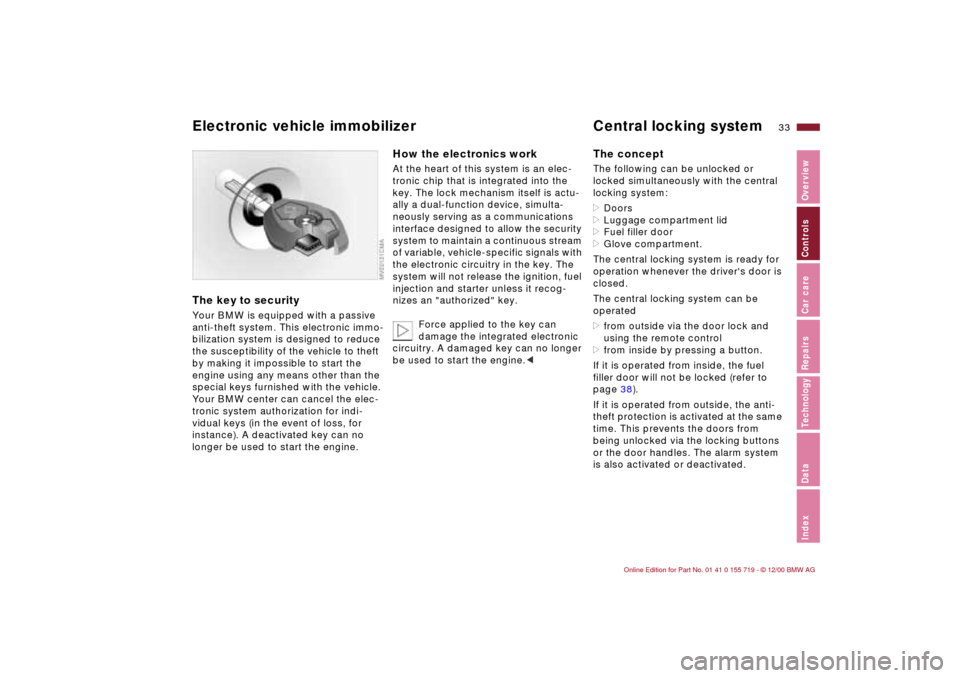
Electronic vehicle immobilizer Central locking systemThe key to security Your BMW is equipped with a passive
anti-theft system. This electronic immo-
bilization system is designed to reduce
the susceptibility of the vehicle to theft
by making it impossible to start the
engine using any means other than the
special keys furnished with the vehicle.
Your BMW center can cancel the elec-
tronic system authorization for indi-
vidual keys (in the event of loss, for
instance). A deactivated key can no
longer be used to start the engine.
How the electronics work At the heart of this system is an elec-
tronic chip that is integrated into the
key. The lock mechanism itself is actu-
ally a dual-function device, simulta-
neously serving as a communications
interface designed to allow the security
system to maintain a continuous stream
of variable, vehicle-specific signals with
the electronic circuitry in the key. The
system will not release the ignition, fuel
injection and starter unless it recog-
nizes an "authorized" key.
Force applied to the key can
damage the integrated electronic
circuitry. A damaged key can no longer
be used to start the engine.<
The conceptThe following can be unlocked or
locked simultaneously with the central
locking system:
>Doors
>Luggage compartment lid
>Fuel filler door
>Glove compartment.
The central locking system is ready for
operation whenever the driver's door is
closed.
The central locking system can be
operated
>from outside via the door lock and
using the remote control
>from inside by pressing a button.
If it is operated from inside, the fuel
filler door will not be locked (refer to
page 38).
If it is operated from outside, the anti-
theft protection is activated at the same
time. This prevents the doors from
being unlocked via the locking buttons
or the door handles. The alarm system
is also activated or deactivated.
Page 35 of 195
35n
IndexDataTechnologyRepairsCar careControlsOverview
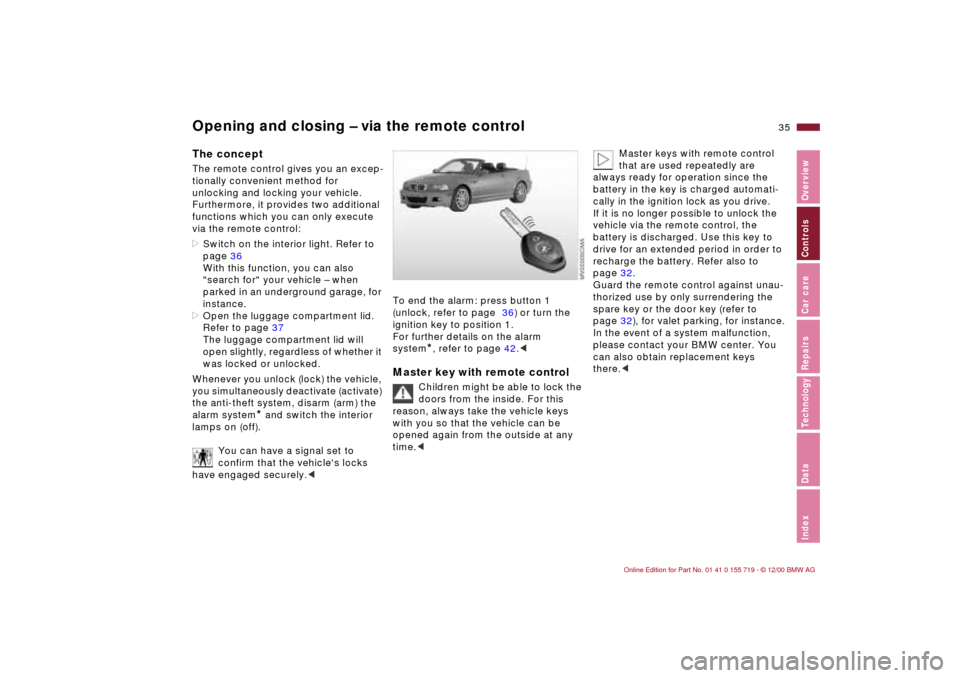
Opening and closing – via the remote control The conceptThe remote control gives you an excep-
tionally convenient method for
unlocking and locking your vehicle.
Furthermore, it provides two additional
functions which you can only execute
via the remote control:
>Switch on the interior light. Refer to
page 36
With this function, you can also
"search for" your vehicle – when
parked in an underground garage, for
instance.
>Open the luggage compartment lid.
Refer to page 37
The luggage compartment lid will
open slightly, regardless of whether it
was locked or unlocked.
Whenever you unlock (lock) the vehicle,
you simultaneously deactivate (activate)
the anti-theft system, disarm (arm) the
alarm system
* and switch the interior
lamps on (off).
You can have a signal set to
confirm that the vehicle's locks
have engaged securely.<
To end the alarm: press button 1
(unlock, refer to page 36) or turn the
ignition key to position 1.
For further details on the alarm
system
*, refer to page 42.<
Master key with remote control
Children might be able to lock the
doors from the inside. For this
reason, always take the vehicle keys
with you so that the vehicle can be
opened again from the outside at any
time.<
Master keys with remote control
that are used repeatedly are
always ready for operation since the
battery in the key is charged automati-
cally in the ignition lock as you drive.
If it is no longer possible to unlock the
vehicle via the remote control, the
battery is discharged. Use this key to
drive for an extended period in order to
recharge the battery. Refer also to
page 32.
Guard the remote control against unau-
thorized use by only surrendering the
spare key or the door key (refer to
page 32), for valet parking, for instance.
In the event of a system malfunction,
please contact your BMW center. You
can also obtain replacement keys
there.<
Page 44 of 195
44n
Alarm system
*
Electric power windows
For US owners onlyThe transmitter and receiver units
comply with part 15 of the FCC (Federal
Communication Commission) regula-
tions. Operation is governed by the
following:
FCC ID: LTQSDR2G5
Compliance statement:
This device complies with part 15 of the
FCC Rules. Operation is subject to the
following two conditions:
>This device may not cause harmful
interference, and
>this device must accept any interfer-
ence received, including interference
that may cause undesired operation.
Any unauthorized modifications to
these devices could void the
user's authority to operate the equip-
ment.<
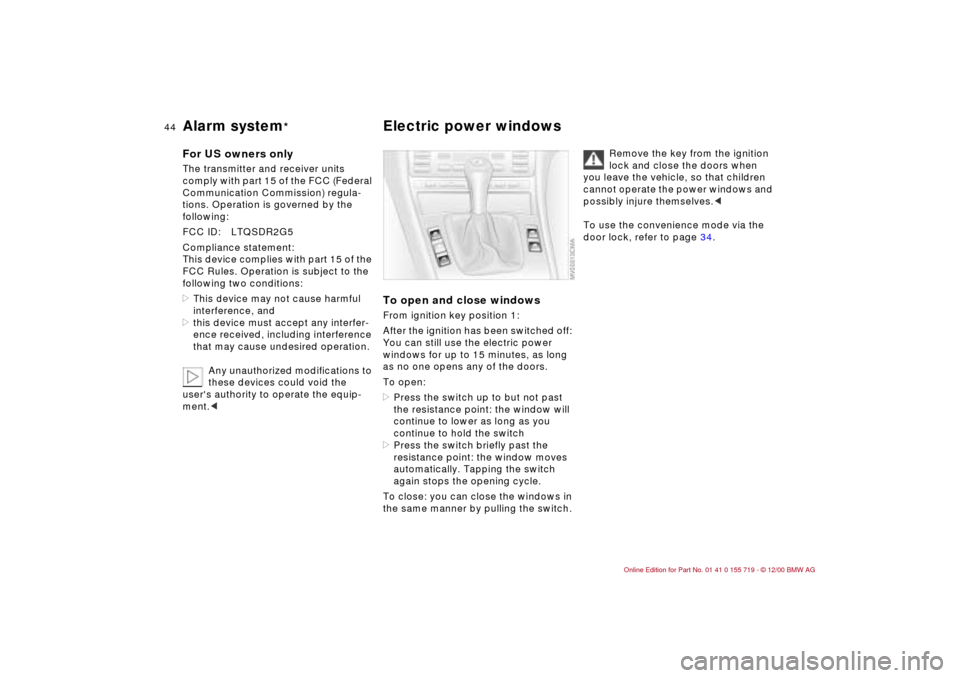
To open and close windowsFrom ignition key position 1:
After the ignition has been switched off:
You can still use the electric power
windows for up to 15 minutes, as long
as no one opens any of the doors.
To open:
>Press the switch up to but not past
the resistance point: the window will
continue to lower as long as you
continue to hold the switch
>Press the switch briefly past the
resistance point: the window moves
automatically. Tapping the switch
again stops the opening cycle.
To close: you can close the windows in
the same manner by pulling the switch.
Remove the key from the ignition
lock and close the doors when
you leave the vehicle, so that children
cannot operate the power windows and
possibly injure themselves.<
To use the convenience mode via the
door lock, refer to page 34.
Page 45 of 195
45n
IndexDataTechnologyRepairsCar careControlsOverview
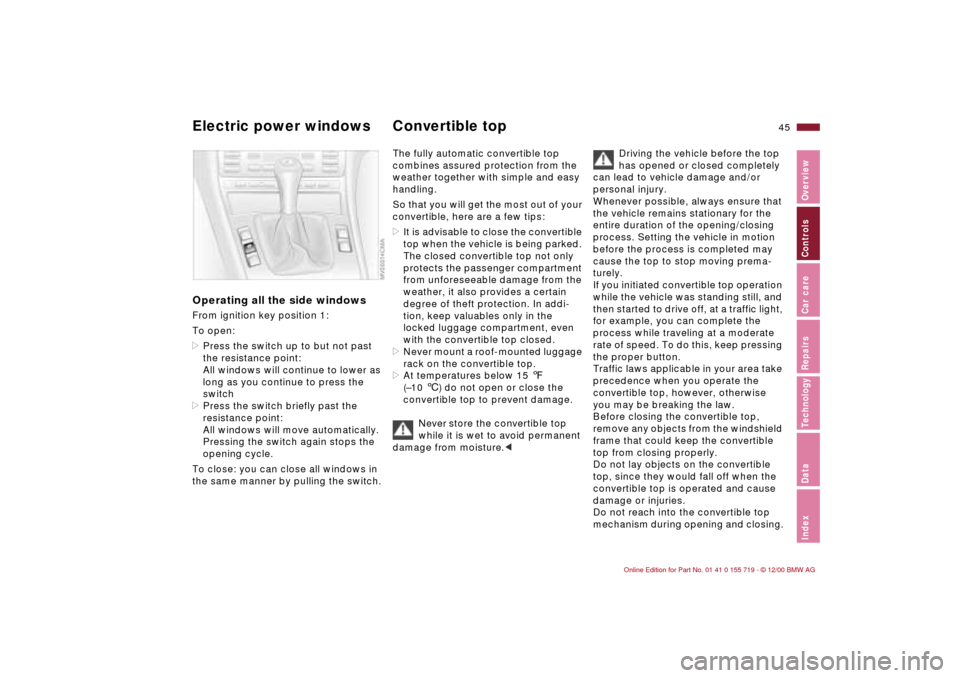
Electric power windows Convertible top Operating all the side windowsFrom ignition key position 1:
To open:
>Press the switch up to but not past
the resistance point:
All windows will continue to lower as
long as you continue to press the
switch
>Press the switch briefly past the
resistance point:
All windows will move automatically.
Pressing the switch again stops the
opening cycle.
To close: you can close all windows in
the same manner by pulling the switch.
The fully automatic convertible top
combines assured protection from the
weather together with simple and easy
handling.
So that you will get the most out of your
convertible, here are a few tips:
>It is advisable to close the convertible
top when the vehicle is being parked.
The closed convertible top not only
protects the passenger compartment
from unforeseeable damage from the
weather, it also provides a certain
degree of theft protection. In addi-
tion, keep valuables only in the
locked luggage compartment, even
with the convertible top closed.
>Never mount a roof-mounted luggage
rack on the convertible top.
>At temperatures below 15 7
(–10 6) do not open or close the
convertible top to prevent damage.
Never store the convertible top
while it is wet to avoid permanent
damage from moisture.<
Driving the vehicle before the top
has opened or closed completely
can lead to vehicle damage and/or
personal injury.
Whenever possible, always ensure that
the vehicle remains stationary for the
entire duration of the opening/closing
process. Setting the vehicle in motion
before the process is completed may
cause the top to stop moving prema-
turely.
If you initiated convertible top operation
while the vehicle was standing still, and
then started to drive off, at a traffic light,
for example, you can complete the
process while traveling at a moderate
rate of speed. To do this, keep pressing
the proper button.
Traffic laws applicable in your area take
precedence when you operate the
convertible top, however, otherwise
you may be breaking the law.
Before closing the convertible top,
remove any objects from the windshield
frame that could keep the convertible
top from closing properly.
Do not lay objects on the convertible
top, since they would fall off when the
convertible top is operated and cause
damage or injuries.
Do not reach into the convertible top
mechanism during opening and closing.
Page 46 of 195
46n
Convertible topKeep children away from the travel path
of the convertible top while it is in
motion.<
To close the electric power
windows while driving, always be
sure to first close either the rear
windows, or all 4 windows at the same
time, otherwise, at high speed, the
windows may not close tightly.<
At higher speeds, the ensuing
vacuum in the passenger
compartment can cause the convertible
top to begin fluttering. Increase the air
supply via the ventilation controls so
that a vacuum does not occur in the
vehicle.<
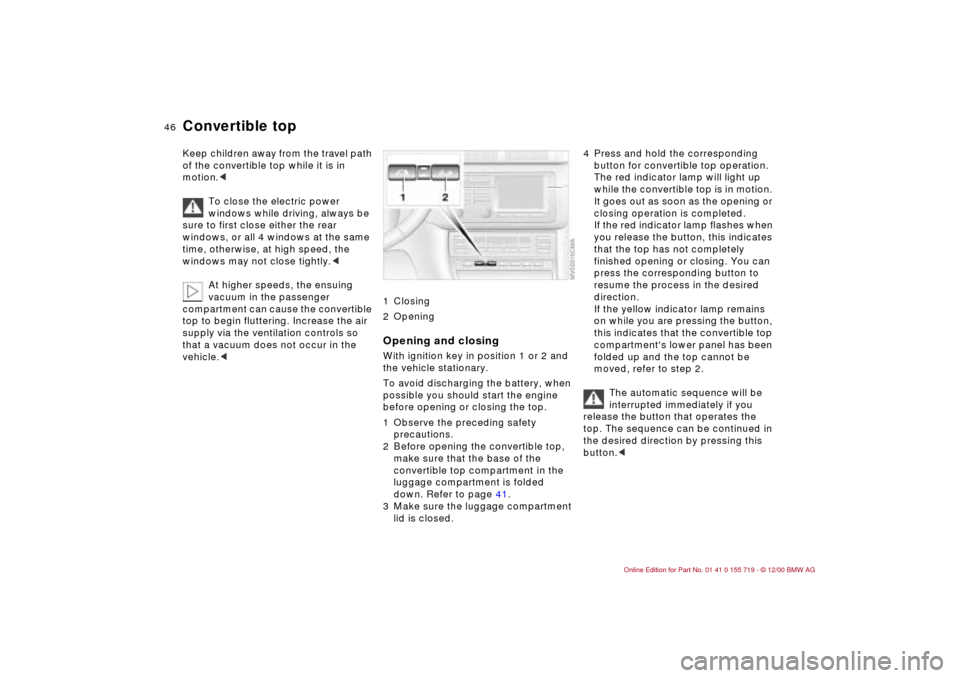
1 Closing
2 OpeningOpening and closingWith ignition key in position 1 or 2 and
the vehicle stationary.
To avoid discharging the battery, when
possible you should start the engine
before opening or closing the top.
1 Observe the preceding safety
precautions.
2 Before opening the convertible top,
make sure that the base of the
convertible top compartment in the
luggage compartment is folded
down. Refer to page 41.
3 Make sure the luggage compartment
lid is closed.
4 Press and hold the corresponding
button for convertible top operation.
The red indicator lamp will light up
while the convertible top is in motion.
It goes out as soon as the opening or
closing operation is completed.
If the red indicator lamp flashes when
you release the button, this indicates
that the top has not completely
finished opening or closing. You can
press the corresponding button to
resume the process in the desired
direction.
If the yellow indicator lamp remains
on while you are pressing the button,
this indicates that the convertible top
compartment's lower panel has been
folded up and the top cannot be
moved, refer to step 2.
The automatic sequence will be
interrupted immediately if you
release the button that operates the
top. The sequence can be continued in
the desired direction by pressing this
button.<