seats BMW M3 CONVERTIBLE 2001 E46 Owner's Manual
[x] Cancel search | Manufacturer: BMW, Model Year: 2001, Model line: M3 CONVERTIBLE, Model: BMW M3 CONVERTIBLE 2001 E46Pages: 195, PDF Size: 1.96 MB
Page 10 of 195

Contents
Overview
Controls and features
Cockpit16
Instrument cluster18
Indicator and warning lamps20
Multifunction steering wheel
(MFL)24
Hazard warning flashers25
Warning triangle25
Refueling26
Fuel specifications27
Tire inflation pressures27
Opening and closing:
Keys32
Electronic vehicle
immobilizer33
Central locking system33
Opening and closing – via the
door lock34
Opening and closing – via the
remote control35
Opening and closing – from
inside38
Luggage compartment lid39
Luggage compartment40
Alarm system42
Electric power windows44
Convertible top45
Adjustments:
Seats48
Mirrors52
Seat and mirror memory54
Steering wheel55
Car Memory, Key Memory55
Passenger safety systems:
Safety belts57
Transporting children safely58
Airbags61
Rollover protection system64
Driving:
Steering/Ignition lock66
Starting the engine66
Switching off the engine67
Parking brake67
Manual transmission68
Turn signal indicator/Headlamp
flasher69
Washer/Wiper system69
Rear window defroster71
Cruise control71
Everything under control:
Odometer73
Tachometer73
Engine oil temperature gauge73
Fuel gauge74
Coolant temperature gauge74
Service Interval Display75
Check Control76
Clock76
Computer77
Technology for safety and
convenience:
Park Distance Control (PDC)79
Dynamic Stability Control
(DSC)80
Tire Pressure Warning (RDW)81
M Engine dynamics control83
Contents
Page 11 of 195

11n
Controls and features
Operation, care and maintenance
Lamps:
Side lamps/Low beam
headlamps84
Instrument lighting84
High beams/Parking lamps85
Fog lamps85
Interior lamps86
Reading lamps86
Controlling the climate
for pleasant driving:
Automatic climate control88
Heated seats93
Interior conveniences:
Glove compartment94
Storage compartments95
Cellular phone96
Ashtray, front96
Cigarette lighter97
Ashtray, rear97
Loading and transporting:
Ski bag98
Cargo loading100
Roof-mounted luggage rack for
the hardtop101
Special operating instructions:
Break-in procedures104
Driving notes105
Catalytic converter105
Antilock Brake System
(ABS)106
Disc brakes108
Brake system109
Winter operation110
Power steering112
Cellular phone112
Radio reception112
Hardtop113
Wheels and tires:
Tire inflation pressures115
Tire condition115
Tire replacement116
Tire rotation117
Wheel and tire
combinations118
Special features of winter
tires119
Snow chains119
Approved wheel and tire
specifications120
Under the hood:
Hood121
Engine compartment124
Washer fluids126
Washer nozzles126
Engine oil127
Coolant129
Brake fluid130
Vehicle Identification130
Care and maintenance:
The BMW Maintenance
System131
Caring for your vehicle132
Cleaning and caring for the
convertible top137
Airbags139
Storing your vehicle140
Laws and regulations:
Technical modifications141
California Proposition 65
Warning141
OBD connector142
Page 30 of 195
30n
Locks and security systems:
Keys32
Electronic vehicle
immobilizer33
Central locking system33
Opening and closing – via the
door lock34
Opening and closing – via the
remote control35
Opening and closing – from
inside38
Luggage compartment lid39
Luggage compartment40
Alarm system42
Electric power windows44
Convertible top45
Adjustments:
Seats48
Mirrors52
Seat and mirror memory54
Steering wheel55
Car Memory, Key Memory55
Passenger safety systems:
Safety belts57
Transporting children safely58
Airbags61
Rollover protection system64
Controls
Page 31 of 195
Overview
Controls and features
Operation, care
and maintenance
Owner service procedures
Technical data
Index Advanced technology
31n
IndexDataTechnologyRepairsCar careControlsOverview
Driving:
Steering/Ignition lock66
Starting the engine66
Switching off the engine67
Parking brake67
Manual transmission68
Turn signal indicator/Headlamp
flasher69
Washer/Wiper system69
Rear window defroster71
Cruise control71
Everything under control:
Odometer73
Tachometer73
Engine oil temperature gauge73
Fuel gauge74
Coolant temperature gauge74
Service Interval Display75
Check Control76
Clock76
Computer77
Technology for driving comfort
and safety:
Park Distance Control (PDC)79
Dynamic Stability Control
(DSC)80
Tire Pressure Warning (RDW)81
M Engine dynamics control83Lamps:
Side lamps/Low beam
headlamps84
Instrument lighting84
High beams/Parking lamps85
Fog lamps85
Interior lamps86
Reading lamps86
Controlling the climate
for pleasant driving:
Automatic climate control88
Heated seats93
Cabin convenience:
Glove compartment94
Storage compartments95
Cellular phone96
Ashtray, front96
Cigarette lighter97
Ashtray, rear97
Loading and transporting
cargo:
Ski bag98
Cargo loading100
Roof-mounted luggage rack for
the hardtop101
Page 58 of 195
58n
Safety belts Transporting children safelywhere it will not exert pressure against
the abdominal area.
Leave the rear safety belts in the
holders, if they are not needed, to avoid
unwanted movement from the safety
belts at high speeds.< Safety belt height adjustmentThe front safety belts automatically
adjust to your height based on the
height adjustment of the head
restraints, refer to page 51.
If the safety belt system has been
subjected to the stresses involved
in an accident or otherwise damaged:
have the entire safety belt mechanism
replaced by your BMW center, includ-
ing the safety belt tensioner. In addi-
tion, have your BMW center inspect the
safety belt anchors. If a child restraint
system was in the vehicle during an
accident, consult the manufacturer's
instructions regarding replacement.<
Child restraint systems
*
Never install a rearward-facing
child restraint device in the front
passenger's seat. If the airbag is trig-
gered, any child in a rear-facing
restraint located within the airbag's
deployment range could sustain serious
injuries.
Children should always travel in the rear
seats, where they should be secured in
a suitable child restraint device
attached to the safety belts in the
outboard positions.
Do not use the center belts to secure a
child restraint unless the two outboard
positions are already occupied, and a
third safety seat is needed.
Never attempt to modify or change a
child restraint device in any way, as
tampering could reduce the protection
it provides in an accident.<
Commercially available child seats
complying with the legal standard are
designed to be secured with a lap belt
or with the lap belt portion of a combi-
nation lap/shoulder belt. Improperly or
inadequately installed restraint systems
can increase the risk of injury to chil-
dren. Always read and follow the
instructions that come with the system.
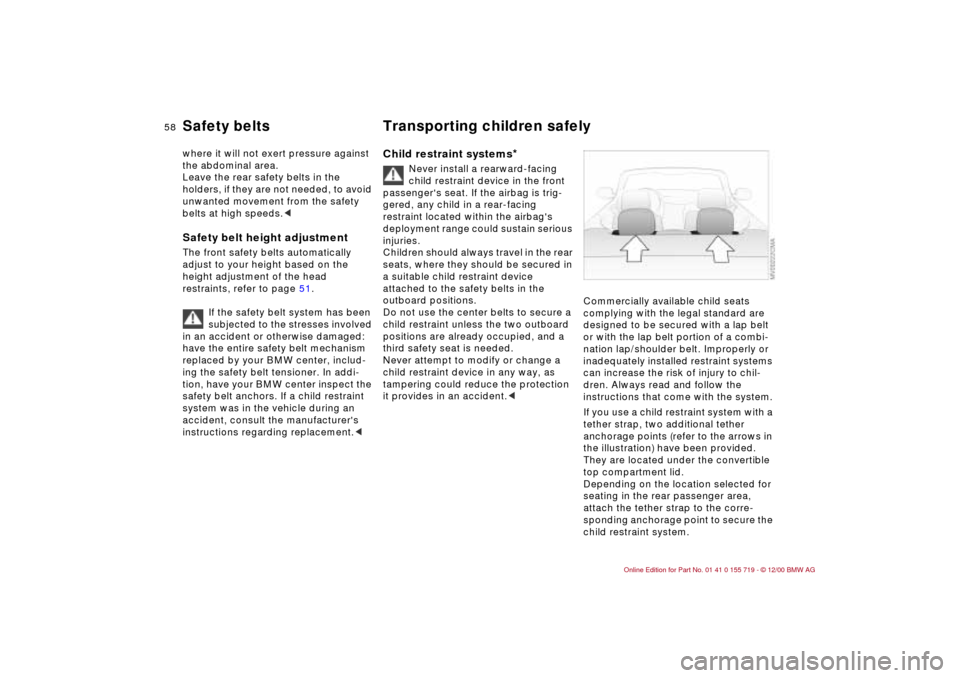
If you use a child restraint system with a
tether strap, two additional tether
anchorage points (refer to the arrows in
the illustration) have been provided.
They are located under the convertible
top compartment lid.
Depending on the location selected for
seating in the rear passenger area,
attach the tether strap to the corre-
sponding anchorage point to secure the
child restraint system.
Page 93 of 195
93n
IndexDataTechnologyRepairsCar careControlsOverview
Heated seats
*
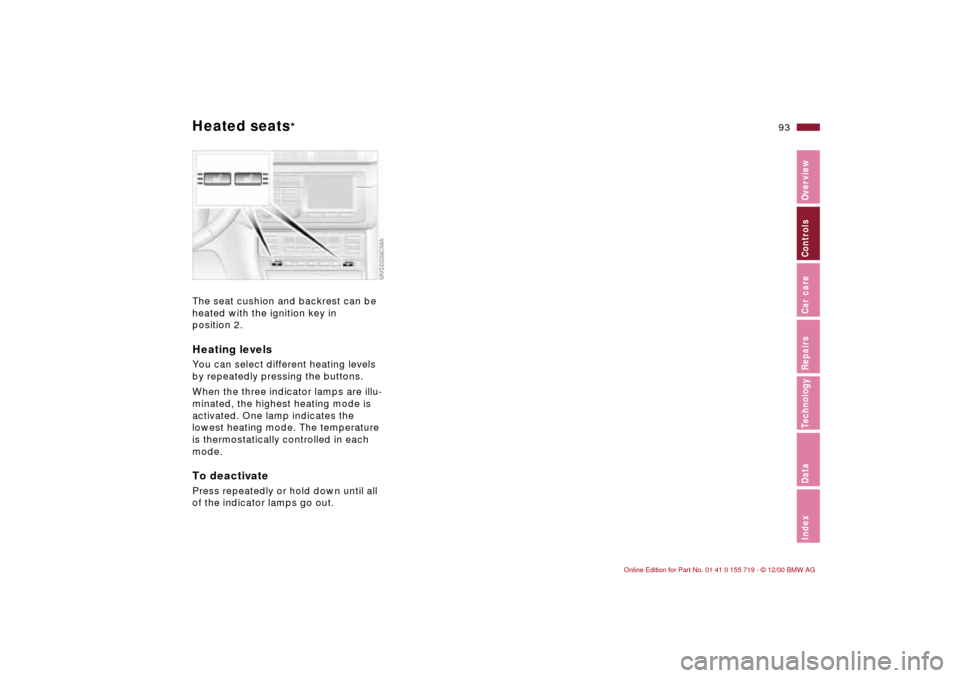
The seat cushion and backrest can be
heated with the ignition key in
position 2.Heating levelsYou can select different heating levels
by repeatedly pressing the buttons.
When the three indicator lamps are illu-
minated, the highest heating mode is
activated. One lamp indicates the
lowest heating mode. The temperature
is thermostatically controlled in each
mode.To deactivatePress repeatedly or hold down until all
of the indicator lamps go out.
Page 98 of 195
98n
Ski bag
*
The ski bag allows the safe and clean
transport of up to 3 pairs of standard
skis or up to two snowboards.
The length of the ski bag and the addi-
tional space provided in the luggage
compartment make it possible to carry
skis with a length of up to 6.8 feet
(2.1 0 meters). Because of the tapered
shape of the bag, the ski bag can only
accommodate two pairs of skis with a
length of 6.8 feet (2.1 0 meters).
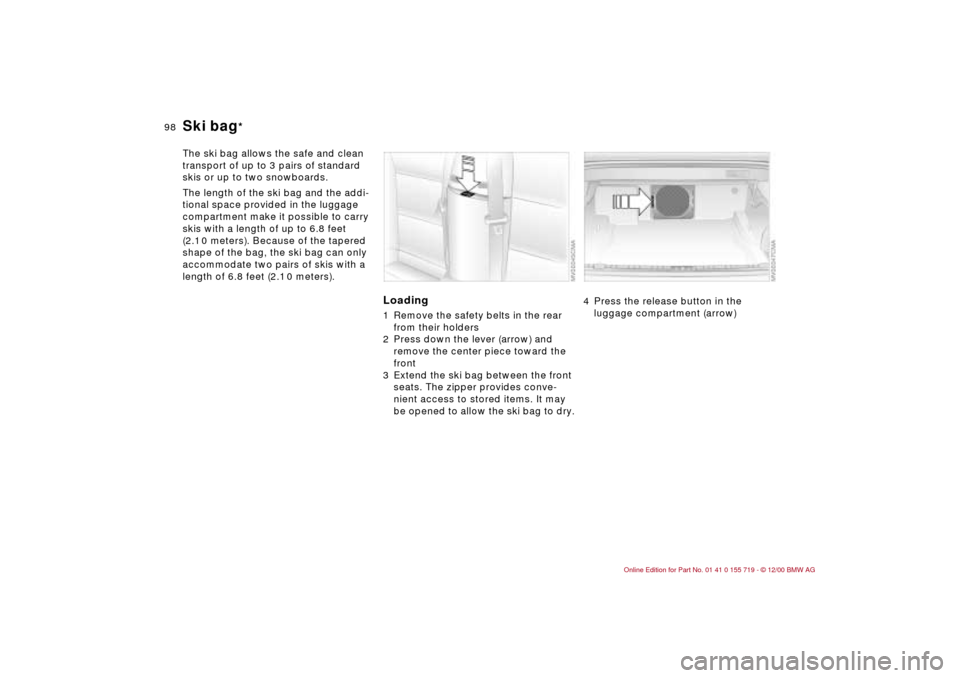
Loading1 Remove the safety belts in the rear
from their holders
2 Press down the lever (arrow) and
remove the center piece toward the
front
3 Extend the ski bag between the front
seats. The zipper provides conve-
nient access to stored items. It may
be opened to allow the ski bag to dry.
4 Press the release button in the
luggage compartment (arrow)
Page 135 of 195
135n
IndexDataTechnologyRepairsCar careControlsOverview
Caring for your vehiclean accumulation of road salt. Use a
chrome polish for an additional treat-
ment.
Plastic components, vinyl upholstery,
headliners, lamp lenses, the clear cover
of the instrument cluster and compon-
ents with a sprayed matt black surface
can be cleaned with water (add plastic
shampoo as required). Do not allow
moisture to soak through the seats or
headliner. Never use solvents such as
lacquer thinner, heavy-duty grease
remover, fuels, or similar substances.
Rubber components should be cleaned
with water only; a rubber treatment or
silicone spray may also be applied. Do not remove safety belts to clean
them. Clean them with mild soapy
water only. Do not use chemicals or dry
cleaners to clean safety belts, since this
could damage the belt fabric.
After cleaning, never allow the inertia
reel to retract the belts until they are
completely dry. Dirty safety belts
prevent the inertia reel mechanism from
retracting the strap properly, and thus
constitute a safety hazard.
Heavily soiled floor carpets and mats
*
can be cleaned with an interior cleaner.
The floor mats can be removed from
the vehicle for cleaning.
Use only a damp cloth to clean trim
panels made of real wood
* and other
parts constructed of real wood
*. Follow
up by drying with a soft cloth.
Use the cleaning and car-care
products available at your BMW
center.<
Care of upholstery materials Depressions in the upholstery that
result from everyday use can be
brushed smooth by brushing against
the nap with a lightly dampened brush.
The tendency of the pile to lie in a
particular direction on velour upholstery
is not a quality defect, and, just as on
home textiles or clothing, cannot be
avoided.
Lint on upholstery materials, textile or
leather remnants that have been worn
into the upholstery may be removed
with a lint brush or a Velcro brush. A
cleaning glove is available for particu-
larly "stubborn" lint. Stains and fairly
large areas of dirt should be cleaned off
without delay, using lukewarm water
and an interior cleaner, stain remover or
appropriate cleaning fluid. Brush the
fabric afterwards to restore its appear-
ance.
If the vehicle will be stored for an
extended period or if it is exposed to
intense sunlight, cover all the seats or
the windows to prevent fading.
Use the cleaning and car-care
products available at your BMW
center.<
Page 162 of 195
162n
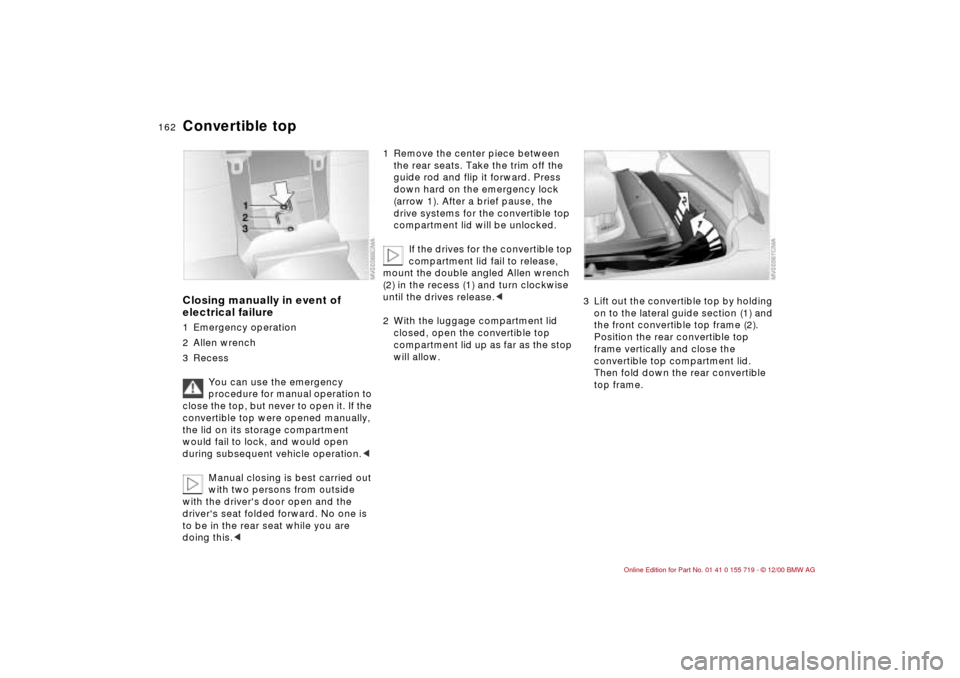
Convertible top Closing manually in event of
electrical failure1 Emergency operation
2 Allen wrench
3 Recess
You can use the emergency
procedure for manual operation to
close the top, but never to open it. If the
convertible top were opened manually,
the lid on its storage compartment
would fail to lock, and would open
during subsequent vehicle operation.<
Manual closing is best carried out
with two persons from outside
with the driver's door open and the
driver's seat folded forward. No one is
to be in the rear seat while you are
doing this.<
1 Remove the center piece between
the rear seats. Take the trim off the
guide rod and flip it forward. Press
down hard on the emergency lock
(arrow 1). After a brief pause, the
drive systems for the convertible top
compartment lid will be unlocked.
If the drives for the convertible top
compartment lid fail to release,
mount the double angled Allen wrench
(2) in the recess (1) and turn clockwise
until the drives release.c
2 With the luggage compartment lid
closed, open the convertible top
compartment lid up as far as the stop
will allow.
3 Lift out the convertible top by holding
on to the lateral guide section (1) and
the front convertible top frame (2).
Position the rear convertible top
frame vertically and close the
convertible top compartment lid.
Then fold down the rear convertible
top frame.
Page 170 of 195
170n
Dynamic Stability Control (DSC) Safety belt tensioner
Highly sensitive sensors monitor the
number of revolutions of the wheels,
steering angle, lateral acceleration,
brake pressure and the movement of
the vehicle around its vertical axis.
If differences in wheel speed should
occur, the system will recognize the
potential dangers associated with
wheel spin and will reduce the drive
torque; if necessary, it will do so using
brake intervention at the rear wheels as
well.
When instable vehicle operating condi-
tions are detected, the application of
the brakes with DSC can also act on the
front wheels to stabilize the vehicle.
You may need some time to become
accustomed to this system's interven-
tion. However, it provides optimum
drive force and vehicle stability.
The braking intervention may be
accompanied by a certain degree of
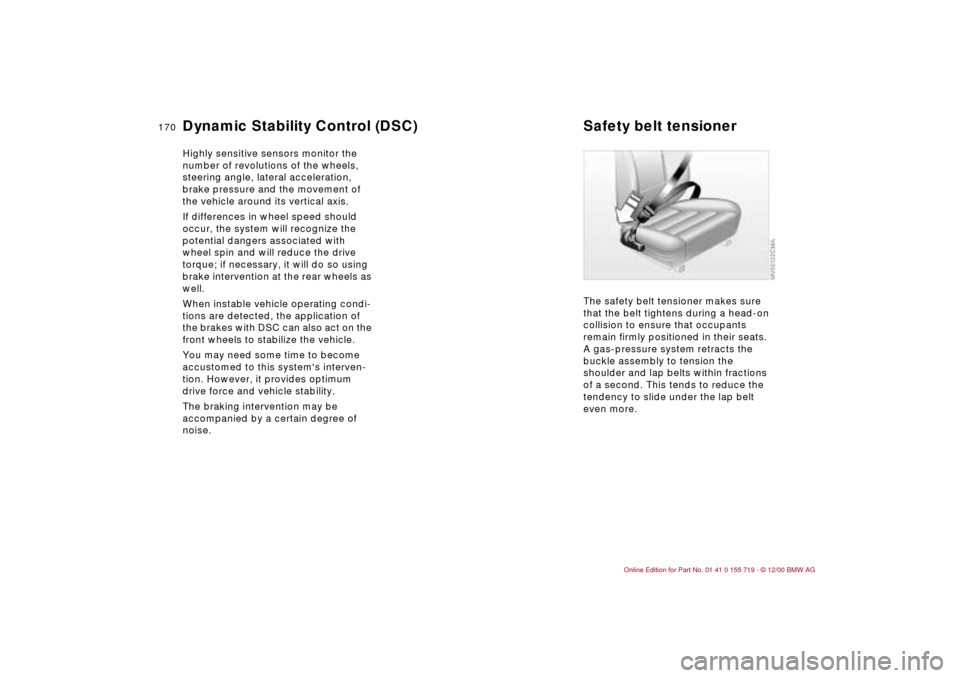
noise.The safety belt tensioner makes sure
that the belt tightens during a head-on
collision to ensure that occupants
remain firmly positioned in their seats.
A gas-pressure system retracts the
buckle assembly to tension the
shoulder and lap belts within fractions
of a second. This tends to reduce the
tendency to slide under the lap belt
even more.