ECU BMW M3 CONVERTIBLE 2002 E46 User Guide
[x] Cancel search | Manufacturer: BMW, Model Year: 2002, Model line: M3 CONVERTIBLE, Model: BMW M3 CONVERTIBLE 2002 E46Pages: 159, PDF Size: 2.19 MB
Page 65 of 159
65n
OverviewControlsMaintenanceRepairsDataIndex
Sequential M gearbox
* SMG II
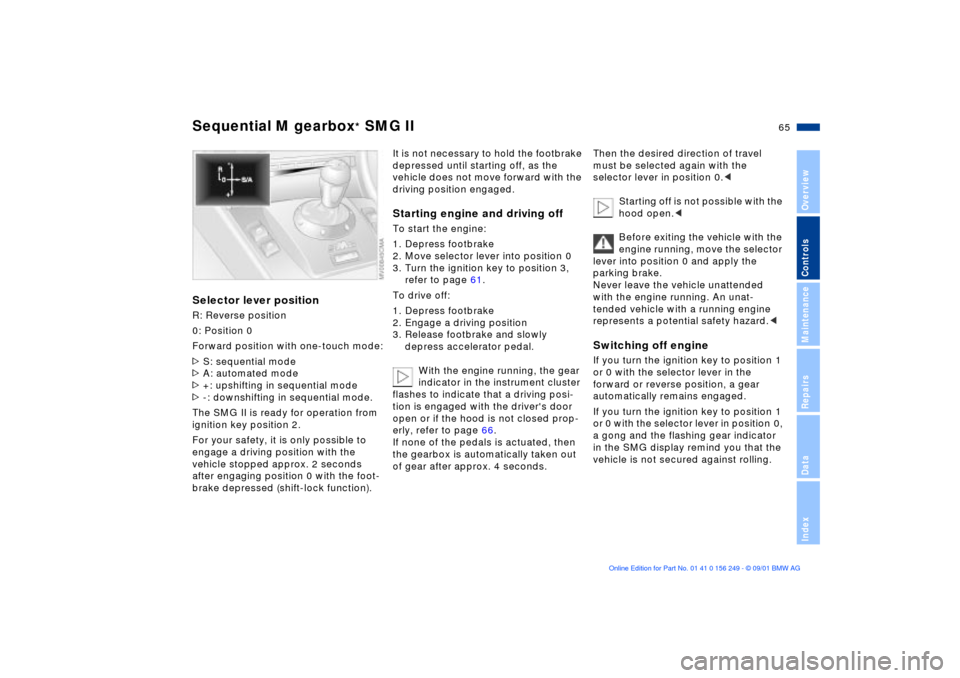
Selector lever positionR: Reverse position
0: Position 0
Forward position with one-touch mode:
>S: sequential mode
>A: automated mode
>+: upshifting in sequential mode
>-: downshifting in sequential mode.
The SMG II is ready for operation from
ignition key position 2.
For your safety, it is only possible to
engage a driving position with the
vehicle stopped approx. 2 seconds
after engaging position 0 with the foot-
brake depressed (shift-lock function).
It is not necessary to hold the footbrake
depressed until starting off, as the
vehicle does not move forward with the
driving position engaged.Starting engine and driving offTo start the engine:
1. Depress footbrake
2. Move selector lever into position 0
3. Turn the ignition key to position 3,
refer to page 61.
To drive off:
1. Depress footbrake
2. Engage a driving position
3. Release footbrake and slowly
depress accelerator pedal.
With the engine running, the gear
indicator in the instrument cluster
flashes to indicate that a driving posi-
tion is engaged with the driver's door
open or if the hood is not closed prop-
erly, refer to page 66.
If none of the pedals is actuated, then
the gearbox is automatically taken out
of gear after approx. 4 seconds.
Then the desired direction of travel
must be selected again with the
selector lever in position 0.<
Starting off is not possible with the
hood open.<
Before exiting the vehicle with the
engine running, move the selector
lever into position 0 and apply the
parking brake.
Never leave the vehicle unattended
with the engine running. An unat-
tended vehicle with a running engine
represents a potential safety hazard.
forward or reverse position, a gear
automatically remains engaged.
If you turn the ignition key to position 1
or 0 with the selector lever in position 0,
a gong and the flashing gear indicator
in the SMG display remind you that the
vehicle is not secured against rolling.
Page 66 of 159
66n
Sequential M gearbox
* SMG II
The warning stops after approx. 10
seconds. If you move the selector lever
into a forward or reverse position
during this time, a gear is automatically
engaged.
The SMG II has no park position
for securing the vehicle against
rolling.
The ignition key can be removed in any
selector lever position.<
Always engage the parking brake
when parking on downhill roads.
Engaging a gear may not sufficiently
secure the vehicle against rolling.<
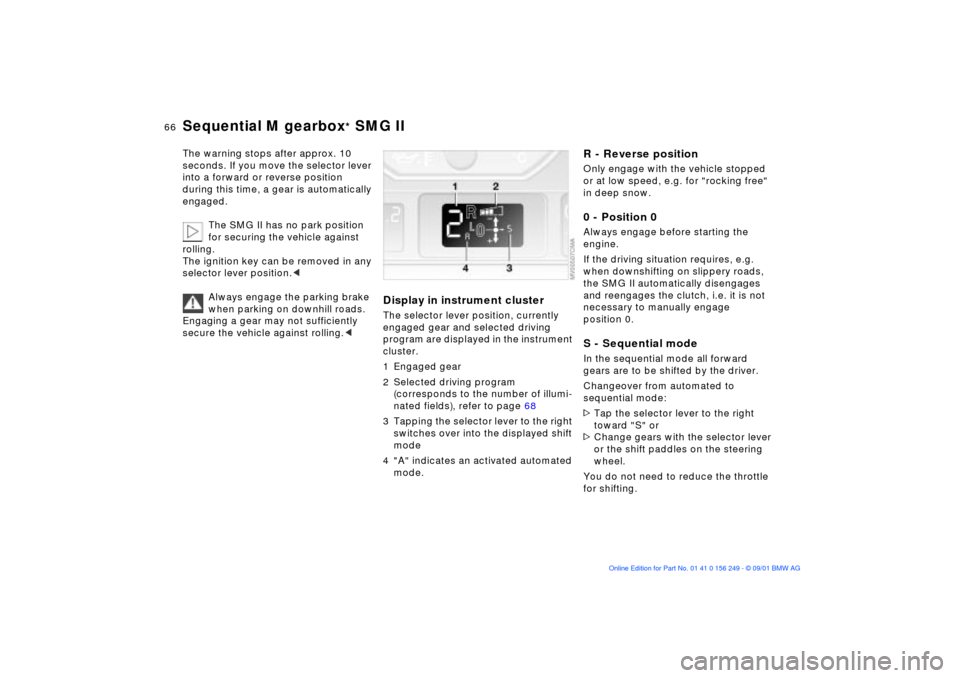
Display in instrument clusterThe selector lever position, currently
engaged gear and selected driving
program are displayed in the instrument
cluster.
1 Engaged gear
2 Selected driving program
(corresponds to the number of illumi-
nated fields), refer to page 68
3 Tapping the selector lever to the right
switches over into the displayed shift
mode
4 "A" indicates an activated automated
mode.
R - Reverse positionOnly engage with the vehicle stopped
or at low speed, e.g. for "rocking free"
in deep snow.0 - Position 0Always engage before starting the
engine.
If the driving situation requires, e.g.
when downshifting on slippery roads,
the SMG II automatically disengages
and reengages the clutch, i.e. it is not
necessary to manually engage
position 0. S - Sequential modeIn the sequential mode all forward
gears are to be shifted by the driver.
Changeover from automated to
sequential mode:
>Tap the selector lever to the right
toward "S" or
>Change gears with the selector lever
or the shift paddles on the steering
wheel.
You do not need to reduce the throttle
for shifting.
Page 67 of 159
67n
OverviewControlsMaintenanceRepairsDataIndex
Sequential M gearbox
* SMG II
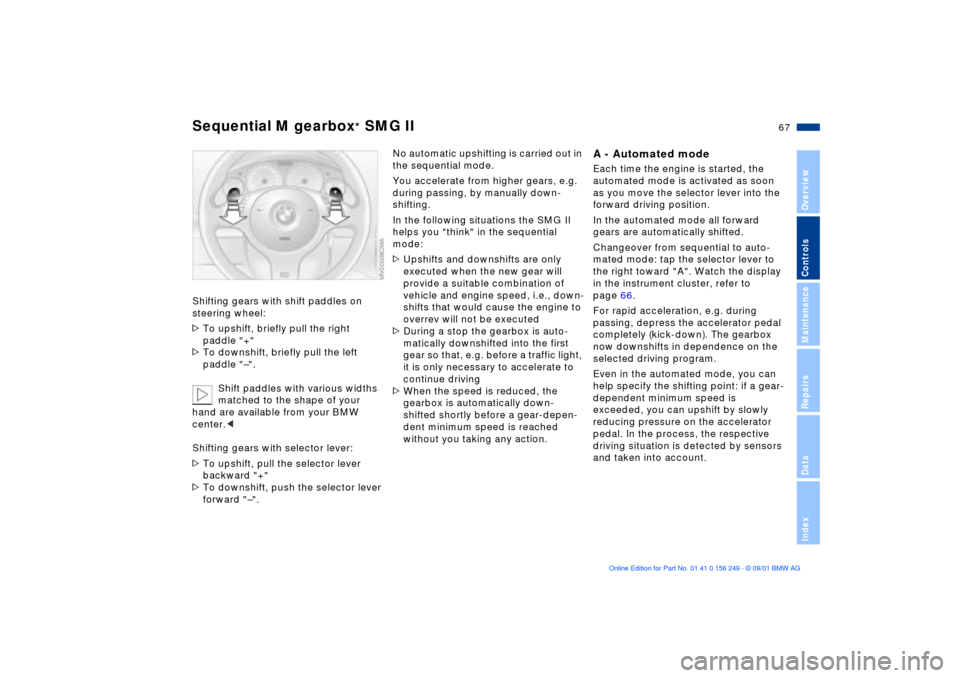
Shifting gears with shift paddles on
steering wheel:
>To upshift, briefly pull the right
paddle "+"
>To downshift, briefly pull the left
paddle "Ð".
Shift paddles with various widths
matched to the shape of your
hand are available from your BMW
center.<
Shifting gears with selector lever:
>To upshift, pull the selector lever
backward "+"
>To downshift, push the selector lever
forward "Ð".
No automatic upshifting is carried out in
the sequential mode.
You accelerate from higher gears, e.g.
during passing, by manually down-
shifting.
In the following situations the SMG II
helps you "think" in the sequential
mode:
>Upshifts and downshifts are only
executed when the new gear will
provide a suitable combination of
vehicle and engine speed, i.e., down-
shifts that would cause the engine to
overrev will not be executed
>During a stop the gearbox is auto-
matically downshifted into the first
gear so that, e.g. before a traffic light,
it is only necessary to accelerate to
continue driving
>When the speed is reduced, the
gearbox is automatically down-
shifted shortly before a gear-depen-
dent minimum speed is reached
without you taking any action.
A - Automated modeEach time the engine is started, the
automated mode is activated as soon
as you move the selector lever into the
forward driving position.
In the automated mode all forward
gears are automatically shifted.
Changeover from sequential to auto-
mated mode: tap the selector lever to
the right toward "A". Watch the display
in the instrument cluster, refer to
page 66.
For rapid acceleration, e.g. during
passing, depress the accelerator pedal
completely (kick-down). The gearbox
now downshifts in dependence on the
selected driving program.
Even in the automated mode, you can
help specify the shifting point: if a gear-
dependent minimum speed is
exceeded, you can upshift by slowly
reducing pressure on the accelerator
pedal. In the process, the respective
driving situation is detected by sensors
and taken into account.
Page 69 of 159
69n
OverviewControlsMaintenanceRepairsDataIndex
Sequential M gearbox
* SMG II
The vehicle may roll slightly before
it is held by the gradient assis-
tance after releasing the footbrake.
Two seconds after the footbrake is
released, the vehicle begins to roll, as it
is no longer held with the gradient
assistance.<
The gradient assistance must be reacti-
vated before each use.
Indicator lamp
The transmission indicator lamp
in the instrument cluster goes
out after the engine is started.
>If it does not go out, or if it lights up
during driving, a fault has occurred.
The available functions may be
limited under certain circumstances.
Drive carefully and with the Dynamic
Stability Control (DSC) activated.
Have the system checked by the
nearest BMW center
>If the indicator lamp flashes while
driving, the system is overloaded.
Avoid high loads until the indicator
lamp goes out again permanently.
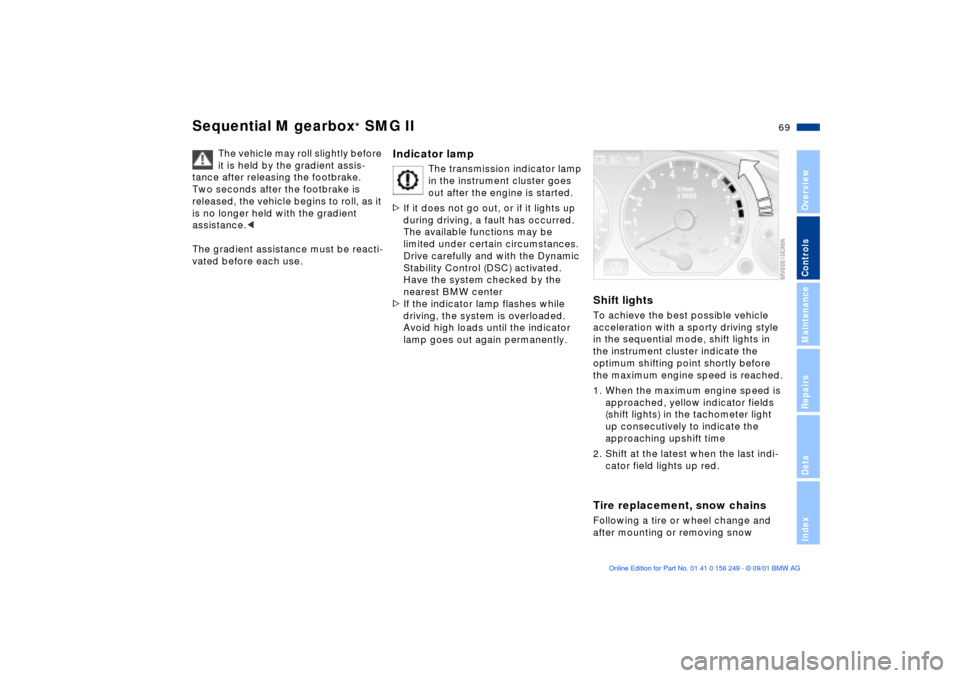
Shift lightsTo achieve the best possible vehicle
acceleration with a sporty driving style
in the sequential mode, shift lights in
the instrument cluster indicate the
optimum shifting point shortly before
the maximum engine speed is reached.
1. When the maximum engine speed is
approached, yellow indicator fields
(shift lights) in the tachometer light
up consecutively to indicate the
approaching upshift time
2. Shift at the latest when the last indi-
cator field lights up red.Tire replacement, snow chainsFollowing a tire or wheel change and
after mounting or removing snow
Page 82 of 159
82n
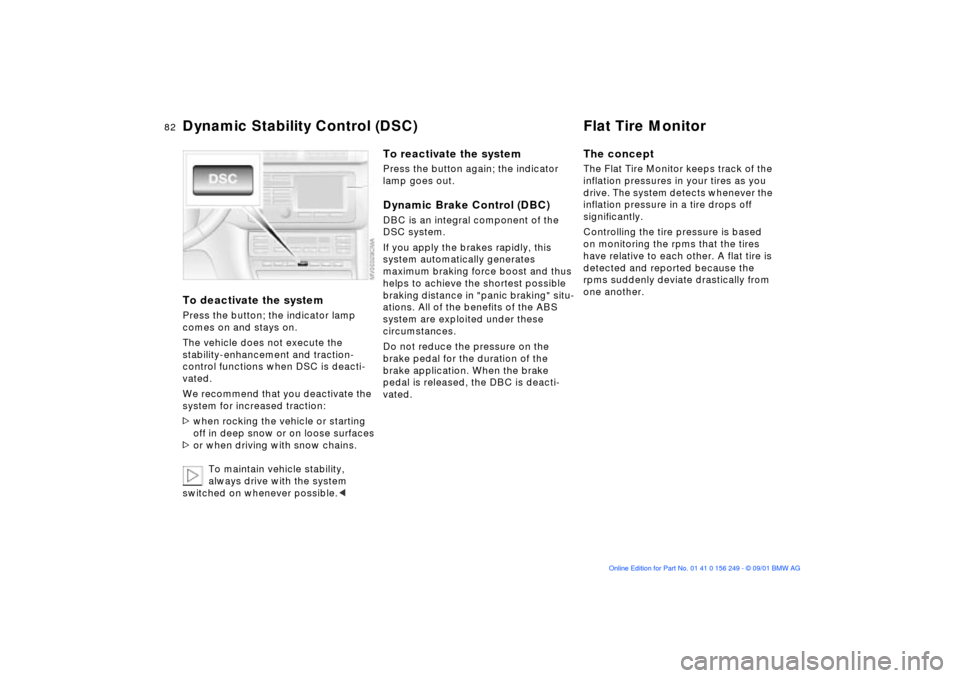
Dynamic Stability Control (DSC) Flat Tire MonitorTo deactivate the systemPress the button; the indicator lamp
comes on and stays on.
The vehicle does not execute the
stability-enhancement and traction-
control functions when DSC is deacti-
vated.
We recommend that you deactivate the
system for increased traction:
>when rocking the vehicle or starting
off in deep snow or on loose surfaces
>or when driving with snow chains.
To maintain vehicle stability,
always drive with the system
switched on whenever possible.<
To reactivate the systemPress the button again; the indicator
lamp goes out.Dynamic Brake Control (DBC)DBC is an integral component of the
DSC system.
If you apply the brakes rapidly, this
system automatically generates
maximum braking force boost and thus
helps to achieve the shortest possible
braking distance in "panic braking" situ-
ations. All of the benefits of the ABS
system are exploited under these
circumstances.
Do not reduce the pressure on the
brake pedal for the duration of the
brake application. When the brake
pedal is released, the DBC is deacti-
vated.
The conceptThe Flat Tire Monitor keeps track of the
inflation pressures in your tires as you
drive. The system detects whenever the
inflation pressure in a tire drops off
significantly.
Controlling the tire pressure is based
on monitoring the rpms that the tires
have relative to each other. A flat tire is
detected and reported because the
rpms suddenly deviate drastically from
one another.
Page 99 of 159
99n
OverviewControlsMaintenanceRepairsDataIndex
Ski bag
*
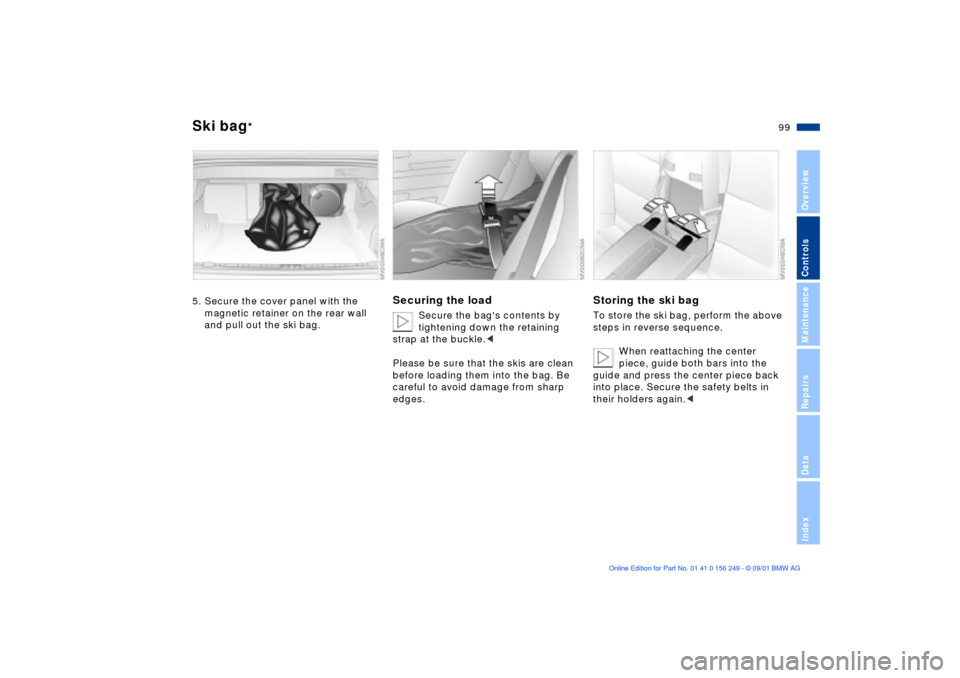
5. Secure the cover panel with the
magnetic retainer on the rear wall
and pull out the ski bag.
Securing the load
Secure the bag's contents by
tightening down the retaining
strap at the buckle.<
Please be sure that the skis are clean
before loading them into the bag. Be
careful to avoid damage from sharp
edges.
Storing the ski bagTo store the ski bag, perform the above
steps in reverse sequence.
When reattaching the center
piece, guide both bars into the
guide and press the center piece back
into place. Secure the safety belts in
their holders again.<
Page 100 of 159
100n
Cargo loading
Always position and secure the
load correctly. If you do not, it can
endanger the passengers during
braking or evasive maneuvers.
Do not exceed the permissible gross
weight and the permissible axle loads
(refer to page 146), otherwise the
vehicle's operating safety is no longer
assured and you are in violation of the
law.
Do not stow heavy or hard objects in
the passenger compartment without
first securing them. Otherwise they
would be thrown around during braking
and evasive maneuvers and endanger
the occupants.<
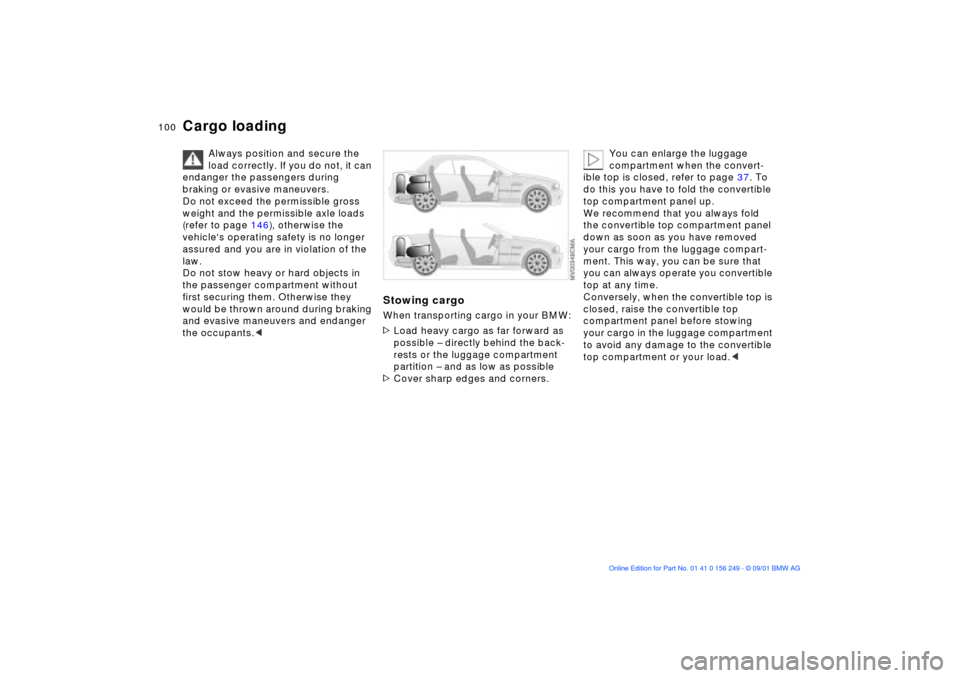
Stowing cargo When transporting cargo in your BMW:
>Load heavy cargo as far forward as
possible Ð directly behind the back-
rests or the luggage compartment
partition Ð and as low as possible
>Cover sharp edges and corners.
You can enlarge the luggage
compartment when the convert-
ible top is closed, refer to page 37. To
do this you have to fold the convertible
top compartment panel up.
We recommend that you always fold
the convertible top compartment panel
down as soon as you have removed
your cargo from the luggage compart-
ment. This way, you can be sure that
you can always operate you convertible
top at any time.
Conversely, when the convertible top is
closed, raise the convertible top
compartment panel before stowing
your cargo in the luggage compartment
to avoid any damage to the convertible
top compartment or your load.<
Page 101 of 159
101n
OverviewControlsMaintenanceRepairsDataIndex
Cargo loading Roof-mounted luggage rack for the hardtop
*
Securing the cargo in the luggage
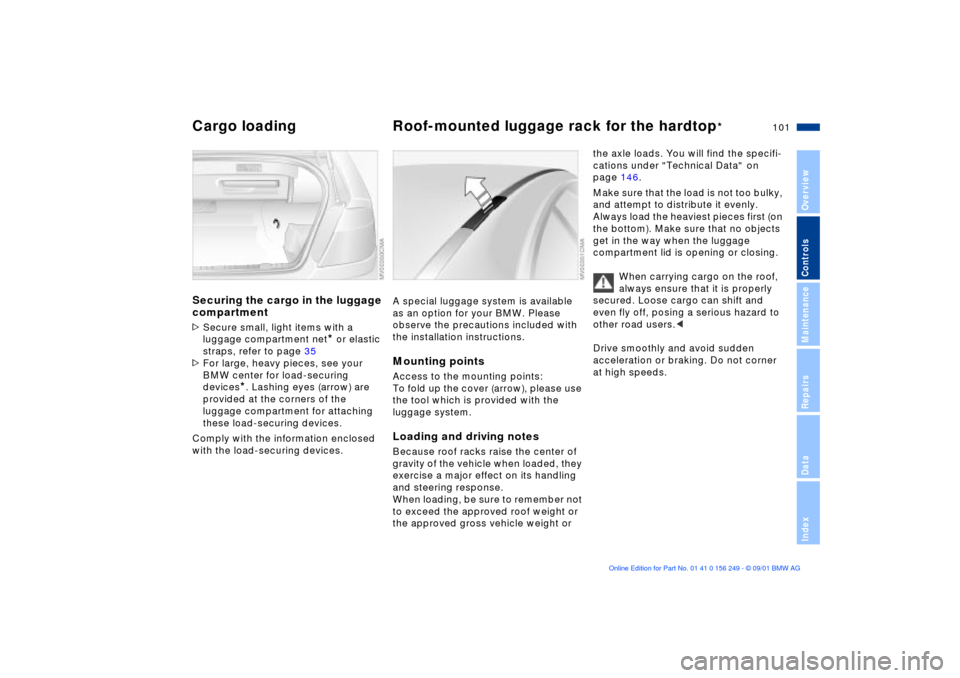
compartment >Secure small, light items with a
luggage compartment net
* or elastic
straps, refer to page 35
>For large, heavy pieces, see your
BMW center for load-securing
devices
*. Lashing eyes (arrow) are
provided at the corners of the
luggage compartment for attaching
these load-securing devices.
Comply with the information enclosed
with the load-securing devices.
A special luggage system is available
as an option for your BMW. Please
observe the precautions included with
the installation instructions.Mounting pointsAccess to the mounting points:
To fold up the cover (arrow), please use
the tool which is provided with the
luggage system.Loading and driving notesBecause roof racks raise the center of
gravity of the vehicle when loaded, they
exercise a major effect on its handling
and steering response.
When loading, be sure to remember not
to exceed the approved roof weight or
the approved gross vehicle weight or
the axle loads. You will find the specifi-
cations under "Technical Data" on
page 146.
Make sure that the load is not too bulky,
and attempt to distribute it evenly.
Always load the heaviest pieces first (on
the bottom). Make sure that no objects
get in the way when the luggage
compartment lid is opening or closing.
When carrying cargo on the roof,
always ensure that it is properly
secured. Loose cargo can shift and
even fly off, posing a serious hazard to
other road users.<
Drive smoothly and avoid sudden
acceleration or braking. Do not corner
at high speeds.
Page 108 of 159
108n
Hardtop
*
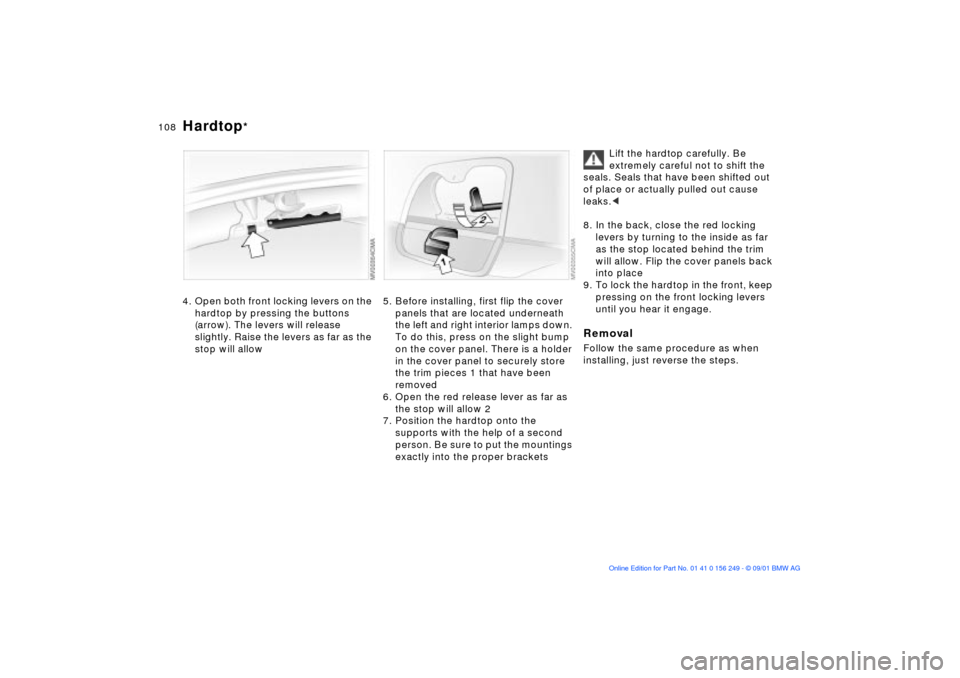
4. Open both front locking levers on the
hardtop by pressing the buttons
(arrow). The levers will release
slightly. Raise the levers as far as the
stop will allow
5. Before installing, first flip the cover
panels that are located underneath
the left and right interior lamps down.
To do this, press on the slight bump
on the cover panel. There is a holder
in the cover panel to securely store
the trim pieces 1 that have been
removed
6. Open the red release lever as far as
the stop will allow 2
7. Position the hardtop onto the
supports with the help of a second
person. Be sure to put the mountings
exactly into the proper brackets
Lift the hardtop carefully. Be
extremely careful not to shift the
seals. Seals that have been shifted out
of place or actually pulled out cause
leaks.<
8. In the back, close the red locking
levers by turning to the inside as far
as the stop located behind the trim
will allow. Flip the cover panels back
into place
9. To lock the hardtop in the front, keep
pressing on the front locking levers
until you hear it engage.
RemovalFollow the same procedure as when
installing, just reverse the steps.
Page 113 of 159
113n
OverviewControlsMaintenanceRepairsDataIndex
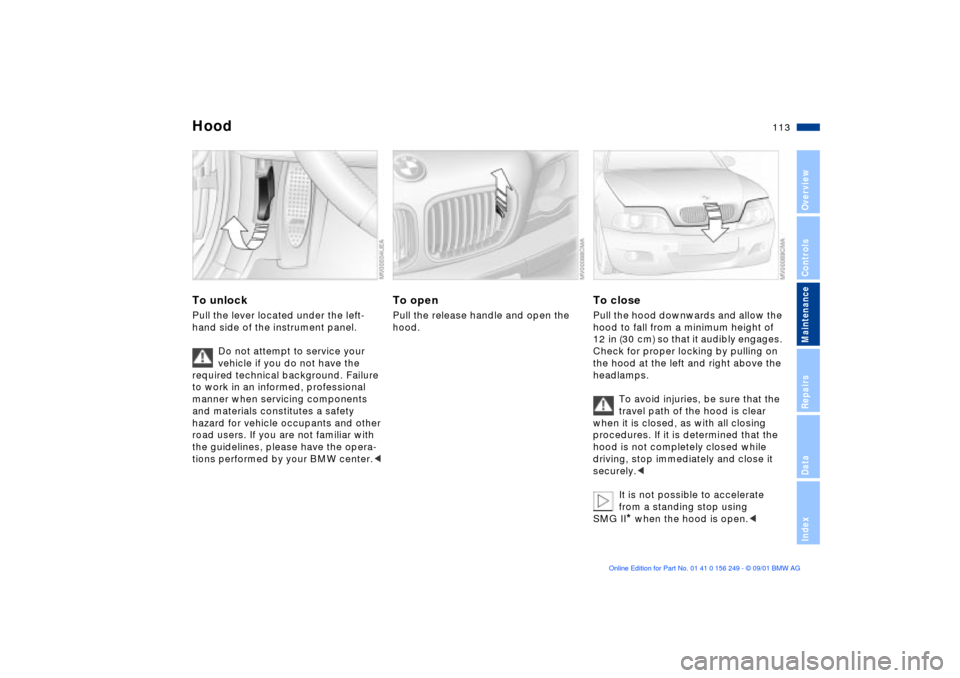
To unlock Pull the lever located under the left-
hand side of the instrument panel.
Do not attempt to service your
vehicle if you do not have the
required technical background. Failure
to work in an informed, professional
manner when servicing components
and materials constitutes a safety
hazard for vehicle occupants and other
road users. If you are not familiar with
the guidelines, please have the opera-
tions performed by your BMW center.<
To openPull the release handle and open the
hood.
To closePull the hood downwards and allow the
hood to fall from a minimum height of
12 in (30 cm) so that it audibly engages.
Check for proper locking by pulling on
the hood at the left and right above the
headlamps.
To avoid injuries, be sure that the
travel path of the hood is clear
when it is closed, as with all closing
procedures. If it is determined that the
hood is not completely closed while
driving, stop immediately and close it
securely.<
It is not possible to accelerate
from a standing stop using
SMG II
* when the hood is open.<
Hood