air condition BMW M3 CONVERTIBLE 2002 E46 User Guide
[x] Cancel search | Manufacturer: BMW, Model Year: 2002, Model line: M3 CONVERTIBLE, Model: BMW M3 CONVERTIBLE 2002 E46Pages: 159, PDF Size: 2.19 MB
Page 91 of 159
91n
OverviewControlsMaintenanceRepairsDataIndex
Automatic climate control
*
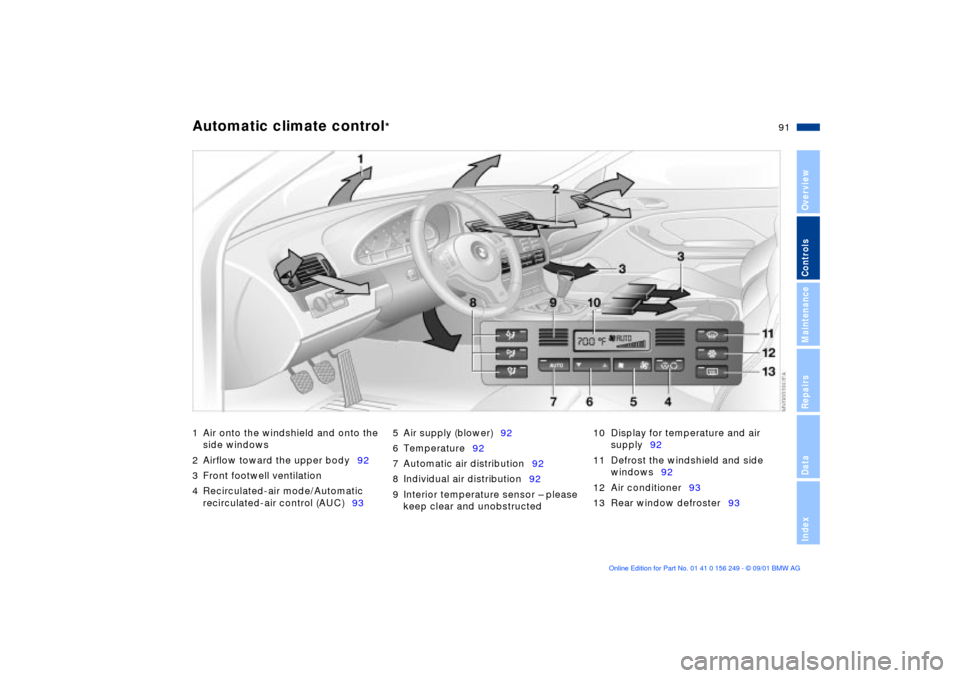
1 Air onto the windshield and onto the
side windows
2 Airflow toward the upper body92
3 Front footwell ventilation
4 Recirculated-air mode/Automatic
recirculated-air control (AUC)935 Air supply (blower)92
6 Temperature92
7 Automatic air distribution92
8 Individual air distribution92
9 Interior temperature sensor Ð please
keep clear and unobstructed10 Display for temperature and air
supply92
11 Defrost the windshield and side
windows92
12 Air conditioner93
13 Rear window defroster93
Page 92 of 159
92n
Automatic climate control
*
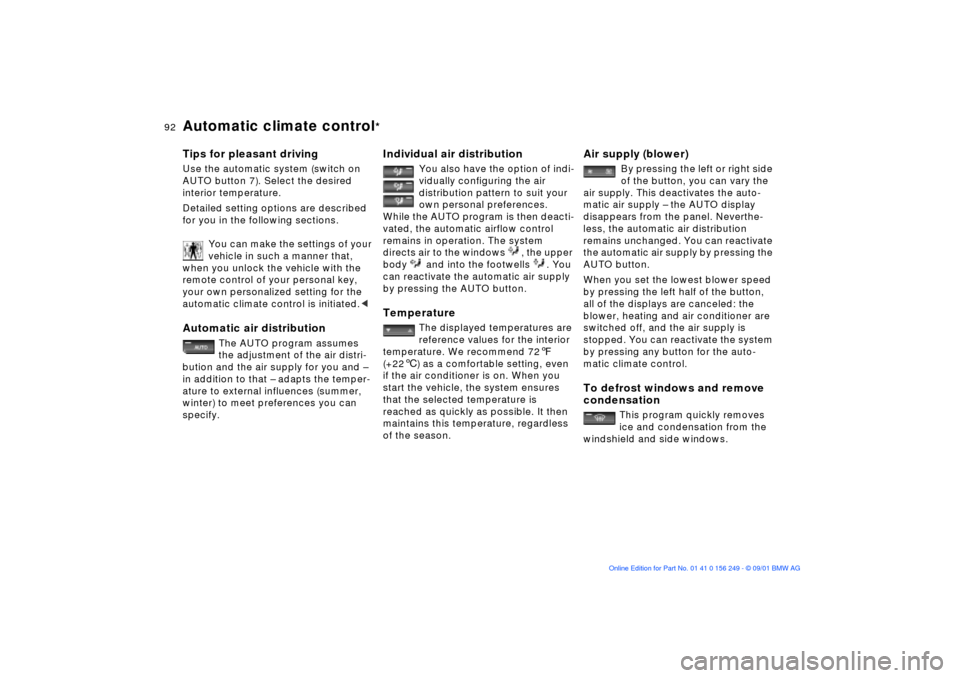
Tips for pleasant drivingUse the automatic system (switch on
AUTO button 7). Select the desired
interior temperature.
Detailed setting options are described
for you in the following sections.
You can make the settings of your
vehicle in such a manner that,
when you unlock the vehicle with the
remote control of your personal key,
your own personalized setting for the
automatic climate control is initiated.
the adjustment of the air distri-
bution and the air supply for you and Ð
in addition to that Ð adapts the temper-
ature to external influences (summer,
winter) to meet preferences you can
specify.
Individual air distribution
You also have the option of indi-
vidually configuring the air
distribution pattern to suit your
own personal preferences.
While the AUTO program is then deacti-
vated, the automatic airflow control
remains in operation. The system
directs air to the windows , the upper
body and into the footwells . You
can reactivate the automatic air supply
by pressing the AUTO button.
Temperature
The displayed temperatures are
reference values for the interior
temperature. We recommend 727
(+226) as a comfortable setting, even
if the air conditioner is on. When you
start the vehicle, the system ensures
that the selected temperature is
reached as quickly as possible. It then
maintains this temperature, regardless
of the season.
Air supply (blower)
By pressing the left or right side
of the button, you can vary the
air supply. This deactivates the auto-
matic air supply Ð the AUTO display
disappears from the panel. Neverthe-
less, the automatic air distribution
remains unchanged. You can reactivate
the automatic air supply by pressing the
AUTO button.
When you set the lowest blower speed
by pressing the left half of the button,
all of the displays are canceled: the
blower, heating and air conditioner are
switched off, and the air supply is
stopped. You can reactivate the system
by pressing any button for the auto-
matic climate control.
To defrost windows and remove
condensation
This program quickly removes
ice and condensation from the
windshield and side windows.
Page 93 of 159
93n
OverviewControlsMaintenanceRepairsDataIndex
Automatic climate control
*
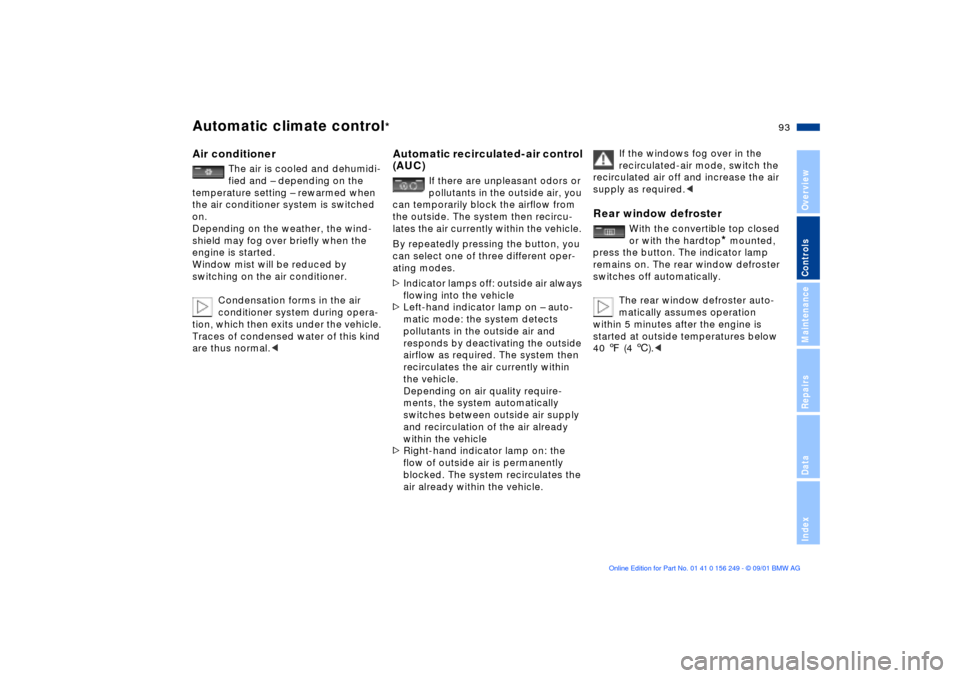
Air conditioner
The air is cooled and dehumidi-
fied and Ð depending on the
temperature setting Ð rewarmed when
the air conditioner system is switched
on.
Depending on the weather, the wind-
shield may fog over briefly when the
engine is started.
Window mist will be reduced by
switching on the air conditioner.
Condensation forms in the air
conditioner system during opera-
tion, which then exits under the vehicle.
Traces of condensed water of this kind
are thus normal.<
Automatic recirculated-air control
(AUC)
If there are unpleasant odors or
pollutants in the outside air, you
can temporarily block the airflow from
the outside. The system then recircu-
lates the air currently within the vehicle.
By repeatedly pressing the button, you
can select one of three different oper-
ating modes.
>Indicator lamps off: outside air always
flowing into the vehicle
>Left-hand indicator lamp on Ð auto-
matic mode: the system detects
pollutants in the outside air and
responds by deactivating the outside
airflow as required. The system then
recirculates the air currently within
the vehicle.
Depending on air quality require-
ments, the system automatically
switches between outside air supply
and recirculation of the air already
within the vehicle
>Right-hand indicator lamp on: the
flow of outside air is permanently
blocked. The system recirculates the
air already within the vehicle.
If the windows fog over in the
recirculated-air mode, switch the
recirculated air off and increase the air
supply as required.<
Rear window defroster
With the convertible top closed
or with the hardtop
* mounted,
press the button. The indicator lamp
remains on. The rear window defroster
switches off automatically.
The rear window defroster auto-
matically assumes operation
within 5 minutes after the engine is
started at outside temperatures below
40 7 (4 6).<
Page 109 of 159
109n
OverviewControlsMaintenanceRepairsDataIndex
Information for your safetyThe factory-approved radial tires are
matched to the vehicle and have been
selected to provide optimum safety and
driving comfort on your vehicle.
It is not merely the tire's service life, but
also driving comfort and Ð above all else
Ð driving safety that depend on the
condition of the tires and the mainte-
nance of the specified tire pressure.
Incorrect inflation pressure is a frequent
cause of tire damage. It also signifi-
cantly influences the roadholding ability
of your BMW.
Check tire inflation pressures on a
regular basis (refer to page 24), at
least every two weeks and before every
long trip. If this is not done, incorrect
tire pressures can cause driving insta-
bility and tire damage, ultimately
resulting in accidents.<
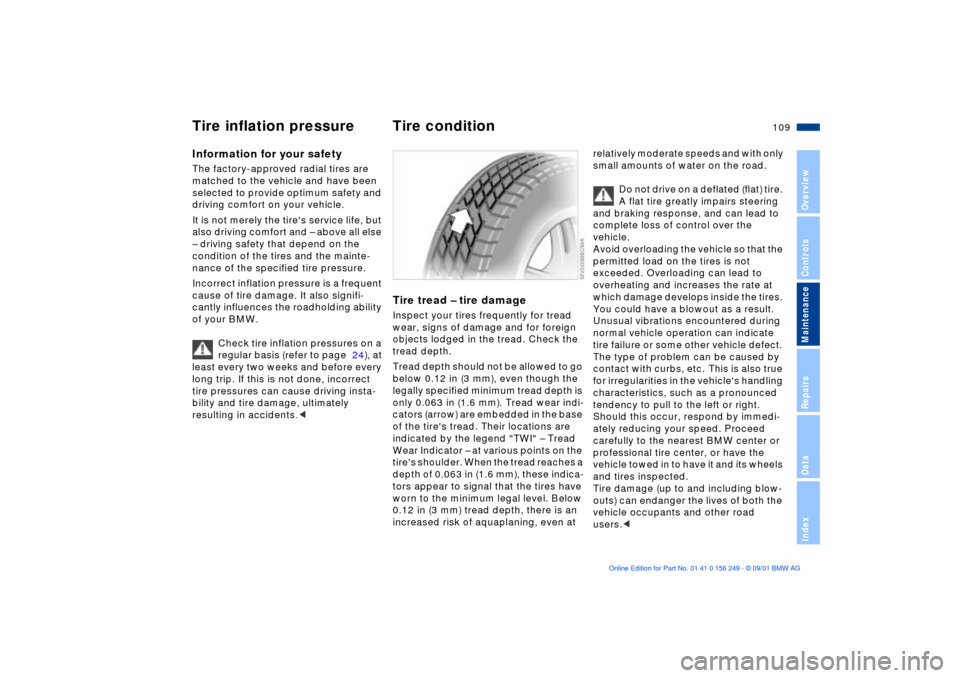
Tire tread Ð tire damageInspect your tires frequently for tread
wear, signs of damage and for foreign
objects lodged in the tread. Check the
tread depth.
Tread depth should not be allowed to go
below 0.12 in (3 mm), even though the
legally specified minimum tread depth is
only 0.063 in (1.6 mm). Tread wear indi-
cators (arrow) are embedded in the base
of the tire's tread. Their locations are
indicated by the legend "TWI" Ð Tread
Wear Indicator Ð at various points on the
tire's shoulder. When the tread reaches a
depth of 0.063 in (1.6 mm), these indica-
tors appear to signal that the tires have
worn to the minimum legal level. Below
0.12 in (3 mm) tread depth, there is an
increased risk of aquaplaning, even at
relatively moderate speeds and with only
small amounts of water on the road.
Do not drive on a deflated (flat) tire.
A flat tire greatly impairs steering
and braking response, and can lead to
complete loss of control over the
vehicle.
Avoid overloading the vehicle so that the
permitted load on the tires is not
exceeded. Overloading can lead to
overheating and increases the rate at
which damage develops inside the tires.
You could have a blowout as a result.
Unusual vibrations encountered during
normal vehicle operation can indicate
tire failure or some other vehicle defect.
The type of problem can be caused by
contact with curbs, etc. This is also true
for irregularities in the vehicle's handling
characteristics, such as a pronounced
tendency to pull to the left or right.
Should this occur, respond by immedi-
ately reducing your speed. Proceed
carefully to the nearest BMW center or
professional tire center, or have the
vehicle towed in to have it and its wheels
and tires inspected.
Tire damage (up to and including blow-
outs) can endanger the lives of both the
vehicle occupants and other road
users.<
Tire inflation pressure Tire condition
Page 112 of 159

112n
Winter tires Snow chains** * *Choosing the right tireBMW recommends winter tires (M+S
radial tires) for driving in adverse winter
road conditions. So-called all-season
tires with the M+S identification mark
do indeed possess better winter trac-
tion than summer tires that have the H,
V, W, Y and ZR speed ratings, they
generally fail to provide the same levels
of performance as snow tires.
In the interests of safe tracking and
steering response, install radial tires
made by the same manufacturer and
with the same tread configuration on all
four wheels if you elect to mount winter
tires.
When mounting winter wheels,
observe the different recess on
the front and rear wheels, as otherwise
damage may result.<
Do not exceed specified
maximum speeds
Never exceed the maximum
speed for which the tires are
rated.
Unprofessional attempts by laymen to
service tires can lead to damage and
accidents.
Have this work performed by skilled
professionals only. Your BMW center
will be glad to assist you with both their
expertise and the proper equipment for
your vehicle.<
Tire condition, tire pressureOnce winter tires wear to a tread depth
of less than 0.16 inches (4 mm), their
performance under winter driving
conditions deteriorates noticeably.
Worn tires should therefore be replaced
for safety considerations.
Comply with the specified tire inflation
pressures Ð and be sure to have the
wheel and tire assemblies balanced
every time you change the tires.
The use of fine-link BMW snow chains
is only permitted in pairs with the winter
tires on the rear wheels. Comply with all
manufacturer's safety precautions
when mounting the chains. Do not
exceed a maximum speed of 30 mph
(50 km/h) with snow chains.
After mounting or removing snow
chains, always reinitialize the sequential
M gearbox
* SMG II, refer to page 83.
It is not possible to mount snow
chains on tires with 18- and
19-inch wheels.
Deactivate the Flat Tire Monitor when
using snow chains. Malfunction warn-
ings and undetected losses in pressure
are a possibility when driving with snow
chains.
For further information, refer to
page 82.<
Page 120 of 159
120n
The BMW Maintenance System has
been designed as a reliable means of
providing maximum driving and oper-
ating safety Ð and as cost-effectively as
possible for you.
Please keep in mind that regular main-
tenance is not only necessary for the
safety of your vehicle, but also plays a
significant role in maintaining the resale
value of the vehicle.
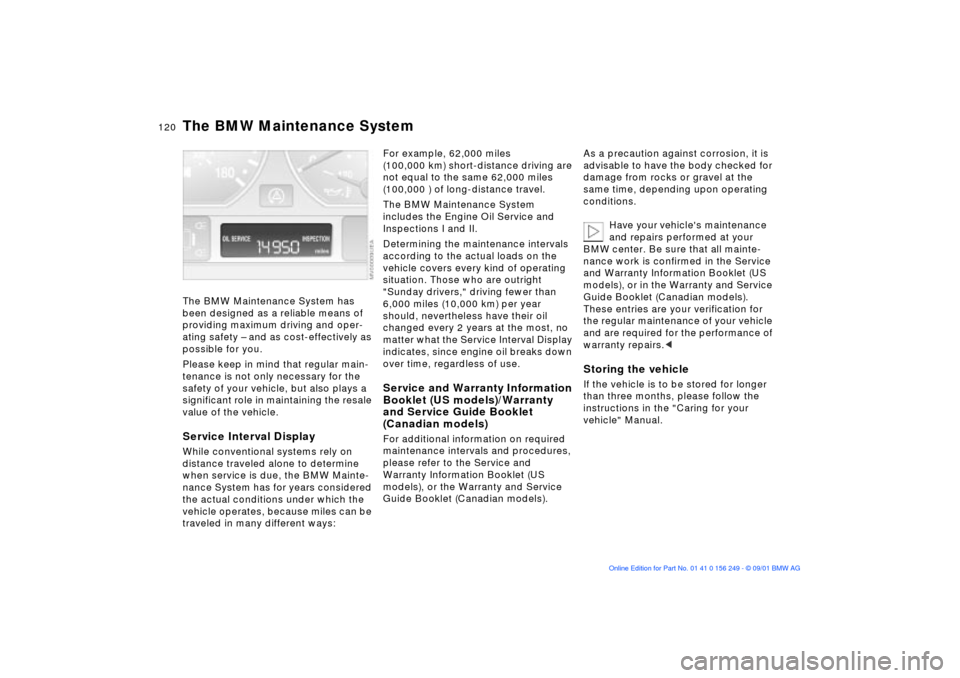
Service Interval DisplayWhile conventional systems rely on
distance traveled alone to determine
when service is due, the BMW Mainte-
nance System has for years considered
the actual conditions under which the
vehicle operates, because miles can be
traveled in many different ways:
For example, 62,000 miles
(100,000 km) short-distance driving are
not equal to the same 62,000 miles
(100,000 ) of long-distance travel.
The BMW Maintenance System
includes the Engine Oil Service and
Inspections I and II.
Determining the maintenance intervals
according to the actual loads on the
vehicle covers every kind of operating
situation. Those who are outright
"Sunday drivers," driving fewer than
6,000 miles (10,000 km) per year
should, nevertheless have their oil
changed every 2 years at the most, no
matter what the Service Interval Display
indicates, since engine oil breaks down
over time, regardless of use. Service and Warranty Information
Booklet (US models)/Warranty
and Service Guide Booklet
(Canadian models)For additional information on required
maintenance intervals and procedures,
please refer to the Service and
Warranty Information Booklet (US
models), or the Warranty and Service
Guide Booklet (Canadian models).As a precaution against corrosion, it is
advisable to have the body checked for
damage from rocks or gravel at the
same time, depending upon operating
conditions.
Have your vehicle's maintenance
and repairs performed at your
BMW center. Be sure that all mainte-
nance work is confirmed in the Service
and Warranty Information Booklet (US
models), or in the Warranty and Service
Guide Booklet (Canadian models).
These entries are your verification for
the regular maintenance of your vehicle
and are required for the performance of
warranty repairs.<
Storing the vehicleIf the vehicle is to be stored for longer
than three months, please follow the
instructions in the "Caring for your
vehicle" Manual.
The BMW Maintenance System
Page 136 of 159
136n
Battery Fuses
Battery posts, terminals, and
related accessories contain lead
and lead compounds. Wash hands after
handling.<
Maintenance The battery is completely maintenance-
free. That means that the original
battery acid will normally last for the
service life of the battery under
moderate climate conditions.
For all questions that regard the
battery, please consult your BMW
center. Since the battery is absolutely
maintenance-free, the following state-
ments are for your information only.<
Do not disconnect the battery
when the engine is running. If you
do so, the ensuing voltage surge will
damage the vehicle's onboard elec-
tronics.<
Charging the battery Charge the battery in the vehicle only
when the engine is not running. Use the
connections provided in the engine
compartment (for correct connections,
refer to "Jump-starting" on page 138.
Return used batteries to a recy-
cling point or your BMW center.
Maintain the battery in an upright posi-
tion for transport and storage. Secure
the battery against tilting in transit.<
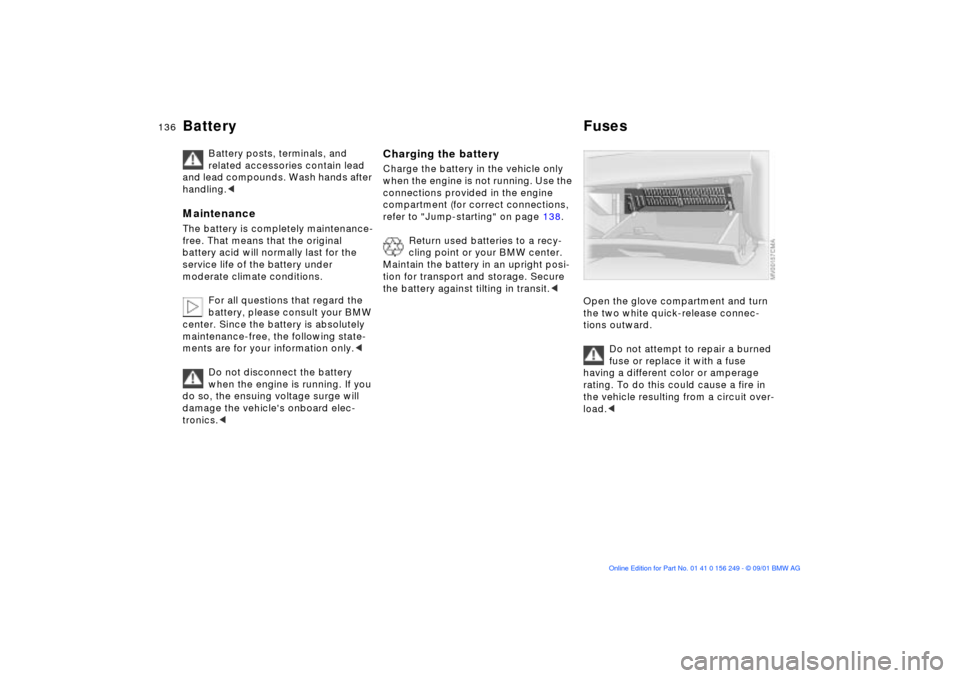
Open the glove compartment and turn
the two white quick-release connec-
tions outward.
Do not attempt to repair a burned
fuse or replace it with a fuse
having a different color or amperage
rating. To do this could cause a fire in
the vehicle resulting from a circuit over-
load.<
Page 150 of 159

Everything from A to Z
A
ABS (Antilock Brake System) 19, 105
Accessories 10
Activated-charcoal filter 94
Adding brake fluid 119t
coolant 118t
engine oil 116t
washer fluid 115t
Adjusting head restraints 46
lumbar support 45
mirrors 50
seats 45
steering wheel 50
temperature 89
thigh support 45
Air conditioner 89, 93
Air distribution 89
automatic 92
Air outlets 88, 91
Air pressure, tires 109
Air supply 89, 92
Airbags 52
warning lamp 18 Alarm system
37
avoiding unintentional
alarm 38
indicator lamp 38
interior motion sensor 37
tilt alarm sensor 37
Antifreeze 118
radiator 118
Antilock Brake System (ABS) 19, 105
Anti-theft alarm system 37
Anti-theft protection 28
Approved weights 146
Aquaplaning 105, 109
Armrest 96
Ashtray front 97
rear 97
AUC (Automatic recirculated-air
control) 93
Automatic climate control 88, 91
Automatic cruise control 73
Automatic headlight
control 85
Automatic recirculated-air control (AUC) 93 Automatic windshield
washer 72
Auxiliary terminal for jump- starting 114t
Average fuel consumption 79
Average speed 79
Avoiding unintentional alarm 38
B
Backrest unlocking 47
Backup lamps 64
bulb replacement 129t
Battery 136
add distilled water 136t
charge current 17
charging 136t
maintenance 136
Belts 48
Beverage holder 96
Blower 89, 92
BMW Maintenance System 120
Bore 144
Bottle holder, refer to beverage holder 96 Brake fluid change
76
Brake fluid level 105
indicator lamp 17
Brake lamps bulb replacement 129t
center 131
Brake system brake fluid level 105
brake fluid level, warning
lamp 105
brake pads 106
brake pads, indicator
lamp 19
disc brakes 106
indicator lamp 17
malfunction 105
Break-in procedure 104
Bulbs and lamps 126
C
California Proposition 65 Warning 121
Can holder, refer to beverage holder 96
Capacities 147
Car care, refer to the "Caring
for your vehicle" manual
Car telephone 96