check engine BMW M3 CONVERTIBLE 2002 E46 User Guide
[x] Cancel search | Manufacturer: BMW, Model Year: 2002, Model line: M3 CONVERTIBLE, Model: BMW M3 CONVERTIBLE 2002 E46Pages: 159, PDF Size: 2.19 MB
Page 114 of 159
114n
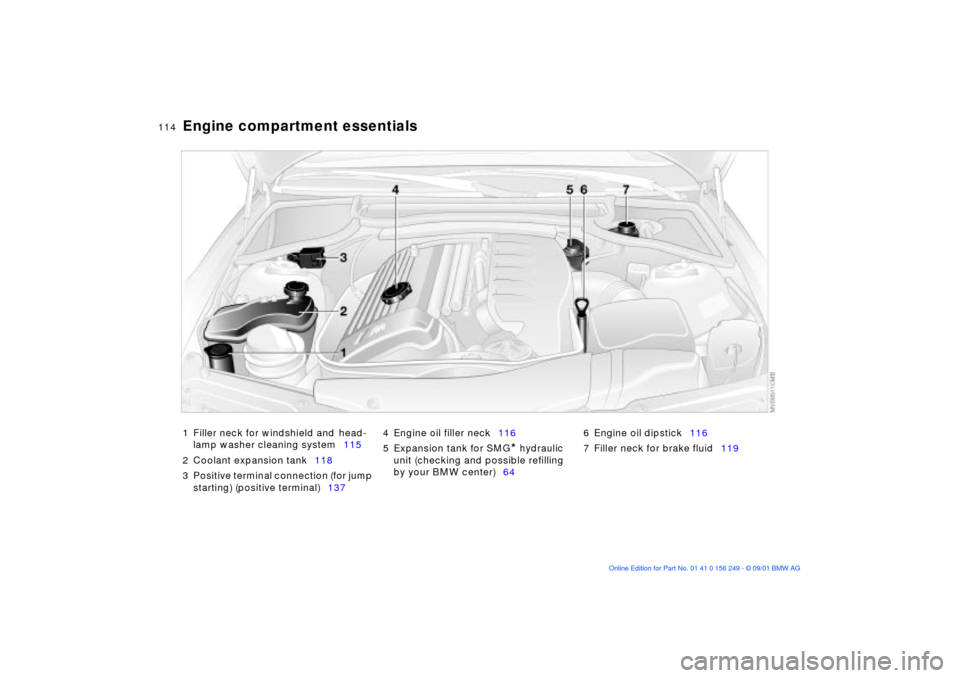
Engine compartment essentials1 Filler neck for windshield and
head-
lamp washer cleaning system115
2 Coolant expansion tank118
3 Positive terminal connection (for jump
starting) (positive terminal)137 4 Engine oil filler neck116
5 Expansion tank for SMG
* hydraulic
unit (checking and possible refilling
by your BMW center)646 Engine oil dipstick116
7 Filler neck for brake fluid119
Page 116 of 159
116n
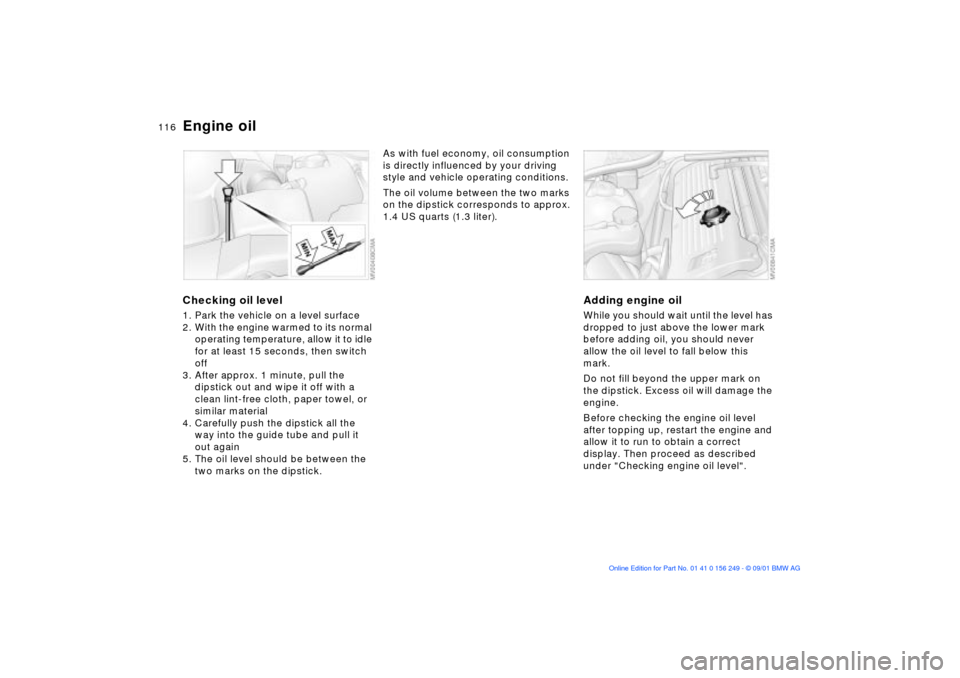
Engine oilChecking oil level 1. Park the vehicle on a level surface
2. With the engine warmed to its normal
operating temperature, allow it to idle
for at least 15 seconds, then switch
off
3. After approx. 1 minute, pull the
dipstick out and wipe it off with a
clean lint-free cloth, paper towel, or
similar material
4. Carefully push the dipstick all the
way into the guide tube and pull it
out again
5. The oil level should be between the
two marks on the dipstick.
As with fuel economy, oil consumption
is directly influenced by your driving
style and vehicle operating conditions.
The oil volume between the two marks
on the dipstick corresponds to approx.
1.4 US quarts (1.3 liter).
Adding engine oil While you should wait until the level has
dropped to just above the lower mark
before adding oil, you should never
allow the oil level to fall below this
mark.
Do not fill beyond the upper mark on
the dipstick. Excess oil will damage the
engine.
Before checking the engine oil level
after topping up, restart the engine and
allow it to run to obtain a correct
display. Then proceed as described
under "Checking engine oil level".
Page 118 of 159
118n
Coolant
Do not add coolant to the cooling
system when the engine is hot. If
you attempt to do so, escaping coolant
can cause burns.
To avoid the possibility of damage later
on, never use anything other than
factory-approved, nitrite and amino-
free extended-duty antifreeze with
corrosion inhibitor. Your BMW center is
familiar with the official specifications.
Antifreeze and anti-corrosion agents
are hazardous to health. You should
always store them in their original
containers and in a location inacces-
sible to children. Extended-duty anti-
freeze with corrosion inhibitor contains
ethylene glycol, a flammable
substance. For this reason, do not spill
extended-duty antifreeze with corrosion
inhibitor on hot engine parts. It could
catch fire and cause burns.<
Check the coolant level and
add coolant
Check the coolant level when the
engine is cold (approx. 68 7 or
+20 6).
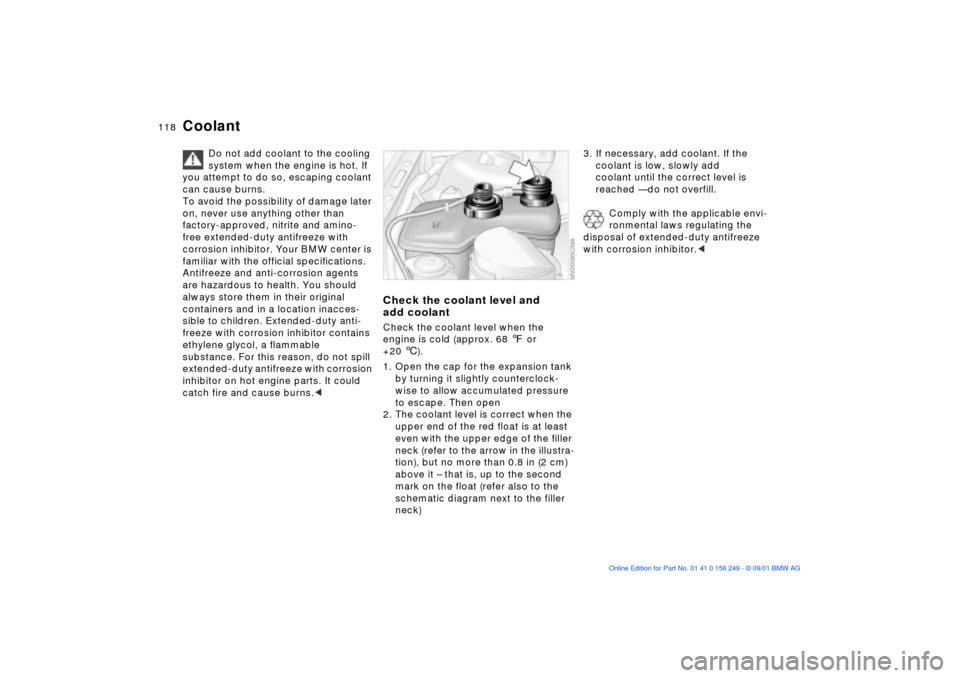
1. Open the cap for the expansion tank
by turning it slightly counterclock-
wise to allow accumulated pressure
to escape. Then open
2. The coolant level is correct when the
upper end of the red float is at least
even with the upper edge of the filler
neck (refer to the arrow in the illustra-
tion), but no more than 0.8 in (2 cm)
above it Ð that is, up to the second
mark on the float (refer also to the
schematic diagram next to the filler
neck)
3. If necessary, add coolant. If the
coolant is low, slowly add
coolant until the correct level is
reached Ñ do not overfill.
Comply with the applicable envi-
ronmental laws regulating the
disposal of extended-duty antifreeze
with corrosion inhibitor.<
Page 120 of 159
120n
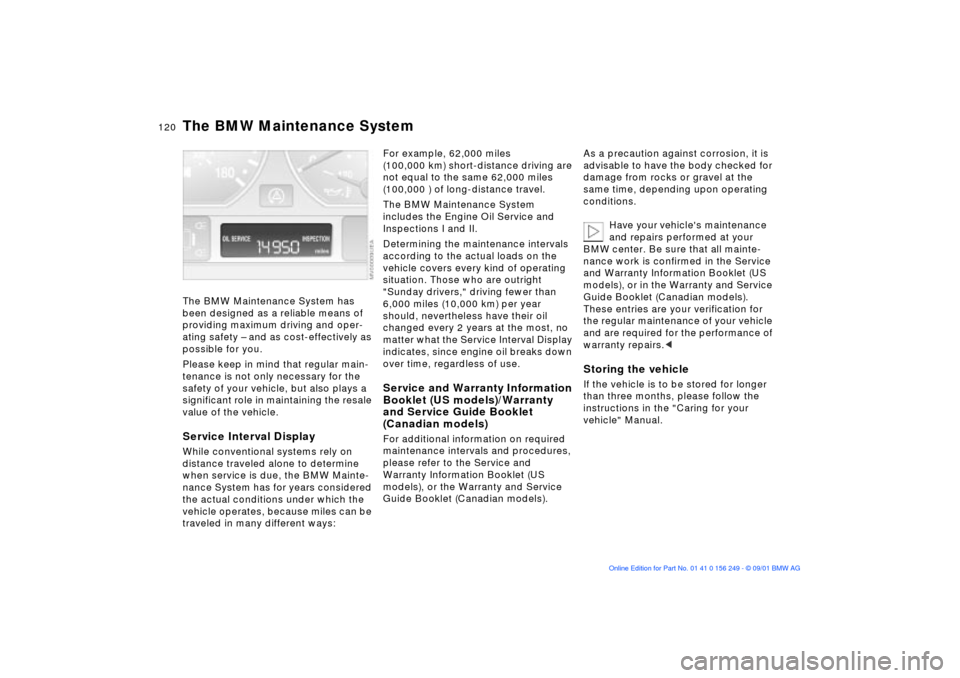
The BMW Maintenance System has
been designed as a reliable means of
providing maximum driving and oper-
ating safety Ð and as cost-effectively as
possible for you.
Please keep in mind that regular main-
tenance is not only necessary for the
safety of your vehicle, but also plays a
significant role in maintaining the resale
value of the vehicle.
Service Interval DisplayWhile conventional systems rely on
distance traveled alone to determine
when service is due, the BMW Mainte-
nance System has for years considered
the actual conditions under which the
vehicle operates, because miles can be
traveled in many different ways:
For example, 62,000 miles
(100,000 km) short-distance driving are
not equal to the same 62,000 miles
(100,000 ) of long-distance travel.
The BMW Maintenance System
includes the Engine Oil Service and
Inspections I and II.
Determining the maintenance intervals
according to the actual loads on the
vehicle covers every kind of operating
situation. Those who are outright
"Sunday drivers," driving fewer than
6,000 miles (10,000 km) per year
should, nevertheless have their oil
changed every 2 years at the most, no
matter what the Service Interval Display
indicates, since engine oil breaks down
over time, regardless of use. Service and Warranty Information
Booklet (US models)/Warranty
and Service Guide Booklet
(Canadian models)For additional information on required
maintenance intervals and procedures,
please refer to the Service and
Warranty Information Booklet (US
models), or the Warranty and Service
Guide Booklet (Canadian models).As a precaution against corrosion, it is
advisable to have the body checked for
damage from rocks or gravel at the
same time, depending upon operating
conditions.
Have your vehicle's maintenance
and repairs performed at your
BMW center. Be sure that all mainte-
nance work is confirmed in the Service
and Warranty Information Booklet (US
models), or in the Warranty and Service
Guide Booklet (Canadian models).
These entries are your verification for
the regular maintenance of your vehicle
and are required for the performance of
warranty repairs.<
Storing the vehicleIf the vehicle is to be stored for longer
than three months, please follow the
instructions in the "Caring for your
vehicle" Manual.
The BMW Maintenance System
Page 122 of 159
122n
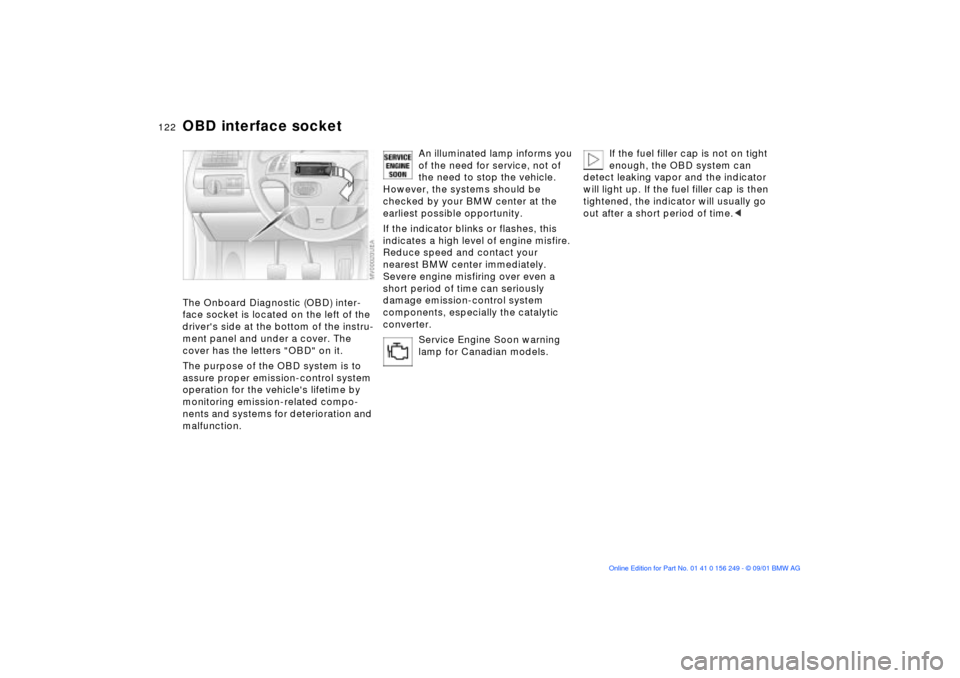
OBD interface socketThe Onboard Diagnostic (OBD) inter-
face socket is located on the left of the
driver's side at the bottom of the instru-
ment panel and under a cover. The
cover has the letters "OBD" on it.
The purpose of the OBD system is to
assure proper emission-control system
operation for the vehicle's lifetime by
monitoring emission-related compo-
nents and systems for deterioration and
malfunction.
An illuminated lamp informs you
of the need for service, not of
the need to stop the vehicle.
However, the systems should be
checked by your BMW center at the
earliest possible opportunity.
If the indicator blinks or flashes, this
indicates a high level of engine misfire.
Reduce speed and contact your
nearest BMW center immediately.
Severe engine misfiring over even a
short period of time can seriously
damage emission-control system
components, especially the catalytic
converter.
Service Engine Soon warning
lamp for Canadian models.
If the fuel filler cap is not on tight
enough, the OBD system can
detect leaking vapor and the indicator
will light up. If the fuel filler cap is then
tightened, the indicator will usually go
out after a short period of time.<
Page 147 of 159

147n
OverviewControlsMaintenanceRepairsDataIndex
Capacities
Notes
Fuel tank
Reserve gal. (liters)
gal. (liters)approx. 16.6 (approx. 63)
approx. 2.1 (approx. 8)Fuel specification: refer to page 24
Windshield washer system/
Headlamp washer system quarts (liters) approx. 5.6 (approx. 5.3)For details: refer to page 115
Cooling system including heater circuit quarts (liters) approx. 9.9 (approx. 9.3) For details: refer to page 118
Engine with oil filter change quarts (liters) approx. 5.3 (approx. 5.0) For details: refer to page 117
Manual transmission quarts (liters) approx. 1.9 (approx. 1.8) Oil change during running-in check
and during each inspection II
Differential quarts (liters) approx. 1.2 (approx. 1.1) Oil change during running-in check
and during each inspection II
Page 151 of 159
Everything from A to Z
151n
OverviewControlsMaintenanceRepairsDataIndex
Car wash systems, refer to
the "Caring for your
vehicle" manual
Cargo loading100
CBC (Cornering Brake
Control)105
Cellular phone96
hands-free system96
speaker96
Center (high-mount) brake
lamp131
Center armrest96
Central locking system28
Check Control77
Checking engine coolant
level118t
Checking engine oil
level116t
Child Seat Safety57
Child-restraint systems54
Cigarette lighter97
Clean the headlamps72
Cleaning windshield72
Clock77
also refer to the "Radio
Owner's Manual" or to the
"Onboard Computer
Owner's Manual" Cockpit14
Coin box96
Combination switch70
Compression ratio144
Computer
also refer to the "Onboard
Computer Owner's
Manual"78
Configure personal settings,
Vehicle Memory, Key
Memory60
Connecting electrical
appliances97
Connecting vacuum
cleaner97
Consumption display76
Consumption, fuel79
Control elements14
Convertible top
electrical
malfunction42t
Coolant118, 147
Coolant temperature
gauge76
Cooling system,
capacities147
Copyright4 Cornering Brake Control
(CBC)105
Correct sitting position44
Cruise control73
Cruising range79
Cup holder, refer to
beverage holder96
Curb weight146
D
Dashboard
lighting86
Data
dimensions145
engine144
technical144
weights146
Daytime driving lamps85
Deep water105
Defroster, rear window89
Defrosting the windows92
Digital clock77
also refer to the "Radio
Owner's Manual"
Dimensions145 Dimming inside rearview
mirror51
Dipstick, engine oil116
Disc brakes106
Displacement144
Display lighting86
Displays15
Distance warning80
Door key28
Door mirror50
Doors
electrical
malfunction29t
manual operation29t
remote control30
unlocking and locking29
Draft-free ventilation90, 94
Driving lamps85
Driving notes
aquaplaning105
brakes105
disc brakes106
in general105
DSC (Dynamic Stability
Control)81
Dynamic Stability Control
(DSC)81
indicator lamp19
Page 152 of 159

Everything from A to ZE
Electric power windows39
Electrical accessories,
failure136t
Electrical malfunction
convertible top42t
doors29t
fuel filler door22t
luggage compartment
lid34t
Electrical outlet97
Emergency release of
luggage compartment lid
from luggage
compartment's interior35
Engine
coolant118
coolant, capacity147
data144
displacement144
output144
starting61t
torque144
Engine compartment114
Engine coolant,
adding118t Engine oil
add116t
capacity147
consumption116
for low ambient
temperatures117
oil dip stick116
pressure17
quality117
temperature75
types117
viscosity117
Engine oil level
checking114t
indicator lamp19
Engine speed144
Entering the rear of the
vehicle47
Entry toward rear47
Eyelets, towing139t
F
Failure messages77
Filling capacities147
Filling the washer
reservoir115t
First-aid kit22 Flat tire109
repairing132
Flat Tire Monitor82
indicator lamp17, 19
Fog lamps86
bulb replacement129t
Follow me home lamps85
Footbrake, refer to brake
system106
Front fog lamps86
Front head restraints46
Front seat adjusting44
Fuel24
consumption display76
gauge76
preparation144
Fuel consumption79
Fuel filler door22
electrical
malfunction22t
manual operation22t
Fuel gauge76
Fuel quality24
Fuel tank capacity147
Fuses, replacing136t G
Gas gauge76
Gasoline24
Gearshift lever63
Glove compartment95
Grilles88, 91
Gross vehicle weight146
H
Handbrake63
Hardtop106
Hazard warning flashers14
Hazard warning triangle22
Head restraints46
adjusting46
Headlamp cleaning
system114, 115
Headlamp covers,
care127t
Headlamp flasher86
Headlamp washer system,
capacities147
Heated mirror50
Heated seats49
Heater and
ventilation88, 91
Heavy loads100
Page 154 of 159

Everything from A to ZM
M Engine dynamics
control84
M Mobility system132
M+S-tires112
Maintenance76, 120
Malfunction displays77
Manual operation
convertible top42t
doors29t
fuel filler door22
luggage compartment
lid34t
Manual transmission63
Master key28
MFL (Multifunction steering
wheel21
MFL (Multifunction steering
wheel)21
Microfilter90, 94
Mirror50
inside rearview51
outside50
Mirror memory48 Mirrors
adjusting50
automatic curb
monitor51
heating50
Mobility system132
Modifications,
technical10, 121
Mounting the roof rack106
Multifunction steering wheel
(MFL)21
O
OBD interface socket122
Odometer75
Oil
additives117
capacity147
consumption116
oil dipstick116
quality117
types117
viscosity117
Oil change intervals, refer to
the Service and Warranty
Information Booklet (US
models) or the Warranty
and Service Guide Booklet
(Canadian models) Oil dipstick116
Oil filter change147
Oil level
checking116t
indicator lamp19
Oil pressure, indicator
lamp17
OILSERVICE76
Onboard Computer
also refer to the "Owner's
Manual for Onboard
Computer"
Onboard tool kit126t
Opening and closing
from inside33
via the door lock29
via the remote control30
Operating vehicle at low
ambient
temperatures117
Outlets, ventilation88, 91
Output, engine144
Outside temperature
display78 P
Paintwork, care, refer to the
"Caring for your vehicle"
manual
Park Distance Control
(PDC)80
Parking brake63
Parking help80
Parking lamps85
bulb replacement127t
PDC (Park Distance
Control)80
Pollen filter90, 94
Power windows39
Prevent accidental alarm38
R
Radiator147
Rain sensor71
Reading lamps87
Rear entry aid47
Rear head restraints46
Rear window
defroster89, 93
Rearview mirror50
Recirculated-air
mode89, 93
Reclining seat44