wheel BMW M3 CONVERTIBLE 2002 E46 User Guide
[x] Cancel search | Manufacturer: BMW, Model Year: 2002, Model line: M3 CONVERTIBLE, Model: BMW M3 CONVERTIBLE 2002 E46Pages: 159, PDF Size: 2.19 MB
Page 61 of 159
61n
OverviewControlsMaintenanceRepairsDataIndex
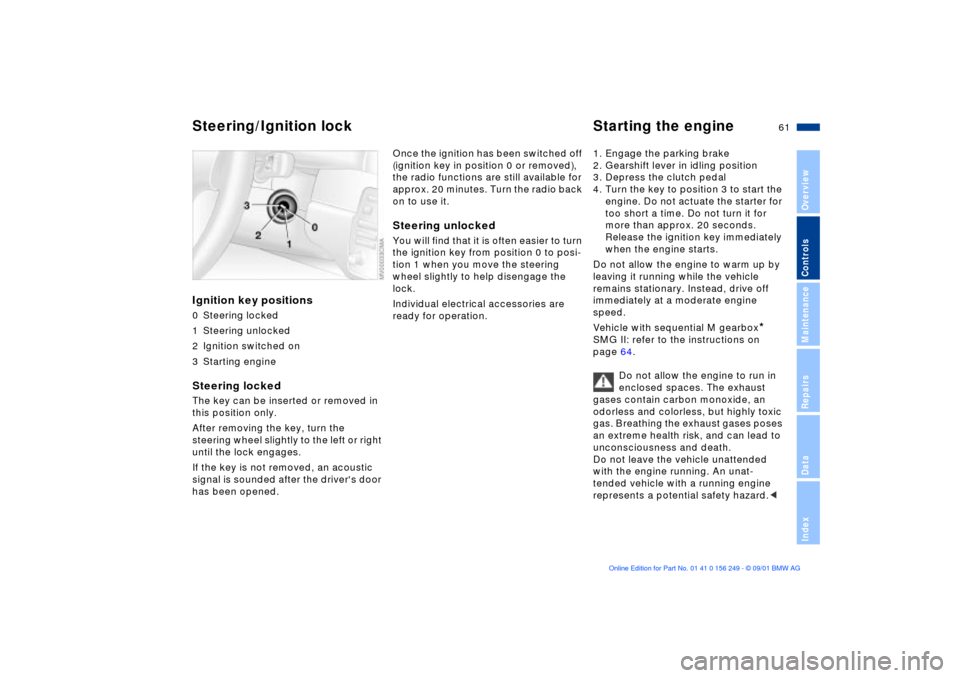
Ignition key positions0 Steering locked
1 Steering unlocked
2 Ignition switched on
3 Starting engineSteering locked The key can be inserted or removed in
this position only.
After removing the key, turn the
steering wheel slightly to the left or right
until the lock engages.
If the key is not removed, an acoustic
signal is sounded after the driver's door
has been opened.
Once the ignition has been switched off
(ignition key in position 0 or removed),
the radio functions are still available for
approx. 20 minutes. Turn the radio back
on to use it.Steering unlocked You will find that it is often easier to turn
the ignition key from position 0 to posi-
tion 1 when you move the steering
wheel slightly to help disengage the
lock.
Individual electrical accessories are
ready for operation. 1. Engage the parking brake
2. Gearshift lever in idling position
3. Depress the clutch pedal
4. Turn the key to position 3 to start the
engine. Do not actuate the starter for
too short a time. Do not turn it for
more than approx. 20 seconds.
Release the ignition key immediately
when the engine starts.
Do not allow the engine to warm up by
leaving it running while the vehicle
remains stationary. Instead, drive off
immediately at a moderate engine
speed.
Vehicle with sequential M gearbox
*
SMG II: refer to the instructions on
page 64.
Do not allow the engine to run in
enclosed spaces. The exhaust
gases contain carbon monoxide, an
odorless and colorless, but highly toxic
gas. Breathing the exhaust gases poses
an extreme health risk, and can lead to
unconsciousness and death.
Do not leave the vehicle unattended
with the engine running. An unat-
tended vehicle with a running engine
represents a potential safety hazard.<
Steering/Ignition lock Starting the engine
Page 63 of 159
63n
OverviewControlsMaintenanceRepairsDataIndex
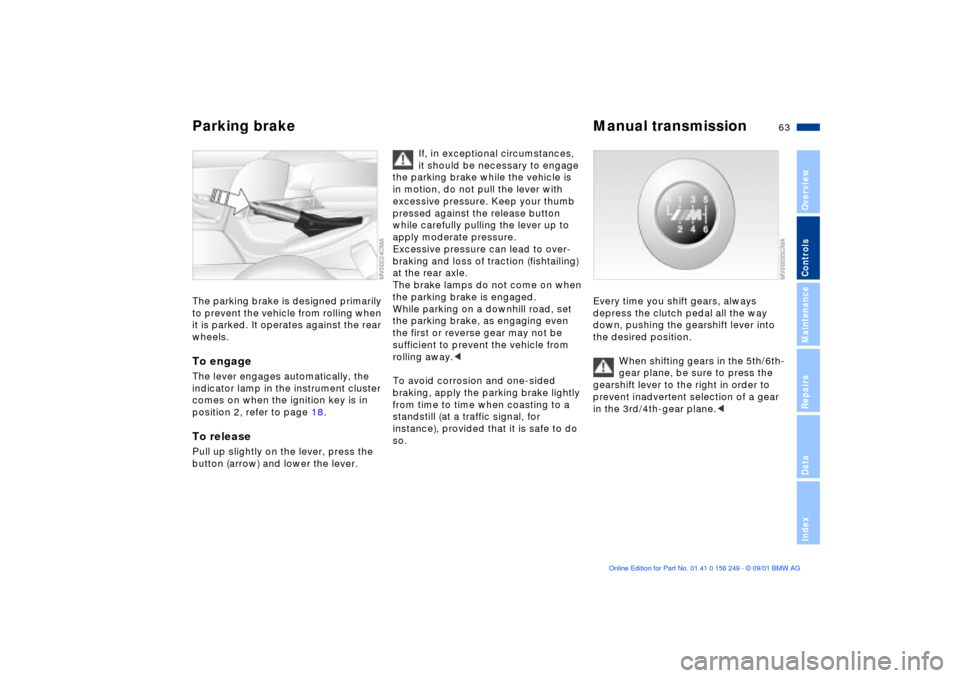
Parking brake Manual transmission The parking brake is designed primarily
to prevent the vehicle from rolling when
it is parked. It operates against the rear
wheels. To engageThe lever engages automatically, the
indicator lamp in the instrument cluster
comes on when the ignition key is in
position 2, refer to page 18.To releasePull up slightly on the lever, press the
button (arrow) and lower the lever.
If, in exceptional circumstances,
it should be necessary to engage
the parking brake while the vehicle is
in motion, do not pull the lever with
excessive pressure. Keep your thumb
pressed against the release button
while carefully pulling the lever up to
apply moderate pressure.
Excessive pressure can lead to over-
braking and loss of traction (fishtailing)
at the rear axle.
The brake lamps do not come on when
the parking brake is engaged.
While parking on a downhill road, set
the parking brake, as engaging even
the first or reverse gear may not be
sufficient to prevent the vehicle from
rolling away.<
To avoid corrosion and one-sided
braking, apply the parking brake lightly
from time to time when coasting to a
standstill (at a traffic signal, for
instance), provided that it is safe to do
so.
Every time you shift gears, always
depress the clutch pedal all the way
down, pushing the gearshift lever into
the desired position.
When shifting gears in the 5th/6th-
gear plane, be sure to press the
gearshift lever to the right in order to
prevent inadvertent selection of a gear
in the 3rd/4th-gear plane.<
Page 64 of 159

64n
Manual transmission Sequential M gearbox
* SMG II
Reverse Select only when the vehicle is
stationary. Press the shift lever to the
left to overcome the resistance.
As you do this, the backup lamps will
turn on automatically when the ignition
key is in position 2.
Do not hold the vehicle in place on
slopes by slipping or "riding" the
clutch. Use the parking brake instead.
Riding the clutch causes the clutch
assembly to wear out sooner.<
The conceptThe sequential M gearbox SMG II is an
automated manual gearbox with which
clutching and shifting is assumed by an
electro-hydraulic system.
The SMG II is operated via two shift
paddles on the steering wheel and the
selector lever in the center console.
It offers the following functions:
>Sequential and automated shifting
mode
>Ability to choose between different
driving programs (Drivelogic)
>Gradient assistance
>Upshift display (shift lights)
>Throttle blip
>Driving dependent functions:
The respective driving situation (e.g.
cornering, mountain driving, braking)
is detected by sensors and taken into
account accordingly for shifting, e.g.
to achieve optimum gear selection
during deceleration and subsequent
acceleration>Slip recognition at the rear axle for
increasing driving stability, e.g.
during downshifting on slippery road
surfaces
>Operating safety through protection
against misshifting.
Page 66 of 159
66n
Sequential M gearbox
* SMG II
The warning stops after approx. 10
seconds. If you move the selector lever
into a forward or reverse position
during this time, a gear is automatically
engaged.
The SMG II has no park position
for securing the vehicle against
rolling.
The ignition key can be removed in any
selector lever position.<
Always engage the parking brake
when parking on downhill roads.
Engaging a gear may not sufficiently
secure the vehicle against rolling.<
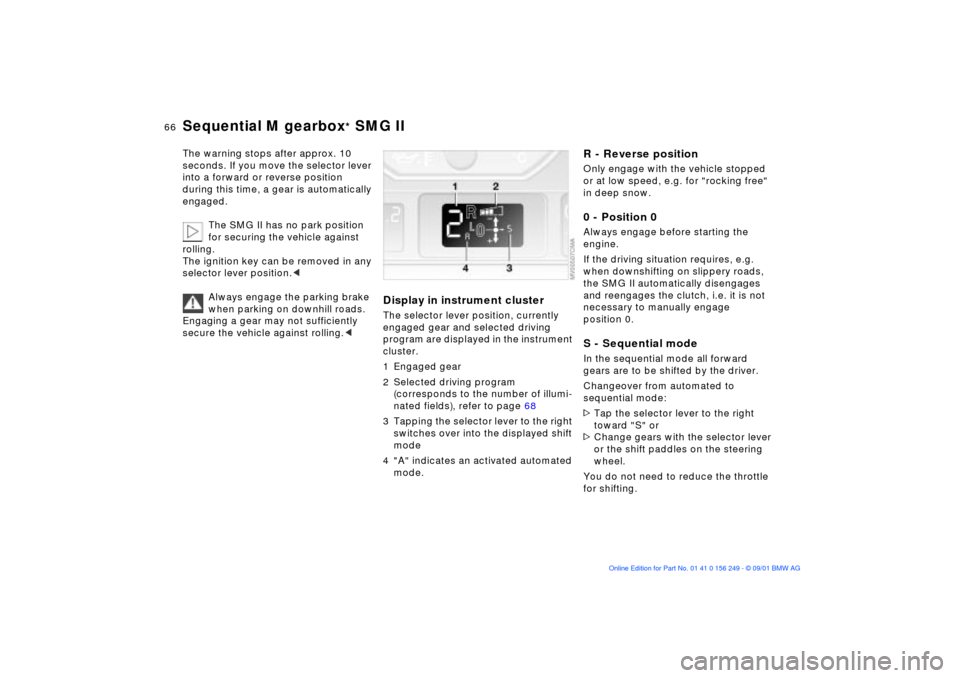
Display in instrument clusterThe selector lever position, currently
engaged gear and selected driving
program are displayed in the instrument
cluster.
1 Engaged gear
2 Selected driving program
(corresponds to the number of illumi-
nated fields), refer to page 68
3 Tapping the selector lever to the right
switches over into the displayed shift
mode
4 "A" indicates an activated automated
mode.
R - Reverse positionOnly engage with the vehicle stopped
or at low speed, e.g. for "rocking free"
in deep snow.0 - Position 0Always engage before starting the
engine.
If the driving situation requires, e.g.
when downshifting on slippery roads,
the SMG II automatically disengages
and reengages the clutch, i.e. it is not
necessary to manually engage
position 0. S - Sequential modeIn the sequential mode all forward
gears are to be shifted by the driver.
Changeover from automated to
sequential mode:
>Tap the selector lever to the right
toward "S" or
>Change gears with the selector lever
or the shift paddles on the steering
wheel.
You do not need to reduce the throttle
for shifting.
Page 67 of 159
67n
OverviewControlsMaintenanceRepairsDataIndex
Sequential M gearbox
* SMG II
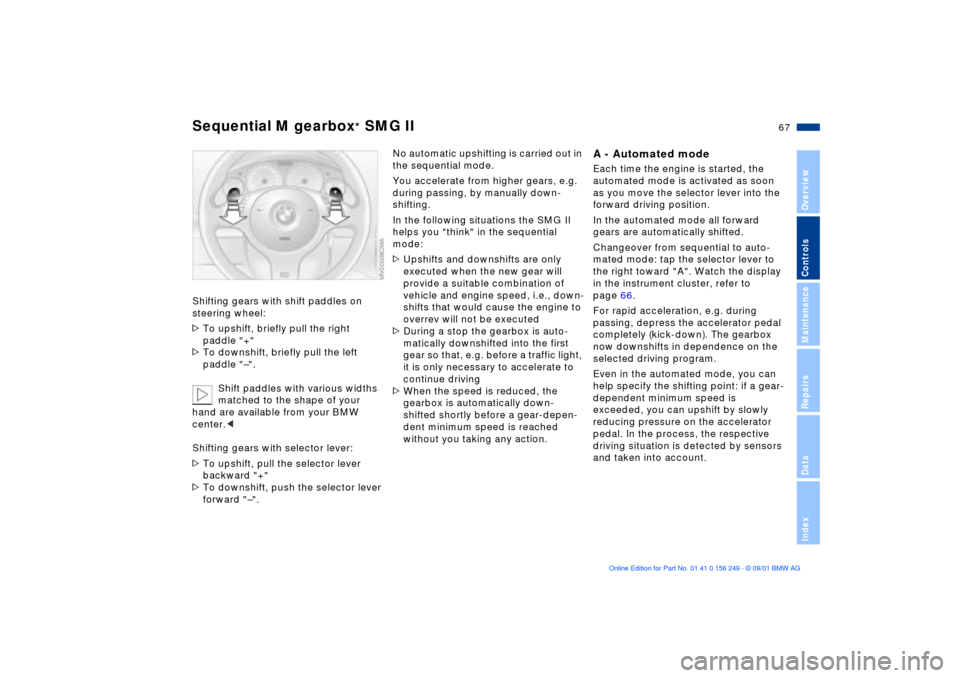
Shifting gears with shift paddles on
steering wheel:
>To upshift, briefly pull the right
paddle "+"
>To downshift, briefly pull the left
paddle "Ð".
Shift paddles with various widths
matched to the shape of your
hand are available from your BMW
center.<
Shifting gears with selector lever:
>To upshift, pull the selector lever
backward "+"
>To downshift, push the selector lever
forward "Ð".
No automatic upshifting is carried out in
the sequential mode.
You accelerate from higher gears, e.g.
during passing, by manually down-
shifting.
In the following situations the SMG II
helps you "think" in the sequential
mode:
>Upshifts and downshifts are only
executed when the new gear will
provide a suitable combination of
vehicle and engine speed, i.e., down-
shifts that would cause the engine to
overrev will not be executed
>During a stop the gearbox is auto-
matically downshifted into the first
gear so that, e.g. before a traffic light,
it is only necessary to accelerate to
continue driving
>When the speed is reduced, the
gearbox is automatically down-
shifted shortly before a gear-depen-
dent minimum speed is reached
without you taking any action.
A - Automated modeEach time the engine is started, the
automated mode is activated as soon
as you move the selector lever into the
forward driving position.
In the automated mode all forward
gears are automatically shifted.
Changeover from sequential to auto-
mated mode: tap the selector lever to
the right toward "A". Watch the display
in the instrument cluster, refer to
page 66.
For rapid acceleration, e.g. during
passing, depress the accelerator pedal
completely (kick-down). The gearbox
now downshifts in dependence on the
selected driving program.
Even in the automated mode, you can
help specify the shifting point: if a gear-
dependent minimum speed is
exceeded, you can upshift by slowly
reducing pressure on the accelerator
pedal. In the process, the respective
driving situation is detected by sensors
and taken into account.
Page 69 of 159
69n
OverviewControlsMaintenanceRepairsDataIndex
Sequential M gearbox
* SMG II
The vehicle may roll slightly before
it is held by the gradient assis-
tance after releasing the footbrake.
Two seconds after the footbrake is
released, the vehicle begins to roll, as it
is no longer held with the gradient
assistance.<
The gradient assistance must be reacti-
vated before each use.
Indicator lamp
The transmission indicator lamp
in the instrument cluster goes
out after the engine is started.
>If it does not go out, or if it lights up
during driving, a fault has occurred.
The available functions may be
limited under certain circumstances.
Drive carefully and with the Dynamic
Stability Control (DSC) activated.
Have the system checked by the
nearest BMW center
>If the indicator lamp flashes while
driving, the system is overloaded.
Avoid high loads until the indicator
lamp goes out again permanently.
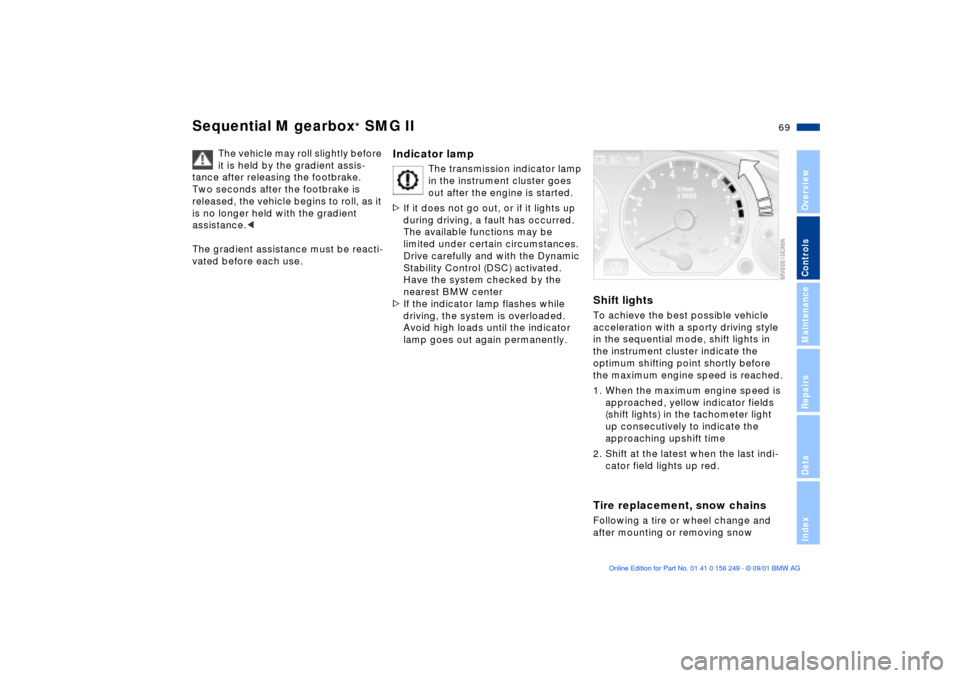
Shift lightsTo achieve the best possible vehicle
acceleration with a sporty driving style
in the sequential mode, shift lights in
the instrument cluster indicate the
optimum shifting point shortly before
the maximum engine speed is reached.
1. When the maximum engine speed is
approached, yellow indicator fields
(shift lights) in the tachometer light
up consecutively to indicate the
approaching upshift time
2. Shift at the latest when the last indi-
cator field lights up red.Tire replacement, snow chainsFollowing a tire or wheel change and
after mounting or removing snow
Page 81 of 159

81n
OverviewControlsMaintenanceRepairsDataIndex
Dynamic Stability Control (DSC)
The concept
DSC maintains vehicle stability, even in
critical driving situations.
The system optimizes vehicle stability
during acceleration and when starting
from a full stop, as well as optimizing
traction. In addition, it also recognizes
unstable driving conditions such as
under- or oversteering on curves, and
keeps the vehicle on a steady course
by using the engine and brake system
to intervene at the different wheels,
doing only what it can within the laws of
physics, of course.
The system starts up automatically
each time you start the engine.The laws of physics cannot be
repealed, even with DSC. The
results of driving irresponsibly rest with
the driver. We therefore urge you to
avoid using the additional safety margin
of the system as an excuse for taking
risks. Do not make any modifications to
the DSC system. Allow only authorized
technicians to perform service proce-
dures on the DSC.<
Indicator lamp
The indicator lamp in the instru-
ment cluster will go out shortly
after the ignition has been
switched on, refer to page 18.
>Indicator lamp flashes: the system is
active and is controlling the drive
torque based on driving conditions
>If the indicator lamp fails to go out
after the engine has been started, or
if it comes on during normal driving
and stays on: the system has been
deactivated via the button or is
defective. You can continue to drive
the vehicle normally, but without
DSC. Please consult your BMW
center for repairs.
Page 84 of 159
84n
Flat Tire Monitor
M Engine dynamics control
Flat tire
The indicator lamp in the instru-
ment cluster will light up red in
the event of a flat tire with
ensuing loss in pressure. In addition, an
acoustic signal is sounded. To come to
an immediate stop, reduce speed, while
avoiding any sudden, jerky braking or
steering maneuvers.
Fix the flat tire using the M Mobility
system (refer to page 132).
Resetting the indicator lamp: the red
indicator lamp has to be switched off
manually after putting on a new wheel.
At this point, hold the Flat Tire Monitor
button down until the indicator lamp
goes out. Reinitialize the system after-
ward.
The Flat Tire Monitor cannot alert
you to severe and sudden tire
damage caused by external factors.
Another factor which the Flat Tire
Monitor does not recognize is the
balanced and very gradual pressure
loss that takes place in all tires over an
extended period of time.<
Check the tire inflation pressure
on a regular basis and correct if
necessary, refer to page 24.
Under certain circumstances, there
may be false warnings or a delayed
detection of losses in pressure when
driving on snow-covered or slippery
road surfaces.
Performance-oriented driving (slip at
the drive wheels, high levels of lateral
acceleration) can also delay the
appearance of status reports in the Flat
Tire Monitor's display panel.<
System malfunctionAs long as there is still a malfunction,
the indicator lamp in the instrument
cluster will stay lit up yellow.
Please contact your BMW center for
additional information.
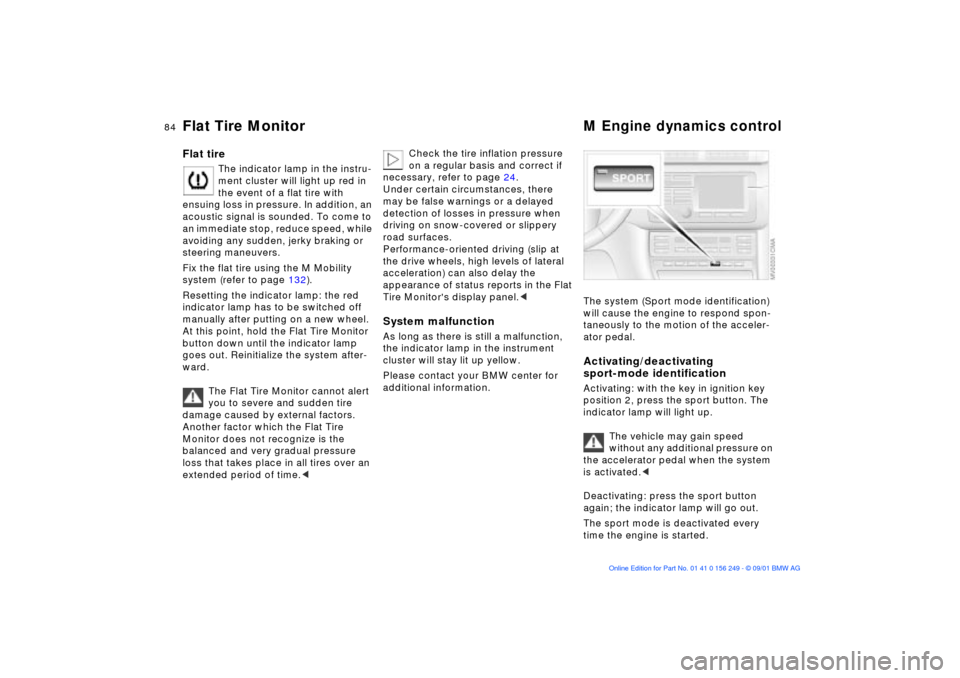
The system (Sport mode identification)
will cause the engine to respond spon-
taneously to the motion of the acceler-
ator pedal. Activating/deactivating
sport-mode identificationActivating: with the key in ignition key
position 2, press the sport button. The
indicator lamp will light up.
The vehicle may gain speed
without any additional pressure on
the accelerator pedal when the system
is activated.<
Deactivating: press the sport button
again; the indicator lamp will go out.
The sport mode is deactivated every
time the engine is started.
Page 105 of 159

105n
OverviewControlsMaintenanceRepairsDataIndex
Brakes: do not rest your foot on
the brake pedal while driving.
Even light but consistent pedal pres-
sure can lead to high temperatures,
brake wear and possibly even brake
failure.
Aquaplaning: when driving on wet or
slushy roads, reduce road speed. If you
do not, a wedge of water can form
between tires and road surface. This
phenomenon is referred to as aqua-
planing, or hydroplaning, and can lead
to partial or complete loss of traction,
vehicle control and braking effective-
ness.
Driving through water: do not drive
through water on the road if it is deeper
than 1 foot (30 cm), and then only at
walking speed. Otherwise the vehicle
can sustain damage to the engine, the
electrical systems and the transmis-
sion.<
The conceptThe Antilock Brake System (ABS) keeps
the wheels from locking while braking,
thereby enhancing active driving safety.Braking with ABSIf you are in a situation that requires full
braking, you will exploit the full benefits
of the ABS system if you apply
maximum brake pressure ("panic
stop"). Since the vehicle maintains
steering responsiveness, you can
nevertheless avoid possible obstacles
with a minimum of steering effort.
Pulsation at the brake pedal combines
with sounds from the hydraulic circuits
to indicate to the driver that ABS is in
its active mode.Cornering Brake Control (CBC)CBC is an advanced engineering
design of the ABS. When braking while
cornering at high speed or braking
during high lateral acceleration, or
when braking during a lane change,
vehicle stability is improved and
steering response is enhanced.
Brake fluid level Low brake fluid level in the reservoir
combined with longer than usual pedal
travel may indicate a defect in one of
the brake system's hydraulic circuits.
Proceed to the nearest BMW
center. Higher brake application
pressure may be necessary when stop-
ping, and the vehicle may exhibit a
slight tendency to pull to one side.
Brake distances may even be longer.
Please remember to adapt your driving
style accordingly.<
Driving notes Antilock Brake System Brake system
Page 109 of 159
109n
OverviewControlsMaintenanceRepairsDataIndex
Information for your safetyThe factory-approved radial tires are
matched to the vehicle and have been
selected to provide optimum safety and
driving comfort on your vehicle.
It is not merely the tire's service life, but
also driving comfort and Ð above all else
Ð driving safety that depend on the
condition of the tires and the mainte-
nance of the specified tire pressure.
Incorrect inflation pressure is a frequent
cause of tire damage. It also signifi-
cantly influences the roadholding ability
of your BMW.
Check tire inflation pressures on a
regular basis (refer to page 24), at
least every two weeks and before every
long trip. If this is not done, incorrect
tire pressures can cause driving insta-
bility and tire damage, ultimately
resulting in accidents.<
Tire tread Ð tire damageInspect your tires frequently for tread
wear, signs of damage and for foreign
objects lodged in the tread. Check the
tread depth.
Tread depth should not be allowed to go
below 0.12 in (3 mm), even though the
legally specified minimum tread depth is
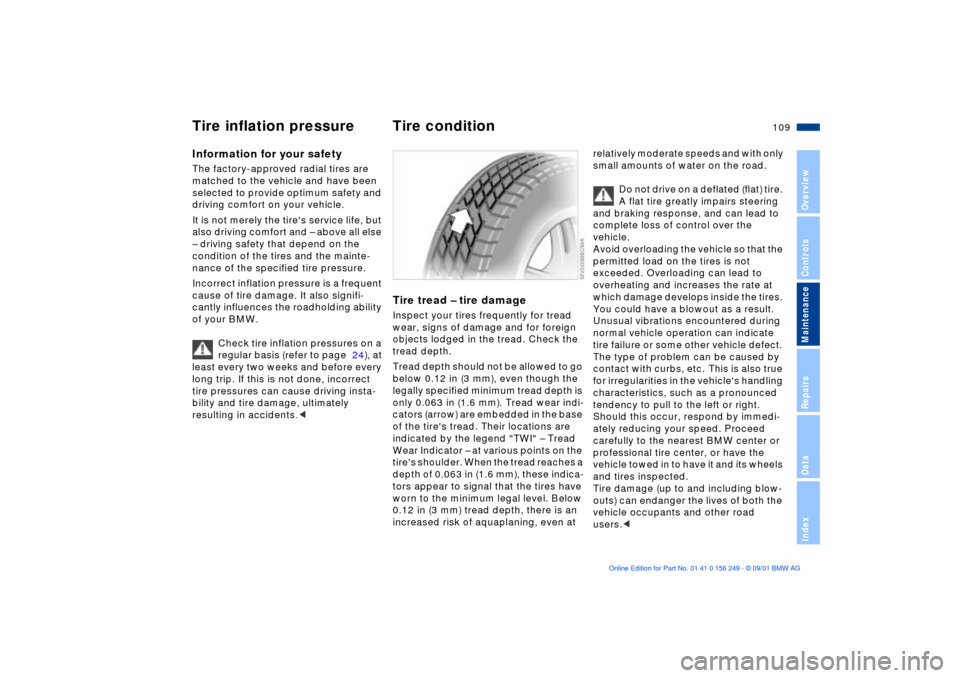
only 0.063 in (1.6 mm). Tread wear indi-
cators (arrow) are embedded in the base
of the tire's tread. Their locations are
indicated by the legend "TWI" Ð Tread
Wear Indicator Ð at various points on the
tire's shoulder. When the tread reaches a
depth of 0.063 in (1.6 mm), these indica-
tors appear to signal that the tires have
worn to the minimum legal level. Below
0.12 in (3 mm) tread depth, there is an
increased risk of aquaplaning, even at
relatively moderate speeds and with only
small amounts of water on the road.
Do not drive on a deflated (flat) tire.
A flat tire greatly impairs steering
and braking response, and can lead to
complete loss of control over the
vehicle.
Avoid overloading the vehicle so that the
permitted load on the tires is not
exceeded. Overloading can lead to
overheating and increases the rate at
which damage develops inside the tires.
You could have a blowout as a result.
Unusual vibrations encountered during
normal vehicle operation can indicate
tire failure or some other vehicle defect.
The type of problem can be caused by
contact with curbs, etc. This is also true
for irregularities in the vehicle's handling
characteristics, such as a pronounced
tendency to pull to the left or right.
Should this occur, respond by immedi-
ately reducing your speed. Proceed
carefully to the nearest BMW center or
professional tire center, or have the
vehicle towed in to have it and its wheels
and tires inspected.
Tire damage (up to and including blow-
outs) can endanger the lives of both the
vehicle occupants and other road
users.<
Tire inflation pressure Tire condition