seats BMW M3 CONVERTIBLE 2002 E46 Owner's Manual
[x] Cancel search | Manufacturer: BMW, Model Year: 2002, Model line: M3 CONVERTIBLE, Model: BMW M3 CONVERTIBLE 2002 E46Pages: 159, PDF Size: 2.19 MB
Page 4 of 159

Contents
© 2001 BMW M GmbH
Munich, Germany
Reprinting, including excerpts, only with the
written consent of BMW M GmbH, Munich.
Order No. 01 41 0 156 249
US English VIII/01
Printed in Germany
Printed on environmentally friendly paper
(bleached without chlorine, suitable for recycling).
Overview
Controls and features
Cockpit14
Instrument cluster15
Indicator and warning lamps17
Steering wheel with multifunction
buttons21
Warning triangle22
First-aid kit22
Refueling22
Fuel specifications24
Tire inflation pressure24
Opening and closing:
Keys28
Central locking system28
Opening and closing Ð via the
door lock29
lOpening and closing Ð via the
remote control30
Opening and closing Ð from the
inside33
Luggage compartment lid34
Luggage compartment36
Alarm system37
Electric power windows39
Convertible top40
Adjustments:
Correct sitting position44
Seats44
Head restraints46
Entering the rear47
Safety belts48
Seat and mirror memory48
Seat heating49
Steering wheel50
Mirrors50
Passenger safety systems:
Airbags52
Transporting children safely54
Rollover protection system58
Vehicle Memory, Key
Memory60
Driving:
Steering/Ignition lock61
Starting the engine61
Switching off the engine62
Parking brake63
Manual transmission63
Sequential M gearbox SMG II64
Indicator/Headlamp flasher70
Washer/Wiper system/Rain
sensor71
Cruise control73
Everything under control:
Odometer75
Tachometer75
Engine oil temperature gauge75
Fuel gauge76
Temperature gauge76
Service Interval Display76
Check Control77
Clock77
Computer78
Technology for driving comfort
and safety:
Park Distance Control (PDC)80
Dynamic Stability Control
(DSC)81
Flat Tire Monitor82
M Engine dynamics control84
Contents
Page 42 of 159
42n
Convertible top
If the opening or closing operation
is interrupted, the convertible top
remains in the respective position for
15 minutes, and the sequence can be
continued in the desired direction with
the button. After that, the convertible
top can be moved again and, if it is an
emergency situation, you may have to
help the top along manually. This can
also be done in ignition key position 0.
In certain cases, the luggage compart-
ment lid cannot be opened if the
opening or closing operation has been
interrupted.<
Convenience operation from the
driver's door lockRefer to page 29.
Closing manually in the event of
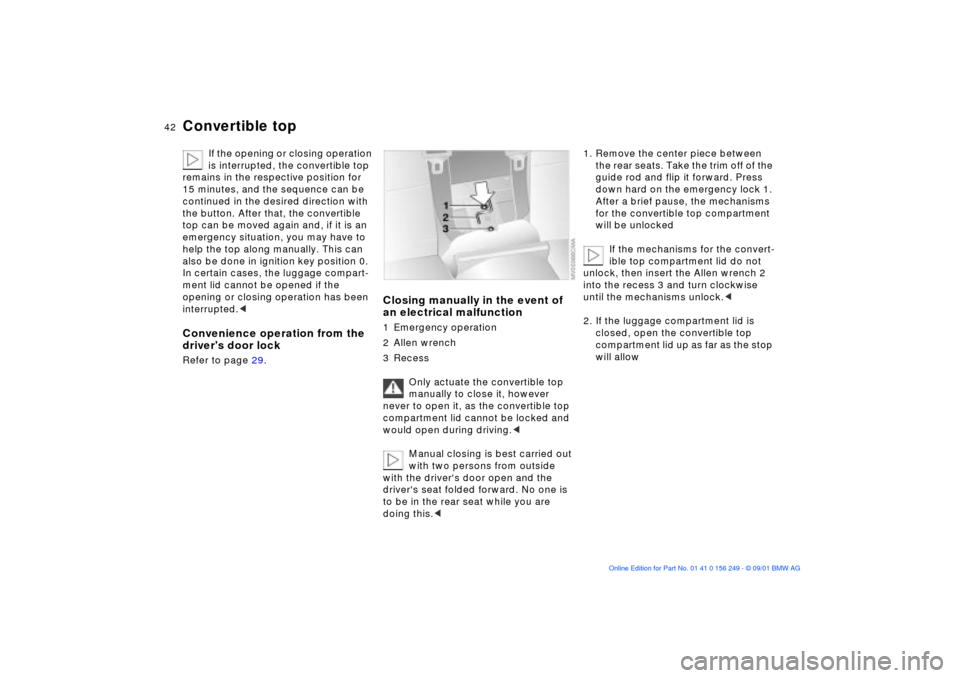
an electrical malfunction1 Emergency operation
2 Allen wrench
3 Recess
Only actuate the convertible top
manually to close it, however
never to open it, as the convertible top
compartment lid cannot be locked and
would open during driving.<
Manual closing is best carried out
with two persons from outside
with the driver's door open and the
driver's seat folded forward. No one is
to be in the rear seat while you are
doing this.<
1. Remove the center piece between
the rear seats. Take the trim off of the
guide rod and flip it forward. Press
down hard on the emergency lock 1.
After a brief pause, the mechanisms
for the convertible top compartment
will be unlocked
If the mechanisms for the convert-
ible top compartment lid do not
unlock, then insert the Allen wrench 2
into the recess 3 and turn clockwise
until the mechanisms unlock.c
2. If the luggage compartment lid is
closed, open the convertible top
compartment lid up as far as the stop
will allow
Page 44 of 159

44n
For relaxed and fatigue-free driving you
should select a sitting position that
reflects your personal requirements.
Correct position combines with safety
belts and airbags to enhance occupant
safety in the event of an accident. To
ensure that the vehicle's safety systems
provide you with optimal protection, we
request that you direct your careful
attention to the following section.
For supplementary information on
transporting children, refer to page 54.
Sitting correctly with airbags
Always maintain an adequate
distance between yourself and the
airbags. Always hold the steering wheel
by the rim to keep any chance of injury
to hands or arms to an absolute
minimum should the airbag be
deployed. Never allow any objects,
individuals or animals to obstruct the
areas between passengers and airbags.
Never use the front airbag's cover as a
storage tray or support for objects of
any kind. Never allow front passengers
to rest their feet or legs on the airbag
cover.<
For airbag locations and additional
information on airbags refer to page 53.
Safe with safety belts
Never allow more than one person
to wear a single safety belt. Never
allow infants or small children to ride in
a passenger's lap. Avoid twisting the
belt while routing it firmly across the
pelvis and shoulder, wear it as snugly
against your body as possible. Do not
allow the belt to rest against hard or
fragile objects in your pockets. Do not
route the belt across your neck, or run it
across sharp edges. Be sure that the
belt does not become caught or
jammed. Avoid wearing bulky clothing
and pull on the lap belt periodically to
retension it over your shoulders. In the
event of a frontal impact, a loose lap
belt could slide over the hips, leading to
abdominal injury. In addition, the safety
belt's restraint effectiveness is reduced
if the belt is worn loosely. Expectant
mothers should always wear their
safety belts, taking care to position the
lap belt against the lower hips, where it
will not exert pressure against the
abdominal area. Leave the rear safety
belts in the holders, if they are not
needed, to avoid unwanted movement
from the safety belts at high speeds.<
For information on using the safety
belts, refer to page 48.
When adjusting your seat, always
observe the following precautions
Never try to adjust your seat while
operating the vehicle. The seat
could respond with an unexpected
movement, and the ensuing loss of
vehicle control could lead to an acci-
dent. Never ride with the backrest
reclined to an extreme angle (especially
important for the front passenger to
remember). If you do so, there is a risk
that you will slide under the safety belt
in an accident, thus reducing the
protection provided by the safety belt.
With the wind deflector in place: never
push the front seats all the way back to
avoid damaging the wind deflector.<
Correct sitting position Seats
Page 45 of 159
45n
OverviewControlsMaintenanceRepairsDataIndex
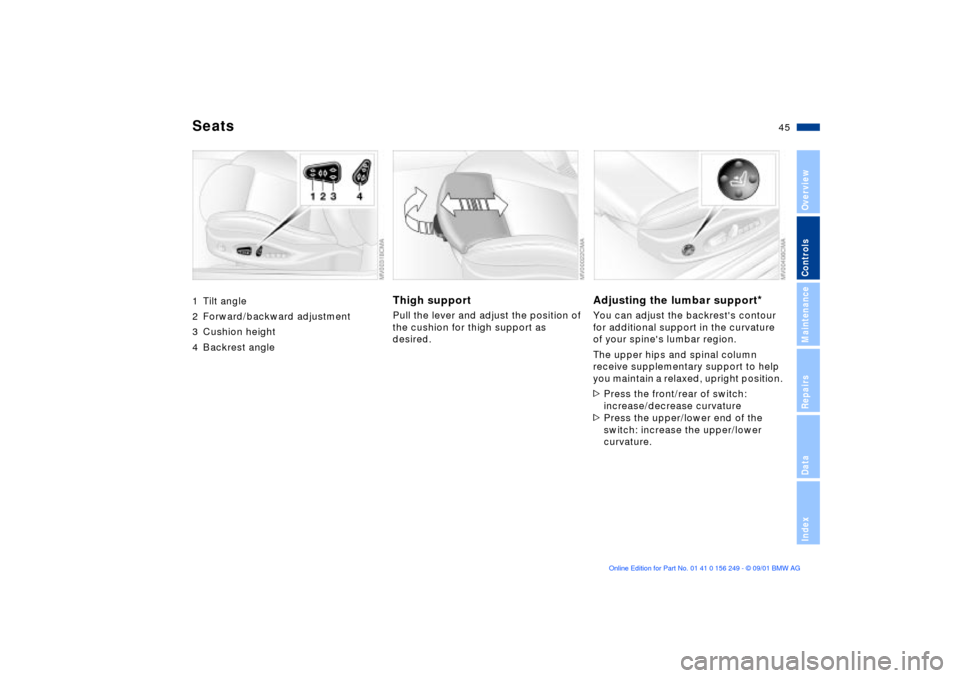
Seats1 Tilt angle
2 Forward/backward adjustment
3 Cushion height
4 Backrest angle
Thigh support Pull the lever and adjust the position of
the cushion for thigh support as
desired.
Adjusting the lumbar support
*
You can adjust the backrest's contour
for additional support in the curvature
of your spine's lumbar region.
The upper hips and spinal column
receive supplementary support to help
you maintain a relaxed, upright position.
>Press the front/rear of switch:
increase/decrease curvature
>Press the upper/lower end of the
switch: increase the upper/lower
curvature.
Page 46 of 159
46n
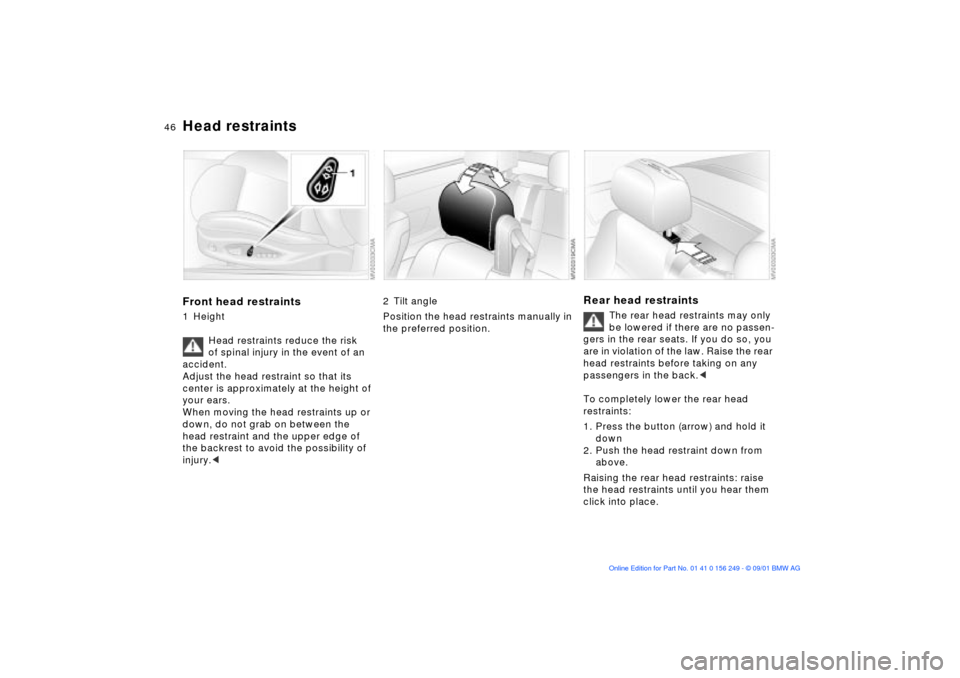
Head restraintsFront head restraints1 Height
Head restraints reduce the risk
of spinal injury in the event of an
accident.
Adjust the head restraint so that its
center is approximately at the height of
your ears.
When moving the head restraints up or
down, do not grab on between the
head restraint and the upper edge of
the backrest to avoid the possibility of
injury.<
2 Tilt angle
Position the head restraints manually in
the preferred position.
Rear head restraints
The rear head restraints may only
be lowered if there are no passen-
gers in the rear seats. If you do so, you
are in violation of the law. Raise the rear
head restraints before taking on any
passengers in the back.<
To completely lower the rear head
restraints:
1. Press the button (arrow) and hold it
down
2. Push the head restraint down from
above.
Raising the rear head restraints: raise
the head restraints until you hear them
click into place.
Page 54 of 159
54n
Airbags
Transporting children safely
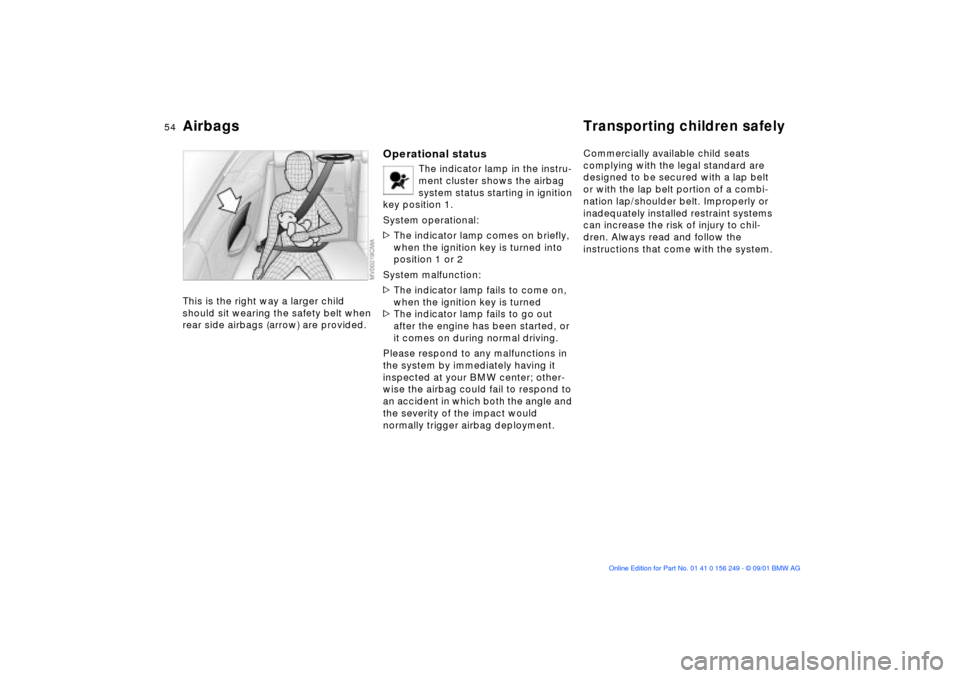
This is the right way a larger child
should sit wearing the safety belt when
rear side airbags (arrow) are provided.
Operational status
The indicator lamp in the instru-
ment cluster shows the airbag
system status starting in ignition
key position 1.
System operational:
>The indicator lamp comes on briefly,
when the ignition key is turned into
position 1 or 2
System malfunction:
>The indicator lamp fails to come on,
when the ignition key is turned
>The indicator lamp fails to go out
after the engine has been started, or
it comes on during normal driving.
Please respond to any malfunctions in
the system by immediately having it
inspected at your BMW center; other-
wise the airbag could fail to respond to
an accident in which both the angle and
the severity of the impact would
normally trigger airbag deployment.
Commercially available child seats
complying with the legal standard are
designed to be secured with a lap belt
or with the lap belt portion of a combi-
nation lap/shoulder belt. Improperly or
inadequately installed restraint systems
can increase the risk of injury to chil-
dren. Always read and follow the
instructions that come with the system.
Page 96 of 159
96n
Storage compartments Cellular phone
*
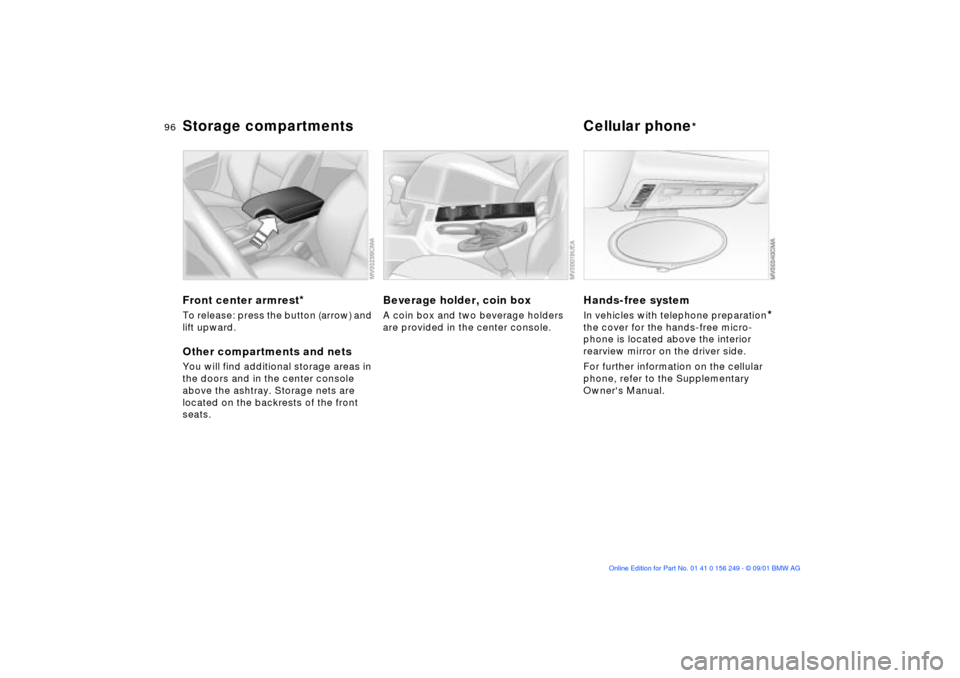
Front center armrest
*
To release: press the button (arrow) and
lift upward.Other compartments and netsYou will find additional storage areas in
the doors and in the center console
above the ashtray. Storage nets are
located on the backrests of the front
seats.
Beverage holder, coin boxA coin box and two beverage holders
are provided in the center console.
Hands-free systemIn vehicles with telephone preparation
*
the cover for the hands-free micro-
phone is located above the interior
rearview mirror on the driver side.
For further information on the cellular
phone, refer to the Supplementary
Owner's Manual.
Page 98 of 159
98n
Ski bag
*
The ski bag allows the safe and clean
transport of up to 3 pairs of standard
skis or up to two snowboards.
The length of the ski bag and the addi-
tional space provided in the luggage
compartment make it possible to carry
skis up to 6.8 ft long (2.1 0 meters).
Because of the tapered shape of the
bag, the ski bag can only accommodate
two pairs of skis up to 6.8 ft long
(2.1 0 meters).
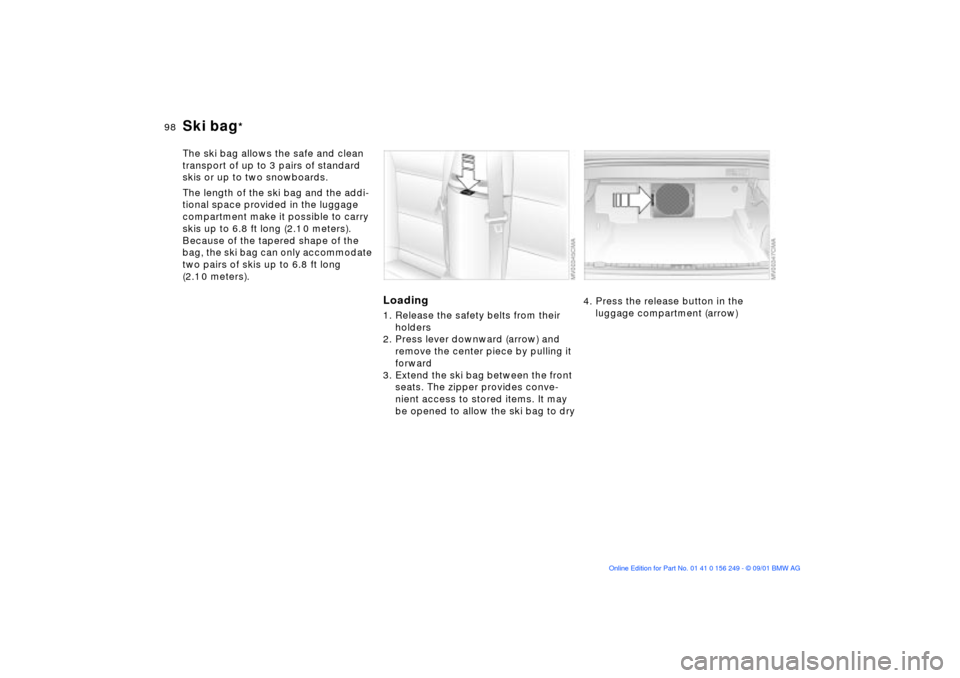
Loading1. Release the safety belts from their
holders
2. Press lever downward (arrow) and
remove the center piece by pulling it
forward
3. Extend the ski bag between the front
seats. The zipper provides conve-
nient access to stored items. It may
be opened to allow the ski bag to dry
4. Press the release button in the
luggage compartment (arrow)
Page 150 of 159

Everything from A to Z
A
ABS (Antilock Brake System) 19, 105
Accessories 10
Activated-charcoal filter 94
Adding brake fluid 119t
coolant 118t
engine oil 116t
washer fluid 115t
Adjusting head restraints 46
lumbar support 45
mirrors 50
seats 45
steering wheel 50
temperature 89
thigh support 45
Air conditioner 89, 93
Air distribution 89
automatic 92
Air outlets 88, 91
Air pressure, tires 109
Air supply 89, 92
Airbags 52
warning lamp 18 Alarm system
37
avoiding unintentional
alarm 38
indicator lamp 38
interior motion sensor 37
tilt alarm sensor 37
Antifreeze 118
radiator 118
Antilock Brake System (ABS) 19, 105
Anti-theft alarm system 37
Anti-theft protection 28
Approved weights 146
Aquaplaning 105, 109
Armrest 96
Ashtray front 97
rear 97
AUC (Automatic recirculated-air
control) 93
Automatic climate control 88, 91
Automatic cruise control 73
Automatic headlight
control 85
Automatic recirculated-air control (AUC) 93 Automatic windshield
washer 72
Auxiliary terminal for jump- starting 114t
Average fuel consumption 79
Average speed 79
Avoiding unintentional alarm 38
B
Backrest unlocking 47
Backup lamps 64
bulb replacement 129t
Battery 136
add distilled water 136t
charge current 17
charging 136t
maintenance 136
Belts 48
Beverage holder 96
Blower 89, 92
BMW Maintenance System 120
Bore 144
Bottle holder, refer to beverage holder 96 Brake fluid change
76
Brake fluid level 105
indicator lamp 17
Brake lamps bulb replacement 129t
center 131
Brake system brake fluid level 105
brake fluid level, warning
lamp 105
brake pads 106
brake pads, indicator
lamp 19
disc brakes 106
indicator lamp 17
malfunction 105
Break-in procedure 104
Bulbs and lamps 126
C
California Proposition 65 Warning 121
Can holder, refer to beverage holder 96
Capacities 147
Car care, refer to the "Caring
for your vehicle" manual
Car telephone 96
Page 152 of 159

Everything from A to ZE
Electric power windows39
Electrical accessories,
failure136t
Electrical malfunction
convertible top42t
doors29t
fuel filler door22t
luggage compartment
lid34t
Electrical outlet97
Emergency release of
luggage compartment lid
from luggage
compartment's interior35
Engine
coolant118
coolant, capacity147
data144
displacement144
output144
starting61t
torque144
Engine compartment114
Engine coolant,
adding118t Engine oil
add116t
capacity147
consumption116
for low ambient
temperatures117
oil dip stick116
pressure17
quality117
temperature75
types117
viscosity117
Engine oil level
checking114t
indicator lamp19
Engine speed144
Entering the rear of the
vehicle47
Entry toward rear47
Eyelets, towing139t
F
Failure messages77
Filling capacities147
Filling the washer
reservoir115t
First-aid kit22 Flat tire109
repairing132
Flat Tire Monitor82
indicator lamp17, 19
Fog lamps86
bulb replacement129t
Follow me home lamps85
Footbrake, refer to brake
system106
Front fog lamps86
Front head restraints46
Front seat adjusting44
Fuel24
consumption display76
gauge76
preparation144
Fuel consumption79
Fuel filler door22
electrical
malfunction22t
manual operation22t
Fuel gauge76
Fuel quality24
Fuel tank capacity147
Fuses, replacing136t G
Gas gauge76
Gasoline24
Gearshift lever63
Glove compartment95
Grilles88, 91
Gross vehicle weight146
H
Handbrake63
Hardtop106
Hazard warning flashers14
Hazard warning triangle22
Head restraints46
adjusting46
Headlamp cleaning
system114, 115
Headlamp covers,
care127t
Headlamp flasher86
Headlamp washer system,
capacities147
Heated mirror50
Heated seats49
Heater and
ventilation88, 91
Heavy loads100