warning BMW M3 CONVERTIBLE 2003 E46 Owner's Guide
[x] Cancel search | Manufacturer: BMW, Model Year: 2003, Model line: M3 CONVERTIBLE, Model: BMW M3 CONVERTIBLE 2003 E46Pages: 166, PDF Size: 4.29 MB
Page 92 of 166
92Lamps
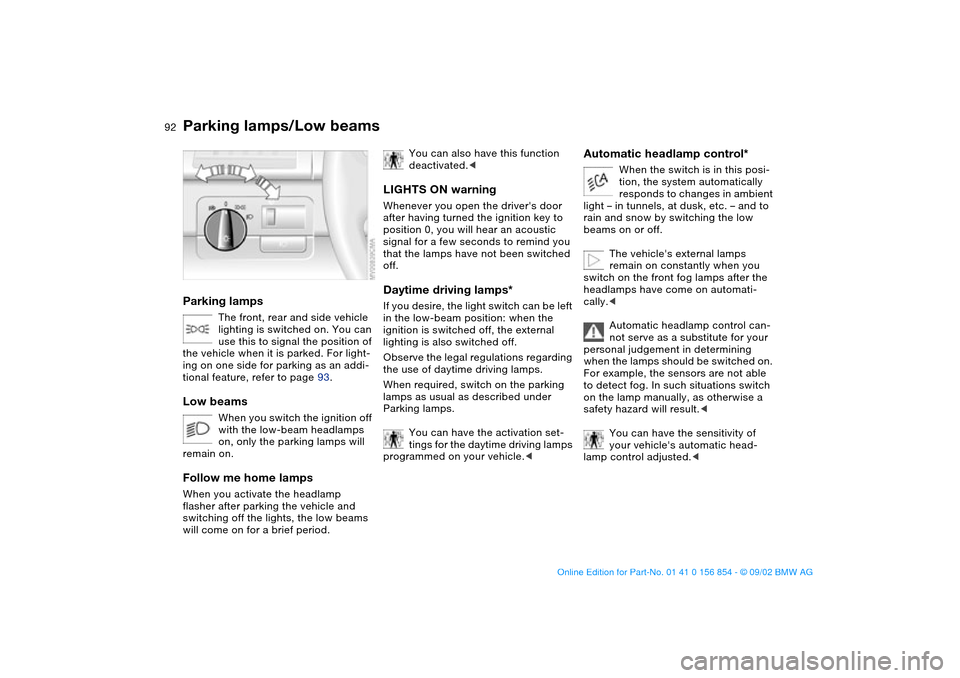
Parking lamps/Low beamsParking lamps
The front, rear and side vehicle
lighting is switched on. You can
use this to signal the position of
the vehicle when it is parked. For light-
ing on one side for parking as an addi-
tional feature, refer to page 93.
Low beams
When you switch the ignition off
with the low-beam headlamps
on, only the parking lamps will
remain on.
Follow me home lampsWhen you activate the headlamp
flasher after parking the vehicle and
switching off the lights, the low beams
will come on for a brief period.
You can also have this function
deactivated.<
LIGHTS ON warningWhenever you open the driver's door
after having turned the ignition key to
position 0, you will hear an acoustic
signal for a few seconds to remind you
that the lamps have not been switched
off.Daytime driving lamps*If you desire, the light switch can be left
in the low-beam position: when the
ignition is switched off, the external
lighting is also switched off.
Observe the legal regulations regarding
the use of daytime driving lamps.
When required, switch on the parking
lamps as usual as described under
Parking lamps.
You can have the activation set-
tings for the daytime driving lamps
programmed on your vehicle.<
Automatic headlamp control*
When the switch is in this posi-
tion, the system automatically
responds to changes in ambient
light – in tunnels, at dusk, etc. – and to
rain and snow by switching the low
beams on or off.
The vehicle's external lamps
remain on constantly when you
switch on the front fog lamps after the
headlamps have come on automati-
cally.<
Automatic headlamp control can-
not serve as a substitute for your
personal judgement in determining
when the lamps should be switched on.
For example, the sensors are not able
to detect fog. In such situations switch
on the lamp manually, as otherwise a
safety hazard will result.<
You can have the sensitivity of
your vehicle's automatic head-
lamp control adjusted.<
handbook.book Page 92 Tuesday, July 30, 2002 9:28 AM
Page 125 of 166
125
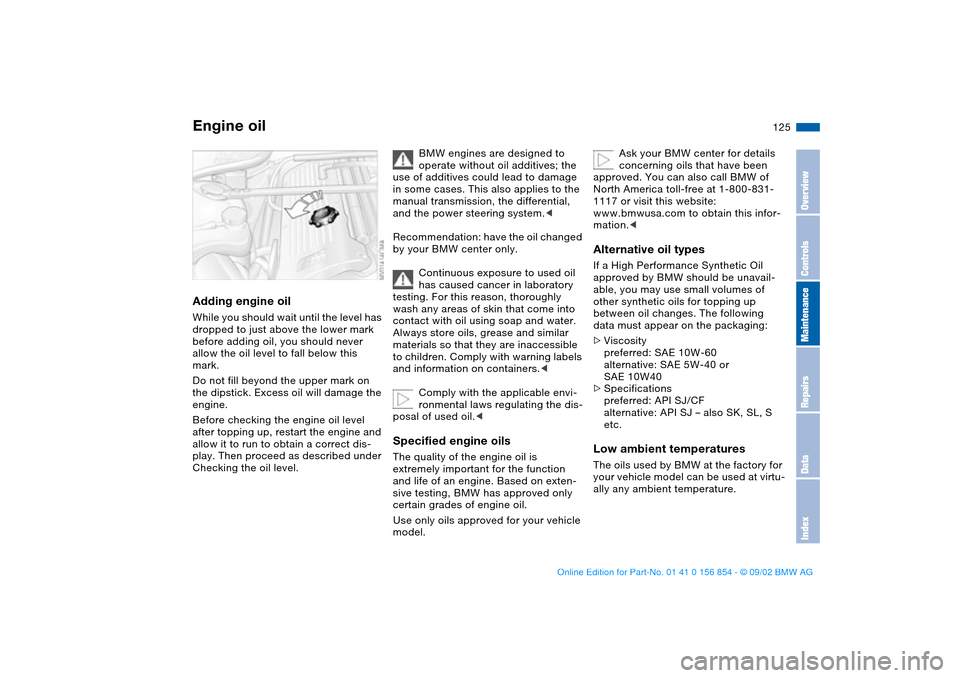
Adding engine oilWhile you should wait until the level has
dropped to just above the lower mark
before adding oil, you should never
allow the oil level to fall below this
mark.
Do not fill beyond the upper mark on
the dipstick. Excess oil will damage the
engine.
Before checking the engine oil level
after topping up, restart the engine and
allow it to run to obtain a correct dis-
play. Then proceed as described under
Checking the oil level.
BMW engines are designed to
operate without oil additives; the
use of additives could lead to damage
in some cases. This also applies to the
manual transmission, the differential,
and the power steering system.<
Recommendation: have the oil changed
by your BMW center only.
Continuous exposure to used oil
has caused cancer in laboratory
testing. For this reason, thoroughly
wash any areas of skin that come into
contact with oil using soap and water.
Always store oils, grease and similar
materials so that they are inaccessible
to children. Comply with warning labels
and information on containers.<
Comply with the applicable envi-
ronmental laws regulating the dis-
posal of used oil.<
Specified engine oilsThe quality of the engine oil is
extremely important for the function
and life of an engine. Based on exten-
sive testing, BMW has approved only
certain grades of engine oil.
Use only oils approved for your vehicle
model.
Ask your BMW center for details
concerning oils that have been
approved. You can also call BMW of
North America toll-free at 1-800-831-
1117 or visit this website:
www.bmwusa.com to obtain this infor-
mation.<
Alternative oil typesIf a High Performance Synthetic Oil
approved by BMW should be unavail-
able, you may use small volumes of
other synthetic oils for topping up
between oil changes. The following
data must appear on the packaging:
>Viscosity
preferred: SAE 10W-60
alternative: SAE 5W-40 or
SAE 10W40
>Specifications
preferred: API SJ/CF
alternative: API SJ – also SK, SL, S
etc.Low ambient temperaturesThe oils used by BMW at the factory for
your vehicle model can be used at virtu-
ally any ambient temperature.
Engine oil
OverviewControlsMaintenanceRepairsDataIndex
handbook.book Page 125 Tuesday, July 30, 2002 9:28 AM
Page 127 of 166
127
3. If necessary, add coolant. If the cool-
ant is low, slowly add coolant until
the correct level is reached — do not
overfill.
Comply with the applicable envi-
ronmental laws regulating the dis-
posal of antifreeze agents with corro-
sion inhibitor.<
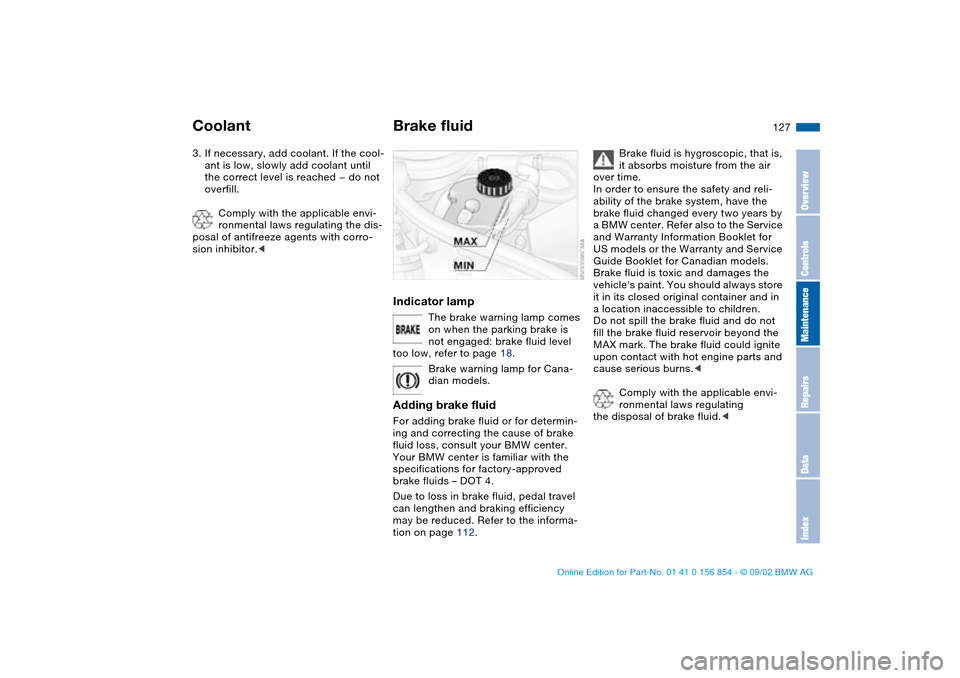
Brake fluidIndicator lamp
The brake warning lamp comes
on when the parking brake is
not engaged: brake fluid level
too low, refer to page 18.
Brake warning lamp for Cana-
dian models.
Adding brake fluidFor adding brake fluid or for determin-
ing and correcting the cause of brake
fluid loss, consult your BMW center.
Your BMW center is familiar with the
specifications for factory-approved
brake fluids – DOT 4.
Due to loss in brake fluid, pedal travel
can lengthen and braking efficiency
may be reduced. Refer to the informa-
tion on page 112.
Brake fluid is hygroscopic, that is,
it absorbs moisture from the air
over time.
In order to ensure the safety and reli-
ability of the brake system, have the
brake fluid changed every two years by
a BMW center. Refer also to the Service
and Warranty Information Booklet for
US models or the Warranty and Service
Guide Booklet for Canadian models.
Brake fluid is toxic and damages the
vehicle's paint. You should always store
it in its closed original container and in
a location inaccessible to children.
Do not spill the brake fluid and do not
fill the brake fluid reservoir beyond the
MAX mark. The brake fluid could ignite
upon contact with hot engine parts and
cause serious burns.<
Comply with the applicable envi-
ronmental laws regulating
the disposal of brake fluid.<
Coolant
OverviewControlsMaintenanceRepairsDataIndex
handbook.book Page 127 Tuesday, July 30, 2002 9:28 AM
Page 130 of 166
130Laws and regulations
California Proposition 65 warningCalifornia laws require us to state the
following warning:
Engine exhaust, some of its con-
stituents, and certain vehicle com-
ponents contain or emit chemicals
known to the State of California to
cause cancer and birth defects and
reproductive harm. In addition, certain
fluids contained in vehicles and certain
products of component wear contain or
emit chemicals known to the State of
California to cause cancer and birth
defects or other reproductive harm.
Battery posts, terminals and related
accessories contain lead and lead com-
pounds. Wash your hands after hand-
ling.
Used engine oil contains chemicals that
have caused cancer in laboratory ani-
mals. Always protect your skin by
washing thoroughly with soap and
water.<
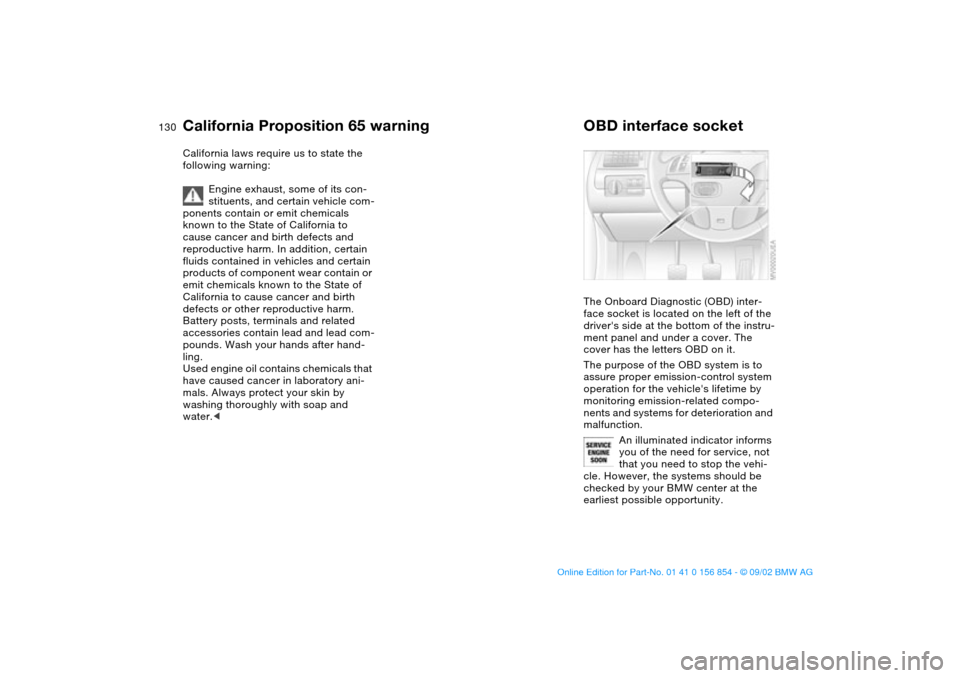
OBD interface socketThe Onboard Diagnostic (OBD) inter-
face socket is located on the left of the
driver's side at the bottom of the instru-
ment panel and under a cover. The
cover has the letters OBD on it.
The purpose of the OBD system is to
assure proper emission-control system
operation for the vehicle's lifetime by
monitoring emission-related compo-
nents and systems for deterioration and
malfunction.
An illuminated indicator informs
you of the need for service, not
that you need to stop the vehi-
cle. However, the systems should be
checked by your BMW center at the
earliest possible opportunity.
handbook.book Page 130 Tuesday, July 30, 2002 9:28 AM
Page 131 of 166
131
If the indicator blinks or flashes, this
indicates a high level of engine misfire.
Reduce speed and contact your near-
est BMW center immediately. Severe
engine misfiring for even a short period
of time can seriously damage emission-
control system components, especially
the catalytic converter.
Service Engine Soon warning
lamp for Canadian models.
If the fuel filler cap is not on tight
enough, the OBD system can
detect leaking vapor and the indicator
will light up. If the fuel filler cap is then
tightened, the indicator will usually go
out after a short period of time.
handbook.book Page 131 Tuesday, July 30, 2002 9:28 AM
Page 139 of 166
139
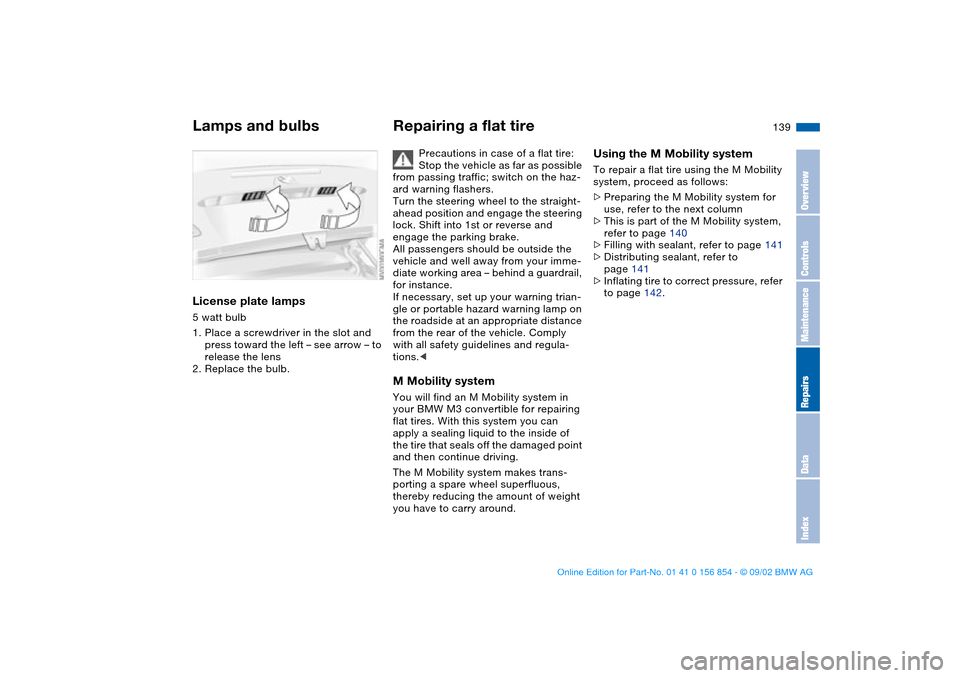
License plate lamps5 watt bulb
1. Place a screwdriver in the slot and
press toward the left – see arrow – to
release the lens
2. Replace the bulb.
Repairing a flat tire
Precautions in case of a flat tire:
Stop the vehicle as far as possible
from passing traffic; switch on the haz-
ard warning flashers.
Turn the steering wheel to the straight-
ahead position and engage the steering
lock. Shift into 1st or reverse and
engage the parking brake.
All passengers should be outside the
vehicle and well away from your imme-
diate working area – behind a guardrail,
for instance.
If necessary, set up your warning trian-
gle or portable hazard warning lamp on
the roadside at an appropriate distance
from the rear of the vehicle. Comply
with all safety guidelines and regula-
tions.<
M Mobility systemYou will find an M Mobility system in
your BMW M3 convertible for repairing
flat tires. With this system you can
apply a sealing liquid to the inside of
the tire that seals off the damaged point
and then continue driving.
The M Mobility system makes trans-
porting a spare wheel superfluous,
thereby reducing the amount of weight
you have to carry around.
Using the M Mobility systemTo repair a flat tire using the M Mobility
system, proceed as follows:
>Preparing the M Mobility system for
use, refer to the next column
>This is part of the M Mobility system,
refer to page 140
>Filling with sealant, refer to page 141
>Distributing sealant, refer to
page 141
>Inflating tire to correct pressure, refer
to page 142.
Lamps and bulbs
OverviewControlsMaintenanceRepairsDataIndex
handbook.book Page 139 Tuesday, July 30, 2002 9:28 AM
Page 140 of 166
140
Preparing the M Mobility system
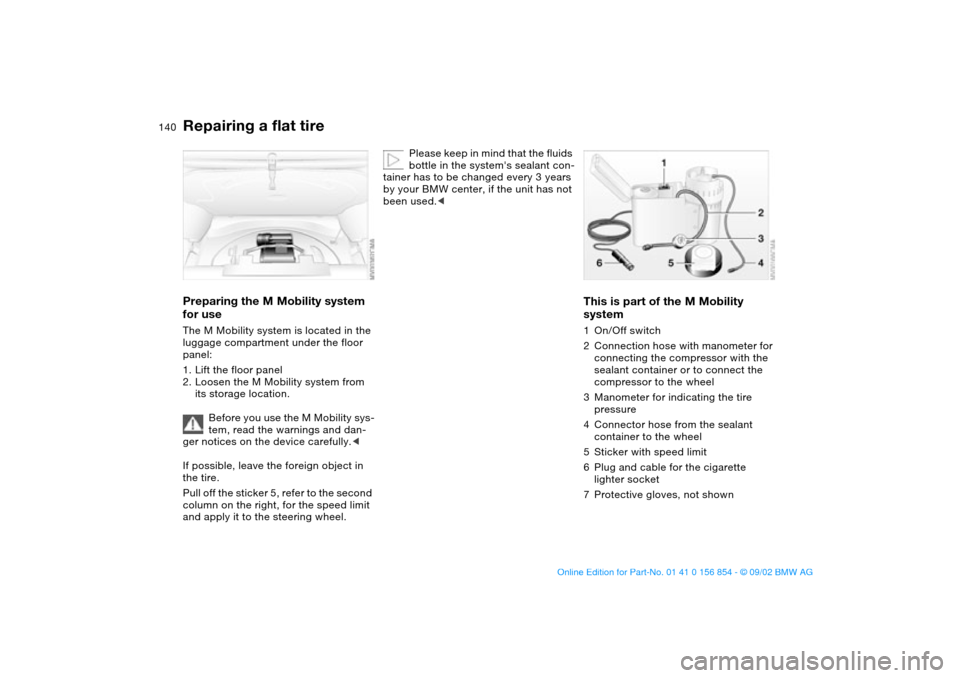
for useThe M Mobility system is located in the
luggage compartment under the floor
panel:
1. Lift the floor panel
2. Loosen the M Mobility system from
its storage location.
Before you use the M Mobility sys-
tem, read the warnings and dan-
ger notices on the device carefully.<
If possible, leave the foreign object in
the tire.
Pull off the sticker 5, refer to the second
column on the right, for the speed limit
and apply it to the steering wheel.
Please keep in mind that the fluids
bottle in the system's sealant con-
tainer has to be changed every 3 years
by your BMW center, if the unit has not
been used.<
This is part of the M Mobility
system1On/Off switch
2Connection hose with manometer for
connecting the compressor with the
sealant container or to connect the
compressor to the wheel
3Manometer for indicating the tire
pressure
4Connector hose from the sealant
container to the wheel
5Sticker with speed limit
6Plug and cable for the cigarette
lighter socket
7Protective gloves, not shown
Repairing a flat tire
handbook.book Page 140 Tuesday, July 30, 2002 9:28 AM
Page 145 of 166
145 Giving and receiving assistance
Jump-startingWhen your battery is discharged, you
can use two jumper cables to start your
vehicle with power from the battery in a
second vehicle. You can also use the
same method to help start another
vehicle. Use only jumper cables with
fully insulated handles on the terminal
clamps.
Do not touch high-voltage wiring
and cables on a running engine.
Contact with components carrying high
voltage can be harmful or fatal.
Carefully observe the following instruc-
tions to avoid personal injury and/or
damage to one or both vehicles.<
1. The battery in the support vehicle
must be rated at 12 volts. This infor-
mation is provided on the battery
label
2. Stop the engine of the support vehi-
cle and switch off all electrical com-
ponents in both vehicles – except for
the hazard warning flashers of the
support vehicle
3. Make absolutely certain that there is
no contact between the bodywork of
the two vehicles – short circuit haz-
ard
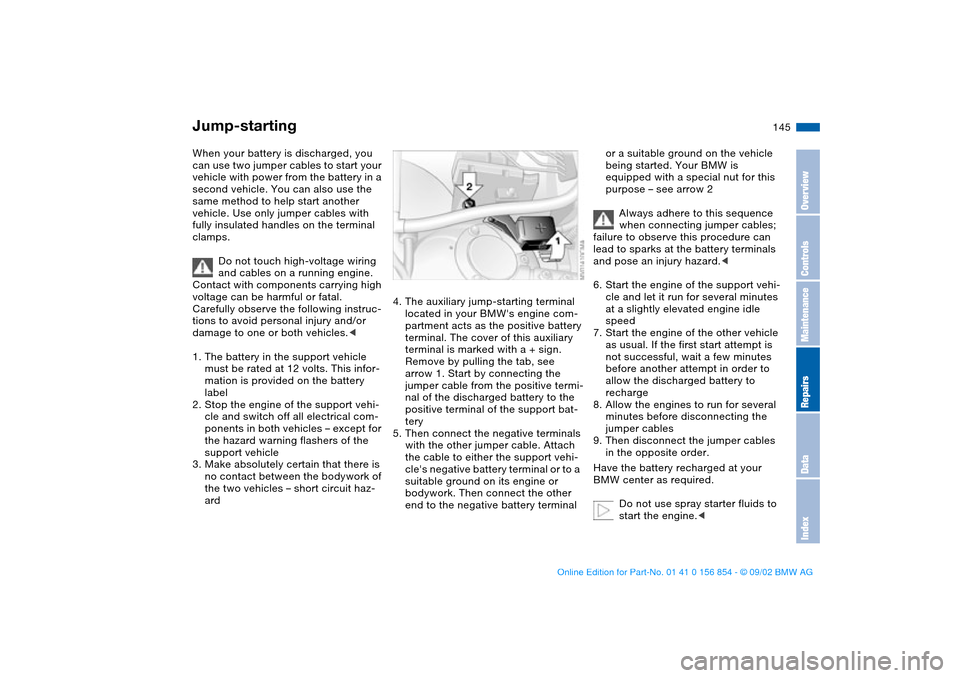
4. The auxiliary jump-starting terminal
located in your BMW's engine com-
partment acts as the positive battery
terminal. The cover of this auxiliary
terminal is marked with a + sign.
Remove by pulling the tab, see
arrow 1. Start by connecting the
jumper cable from the positive termi-
nal of the discharged battery to the
positive terminal of the support bat-
tery
5. Then connect the negative terminals
with the other jumper cable. Attach
the cable to either the support vehi-
cle's negative battery terminal or to a
suitable ground on its engine or
bodywork. Then connect the other
end to the negative battery terminal
or a suitable ground on the vehicle
being started. Your BMW is
equipped with a special nut for this
purpose – see arrow 2
Always adhere to this sequence
when connecting jumper cables;
failure to observe this procedure can
lead to sparks at the battery terminals
and pose an injury hazard.<
6. Start the engine of the support vehi-
cle and let it run for several minutes
at a slightly elevated engine idle
speed
7. Start the engine of the other vehicle
as usual. If the first start attempt is
not successful, wait a few minutes
before another attempt in order to
allow the discharged battery to
recharge
8. Allow the engines to run for several
minutes before disconnecting the
jumper cables
9. Then disconnect the jumper cables
in the opposite order.
Have the battery recharged at your
BMW center as required.
Do not use spray starter fluids to
start the engine.<
OverviewControlsMaintenanceRepairsDataIndex
handbook.book Page 145 Tuesday, July 30, 2002 9:28 AM
Page 147 of 166
147
Use only a nylon towing strap to tow
the vehicle, since the inherent resil-
ience of this material helps protect both
vehicles from sudden jerking move-
ments.
The towed vehicle should always
be the lighter of the two vehicles.
If this is not the case, it will not be pos-
sible to control vehicle handling.
Never attempt to use your vehicle to
push another vehicle, since damage to
the energy-absorbing bumpers could
result.Towing a vehicle1. Gearshift lever in Neutral
2. Towing speed:
Max. 45 mph / 70 km/h
3. Towing distance:
Max. 95 miles/150 km
4. Leave the ignition key at position 1 to
ensure that the brake lamps, turn sig-
nal indicators, horn and windshield
wipers remain operative, and to pre-
vent the steering lock detent from
engaging
5. Switch on the hazard-warning sys-
tem – observe applicable legal regu-
lations.
Find some means of identifying the
vehicle in tow, for instance, place a sign
or warning triangle in the rear window.
Make sure that the ignition key
remains in position 1 even when
the electrical system has failed to pre-
vent the steering lock from engaging.
The steering and brakes are without
power-assist when the engine is off.
This means that increased effort is
required for steering and braking.<
Vehicle with sequential M gearbox
SMG II:
To push or tow, engage selector lever
in position 0.
Never work on the vehicle with a
driving position engaged.<
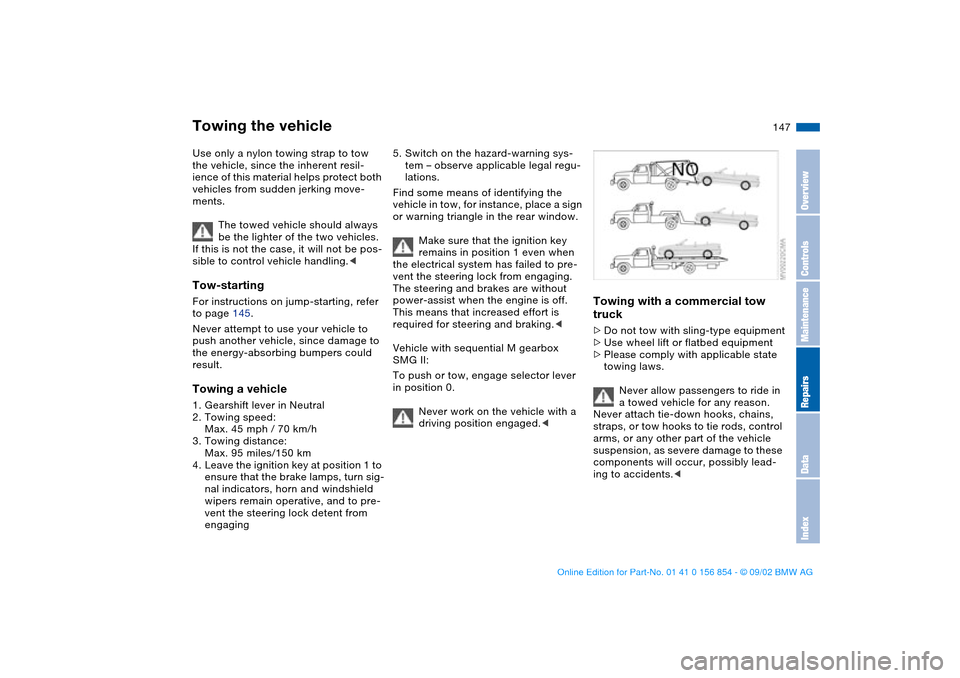
Towing with a commercial tow
truck>Do not tow with sling-type equipment
>Use wheel lift or flatbed equipment
>Please comply with applicable state
towing laws.
Never allow passengers to ride in
a towed vehicle for any reason.
Never attach tie-down hooks, chains,
straps, or tow hooks to tie rods, control
arms, or any other part of the vehicle
suspension, as severe damage to these
components will occur, possibly lead-
ing to accidents.<
Towing the vehicle
OverviewControlsMaintenanceRepairsDataIndex
handbook.book Page 147 Tuesday, July 30, 2002 9:28 AM
Page 156 of 166
Everything from A to ZA
ABS Antilock Brake System
indicator lamp 19
Accessories 5
Activated-charcoal filter 100
Adding brake fluid 122, 127
Air conditioning 98
Air distribution, automatic 98
Air distribution, individual 98
Air nozzles 96
Air outlets 96
Air pressure 115
checking 25
Air supply 98
Air supply vents
recirculated-air mode 99
Airbags 57
warning lamp 18
Alarm system 38
avoiding false alarm 39
indicator lamp 39
interior motion sensor 38
tilt alarm sensor 38
Antifreeze 126
Antilock Brake System
(ABS) 111
indicator lamp 19
Anti-theft system 30, 38
Armrest 101
Ashtray
front 102
rear 103AUC Automatic recircu-
lated-air control 99
Automatic car wash, refer to
the Caring for your vehicle
brochure
Automatic climate control 96
Automatic cruise control 78
Automatic dimming, interior
rearview mirror 56
Automatic headlamp
control 92
Automatic recirculated-air
control (AUC) 99
Auxiliary terminal for jump-
starting 122, 145
Average fuel
consumption 85
Average speed 85
Avoiding unintentional
alarms 39
Axle loads 152
B
Backrests
unlocking 51
Backup lamps 70
replacing bulb 137
Battery 143
charge 143
charge current 18
charge current lamp 18
Belts 52Beverage holder 102
Blower 98
BMW Maintenance
System 128
Bore 150
Bottle holder, see Beverage
holder 102
Brake fluid level 112
warning lamp 18, 127
Brake hydraulic system
warning lamp 18
Brake lamps
replacing bulb 137
Brake pads 112
Brake system
brake fluid level, warning
lamp 18
brake pads, indicator
lamp 19
Brakes
malfunctions 112
parking brake 69
Braking
driving notes 111
Break-in procedures 110
Bulb replacement 135
C
California Proposition
65 warning 130
Can holder, see Beverage
holder 102Capacities 153
Car care, refer to the Caring
for your vehicle brochure
Car vacuum cleaner, con-
necting 103
Car wash, refer to the Caring
for your vehicle brochure
Care, refer to the Caring for
your vehicle brochure
Cargo loading 106
Caring for headlamp cov-
ers, refer to the Caring for
your vehicle brochure 135
CBC Cornering Brake Con-
trol 111
indicator lamp 19
Cellular phone 102
Center armrest 101
Center high-mount brake
lamp 138
Central locking system 30
button 34
Check Control 82
CHECK FILLER CAP
indicator lamp 19
Checking coolant level 126
Checking oil level 124
Child seat 59
Child-restraint systems 59
Cigarette lighter 102
Clean windshield 78
handbook.book Page 156 Tuesday, July 30, 2002 9:28 AM