wheel BMW M3 CONVERTIBLE 2003 E46 Owner's Guide
[x] Cancel search | Manufacturer: BMW, Model Year: 2003, Model line: M3 CONVERTIBLE, Model: BMW M3 CONVERTIBLE 2003 E46Pages: 166, PDF Size: 4.29 MB
Page 116 of 166
116
ceed carefully to the nearest BMW cen-
ter or professional tire center, or have
the vehicle towed in to have it, its
wheels or its tires inspected.
Tire damage, up to and including blow-
outs, can endanger the lives of both the
vehicle occupants and other road
users<
Tire replacementDOT quality grades>Treadwear
>Traction AA A B C
>Temperature A B C
All passenger car tires must con-
form to Federal Safety Require-
ments in addition to these grades.
when tested under controlled condi-
tions on a specified government test
course.
For example, a tire graded 150 would
wear one and one-half – 1
1/2 – times as
well on the government course as a tire
graded 100. The relative performance
of tires depends upon the actual condi-
tions of their use, however, and may
depart significantly from the norm due
to variations in driving habits, service
practices and differences in road char-
acteristics and climate.
TractionThe traction grades, from highest to
lowest, are AA, A, B and C.
Those grades represent the tire's ability
to stop on wet pavement as measured
under controlled conditions on speci-
fied government test surfaces of
asphalt and concrete. A tire marked C
may have poor traction performance.
The traction grade assigned to
this tire is based on straight-
ahead braking traction tests, and does
not include acceleration, cornering,
hydroplaning, or peak traction charac-
teristics.
tire's resistance to the generation of
heat and its ability to dissipate heat
when tested under controlled condi-
tions on a specified indoor laboratory
test wheel.
Sustained high temperature can cause
the material of the tire to degenerate
and reduce tire life, and excessive tem-
perature can lead to sudden tire failure.
The grade C corresponds to a level of
performance which all passenger car
tires must meet under the Federal
Motor Vehicle Safety Standard No. 109.
Tire condition
handbook.book Page 116 Tuesday, July 30, 2002 9:28 AM
Page 117 of 166
117
Grades B and A represent higher levels
of performance on the laboratory test
wheel than the minimum required by
law.
The temperature grade for this tire
is established for a tire that is
properly inflated and not overloaded.
Excessive speed, under-inflation, or
excessive loading, either separately or
in combination, can cause heat buildup
and possible tire failure.
tread shoulder and maximum section
width. For example:
Treadwear 200 Traction AA
Temperature ATire ageThe date on which the tire was manu-
factured is indicated by the code on the
sidewall:
DOT ... 3502 indicates that the tire was
manufactured in week 35 of the year
2002.
BMW recommends the replacement of
all tires when the tires are no more than
6 years old, even if a tire life of 10 years
is possible.Following wheel/tire changesFollowing wheel and/or tire changes
you will need to reinitialize both the Flat
Tire Monitor and the sequential M gear-
box SMG II, refer to pages 75, 89.
Tire replacement
OverviewControlsMaintenanceRepairsDataIndex
handbook.book Page 117 Tuesday, July 30, 2002 9:28 AM
Page 118 of 166
118
Wheel and tire combinationsThe right choice
BMW recommends using only
wheels and tires that have been
approved by BMW for use on your par-
ticular model. Although other wheels
and tires may theoretically have the
same dimensions, variations in factors
such as manufacturing tolerances can
result in contact between tire and body-
work, ultimately leading to serious acci-
dents. If non-approved wheels and tires
are used, BMW cannot evaluate their
suitability, and therefore cannot be held
liable for driving safety.<
BMW tests certain tire brands for each
tire size, classifies them as road-safe
and approves them. Consult your BMW
center for more information. Observe
any country-specific regulations, e.g.
on making a corresponding entry in the
vehicle documents.
The correct wheel and tire combi-
nation affects different systems
such as ABS, DSC, Flat Tire Monitor.
The function of these systems is
impaired if improper wheel and tire
combinations are used.
Therefore, only use tires of the same
brand and same tread configuration on
the vehicle and, for example following a
tire failure, restore the approved wheel
and tire combination as soon as possi-
ble.<
The use of rims and lug bolts that
do not meet the specifications of
the original factory-installed equipment
will affect the safe operation of your
vehicle and may cause an accident and
personal injury.
Never mix tires of different design, such
as steel-belted radials with radial bias-
belted or bias-ply tires, etc. Mixing tire
types will adversely affect roadholding
and can lead to loss of vehicle con-
trol.<
StorageStore wheels and tires in a cool, dry
place, protecting them against light
whenever possible. Protect the tires
against contact with oil, grease and
fuel.
Winter tiresChoosing the right tireBMW recommends winter tires – M+S
tires – for operation under inclement
winter driving conditions. While all-sea-
son tires – M+S designation – provide
better winter traction than the corre-
sponding summer tires, they generally
do not achieve the performance of win-
ter tires.
In the interest of safe tracking and
steering response, install radial tires
made by the same manufacturer and
with the same tread configuration on all
four wheels if you elect to mount winter
tires.
When mounting winter wheels,
observe the different recesses of
the front and rear wheels, as otherwise
damage may result.<
handbook.book Page 118 Tuesday, July 30, 2002 9:28 AM
Page 119 of 166
119
Do not exceed specified
maximum speeds
Never exceed the maximum
speed for which the winter tires
are rated.
Unprofessional attempts by laymen to
service tires can lead to damage and
accidents.
Have this work performed by skilled
professionals only. Your BMW center
will be glad to assist you with both their
expertise and the proper equipment for
your vehicle.<
Tire condition, tire pressureAt tread depth below approx. 3/16 in /
4 mm, their performance under winter
driving conditions deteriorates notice-
ably. Worn tires should therefore be
replaced for safety considerations.
Comply with the specified tire inflation
pressures – and be sure to have the
wheel and tire assembly balanced
every time you change a tire or wheel.
Snow chains*Only certain snow chains have been
tested by BMW and determined and
approved as roadworthy. Consult your
BMW center for more information.
BMW recommends using only these
approved fine-link snow chains. Use
them in pairs on winter tires, but only on
both rear wheels.
Comply with all manufacturer's safety
precautions when mounting the chains.
Do not exceed a speed of 30 mph /
50 km/h with snow chains.
After mounting or removing snow
chains, always reinitialize the sequential
M gearbox SMG II, refer to page 89.
It is not possible to mount snow
chains on tires with 18- and 19-
inch wheels.
Deactivate the Flat Tire Monitor when
using snow chains. Malfunction warn-
ings and undetected losses in pressure
are a possibility when driving with snow
chains.
For additional information, refer to
page 88.<
Winter tires
OverviewControlsMaintenanceRepairsDataIndex
handbook.book Page 119 Tuesday, July 30, 2002 9:28 AM
Page 139 of 166
139
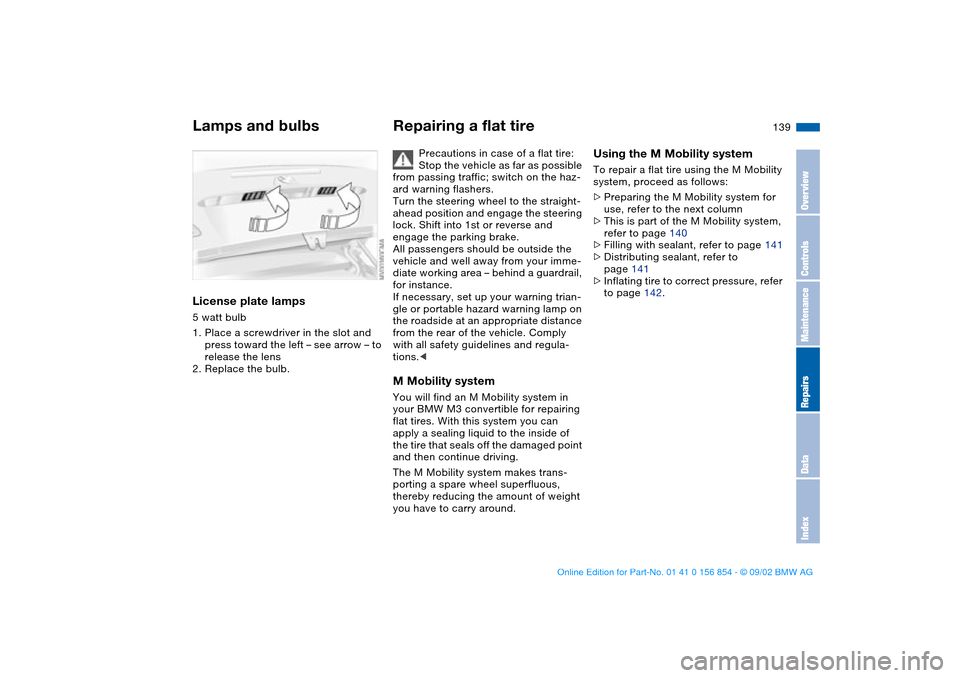
License plate lamps5 watt bulb
1. Place a screwdriver in the slot and
press toward the left – see arrow – to
release the lens
2. Replace the bulb.
Repairing a flat tire
Precautions in case of a flat tire:
Stop the vehicle as far as possible
from passing traffic; switch on the haz-
ard warning flashers.
Turn the steering wheel to the straight-
ahead position and engage the steering
lock. Shift into 1st or reverse and
engage the parking brake.
All passengers should be outside the
vehicle and well away from your imme-
diate working area – behind a guardrail,
for instance.
If necessary, set up your warning trian-
gle or portable hazard warning lamp on
the roadside at an appropriate distance
from the rear of the vehicle. Comply
with all safety guidelines and regula-
tions.<
M Mobility systemYou will find an M Mobility system in
your BMW M3 convertible for repairing
flat tires. With this system you can
apply a sealing liquid to the inside of
the tire that seals off the damaged point
and then continue driving.
The M Mobility system makes trans-
porting a spare wheel superfluous,
thereby reducing the amount of weight
you have to carry around.
Using the M Mobility systemTo repair a flat tire using the M Mobility
system, proceed as follows:
>Preparing the M Mobility system for
use, refer to the next column
>This is part of the M Mobility system,
refer to page 140
>Filling with sealant, refer to page 141
>Distributing sealant, refer to
page 141
>Inflating tire to correct pressure, refer
to page 142.
Lamps and bulbs
OverviewControlsMaintenanceRepairsDataIndex
handbook.book Page 139 Tuesday, July 30, 2002 9:28 AM
Page 140 of 166
140
Preparing the M Mobility system
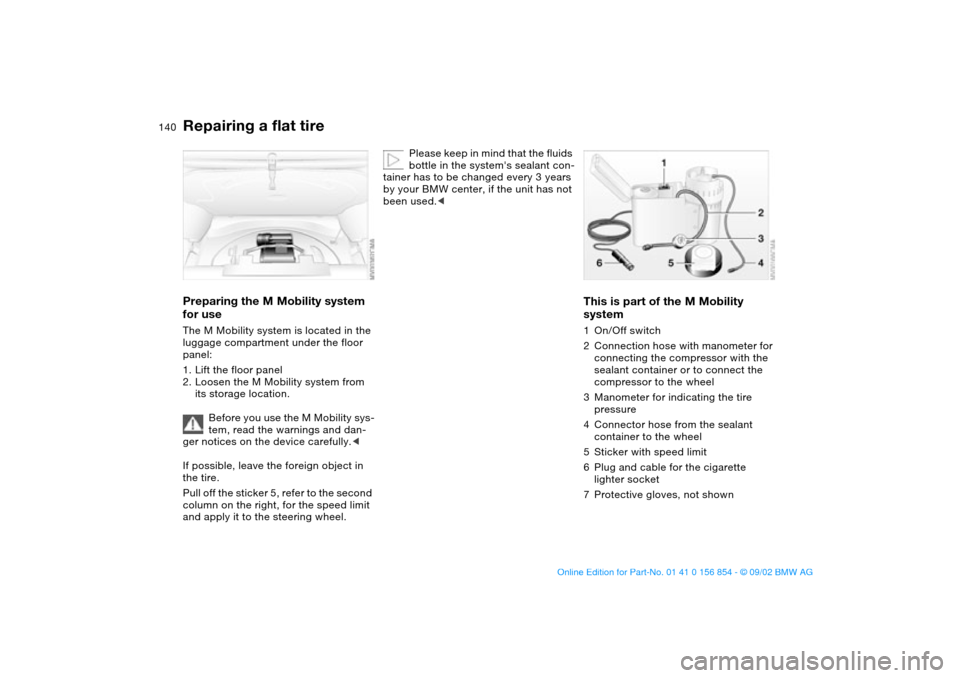
for useThe M Mobility system is located in the
luggage compartment under the floor
panel:
1. Lift the floor panel
2. Loosen the M Mobility system from
its storage location.
Before you use the M Mobility sys-
tem, read the warnings and dan-
ger notices on the device carefully.<
If possible, leave the foreign object in
the tire.
Pull off the sticker 5, refer to the second
column on the right, for the speed limit
and apply it to the steering wheel.
Please keep in mind that the fluids
bottle in the system's sealant con-
tainer has to be changed every 3 years
by your BMW center, if the unit has not
been used.<
This is part of the M Mobility
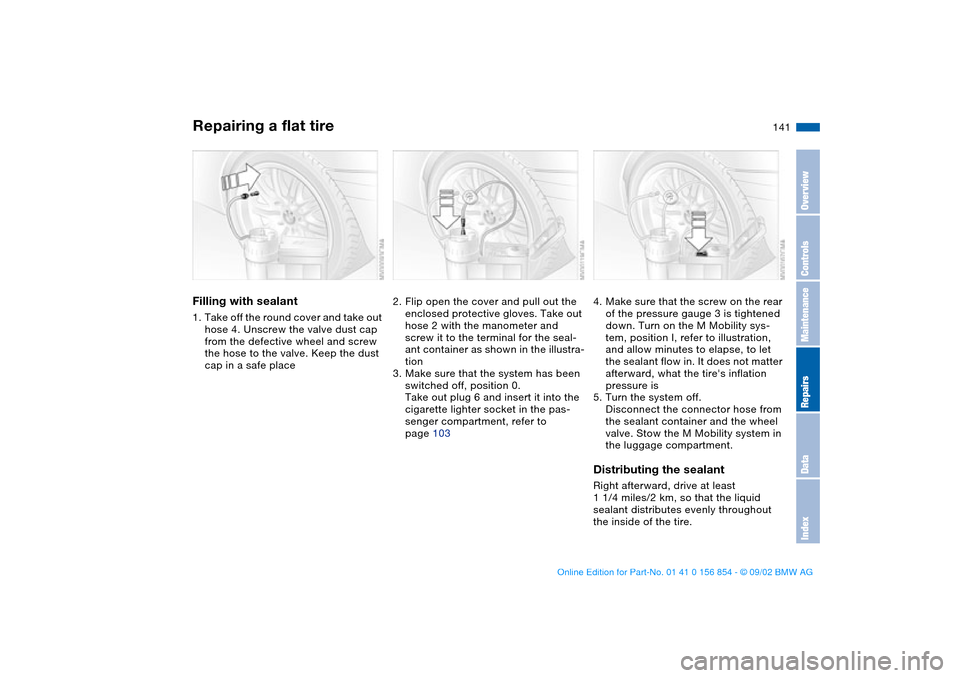
system1On/Off switch
2Connection hose with manometer for
connecting the compressor with the
sealant container or to connect the
compressor to the wheel
3Manometer for indicating the tire
pressure
4Connector hose from the sealant
container to the wheel
5Sticker with speed limit
6Plug and cable for the cigarette
lighter socket
7Protective gloves, not shown
Repairing a flat tire
handbook.book Page 140 Tuesday, July 30, 2002 9:28 AM
Page 141 of 166
141
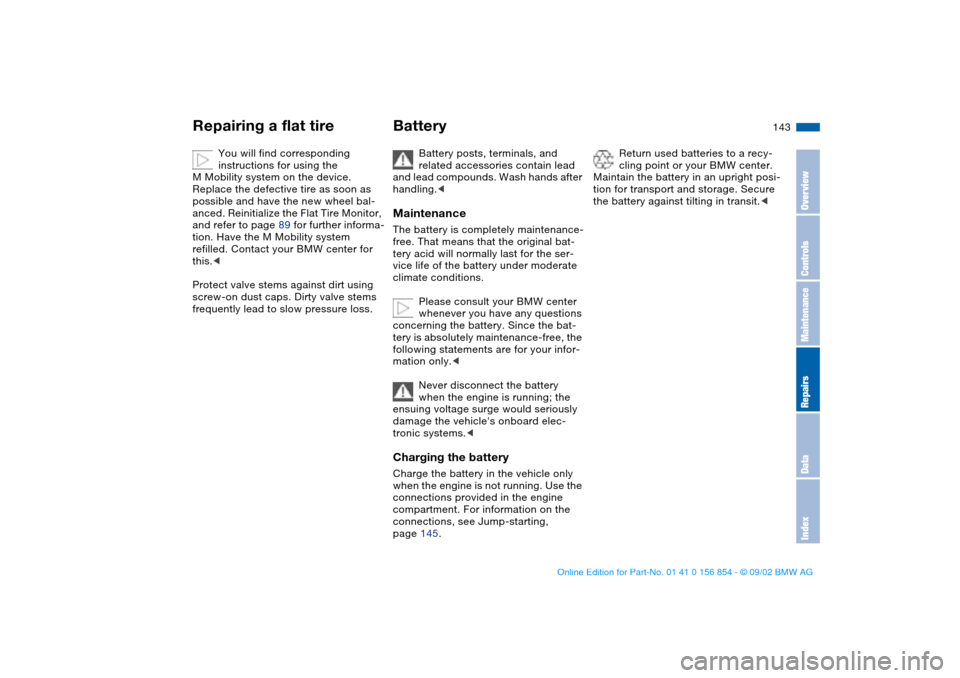
Filling with sealant1. Take off the round cover and take out
hose 4. Unscrew the valve dust cap
from the defective wheel and screw
the hose to the valve. Keep the dust
cap in a safe place
2. Flip open the cover and pull out the
enclosed protective gloves. Take out
hose 2 with the manometer and
screw it to the terminal for the seal-
ant container as shown in the illustra-
tion
3. Make sure that the system has been
switched off, position 0.
Take out plug 6 and insert it into the
cigarette lighter socket in the pas-
senger compartment, refer to
page 103
4. Make sure that the screw on the rear
of the pressure gauge 3 is tightened
down. Turn on the M Mobility sys-
tem, position I, refer to illustration,
and allow minutes to elapse, to let
the sealant flow in. It does not matter
afterward, what the tire's inflation
pressure is
5. Turn the system off.
Disconnect the connector hose from
the sealant container and the wheel
valve. Stow the M Mobility system in
the luggage compartment.Distributing the sealantRight afterward, drive at least
1 1/4 miles/2 km, so that the liquid
sealant distributes evenly throughout
the inside of the tire.
Repairing a flat tire
OverviewControlsMaintenanceRepairsDataIndex
handbook.book Page 141 Tuesday, July 30, 2002 9:28 AM
Page 143 of 166
143
You will find corresponding
instructions for using the
M Mobility system on the device.
Replace the defective tire as soon as
possible and have the new wheel bal-
anced. Reinitialize the Flat Tire Monitor,
and refer to page 89 for further informa-
tion. Have the M Mobility system
refilled. Contact your BMW center for
this.<
Protect valve stems against dirt using
screw-on dust caps. Dirty valve stems
frequently lead to slow pressure loss.
Battery
Battery posts, terminals, and
related accessories contain lead
and lead compounds. Wash hands after
handling.<
MaintenanceThe battery is completely maintenance-
free. That means that the original bat-
tery acid will normally last for the ser-
vice life of the battery under moderate
climate conditions.
Please consult your BMW center
whenever you have any questions
concerning the battery. Since the bat-
tery is absolutely maintenance-free, the
following statements are for your infor-
mation only.<
Never disconnect the battery
when the engine is running; the
ensuing voltage surge would seriously
damage the vehicle's onboard elec-
tronic systems.
connections provided in the engine
compartment. For information on the
connections, see Jump-starting,
page 145.
Return used batteries to a recy-
cling point or your BMW center.
Maintain the battery in an upright posi-
tion for transport and storage. Secure
the battery against tilting in transit.<
Repairing a flat tire
OverviewControlsMaintenanceRepairsDataIndex
handbook.book Page 143 Tuesday, July 30, 2002 9:28 AM
Page 147 of 166
147
Use only a nylon towing strap to tow
the vehicle, since the inherent resil-
ience of this material helps protect both
vehicles from sudden jerking move-
ments.
The towed vehicle should always
be the lighter of the two vehicles.
If this is not the case, it will not be pos-
sible to control vehicle handling.
Never attempt to use your vehicle to
push another vehicle, since damage to
the energy-absorbing bumpers could
result.Towing a vehicle1. Gearshift lever in Neutral
2. Towing speed:
Max. 45 mph / 70 km/h
3. Towing distance:
Max. 95 miles/150 km
4. Leave the ignition key at position 1 to
ensure that the brake lamps, turn sig-
nal indicators, horn and windshield
wipers remain operative, and to pre-
vent the steering lock detent from
engaging
5. Switch on the hazard-warning sys-
tem – observe applicable legal regu-
lations.
Find some means of identifying the
vehicle in tow, for instance, place a sign
or warning triangle in the rear window.
Make sure that the ignition key
remains in position 1 even when
the electrical system has failed to pre-
vent the steering lock from engaging.
The steering and brakes are without
power-assist when the engine is off.
This means that increased effort is
required for steering and braking.<
Vehicle with sequential M gearbox
SMG II:
To push or tow, engage selector lever
in position 0.
Never work on the vehicle with a
driving position engaged.<
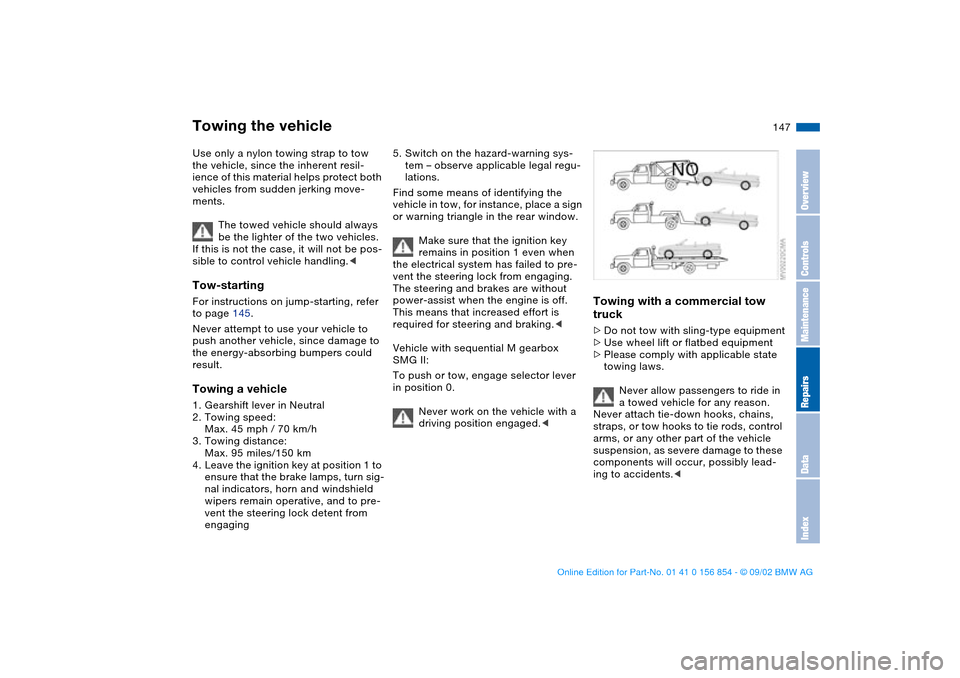
Towing with a commercial tow
truck>Do not tow with sling-type equipment
>Use wheel lift or flatbed equipment
>Please comply with applicable state
towing laws.
Never allow passengers to ride in
a towed vehicle for any reason.
Never attach tie-down hooks, chains,
straps, or tow hooks to tie rods, control
arms, or any other part of the vehicle
suspension, as severe damage to these
components will occur, possibly lead-
ing to accidents.<
Towing the vehicle
OverviewControlsMaintenanceRepairsDataIndex
handbook.book Page 147 Tuesday, July 30, 2002 9:28 AM
Page 159 of 166
Everything from A to Z
159
LATCH child-restraint
mounting system 62
Leather care, refer to the
Caring for your vehicle
brochure
Length 151
License plate lamp
replacing bulb 139
Light switch 92
Lighter 102
Lighting, see lamps
LIGHTS ON warning 92
Load-securing devices 106
Lock, steering wheel 66
Low beams 92
bulb replacement 135
Luggage compartment
35, 37
capacity 152
floor panel 37
increase volume 37
Luggage compartment lid 35
emergency release 36
manual operation 35
opening from the inside 35
remote control 32
securing separately 35
Luggage compartment light-
ing 35
Luggage rack 107
Lumbar support 50M
M Engine dynamics
control 91
M Mobility system 139
M+S tires 118
Maintenance 82, 128
Malfunction displays 82
Manual operation
convertible top 44
Manual transmission 70
Master keys 30
with remote control 30
Memory 53, 65
Microfilter 100
Microphone 102
Mirror defrosting 55
Mirror memory 53
Mirrors 55
automatic curb monitor 54
inside rearview 56
outside 55
Mobility system 139
Modifications, technical 5
Mounting the roof rack 113
Multifunction switch 76
N
Navigation system, refer to
Owner's Manual for
Onboard Computer
Neckrest 50O
OBD interface socket 130
Odometer 80
Oil
additives 125
capacity 153
quality 125
viscosity 125
Oil change interval, see Ser-
vice and Warranty Infor-
mation Booklet for US
models / Warranty and
Service Guide Booklet for
Canadian models
Oil filter change 153
Oil level
checking 124
indicator lamp 19
warning lamp 18
Oil pressure
warning lamp 18
OIL SERVICE 82
Oil types 125
Onboard computer, refer to
the Owner's Manual for
Onboard Computer
Onboard tool kit 134
Opening and closing
from inside 34
via remote control 31
via the door lock 33
Operating elements 14Outlets, ventilation 96
Outside temperature dis-
play 84
P
Paintwork care, refer to the
Caring for your vehicle
brochure
Panic mode, trigger
alarm 32
Park Distance Control
(PDC) 86
Parking aid 86
Parking brake 69
Parking lamps 92
PDC Park Distance
Control 86
Pollen 100
Power output 150
Power seat 49
Pressure, tires 25, 115
R
Radiator 153
Radio navigation, refer to
Owner's Manual for
Radio 85
Radio, refer to the Owner's
Manual for Radio
Rain sensor 77
Range 85
OverviewControlsMaintenanceRepairsDataIndex
handbook.book Page 159 Tuesday, July 30, 2002 9:28 AM