climate control BMW M3 CONVERTIBLE 2004 E46 Owner's Manual
[x] Cancel search | Manufacturer: BMW, Model Year: 2004, Model line: M3 CONVERTIBLE, Model: BMW M3 CONVERTIBLE 2004 E46Pages: 174, PDF Size: 2.67 MB
Page 9 of 174
Contents
9
Driving:
Ignition lock65
Starting the engine and driving
off66
Switching off the engine68
Parking brake68
Manual transmission69
Sequential M gearbox with
Drivelogic*70
Turn signal indicator/Headlamp
flasher75
Washer/wiper system/Rain
sensor*76
Cruise control77
Everything under control:
Odometer79
Tachometer79
Engine oil temperature79
Fuel gauge80
Engine coolant temperature
gauge80
Service interval display81
Check Control81
Clock82
Computer83
Technology for safety and
driving convenience:
Park Distance Control (PDC)*85
Dynamic Stability Control
DSC86
Flat Tire Monitor87
M Engine dynamics control90
Brake force display90
Lamps:
Parking lamps/Low beams91
Instrument lighting92
High beams/Standing lamps92
Fog lamps93
Interior lamps93
Reading lamps93
Controlling the climate for
pleasant driving:
Automatic climate control96
Interior conveniences:
Glove compartment101
Storage compartments101
Cellular phone*102
Ashtray, front*103
Ashtray, rear*103
Loading and transporting:
Ski bag*104
Cargo loading106
Roof-mounted luggage rack for
the hardtop*108
Operation, maintenance
Special operating instructions:
Break-in procedures112
General driving notes113
Antilock Brake System
(ABS)114
Brake system114
Hardtop*115
Wheels and tires:
Tire inflation pressure118
Tire condition118
Tire replacement119
Wheel and tire
combinations121
Winter tires122
Snow chains*122
In the engine compartment:
Hood123
Engine compartment
essentials124
Washer fluids126
Engine oil126
Coolant128
Brake fluid129
Maintenance:
The BMW Maintenance
System130
Laws and regulations:
California Proposition 65
warning132
OBD interface socket132
Controls and features
Page 36 of 174
36
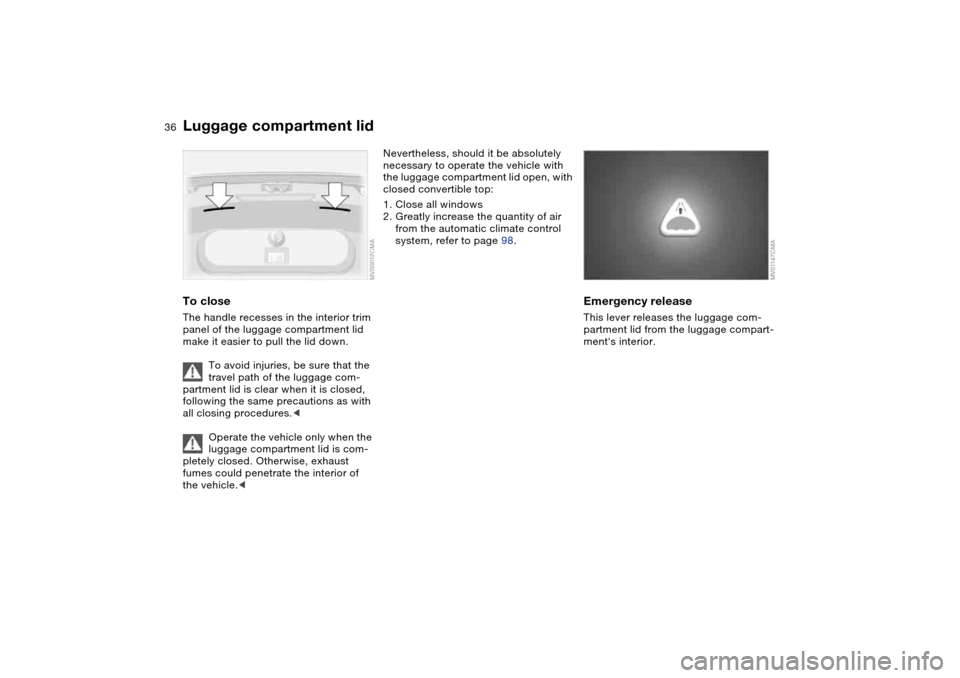
To closeThe handle recesses in the interior trim
panel of the luggage compartment lid
make it easier to pull the lid down.
To avoid injuries, be sure that the
travel path of the luggage com-
partment lid is clear when it is closed,
following the same precautions as with
all closing procedures.<
Operate the vehicle only when the
luggage compartment lid is com-
pletely closed. Otherwise, exhaust
fumes could penetrate the interior of
the vehicle.<
Nevertheless, should it be absolutely
necessary to operate the vehicle with
the luggage compartment lid open, with
closed convertible top:
1. Close all windows
2. Greatly increase the quantity of air
from the automatic climate control
system, refer to page 98.
Emergency releaseThis lever releases the luggage com-
partment lid from the luggage compart-
ment's interior.
Luggage compartment lid
Page 96 of 174
96Controlling the climate for pleasant driving
Automatic climate control
Page 97 of 174
97
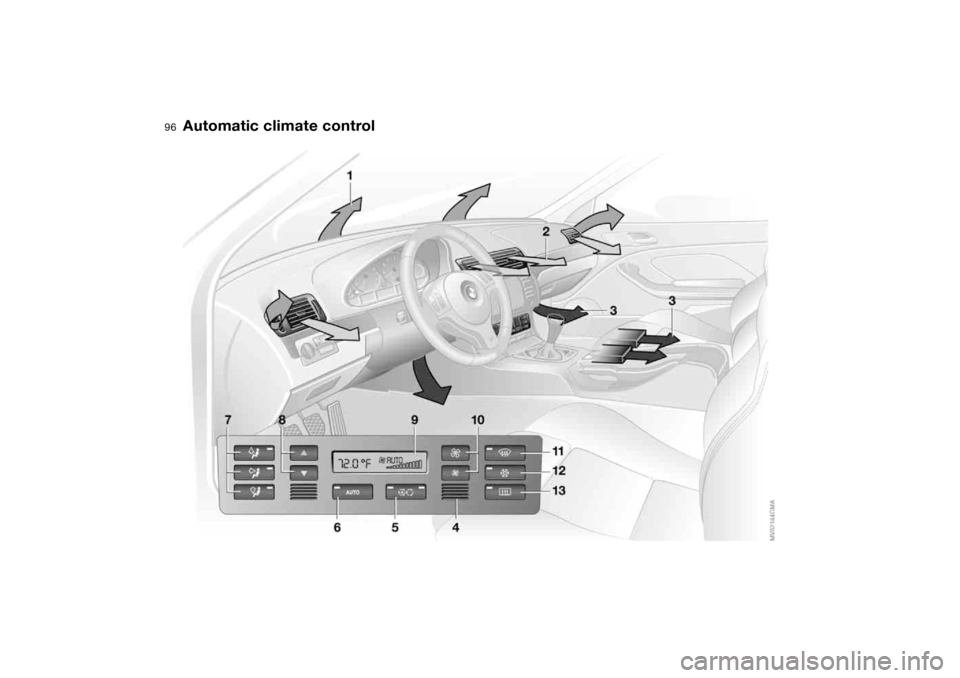
1Air onto the windshield and the side
windows
2Air for the upper body area99
3Air to the footwell
4Interior temperature sensor – please
keep clear and unobstructed
5Outside air/Automatic recirculated-
air control (AUC)/Recirculated
air99
6Automatic air distribution and
supply98
7Individual air distribution98
8Temperature98
9Display for temperature and air
supply98
10 Air supply/Blower98
11 To defrost windows and remove
condensation98
12 Air conditioning98
13 Rear window defroster99Automatic climate control
OverviewControlsMaintenanceRepairsDataIndex
Page 98 of 174
98
Tips for pleasant drivingUse the automatic mode – switch on
with AUTO button 6. Select the desired
interior temperature.
Detailed setting options are described
for you in the following sections.
You can make the settings of your
vehicle in such a manner that,
when you unlock the vehicle with the
remote control of your personal key,
your own personalized setting for the
automatic climate control is initiated.
The AUTO program adjusts the
air distribution and the air sup-
ply for you and in addition adapts the
temperature to external influences –
summer, winter – to meet preferences
you can specify.
Individual air distribution
You can cancel the AUTO pro-
gram by selecting specific dis-
tribution patterns to suit your
own individual requirements.
While the AUTO program is then deacti-
vated, the automatic airflow control
remains in operation. Air flows onto
the windows , toward the upper
body , and into the footwell . You
can reactivate the automatic air supply
by pressing the AUTO button.Temperature
The interior temperature that
appears in the display panel is a
general figure intended for refer-
ence purposes. We recommend
727/+226 as a comfortable setting,
even if the air conditioning is on. When
you start the vehicle, the system
ensures that the selected temperature
is reached as quickly as possible. It
then maintains this temperature,
regardless of the season.
To select the units of measure 6/7
of the display, refer to page 83.
Air supply/Blower
By pressing the upper or lower
button, you can vary the air sup-
ply. This deactivates the auto-
matic air supply – the AUTO display dis-
appears from the panel. Nevertheless,
the automatic air distribution remains
unchanged. You can reactivate the
automatic air supply by pressing the
AUTO button.
When the lowest blower speed is set
and you press the lower button, all of
the displays are canceled: the blower,
heating and air conditioner are
switched off, and the air supply is
stopped. You can reactivate the system
by pressing any button for the auto-
matic climate control.To defrost windows and remove
condensation
This program quickly removes
ice and condensation from the
windshield and the side windows.
Air conditioning
The air is cooled and dehumidi-
fied and – depending on the
temperature setting – rewarmed.
Depending on the weather, the wind-
shield may fog over briefly when the
engine is started. Air conditioning helps
prevent the windows from fogging up.
Condensation forms during opera-
tion of the air conditioning system,
which then exits under the vehicle.
Traces of condensed water of this kind
are thus normal.<
Automatic climate control
Page 99 of 174
99
Outside air/Automatic
recirculated-air control (AUC)/
Recirculated air
You can respond to unpleasant
external odors or pollutants by
temporarily stopping the flow of outside
air. The system then recirculates the air
currently within the vehicle.
By repeatedly pressing the button, you
can select one of three different operat-
ing modes.
>Indicator lamps off: outside air always
flowing into the vehicle
>Left-hand indicator lamp on – auto-
matic mode: the system detects pol-
lutants in the outside air and
responds by deactivating the outside
airflow as required. The system then
recirculates the air currently within
the vehicle.
Depending on air quality require-
ments, the system automatically
switches between outside air supply
and recirculation of the air already
within the vehicle
>Right-hand indicator lamp on: the
flow of outside air is permanently
blocked. The system recirculates the
air already within the vehicle.
If the windows fog over in the
recirculated-air mode, switch the
recirculated-air mode off and increase
the air supply as required.<
Rear window defroster
With the convertible top closed
or with the hardtop* mounted,
press the button. The indicator lamp
remains on. The rear window defroster
switches off automatically.
You can have your vehicle pro-
grammed in such a way that the
rear window defroster switches on
automatically. This occurs within 5 min-
utes after starting the engine when out-
side temperatures are below approx.
397/+46.<
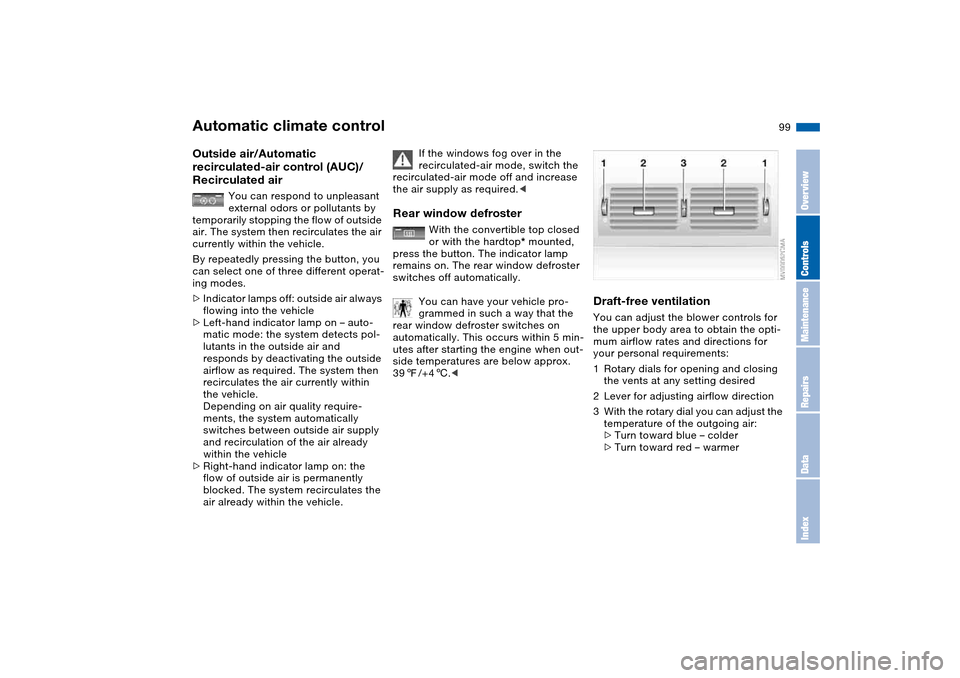
Draft-free ventilationYou can adjust the blower controls for
the upper body area to obtain the opti-
mum airflow rates and directions for
your personal requirements:
1Rotary dials for opening and closing
the vents at any setting desired
2Lever for adjusting airflow direction
3With the rotary dial you can adjust the
temperature of the outgoing air:
>Turn toward blue – colder
>Turn toward red – warmer
Automatic climate control
OverviewControlsMaintenanceRepairsDataIndex
Page 100 of 174
100
Microfilter, activated-charcoal
filterThe built-in microfilter removes dust
and pollen from the incoming air. The
activated-charcoal filter provides addi-
tional protection by filtering gaseous
pollutants from the outside air. Your
BMW center will replace the combined
filter as a standard part of your sched-
uled maintenance. A substantial reduc-
tion in airflow indicates that the filter
needs to be replaced early.Automatic climate control
Page 119 of 174
119
Do not drive on a deflated – flat –
tire. A flat tire greatly impairs
steering and braking response, and can
lead to complete loss of control over
the vehicle.
Avoid overloading the vehicle so that
the permitted load on the tires is not
exceeded. Overloading can lead to
overheating and internal tire damage.
This can result in a sudden loss of tire
inflation pressure.
Unusual vibrations encountered during
normal vehicle operation can indicate
tire failure or some other vehicle defect.
This type of problem can be caused by
contact with curbs, etc. This is also true
for irregularities in the vehicle's han-
dling characteristics, such as a pro-
nounced tendency to pull to the left or
right. Should this occur, respond by
immediately reducing your speed. Pro-
ceed carefully to the nearest BMW cen-
ter or professional tire center, or have
the vehicle towed in to have it, its
wheels or its tires inspected.
Tire damage, up to and including blow-
outs, can endanger the lives of both the
vehicle occupants and other road
users.<
Tire replacementTo maintain good handling characteris-
tics, only use a full set of tires of the
same brand and tread configuration.
Comply with the specified tire inflation
pressures, and be sure to have the
wheel and tire assembly balanced
every time you change a tire or wheel.DOT quality grades>Treadwear
>Traction AA A B C
>Temperature A B C
All passenger car tires must con-
form to Federal Safety Require-
ments in addition to these grades.
when tested under controlled condi-
tions on a specified government test
course.
For example, a tire graded 150 would
wear one and one-half – 1
1/2 – times as
well on the government course as a tire
graded 100. The relative performance
of tires depends upon the actual condi-
tions of their use, however, and may
depart significantly from the norm due
to variations in driving habits, service
practices and differences in road char-
acteristics and climate.TractionThe traction grades, from highest to
lowest, are AA, A, B and C.
Those grades represent the tire's ability
to stop on wet pavement as measured
under controlled conditions on speci-
fied government test surfaces of
asphalt and concrete. A tire marked C
may have poor traction performance.
The traction grade assigned to
this tire is based on straight-
ahead braking traction tests, and does
not include acceleration, cornering,
hydroplaning, or peak traction charac-
teristics.
tire's resistance to the generation of
heat and its ability to dissipate heat
when tested under controlled condi-
tions on a specified indoor laboratory
test wheel.
Tire condition
OverviewControlsMaintenanceRepairsDataIndex
Page 160 of 174
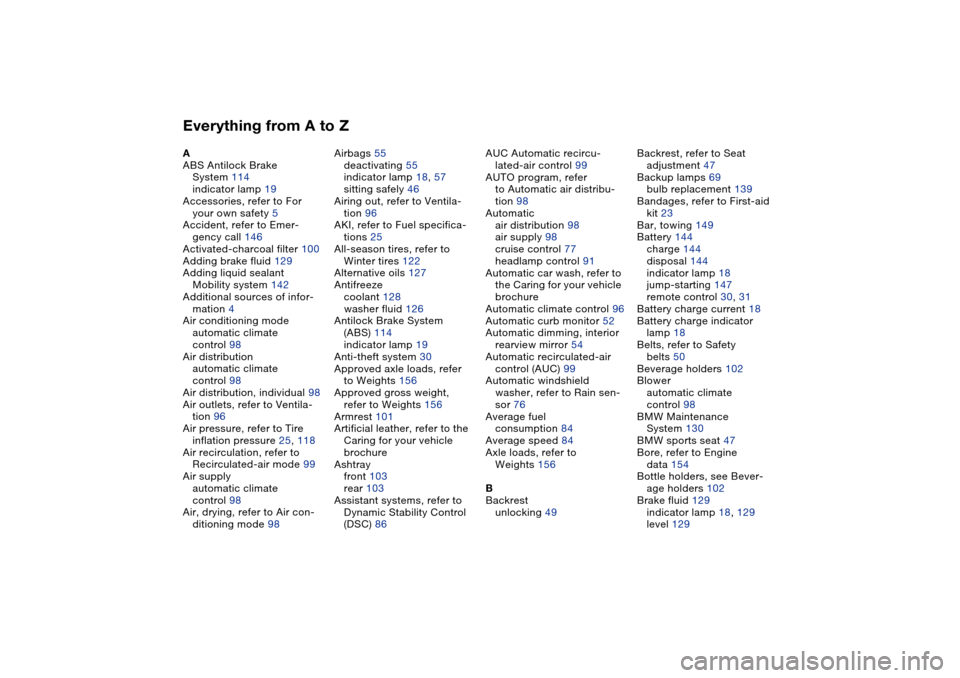
Everything from A to ZA
ABS Antilock Brake
System 114
indicator lamp 19
Accessories, refer to For
your own safety 5
Accident, refer to Emer-
gency call 146
Activated-charcoal filter 100
Adding brake fluid 129
Adding liquid sealant
Mobility system 142
Additional sources of infor-
mation 4
Air conditioning mode
automatic climate
control 98
Air distribution
automatic climate
control 98
Air distribution, individual 98
Air outlets, refer to Ventila-
tion 96
Air pressure, refer to Tire
inflation pressure 25, 118
Air recirculation, refer to
Recirculated-air mode 99
Air supply
automatic climate
control 98
Air, drying, refer to Air con-
ditioning mode 98Airbags 55
deactivating 55
indicator lamp 18, 57
sitting safely 46
Airing out, refer to Ventila-
tion 96
AKI, refer to Fuel specifica-
tions 25
All-season tires, refer to
Winter tires 122
Alternative oils 127
Antifreeze
coolant 128
washer fluid 126
Antilock Brake System
(ABS) 114
indicator lamp 19
Anti-theft system 30
Approved axle loads, refer
to Weights 156
Approved gross weight,
refer to Weights 156
Armrest 101
Artificial leather, refer to the
Caring for your vehicle
brochure
Ashtray
front 103
rear 103
Assistant systems, refer to
Dynamic Stability Control
(DSC) 86AUC Automatic recircu-
lated-air control 99
AUTO program, refer
to Automatic air distribu-
tion 98
Automatic
air distribution 98
air supply 98
cruise control 77
headlamp control 91
Automatic car wash, refer to
the Caring for your vehicle
brochure
Automatic climate control 96
Automatic curb monitor 52
Automatic dimming, interior
rearview mirror 54
Automatic recirculated-air
control (AUC) 99
Automatic windshield
washer, refer to Rain sen-
sor 76
Average fuel
consumption 84
Average speed 84
Axle loads, refer to
Weights 156
B
Backrest
unlocking 49Backrest, refer to Seat
adjustment 47
Backup lamps 69
bulb replacement 139
Bandages, refer to First-aid
kit 23
Bar, towing 149
Battery 144
charge 144
disposal 144
indicator lamp 18
jump-starting 147
remote control 30, 31
Battery charge current 18
Battery charge indicator
lamp 18
Belts, refer to Safety
belts 50
Beverage holders 102
Blower
automatic climate
control 98
BMW Maintenance
System 130
BMW sports seat 47
Bore, refer to Engine
data 154
Bottle holders, see Bever-
age holders 102
Brake fluid 129
indicator lamp 18, 129
level 129
Page 162 of 174
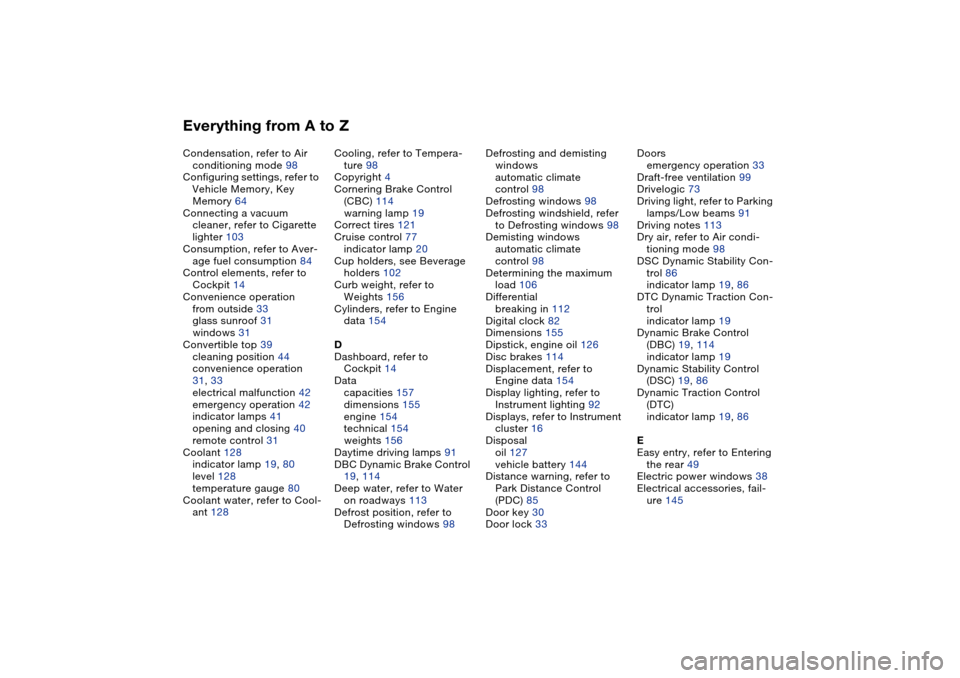
Everything from A to ZCondensation, refer to Air
conditioning mode 98
Configuring settings, refer to
Vehicle Memory, Key
Memory 64
Connecting a vacuum
cleaner, refer to Cigarette
lighter 103
Consumption, refer to Aver-
age fuel consumption 84
Control elements, refer to
Cockpit 14
Convenience operation
from outside 33
glass sunroof 31
windows 31
Convertible top 39
cleaning position 44
convenience operation
31, 33
electrical malfunction 42
emergency operation 42
indicator lamps 41
opening and closing 40
remote control 31
Coolant 128
indicator lamp 19, 80
level 128
temperature gauge 80
Coolant water, refer to Cool-
ant 128Cooling, refer to Tempera-
ture 98
Copyright 4
Cornering Brake Control
(CBC) 114
warning lamp 19
Correct tires 121
Cruise control 77
indicator lamp 20
Cup holders, see Beverage
holders 102
Curb weight, refer to
Weights 156
Cylinders, refer to Engine
data 154
D
Dashboard, refer to
Cockpit 14
Data
capacities 157
dimensions 155
engine 154
technical 154
weights 156
Daytime driving lamps 91
DBC Dynamic Brake Control
19, 114
Deep water, refer to Water
on roadways 113
Defrost position, refer to
Defrosting windows 98Defrosting and demisting
windows
automatic climate
control 98
Defrosting windows 98
Defrosting windshield, refer
to Defrosting windows 98
Demisting windows
automatic climate
control 98
Determining the maximum
load 106
Differential
breaking in 112
Digital clock 82
Dimensions 155
Dipstick, engine oil 126
Disc brakes 114
Displacement, refer to
Engine data 154
Display lighting, refer to
Instrument lighting 92
Displays, refer to Instrument
cluster 16
Disposal
oil 127
vehicle battery 144
Distance warning, refer to
Park Distance Control
(PDC) 85
Door key 30
Door lock 33Doors
emergency operation 33
Draft-free ventilation 99
Drivelogic 73
Driving light, refer to Parking
lamps/Low beams 91
Driving notes 113
Dry air, refer to Air condi-
tioning mode 98
DSC Dynamic Stability Con-
trol 86
indicator lamp 19, 86
DTC Dynamic Traction Con-
trol
indicator lamp 19
Dynamic Brake Control
(DBC) 19, 114
indicator lamp 19
Dynamic Stability Control
(DSC) 19, 86
Dynamic Traction Control
(DTC)
indicator lamp 19, 86
E
Easy entry, refer to Entering
the rear 49
Electric power windows 38
Electrical accessories, fail-
ure 145