brake light BMW M3 CONVERTIBLE 2008 E93 User Guide
[x] Cancel search | Manufacturer: BMW, Model Year: 2008, Model line: M3 CONVERTIBLE, Model: BMW M3 CONVERTIBLE 2008 E93Pages: 172, PDF Size: 5.29 MB
Page 105 of 172
Reference
At a glance
Controls
Driving tips
Mobility
103
BMW M3 engineering
High performance V8 engine
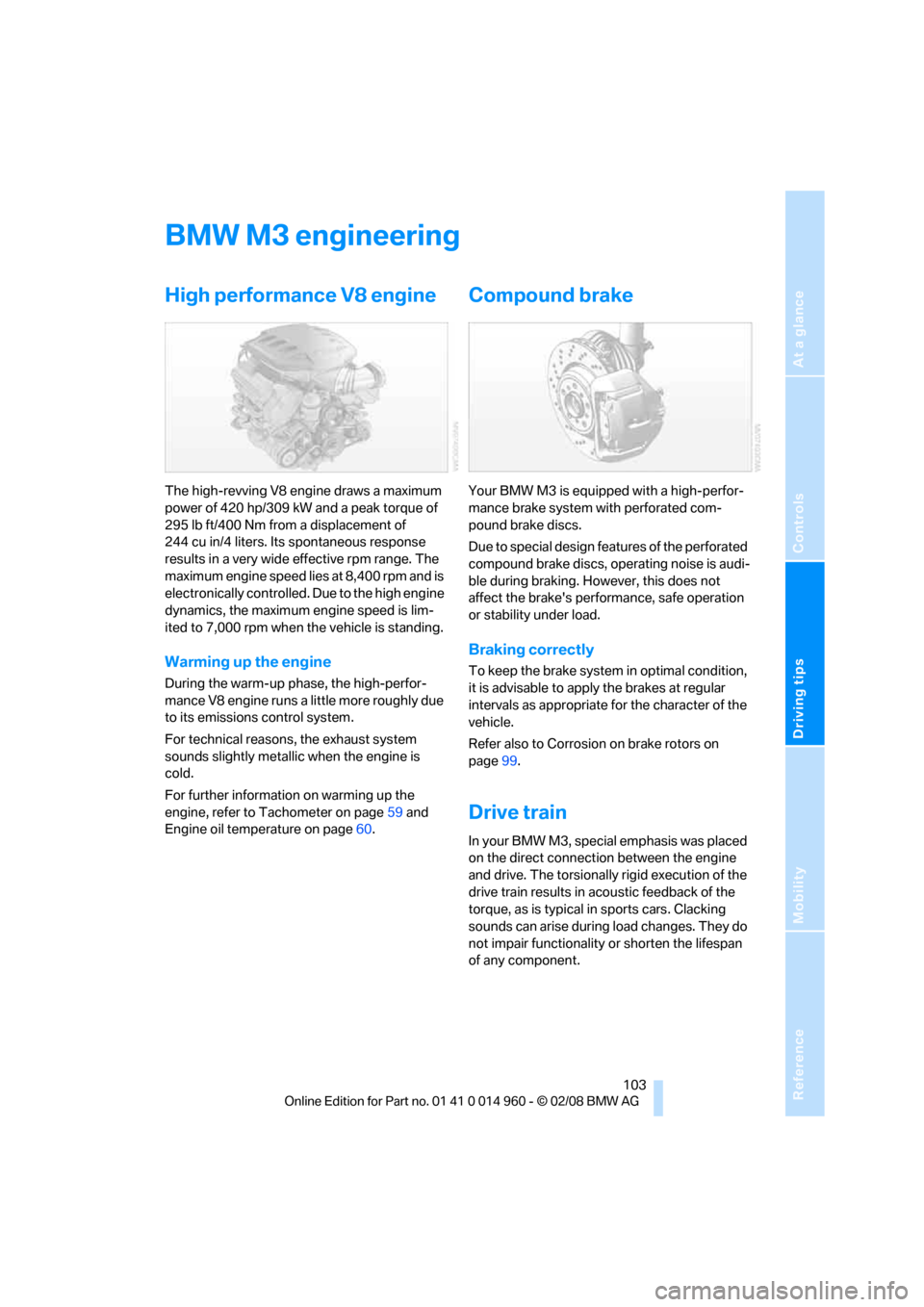
The high-revving V8 engine draws a maximum
power of 420 hp/309 kW and a peak torque of
295 lb ft/400 Nm from a displacement of
244 cu in/4 liters. Its spontaneous response
results in a very wide effective rpm range. The
maximum engine speed lies at 8,400 rpm and is
electronically controlled. Due to the high engine
dynamics, the maximum engine speed is lim-
ited to 7,000 rpm when the vehicle is standing.
Warming up the engine
During the warm-up phase, the high-perfor-
mance V8 engine runs a little more roughly due
to its emissions control system.
For technical reasons, the exhaust system
sounds slightly metallic when the engine is
cold.
For further information on warming up the
engine, refer to Tachometer on page59 and
Engine oil temperature on page60.
Compound brake
Your BMW M3 is equipped with a high-perfor-
mance brake system with perforated com-
pound brake discs.
Due to special design features of the perforated
compound brake discs, operating noise is audi-
ble during braking. However, this does not
affect the brake's performance, safe operation
or stability under load.
Braking correctly
To keep the brake system in optimal condition,
it is advisable to apply the brakes at regular
intervals as appropriate for the character of the
vehicle.
Refer also to Corrosion on brake rotors on
page99.
Drive train
In your BMW M3, special emphasis was placed
on the direct connection between the engine
and drive. The torsionally rigid execution of the
drive train results in acoustic feedback of the
torque, as is typical in sports cars. Clacking
sounds can arise during load changes. They do
not impair functionality or shorten the lifespan
of any component.
Page 132 of 172
Replacing components
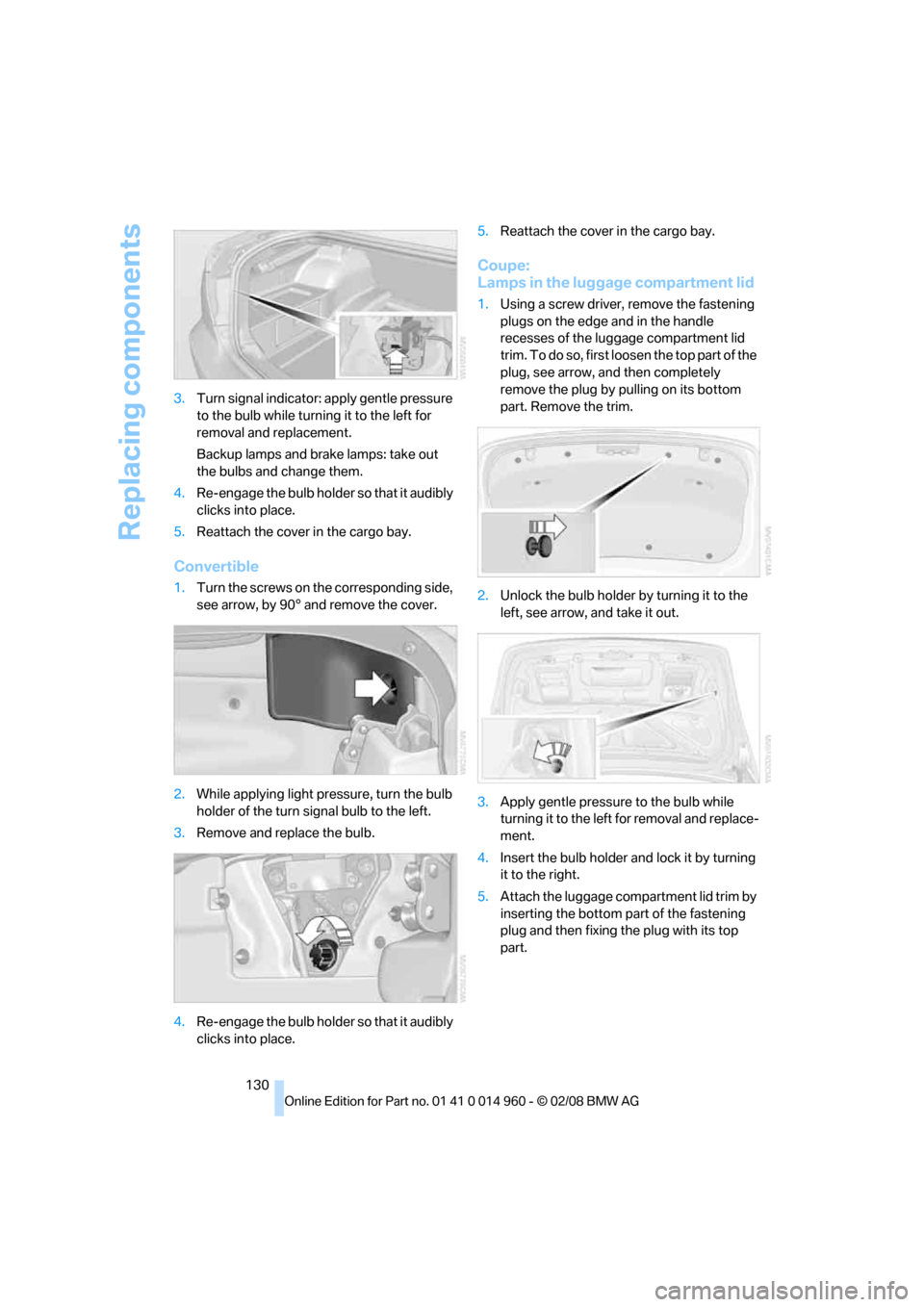
130 3.Turn signal indicator: apply gentle pressure
to the bulb while turning it to the left for
removal and replacement.
Backup lamps and brake lamps: take out
the bulbs and change them.
4.Re-engage the bulb holder so that it audibly
clicks into place.
5.Reattach the cover in the cargo bay.
Convertible
1.Turn the screws on the corresponding side,
see arrow, by 90° and remove the cover.
2.While applying light pressure, turn the bulb
holder of the turn signal bulb to the left.
3.Remove and replace the bulb.
4.Re-engage the bulb holder so that it audibly
clicks into place.5.Reattach the cover in the cargo bay.
Coupe:
Lamps in the luggage compartment lid
1.Using a screw driver, remove the fastening
plugs on the edge and in the handle
recesses of the luggage compartment lid
trim. To do so, first loosen the top part of the
plug, see arrow, and then completely
remove the plug by pulling on its bottom
part. Remove the trim.
2.Unlock the bulb holder by turning it to the
left, see arrow, and take it out.
3.Apply gentle pressure to the bulb while
turning it to the left for removal and replace-
ment.
4.Insert the bulb holder and lock it by turning
it to the right.
5.Attach the luggage compartment lid trim by
inserting the bottom part of the fastening
plug and then fixing the plug with its top
part.
Page 133 of 172
Reference
At a glance
Controls
Driving tips
Mobility
131
License plate lamp, center brake lamp,
rear lamps and side turn signal
indicators
These lamps use LED technology for operation.
In the event of a malfunction, please contact
your BMW center or a workshop that works
according to BMW repair procedures with cor-
respondingly trained personnel.
Repairing a flat tire with the
M Mobility System
To repair a flat tire, your BMW M3 includes an
M Mobility System. With this system you can
apply a sealant to the inside of the tire to seal
the damaged section, restore the tire inflation
pressure and continue on your trip.
Safety measures in the event of a flat tire:
Park the vehicle as far away from moving
traffic as possible and on a firm surface. Switch
on the hazard warning flashers.
Apply the parking brake and engage first gear
or reverse. Have all occupants leave the vehicle
and move beyond the danger zone, e. g. behind
the guard rails.
If necessary, erect a warning triangle
* or warn-
ing flasher
* at a suitable distance. Adhere to
country-specific regulations.<
Preparations
The M Mobility System is located in the cargo
bay under the floor board.
If possible, leave any foreign bodies that have
penetrated the tire in place.
Instructions on how to use the M Mobility
System can also be found on the device
itself.
tle.<
Remove the label with the speed restriction
from the sealant bottle and apply it to the steer-
ing wheel.
Please note the expiry date on the sealant
bottle.<
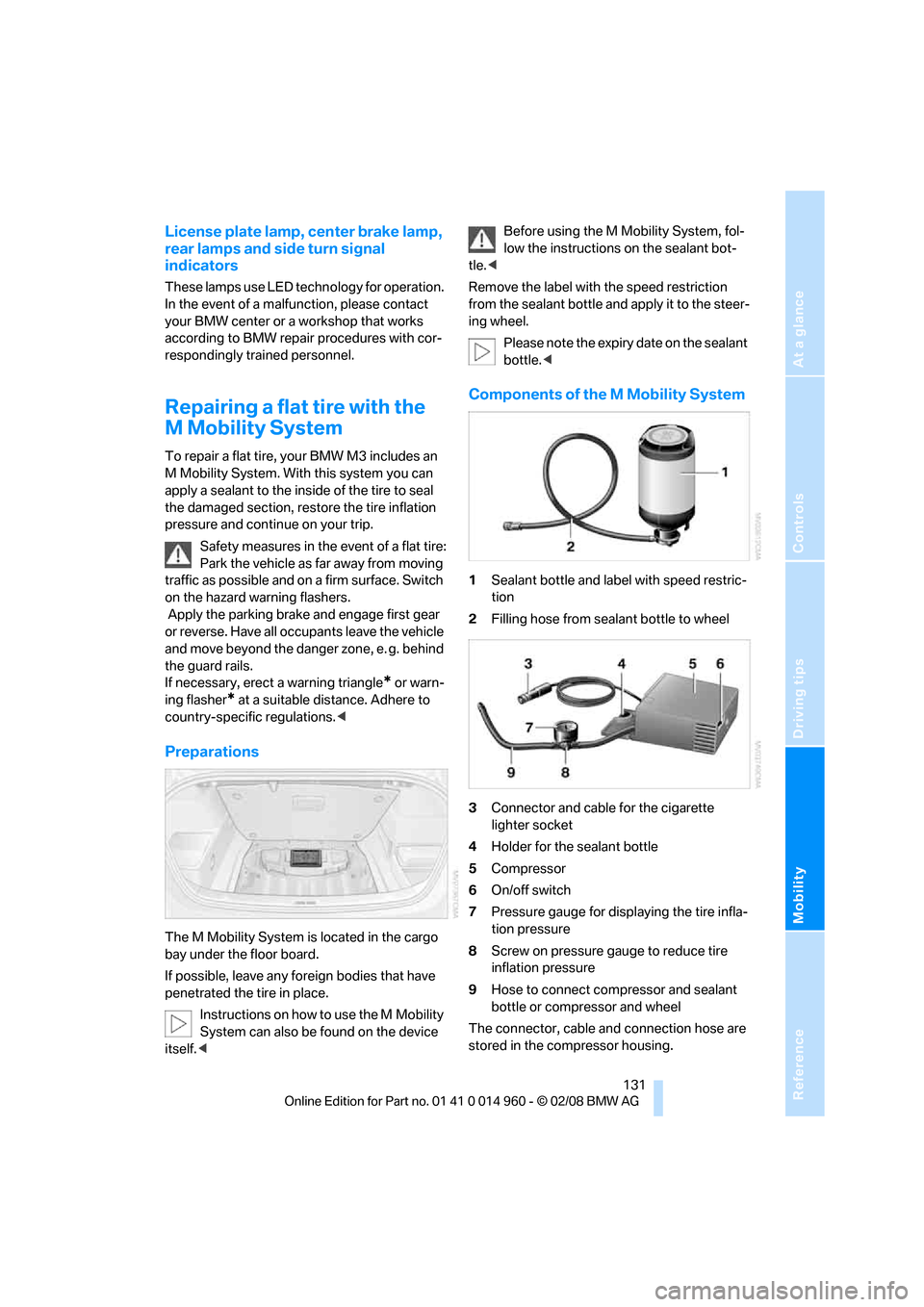
Components of the M Mobility System
1Sealant bottle and label with speed restric-
tion
2Filling hose from sealant bottle to wheel
3Connector and cable for the cigarette
lighter socket
4Holder for the sealant bottle
5Compressor
6On/off switch
7Pressure gauge for displaying the tire infla-
tion pressure
8Screw on pressure gauge to reduce tire
inflation pressure
9Hose to connect compressor and sealant
bottle or compressor and wheel
The connector, cable and connection hose are
stored in the compressor housing.
Page 142 of 172
Indicator and warning lamps
140
Indicator and warning lamps
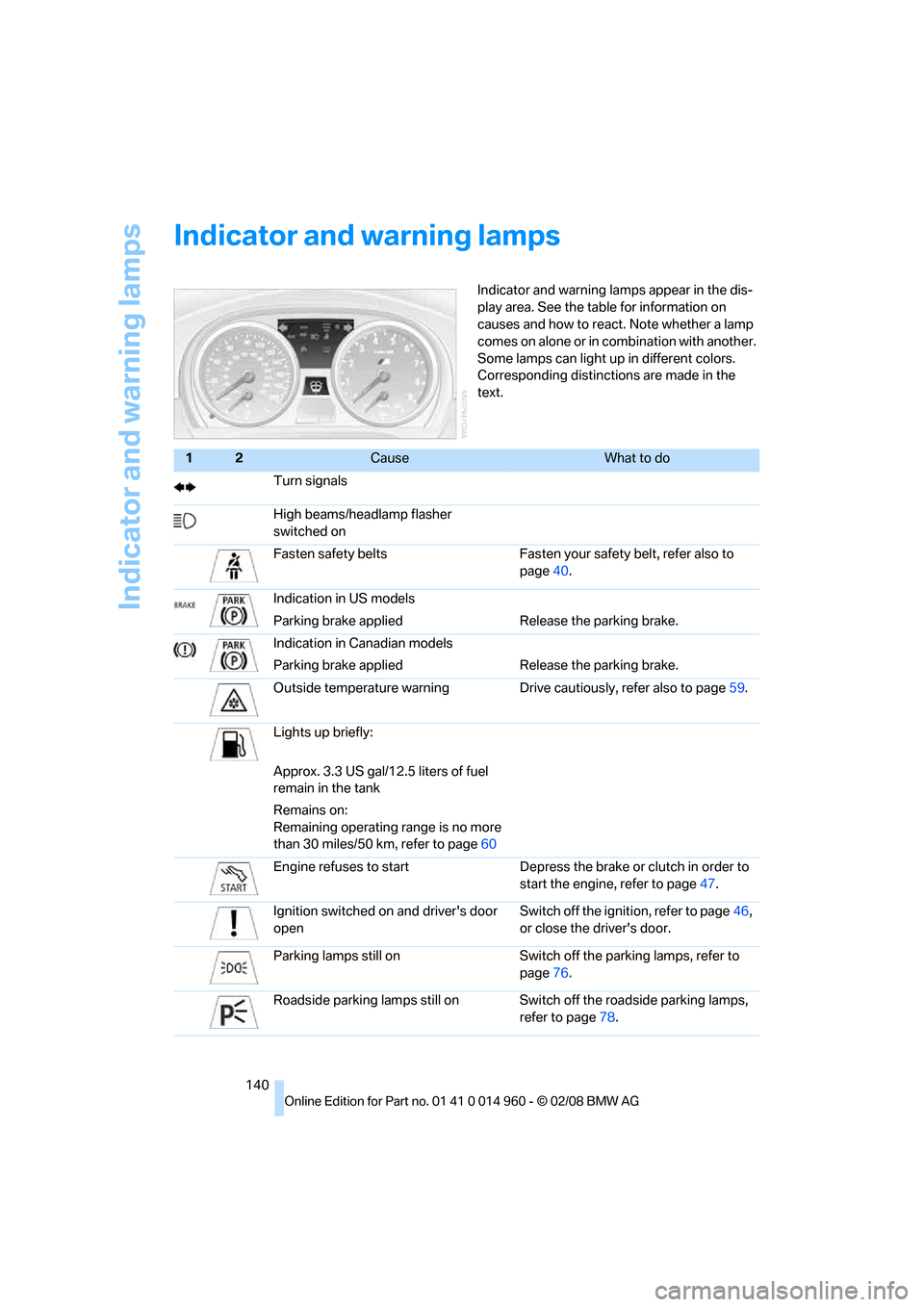
Indicator and warning lamps appear in the dis-
play area. See the table for information on
causes and how to react. Note whether a lamp
comes on alone or in combination with another.
Some lamps can light up in different colors.
Corresponding distinctions are made in the
text.
12Cause What to do
Turn signals
High beams/headlamp flasher
switched on
Fasten safety belts Fasten your safety belt, refer also to
page40.
Indication in US models
Parking brake applied Release the parking brake.
Indication in Canadian models
Parking brake applied Release the parking brake.
Outside temperature warning Drive cautiously, refer also to page59.
Lights up briefly:
Approx. 3.3 US gal/12.5 liters of fuel
remain in the tank
Remains on:
Remaining operating range is no more
than 30 miles/50 km, refer to page60
Engine refuses to start Depress the brake or clutch in order to
start the engine, refer to page47.
Ignition switched on and driver's door
openSwitch off the ignition, refer to page46,
or close the driver's door.
Parking lamps still on Switch off the parking lamps, refer to
page76.
Roadside parking lamps still on Switch off the roadside parking lamps,
refer to page78.
Page 144 of 172
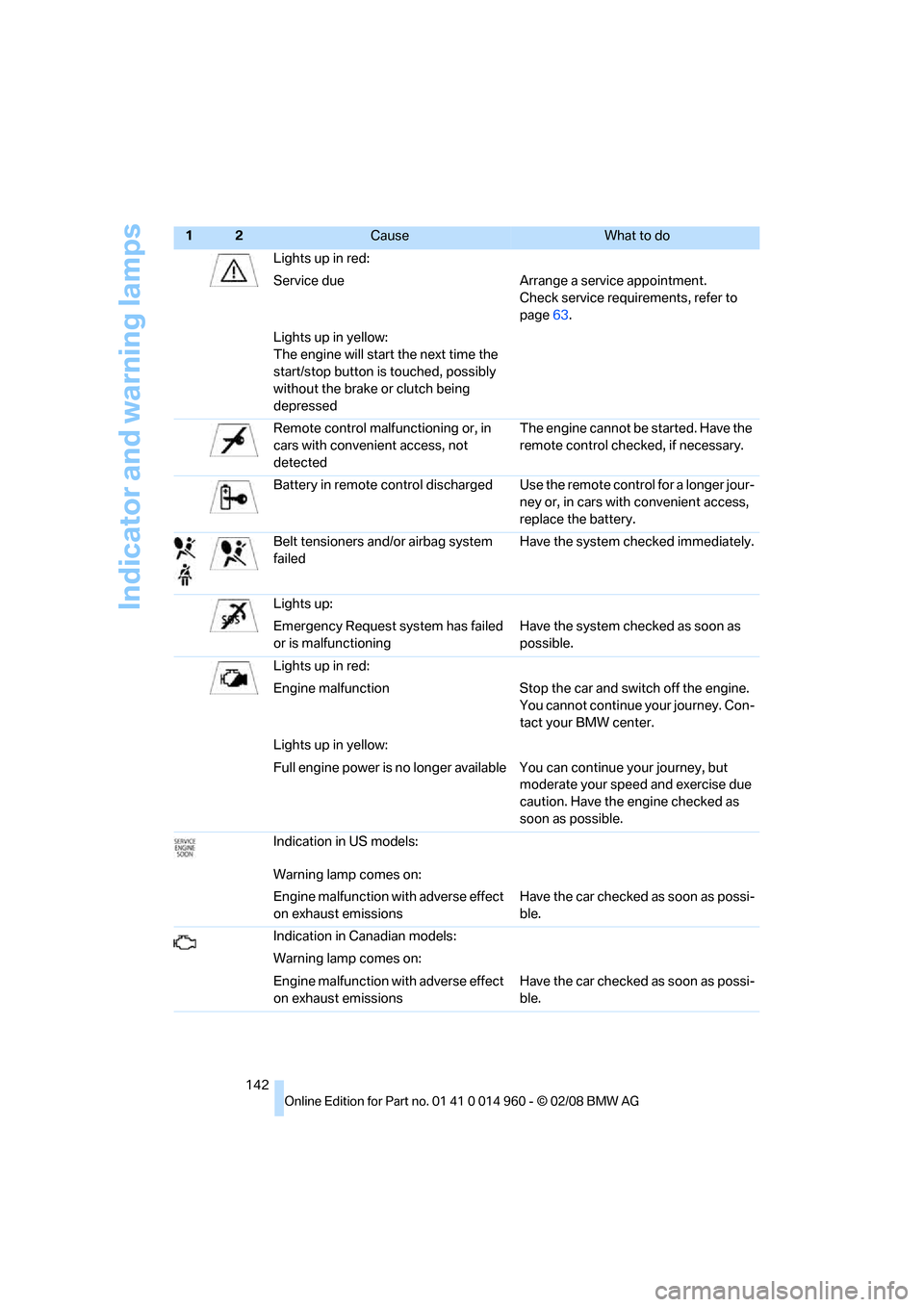
Indicator and warning lamps
142Lights up in red:
Service due Arrange a service appointment.
Check service requirements, refer to
page63.
Lights up in yellow:
The engine will start the next time the
start/stop button is touched, possibly
without the brake or clutch being
depressed
Remote control malfunctioning or, in
cars with convenient access, not
detectedThe engine cannot be started. Have the
remote control checked, if necessary.
Battery in remote control discharged Use the remote control for a longer jour-
ney or, in cars with convenient access,
replace the battery.
Belt tensioners and/or airbag system
failedHave the system checked immediately.
Lights up:
Emergency Request system has failed
or is malfunctioningHave the system checked as soon as
possible.
Lights up in red:
Engine malfunction Stop the car and switch off the engine.
You cannot continue your journey. Con-
tact your BMW center.
Lights up in yellow:
Full engine power is no longer available You can continue your journey, but
moderate your speed and exercise due
caution. Have the engine checked as
soon as possible.
Indication in US models:
Warning lamp comes on:
Engine malfunction with adverse effect
on exhaust emissionsHave the car checked as soon as possi-
ble.
Indication in Canadian models:
Warning lamp comes on:
Engine malfunction with adverse effect
on exhaust emissionsHave the car checked as soon as possi-
ble.
12Cause What to do
Page 145 of 172
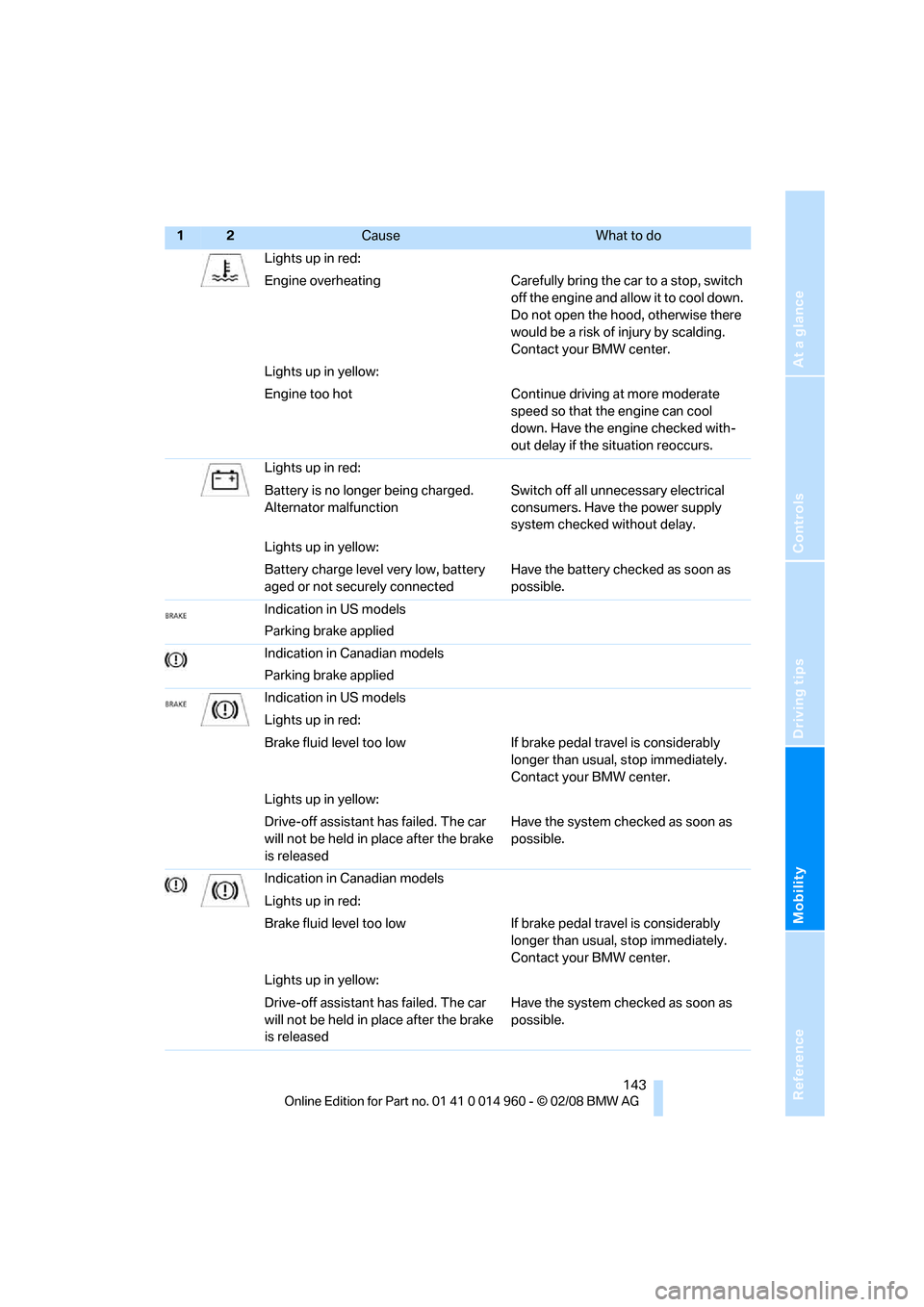
Reference
At a glance
Controls
Driving tips
Mobility
143
Lights up in red:
Engine overheating Carefully bring the car to a stop, switch
off the engine and allow it to cool down.
Do not open the hood, otherwise there
would be a risk of injury by scalding.
Contact your BMW center.
Lights up in yellow:
Engine too hot Continue driving at more moderate
speed so that the engine can cool
down. Have the engine checked with-
out delay if the situation reoccurs.
Lights up in red:
Battery is no longer being charged.
Alternator malfunctionSwitch off all unnecessary electrical
consumers. Have the power supply
system checked without delay.
Lights up in yellow:
Battery charge level very low, battery
aged or not securely connectedHave the battery checked as soon as
possible.
Indication in US models
Parking brake applied
Indication in Canadian models
Parking brake applied
Indication in US models
Lights up in red:
Brake fluid level too low If brake pedal travel is considerably
longer than usual, stop immediately.
Contact your BMW center.
Lights up in yellow:
Drive-off assistant has failed. The car
will not be held in place after the brake
is releasedHave the system checked as soon as
possible.
Indication in Canadian models
Lights up in red:
Brake fluid level too low If brake pedal travel is considerably
longer than usual, stop immediately.
Contact your BMW center.
Lights up in yellow:
Drive-off assistant has failed. The car
will not be held in place after the brake
is releasedHave the system checked as soon as
possible.
12Cause What to do
Page 146 of 172
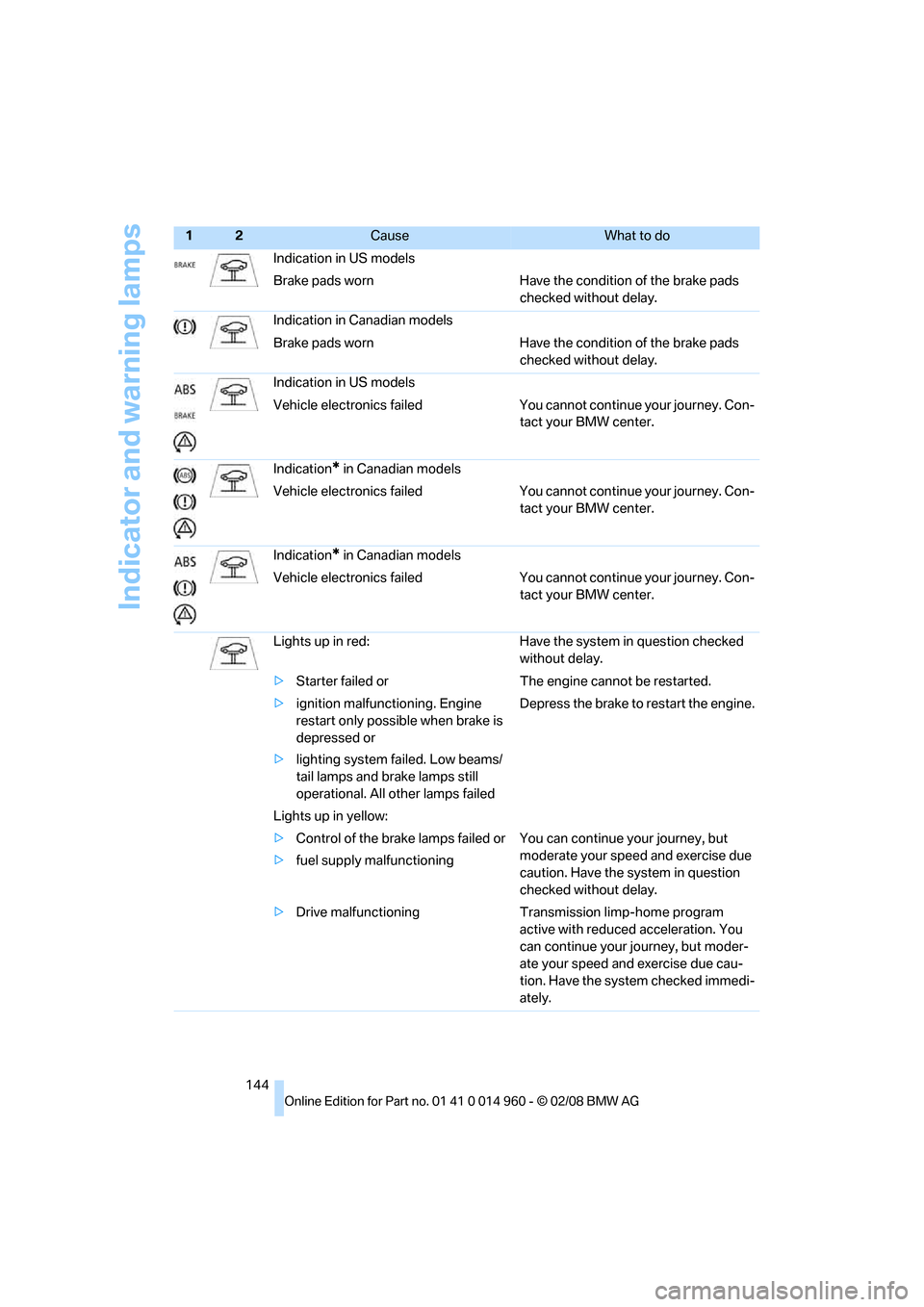
Indicator and warning lamps
144Indication in US models
Brake pads worn Have the condition of the brake pads
checked without delay.
Indication in Canadian models
Brake pads worn Have the condition of the brake pads
checked without delay.
Indication in US models
Vehicle electronics failed You cannot continue your journey. Con-
tact your BMW center.
Indication
* in Canadian models
Vehicle electronics failed You cannot continue your journey. Con-
tact your BMW center.
Indication
* in Canadian models
Vehicle electronics failed You cannot continue your journey. Con-
tact your BMW center.
Lights up in red: Have the system in question checked
without delay.
>Starter failed or The engine cannot be restarted.
>ignition malfunctioning. Engine
restart only possible when brake is
depressed or
>lighting system failed. Low beams/
tail lamps and brake lamps still
operational. All other lamps failedDepress the brake to restart the engine.
Lights up in yellow:
>Control of the brake lamps failed or
>fuel supply malfunctioningYou can continue your journey, but
moderate your speed and exercise due
caution. Have the system in question
checked without delay.
>Drive malfunctioning Transmission limp-home program
active with reduced acceleration. You
can continue your journey, but moder-
ate your speed and exercise due cau-
tion. Have the system checked immedi-
ately.
12Cause What to do
Page 148 of 172
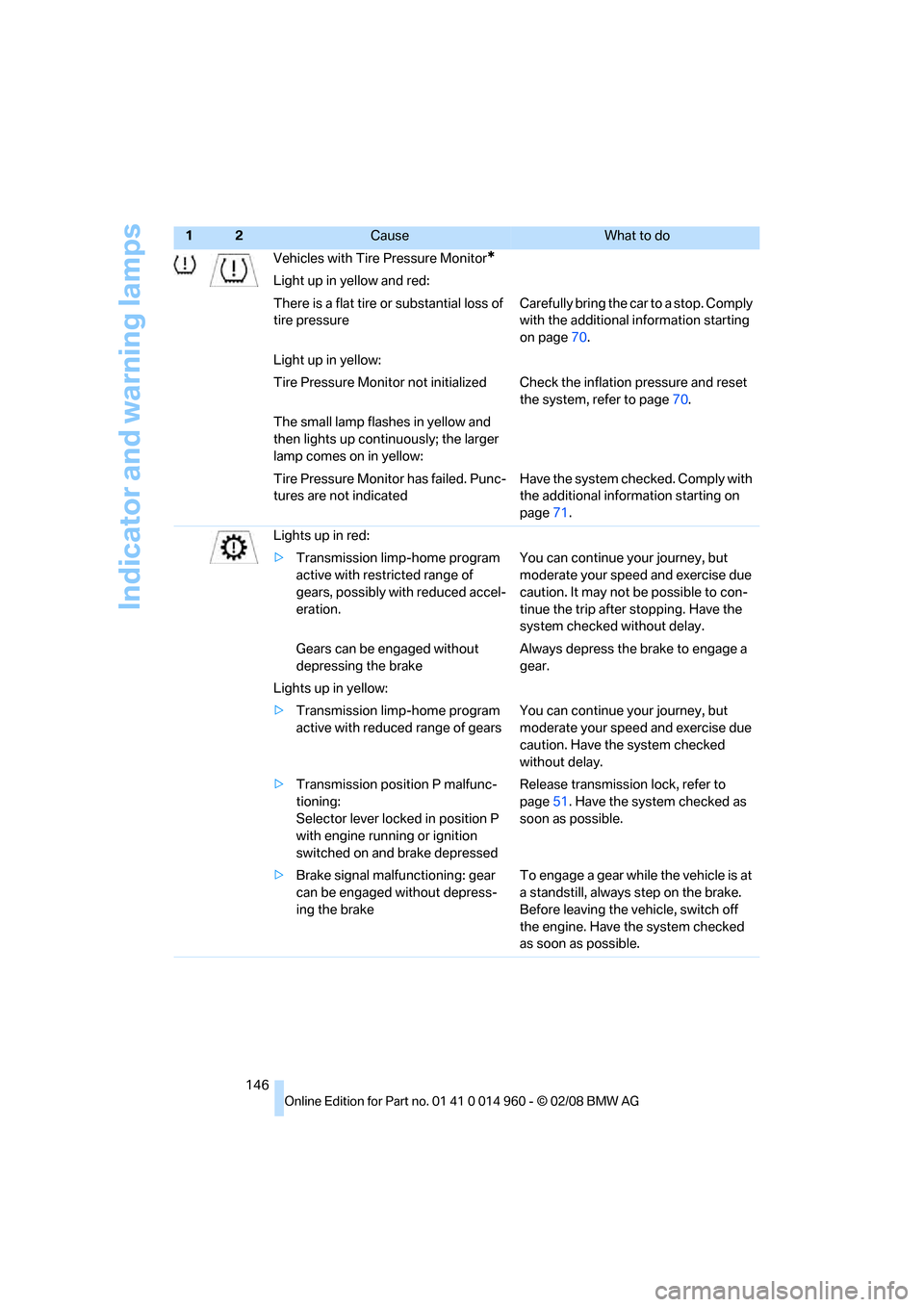
Indicator and warning lamps
146Vehicles with Tire Pressure Monitor
*
Light up in yellow and red:
There is a flat tire or substantial loss of
tire pressureCarefully bring the car to a stop. Comply
with the additional information starting
on page70.
Light up in yellow:
Tire Pressure Monitor not initialized Check the inflation pressure and reset
the system, refer to page70.
The small lamp flashes in yellow and
then lights up continuously; the larger
lamp comes on in yellow:
Tire Pressure Monitor has failed. Punc-
tures are not indicatedHave the system checked. Comply with
the additional information starting on
page71.
Lights up in red:
>Transmission limp-home program
active with restricted range of
gears, possibly with reduced accel-
eration.You can continue your journey, but
moderate your speed and exercise due
caution. It may not be possible to con-
tinue the trip after stopping. Have the
system checked without delay.
Gears can be engaged without
depressing the brakeAlways depress the brake to engage a
gear.
Lights up in yellow:
>Transmission limp-home program
active with reduced range of gearsYou can continue your journey, but
moderate your speed and exercise due
caution. Have the system checked
without delay.
>Transmission position P malfunc-
tioning:
Selector lever locked in position P
with engine running or ignition
switched on and brake depressedRelease transmission lock, refer to
page51. Have the system checked as
soon as possible.
>Brake signal malfunctioning: gear
can be engaged without depress-
ing the brakeTo engage a gear while the vehicle is at
a standstill, always step on the brake.
Before leaving the vehicle, switch off
the engine. Have the system checked
as soon as possible.
12Cause What to do
Page 149 of 172
Reference
At a glance
Controls
Driving tips
Mobility
147
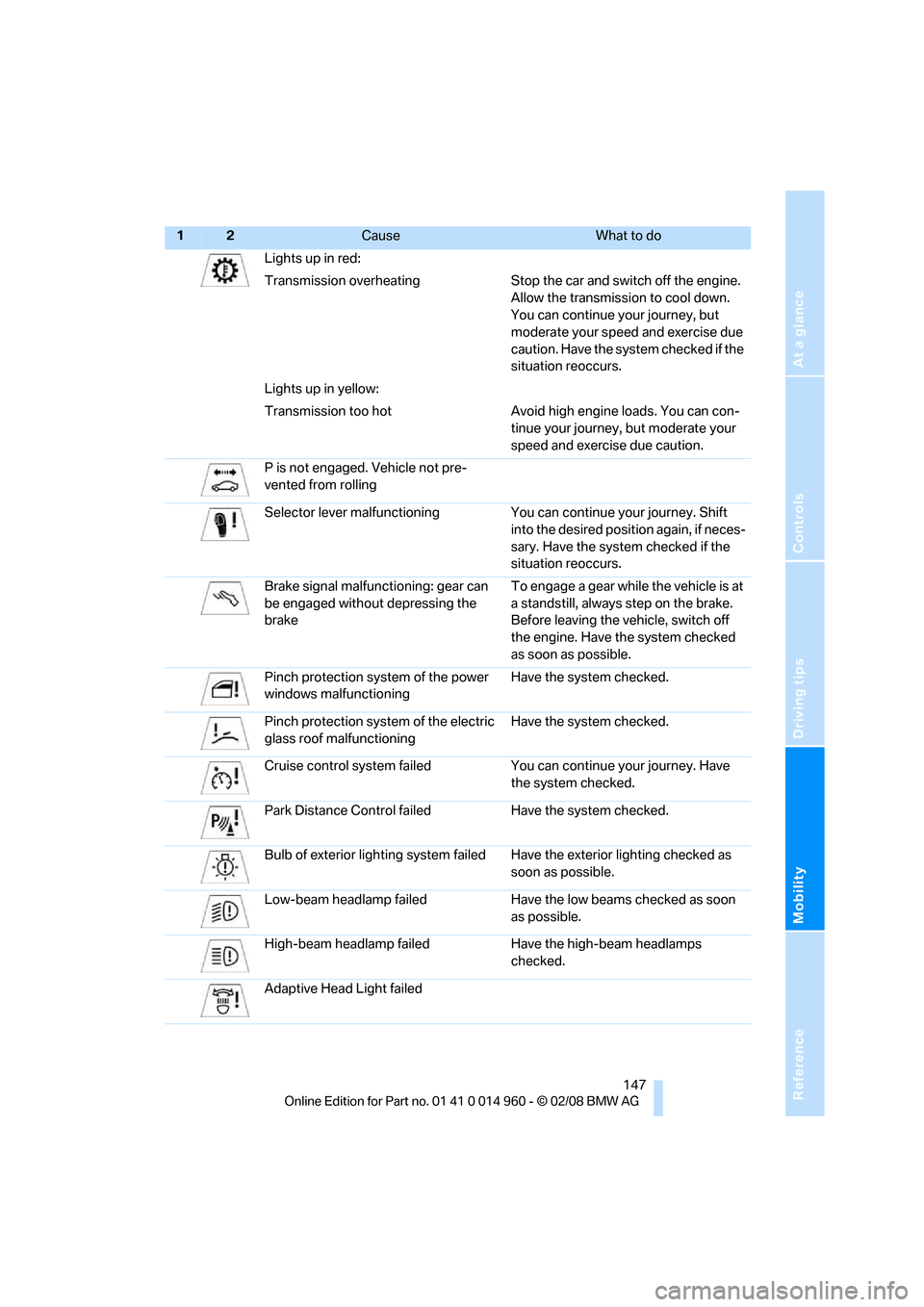
Lights up in red:
Transmission overheating Stop the car and switch off the engine.
Allow the transmission to cool down.
You can continue your journey, but
moderate your speed and exercise due
caution. Have the system checked if the
situation reoccurs.
Lights up in yellow:
Transmission too hot Avoid high engine loads. You can con-
tinue your journey, but moderate your
speed and exercise due caution.
P is not engaged. Vehicle not pre-
vented from rolling
Selector lever malfunctioning You can continue your journey. Shift
into the desired position again, if neces-
sary. Have the system checked if the
situation reoccurs.
Brake signal malfunctioning: gear can
be engaged without depressing the
brakeTo engage a gear while the vehicle is at
a standstill, always step on the brake.
Before leaving the vehicle, switch off
the engine. Have the system checked
as soon as possible.
Pinch protection system of the power
windows malfunctioningHave the system checked.
Pinch protection system of the electric
glass roof malfunctioningHave the system checked.
Cruise control system failed You can continue your journey. Have
the system checked.
Park Distance Control failed Have the system checked.
Bulb of exterior lighting system failed Have the exterior lighting checked as
soon as possible.
Low-beam headlamp failed Have the low beams checked as soon
as possible.
High-beam headlamp failed Have the high-beam headlamps
checked.
Adaptive Head Light failed
12Cause What to do
Page 158 of 172
Everything from A to Z
156
Everything from A to Z
Index
A
ABS Antilock Brake
System67
Acceleration assistant, refer to
Launch Control53
Accident, refer to Sending an
Emergency Request135
Activated-charcoal filter for
automatic climate control83
Adaptive Head Light77
Additives
– coolant119
Adjusting temperature inside
the car, refer to Automatic
climate control81
Adjusting the thigh support36
Airbags72
– indicator/warning lamp74
– sitting safely35
Air conditioning mode
– automatic climate control81
– ventilation83
Air distribution
– automatic81
Air flow rate81
Airing, refer to Ventilation83
Air pressure, refer to Tire
inflation pressure110
Air recirculation, refer to
Recirculated-air mode82
Air supply
– automatic climate control81
– ventilation83
Air vents80
AKI, refer to Fuel
specifications109
Alarm system25
– avoiding unintentional
alarms26
– interior motion sensor26
– switching off an alarm26
– tilt alarm sensor26All-season tires, refer to
Winter tires114
Ambient air, refer to
Recirculated-air mode82
Antifreeze
– coolant119
– washer fluid57
Antilock Brake System
ABS67
Anti-theft alarm system, refer
to Alarm system25
Anti-theft system19
Approved axle loads, refer to
Weights155
Approved gross vehicle
weight, refer to Weights155
Armrest, refer to Center
armrest88
Ashtray
– front90
– rear90
Assistance systems, refer to
Driving stability control
systems67
AUC Automatic recirculated-
air control82
Audio device, external88
Automatic
– air distribution81
– air flow rate81
– cruise control57
– headlamp control76
Automatic car washes123
Automatic climate control80
– automatic air distribution81
Automatic curb monitor42
Automatic recirculated-air
control AUC82
Automatic transmission with
Steptronic
– towing137
– tow-starting137AUTO program for automatic
climate control81
AUX-In port88
Average fuel consumption61
– setting the units62
Avoiding unintentional
alarms26
Axle loads, refer to
Weights155
B
Backrest contour, refer to
Lumbar support36
Backrests, refer to Seat
adjustment36
Backrest width adjustment37
Back seats
– refer to Rear seats38
Backup lamps
– replacing bulb129
Backup lamps, refer to Tail
lamps129
Bag holder92
Band-aids, refer to First-aid
pouch136
Bar, refer to Towing
methods138
Base plate for telephone or
mobile phone
– refer to Snap-in adapter in
the center armrest storage
compartment88
Battery133
– charging133
– disposal28,133
– jump starting136
– remote control18
– temporary power failure133
Battery renewal
– remote control28
– remote control for vehicle28
Being towed138