ECU BMW M3 COUPE 2001 E46 User Guide
[x] Cancel search | Manufacturer: BMW, Model Year: 2001, Model line: M3 COUPE, Model: BMW M3 COUPE 2001 E46Pages: 183, PDF Size: 1.65 MB
Page 51 of 183
51n
IndexDataTechnologyRepairsCar careControlsOverview
Seat and mirror memoryYou can store and recall three different
driver's seat and outside mirror posi-
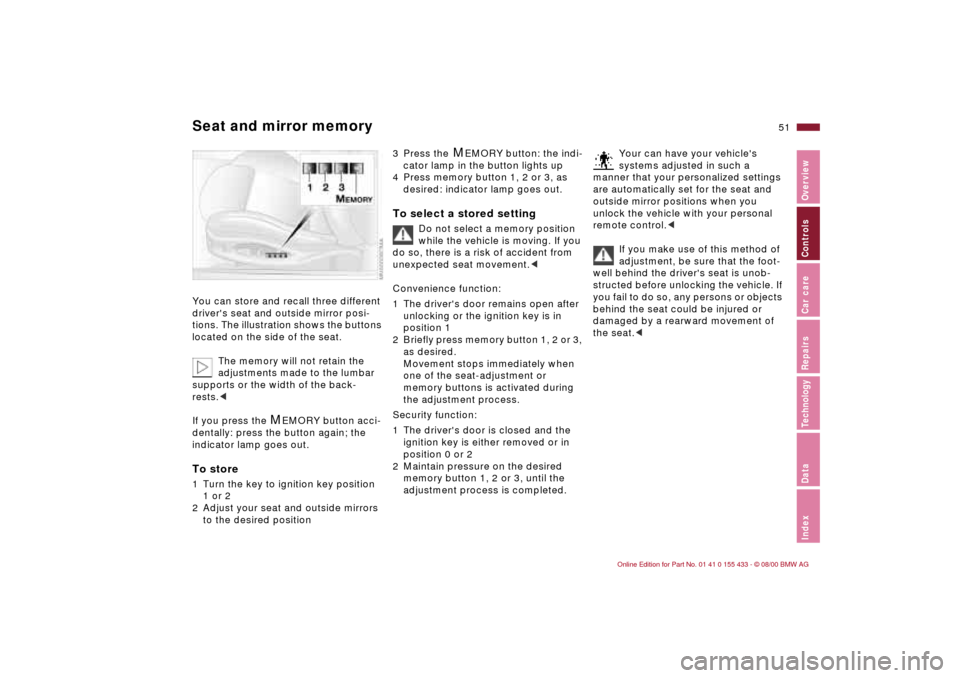
tions. The illustration shows the buttons
located on the side of the seat.
The memory will not retain the
adjustments made to the lumbar
supports or the width of the back-
rests.<
If you press the
M
EMORY button acci-
dentally: press the button again; the
indicator lamp goes out.
To store1 Turn the key to ignition key position
1 or 2
2 Adjust your seat and outside mirrors
to the desired position
3 Press the
M
EMORY button: the indi-
cator lamp in the button lights up
4 Press memory button 1, 2 or 3, as
desired: indicator lamp goes out.
To select a stored setting
Do not select a memory position
while the vehicle is moving. If you
do so, there is a risk of accident from
unexpected seat movement.<
Convenience function:
1 The driver's door remains open after
unlocking or the ignition key is in
position 1
2 Briefly press memory button 1, 2 or 3,
as desired.
Movement stops immediately when
one of the seat-adjustment or
memory buttons is activated during
the adjustment process.
Security function:
1 The driver's door is closed and the
ignition key is either removed or in
position 0 or 2
2 Maintain pressure on the desired
memory button 1, 2 or 3, until the
adjustment process is completed.
Your can have your vehicle's
systems adjusted in such a
manner that your personalized settings
are automatically set for the seat and
outside mirror positions when you
unlock the vehicle with your personal
remote control.<
If you make use of this method of
adjustment, be sure that the foot-
well behind the driver's seat is unob-
structed before unlocking the vehicle. If
you fail to do so, any persons or objects
behind the seat could be injured or
damaged by a rearward movement of
the seat.<
Page 55 of 183
55n
IndexDataTechnologyRepairsCar careControlsOverview
Safety beltsSafety belt height adjustmentYou can adjust the safety belts to fit
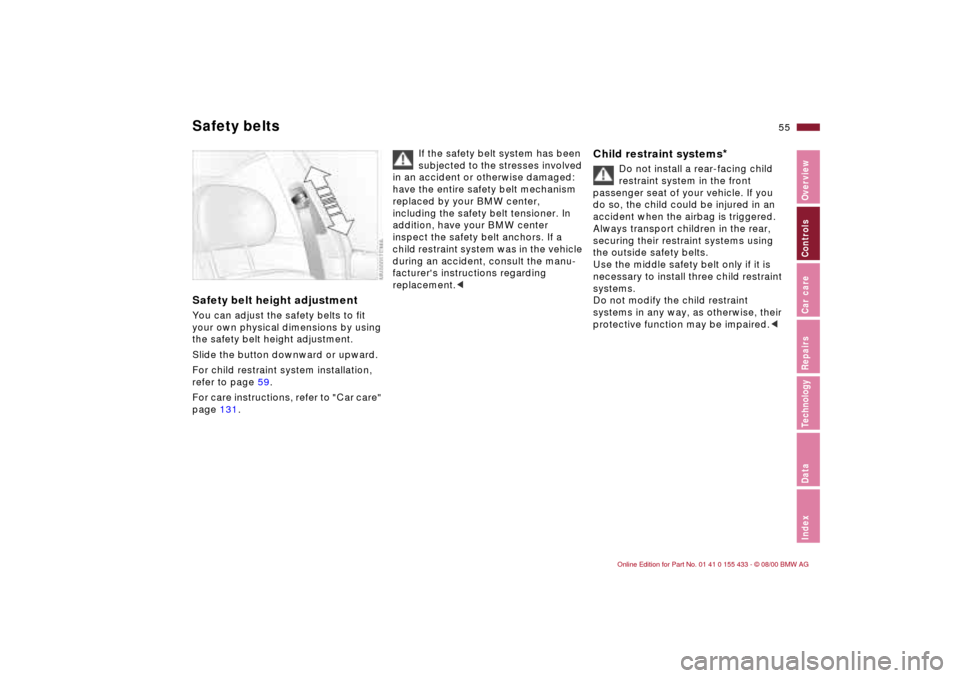
your own physical dimensions by using
the safety belt height adjustment.
Slide the button downward or upward.
For child restraint system installation,
refer to page 59.
For care instructions, refer to "Car care"
page 131.
If the safety belt system has been
subjected to the stresses involved
in an accident or otherwise damaged:
have the entire safety belt mechanism
replaced by your BMW center,
including the safety belt tensioner. In
addition, have your BMW center
inspect the safety belt anchors. If a
child restraint system was in the vehicle
during an accident, consult the manu-
facturer's instructions regarding
replacement.<
Child restraint systems
*
Do not install a rear-facing child
restraint system in the front
passenger seat of your vehicle. If you
do so, the child could be injured in an
accident when the airbag is triggered.
Always transport children in the rear,
securing their restraint systems using
the outside safety belts.
Use the middle safety belt only if it is
necessary to install three child restraint
systems.
Do not modify the child restraint
systems in any way, as otherwise, their
protective function may be impaired.<
Page 59 of 183
59n
IndexDataTechnologyRepairsCar careControlsOverview
Transporting children safelyCommercially available child restraint
systems are designed to be secured
with a lap belt or with the lap belt
portion of a combination lap/shoulder
belt. Improperly or inadequately
installed restraint systems can increase
the risk of injury to children. Always
read and follow the instructions that
come with the system.
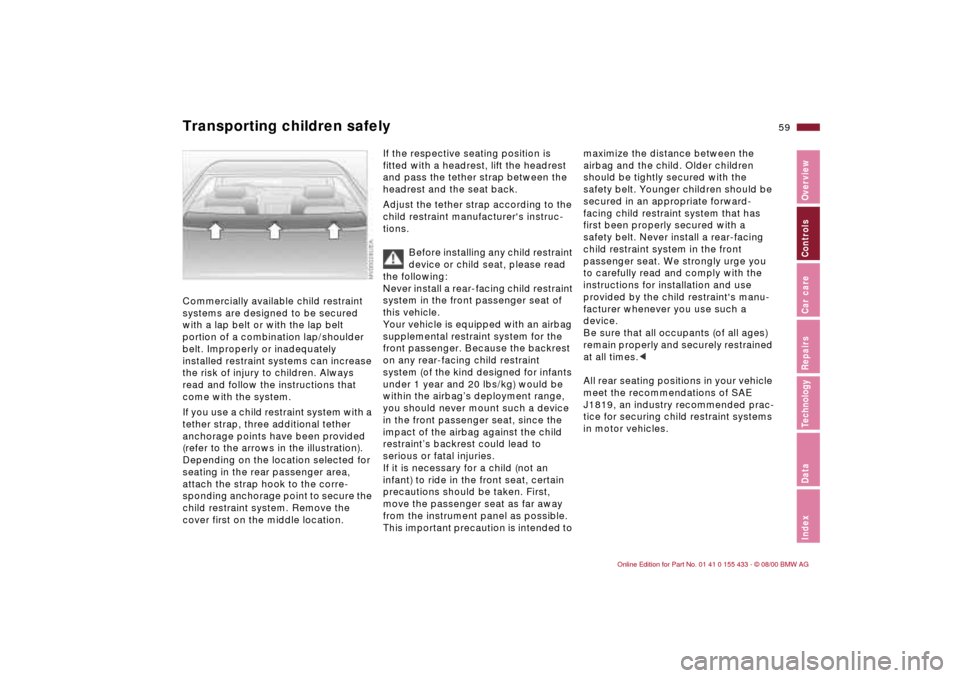
If you use a child restraint system with a
tether strap, three additional tether
anchorage points have been provided
(refer to the arrows in the illustration).
Depending on the location selected for
seating in the rear passenger area,
attach the strap hook to the corre-
sponding anchorage point to secure the
child restraint system. Remove the
cover first on the middle location.
If the respective seating position is
fitted with a headrest, lift the headrest
and pass the tether strap between the
headrest and the seat back.
Adjust the tether strap according to the
child restraint manufacturer's instruc-
tions.
Before installing any child restraint
device or child seat, please read
the following:
Never install a rear-facing child restraint
system in the front passenger seat of
this vehicle.
Your vehicle is equipped with an airbag
supplemental restraint system for the
front passenger. Because the backrest
on any rear-facing child restraint
system (of the kind designed for infants
under 1 year and 20 lbs/kg) would be
within the airbagÕs deployment range,
you should never mount such a device
in the front passenger seat, since the
impact of the airbag against the child
restraintÕs backrest could lead to
serious or fatal injuries.
If it is necessary for a child (not an
infant) to ride in the front seat, certain
precautions should be taken. First,
move the passenger seat as far away
from the instrument panel as possible.
This important precaution is intended to
maximize the distance between the
airbag and the child. Older children
should be tightly secured with the
safety belt. Younger children should be
secured in an appropriate forward-
facing child restraint system that has
first been properly secured with a
safety belt. Never install a rear-facing
child restraint system in the front
passenger seat. We strongly urge you
to carefully read and comply with the
instructions for installation and use
provided by the child restraint's manu-
facturer whenever you use such a
device.
Be sure that all occupants (of all ages)
remain properly and securely restrained
at all times.c
All rear seating positions in your vehicle
meet the recommendations of SAE
J1819, an industry recommended prac-
tice for securing child restraint systems
in motor vehicles.
Page 60 of 183
60n
Transporting children safelyLATCH attachment of the child
seat
*
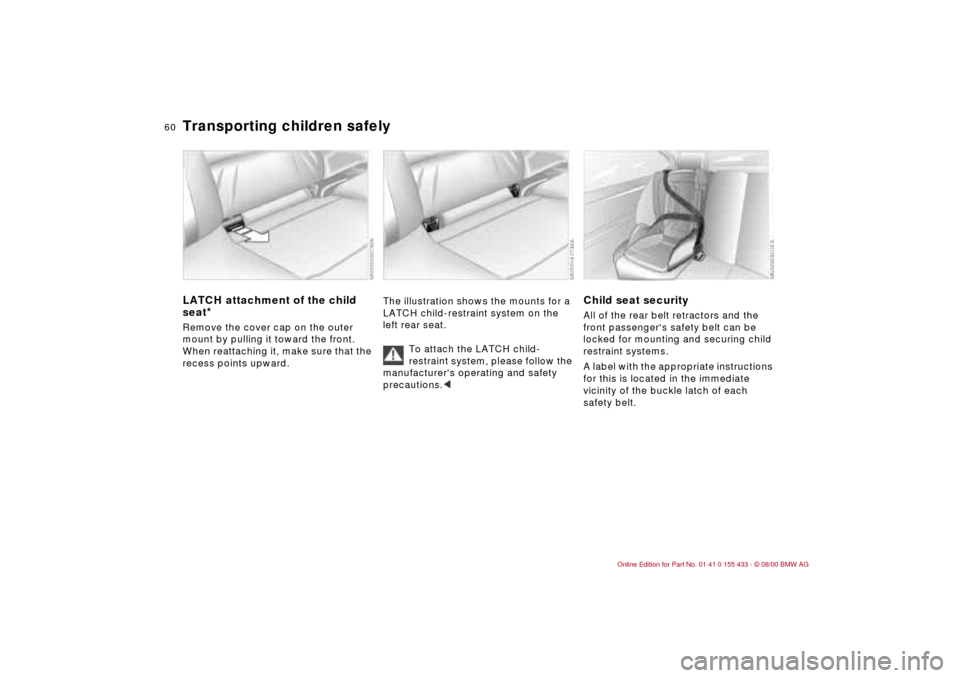
Remove the cover cap on the outer
mount by pulling it toward the front.
When reattaching it, make sure that the
recess points upward.
The illustration shows the mounts for a
LATCH child-restraint system on the
left rear seat.
To attach the LATCH child-
restraint system, please follow the
manufacturer's operating and safety
precautions.<< < <
Child seat securityAll of the rear belt retractors and the
front passenger's safety belt can be
locked for mounting and securing child
restraint systems.
A label with the appropriate instructions
for this is located in the immediate
vicinity of the buckle latch of each
safety belt.
Page 96 of 183
96n
Ski bag
*
The ski bag allows the safe and clean
transport of up to 4 pairs of standard
skis or up to two snowboards.
The length of the ski bag and the addi-
tional space provided in the luggage
compartment make it possible to carry
skis up to 6.8 ft long (2.1 0 meters).
Because of the tapered shape of the ski
bag, it can only accommodate two pairs
of skis 6.8 ft long (2.1 0 meters).
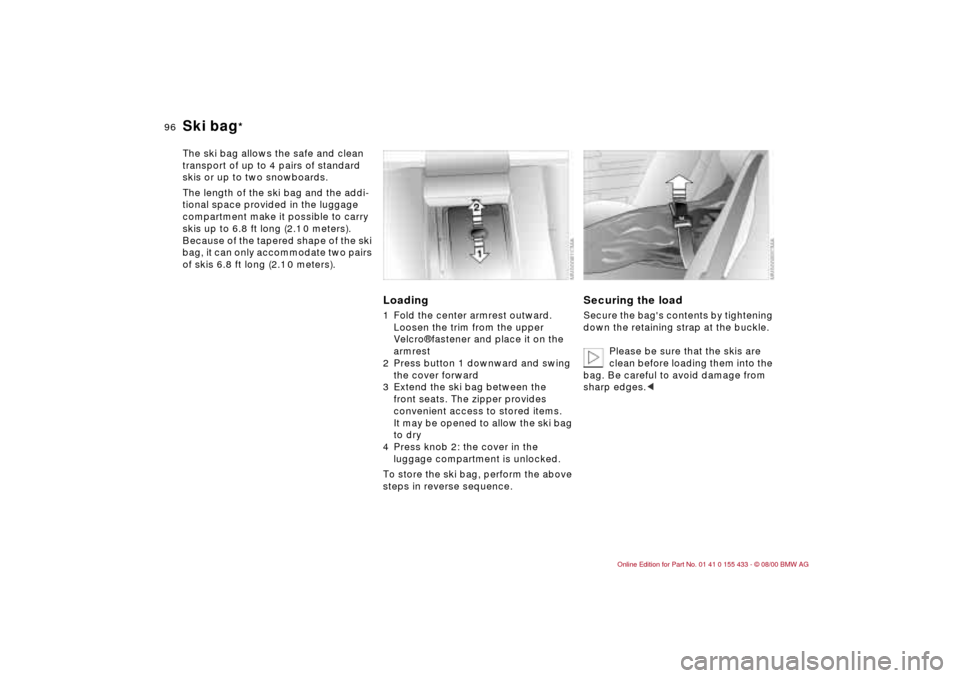
Loading1 Fold the center armrest outward.
Loosen the trim from the upper
Velcro¨ fastener and place it on the
armrest
2 Press button 1 downward and swing
the cover forward
3 Extend the ski bag between the
front seats. The zipper provides
convenient access to stored items.
It may be opened to allow the ski bag
to dry
4 Press knob 2: the cover in the
luggage compartment is unlocked.
To store the ski bag, perform the above
steps in reverse sequence.
Securing the loadSecure the bag's contents by tightening
down the retaining strap at the buckle.
Please be sure that the skis are
clean before loading them into the
bag. Be careful to avoid damage from
sharp edges.<
Page 97 of 183
97n
IndexDataTechnologyRepairsCar careControlsOverview
Cargo loading
Always position and secure the
load correctly. If you do not, it
can endanger the passengers during
braking or evasive maneuvers.
Do not exceed the permissible gross
weight and axle load (refer to
page 168), otherwise the vehicle's
operating safety is no longer assured
and you are in violation of the law.
Do not stow heavy or hard objects in
the passenger compartment without
first securing them. Otherwise they
would be thrown around during braking
and evasive maneuvers and endanger
the occupants.<
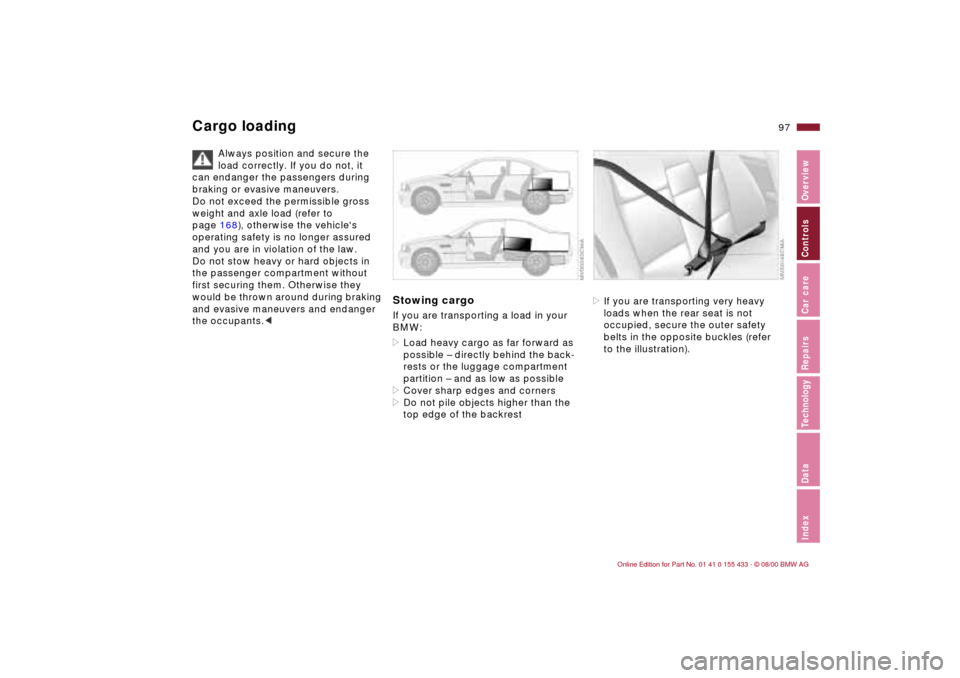
Stowing cargo If you are transporting a load in your
BMW:
>Load heavy cargo as far forward as
possible Ð directly behind the back-
rests or the luggage compartment
partition Ð and as low as possible
>Cover sharp edges and corners
>Do not pile objects higher than the
top edge of the backrest
>If you are transporting very heavy
loads when the rear seat is not
occupied, secure the outer safety
belts in the opposite buckles (refer
to the illustration).
Page 98 of 183
98n
Cargo loading Roof-mounted luggage rack
*
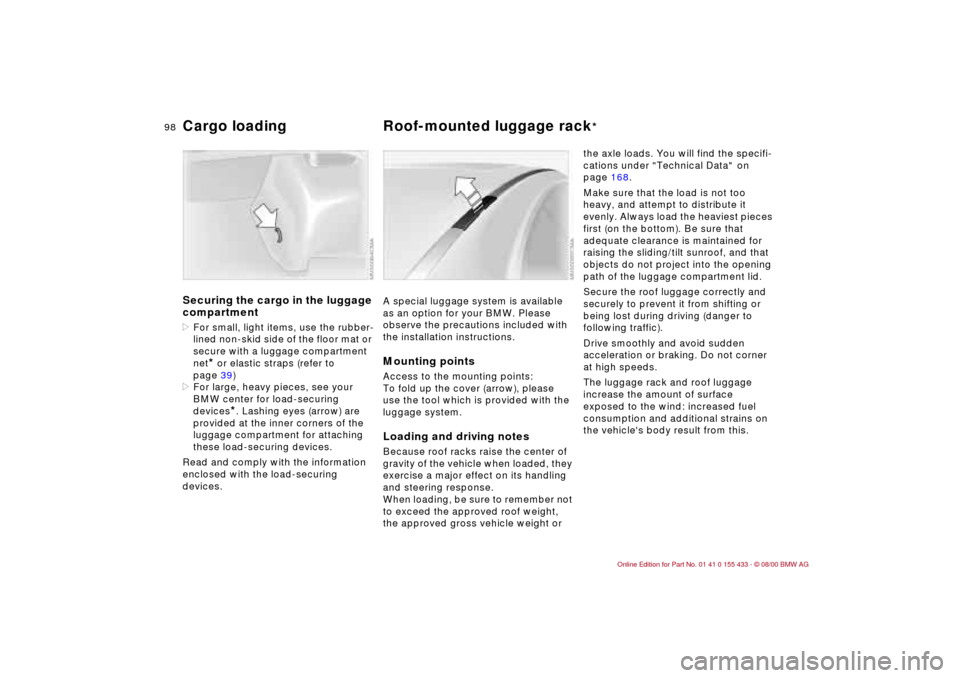
Securing the cargo in the luggage
compartment >For small, light items, use the rubber-
lined non-skid side of the floor mat or
secure with a luggage compartment
net
* or elastic straps (refer to
page 39)
>For large, heavy pieces, see your
BMW center for load-securing
devices
*. Lashing eyes (arrow) are
provided at the inner corners of the
luggage compartment for attaching
these load-securing devices.
Read and comply with the information
enclosed with the load-securing
devices.
A special luggage system is available
as an option for your BMW. Please
observe the precautions included with
the installation instructions.Mounting pointsAccess to the mounting points:
To fold up the cover (arrow), please
use the tool which is provided with the
luggage system.Loading and driving notesBecause roof racks raise the center of
gravity of the vehicle when loaded, they
exercise a major effect on its handling
and steering response.
When loading, be sure to remember not
to exceed the approved roof weight,
the approved gross vehicle weight or
the axle loads. You will find the specifi-
cations under "Technical Data" on
page 168.
Make sure that the load is not too
heavy, and attempt to distribute it
evenly. Always load the heaviest pieces
first (on the bottom). Be sure that
adequate clearance is maintained for
raising the sliding/tilt sunroof, and that
objects do not project into the opening
path of the luggage compartment lid.
Secure the roof luggage correctly and
securely to prevent it from shifting or
being lost during driving (danger to
following traffic).
Drive smoothly and avoid sudden
acceleration or braking. Do not corner
at high speeds.
The luggage rack and roof luggage
increase the amount of surface
exposed to the wind: increased fuel
consumption and additional strains on
the vehicle's body result from this.
Page 104 of 183

104n
Antilock Brake System (ABS)The concept ABS keeps the wheels from locking
while braking, thereby enhancing active
driving safety. The reason: locked
wheels are dangerous. When the front
wheels slide, the driver loses steering
control over the vehicle. Traction loss at
the rear wheels can cause the rear end
to break into an uncontrolled skid.
Based on current road conditions, ABS
can brake the vehicle within the
shortest possible distance and with the
greatest possible driving stability (on
straight-aways and curves, asphalt, ice,
wet road surfaces, etc.).
ABS is designed to meet two essential
requirements during every brake appli-
cation:
>To help provide vehicle stability
>To help maintain steering control and
maneuverability Ð on all types of road
surfaces (asphalt, concrete, mud,
wet, snow, ice). Braking with ABSThe system becomes operative once
the vehicle exceeds a speed of approx.
6 mph (10 km/h). Whenever the
vehicle's speed drops below approx.
4 mph (6 km/h), the ABS is deactivated.
This means that the wheels can lock in the final phase of a panic stop Ð a factor
of no significance in actual use.
The ABS system works best in situa-
tions requiring maximum pressure on
the pedal ("panic stop"). Do not let up
on the brake pedal even after it starts
pulsating. Since the vehicle maintains
steering responsiveness, you can
nevertheless avoid possible obstacles
with a minimum of steering effort.
The ABS closed-loop control circuit
cycles in fractions of a second. Pulsa-
tion at the brake pedal shows you that
ABS is active, that you are braking
within the ABS' braking range and that
you are thus pushing the limit of the
system. In addition, a pulsation Ð a
result of the control function cycles Ð
indicates to the driver that the vehicle
speed should be reduced to adapt to
road surface conditions when there is
reduced traction and grip between tires
and road surface (slippery road
surface).
On road surfaces with a loose surface
layer over a firm base, e.g. on gravel or
snow, as well as when driving with
snow chains on, braking distances may
be longer for a locked-wheel condition.
However, ABS continues to provide
enhanced vehicle stability and steering
response under these conditions.
Information for your safetyNot even ABS can suspend the laws of
physics. The consequences of hitting
the brakes when there is inadequate
distance between vehicles, when the
vehicle is driven at excessive speeds
through curves, or during aquaplaning,
remain the driver's responsibility. You
should never allow the added safety of
ABS to lull you into a false sense of
security, or mislead you into taking risks
that could affect your own safety and
that of others.
Do not make any modifications to
the ABS system.
Service procedures on ABS are to be
performed by authorized technicians
only.< Antilock Brake System (ABS)/
Cornering Brake Control (CBC) CBC is an advanced engineering
design of the ABS. When braking while
cornering at high speed or braking
during high lateral acceleration, or
when braking during a lane change,
vehicle stability is improved and
steering response is enhanced.
Page 119 of 183
119n
IndexDataTechnologyRepairsCar careControlsOverview
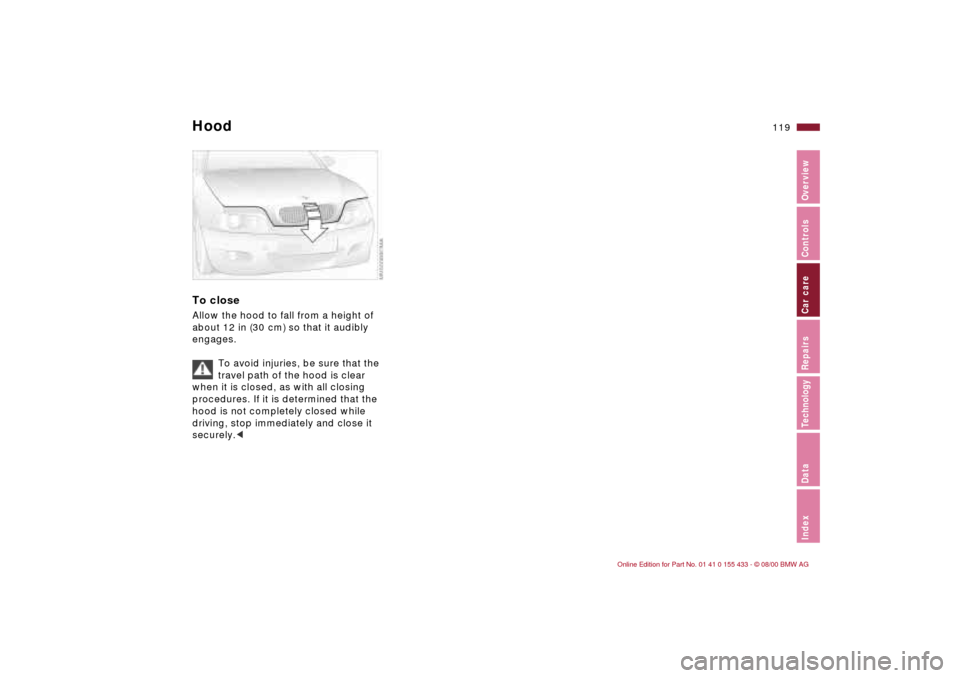
Hood To closeAllow the hood to fall from a height of
about 12 in (30 cm) so that it audibly
engages.
To avoid injuries, be sure that the
travel path of the hood is clear
when it is closed, as with all closing
procedures. If it is determined that the
hood is not completely closed while
driving, stop immediately and close it
securely.<
Page 132 of 183
132n
Caring for your vehicleThe buildup of an electrostatic charge
on the seat covers, particularly if atmo-
spheric humidity is low, can give the
occupants an unpleasant electric shock
if they touch metal body parts after
leaving the vehicle. Although this is not
dangerous in any way, it can be
avoided by touching a bare or polished
metal part of the vehicle while getting
out.Alcantara
*
Clean using a gentle detergent, taking
care not to rub or scratch. Then finish
off by wiping it with a wet cloth.Leather care The leather upholstery
* used by BMW
is a natural product of the highest qual-
ity, processed using state-of-the-art
methods to ensure that it will maintain
its high quality for years to come, pro-
vided that it is properly cared for.
Because this product is manufactured
using natural materials, you must make
allowance for its special characteristics
as well as for the peculiarities of its use
and care.
Regular periodic cleaning and care are
essential, as dust and road dirt act as
abrasives in the pores and creases of the material. This leads to wear spots
and premature brittleness on the sur-
face of the leather. We therefore sug-
gest that you clean the leather with a
vacuum cleaner or cloth at frequent
intervals.
For cleaning, use BMW leather cleaning
foam.
Since dirt and grease gradually attack
the protective layer of the leather, the
cleaned surfaces should be treated
with BMW leather care agent. This also
acts as an antistatic agent.
For protection against dampness or
moisture, treat the leather with a
BMW impregnating agent.
We recommend that you perform this
procedure twice a year on leather
exposed to normal use.
Spills should be wiped up immediately.
Remove grease and oil stains without
rubbing, but rather by dabbing with
spot remover.
If the upholstery is exposed to intense
sunlight or if the vehicle is going to be
left parked for an extended period of
time, cover all leather surfaces or all the
windows to prevent fading.Use the cleaning and car-care
products that you can obtain at
your BMW center.<
Cleaning agents can contain sub-
stances that are dangerous or
pose health risks. Therefore, always
comply with the warnings and danger
notices on the package.
Open the doors or windows on your
vehicle when cleaning the interior.
Never clean your vehicle with solvents
or other materials not specifically
intended for this purpose.<