belt BMW M3 COUPE 2001 E46 User Guide
[x] Cancel search | Manufacturer: BMW, Model Year: 2001, Model line: M3 COUPE, Model: BMW M3 COUPE 2001 E46Pages: 183, PDF Size: 1.65 MB
Page 57 of 183
57n
IndexDataTechnologyRepairsCar careControlsOverview
AirbagsSitting correctly with airbags
Comply with the following instruc-
tions for the airbags. If you do not,
the airbags may not be able to provide
their maximum protection, with
resulting risks to personal safety. The
following information pertains to all
occupants:
Even though there is an airbag, wear a
safety belt every time you get in the
vehicle, because airbags supplement
the safety belts as an additional
restraint device.
Assume a sitting posture that is
comfortable and allows the greatest
possible distance between you and the
airbags.
Always hold the steering wheel by the
rim to keep any chance of injury to
hands or arms to an absolute minimum,
should the airbag deploy. Keep the
instructions regarding sitting properly in
your seat on page 45 in mind as well.
No one and nothing is to come between
the airbag and the seat occupant.
Do not use the cover panel above the
front passenger-side airbag as a
storage area.
Do not apply adhesive materials to the
cover panels of the airbags, cover them
or modify them in any other way.
Do not use any child restraint systems
on the passenger side. Children under
12 years of age, who are smaller than
5 feet (150 cm), may ride in the back
only.
If your vehicle is equipped with side
airbags in the rear passenger area, be
sure that child restraints are mounted
correctly and provided with the
greatest-possible distance between the
airbags in the side trim panels. Do not
allow children to lean out of the child's
seat in the direction of the side trim
panels. If they do so, serious injuries
can occur if the airbag is triggered.
(infants and small children in appro-
priate child restraint systems; larger
children and adults using the safety
belts). Never let an occupant's head
rest near or on a side airbag because
the inflating airbag could cause a
serious or fatal injury. Please note that
the word "Airbag" imprinted on the door
trim panel indicates the airbag's loca-
tion.
Accident research shows that the
safest place for children in an automo-
bile is in the rear seat. However, a child
sitting in the rear seat and not properly
restrained may place his or her head on
or near the airbag, if so equipped. For
example, a child Ñ even though belted
Ñ may fall asleep with his or her head
against the side airbag. It may be diffi-
cult for a driver to ensure that children
in the rear seat will remain properly
positioned at all times and not place
their heads on or near the side airbag.
Therefore, we recommend that the rear
seat side airbags, if so equipped, be
deactivated if children will travel in the
rear seat.
The rear seat side airbags may already
have been deactivated, either at the
time of manufacture or by a BMW
Page 58 of 183
58n
Airbagscenter. Labels in the door opening
should indicate the status of your rear
seat side airbags. If you are uncertain of
their status, or wish to have the airbags
activated or deactivated, please
contact your BMW center.<
Even when all these guidelines are
observed, there is still a small residual
risk of injuries to the face, hands and
arms occurring from airbag deployment
in isolated instances. The ignition and
inflation noise may cause a mild tempo-
rary hearing loss in extremely sensitive
individuals.
For additional information concerning
the airbag system, refer to pages 133
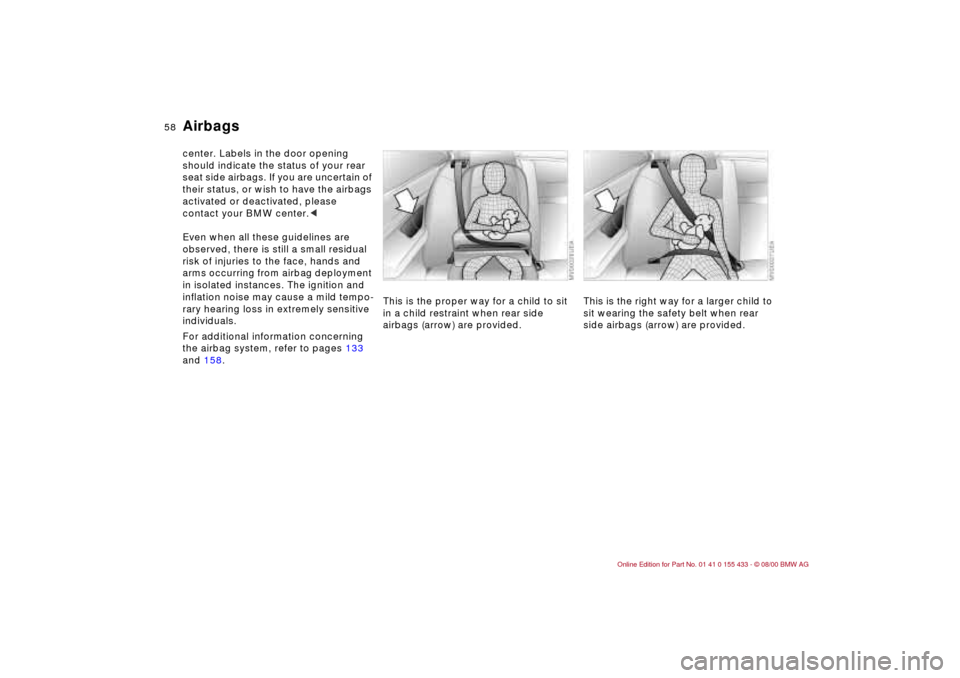
and 158.This is the proper way for a child to sit
in a child restraint when rear side
airbags (arrow) are provided.
This is the right way for a larger child to
sit wearing the safety belt when rear
side airbags (arrow) are provided.
Page 59 of 183
59n
IndexDataTechnologyRepairsCar careControlsOverview
Transporting children safelyCommercially available child restraint
systems are designed to be secured
with a lap belt or with the lap belt
portion of a combination lap/shoulder
belt. Improperly or inadequately
installed restraint systems can increase
the risk of injury to children. Always
read and follow the instructions that
come with the system.
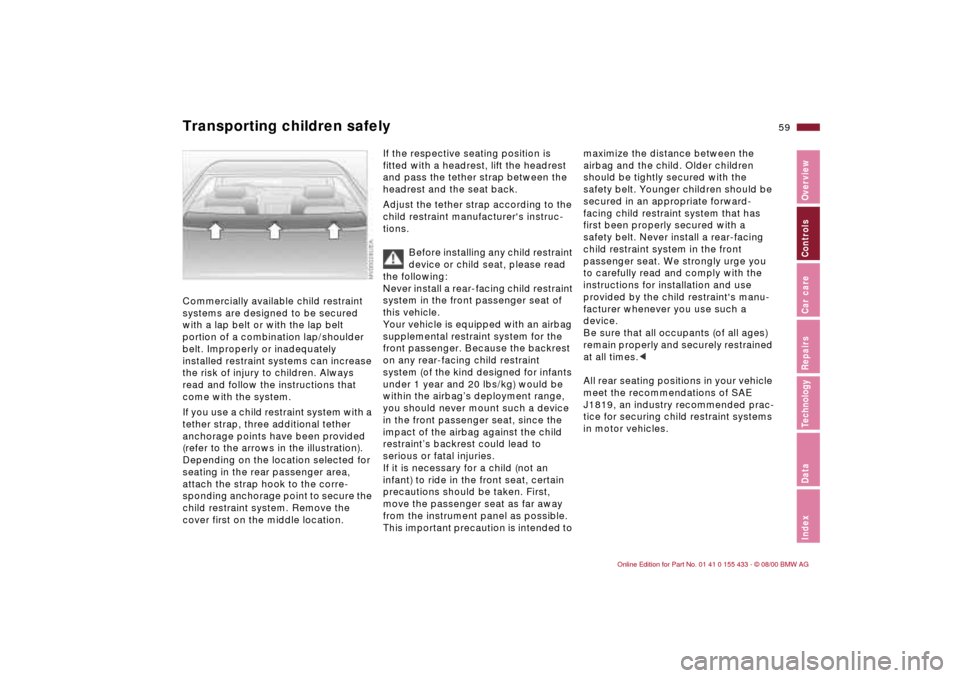
If you use a child restraint system with a
tether strap, three additional tether
anchorage points have been provided
(refer to the arrows in the illustration).
Depending on the location selected for
seating in the rear passenger area,
attach the strap hook to the corre-
sponding anchorage point to secure the
child restraint system. Remove the
cover first on the middle location.
If the respective seating position is
fitted with a headrest, lift the headrest
and pass the tether strap between the
headrest and the seat back.
Adjust the tether strap according to the
child restraint manufacturer's instruc-
tions.
Before installing any child restraint
device or child seat, please read
the following:
Never install a rear-facing child restraint
system in the front passenger seat of
this vehicle.
Your vehicle is equipped with an airbag
supplemental restraint system for the
front passenger. Because the backrest
on any rear-facing child restraint
system (of the kind designed for infants
under 1 year and 20 lbs/kg) would be
within the airbagÕs deployment range,
you should never mount such a device
in the front passenger seat, since the
impact of the airbag against the child
restraintÕs backrest could lead to
serious or fatal injuries.
If it is necessary for a child (not an
infant) to ride in the front seat, certain
precautions should be taken. First,
move the passenger seat as far away
from the instrument panel as possible.
This important precaution is intended to
maximize the distance between the
airbag and the child. Older children
should be tightly secured with the
safety belt. Younger children should be
secured in an appropriate forward-
facing child restraint system that has
first been properly secured with a
safety belt. Never install a rear-facing
child restraint system in the front
passenger seat. We strongly urge you
to carefully read and comply with the
instructions for installation and use
provided by the child restraint's manu-
facturer whenever you use such a
device.
Be sure that all occupants (of all ages)
remain properly and securely restrained
at all times.c
All rear seating positions in your vehicle
meet the recommendations of SAE
J1819, an industry recommended prac-
tice for securing child restraint systems
in motor vehicles.
Page 60 of 183
60n
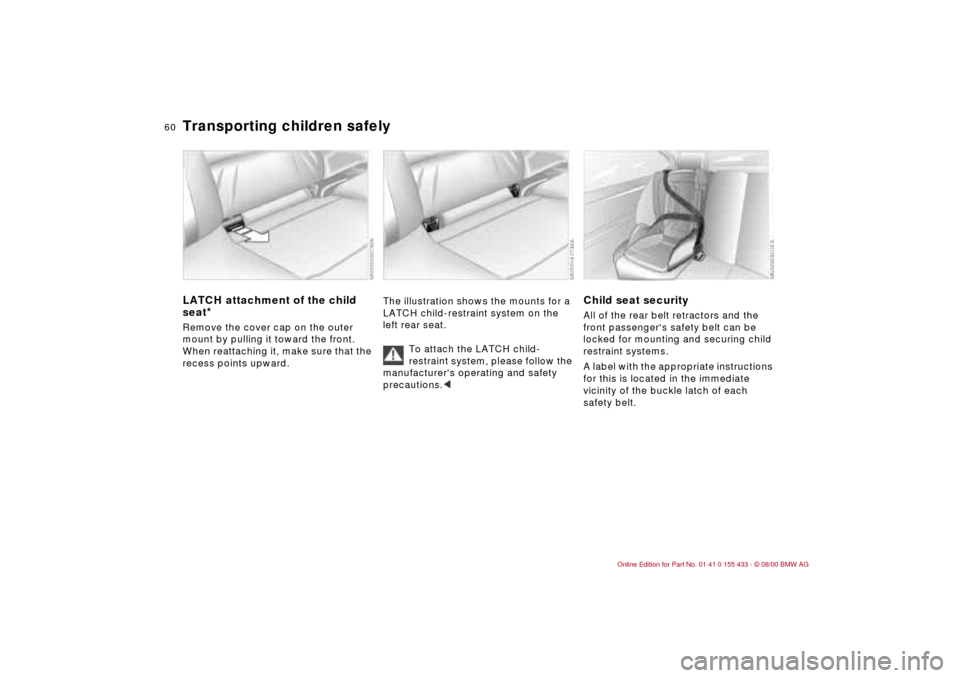
Transporting children safelyLATCH attachment of the child
seat
*
Remove the cover cap on the outer
mount by pulling it toward the front.
When reattaching it, make sure that the
recess points upward.
The illustration shows the mounts for a
LATCH child-restraint system on the
left rear seat.
To attach the LATCH child-
restraint system, please follow the
manufacturer's operating and safety
precautions.<< < <
Child seat securityAll of the rear belt retractors and the
front passenger's safety belt can be
locked for mounting and securing child
restraint systems.
A label with the appropriate instructions
for this is located in the immediate
vicinity of the buckle latch of each
safety belt.
Page 61 of 183
61n
IndexDataTechnologyRepairsCar careControlsOverview
Transporting children safelyTo lock the beltExtract the entire length of the belt from
the inertia reel mechanism. Allow the
reel to retract the belt somewhat and
engage the buckle, then tighten the belt
against the child restraint system. The
retraction mechanism is now locked.
The belt cannot be extracted further.
Always comply with the installation
instructions provided by the manufac-
turer of the child restraint system.
To release the beltRelease the safety belt, remove the
child's seat and retract the safety belt
to its end position on the belt retractor.
Page 95 of 183
95n
IndexDataTechnologyRepairsCar careControlsOverview
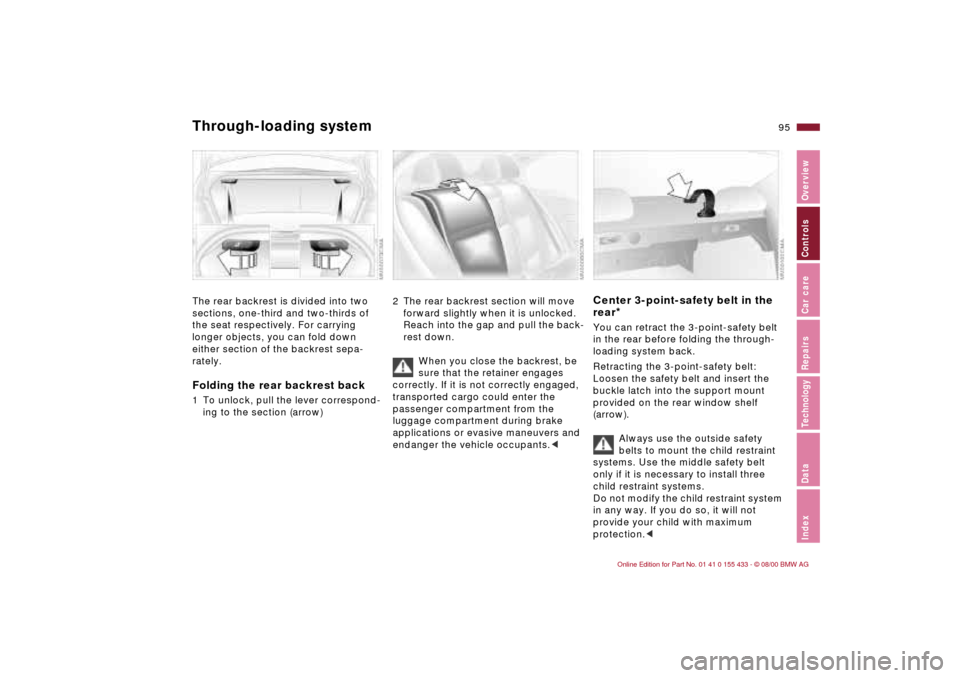
Through-loading systemThe rear backrest is divided into two
sections, one-third and two-thirds of
the seat respectively. For carrying
longer objects, you can fold down
either section of the backrest sepa-
rately.Folding the rear backrest back1 To unlock, pull the lever correspond-
ing to the section (arrow)
2 The rear backrest section will move
forward slightly when it is unlocked.
Reach into the gap and pull the back-
rest down.
When you close the backrest, be
sure that the retainer engages
correctly. If it is not correctly engaged,
transported cargo could enter the
passenger compartment from the
luggage compartment during brake
applications or evasive maneuvers and
endanger the vehicle occupants.<
Center 3-point-safety belt in the
rear
*
You can retract the 3-point-safety belt
in the rear before folding the through-
loading system back.
Retracting the 3-point-safety belt:
Loosen the safety belt and insert the
buckle latch into the support mount
provided on the rear window shelf
(arrow).
Always use the outside safety
belts to mount the child restraint
systems. Use the middle safety belt
only if it is necessary to install three
child restraint systems.
Do not modify the child restraint system
in any way. If you do so, it will not
provide your child with maximum
protection.<
Page 97 of 183
97n
IndexDataTechnologyRepairsCar careControlsOverview
Cargo loading
Always position and secure the
load correctly. If you do not, it
can endanger the passengers during
braking or evasive maneuvers.
Do not exceed the permissible gross
weight and axle load (refer to
page 168), otherwise the vehicle's
operating safety is no longer assured
and you are in violation of the law.
Do not stow heavy or hard objects in
the passenger compartment without
first securing them. Otherwise they
would be thrown around during braking
and evasive maneuvers and endanger
the occupants.<
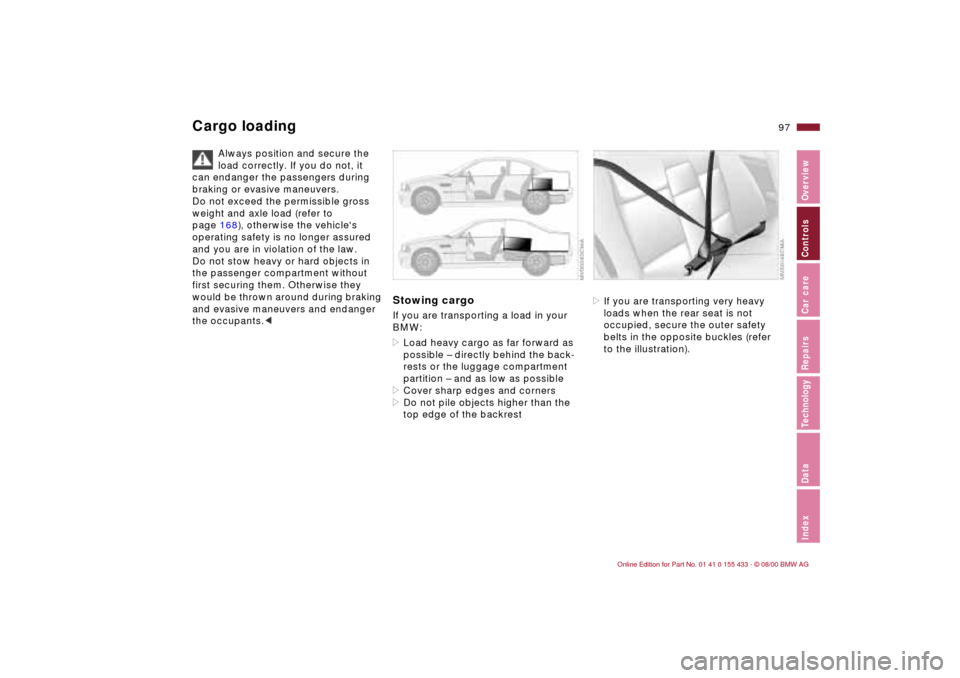
Stowing cargo If you are transporting a load in your
BMW:
>Load heavy cargo as far forward as
possible Ð directly behind the back-
rests or the luggage compartment
partition Ð and as low as possible
>Cover sharp edges and corners
>Do not pile objects higher than the
top edge of the backrest
>If you are transporting very heavy
loads when the rear seat is not
occupied, secure the outer safety
belts in the opposite buckles (refer
to the illustration).
Page 131 of 183
131n
IndexDataTechnologyRepairsCar careControlsOverview
Caring for your vehicleCaring for other vehicle
components and materials Light-alloy wheels should be treated
with alloy wheel cleaner, especially
during the winter months. However, do
not use aggressive products contain-
ing acids, strong alkalis or abrasives.
Do not use steam cleaners operating at
temperatures above 140 7 (+60 6).
Follow the manufacturer's instructions.
If your vehicle has chrome parts
* such
as window moldings, door handles or
similar items, clean these parts carefully
with ample clean water, and possibly a
shampoo additive, especially if there is
an accumulation of road salt. Use
chrome polish as an additional treat-
ment.
Plastic components, vinyl upholstery,
headliners, lamp lenses, the clear cover
of the instrument cluster and compon-
ents with a sprayed dull black surface
can be cleaned with water (add plastic
shampoo as required). Do not allow
moisture to soak through the seats or
headliner. Never use solvents such as
lacquer thinner, heavy-duty grease
remover, fuels, or similar substances.
Rubber components should be cleaned
with water only; a rubber treatment or
silicone spray may also be applied. The safety belts should be cleaned with
a mild soap and water solution without
being removed from the vehicle. Never
attempt chemical or dry cleaning, as
damage to the belt fabric could result.
After cleaning, never allow the inertia
reel to retract the belts until they are
completely dry. Dirty safety belts pre-
vent the inertia reel mechanism from
retracting the strap properly, and thus
constitute a safety hazard.
Heavily soiled floor carpets and mats
*
can be cleaned with an interior cleaner.
The floor mats can be removed from
the vehicle for cleaning.
Use only a damp cloth to clean trim
panels made of real wood
* and other
parts constructed of real wood
*. Follow
up by drying with a soft cloth.
Use the cleaning and car-care
products that you can obtain at
your BMW center.<
Care of upholstery materials Depressions in the upholstery that
result from everyday use can be
brushed smooth by brushing against
the nap with a lightly dampened brush.
The tendency of the pile to lie in a par-
ticular direction on velour upholstery is
not a quality defect. Just as with home
textiles or clothing, this cannot be
avoided.
Lint on upholstery materials, textile or
leather remnants that have been worn
into the upholstery may be removed
with a lint brush or a Velcro brush. A
cleaning glove is available for particu-
larly "stubborn" lint. Stains and fairly
large areas of dirt should be cleaned off
without delay, using lukewarm water
and an interior cleaner, stain remover or
appropriate cleaning fluid. Brush the
fabric afterwards to restore its appear-
ance.
If the vehicle will be stored for an
extended period or if it is exposed to
intense sunlight, cover all the seats or
the windows to prevent fading.
Use the cleaning and car-care
products that you can obtain at
your BMW center.<
Page 157 of 183
157n
IndexDataTechnologyRepairsCar careControlsOverview
Overview
Controls and features
Operation, care
and maintenance
Technical data
Index Advanced technology
Airbags158
Radio reception158
Dynamic Stability Control
(DSC)159
Safety belt tensioner159
M3 Engine concept160
Rain sensor160
Interior rearview mirror with
automatic dimming
feature161
Self-diagnostics162
Xenon lamps163
Technology
Owner service procedures
Page 158 of 183
158n
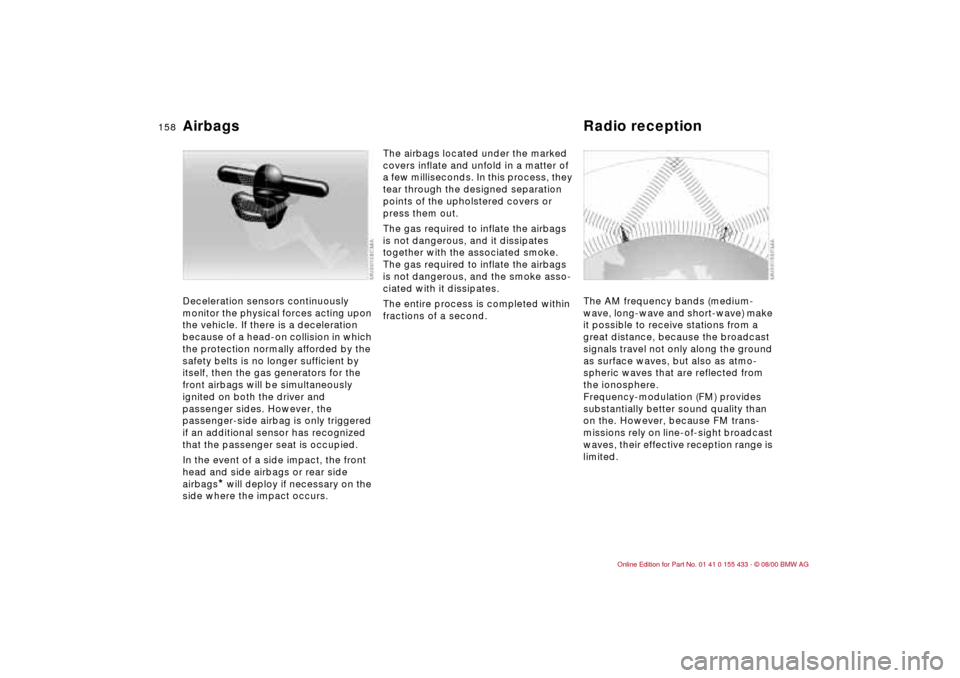
Deceleration sensors continuously
monitor the physical forces acting upon
the vehicle. If there is a deceleration
because of a head-on collision in which
the protection normally afforded by the
safety belts is no longer sufficient by
itself, then the gas generators for the
front airbags will be simultaneously
ignited on both the driver and
passenger sides. However, the
passenger-side airbag is only triggered
if an additional sensor has recognized
that the passenger seat is occupied.
In the event of a side impact, the front
head and side airbags or rear side
airbags
* will deploy if necessary on the
side where the impact occurs.
The airbags located under the marked
covers inflate and unfold in a matter of
a few milliseconds. In this process, they
tear through the designed separation
points of the upholstered covers or
press them out.
The gas required to inflate the airbags
is not dangerous, and it dissipates
together with the associated smoke.
The gas required to inflate the airbags
is not dangerous, and the smoke asso-
ciated with it dissipates.
The entire process is completed within
fractions of a second. The AM frequency bands (medium-
wave, long-wave and short-wave) make
it possible to receive stations from a
great distance, because the broadcast
signals travel not only along the ground
as surface waves, but also as atmo-
spheric waves that are reflected from
the ionosphere.
Frequency-modulation (FM) provides
substantially better sound quality than
on the. However, because FM trans-
missions rely on line-of-sight broadcast
waves, their effective reception range is
limited.
Airbags Radio reception