brake BMW M3 COUPE 2001 E46 User Guide
[x] Cancel search | Manufacturer: BMW, Model Year: 2001, Model line: M3 COUPE, Model: BMW M3 COUPE 2001 E46Pages: 183, PDF Size: 1.65 MB
Page 68 of 183

68n
Cruise control
Do not use cruise control on
winding roads, when high traffic
density prevents driving at a constant
speed, when the road surface is slick
(snow, rain, ice), or when the road
surface is loose (rocks, sand).<
To deactivate the system Press switch 3 repeatedly until the indi-
cator lamp in the instrument cluster
goes out.
The cruise control is also deactivated
when the ignition key is in position 0.
The speed stored in the memory is
deleted.To store and maintain speed as
well as to acceleratePress button 1 briefly:
The system registers and maintains the
current vehicle speed. Each additional
tap on the button increases the speed
by approx. 0.6 mph (1 km/h).
Press and hold button 1:
The vehicle accelerates without pres-
sure on the accelerator pedal. When
you release the button, the system
records and maintains the current
speed.
If, on a downhill gradient, the
engine braking effect is not suffi-
cient, the controlled speed can be
exceeded. Speed can drop on uphill
grades if the engine output is insuffi-
cient.<
To deceleratePress button 2 briefly:
Whenever cruise control is active,
your speed will reduce by approx.
0.6 mph (1 km/h) each time you tap
the button.
Press and hold button 2:
With the cruise control active, the
system automatically reduces the
throttle opening to slow the vehicle.
When you release the button, the
system records and maintains the
current speed.To cancel the cruise control When the cruise control is on, press
and hold button 3. The indicator lamp
will stay on.
You can use the cruise control again
whenever required by calling up the
speed that was stored last.
In addition, the cruise control is
canceled automatically:
>If the brakes are applied
>When pressing down the clutch pedal
>If the cruise speed is either exceeded
or not met for an extended length of
time (if you depress the accelerator
pedal and exceed the set speed, for
example).Recal the stored speedPress button 4:
The vehicle accelerates to and main-
tains the last speed stored.
Page 72 of 183
72n
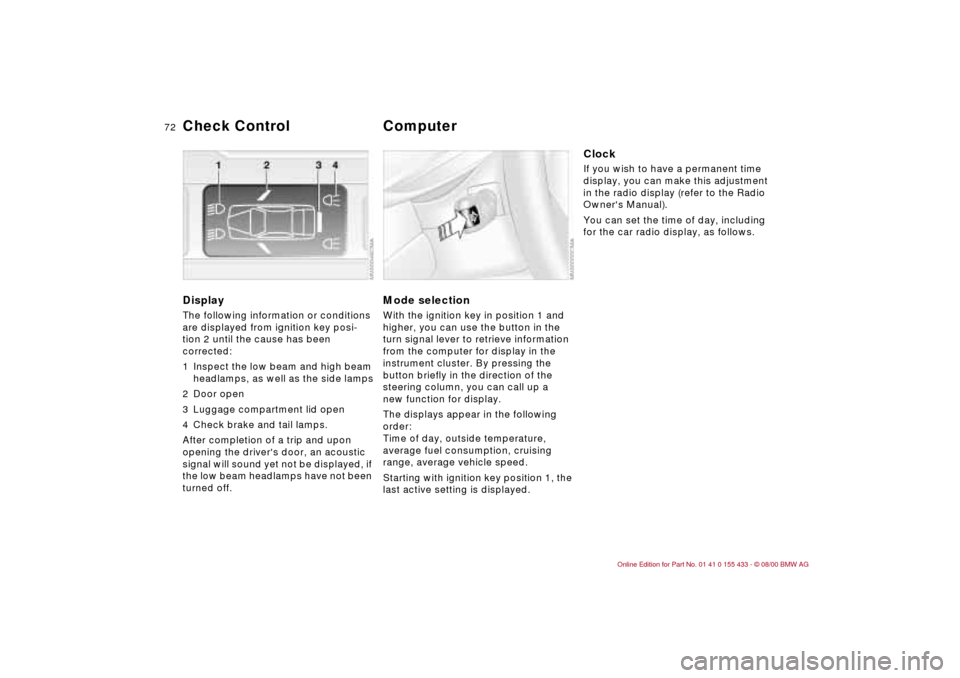
DisplayThe following information or conditions
are displayed from ignition key posi-
tion 2 until the cause has been
corrected:
1 Inspect the low beam and high beam
headlamps, as well as the side lamps
2 Door open
3 Luggage compartment lid open
4 Check brake and tail lamps.
After completion of a trip and upon
opening the driver's door, an acoustic
signal will sound yet not be displayed, if
the low beam headlamps have not been
turned off.
Mode selectionWith the ignition key in position 1 and
higher, you can use the button in the
turn signal lever to retrieve information
from the computer for display in the
instrument cluster. By pressing the
button briefly in the direction of the
steering column, you can call up a
new function for display.
The displays appear in the following
order:
Time of day, outside temperature,
average fuel consumption, cruising
range, average vehicle speed.
Starting with ignition key position 1, the
last active setting is displayed.
ClockIf you wish to have a permanent time
display, you can make this adjustment
in the radio display (refer to the Radio
Owner's Manual).
You can set the time of day, including
for the car radio display, as follows.
Check Control Computer
Page 76 of 183
76n
Dynamic Stability Control (DSC) The conceptDSC maintains vehicle stability, even in
critical driving situations.
The system optimizes vehicle stability
during acceleration and when starting
from a full stop, as well as optimizing
traction. In addition, it also recognizes
unstable driving conditions such as
understeering or oversteering in curves,
and helps the vehicle remin on a steady
course by using the engine and brake
system to intervene at the different
wheels. This, of course, is true only
within physically teasible limits.
The DSC is operational every time you
start the engine. The laws of physics cannot be
repealed, even with DSC. It will
always be the driver's responsibility to
drive in a manner that matches road
conditions. We therefore urge you to
avoid using the additional safety margin
of the system as an excuse for taking
risks.
Do not make any modifications to the
DSC system. Allow only authorized
technicians to perform service proce-
dures on the DSC.<
At first, you may need some time to
become accustomed to this system's
intervention. However, it guarantees
optimum drive force and at the same
time, the best possible vehicle stability.
For additional details concerning DSC,
refer to the chapter "Advanced tech-
nology" on page 158.
Indicator lamp
The indicator lamp in the instru-
ment cluster will go out shortly
after the ignition has been
switched on. Refer to pages 21, 22.
>Indicator lamp flashes: the DSC is
active and is controlling the drive
torque based on driving conditions
>If the indicator lamp fails to go out
after the engine has been started, or
if it comes on during normal driving
and stays on: the DSC has been
switched off via the button or there is
a malfunction. You can continue to
drive the vehicle normally, but
without DSC. Please consult your
BMW center for repairs.
Page 95 of 183
95n
IndexDataTechnologyRepairsCar careControlsOverview
Through-loading systemThe rear backrest is divided into two
sections, one-third and two-thirds of
the seat respectively. For carrying
longer objects, you can fold down
either section of the backrest sepa-
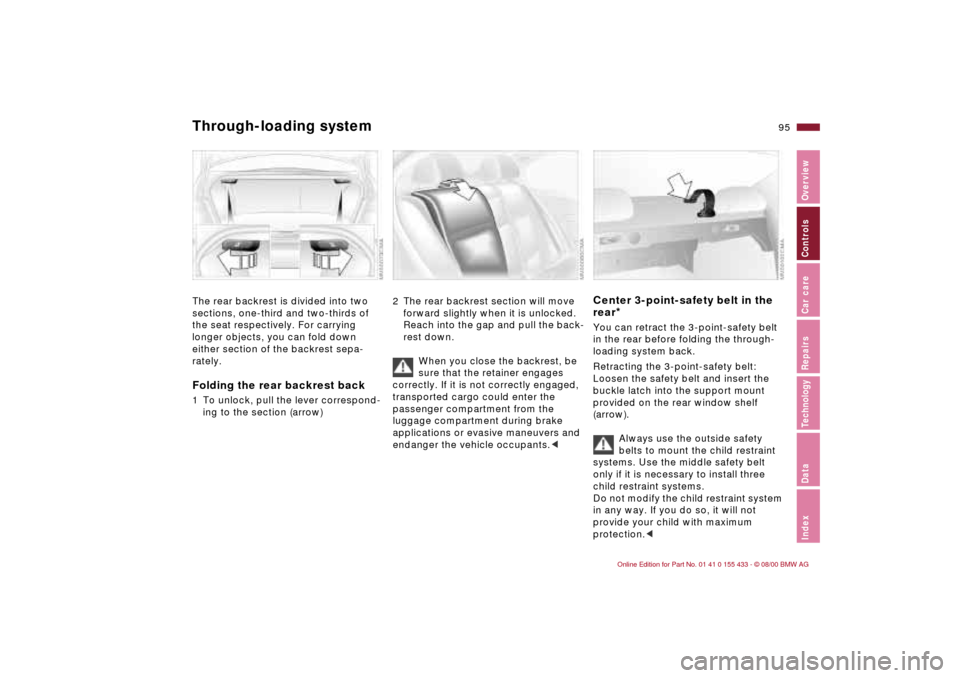
rately.Folding the rear backrest back1 To unlock, pull the lever correspond-
ing to the section (arrow)
2 The rear backrest section will move
forward slightly when it is unlocked.
Reach into the gap and pull the back-
rest down.
When you close the backrest, be
sure that the retainer engages
correctly. If it is not correctly engaged,
transported cargo could enter the
passenger compartment from the
luggage compartment during brake
applications or evasive maneuvers and
endanger the vehicle occupants.<
Center 3-point-safety belt in the
rear
*
You can retract the 3-point-safety belt
in the rear before folding the through-
loading system back.
Retracting the 3-point-safety belt:
Loosen the safety belt and insert the
buckle latch into the support mount
provided on the rear window shelf
(arrow).
Always use the outside safety
belts to mount the child restraint
systems. Use the middle safety belt
only if it is necessary to install three
child restraint systems.
Do not modify the child restraint system
in any way. If you do so, it will not
provide your child with maximum
protection.<
Page 101 of 183
Overview
Controls and features
Operation, care
and maintenance
Owner service procedures
Technical data
Index Advanced technology
101n
IndexDataTechnologyRepairsCar careControlsOverview
Special operating instructions:
Break-in procedures102
Driving notes103
Catalytic converter103
Antilock Brake System
(ABS)104
Disk brakes106
Brake system107
Winter operation108
Power steering110
Cellular phones110
Radio reception110
Wheels and tires:
Tire inflation pressure111
Tire condition111
Tire replacement112
Tire rotation113
Wheel and tire
combinations114
Winter tires115
Snow chains115
Approved wheel and tire
specifications116Under the hood:
Hood118
Engine compartment120
Washer fluids122
Washer nozzles122
Engine oil123
Coolant125
Brake fluid126
Vehicle Identification
Number126
Care and maintenance:
The BMW Maintenance
System127
Caring for your vehicle128
Airbags133
Vehicle storage133
Laws and regulations:
Technical modifications134
California Proposition
65 Warning134
OBD connector135
Car care
Page 102 of 183

102n
To ensure that your vehicle provides
maximum economy throughout a long
service life, we request that you
observe the following instructions:
Because of its engineering design,
the BMW M3 is an especially high-
quality vehicle. It is in your best interest
to follow the break-in procedure very
closely. Doing this, you will create the
basis for a long, optimum service life.<
Engine and differential>Until a mileage reading of 1,200 miles
(2,000 km): drive at varying engine
and road speeds, but do not exceed
the following engine speeds or road
speeds:
5,500/rpm or 105 mph (170 km/h)
Obey your local and state maximum
speed limits.
Do not depress the accelerator pedal to
the full-throttle position.
>After you have monitored the break-
in period for 1,200 miles (2,000 km),
you can begin to gradually increase
both the engine speed and road
speed.
You should also comply with these
break-in procedures if the engine or
differential is replaced later in the
course of the vehicle service life.
TiresDue to technical factors associated
with their manufacture, tires do not
achieve their full traction potential until
an initial break-in period has elapsed.
Thus drive with extra care during the
initial 200 miles (300 km).
Obey your local and state maximum
speed limits.
When the vehicle is operated on
wet or slushy roads, a wedge of
water may form between the tire and
the road surface. This phenomenon is
referred to as aquaplaning, or hydro-
planing, and can lead to partial or
complete loss of traction, vehicle
control and braking effectiveness.
Reduce your speed on wet roads.<
Brake systemApproximately 300 miles (500 km) must
elapse before the brake pads and disks
achieve the optimal pad-surface and
wear patterns required for trouble -free
operation and long service life later on.
To break-in the separate parking brake
drums, apply the parking brake lightly
when coasting to a standstill (at a traffic
signal, for instance), provided that
traffic conditions allow you to do so. To
avoid corrosion, repeat this procedure
from time to time.
The brake lamps do not come on
when the parking brake is set.
Vacuum for the brake system servo unit
on your BMW is available only when the
engine is running. When you move the
vehicle with the engine off Ð when
towing, for example Ð substantially
higher levels of pedal force will be
required to brake the vehicle.
(500 km). Drive cautiously during this
break-in period and do not shift
roughly.
Break-in procedures
Page 103 of 183

103n
IndexDataTechnologyRepairsCar careControlsOverview
Brakes: do not drive with your foot
resting on the brake pedal. Even
light but consistent pedal pressure can
lead to high temperatures, brake wear
and possibly even brake failure.
Aquaplaning:
When driving on wet or slushy roads,
reduce vehicle speed. If you do not, a
wedge of water may form between the
tires and the road surface. This
phenomenon is referred to as aqua-
planing, or hydroplaning, and can lead
to partial or complete loss of traction,
vehicle control and braking effective-
ness.
Driving through water:
Do not drive through water on the road
if it is deeper than 1 foot (30 cm), and
then only at walking speed. Otherwise,
the vehicle's engine, the electrical
systems and the transmission may be
damaged.
Rear window shelf:
Never use it to store heavy or hard
objects, otherwise, occupants could be
injured if the vehicle is braked hard.<
The catalytic converter reduces harmful
exhaust emissions.
It is designed for use with unleaded fuel
only. Even minute quantities of lead
would be enough to permanently
damage both the catalytic converter
and the system oxygen sensor.
To ensure efficient, trouble-free engine
operation and avoid potential damage:
>Be sure to comply with the scheduled
maintenance requirements
>Fill the fuel tank well before it is
empty
>Tow-start only when the engine is
cold. If you attempt to tow-start with
a warm engine, unburned residual
fuel in the catalytic converter could
ignite and cause damage. It is better
to start the vehicle with an outside
starting aid
>Avoid other situations in which the
fuel is not burned or burns incom-
pletely such as frequent or extended
starter engagement or repeated start
attempts in which the engine does
not start. Stopping and restarting an
engine which is running properly
does not present a problem. Never
allow the engine to run with any of
the spark plug cables disconnected. Be sure to observe the instruc-
tions above to prevent unburned
fuel from reaching the catalytic
converter. Otherwise there is danger of
overheating and damage to the cata-
lytic converter.
Extreme temperatures occur at the
catalytic converter on this and every
catalyst-equipped vehicle. Heat shields
are installed adjacent to some sections
of the exhaust system. Never remove
these shields; do not apply under-
coating to their surfaces. When driving,
standing at idle or when parking, take
precautions to avoid contact between
the hot exhaust system and easily flam-
mable materials (grass, hay or leaves,
for example). Such contact could lead
to a fire, resulting in personal injury and
property damage.<
Driving notes Catalytic converter
Page 104 of 183

104n
Antilock Brake System (ABS)The concept ABS keeps the wheels from locking
while braking, thereby enhancing active
driving safety. The reason: locked
wheels are dangerous. When the front
wheels slide, the driver loses steering
control over the vehicle. Traction loss at
the rear wheels can cause the rear end
to break into an uncontrolled skid.
Based on current road conditions, ABS
can brake the vehicle within the
shortest possible distance and with the
greatest possible driving stability (on
straight-aways and curves, asphalt, ice,
wet road surfaces, etc.).
ABS is designed to meet two essential
requirements during every brake appli-
cation:
>To help provide vehicle stability
>To help maintain steering control and
maneuverability Ð on all types of road
surfaces (asphalt, concrete, mud,
wet, snow, ice). Braking with ABSThe system becomes operative once
the vehicle exceeds a speed of approx.
6 mph (10 km/h). Whenever the
vehicle's speed drops below approx.
4 mph (6 km/h), the ABS is deactivated.
This means that the wheels can lock in the final phase of a panic stop Ð a factor
of no significance in actual use.
The ABS system works best in situa-
tions requiring maximum pressure on
the pedal ("panic stop"). Do not let up
on the brake pedal even after it starts
pulsating. Since the vehicle maintains
steering responsiveness, you can
nevertheless avoid possible obstacles
with a minimum of steering effort.
The ABS closed-loop control circuit
cycles in fractions of a second. Pulsa-
tion at the brake pedal shows you that
ABS is active, that you are braking
within the ABS' braking range and that
you are thus pushing the limit of the
system. In addition, a pulsation Ð a
result of the control function cycles Ð
indicates to the driver that the vehicle
speed should be reduced to adapt to
road surface conditions when there is
reduced traction and grip between tires
and road surface (slippery road
surface).
On road surfaces with a loose surface
layer over a firm base, e.g. on gravel or
snow, as well as when driving with
snow chains on, braking distances may
be longer for a locked-wheel condition.
However, ABS continues to provide
enhanced vehicle stability and steering
response under these conditions.
Information for your safetyNot even ABS can suspend the laws of
physics. The consequences of hitting
the brakes when there is inadequate
distance between vehicles, when the
vehicle is driven at excessive speeds
through curves, or during aquaplaning,
remain the driver's responsibility. You
should never allow the added safety of
ABS to lull you into a false sense of
security, or mislead you into taking risks
that could affect your own safety and
that of others.
Do not make any modifications to
the ABS system.
Service procedures on ABS are to be
performed by authorized technicians
only.< Antilock Brake System (ABS)/
Cornering Brake Control (CBC) CBC is an advanced engineering
design of the ABS. When braking while
cornering at high speed or braking
during high lateral acceleration, or
when braking during a lane change,
vehicle stability is improved and
steering response is enhanced.
Page 105 of 183
105n
IndexDataTechnologyRepairsCar careControlsOverview
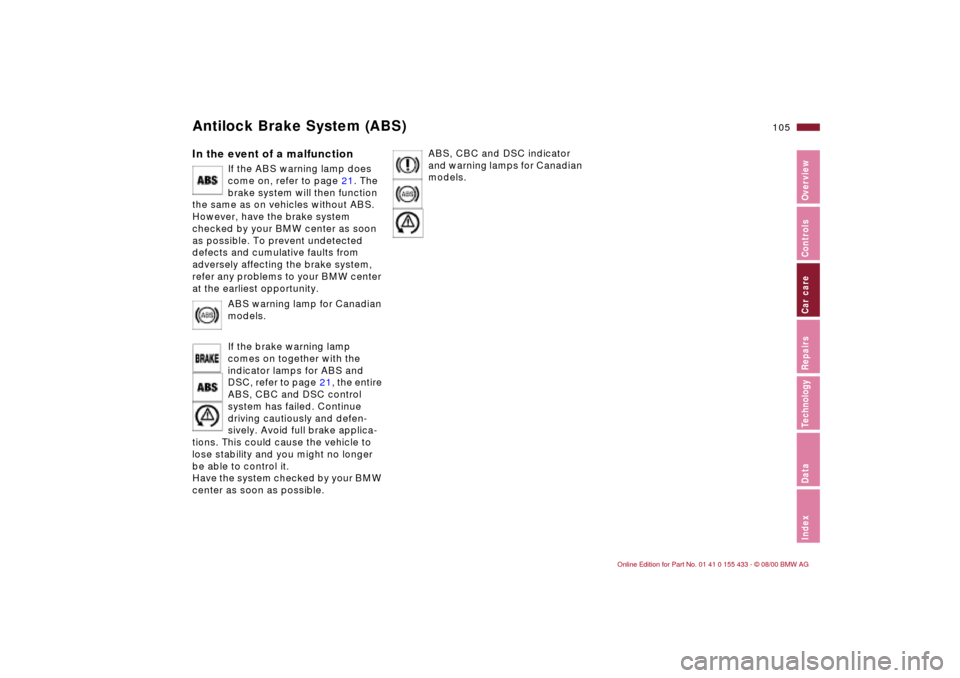
Antilock Brake System (ABS)In the event of a malfunction
If the ABS warning lamp does
come on, refer to page 21. The
brake system will then function
the same as on vehicles without ABS.
However, have the brake system
checked by your BMW center as soon
as possible. To prevent undetected
defects and cumulative faults from
adversely affecting the brake system,
refer any problems to your BMW center
at the earliest opportunity.
ABS warning lamp for Canadian
models.
If the brake warning lamp
comes on together with the
indicator lamps for ABS and
DSC, refer to page 21, the entire
ABS, CBC and DSC control
system has failed. Continue
driving cautiously and defen-
sively. Avoid full brake applica-
tions. This could cause the vehicle to
lose stability and you might no longer
be able to control it.
Have the system checked by your BMW
center as soon as possible.
ABS, CBC and DSC indicator
and warning lamps for Canadian
models.
Page 106 of 183

106n
Disk brakesDisk brakes furnish optimum decelera-
tion and braking control and greater
fade resistance under heavy use.
When the vehicle is driven only occa-
sionally, during extended periods when
the vehicle is not used at all, and in
operating conditions where brake appli-
cations are less frequent, there is an
increased tendency for corrosion of the
disks and accumulation of contamina-
tion on the brake pads. This occurs
because the minimal pressure that must
be exerted by the pads to clean the
disks by brake applications is not
reached.
If the brake disks are corroded, they will
tend to respond to braking with a
pulsating effect which even extended
application will fail to cure.
For your own safety: use only
brake pads which BMW has
approved for your specific vehicle
model. BMW cannot evaluate non-
approved brake pads to determine if
they are suited for use, and therefore
cannot ensure the operating safety of
the vehicle if they are installed.<
Driving notes While driving on wet roads or in heavy
rain, it is a good idea to apply light
pressure to the brake pedal every few
miles or kilometers. Watch traffic condi-
tions to ensure that this maneuver does
not endanger other road users. The
heat which is generated by the brake
applications helps to dry the brake
pads and disks.
Maximum braking force is obtained
while the wheels continue to rotate,
peaking when the wheels remain on the
verge of locking without actually doing
so. ABS maintains this state automati-
cally. If the ABS should ever fail, pump
the brakes if possible (refer to
page 109).
Extended or steep mountain descents
should be driven in the gear in which
only minimal periodic brake application
is required. This avoids excessive strain
on the brakes and possible
impairment of the braking effect. Stay
within the allowable engine speed
range. For further information, refer to
page 69.
The braking effect of the engine can be
further increased by downshifting, into
first gear, if necessary. Should engine braking prove inade-
quate, you should still avoid extended,
continuous braking. Instead of main-
taining low to moderate pressure over
an extended period of time, you should
decelerate the vehicle by applying more
substantial force on the pedal (watch
for following traffic). Pause before
repeating the brake application. This
staggered braking technique allows the
brakes to cool in the intervals between
active braking phases, preventing over-
heating and ensuring that full braking
capacity remains available at all times.
Do not coast with the clutch
depressed, with the shift lever in
neutral or with the engine shut off. The
engine does not provide any braking
effect with the transmission in neutral or
with the engine shut off.
Do not allow floor mats, carpets or any
other objects to protrude into the area
around the brake pedal, the clutch or
the accelerator which could obstruct
their freedom of movement.<