sensor BMW M3 COUPE 2001 E46 User Guide
[x] Cancel search | Manufacturer: BMW, Model Year: 2001, Model line: M3 COUPE, Model: BMW M3 COUPE 2001 E46Pages: 183, PDF Size: 1.65 MB
Page 85 of 183

85n
IndexDataTechnologyRepairsCar careControlsOverview
Automatic climate control 1 Air onto the windshield and onto the
side windows
2 Airflow toward the upper body
The side rotary dials allow you to
open and close the air supply
through an infinitely-variable range,
while the levers change the airflow
direction. The center rotary dial
adjusts the temperature of the air as
it flows out, see page 88
3 Ventilation for the front footwell
There are corresponding air vents in
the rear footwell as well
4 Recirculated air mode/Automatic
recirculated air control (AUC)87
5 Air supply (fan)87
6 Temperature86
7 Automatic air distribution86
8 Individual air distribution86
9 Air grill for interior temperature
sensor Ð please keep clear and
unobstructed
10 Display for temperature and air
supply86
11 To defrost windshield and side
windows87
12 Air conditioner87
13 Rear window defroster67, 88
Page 103 of 183

103n
IndexDataTechnologyRepairsCar careControlsOverview
Brakes: do not drive with your foot
resting on the brake pedal. Even
light but consistent pedal pressure can
lead to high temperatures, brake wear
and possibly even brake failure.
Aquaplaning:
When driving on wet or slushy roads,
reduce vehicle speed. If you do not, a
wedge of water may form between the
tires and the road surface. This
phenomenon is referred to as aqua-
planing, or hydroplaning, and can lead
to partial or complete loss of traction,
vehicle control and braking effective-
ness.
Driving through water:
Do not drive through water on the road
if it is deeper than 1 foot (30 cm), and
then only at walking speed. Otherwise,
the vehicle's engine, the electrical
systems and the transmission may be
damaged.
Rear window shelf:
Never use it to store heavy or hard
objects, otherwise, occupants could be
injured if the vehicle is braked hard.<
The catalytic converter reduces harmful
exhaust emissions.
It is designed for use with unleaded fuel
only. Even minute quantities of lead
would be enough to permanently
damage both the catalytic converter
and the system oxygen sensor.
To ensure efficient, trouble-free engine
operation and avoid potential damage:
>Be sure to comply with the scheduled
maintenance requirements
>Fill the fuel tank well before it is
empty
>Tow-start only when the engine is
cold. If you attempt to tow-start with
a warm engine, unburned residual
fuel in the catalytic converter could
ignite and cause damage. It is better
to start the vehicle with an outside
starting aid
>Avoid other situations in which the
fuel is not burned or burns incom-
pletely such as frequent or extended
starter engagement or repeated start
attempts in which the engine does
not start. Stopping and restarting an
engine which is running properly
does not present a problem. Never
allow the engine to run with any of
the spark plug cables disconnected. Be sure to observe the instruc-
tions above to prevent unburned
fuel from reaching the catalytic
converter. Otherwise there is danger of
overheating and damage to the cata-
lytic converter.
Extreme temperatures occur at the
catalytic converter on this and every
catalyst-equipped vehicle. Heat shields
are installed adjacent to some sections
of the exhaust system. Never remove
these shields; do not apply under-
coating to their surfaces. When driving,
standing at idle or when parking, take
precautions to avoid contact between
the hot exhaust system and easily flam-
mable materials (grass, hay or leaves,
for example). Such contact could lead
to a fire, resulting in personal injury and
property damage.<
Driving notes Catalytic converter
Page 128 of 183

128n
Washing your vehicle You can have your BMW washed in an
automatic car wash, even when it is
new. Car wash systems that do not
employ brushes are preferable.
Wipe away tough dirt and loosen and
remove dead insects before washing
the vehicle.
To prevent spots, avoid washing when
the hood is still warm, or immediately
after and during exposure to strong
sunlight.
When using an automatic car wash, be
sure that:
>The car wash system is suited for the
dimensions of your vehicle
>No damage will occur on vehicles
with attached body accessories (such
as spoilers or antennas). Consult the
car wash operator if necessary
>The wheels and tires of your vehicle
cannot be damaged by the convey-
ance devices of the car wash system
>The vehicle is cleaned with minimum
brush pressure, and that plenty of
water is available for washing and
rinsing. Vehicles with rain sensor:
Clean the windshield regularly. Wax
from automatic car washes or insects
can cause malfunctions in the rain
sensor function.
Turn the rain sensor off (refer to
page 66) when going through an
automatic car wash, otherwise, damage
could occur from unintended wiper
activation.<
Parts of the vehicle which are inacces-
sible to the automatic washer Ð such
as door sills, door and hood edges, etc.
Ð should be cleaned by hand.
In the winter months, it is especially
important to ensure that the vehicle is
washed on a regular basis. Large
quantities of dirt and road salt are
difficult to remove, and they also cause
damage to the vehicle.
If spray wands or high-pressure
washers are used, be sure to
maintain an adequate distance between
the spray source and the vehicle's
surface. Inadequate distance and
excessive pressure can damage or
weaken the finish, making it more
susceptible to subsequent attack. In
addition, moisture could penetrate to
vehicle components, leading to long-
term damage.<
When cleaning the headlamps,
please observe the following:
Do not wipe dry with a cloth
(scratches). Never use abrasives or
strong solvents. Remove dirt and
contamination (such as insects) by
soaking with BMW Car Shampoo and
then rinsing with plenty of water.
Always use a deicer spray to remove
accumulated ice and snow Ð never use
a scraper.<
After washing the vehicle, apply
the brakes briefly to dry them.
Braking efficiency might otherwise be
reduced by the moisture and the brake
rotors could also corrode.<
Caring for your vehicle
Page 130 of 183

130n
Caring for your vehicleWaxing your vehicle Protect the finish using only carnauba
or synthetic-based waxes.
The best way to determine when the
finish needs to be waxed is by noting
when water stops beading on the
surface.
You can use a glass cleaner to remove
any wax or silicone that may have been
left on the windows during waxing.
Use the cleaning and car-care
products that you can obtain at
your BMW center.<
Paint damageYou can touch up small areas of paint
damage with a BMW spray paint or a
BMW touchup stick.
The paint color code for your vehicle is
provided on a sticker located on the
right hand side under the hood and on
the first page of your Service and
Warranty Information Booklet (US
models) or Warranty and Service Guide
Booklet (Canadian models).
Damage caused by flying stones,
scratches, etc., must be touched up
without delay to prevent rust from
forming.
If corrosion has started to form in an
area with paint damage, remove all rust
and clean the area. Then prime the area
with a BMW Primer Stick. Finally, apply
the finish coat. Wait a few days, then
polish the repaired area. Finish by
applying a wax preservative.
More extensive paint damage
should be professionally repaired in
accordance with the manufacturer's
instructions. Your BMW center uses
original BMW finish materials in
accordance with factory-approved
repair procedures.
Window careYou can use window and glass cleaner
to clean inside window surfaces and
mirrors without smearing and streaking.
Never use polishing pastes or abrasive
(quartz) cleansers on mirror lenses.
Clean the wiper blades with soapy
water. The wiper blades should be
replaced twice a year Ð before and after
the cold season. This is especially
important for vehicles equipped with
rain sensor.
Use only wiper blades approved
by BMW.<
Page 157 of 183
157n
IndexDataTechnologyRepairsCar careControlsOverview
Overview
Controls and features
Operation, care
and maintenance
Technical data
Index Advanced technology
Airbags158
Radio reception158
Dynamic Stability Control
(DSC)159
Safety belt tensioner159
M3 Engine concept160
Rain sensor160
Interior rearview mirror with
automatic dimming
feature161
Self-diagnostics162
Xenon lamps163
Technology
Owner service procedures
Page 158 of 183
158n
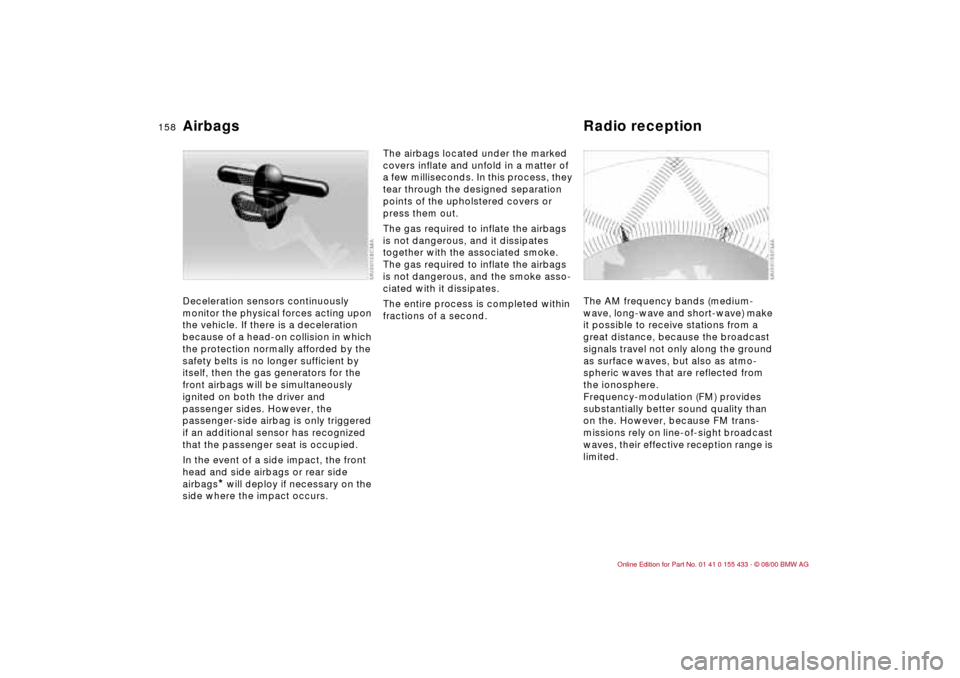
Deceleration sensors continuously
monitor the physical forces acting upon
the vehicle. If there is a deceleration
because of a head-on collision in which
the protection normally afforded by the
safety belts is no longer sufficient by
itself, then the gas generators for the
front airbags will be simultaneously
ignited on both the driver and
passenger sides. However, the
passenger-side airbag is only triggered
if an additional sensor has recognized
that the passenger seat is occupied.
In the event of a side impact, the front
head and side airbags or rear side
airbags
* will deploy if necessary on the
side where the impact occurs.
The airbags located under the marked
covers inflate and unfold in a matter of
a few milliseconds. In this process, they
tear through the designed separation
points of the upholstered covers or
press them out.
The gas required to inflate the airbags
is not dangerous, and it dissipates
together with the associated smoke.
The gas required to inflate the airbags
is not dangerous, and the smoke asso-
ciated with it dissipates.
The entire process is completed within
fractions of a second. The AM frequency bands (medium-
wave, long-wave and short-wave) make
it possible to receive stations from a
great distance, because the broadcast
signals travel not only along the ground
as surface waves, but also as atmo-
spheric waves that are reflected from
the ionosphere.
Frequency-modulation (FM) provides
substantially better sound quality than
on the. However, because FM trans-
missions rely on line-of-sight broadcast
waves, their effective reception range is
limited.
Airbags Radio reception
Page 159 of 183
159n
IndexDataTechnologyRepairsCar careControlsOverview
The limitations inherent to radio recep-
tion in a moving vehicle have been
minimized by a number of innovative
system designs:
The "Radio Data System" (RDS) makes
sure that, for broadcast stations
sending on several frequencies, the
radio automatically tunes to the
frequency with the best reception
quality.
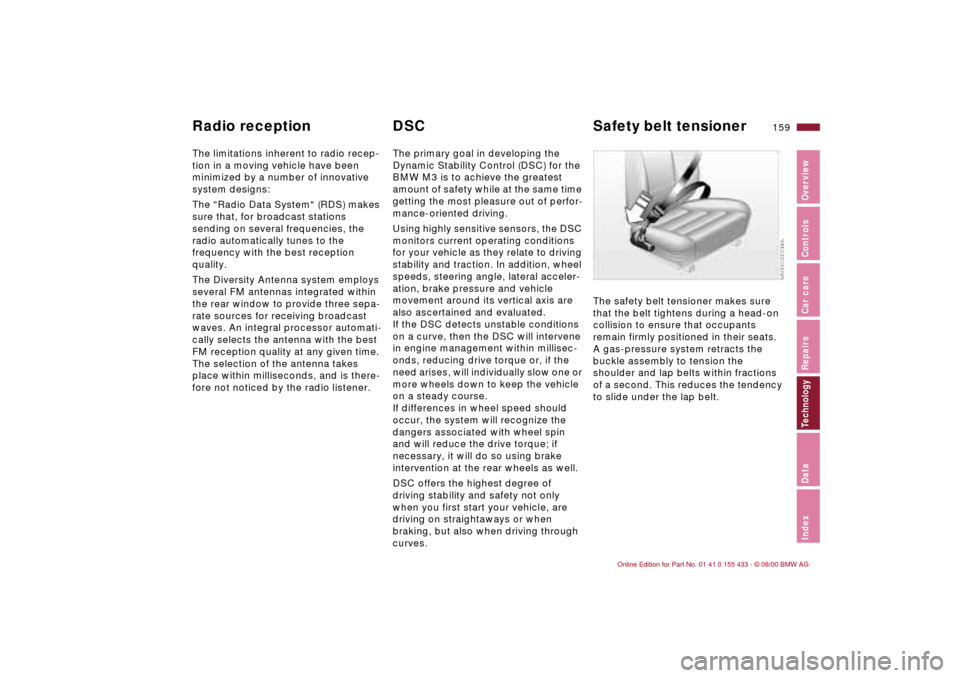
The Diversity Antenna system employs
several FM antennas integrated within
the rear window to provide three sepa-
rate sources for receiving broadcast
waves. An integral processor automati-
cally selects the antenna with the best
FM reception quality at any given time.
The selection of the antenna takes
place within milliseconds, and is there-
fore not noticed by the radio listener. The primary goal in developing the
Dynamic Stability Control (DSC) for the
BMW M3 is to achieve the greatest
amount of safety while at the same time
getting the most pleasure out of perfor-
mance-oriented driving.
Using highly sensitive sensors, the DSC
monitors current operating conditions
for your vehicle as they relate to driving
stability and traction. In addition, wheel
speeds, steering angle, lateral acceler-
ation, brake pressure and vehicle
movement around its vertical axis are
also ascertained and evaluated.
If the DSC detects unstable conditions
on a curve, then the DSC will intervene
in engine management within millisec-
onds, reducing drive torque or, if the
need arises, will individually slow one or
more wheels down to keep the vehicle
on a steady course.
If differences in wheel speed should
occur, the system will recognize the
dangers associated with wheel spin
and will reduce the drive torque; if
necessary, it will do so using brake
intervention at the rear wheels as well.
DSC offers the highest degree of
driving stability and safety not only
when you first start your vehicle, are
driving on straightaways or when
braking, but also when driving through
curves.The safety belt tensioner makes sure
that the belt tightens during a head-on
collision to ensure that occupants
remain firmly positioned in their seats.
A gas-pressure system retracts the
buckle assembly to tension the
shoulder and lap belts within fractions
of a second. This reduces the tendency
to slide under the lap belt. Radio reception DSC Safety belt tensioner
Page 160 of 183
160n
M3 Engine concept Rain sensor
*
BMW M will continue to develop BMW
engines for the performance-oriented,
yet responsible driver. That is why value
is placed on an engine design that
guarantees maximum thrust over a
wide engine speed range.
This is done by using high-grade mate-
rials and components with optimized
details. The engine thereby produces
higher speeds than can be achieved
with conventional engines.
Associated with the proper transmis-
sion gear ratio and an especially perfor-
mance-oriented engine electronics
system, the torque opens up with this
so-called "high-speed aspirated
engine" extremely evenly throughout
the entire engine speed range from
1,000 to max. 8 ,000 rpm.
In actual usage, this means improved
acceleration and more spontaneous
response throughout the engine speed
range, thus affording more driving plea-
sure.
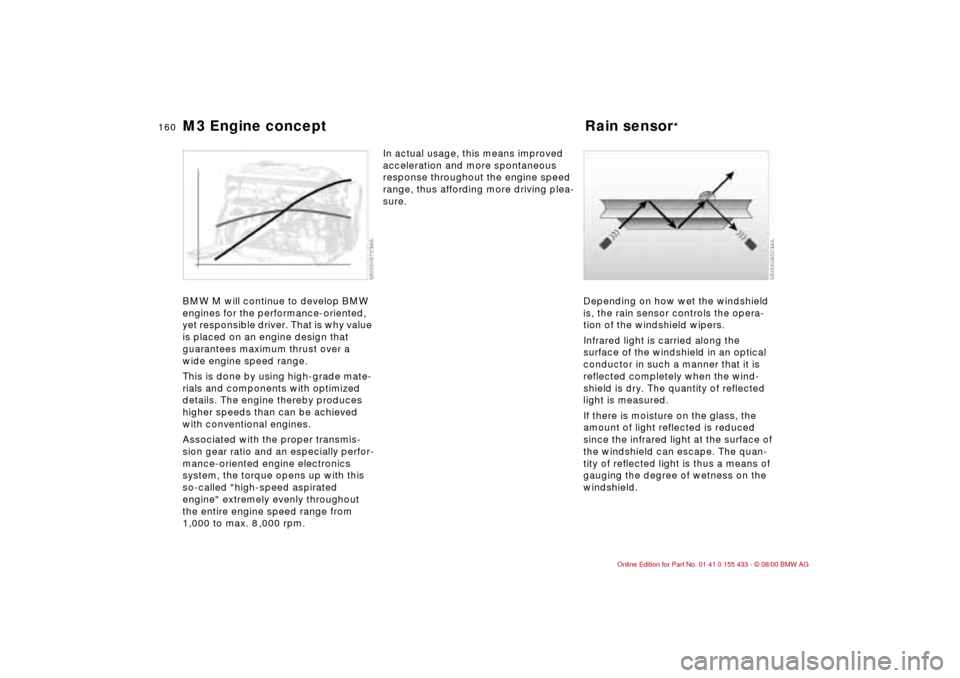
Depending on how wet the windshield
is, the rain sensor controls the opera-
tion of the windshield wipers.
Infrared light is carried along the
surface of the windshield in an optical
conductor in such a manner that it is
reflected completely when the wind-
shield is dry. The quantity of reflected
light is measured.
If there is moisture on the glass, the
amount of light reflected is reduced
since the infrared light at the surface of
the windshield can escape. The quan-
tity of reflected light is thus a means of
gauging the degree of wetness on the
windshield.
Page 161 of 183
161n
IndexDataTechnologyRepairsCar careControlsOverview
Rain sensor
*
Interior rearview mirror, automatic dimming feature
When the "intermittent wiper" speed
position is selected, the wiper reacts
immediately if water is splashed onto
the windshield from vehicles traveling
ahead, for example. As a result, the rain
sensor contributes to driving safety and
comfort.
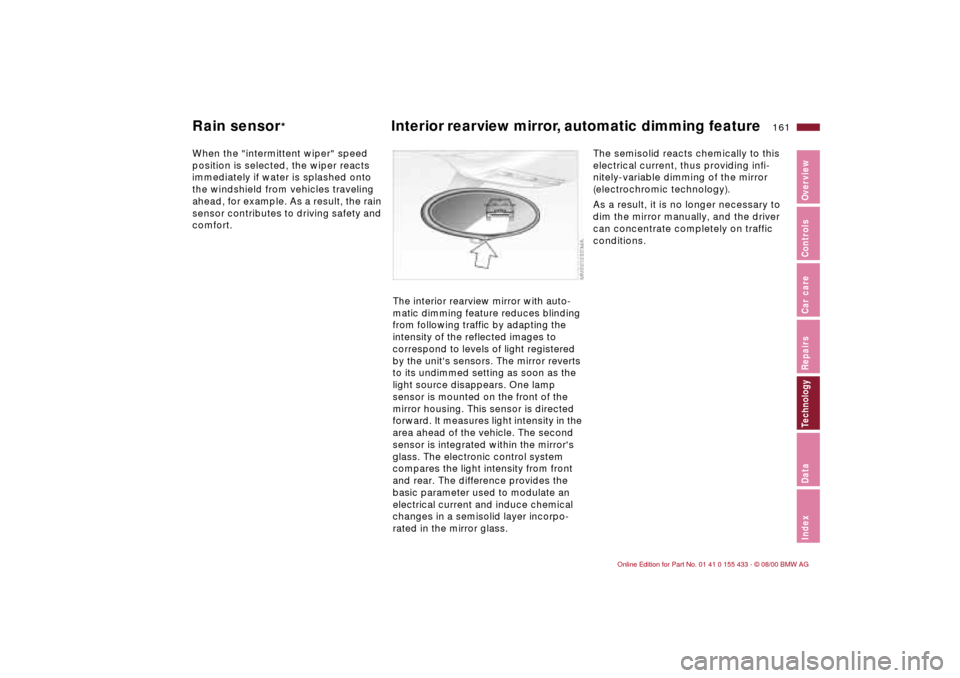
The interior rearview mirror with auto-
matic dimming feature reduces blinding
from following traffic by adapting the
intensity of the reflected images to
correspond to levels of light registered
by the unit's sensors. The mirror reverts
to its undimmed setting as soon as the
light source disappears. One lamp
sensor is mounted on the front of the
mirror housing. This sensor is directed
forward. It measures light intensity in the
area ahead of the vehicle. The second
sensor is integrated within the mirror's
glass. The electronic control system
compares the light intensity from front
and rear. The difference provides the
basic parameter used to modulate an
electrical current and induce chemical
changes in a semisolid layer incorpo-
rated in the mirror glass.
The semisolid reacts chemically to this
electrical current, thus providing infi-
nitely-variable dimming of the mirror
(electrochromic technology).
As a result, it is no longer necessary to
dim the mirror manually, and the driver
can concentrate completely on traffic
conditions.
Page 176 of 183

Everything from A to Zhigh-speed aspirated
engine160
speed166
starting62t
torque166
Engine concept M3160
Engine oil
add123t
capacity169
consumption123
pressure20
temperature69
Entry to the rear47
Exterior mirrors49
Eyelets, towing155tFFailure messages72t
Fan87
Fault, ABS105
Filler cap cover25
Filling capacities169
Filling the washer
reservoir122t
First-aid kit24t
Flat tire111
repairing145
Fog lamps82
bulb replacement141t
Folding rear backrest95
Follow-Me-Home lamps81
Footbrake106Footwell lamps82
bulb replacement144t
Frost protection,
radiator125
Fuel26
consumption74
consumption display70
gauge70
preparation166
quality26
reserve indicator lamp70
Fuel filler door
manual release after
electrical fault152t
Fuel tank capacity169
Fuel tank gauge70
Functional status, electrical
and electronic
systems162
Fuses151
replacing151t
GGasoline26
Gasoline gauge70
Glove compartment90
Glove compartment lamp,
bulb replacement144t
Gross vehicle weight168
HHandbrake63
Handsfree system92
Hazard warning
flashers24t
Hazard warning triangle24
Head restraint46
Headlamp cleaning
system121, 122, 169
Headlamp cover,
care139t
Headlamp flasher82
Headlamp washer system,
refer to headlamp cleaning
system
Heated seats89
Heavy loads97
Height167
HiFi system Ð harman
kardon90
High beams65, 82
indicator lamp22
High engine speed160
High Performance Synthetic
Oil124
High-mount brake lamp143
Holder for beverages91
Hood release118t
Horn17
IIce warning73
Identification, tires114
Ignition key30
Ignition lock62
Imprint4
Indicator lamps20t
Individual settings52
Inflation
pressure26t, 111t
INSPECTION71
Instrument cluster18
Instrument lighting81
Instrument panel18
Interaxle tire rotation113t
Interface socket
for Onboard
Diagnostics135
Interference
cellular phone110
Interior lamps34, 82
bulb replacement143t
remote control34
Interior motion sensor40
Interior rearview mirror
automatic dimming
feature50, 161
Intermittent mode, wiper
system65