light BMW M3 COUPE 2001 E46 Owner's Guide
[x] Cancel search | Manufacturer: BMW, Model Year: 2001, Model line: M3 COUPE, Model: BMW M3 COUPE 2001 E46Pages: 183, PDF Size: 1.65 MB
Page 77 of 183
77n
IndexDataTechnologyRepairsCar careControlsOverview
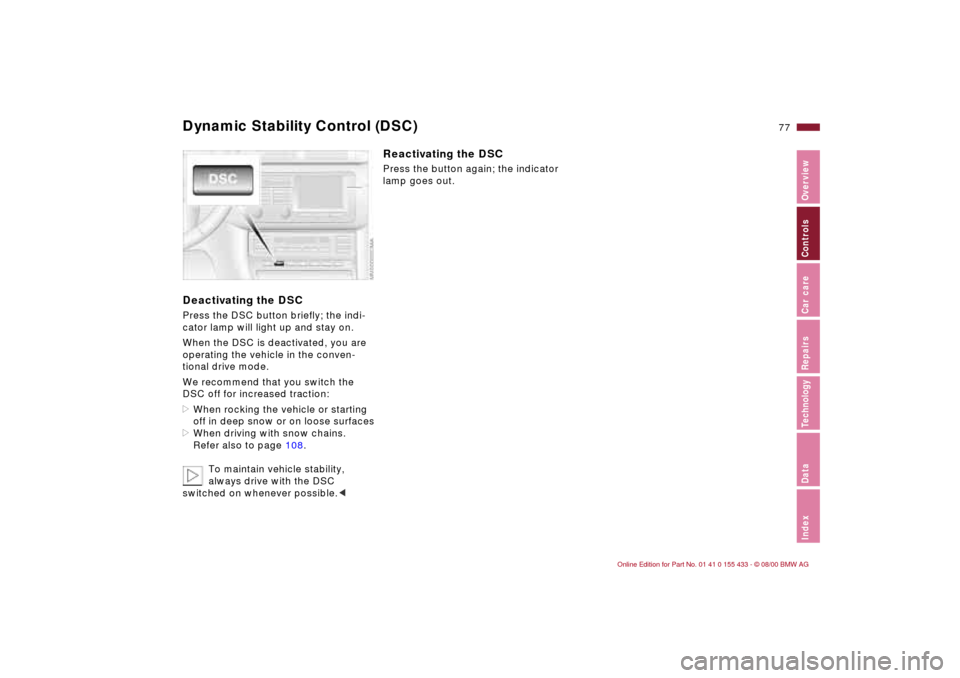
Dynamic Stability Control (DSC)Deactivating the DSCPress the DSC button briefly; the indi-
cator lamp will light up and stay on.
When the DSC is deactivated, you are
operating the vehicle in the conven-
tional drive mode.
We recommend that you switch the
DSC off for increased traction:
>When rocking the vehicle or starting
off in deep snow or on loose surfaces
>When driving with snow chains.
Refer also to page 108.
To maintain vehicle stability,
always drive with the DSC
switched on whenever possible.<
Reactivating the DSCPress the button again; the indicator
lamp goes out.
Page 78 of 183
78n
Tire Pressure Warning (RDW)The conceptThe Tire Pressure Warning (RDW) moni-
tors the tire pressure in all four wheels
while driving. The system detects
whenever the inflation pressure in a tire
drops significantly.
Controlling the tire pressure is based
on monitoring the speed of the tires
relative to each other. A flat tire is
detected and reported because the
speed suddenly deviate drastically from
one another.
Initializing the systemInitializing is necessary to familiarize the
system with the correct inflation pres-
sure.
Repeat this process after any changes
in tire inflation pressure, tire rotation or
replacement. Do not carry out further
system initialization after correcting the
inflation pressure and letting the system
"learn" what condition is required.
1 Check the tire inflation pressure in all
the tires, comparing them with the
inflation pressure table (page 27),
and adjusting their pressure if neces-
sary
2 Turn the ignition key to position 2
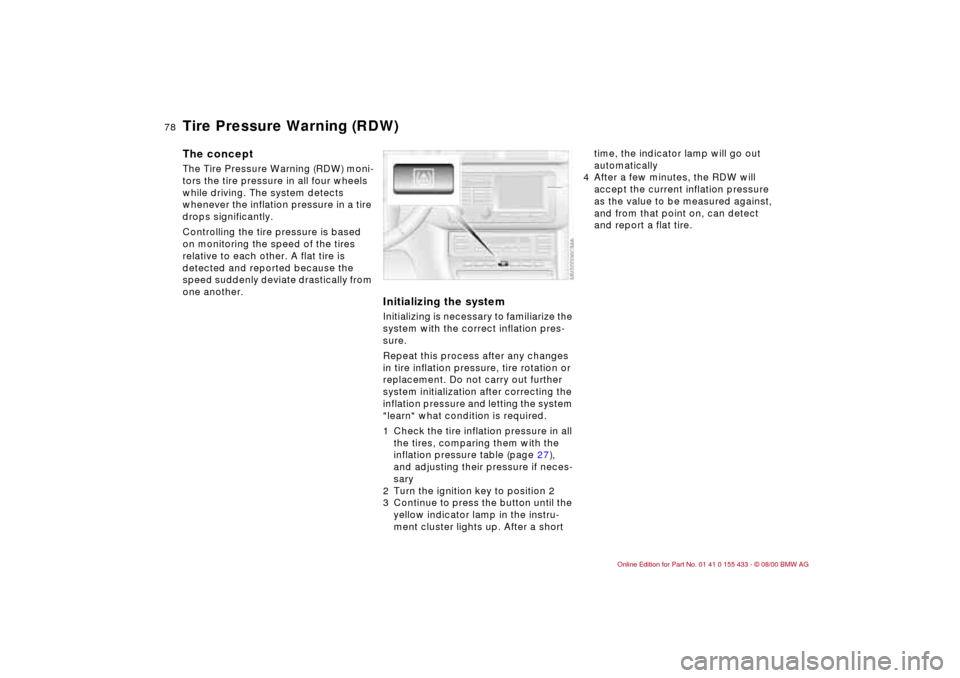
3 Continue to press the button until the
yellow indicator lamp in the instru-
ment cluster lights up. After a short
time, the indicator lamp will go out
automatically
4 After a few minutes, the RDW will
accept the current inflation pressure
as the value to be measured against,
and from that point on, can detect
and report a flat tire.
Page 79 of 183
79n
IndexDataTechnologyRepairsCar careControlsOverview
Tire Pressure Warning (RDW)Activating/deactivating the
systemThe system is automatically active in
ignition key position 2 and is therefore
always on during driving.
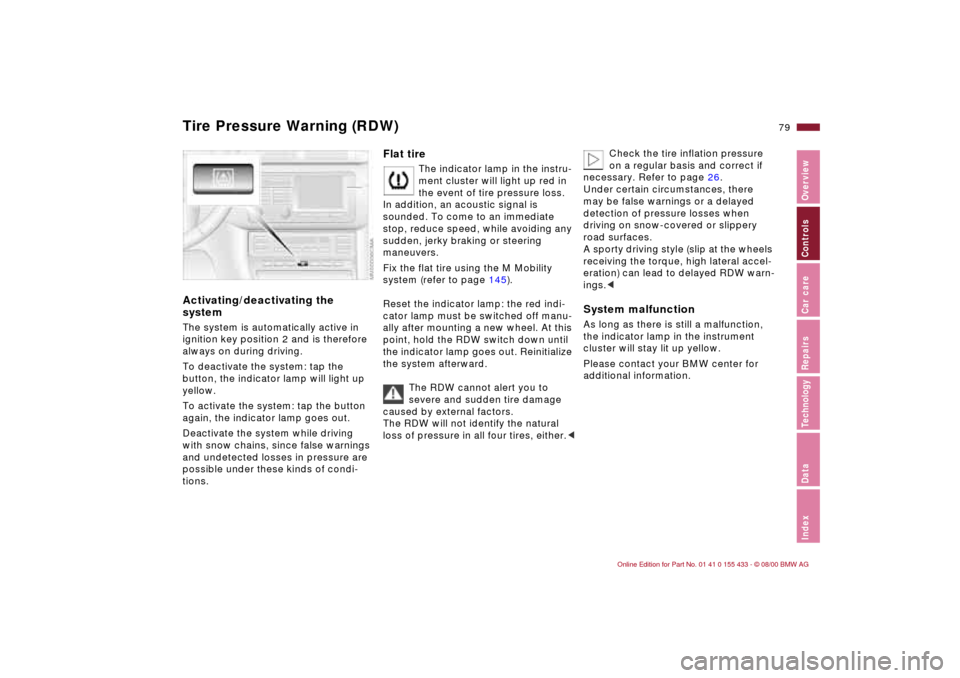
To deactivate the system: tap the
button, the indicator lamp will light up
yellow.
To activate the system: tap the button
again, the indicator lamp goes out.
Deactivate the system while driving
with snow chains, since false warnings
and undetected losses in pressure are
possible under these kinds of condi-
tions.
Flat tire
The indicator lamp in the instru-
ment cluster will light up red in
the event of tire pressure loss.
In addition, an acoustic signal is
sounded. To come to an immediate
stop, reduce speed, while avoiding any
sudden, jerky braking or steering
maneuvers.
Fix the flat tire using the M Mobility
system (refer to page 145).
Reset the indicator lamp: the red indi-
cator lamp must be switched off manu-
ally after mounting a new wheel. At this
point, hold the RDW switch down until
the indicator lamp goes out. Reinitialize
the system afterward.
The RDW cannot alert you to
severe and sudden tire damage
caused by external factors.
The RDW will not identify the natural
loss of pressure in all four tires, either.<
Check the tire inflation pressure
on a regular basis and correct if
necessary. Refer to page 26.
Under certain circumstances, there
may be false warnings or a delayed
detection of pressure losses when
driving on snow-covered or slippery
road surfaces.
A sporty driving style (slip at the wheels
receiving the torque, high lateral accel-
eration) can lead to delayed RDW warn-
ings.<
System malfunctionAs long as there is still a malfunction,
the indicator lamp in the instrument
cluster will stay lit up yellow.
Please contact your BMW center for
additional information.
Page 80 of 183
80n
M Engine dynamics controlThe system (sport-mode identification)
will cause the engine to respond more
spontaneously to the motion of the
accelerator pedal. Activating/deactivate sport-mode
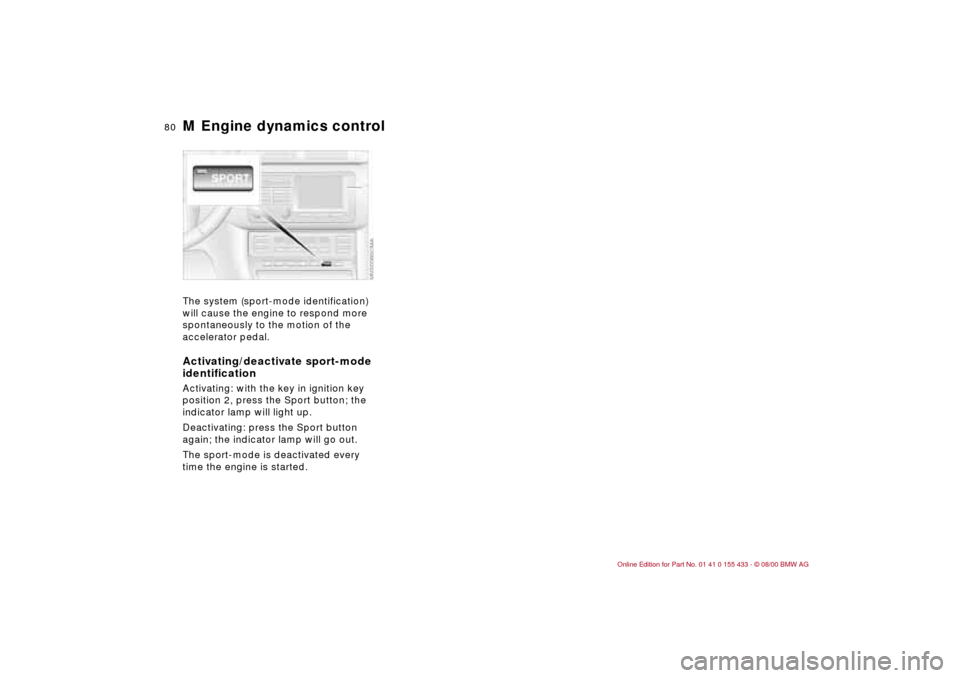
identificationActivating: with the key in ignition key
position 2, press the Sport button; the
indicator lamp will light up.
Deactivating: press the Sport button
again; the indicator lamp will go out.
The sport-mode is deactivated every
time the engine is started.
Page 81 of 183
81n
IndexDataTechnologyRepairsCar careControlsOverview
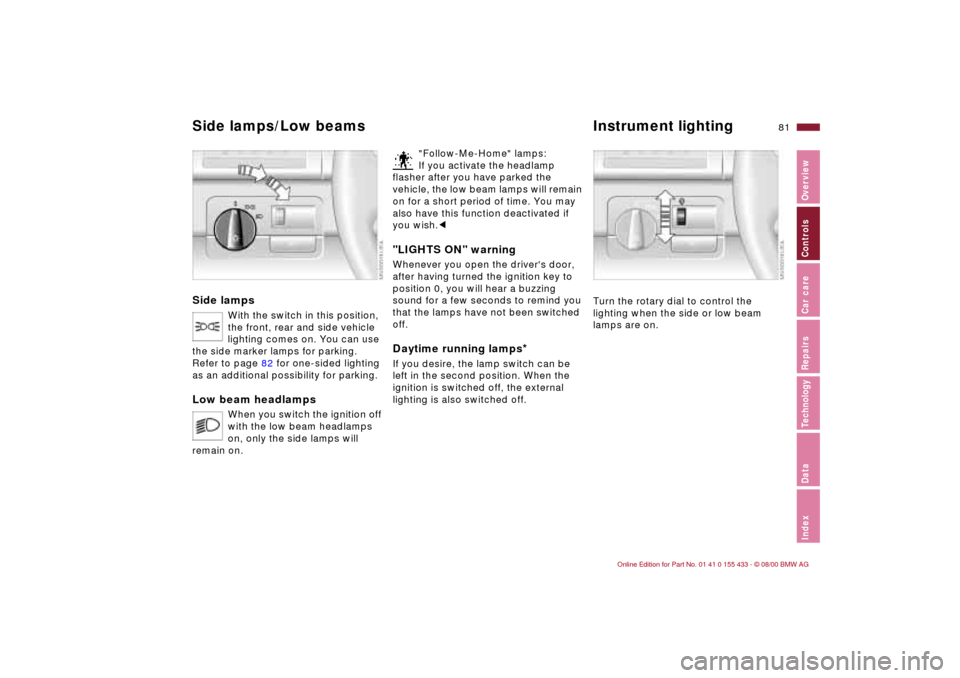
Side lamps
With the switch in this position,
the front, rear and side vehicle
lighting comes on. You can use
the side marker lamps for parking.
Refer to page 82 for one-sided lighting
as an additional possibility for parking.
Low beam headlamps
When you switch the ignition off
with the low beam headlamps
on, only the side lamps will
remain on.
"Follow-Me-Home" lamps:
If you activate the headlamp
flasher after you have parked the
vehicle, the low beam lamps will remain
on for a short period of time. You may
also have this function deactivated if
you wish.<
"LIGHTS ON" warningWhenever you open the driver's door,
after having turned the ignition key to
position 0, you will hear a buzzing
sound for a few seconds to remind you
that the lamps have not been switched
off.Daytime running lamps
*
If you desire, the lamp switch can be
left in the second position. When the
ignition is switched off, the external
lighting is also switched off.
Turn the rotary dial to control the
lighting when the side or low beam
lamps are on.
Side lamps/Low beams Instrument lighting
Page 90 of 183
90n
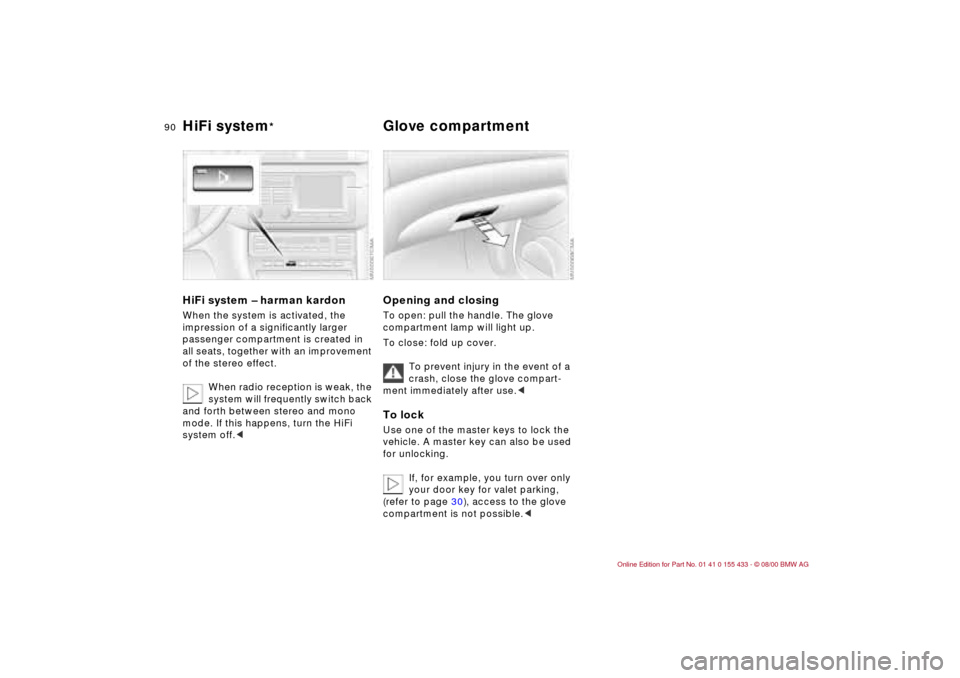
HiFi system Ð harman kardonWhen the system is activated, the
impression of a significantly larger
passenger compartment is created in
all seats, together with an improvement
of the stereo effect.
When radio reception is weak, the
system will frequently switch back
and forth between stereo and mono
mode. If this happens, turn the HiFi
system off.<
Opening and closingTo open: pull the handle. The glove
compartment lamp will light up.
To close: fold up cover.
To prevent injury in the event of a
crash, close the glove compart-
ment immediately after use.< To lockUse one of the master keys to lock the
vehicle. A master key can also be used
for unlocking.
If, for example, you turn over only
your door key for valet parking,
(refer to page 30), access to the glove
compartment is not possible.<
HiFi system
* Glove compartment
Page 93 of 183
93n
IndexDataTechnologyRepairsCar careControlsOverview
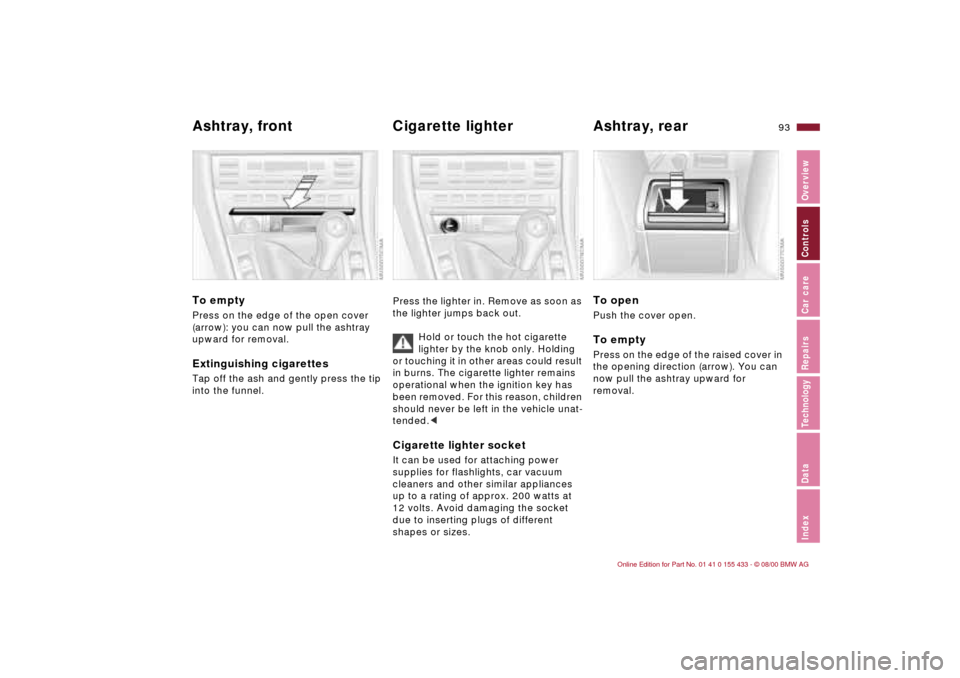
Ashtray, front Cigarette lighter Ashtray, rear To emptyPress on the edge of the open cover
(arrow): you can now pull the ashtray
upward for removal.Extinguishing cigarettesTap off the ash and gently press the tip
into the funnel.
Press the lighter in. Remove as soon as
the lighter jumps back out.
Hold or touch the hot cigarette
lighter by the knob only. Holding
or touching it in other areas could result
in burns. The cigarette lighter remains
operational when the ignition key has
been removed. For this reason, children
should never be left in the vehicle unat-
tended.< Cigarette lighter socketIt can be used for attaching power
supplies for flashlights, car vacuum
cleaners and other similar appliances
up to a rating of approx. 200 watts at
12 volts. Avoid damaging the socket
due to inserting plugs of different
shapes or sizes.
To openPush the cover open.To emptyPress on the edge of the raised cover in
the opening direction (arrow). You can
now pull the ashtray upward for
removal.
Page 95 of 183
95n
IndexDataTechnologyRepairsCar careControlsOverview
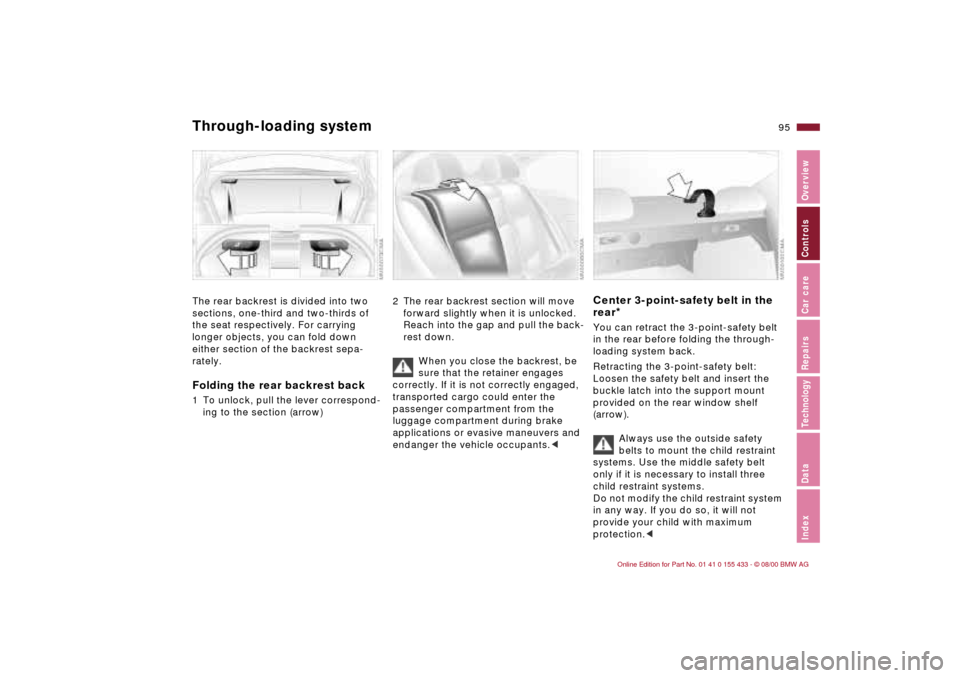
Through-loading systemThe rear backrest is divided into two
sections, one-third and two-thirds of
the seat respectively. For carrying
longer objects, you can fold down
either section of the backrest sepa-
rately.Folding the rear backrest back1 To unlock, pull the lever correspond-
ing to the section (arrow)
2 The rear backrest section will move
forward slightly when it is unlocked.
Reach into the gap and pull the back-
rest down.
When you close the backrest, be
sure that the retainer engages
correctly. If it is not correctly engaged,
transported cargo could enter the
passenger compartment from the
luggage compartment during brake
applications or evasive maneuvers and
endanger the vehicle occupants.<
Center 3-point-safety belt in the
rear
*
You can retract the 3-point-safety belt
in the rear before folding the through-
loading system back.
Retracting the 3-point-safety belt:
Loosen the safety belt and insert the
buckle latch into the support mount
provided on the rear window shelf
(arrow).
Always use the outside safety
belts to mount the child restraint
systems. Use the middle safety belt
only if it is necessary to install three
child restraint systems.
Do not modify the child restraint system
in any way. If you do so, it will not
provide your child with maximum
protection.<
Page 98 of 183
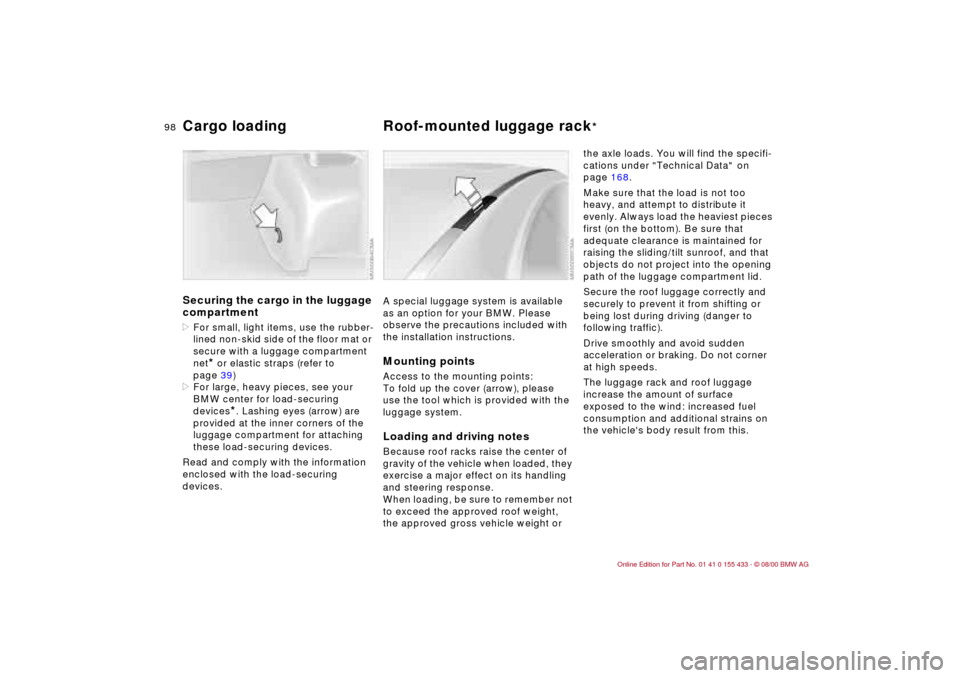
98n
Cargo loading Roof-mounted luggage rack
*
Securing the cargo in the luggage
compartment >For small, light items, use the rubber-
lined non-skid side of the floor mat or
secure with a luggage compartment
net
* or elastic straps (refer to
page 39)
>For large, heavy pieces, see your
BMW center for load-securing
devices
*. Lashing eyes (arrow) are
provided at the inner corners of the
luggage compartment for attaching
these load-securing devices.
Read and comply with the information
enclosed with the load-securing
devices.
A special luggage system is available
as an option for your BMW. Please
observe the precautions included with
the installation instructions.Mounting pointsAccess to the mounting points:
To fold up the cover (arrow), please
use the tool which is provided with the
luggage system.Loading and driving notesBecause roof racks raise the center of
gravity of the vehicle when loaded, they
exercise a major effect on its handling
and steering response.
When loading, be sure to remember not
to exceed the approved roof weight,
the approved gross vehicle weight or
the axle loads. You will find the specifi-
cations under "Technical Data" on
page 168.
Make sure that the load is not too
heavy, and attempt to distribute it
evenly. Always load the heaviest pieces
first (on the bottom). Be sure that
adequate clearance is maintained for
raising the sliding/tilt sunroof, and that
objects do not project into the opening
path of the luggage compartment lid.
Secure the roof luggage correctly and
securely to prevent it from shifting or
being lost during driving (danger to
following traffic).
Drive smoothly and avoid sudden
acceleration or braking. Do not corner
at high speeds.
The luggage rack and roof luggage
increase the amount of surface
exposed to the wind: increased fuel
consumption and additional strains on
the vehicle's body result from this.
Page 102 of 183

102n
To ensure that your vehicle provides
maximum economy throughout a long
service life, we request that you
observe the following instructions:
Because of its engineering design,
the BMW M3 is an especially high-
quality vehicle. It is in your best interest
to follow the break-in procedure very
closely. Doing this, you will create the
basis for a long, optimum service life.<
Engine and differential>Until a mileage reading of 1,200 miles
(2,000 km): drive at varying engine
and road speeds, but do not exceed
the following engine speeds or road
speeds:
5,500/rpm or 105 mph (170 km/h)
Obey your local and state maximum
speed limits.
Do not depress the accelerator pedal to
the full-throttle position.
>After you have monitored the break-
in period for 1,200 miles (2,000 km),
you can begin to gradually increase
both the engine speed and road
speed.
You should also comply with these
break-in procedures if the engine or
differential is replaced later in the
course of the vehicle service life.
TiresDue to technical factors associated
with their manufacture, tires do not
achieve their full traction potential until
an initial break-in period has elapsed.
Thus drive with extra care during the
initial 200 miles (300 km).
Obey your local and state maximum
speed limits.
When the vehicle is operated on
wet or slushy roads, a wedge of
water may form between the tire and
the road surface. This phenomenon is
referred to as aquaplaning, or hydro-
planing, and can lead to partial or
complete loss of traction, vehicle
control and braking effectiveness.
Reduce your speed on wet roads.<
Brake systemApproximately 300 miles (500 km) must
elapse before the brake pads and disks
achieve the optimal pad-surface and
wear patterns required for trouble -free
operation and long service life later on.
To break-in the separate parking brake
drums, apply the parking brake lightly
when coasting to a standstill (at a traffic
signal, for instance), provided that
traffic conditions allow you to do so. To
avoid corrosion, repeat this procedure
from time to time.
The brake lamps do not come on
when the parking brake is set.
Vacuum for the brake system servo unit
on your BMW is available only when the
engine is running. When you move the
vehicle with the engine off Ð when
towing, for example Ð substantially
higher levels of pedal force will be
required to brake the vehicle.
(500 km). Drive cautiously during this
break-in period and do not shift
roughly.
Break-in procedures