steering BMW M3 COUPE 2001 E46 Owner's Guide
[x] Cancel search | Manufacturer: BMW, Model Year: 2001, Model line: M3 COUPE, Model: BMW M3 COUPE 2001 E46Pages: 183, PDF Size: 1.65 MB
Page 109 of 183

109n
IndexDataTechnologyRepairsCar careControlsOverview
Winter operationBrakingWinter road conditions substantially
reduce the amount of traction available
between the tires and the road surface;
the resulting increase in braking
distance is considerable and should
always be kept in mind.
ABS is intended to prevent the wheels
from locking during brake applications,
thus helping to maintain vehicle stability
and steering response.
If the ABS does not respond in a critical
braking situation and the wheels lock:
Reduce the pressure on the brake
pedal until the wheels just start to roll
again while still maintaining enough
force to continue braking. Then
increase the pressure, reduce the pres-
sure when the wheels lock, reapply
pressure etc.
This staggered braking procedure will
reduce stopping distances while
helping you maintain steering control.
You can then attempt to steer around
hazards after you have reduced pres-
sure on the brake pedal. Do not shift down on slick road
surfaces. Doing so could cause
the rear wheels to lose traction and
skid, which could result in the loss of
vehicle control.<
Depress the clutch during hard
braking on road surfaces which
provide only poor or uneven traction.<
Skid control Depress the clutch and let up on the
gas. Countersteer carefully and attempt
to regain control of the vehicle.
ParkingEngage first or reverse gear. Depending
on the steepness of the incline, you can
apply the parking brake as well. In order
to prevent the parking brake pads from
locking due to frost or corrosion, dry
them by gently applying the parking
brake as the vehicle is coming to a
stop. Make sure that following traffic
is not endangered.
The brake lamps do not light up
when the parking brake is
applied.<
Page 110 of 183

110n
Power steering Cellular phone
* Radio reception
If the steering response changes, e.g.
high steering effort:
Consult a BMW center to have it
checked.
If the power steering fails,
increased effort will be required to
steer the vehicle.<
Only mobile communications systems
(cellular phone, radio, etc.) with an
output up to 10 watts are permitted.
Mobile communications devices not
specifically designed for use in your
vehicle may trigger malfunctions while
operating your vehicle. BMW can
neither test nor assume responsibility
for every individual product being
offered on the market. We recommend
that you consult your BMW center
before purchasing any device of this
kind.
To ensure that your BMW continues to
provide reliable and trouble-free opera-
tion, do not use a cellular phone or
other radio device with an antenna
located inside the passenger compart-
ment. The antenna should always be
mounted on the outside of the vehicle.
Before loading the vehicle on
a car-carrier train or driving it
through a car-wash, remove the
antenna.<
The reception and sound quality
obtained from mobile radios vary
according to a variety of factors,
including the broadcast range of the
transmitter and the directional orienta-
tion of the antenna. Interference factors
such as high-tension power lines,
structural or natural obstructions can all
lead to unavoidable reception interfer-
ence, regardless of how well the vehicle
sound system is operating.
Climatic factors such as intense solar
radiation, fog, rain and snow can also
interfere with reception.
Telephones without formal BMW
approval can also generate interfer-
ence. This phenomenon assumes the
form of a low-pitched hum emanating
from the speaker system.
Please refer to the separate Owner's
Manual that came with your vehicle for
information on setting and operating
your car radio.
Page 111 of 183
111n
IndexDataTechnologyRepairsCar careControlsOverview
Information for your safetyThe factory-approved radial tires are
matched to the vehicle and have been
selected to provide optimum safety and
driving comfort on your vehicle.
It is not merely the tire's service life, but
also driving comfort and Ð above all else
Ð driving safety that depend on the
condition of the tires and the mainte-
nance of the specified tire pressure.
Incorrect inflation pressure is a frequent
cause of tire damage. It also signifi-
cantly influences the roadholding ability
of your BMW.
Check tire inflation pressures on a
regular basis (refer to page 27), at
least every two weeks and before
beginning a longer trip. If this is not
done, incorrect tire pressures can
cause driving instability and tire
damage, ultimately resulting in acci-
dents.<
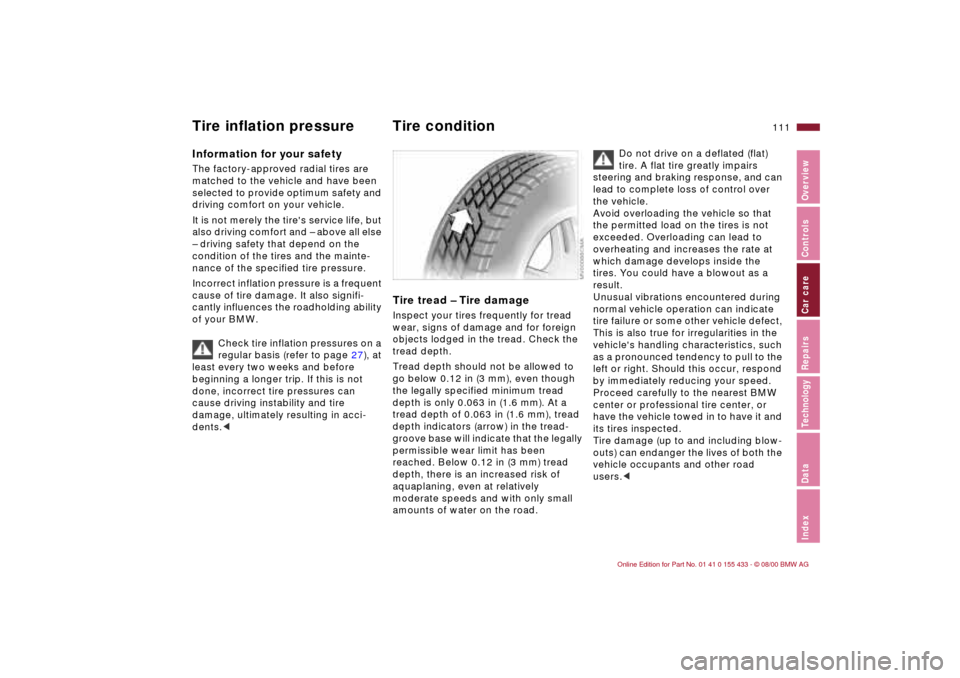
Tire tread Ð Tire damageInspect your tires frequently for tread
wear, signs of damage and for foreign
objects lodged in the tread. Check the
tread depth.
Tread depth should not be allowed to
go below 0.12 in (3 mm), even though
the legally specified minimum tread
depth is only 0.063 in (1.6 mm). At a
tread depth of 0.063 in (1.6 mm), tread
depth indicators (arrow) in the tread-
groove base will indicate that the legally
permissible wear limit has been
reached. Below 0.12 in (3 mm) tread
depth, there is an increased risk of
aquaplaning, even at relatively
moderate speeds and with only small
amounts of water on the road.
Do not drive on a deflated (flat)
tire. A flat tire greatly impairs
steering and braking response, and can
lead to complete loss of control over
the vehicle.
Avoid overloading the vehicle so that
the permitted load on the tires is not
exceeded. Overloading can lead to
overheating and increases the rate at
which damage develops inside the
tires. You could have a blowout as a
result.
Unusual vibrations encountered during
normal vehicle operation can indicate
tire failure or some other vehicle defect,
This is also true for irregularities in the
vehicle's handling characteristics, such
as a pronounced tendency to pull to the
left or right. Should this occur, respond
by immediately reducing your speed.
Proceed carefully to the nearest BMW
center or professional tire center, or
have the vehicle towed in to have it and
its tires inspected.
Tire damage (up to and including blow-
outs) can endanger the lives of both the
vehicle occupants and other road
users.<
Tire inflation pressure Tire condition
Page 115 of 183

115n
IndexDataTechnologyRepairsCar careControlsOverview
Winter tires Snow chainsChoosing the right tire BMW recommends winter tires (M+S
radial tires) for operation under inclem-
ent winter driving conditions. While
so-called all season tires (M+S desig-
nation) provide better winter traction
than summer tires with the load ratings
H, V, W, Y and ZR, they generally do
not achieve the performance of winter
tires.
In the interests of safe tracking and
steering response, install radial tires
made by the same manufacturer and
with the same tread configuration on all
four wheels if you elect to mount winter
tires. Do not exceed specified
maximum speedsIn Germany: attach a corresponding
sign in accordance with the Federal
Motor Vehicles Safety Standards in
your field of vision if the maximum
speed of the vehicle is higher. This
sticker is available from the tire dealer
or your BMW center. Never exceed the maximum speed
for which the tires are rated.
Unprofessional attempts by laymen to
service tires can lead to damage and
accidents.
Have this work performed by skilled
professionals only. Your BMW center
will be glad to assist you with both their
expertise and the proper equipment for
your vehicle.<
Tire condition, tire pressureWinter tires display a perceptible loss in
their ability to cope with winter driving
conditions once the tread wears to
below 0.16 in (4 mm), and should thus
be replaced.
Comply with the specified tire inflation
pressure and be sure to have the
wheels balanced each time a tire or
wheel is changed. In addition, also have
the Tire Pressure Warning (RDW) reini-
tialized, for details refer to page 78.
The use of narrow-link BMW snow
chains on winter tires is approved only
in pairs and only on the rear wheels.
Comply with all manufacturer's safety
precautions when mounting the chains.
Deactivate the Tire Pressure
Warning (RDW) when using snow
chains. The snow chains can lead to
malfunction warnings and undetected
losses in pressure.
For further information, refer to
page 78.<
Page 123 of 183
123n
IndexDataTechnologyRepairsCar careControlsOverview
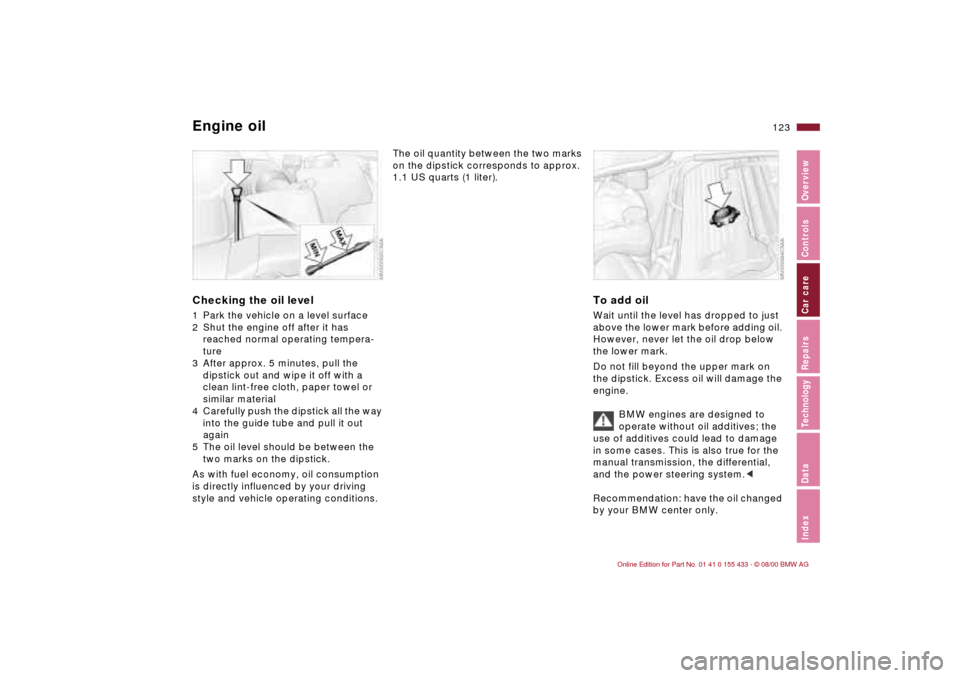
Engine oilChecking the oil level 1 Park the vehicle on a level surface
2 Shut the engine off after it has
reached normal operating tempera-
ture
3 After approx. 5 minutes, pull the
dipstick out and wipe it off with a
clean lint-free cloth, paper towel or
similar material
4 Carefully push the dipstick all the way
into the guide tube and pull it out
again
5 The oil level should be between the
two marks on the dipstick.
As with fuel economy, oil consumption
is directly influenced by your driving
style and vehicle operating conditions.
The oil quantity between the two marks
on the dipstick corresponds to approx.
1.1 US quarts (1 liter).
To add oil Wait until the level has dropped to just
above the lower mark before adding oil.
However, never let the oil drop below
the lower mark.
Do not fill beyond the upper mark on
the dipstick. Excess oil will damage the
engine.
BMW engines are designed to
operate without oil additives; the
use of additives could lead to damage
in some cases. This is also true for the
manual transmission, the differential,
and the power steering system.<
Recommendation: have the oil changed
by your BMW center only.
Page 133 of 183

133n
IndexDataTechnologyRepairsCar careControlsOverview
Airbags Vehicle storageImportant safety notices
Don't remove the airbag restraint
system's gas generator. Have
testing and service procedures per-
formed by specially-qualified techni-
cians only. In the event of any faults, if
the airbag stops working, or in the
event of function-oriented use (deploy-
ment) of the airbag restraint system,
entrust your BMW center alone with
repair or disassembly.
No modifications may be made to either
the wiring or to individual components.
These include the padded steering
wheel hub, the instrument panel, the
side trim panels of the front or rear
doors and the roof pillars or the sides of
the headliner. Do not apply adhesive
materials to these components, cover
or modify them in any way. Do not
remove or dismantle the steering wheel
yourself.
To ensure compliance with official
safety regulations, entrust disposal of
airbag generators to a BMW center.
Unprofessional attempts to service the
system could lead to failure in an emer-
gency or undesired airbag activation,
either of which could result in personal
injury.<
Consult your BMW center regarding
special procedures if you intend to
store the vehicle for more than three
months.
Page 145 of 183
IndexDataTechnologyRepairsCar careControlsOverview
145n
Repairing a flat tire
Precautions in case of a flat tire:
Stop the vehicle as far as possible
from passing traffic; switch on the
hazard warning flashers.
Switch on the hazard warning flashers.
Turn the steering wheel to the straight-
ahead position, remove the key and
engage the steering lock. Shift into 1st
or reverse gear and engage the parking
brake.
All passengers should be outside the
vehicle and well away from your imme-
diate working area (behind a guardrail,
for instance).
If a warning triangle or portable hazard
warning lamp is available, set it up on
the roadside at an appropriate distance
from the rear of the vehicle.
Comply with all safety guidelines and
regulations.<
M Mobility system With the BMW M3, you will find an
M Mobility system for fixing flat tires.
With the aid of this system, you can
apply a liquid sealant to the inside of
the tire, thereby sealing off the
damaged area, and then continue
driving.
The M Mobility system makes trans-
porting a spare wheel superfluous,
thereby reducing the amount of weight
you have to carry around.
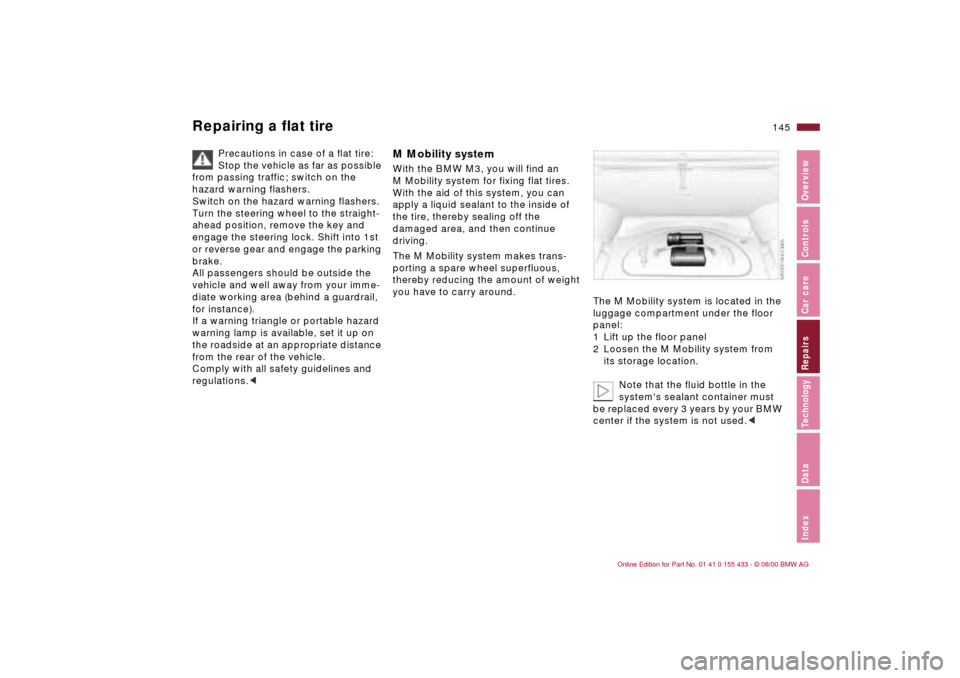
The M Mobility system is located in the
luggage compartment under the floor
panel:
1 Lift up the floor panel
2 Loosen the M Mobility system from
its storage location.
Note that the fluid bottle in the
system's sealant container must
be replaced every 3 years by your BMW
center if the system is not used.<
Page 146 of 183
146n
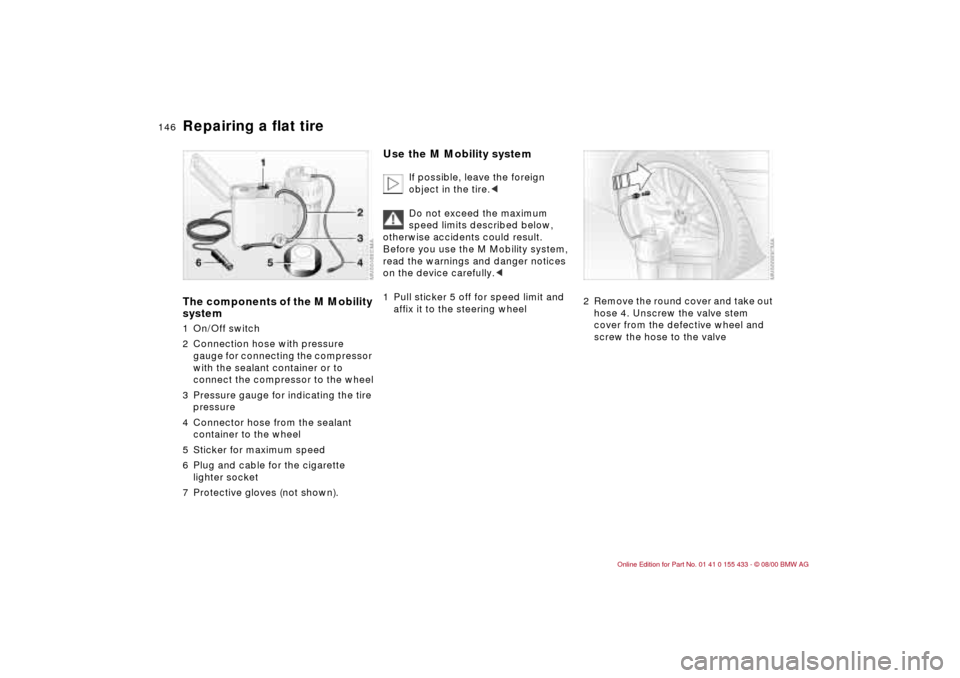
Repairing a flat tireThe components of the M Mobility
system1 On/Off switch
2 Connection hose with pressure
gauge for connecting the compressor
with the sealant container or to
connect the compressor to the wheel
3 Pressure gauge for indicating the tire
pressure
4 Connector hose from the sealant
container to the wheel
5 Sticker for maximum speed
6 Plug and cable for the cigarette
lighter socket
7 Protective gloves (not shown).
Use the M Mobility system
If possible, leave the foreign
object in the tire.<
Do not exceed the maximum
speed limits described below,
otherwise accidents could result.
Before you use the M Mobility system,
read the warnings and danger notices
on the device carefully.<
1 Pull sticker 5 off for speed limit and
affix it to the steering wheel
2 Remove the round cover and take out
hose 4. Unscrew the valve stem
cover from the defective wheel and
screw the hose to the valve
Page 159 of 183
159n
IndexDataTechnologyRepairsCar careControlsOverview
The limitations inherent to radio recep-
tion in a moving vehicle have been
minimized by a number of innovative
system designs:
The "Radio Data System" (RDS) makes
sure that, for broadcast stations
sending on several frequencies, the
radio automatically tunes to the
frequency with the best reception
quality.
The Diversity Antenna system employs
several FM antennas integrated within
the rear window to provide three sepa-
rate sources for receiving broadcast
waves. An integral processor automati-
cally selects the antenna with the best
FM reception quality at any given time.
The selection of the antenna takes
place within milliseconds, and is there-
fore not noticed by the radio listener. The primary goal in developing the
Dynamic Stability Control (DSC) for the
BMW M3 is to achieve the greatest
amount of safety while at the same time
getting the most pleasure out of perfor-
mance-oriented driving.
Using highly sensitive sensors, the DSC
monitors current operating conditions
for your vehicle as they relate to driving
stability and traction. In addition, wheel
speeds, steering angle, lateral acceler-
ation, brake pressure and vehicle
movement around its vertical axis are
also ascertained and evaluated.
If the DSC detects unstable conditions
on a curve, then the DSC will intervene
in engine management within millisec-
onds, reducing drive torque or, if the
need arises, will individually slow one or
more wheels down to keep the vehicle
on a steady course.
If differences in wheel speed should
occur, the system will recognize the
dangers associated with wheel spin
and will reduce the drive torque; if
necessary, it will do so using brake
intervention at the rear wheels as well.
DSC offers the highest degree of
driving stability and safety not only
when you first start your vehicle, are
driving on straightaways or when
braking, but also when driving through
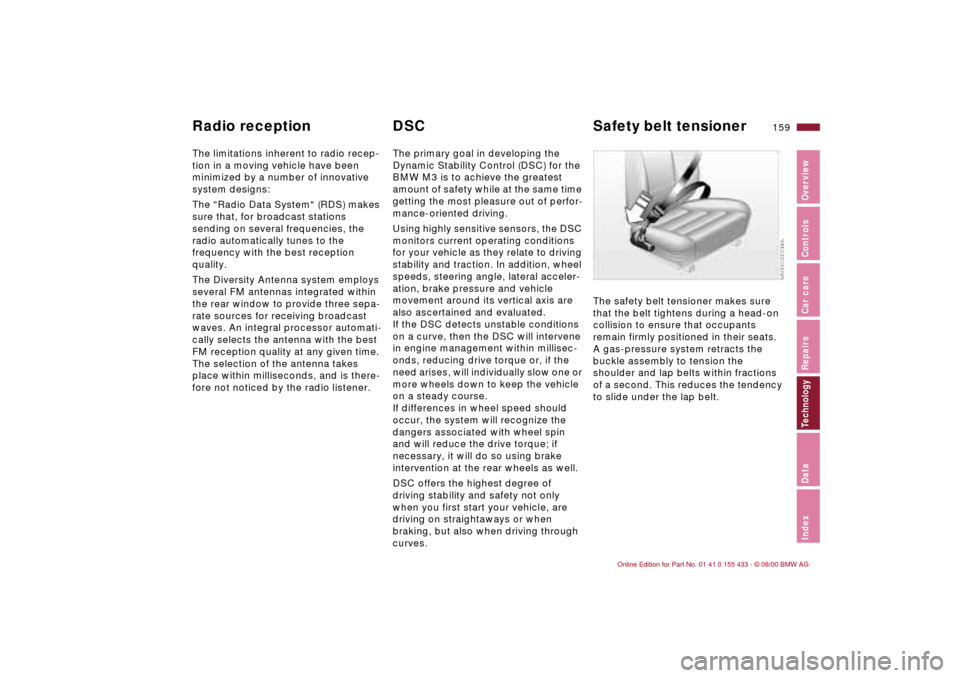
curves.The safety belt tensioner makes sure
that the belt tightens during a head-on
collision to ensure that occupants
remain firmly positioned in their seats.
A gas-pressure system retracts the
buckle assembly to tension the
shoulder and lap belts within fractions
of a second. This reduces the tendency
to slide under the lap belt. Radio reception DSC Safety belt tensioner
Page 170 of 183

170n
Electrical system Drive belts Battery 12V, 70 AhSpark plugs NGK DCPR8EKPWater pump Ð Generator Ð
Power steering
Drive belt 6 PK x 1470
Compressor for the automatic
climate control
Drive belt 5 PK x 829You can obtain Original BMW
Parts and Accessories, as well as
professional advice from your BMW
center.<