power steering BMW M3 COUPE 2001 E46 Owner's Manual
[x] Cancel search | Manufacturer: BMW, Model Year: 2001, Model line: M3 COUPE, Model: BMW M3 COUPE 2001 E46Pages: 183, PDF Size: 1.65 MB
Page 10 of 183

Contents
Overview
Controls and features
Cockpit16
Instrument cluster18
Indicator and warning lamps20
Multifunction steering wheel
(MFL)23
Hazard warning flashers24
Warning triangle24
First-aid kit24
Refueling25
Fuel specifications26
Tire inflation pressure26
Opening and closing:
Keys30
Electronic vehicle
immobilizer31
Central locking system31
Opening and closing Ð
via the door lock32
Opening and closing Ð
via the remote control33
Opening and closing Ð
from the inside36
Luggage compartment lid37
Luggage compartment39
Alarm system40
Electric power windows42
Sliding/tilt sunroof43
Adjustments:
Seats45
Mirrors49
Seat and mirror memory51
Steering wheel52
Car Memory, Key Memory52
Passenger safety systems:
Safety belts54
Airbags56
Transporting children safely59
Driving:
Steering/Ignition lock62
Starting the engine62
Switching off the engine63
Parking brake63
Manual transmission64
Turn signal indicator/Headlamp
flasher65
Washer/Wiper system/Rain
sensor65
Rear window defroster67
Cruise control67
Everything under control:
Odometer69
Tachometer69
Engine oil temperature gauge69
Fuel gauge70
Coolant temperature gauge70
Service Interval Display71
Check Control72
Computer72
Technology for driving comfort
and safety:
Park Distance Control (PDC)75
Dynamic Stability Control
(DSC)76
Tire Pressure Warning (RDW)78
M Engine dynamics control80
Contents
Page 11 of 183

11n
Controls and features
Operation, care and maintenance
Lamps:
Side lamps/Low beams81
Instrument lightning81
High beams/Parking lamps82
Fog lamps82
Interior lamps82
Reading lamps83
Controlling the climate
for pleasant driving:
Automatic climate control84
Heated seats89
Roller sun blind89
Interior conveniences:
HiFi system90
Glove compartment90
Storage compartments91
Cellular phone92
Ashtray, front92
Cigarette lighter93
Ashtray, rear93
Clothes hooks94
Loading and transporting:
Through-loading system95
Ski bag96
Cargo loading97
Roof-mounted luggage rack98
Special operating instructions:
Break-in procedures102
Driving notes103
Catalytic converter103
Antilock Brake System
(ABS)104
Disk brakes106
Brake system107
Winter operation108
Power steering110
Cellular phones110
Radio reception110
Wheels and tires:
Tire inflation pressure111
Tire condition111
Tire replacement112
Tire rotation113
Wheel and tire
combinations114
Winter tires115
Snow chains115
Approved wheel and tire
specifications116
Under the hood:
Hood118
Engine compartment120
Washer fluids122
Washer nozzles122
Engine oil123
Coolant125
Brake fluid126
Vehicle Identification
Number126
Care and maintenance:
The BMW Maintenance
System127
Caring for your vehicle128
Airbags133
Vehicle storage133
Laws and regulations:
Technical modifications134
California Proposition
65 Warning134
OBD connector135
Page 28 of 183
28n
Locks and security systems:
Keys30
Electronic vehicle
immobilizer31
Central locking system31
Opening and closing Ð
via the door lock32
Opening and closing Ð
via the remote control33
Opening and closing Ð
from the inside36
Lugagge compartment lid37
Luggage compartment39
Alarm system40
Electric power windows42
Sliding/tilt sunroof43
Adjustments:
Seats45
Mirrors49
Seat and mirror memory51
Steering wheel52
Car Memory, Key Memory52
Passenger safety systems:
Safety belts54
Airbags56
Transporting children safely59
Controls
Page 63 of 183
63n
IndexDataTechnologyRepairsCar careControlsOverview
Starting the engine Switching off engine Parking brake If the engine does not start on the first
attempt (if the engine is very hot or
cold, for instance):
>Press the accelerator pedal halfway
down while engaging the starter.
Cold starts at very low temperatures,
starting at about +5 7 (Ð15 6) and
at high altitudes over 3,300 ft
(1,000 meters):
>On the first start attempt, engage the
starter for a longer period (approx.
10 seconds)
>Press the accelerator pedal halfway
down while engaging the starter.
Engine idle speed is controlled by the
engine computer system. Increased
speeds at startup are normal and
should decrease as the engine warms
up. If engine speed does not decrease,
service is required.
To prevent the battery from
discharging, always deactivate elec-
trical devices that are not in use. Switch
the ignition off when the vehicle is not
being driven.Turn the ignition key to position 1 or 0.
Do not remove the ignition key
while the vehicle is still moving. If
you do so, the steering will lock, making
it impossible to steer the vehicle.
When you leave the vehicle, always
remove the ignition key and engage
the steering lock.
Set the parking brake when parking on
steep hills, because under certain
conditions, putting the vehicle into first
gear or reverse may not be enough to
prevent it from rolling away.
The power assist is not available when
the engine is not on. This means that
more effort is required to apply the
brakes.<
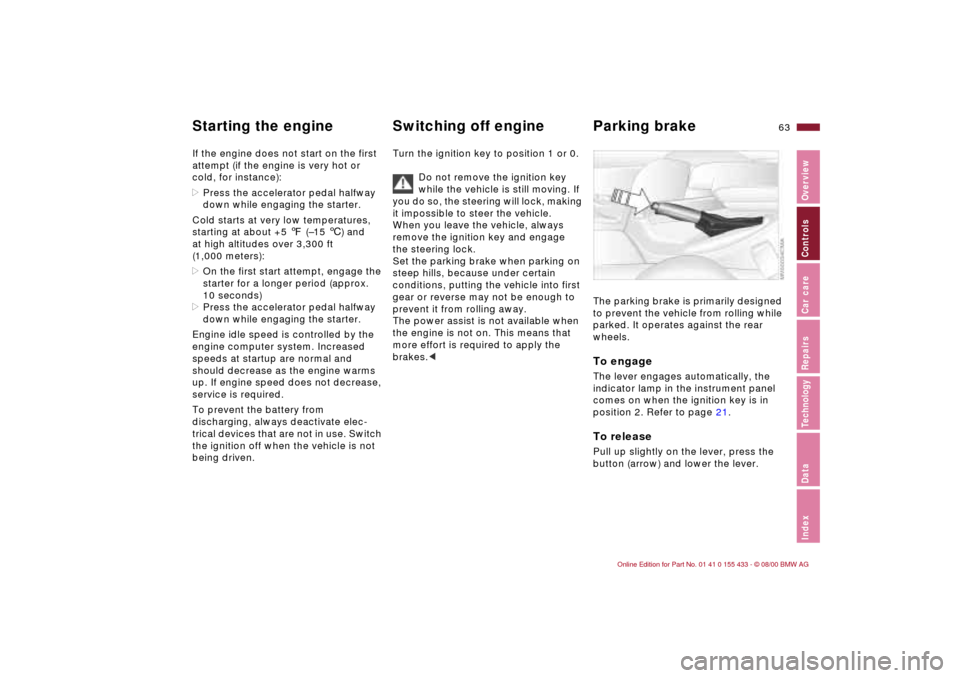
The parking brake is primarily designed
to prevent the vehicle from rolling while
parked. It operates against the rear
wheels. To engageThe lever engages automatically, the
indicator lamp in the instrument panel
comes on when the ignition key is in
position 2. Refer to page 21.To releasePull up slightly on the lever, press the
button (arrow) and lower the lever.
Page 101 of 183
Overview
Controls and features
Operation, care
and maintenance
Owner service procedures
Technical data
Index Advanced technology
101n
IndexDataTechnologyRepairsCar careControlsOverview
Special operating instructions:
Break-in procedures102
Driving notes103
Catalytic converter103
Antilock Brake System
(ABS)104
Disk brakes106
Brake system107
Winter operation108
Power steering110
Cellular phones110
Radio reception110
Wheels and tires:
Tire inflation pressure111
Tire condition111
Tire replacement112
Tire rotation113
Wheel and tire
combinations114
Winter tires115
Snow chains115
Approved wheel and tire
specifications116Under the hood:
Hood118
Engine compartment120
Washer fluids122
Washer nozzles122
Engine oil123
Coolant125
Brake fluid126
Vehicle Identification
Number126
Care and maintenance:
The BMW Maintenance
System127
Caring for your vehicle128
Airbags133
Vehicle storage133
Laws and regulations:
Technical modifications134
California Proposition
65 Warning134
OBD connector135
Car care
Page 110 of 183

110n
Power steering Cellular phone
* Radio reception
If the steering response changes, e.g.
high steering effort:
Consult a BMW center to have it
checked.
If the power steering fails,
increased effort will be required to
steer the vehicle.<
Only mobile communications systems
(cellular phone, radio, etc.) with an
output up to 10 watts are permitted.
Mobile communications devices not
specifically designed for use in your
vehicle may trigger malfunctions while
operating your vehicle. BMW can
neither test nor assume responsibility
for every individual product being
offered on the market. We recommend
that you consult your BMW center
before purchasing any device of this
kind.
To ensure that your BMW continues to
provide reliable and trouble-free opera-
tion, do not use a cellular phone or
other radio device with an antenna
located inside the passenger compart-
ment. The antenna should always be
mounted on the outside of the vehicle.
Before loading the vehicle on
a car-carrier train or driving it
through a car-wash, remove the
antenna.<
The reception and sound quality
obtained from mobile radios vary
according to a variety of factors,
including the broadcast range of the
transmitter and the directional orienta-
tion of the antenna. Interference factors
such as high-tension power lines,
structural or natural obstructions can all
lead to unavoidable reception interfer-
ence, regardless of how well the vehicle
sound system is operating.
Climatic factors such as intense solar
radiation, fog, rain and snow can also
interfere with reception.
Telephones without formal BMW
approval can also generate interfer-
ence. This phenomenon assumes the
form of a low-pitched hum emanating
from the speaker system.
Please refer to the separate Owner's
Manual that came with your vehicle for
information on setting and operating
your car radio.
Page 123 of 183
123n
IndexDataTechnologyRepairsCar careControlsOverview
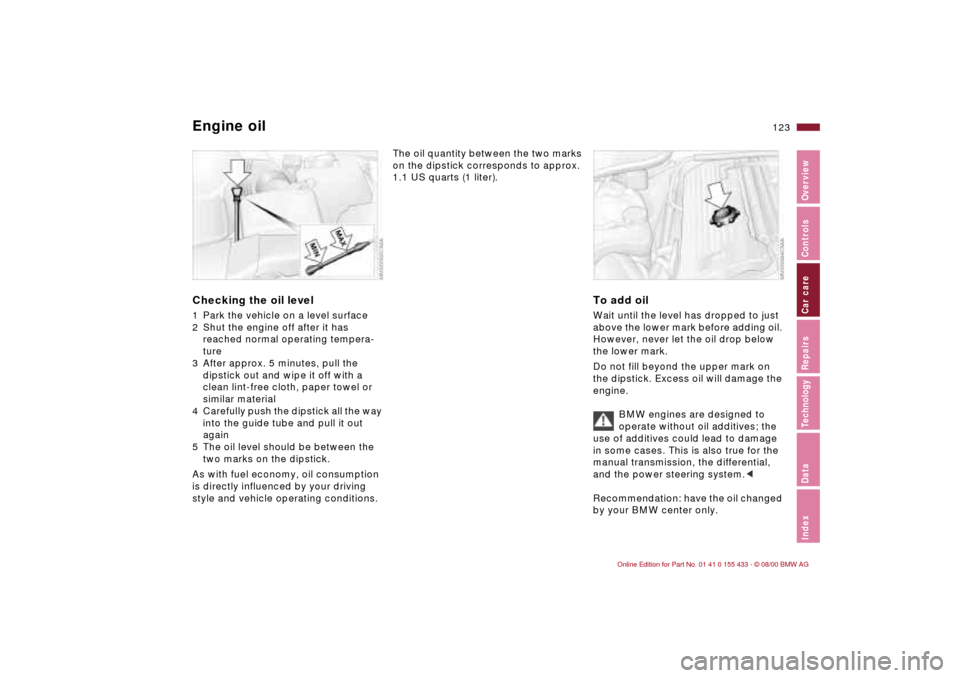
Engine oilChecking the oil level 1 Park the vehicle on a level surface
2 Shut the engine off after it has
reached normal operating tempera-
ture
3 After approx. 5 minutes, pull the
dipstick out and wipe it off with a
clean lint-free cloth, paper towel or
similar material
4 Carefully push the dipstick all the way
into the guide tube and pull it out
again
5 The oil level should be between the
two marks on the dipstick.
As with fuel economy, oil consumption
is directly influenced by your driving
style and vehicle operating conditions.
The oil quantity between the two marks
on the dipstick corresponds to approx.
1.1 US quarts (1 liter).
To add oil Wait until the level has dropped to just
above the lower mark before adding oil.
However, never let the oil drop below
the lower mark.
Do not fill beyond the upper mark on
the dipstick. Excess oil will damage the
engine.
BMW engines are designed to
operate without oil additives; the
use of additives could lead to damage
in some cases. This is also true for the
manual transmission, the differential,
and the power steering system.<
Recommendation: have the oil changed
by your BMW center only.
Page 170 of 183

170n
Electrical system Drive belts Battery 12V, 70 AhSpark plugs NGK DCPR8EKPWater pump Ð Generator Ð
Power steering
Drive belt 6 PK x 1470
Compressor for the automatic
climate control
Drive belt 5 PK x 829You can obtain Original BMW
Parts and Accessories, as well as
professional advice from your BMW
center.<
Page 175 of 183

Everything from A to Z
175n
IndexDataTechnologyRepairsCar careControlsOverview
Caring for the vehicle
finish129
Cassette operation, refer to
the radio Owner's Manual
Catalytic converter103
starting problems103
CBC (Cornering Brake
Control)21, 104
CD operaton, refer to the
radio Owner's Manual
Cellular phone110
refer also to the separate
Owner's Manual
Center armrest91
Center (high-mount) brake
lamp143
Central locking system31
key36
Check Control72t
Checking air pressure26t
Checking engine oil
level123t
Child restraint
system55, 59
Child seat safety55, 60
Cigarette lighter93
Clean the headlamps67
Clean the windshield66
Clock73
Clothes hooks94
Cockpit16Code, refer to the radio
Owner's Manual
Coin box91
Combination switch65
Compression166
Computer72
Configuring the settings52
Consumption74
Consumption display70
Control elements16
Coolant108, 121t, 125
antifreeze108
Coolant temperature
gauge70
Cooling system169
Copyright4
Cornering Brake Control
(CBC)21, 104
Cruise control67
Cruising range74
Cup holder, refer to
beverage holder91
Curb weight168
DDashboard16
Data
dimensions167
engine166
technical166
weights168Daytime-driving lamp
switch81
Deep water103
Defrost position87t
Defrostable rear window88
Defrosting the
windows87t
Difficult steering110t
Digital clock73
Dimensions167
Dipstick123
Disk brakes106
Displacement166
Display lighting81
Displays18
Disposal
used batteries151
used engine oil124
Distance warning75
Diversity Antenna159
Door key30
Door locks, care108
Doors
emergency
actuation32t
operating manually32
remote control33
unlocking and
locking32, 33
DOT Quality Grades112
Draft-free ventilation88
Drive belts170Driving in winter108
Driving lamps81
Driving notes
aquaplaning103
brakes103
disk brakes106
sliding109
slippery roads108
DSC (Dynamic Stability
Control)22, 76, 159
Dynamic Stability Control
(DSC)22, 76, 159
EElectric power windows42
Electrical accessories,
failure151t
Electrical failure
fuel filler door152t
sliding/tilt sunroof153t
Electrical system170
Electronic vehicle
immobilizer31
Emergency actuation
doors32t
fuel filler door152t
sliding/tilt sunroof153t
Engine
compartment120
coolant125, 169
data166
displacement166
Page 178 of 183

Everything from A to ZPark Distance Control
(PDC)75
Parking brake63
Parking help75
Parking lamp82
Parking, winter109
PDC (Park Distance
Control)75
Performance166
Phone hookup92
Phone, mobile110
Pollen88
Power seat47
Power windows42
Pressure specifications for
tires26
Pressure,
tires26, 26t, 111
Protective gloves141QQuality Grades112RRadiator169
Radio
please refer to the
separate Owner's Manual
reception110, 158
Radio Data System
(RDS)159
Rain sensor66, 160RDS (Radio Data
System)159
RDW (Tire Pressure
Warning)78
indicator lamp22
Reading lamps83
Rear backrest, folding95
Rear lamps141t
Rear window
defroster67, 88
Rear-entry assist47
Rearview mirror49
Recirculated air mode87
Reclining seat45
Refueling25
Remote control33
Removing condensation
from the windows87t
Repairing a flat tire145t
Replace windshield wiper
blades138t
Replacement key30t
Replacing bulbs138t
Reporting safety defects7
Restraint system55, 59
Return used
batteries151t
Reverse64
Roller blind, sun
protection89
Roof load capacity168Roof-mounted luggage
rack98
Rubber seals and
components108
SSafety belt tensioner159
Safety belts54
height adjustment55
three-point safety belt95
Safety buttons36
Safety defects, reporting7
Safety feature, electric
power windows42
Safety glasses141
Seat
mechanical45
power47
Seat adjusting45
Seat heating89
Seat memory51
Securing cargo97
Securing loads97
Self-defrosting mirrors49
Self-diagnostics162
Service and Warranty
Information Booklet127
Service Interval
Display71, 127
Service Manual127
Side airbags56Side impact Head Protection
System56
Side lamps81
Side marker lamp, bulb
replacement139t
Side turn signals, bulb
replacement140t
Ski bag96
Sliding/tilt sunroof43
closing after electrical
fault153t
convenience
operation32, 33
remote control33
Snow chains108, 115
Socket93
for flashlights93
for power supplies93
for vacuum cleaner93
Spare key30t
Spark plugs170
Speaker92
Speedometer18
Sport-mode,
identification80
Sports seat46, 47
Starting
problems63t, 103
Starting the engine62
Steel wheels116
Steering110
Steering lock62