wheel BMW M3 COUPE 2001 E46 Owner's Manual
[x] Cancel search | Manufacturer: BMW, Model Year: 2001, Model line: M3 COUPE, Model: BMW M3 COUPE 2001 E46Pages: 183, PDF Size: 1.65 MB
Page 6 of 183

6n
For your own safety
Use unleaded gasoline only. Fuels
containing up to and including
10 % ethanol or other oxygenates with
up to 2,8 % oxygen by weight (i.e. 15 %
MTBE or 3 % methanol plus an equiva-
lent amount of co-solvent) will not void
the applicable warranties respecting
defects in materials or workmanship.
Field experience has indicated signifi-
cant differences in fuel quality (volatility,
composition, additives, others) among
gasolines offered for sale in the United
States and Canada. The use of poor
quality fuels may result in drivability,
starting and stalling problems espe-
cially under certain environmental
conditions, such as high ambient
temperature and high altitude.
Should you encounter driveability
problems which you suspect could be
related to the fuel you are using, we
recommend that you respond by
switching to a recognized high-quality
brand.
Failure to comply with these recom-
mendations may result in unscheduled
maintenance.
Obey pertinent safety rules when you
are handling gasoline.
<
Important safety information.
For your own safety, use genuine parts
and accessories approved by BMW.
When you purchase accessories tested
and approved by BMW and Original
BMW Parts, you simultaneously acquire
the assurance that they have been thor-
oughly tested by BMW to ensure
optimum performance when installed
on your vehicle.
BMW warrants these parts to be free
from defects in material and workman-
ship.
BMW will not accept any liability for
damages resulting from installation of
parts and accessories not approved by
BMW.
BMW cannot test every product made
by other manufacturers to verify if it can
be used on a BMW safely and without
risk to either the vehicle, its operation,
or its occupants.
Original BMW Parts, BMW Accessories
and other products approved by BMW,
together with professional advice on
using these items, are available from all
BMW centers.
Installation and operation of non-BMW
approved accessories such as alarms,
radios, amplifiers, radar detectors,
wheels, suspension components, brake
dust shields, telephones (including
operation of any portable cellular phone
from within the vehicle without using an
externally mounted antenna) or trans-
ceiver equipment (such as CB, walkie-
talkie, ham radio or similar) may cause
extensive damage to the vehicle,
compromise its safety, interfere with
the vehicle's electrical system or affect
the validity of the BMW Limited
Warranty. See your BMW center for
additional information.
Do not use a key or remote control to
lock doors or luggage compartment
with anyone inside the car. See page 34
for more details.
<
Symbol on vehicle parts
Indicates that you should consult
the relevant section of this
Owner's Manual for information on a
particular part or assembly.
For your own safety
Page 10 of 183

Contents
Overview
Controls and features
Cockpit16
Instrument cluster18
Indicator and warning lamps20
Multifunction steering wheel
(MFL)23
Hazard warning flashers24
Warning triangle24
First-aid kit24
Refueling25
Fuel specifications26
Tire inflation pressure26
Opening and closing:
Keys30
Electronic vehicle
immobilizer31
Central locking system31
Opening and closing Ð
via the door lock32
Opening and closing Ð
via the remote control33
Opening and closing Ð
from the inside36
Luggage compartment lid37
Luggage compartment39
Alarm system40
Electric power windows42
Sliding/tilt sunroof43
Adjustments:
Seats45
Mirrors49
Seat and mirror memory51
Steering wheel52
Car Memory, Key Memory52
Passenger safety systems:
Safety belts54
Airbags56
Transporting children safely59
Driving:
Steering/Ignition lock62
Starting the engine62
Switching off the engine63
Parking brake63
Manual transmission64
Turn signal indicator/Headlamp
flasher65
Washer/Wiper system/Rain
sensor65
Rear window defroster67
Cruise control67
Everything under control:
Odometer69
Tachometer69
Engine oil temperature gauge69
Fuel gauge70
Coolant temperature gauge70
Service Interval Display71
Check Control72
Computer72
Technology for driving comfort
and safety:
Park Distance Control (PDC)75
Dynamic Stability Control
(DSC)76
Tire Pressure Warning (RDW)78
M Engine dynamics control80
Contents
Page 11 of 183

11n
Controls and features
Operation, care and maintenance
Lamps:
Side lamps/Low beams81
Instrument lightning81
High beams/Parking lamps82
Fog lamps82
Interior lamps82
Reading lamps83
Controlling the climate
for pleasant driving:
Automatic climate control84
Heated seats89
Roller sun blind89
Interior conveniences:
HiFi system90
Glove compartment90
Storage compartments91
Cellular phone92
Ashtray, front92
Cigarette lighter93
Ashtray, rear93
Clothes hooks94
Loading and transporting:
Through-loading system95
Ski bag96
Cargo loading97
Roof-mounted luggage rack98
Special operating instructions:
Break-in procedures102
Driving notes103
Catalytic converter103
Antilock Brake System
(ABS)104
Disk brakes106
Brake system107
Winter operation108
Power steering110
Cellular phones110
Radio reception110
Wheels and tires:
Tire inflation pressure111
Tire condition111
Tire replacement112
Tire rotation113
Wheel and tire
combinations114
Winter tires115
Snow chains115
Approved wheel and tire
specifications116
Under the hood:
Hood118
Engine compartment120
Washer fluids122
Washer nozzles122
Engine oil123
Coolant125
Brake fluid126
Vehicle Identification
Number126
Care and maintenance:
The BMW Maintenance
System127
Caring for your vehicle128
Airbags133
Vehicle storage133
Laws and regulations:
Technical modifications134
California Proposition
65 Warning134
OBD connector135
Page 15 of 183
Overview
Controls and features
Operation, care
and maintenance
Owner service procedures
Technical data
Index Advanced technology
15n
IndexDataTechnologyRepairsCar careControlsOverview
Cockpit16
Instrument cluster18
Indicator and warning lamps20
Multifunction steering wheel
(MFL)23
Hazard warning flashers24
Warning triangle24
First-aid kit24
Refueling25
Fuel specifications26
Tire inflation pressure26
Overview
Page 17 of 183

17n
IndexDataTechnologyRepairsCar careControlsOverview
Cockpit
1 Side lamps/Low beams81
2
d
Turn signal indicator65
>
Parking lamp82
>
High beams82
>
Headlamp flasher65
>
Computer72
3 Washer/Wiper system65
4 Hazard warning flashers24
5 Shift lever64
6 Rear window defroster67
7 Central locking system31
8 Adjusting steering wheel52
9 Horn, entire surface
10 Fog lamps82
Page 22 of 183
22n
Indicator and warning lamps
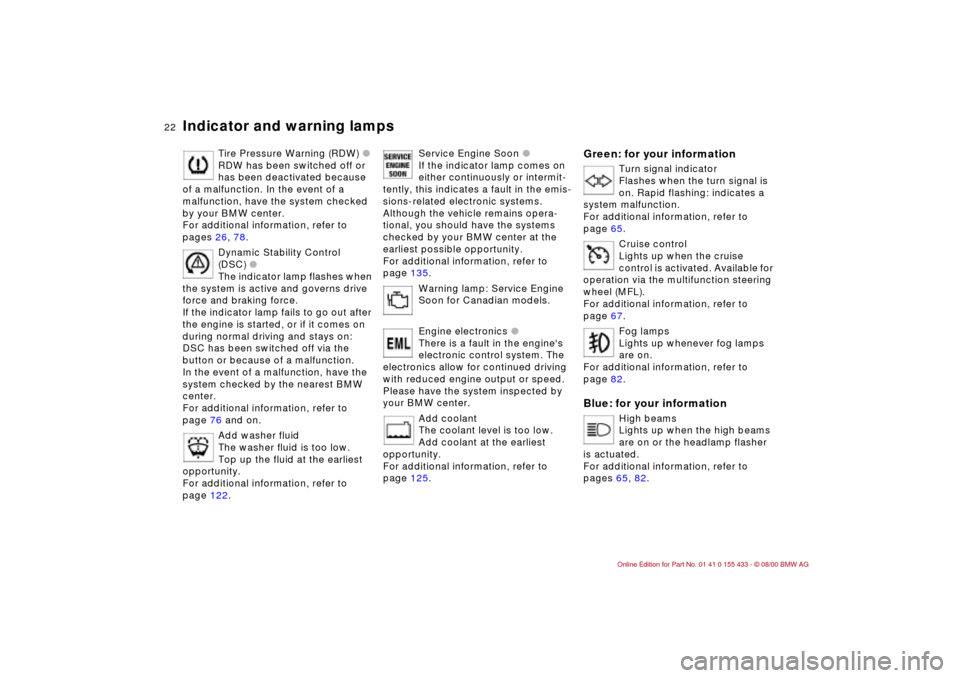
Tire Pressure Warning (RDW) l
RDW has been switched off or
has been deactivated because
of a malfunction. In the event of a
malfunction, have the system checked
by your BMW center.
For additional information, refer to
pages 26, 78.
Dynamic Stability Control
(DSC) l
The indicator lamp flashes when
the system is active and governs drive
force and braking force.
If the indicator lamp fails to go out after
the engine is started, or if it comes on
during normal driving and stays on:
DSC has been switched off via the
button or because of a malfunction.
In the event of a malfunction, have the
system checked by the nearest BMW
center.
For additional information, refer to
page 76 and on.
Add washer fluid
The washer fluid is too low.
Top up the fluid at the earliest
opportunity.
For additional information, refer to
page 122.
Service Engine Soon l
If the indicator lamp comes on
either continuously or intermit-
tently, this indicates a fault in the emis-
sions-related electronic systems.
Although the vehicle remains opera-
tional, you should have the systems
checked by your BMW center at the
earliest possible opportunity.
For additional information, refer to
page 135.
Warning lamp: Service Engine
Soon for Canadian models.
Engine electronics l
There is a fault in the engine's
electronic control system. The
electronics allow for continued driving
with reduced engine output or speed.
Please have the system inspected by
your BMW center.
Add coolant
The coolant level is too low.
Add coolant at the earliest
opportunity.
For additional information, refer to
page 125.
Green: for your information
Turn signal indicator
Flashes when the turn signal is
on. Rapid flashing: indicates a
system malfunction.
For additional information, refer to
page 65.
Cruise control
Lights up when the cruise
control is activated. Available for
operation via the multifunction steering
wheel (MFL).
For additional information, refer to
page 67.
Fog lamps
Lights up whenever fog lamps
are on.
For additional information, refer to
page 82.
Blue: for your information
High beams
Lights up when the high beams
are on or the headlamp flasher
is actuated.
For additional information, refer to
pages 65, 82.
Page 23 of 183
23n
IndexDataTechnologyRepairsCar careControlsOverview
Multifunction steering wheel (MFL)
The buttons integrated in the multifunc-
tion steering wheel (MFL) are provided
so that you can operate a number of
accessories quickly and without being
distracted from traffic conditions. You
may operate:
>Selected radio functions
>the cruise control
>selected cellular phone functions
*
>the voice recognition
*.
In order to operate a system via
the MFL, the corresponding
system controls must be switched on.<
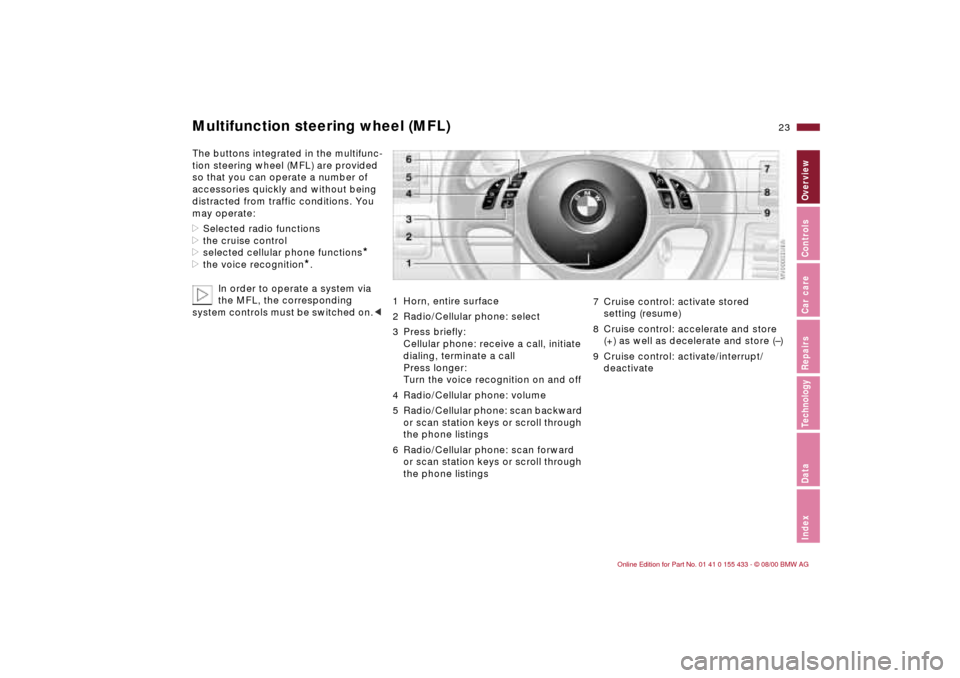
1 Horn, entire surface
2 Radio/Cellular phone: select
3 Press briefly:
Cellular phone: receive a call, initiate
dialing, terminate a call
Press longer:
Turn the voice recognition on and off
4 Radio/Cellular phone: volume
5 Radio/Cellular phone: scan backward
or scan station keys or scroll through
the phone listings
6 Radio/Cellular phone: scan forward
or scan station keys or scroll through
the phone listings
7 Cruise control: activate stored
setting (resume)
8 Cruise control: accelerate and store
(+) as well as decelerate and store (Ð)
9 Cruise control: activate/interrupt/
deactivate
Page 28 of 183
28n
Locks and security systems:
Keys30
Electronic vehicle
immobilizer31
Central locking system31
Opening and closing Ð
via the door lock32
Opening and closing Ð
via the remote control33
Opening and closing Ð
from the inside36
Lugagge compartment lid37
Luggage compartment39
Alarm system40
Electric power windows42
Sliding/tilt sunroof43
Adjustments:
Seats45
Mirrors49
Seat and mirror memory51
Steering wheel52
Car Memory, Key Memory52
Passenger safety systems:
Safety belts54
Airbags56
Transporting children safely59
Controls
Page 40 of 183
40n
Alarm system
*
The conceptThe vehicle alarm system responds:
>When a door, the hood or the
luggage compartment lid is opened.
>To movement inside the vehicle (inte-
rior motion sensor).
>Altering the angle of the vehicle tilt
sensor, e. g. as would occur while
attempting to steal the wheels or tow
the vehicle (tilt sensor alarm system).
>To interruption of battery voltage.
The system responds to unauthorized
vehicle entry and attempted theft by
simultaneously activating the following:
>Sounding an acoustical alarm for
30 seconds.
>Activating the hazard warning
flashers for approx. five minutes.
>Flashing the high beams on and off in
rhythm with the hazard warning
flashers.
To activate and deactivate the
alarm systemWhen the vehicle is locked or unlocked
by using a key or the remote control,
the alarm system is also simultaneously
armed or disarmed.
The interior motion sensor and the
alarm system tilt sensor are activated
approx. 30 seconds after the last door
has been locked.
If the alarm system has been armed
correctly, the hazard warning flashers
flash once.
You can have a signal set as
acknowledgment for both setting
and deactivating the alarm.<
You can also open the luggage
compartment lid when the system is
armed by pressing button 3 of the
remote control (refer to page 34). When
it is closed, the lid is once again
secured.
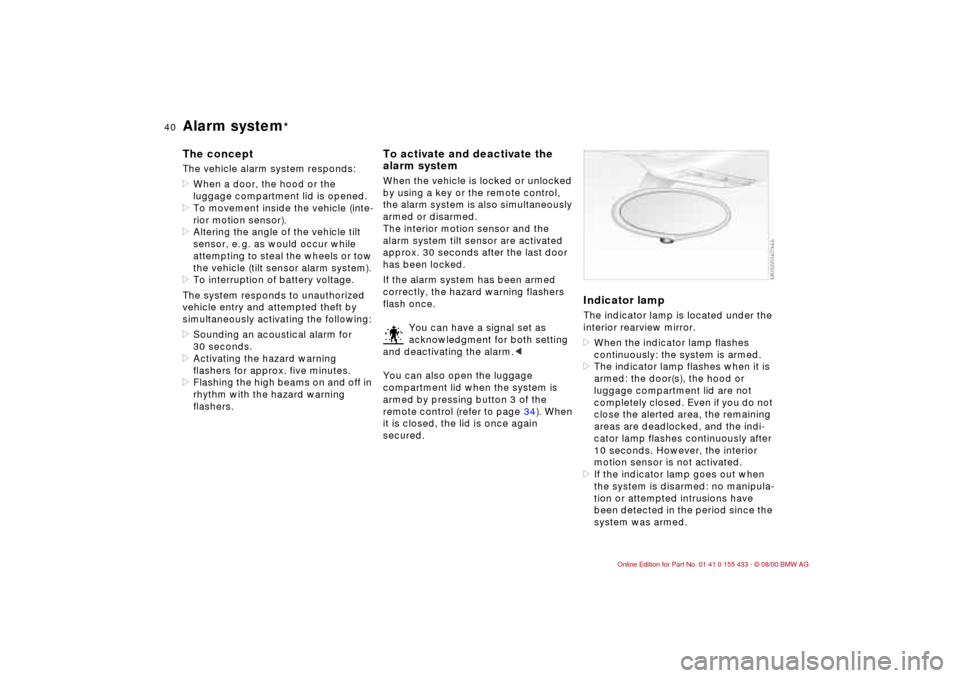
Indicator lampThe indicator lamp is located under the
interior rearview mirror.
>When the indicator lamp flashes
continuously: the system is armed.
>The indicator lamp flashes when it is
armed: the door(s), the hood or
luggage compartment lid are not
completely closed. Even if you do not
close the alerted area, the remaining
areas are deadlocked, and the indi-
cator lamp flashes continuously after
10 seconds. However, the interior
motion sensor is not activated.
>If the indicator lamp goes out when
the system is disarmed: no manipula-
tion or attempted intrusions have
been detected in the period since the
system was armed.
Page 45 of 183
45n
IndexDataTechnologyRepairsCar careControlsOverview
For maximum safety when adjusting the
seat position, please observe the
following:
Never try to adjust your seat while
operating the vehicle. The seat
could respond with unexpected move-
ment, and the ensuing loss of vehicle
control could lead to an accident.
Be sure that the safety belt remains
firmly against your body at all times. In
the event of a frontal impact, a loose lap
belt could slide over the hips, leading to
abdominal injury. In addition, the safety
belt's restraint effectiveness is reduced
if the belt is worn loosely.
Never ride with the backrest reclined to
an extreme angle (especially important
for the front passenger to remember). If
you do so, there is a risk that you will
slide under the safety belt in an acci-
dent, thus reducing the protection
provided by the safety belt.<
Correct sitting posture To reduce strain on your spinal column,
sit all the way back in the seat and rest
your back fully against the backrest.
The ideal sitting posture is achieved
with your head extending from your
spine in a straight line.
For long-distance driving, you may wish
to increase the backrest tilt-angle
slightly to reduce muscular tension. You
should be able to grasp the steering
wheel at its highest point with your
arms slightly bent.
After a seat adjustment, adjust the
height of the safety belt also. Refer to
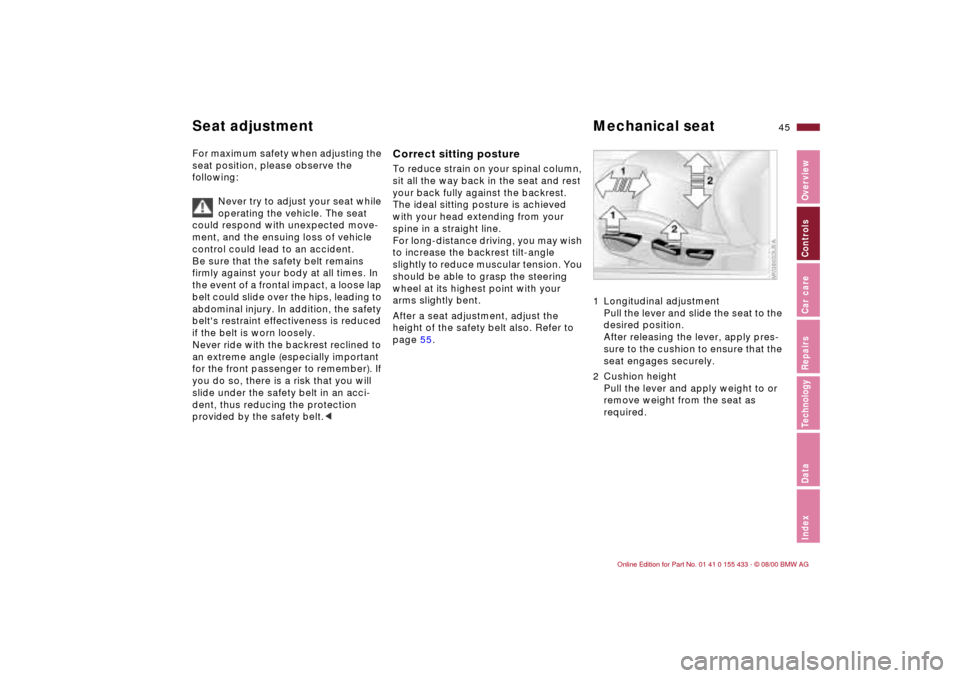
page 55. 1 Longitudinal adjustment
Pull the lever and slide the seat to the
desired position.
After releasing the lever, apply pres-
sure to the cushion to ensure that the
seat engages securely.
2 Cushion height
Pull the lever and apply weight to or
remove weight from the seat as
required.
Seat adjustment Mechanical seat