ECO mode BMW M3 COUPE 2002 E46 User Guide
[x] Cancel search | Manufacturer: BMW, Model Year: 2002, Model line: M3 COUPE, Model: BMW M3 COUPE 2002 E46Pages: 151, PDF Size: 2.14 MB
Page 64 of 151
64n
Sequential M gearbox* SMG II
The vehicle may roll slightly before
it is held by the gradient assis-
tance after releasing the footbrake.
Two seconds after the footbrake is
released, the vehicle begins to roll, as it
is no longer held with the gradient
assistance.<
The gradient assistance must be reacti-
vated before each use.
Indicator lamp
The transmission indicator lamp
in the instrument cluster goes
out after the engine is started.
>If it does not go out, or if it lights up
during driving, a fault has occurred.
The available functions may be
limited under certain circumstances.
Drive carefully and with the Dynamic
Stability Control (DSC) activated.
Have the system checked by the
nearest BMW center
>If the indicator lamp flashes while
driving, the system is overloaded.
Avoid high loads until the indicator
lamp goes out again permanently.
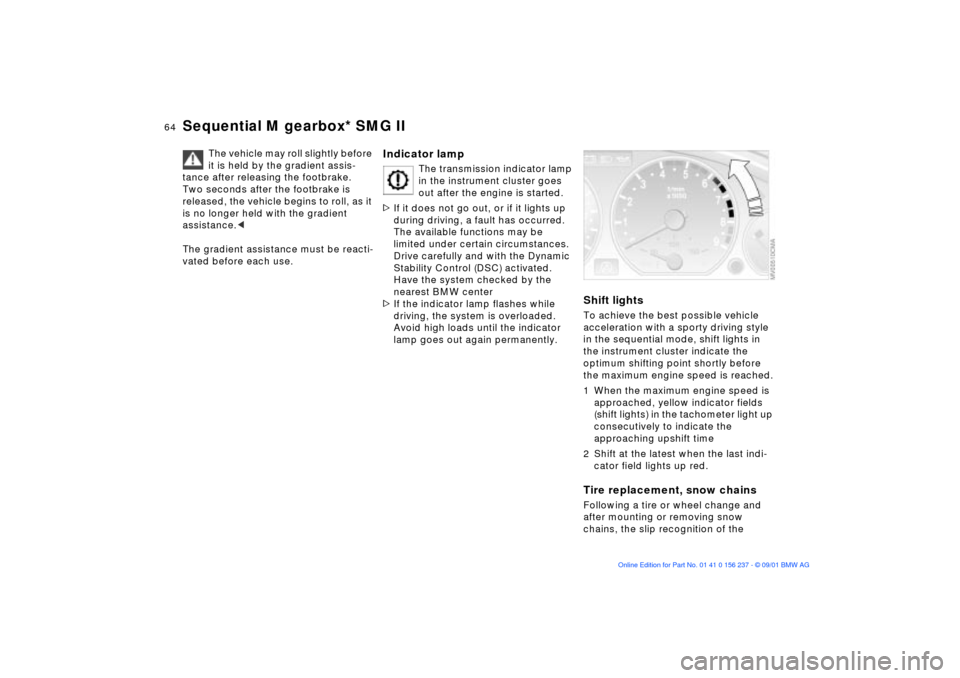
Shift lightsTo achieve the best possible vehicle
acceleration with a sporty driving style
in the sequential mode, shift lights in
the instrument cluster indicate the
optimum shifting point shortly before
the maximum engine speed is reached.
1 When the maximum engine speed is
approached, yellow indicator fields
(shift lights) in the tachometer light up
consecutively to indicate the
approaching upshift time
2 Shift at the latest when the last indi-
cator field lights up red.Tire replacement, snow chainsFollowing a tire or wheel change and
after mounting or removing snow
chains, the slip recognition of the
Page 71 of 151
71n
OverviewControlsMaintenanceRepairsDataIndex
Fuel gauge Temperature gauge Service Interval Display Once the indicator lamp stays on
continuously, there are still approx.
2 gallons (8 liters) of fuel in the fuel
tank.
Fuel tank capacity: approx. 16.6 gal.
(63 liters).
If the tilt of the vehicle varies (when you
are driving in mountainous areas, for
example), the needle may fluctuate
slightly.
Please refuel early, since driving
to the last drop of fuel can result in
damage to the engine and/or catalytic
converter.<
When you switch on the ignition, the
indicator lamp lights up briefly as a
functional check.
BlueThe engine is still cold. Drive at
moderate engine and vehicle speeds. RedWhen you switch on the ignition, the
warning lamp comes on briefly to
confirm that the system is operational.
If the lamp comes on while operating
the vehicle, the engine has overheated.
Switch off the engine immediately and
allow it to cool down.
Checking coolant level, refer to
page 112.Between the blue and red zonesNormal operating range. The needle
may rise as far as the edge of the red
sector in normal operation.
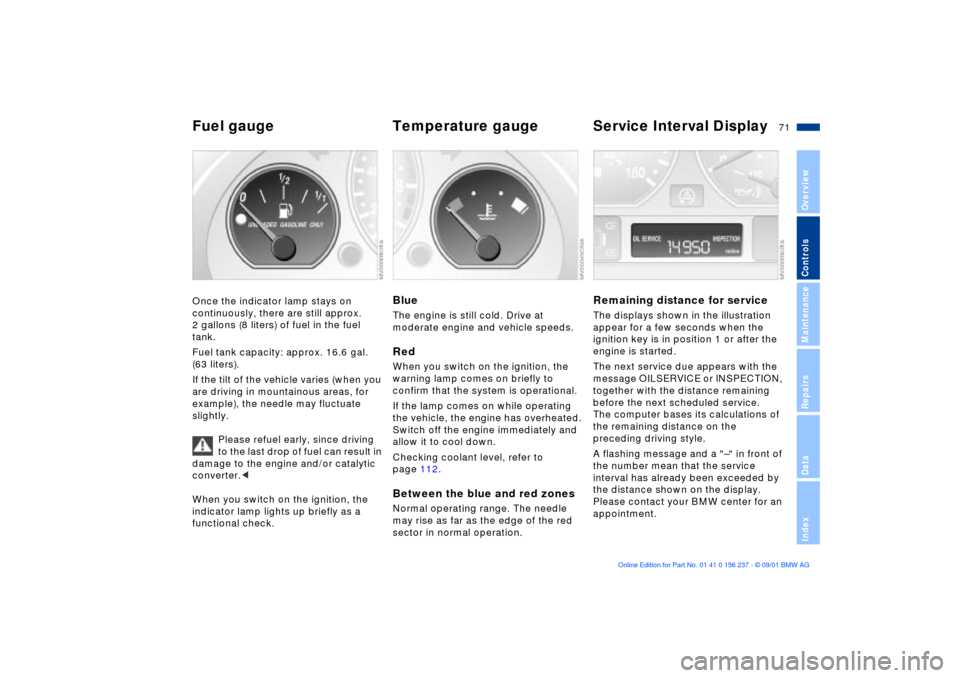
Remaining distance for serviceThe displays shown in the illustration
appear for a few seconds when the
ignition key is in position 1 or after the
engine is started.
The next service due appears with the
message OILSERVICE or INSPECTION,
together with the distance remaining
before the next scheduled service.
The computer bases its calculations of
the remaining distance on the
preceding driving style.
A flashing message and a "Ð" in front of
the number mean that the service
interval has already been exceeded by
the distance shown on the display.
Please contact your BMW center for an
appointment.
Page 73 of 151
73n
OverviewControlsMaintenanceRepairsDataIndex
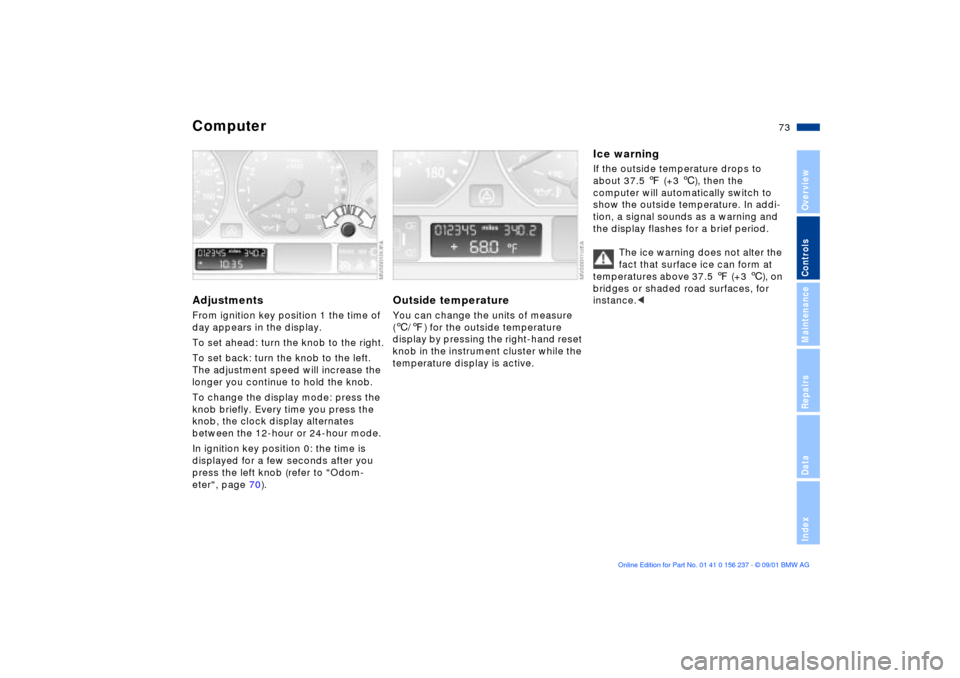
ComputerAdjustments From ignition key position 1 the time of
day appears in the display.
To set ahead: turn the knob to the right.
To set back: turn the knob to the left.
The adjustment speed will increase the
longer you continue to hold the knob.
To change the display mode: press the
knob briefly. Every time you press the
knob, the clock display alternates
between the 12-hour or 24-hour mode.
In ignition key position 0: the time is
displayed for a few seconds after you
press the left knob (refer to "Odom-
eter", page 70).
Outside temperature You can change the units of measure
(6/7) for the outside temperature
display by pressing the right-hand reset
knob in the instrument cluster while the
temperature display is active.
Ice warning If the outside temperature drops to
about 37.5 7 (+3 6), then the
computer will automatically switch to
show the outside temperature. In addi-
tion, a signal sounds as a warning and
the display flashes for a brief period.
The ice warning does not alter the
fact that surface ice can form at
temperatures above 37.5 7 (+3 6), on
bridges or shaded road surfaces, for
instance.<
Page 79 of 151
79n
OverviewControlsMaintenanceRepairsDataIndex
Flat Tire Monitor
M Engine dynamics control
In the event of a flat tire
The indicator lamp in the instru-
ment cluster will light up red in
the event of a flat tire with
ensuing loss in pressure. In addition, an
acoustic signal is sounded. To come to
an immediate stop, reduce speed, while
avoiding any sudden, jerky braking or
steering maneuvers.
Fix the flat tire using the M Mobility
system, refer to page 126.
Reset the indicator lamp: the red indi-
cator lamp has to be switched off
manually after putting on a new wheel.
At this point, hold the Flat Tire Monitor
button down until the indicator lamp
goes out. Reinitialize the system after-
ward.
The Flat Tire Monitor cannot alert
you to severe and sudden tire
damage caused by external factors.
Another factor which the Flat Tire
Monitor does not recognize is the
balanced and very gradual pressure
loss that takes place in all tires over an
extended period of time.<
Check the tire inflation pressure
on a regular basis and correct if
necessary, refer to page 24.
Under certain circumstances, there
may be false warnings or a delayed
detection of losses in pressure when
driving on snow-covered or slippery
road surfaces.
Performance-oriented driving (slip at
the drive wheels, high levels of lateral
acceleration) can also delay the
appearance of status reports in the Flat
Tire Monitor's display.<
System malfunctionAs long as there is still a malfunction,
the indicator lamp in the instrument
cluster will stay lit up yellow.
Please contact your BMW center for
additional information.
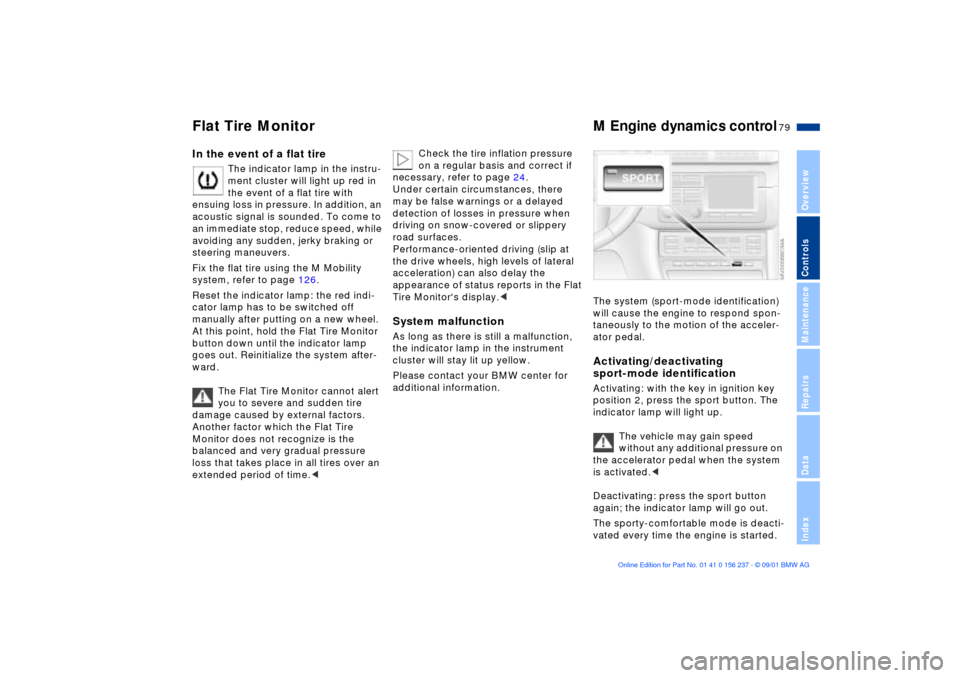
The system (sport-mode identification)
will cause the engine to respond spon-
taneously to the motion of the acceler-
ator pedal. Activating/deactivating
sport-mode identificationActivating: with the key in ignition key
position 2, press the sport button. The
indicator lamp will light up.
The vehicle may gain speed
without any additional pressure on
the accelerator pedal when the system
is activated.<
Deactivating: press the sport button
again; the indicator lamp will go out.
The sporty-comfortable mode is deacti-
vated every time the engine is started.
Page 84 of 151
84n
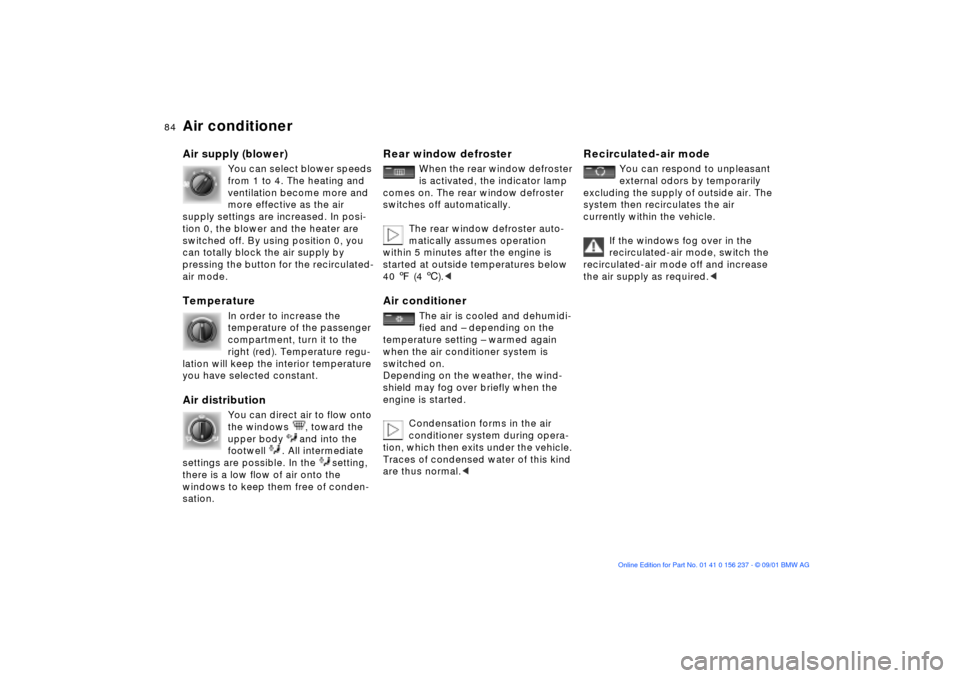
Air conditionerAir supply (blower)
You can select blower speeds
from 1 to 4. The heating and
ventilation become more and
more effective as the air
supply settings are increased. In posi-
tion 0, the blower and the heater are
switched off. By using position 0, you
can totally block the air supply by
pressing the button for the recirculated-
air mode.
Temperature
In order to increase the
temperature of the passenger
compartment, turn it to the
right (red). Temperature regu-
lation will keep the interior temperature
you have selected constant.
Air distribution
You can direct air to flow onto
the windows , toward the
upper body and into the
footwell . All intermediate
settings are possible. In the setting,
there is a low flow of air onto the
windows to keep them free of conden-
sation.
Rear window defroster
When the rear window defroster
is activated, the indicator lamp
comes on. The rear window defroster
switches off automatically.
The rear window defroster auto-
matically assumes operation
within 5 minutes after the engine is
started at outside temperatures below
40 7 (4 6).<
Air conditioner
The air is cooled and dehumidi-
fied and Ð depending on the
temperature setting Ð warmed again
when the air conditioner system is
switched on.
Depending on the weather, the wind-
shield may fog over briefly when the
engine is started.
Condensation forms in the air
conditioner system during opera-
tion, which then exits under the vehicle.
Traces of condensed water of this kind
are thus normal.<
Recirculated-air mode
You can respond to unpleasant
external odors by temporarily
excluding the supply of outside air. The
system then recirculates the air
currently within the vehicle.
If the windows fog over in the
recirculated-air mode, switch the
recirculated-air mode off and increase
the air supply as required.<
Page 100 of 151

100n
To ensure that your vehicle provides
maximum economy throughout a long
service life, we request that you
observe the following instructions.
Because of its engineering design,
the BMW M3 is an especially high-
quality vehicle. It is in your best interest
to follow the break-in instructions very
closely. Doing this, you will create the
basis for a long, optimum service life.<
Engine and differential>Until a km reading of 1,200 miles
(2,000 km): drive at varying engine
and road speeds, but do not exceed
the following rpms or road speeds:
5,500 rpm or 105 mph (170 km/h)
Obey your local and state maximum
speed limits.
Do not depress the accelerator pedal to
the full-throttle position.
Vehicles with SMG II
* (refer to
page 59): refrain from using driving
program 6 in the sequential mode
during the break-in period.
>After you have monitored the break-
in period for 1,200 miles (2,000 km),
you can begin to gradually increase
both engine and road speed.
Please remember to observe the same
break-in procedures if either the engine
or the differential is replaced later in the
course of the vehicle's service life.TiresOwing to technical factors associated
with their manufacture, tires do not
achieve their full traction potential until
an initial break-in period has elapsed.
Thus drive with extra care during the
initial 200 miles (300 km).
Obey your local and state maximum
speed limits.
When the vehicle is operated on
wet or slushy roads, a wedge of
water may form between the tire and
the road surface. This phenomenon is
referred to as aquaplaning, or hydro-
planing, and can lead to partial or
complete loss of traction, vehicle
control and braking effectiveness.
Reduce your speed on wet roads.<
Brake systemApprox. 300 miles (500 km) must
elapse before the brake pads and
rotors achieve the optimal pad-surface
and wear patterns required for trouble-
free operation and long service life later
on.
To break-in the separate parking brake
drums, apply the parking brake lightly
when coasting to a standstill (at a traffic
signal, for instance), provided that
traffic conditions allow you to do so. To
avoid corrosion, repeat this procedure
from time to time.
The brake lamps do not come on
when the parking brake is
engaged.
Vacuum for the brake system servo unit
on your BMW is available only when the
engine is running. When you move the
vehicle with the engine off Ð when
towing, for example Ð substantially
higher levels of pedal force will be
required to brake the vehicle.
(500 km). Drive cautiously during this
break-in period and do not shift at high
engine speeds.
Break-in procedures
Page 105 of 151

105n
OverviewControlsMaintenanceRepairsDataIndex
Tire replacement Wheel and tire combinationsTire ageBMW recommends the replacement of
all tires after 6 years at the latest, even
if a tire life of 10 years is possible.
The date on which the tire was manu-
factured is indicated by the code on the
sidewall:
DOT ... 4 101 means that the tire was
produced in the 41st week of the year
2001. Following wheel/tire changesFollowing wheel and/or tire replace-
ment you will need to reinitialize both
the Flat Tire Monitor and the sequential
M gearbox
* SMG II, refer to pages 65,
78.
The right choice
Use only wheels and tires
approved by BMW for the corre-
sponding vehicle model, as otherwise
the tires may make contact with the
body as the result of tolerances despite
the same nominal size being used,
resulting in serious accidents. If non-
approved wheels and tires are used,
BMW cannot evaluate their suitability,
and therefore cannot be held liable for
driving safety.<
BMW tests certain tire brands for each
tire size, classifies them as road-safe
and approves them. Consult your BMW
center for more information. Observe
any country-specific regulations, e.g.
on making a corresponding entry in the
vehicle documents.
The correct wheel and tire combi-
nation affects different systems
such as ABS, DSC, Flat Tire Monitor.
The function of these systems is
impaired if improper wheel and tire
combinations are used.
For this reason, use only tires of the
same brand and tread pattern on the
vehicle and, for example, restore the
approved wheel and tire combination
following a flat tire as soon as possible.<
The use of rims and lug bolts that
do not meet the specifications of
the original factory-installed equipment
will affect the safe operation of your
vehicle and may cause an accident and
personal injury.
Never mix tires of different design, such
as steel-belted radials with radial bias-
belted or bias-ply tires, etc. Mixing tire
types will adversely affect roadholding
and can lead to loss of vehicle
control.<
Storage Store tires in a cool, dry place,
protecting them against light whenever
possible. Protect the tires against
contact with oil, grease and fuel.
Page 111 of 151

111n
OverviewControlsMaintenanceRepairsDataIndex
Engine oil
BMW engines are designed to
operate without oil additives; the
use of additives could lead to damage
in some cases. This is also true for the
manual transmission, the differential,
and the power steering system.<
Recommendation: have the oil changed
by your BMW center only.
Continuous exposure to used oil
has caused cancer in laboratory
testing. For this reason, thoroughly
wash any areas of skin that come into
contact with oil using soap and water.
Always store oils, grease and similar
materials so that they are inaccessible
to children. Comply with warning labels
and information on containers.<
Comply with the applicable envi-
ronmental laws regulating the
disposal of used oil.<
Prescribed engine oilThe quality of the engine oil is
extremely important for the function
and life of an engine. Based on exten-
sive testing, BMW has approved only
certain types of engine oils.
Use only oils approved for your vehicle
model.
Ask your BMW center for details
concerning oils that have been
approved. You can also call BMW of
North America at 1-800-831-1117 or
visit this website: www.bmwusa.com
to obtain this information.< Alternative oil typesShould it not be possible to purchase
an oil approved by BMW, you can also
use other oils for adding smaller quanti-
ties between oil changes as an excep-
tion. The following information must be
specified on the package:
1. Viscosity
preferred: SAE 10W-60
or as an alternative: SAE 5W-40 or
SAE 10W-40
2. Specification
preferred: API SJ/CF
or as an alternative: API SJ
(also SK, SL, S etc.).
Low ambient temperaturesThe oils used by BMW at the factory for
your vehicle model can be used at virtu-
ally any ambient temperature.
However, if the vehicle is exposed to
temperatures below Ð4 7 (Ð20 6) for
extended periods, please have your
BMW center recommend a suitable oil.