steering wheel BMW M3 COUPE 2002 E46 User Guide
[x] Cancel search | Manufacturer: BMW, Model Year: 2002, Model line: M3 COUPE, Model: BMW M3 COUPE 2002 E46Pages: 151, PDF Size: 2.14 MB
Page 61 of 151
61n
OverviewControlsMaintenanceRepairsDataIndex
Sequential M gearbox* SMG IIThe warning stops after approx.
10 seconds. If you move the selector
lever into a forward or reverse position
during this time, a gear is automatically
engaged.
The SMG II has no park position
for securing the vehicle against
rolling.
The ignition key can be removed in any
selector lever position.<
Always engage the parking brake
when parking on downhill roads.
Engaging a gear may not sufficiently
secure the vehicle against rolling.<
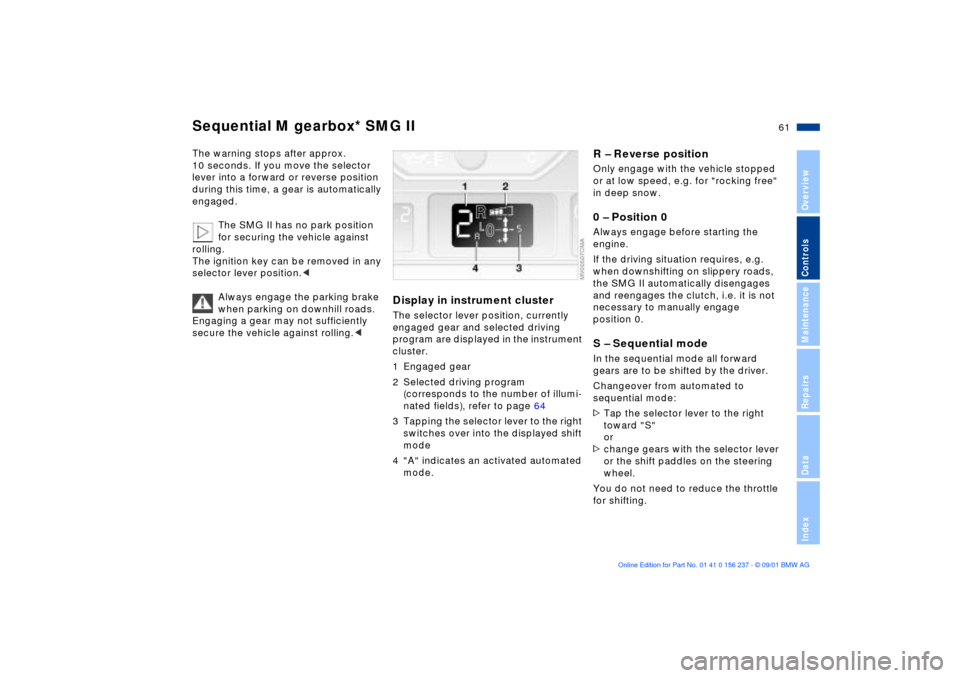
Display in instrument clusterThe selector lever position, currently
engaged gear and selected driving
program are displayed in the instrument
cluster.
1 Engaged gear
2 Selected driving program
(corresponds to the number of illumi-
nated fields), refer to page 64
3 Tapping the selector lever to the right
switches over into the displayed shift
mode
4 "A" indicates an activated automated
mode.
R Ð Reverse positionOnly engage with the vehicle stopped
or at low speed, e.g. for "rocking free"
in deep snow.0 Ð Position 0Always engage before starting the
engine.
If the driving situation requires, e.g.
when downshifting on slippery roads,
the SMG II automatically disengages
and reengages the clutch, i.e. it is not
necessary to manually engage
position 0. S Ð Sequential modeIn the sequential mode all forward
gears are to be shifted by the driver.
Changeover from automated to
sequential mode:
>Tap the selector lever to the right
toward "S"
or
>change gears with the selector lever
or the shift paddles on the steering
wheel.
You do not need to reduce the throttle
for shifting.
Page 62 of 151
62n
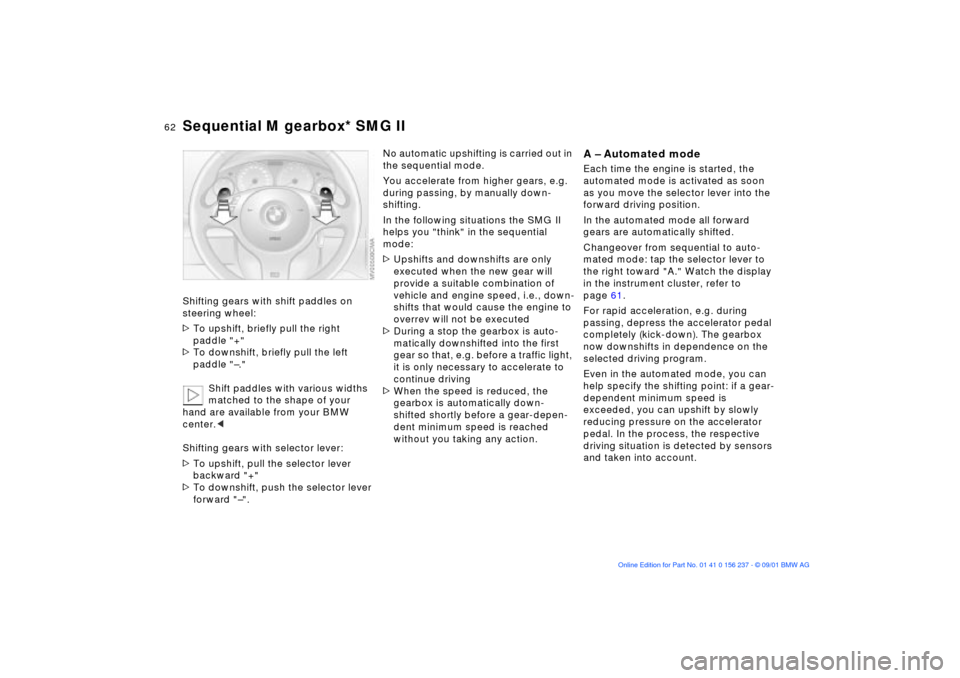
Sequential M gearbox* SMG IIShifting gears with shift paddles on
steering wheel:
>To upshift, briefly pull the right
paddle "+"
>To downshift, briefly pull the left
paddle "Ð."
Shift paddles with various widths
matched to the shape of your
hand are available from your BMW
center.<
Shifting gears with selector lever:
>To upshift, pull the selector lever
backward "+"
>To downshift, push the selector lever
forward "Ð".
No automatic upshifting is carried out in
the sequential mode.
You accelerate from higher gears, e.g.
during passing, by manually down-
shifting.
In the following situations the SMG II
helps you "think" in the sequential
mode:
>Upshifts and downshifts are only
executed when the new gear will
provide a suitable combination of
vehicle and engine speed, i.e., down-
shifts that would cause the engine to
overrev will not be executed
>During a stop the gearbox is auto-
matically downshifted into the first
gear so that, e.g. before a traffic light,
it is only necessary to accelerate to
continue driving
>When the speed is reduced, the
gearbox is automatically down-
shifted shortly before a gear-depen-
dent minimum speed is reached
without you taking any action.
A Ð Automated modeEach time the engine is started, the
automated mode is activated as soon
as you move the selector lever into the
forward driving position.
In the automated mode all forward
gears are automatically shifted.
Changeover from sequential to auto-
mated mode: tap the selector lever to
the right toward "A." Watch the display
in the instrument cluster, refer to
page 61.
For rapid acceleration, e.g. during
passing, depress the accelerator pedal
completely (kick-down). The gearbox
now downshifts in dependence on the
selected driving program.
Even in the automated mode, you can
help specify the shifting point: if a gear-
dependent minimum speed is
exceeded, you can upshift by slowly
reducing pressure on the accelerator
pedal. In the process, the respective
driving situation is detected by sensors
and taken into account.
Page 76 of 151

76n
Dynamic Stability Control (DSC)
The conceptDSC maintains vehicle stability, even in
critical driving situations.
The system optimizes vehicle stability
during acceleration and when starting
from a full stop, as well as optimizing
traction. In addition, it also recognizes
unstable driving conditions such as
under- or oversteering on curves, and
helps the vehicle remain on a steady
course by using the engine and brake
system to intervene at the different
wheels Ð doing only what it can within
the laws of physics, of course.
The DSC is operational every time you
start the engine. The laws of physics cannot be
repealed, even with DSC. The
results of driving irresponsibly rest with
the driver. We therefore urge you to
avoid using the additional safety margin
of the system as an excuse for taking
risks.
Do not make any modifications to the
DSC system. Allow only authorized
technicians to perform service proce-
dures on the DSC.<
At first, you may need some time to
become accustomed to this system's
intervention. However, it guarantees
optimum drive force and at the same
time, the best possible vehicle stability.
Indicator lamp
The indicator lamp in the instru-
ment cluster will go out shortly
after the ignition has been
switched on, refer to pages 18, 19.
>Indicator lamp flashes: the DSC is
active and is controlling the drive
torque based on driving conditions
>If the indicator lamp fails to go out
after the engine has been started, or
if it comes on during normal driving
and stays on: the DSC has been
deactivated via the button or there is
a malfunction. You can continue to
drive the vehicle normally, but
without DSC. Please consult your
BMW center for repairs.
Page 79 of 151
79n
OverviewControlsMaintenanceRepairsDataIndex
Flat Tire Monitor
M Engine dynamics control
In the event of a flat tire
The indicator lamp in the instru-
ment cluster will light up red in
the event of a flat tire with
ensuing loss in pressure. In addition, an
acoustic signal is sounded. To come to
an immediate stop, reduce speed, while
avoiding any sudden, jerky braking or
steering maneuvers.
Fix the flat tire using the M Mobility
system, refer to page 126.
Reset the indicator lamp: the red indi-
cator lamp has to be switched off
manually after putting on a new wheel.
At this point, hold the Flat Tire Monitor
button down until the indicator lamp
goes out. Reinitialize the system after-
ward.
The Flat Tire Monitor cannot alert
you to severe and sudden tire
damage caused by external factors.
Another factor which the Flat Tire
Monitor does not recognize is the
balanced and very gradual pressure
loss that takes place in all tires over an
extended period of time.<
Check the tire inflation pressure
on a regular basis and correct if
necessary, refer to page 24.
Under certain circumstances, there
may be false warnings or a delayed
detection of losses in pressure when
driving on snow-covered or slippery
road surfaces.
Performance-oriented driving (slip at
the drive wheels, high levels of lateral
acceleration) can also delay the
appearance of status reports in the Flat
Tire Monitor's display.<
System malfunctionAs long as there is still a malfunction,
the indicator lamp in the instrument
cluster will stay lit up yellow.
Please contact your BMW center for
additional information.
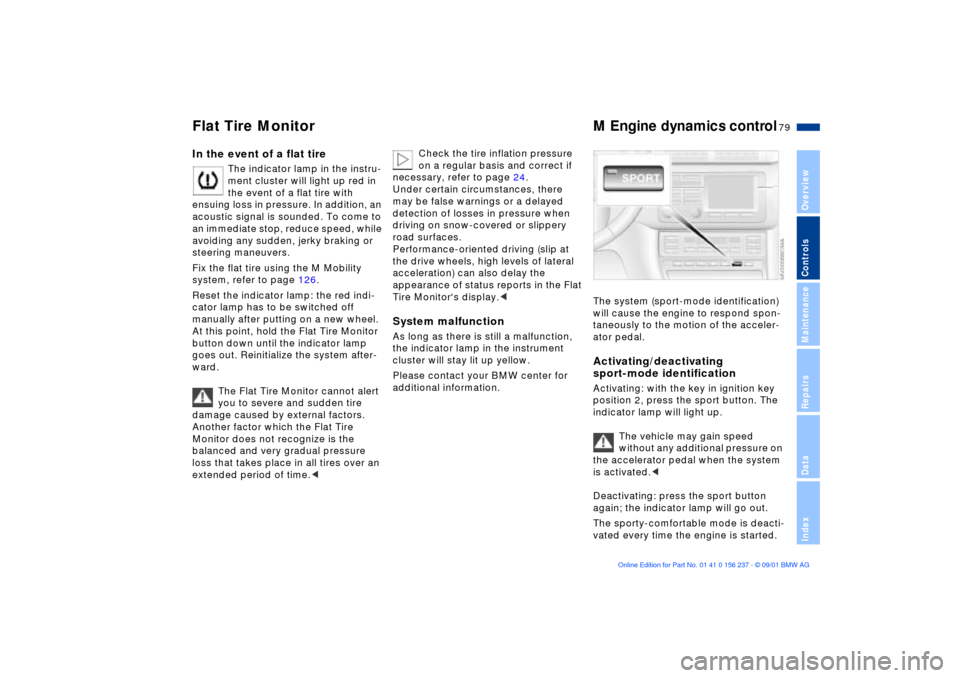
The system (sport-mode identification)
will cause the engine to respond spon-
taneously to the motion of the acceler-
ator pedal. Activating/deactivating
sport-mode identificationActivating: with the key in ignition key
position 2, press the sport button. The
indicator lamp will light up.
The vehicle may gain speed
without any additional pressure on
the accelerator pedal when the system
is activated.<
Deactivating: press the sport button
again; the indicator lamp will go out.
The sporty-comfortable mode is deacti-
vated every time the engine is started.
Page 101 of 151

101n
OverviewControlsMaintenanceRepairsDataIndex
Brakes:
Do not drive with your foot resting
on the brake pedal. Even light but
consistent pedal pressure can lead to
high temperatures, brake wear and
possibly even brake failure.
Aquaplaning:
When driving on wet or slushy roads,
reduce vehicle speed. If you do not, a
wedge of water may form between the
tires and the road surface. This
phenomenon is referred to as aqua-
planing, or hydroplaning, and can lead
to partial or complete loss of traction,
vehicle control and braking effective-
ness.
Driving through water:
Do not drive through water on the road
if it is deeper than 1 foot (30 cm), and
then only at walking speed. Otherwise,
the vehicle's engine, the electrical
systems and the transmission may be
damaged.
Rear parcel tray:
Never use it to store heavy or hard
objects, otherwise, occupants could be
injured if the vehicle is braked hard.
Clothes hooks:
When suspending clothing from the
hooks, be sure that they will not
obstruct the driver's vision. Do not hang
heavy objects on the hooks. If you do
so, they could cause personal injury
during braking or evasive maneuvers.<
The conceptThe Antilock Brake System (ABS) keeps
the wheels from locking while braking,
thereby enhancing active driving safety.Braking with ABSIf you are in a situation that requires full
braking, you will exploit the full benefits
of the ABS system if you apply
maximum brake pressure ("panic
stop"). Since the vehicle maintains
steering responsiveness, you can
nevertheless avoid possible obstacles
with a minimum of steering effort.
Pulsation at the brake pedal combines
with sounds from the hydraulic circuits
to indicate to the driver that ABS is in
its active mode.Cornering Brake Control (CBC)CBC is an advanced engineering
design of the ABS. When braking while
cornering at high speed or braking
during high lateral acceleration, or
when braking during a lane change,
vehicle stability is improved and
steering response is enhanced.
Driving notes Antilock Brake System
Page 103 of 151
103n
OverviewControlsMaintenanceRepairsDataIndex
Information for your safetyThe factory-approved radial tires are
matched to the vehicle and have been
selected to provide optimum safety and
driving comfort on your vehicle.
It is not merely the tire's service life, but
also driving comfort and Ð above all else
Ð driving safety that depend on the
condition of the tires and the mainte-
nance of the specified tire pressure.
Incorrect inflation pressures are a
frequent cause of tire problems
and tire damage. Tire pressure also has
a major effect on your BMW's handling
response. Check tire inflation pressures
on a regular basis (refer to page 25), at
least every two weeks and before
beginning a longer trip. Failure to
observe these precautions can result in
incorrect tire pressures, which cause
instable handling response as well as
tire damage, and can ultimately lead to
an accident.<
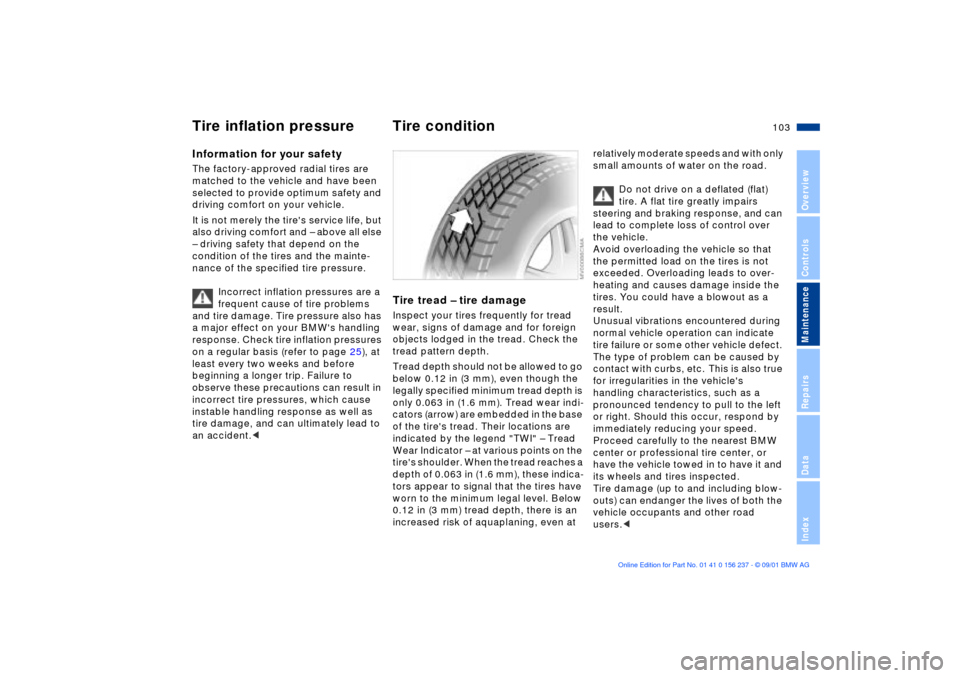
Tire tread Ð tire damageInspect your tires frequently for tread
wear, signs of damage and for foreign
objects lodged in the tread. Check the
tread pattern depth.
Tread depth should not be allowed to go
below 0.12 in (3 mm), even though the
legally specified minimum tread depth is
only 0.063 in (1.6 mm). Tread wear indi-
cators (arrow) are embedded in the base
of the tire's tread. Their locations are
indicated by the legend "TWI" Ð Tread
Wear Indicator Ð at various points on the
tire's shoulder. When the tread reaches a
depth of 0.063 in (1.6 mm), these indica-
tors appear to signal that the tires have
worn to the minimum legal level. Below
0.12 in (3 mm) tread depth, there is an
increased risk of aquaplaning, even at
relatively moderate speeds and with only
small amounts of water on the road.
Do not drive on a deflated (flat)
tire. A flat tire greatly impairs
steering and braking response, and can
lead to complete loss of control over
the vehicle.
Avoid overloading the vehicle so that
the permitted load on the tires is not
exceeded. Overloading leads to over-
heating and causes damage inside the
tires. You could have a blowout as a
result.
Unusual vibrations encountered during
normal vehicle operation can indicate
tire failure or some other vehicle defect.
The type of problem can be caused by
contact with curbs, etc. This is also true
for irregularities in the vehicle's
handling characteristics, such as a
pronounced tendency to pull to the left
or right. Should this occur, respond by
immediately reducing your speed.
Proceed carefully to the nearest BMW
center or professional tire center, or
have the vehicle towed in to have it and
its wheels and tires inspected.
Tire damage (up to and including blow-
outs) can endanger the lives of both the
vehicle occupants and other road
users.<
Tire inflation pressure Tire condition
Page 106 of 151

106n
Special characteristics of winter tires Snow chainsChoosing the right tireBMW recommends winter tires (M+S
radial tires) for operation under adverse
winter driving conditions. So-called all-
season tires with the M+S identification
mark do indeed possess better winter
traction than summer tires that have the
H, V, W, Y and ZR speed ratings, they
generally fail to provide the same levels
of performance as snow tires.
In the interest of safe tracking and
steering response, install winter tires
made by the same manufacturer having
the same tread configuration on all four
wheels. Do not exceed specified
maximum speeds
Never exceed the maximum
speed for which winter tires are
rated.
Unprofessional attempts by laymen to
service tires can lead to damage and
accidents.
Have this work performed by skilled
professionals only. Any BMW center
has the required technical knowledge
and the proper equipment and will be
happy to assist you.<
Tire condition, tire pressureOnce winter tires wear to a tread depth
of less than 0.16 in (4 mm), their perfor-
mance under winter driving conditions
deteriorates noticeably. Worn tires
should therefore be replaced for safety
considerations.
Inflate tires to specified pressure and
have the wheels balanced every time
the tires or wheels have been replaced.Use narrow-link BMW snow chains
* on
winter tires in pairs only and only on the
rear wheels. Comply with all manufac-
turer's safety precautions when
mounting the chains. Do not exceed a
maximum speed of 30 mph (50 km/h)
with snow chains.
After mounting or removing snow
chains, always reinitialize the sequential
M gearbox
* SMG II, refer to page 65.
It is not possible to mount snow
chains on tires with 18- and
19-inch wheels.
Deactivate the Flat Tire Monitor when
using snow chains. Malfunction warn-
ings and undetected losses in pressure
are a possibility when driving with snow
chains.
For additional information, refer to
page 77.<
Page 126 of 151
126n
Repairing a flat tire
Precautions in case of a flat tire:
Stop the vehicle as far as possible
from passing traffic; switch on the
hazard warning flashers.
Turn the steering wheel to the straight-
ahead position and engage the steering
lock. Shift into 1st or reverse and
engage the parking brake.
All passengers should be outside the
vehicle and well away from your imme-
diate working area (behind a guardrail,
for instance).
If a warning triangle or portable hazard
warning lamp is available, set it up on
the roadside at an appropriate distance
from the rear of the vehicle.
Comply with all safety guidelines and
regulations.<
M Mobility systemWith the BMW M3, you will find an M
Mobility system for fixing flat tires. With
the aid of this system, you can apply a
liquid sealant to the inside of the tire,
thereby sealing off the damaged area,
and then continue driving.
The M Mobility system makes trans-
porting a spare wheel superfluous,
thereby reducing the amount of weight
you have to carry around. Using the M Mobility systemTo repair a flat tire using the M Mobility
system, proceed as follows:
>Prepare the M Mobility system for
use, refer to the next column
>This is part of the M Mobility system,
refer to page 127
>Filling with sealant, refer to page 127
>Distributing sealant, refer to
page 128
>Inflating tire to correct pressure, refer
to page 129.
Preparing the M Mobility system
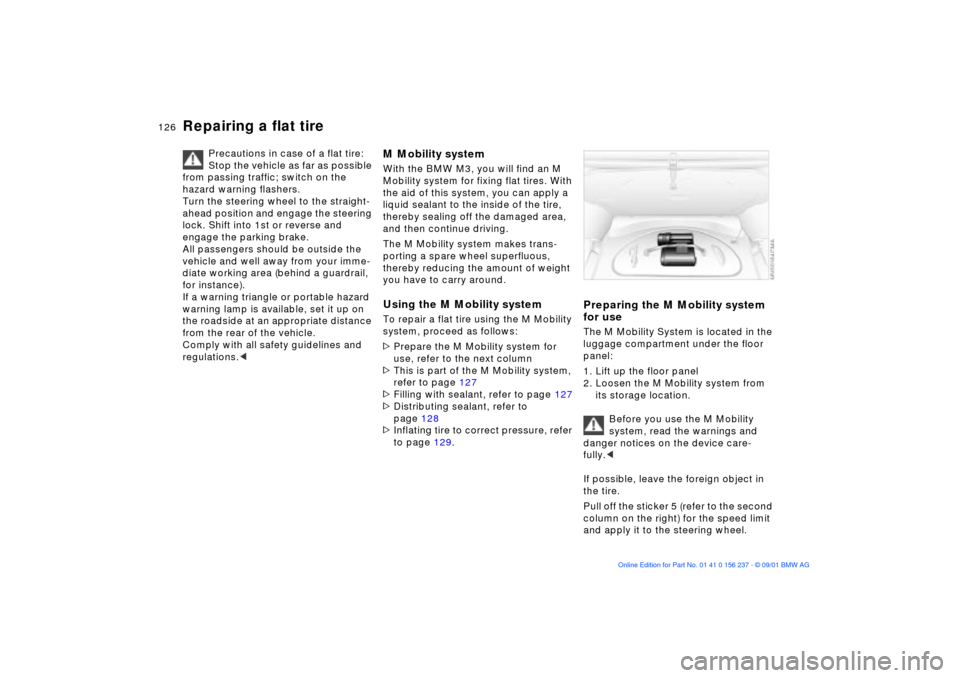
for useThe M Mobility System is located in the
luggage compartment under the floor
panel:
1. Lift up the floor panel
2. Loosen the M Mobility system from
its storage location.
Before you use the M Mobility
system, read the warnings and
danger notices on the device care-
fully.<
If possible, leave the foreign object in
the tire.
Pull off the sticker 5 (refer to the second
column on the right) for the speed limit
and apply it to the steering wheel.
Page 133 of 151
133n
OverviewControlsMaintenanceRepairsDataIndex
Towing the vehicleTowing a vehicle1. Shift lever in Neutral
2. Towing speed:
Max. 45 mph (70 km/h)
3. Towing distance:
Max. 95 miles (150 km)
4. Leave the ignition key at position 1 to
ensure that the brake lamps, turn
signal indicators, horn and wind-
shield wipers remain operative, and
to prevent the steering lock detent
from engaging
5. Switch on the hazard-warning
system (observe applicable legal
regulations).
Find some means of identifying the
vehicle in tow, for instance, place a sign
or warning triangle in the rear window.
Make sure that the ignition key
remains in position 1 even when
the electrical system has failed to
prevent the steering lock from
engaging.
The steering and brakes are without
power assist when the engine is off.
This means that increased effort is
required for steering and braking.c
Vehicles with sequential M gearbox
*
SMG II:
To push or tow, engage selector lever
in position 0.
Never work on the vehicle with a
driving position engaged.c
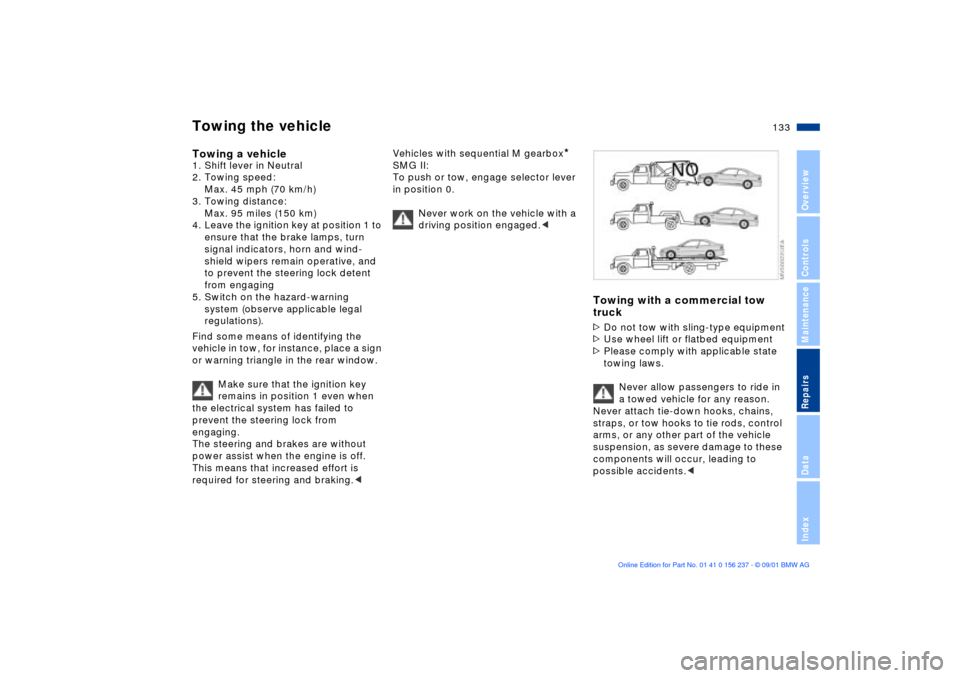
Towing with a commercial tow
truck>Do not tow with sling-type equipment
>Use wheel lift or flatbed equipment
>Please comply with applicable state
towing laws.
Never allow passengers to ride in
a towed vehicle for any reason.
Never attach tie-down hooks, chains,
straps, or tow hooks to tie rods, control
arms, or any other part of the vehicle
suspension, as severe damage to these
components will occur, leading to
possible accidents.c
Page 145 of 151

Everything from A to Z
145n
OverviewControlsMaintenanceRepairsDataIndex
INSPECTION71
Instrument cluster15
Instrument lighting81
Instrument panel15
Interface socket
for Onboard
Diagnostics116
Interior lamps31, 82
remote control31
Interior motion
sensor37, 38
avoiding unintentional
alarms38
deactivate31
operating via remote
control31
Interior rearview mirror with
automatic dimming
feature49 J
Jump-starting131 K
Key28
with remote control28
Key Memory55
L
Lamps80, 120
LAMPS ON warning80
Lashing eyes97
LATCH child-restraint
system installation53
Leather care, refer to the
"Caring for your vehicle"
manual
Length137
License plate lamp
bulb replacement125t
Lighting, refer to lamps
Load-securing devices97
Locking luggage
compartment lid
separately34
Louvers83, 86
Low ambient
temperatures111
Low beams80
bulb replacement121t
Luggage compartment
capacity138
floor mat36
floor panel36
lighting34
operating via remote
control31 Luggage compartment
lid34
electrical malfunction34
emergency release from
luggage compartment's
interior36
locking it separately34
manual operation34t
Luggage rack97
Lumbar support,
adjusting43
M
M Engine dynamics
control79
M+S-tires106
Maintenance71, 114
Malfunction displays72
Manual operation
doors29t
fuel filler door22t
luggage compartment
lid34t
sliding/tilt sunroof41t
Manual transmission58
Master key28 MFL (Multifunction steering
wheel)21
Microfilter85, 89
Mirror memory46
Mirrors48
automatic curb
monitor48
Modifications,
technical10, 115
Multifunction steering wheel
(MFL)21
N
Navigation system, refer to
the "Onboard Computer
Owner's Manual"
Neckrest44 O
OBD interface socket116
Obstruction protection39
Odometer70
Oil
additives111
capacity139
quality111
specifications111
viscosity111