warning BMW M3 COUPE 2002 E46 User Guide
[x] Cancel search | Manufacturer: BMW, Model Year: 2002, Model line: M3 COUPE, Model: BMW M3 COUPE 2002 E46Pages: 151, PDF Size: 2.14 MB
Page 28 of 151
28n
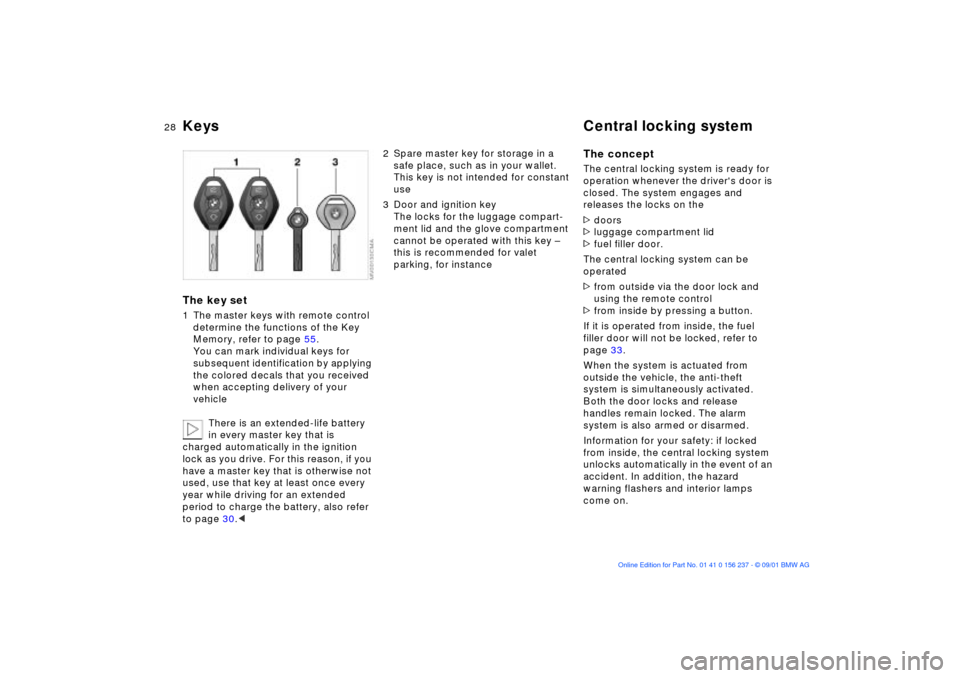
Keys Central locking systemThe key set1 The master keys with remote control
determine the functions of the Key
Memory, refer to page 55.
You can mark individual keys for
subsequent identification by applying
the colored decals that you received
when accepting delivery of your
vehicle
There is an extended-life battery
in every master key that is
charged automatically in the ignition
lock as you drive. For this reason, if you
have a master key that is otherwise not
used, use that key at least once every
year while driving for an extended
period to charge the battery, also refer
to page 30.<
2 Spare master key for storage in a
safe place, such as in your wallet.
This key is not intended for constant
use
3 Door and ignition key
The locks for the luggage compart-
ment lid and the glove compartment
cannot be operated with this key Ð
this is recommended for valet
parking, for instance
The conceptThe central locking system is ready for
operation whenever the driver's door is
closed. The system engages and
releases the locks on the
>doors
>luggage compartment lid
>fuel filler door.
The central locking system can be
operated
>from outside via the door lock and
using the remote control
>from inside by pressing a button.
If it is operated from inside, the fuel
filler door will not be locked, refer to
page 33.
When the system is actuated from
outside the vehicle, the anti-theft
system is simultaneously activated.
Both the door locks and release
handles remain locked. The alarm
system is also armed or disarmed.
Information for your safety: if locked
from inside, the central locking system
unlocks automatically in the event of an
accident. In addition, the hazard
warning flashers and interior lamps
come on.
Page 37 of 151
37n
OverviewControlsMaintenanceRepairsDataIndex
Alarm system
*
The conceptThe vehicle alarm system responds:
>When a door, the hood or the
luggage compartment lid are opened
>To movement inside the vehicle (inte-
rior motion sensor)
>To variations in the vehicle tilt, as
would occur while attempting to steal
the wheels or tow the vehicle (tilt
alarm sensor)
>To interruption of battery voltage.
The system responds to unauthorized
vehicle entry and attempted theft by
simultaneously activating the following:
>Sounding an acoustic alarm for
30 seconds
>Activating the hazard warning
flashers for approx. five minutes
>Flashing the high beams on and off in
rhythm with the hazard warning
flashers.
To arm and disarm the alarm
systemWhen the vehicle is locked or unlocked
by using a key or the remote control,
the alarm system is also simultaneously
armed or disarmed.
You can have a signal set as
acknowledgment for both arming
and disarming the alarm.<
You can also open the luggage
compartment lid when the system is
armed by pressing the button of the
remote control, refer to page 31. When
it is closed, the lid is once again
secured.
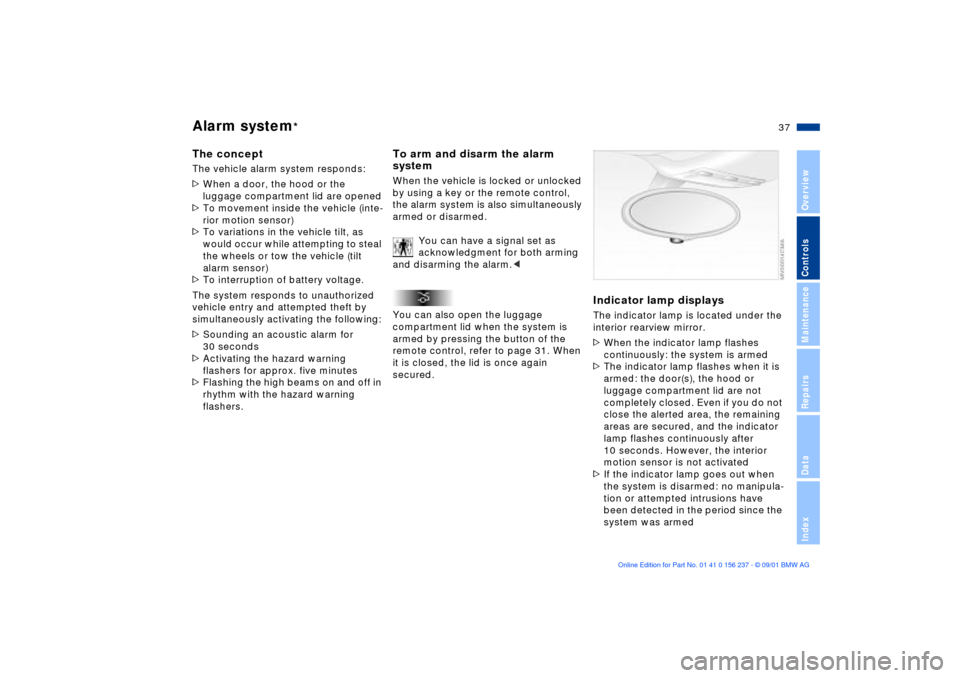
Indicator lamp displaysThe indicator lamp is located under the
interior rearview mirror.
>When the indicator lamp flashes
continuously: the system is armed
>The indicator lamp flashes when it is
armed: the door(s), the hood or
luggage compartment lid are not
completely closed. Even if you do not
close the alerted area, the remaining
areas are secured, and the indicator
lamp flashes continuously after
10 seconds. However, the interior
motion sensor is not activated
>If the indicator lamp goes out when
the system is disarmed: no manipula-
tion or attempted intrusions have
been detected in the period since the
system was armed
Page 51 of 151
51n
OverviewControlsMaintenanceRepairsDataIndex
AirbagsThe rear seat side airbags may already
have been deactivated, either at the
time of manufacture or by a BMW
center. Labels in the rear door opening
should indicate the status of your rear
seat side airbags. If you are uncertain of
their status, or wish to have the airbags
activated or deactivated, please
contact your BMW center.<
Even when all these guidelines are
followed, there is still a small residual
risk of injuries to the face, hands and
arms occurring from airbag deployment
in isolated instances. The ignition and
inflation noise may provoke a mild
temporary hearing loss in extremely
sensitive individuals.
Airbag warning information is also
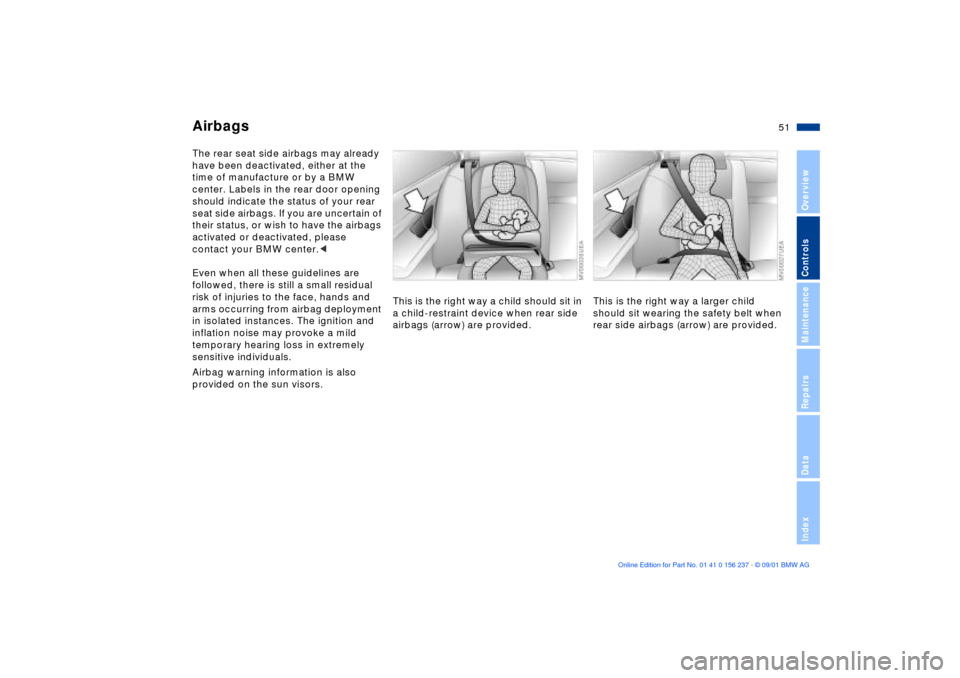
provided on the sun visors. This is the right way a child should sit in
a child-restraint device when rear side
airbags (arrow) are provided.
This is the right way a larger child
should sit wearing the safety belt when
rear side airbags (arrow) are provided.
Page 61 of 151
61n
OverviewControlsMaintenanceRepairsDataIndex
Sequential M gearbox* SMG IIThe warning stops after approx.
10 seconds. If you move the selector
lever into a forward or reverse position
during this time, a gear is automatically
engaged.
The SMG II has no park position
for securing the vehicle against
rolling.
The ignition key can be removed in any
selector lever position.<
Always engage the parking brake
when parking on downhill roads.
Engaging a gear may not sufficiently
secure the vehicle against rolling.<
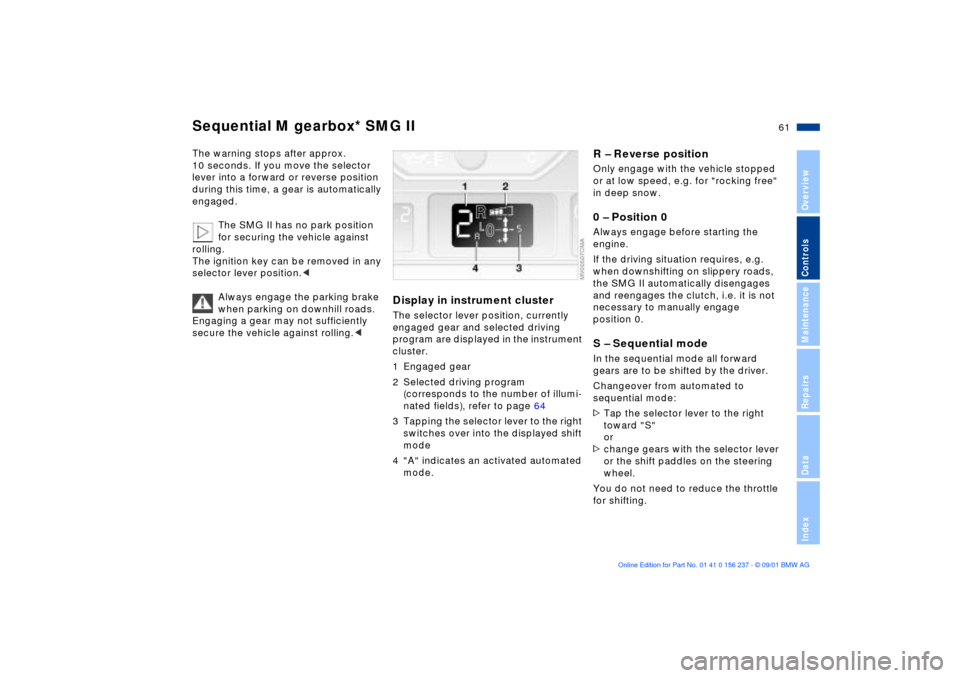
Display in instrument clusterThe selector lever position, currently
engaged gear and selected driving
program are displayed in the instrument
cluster.
1 Engaged gear
2 Selected driving program
(corresponds to the number of illumi-
nated fields), refer to page 64
3 Tapping the selector lever to the right
switches over into the displayed shift
mode
4 "A" indicates an activated automated
mode.
R Ð Reverse positionOnly engage with the vehicle stopped
or at low speed, e.g. for "rocking free"
in deep snow.0 Ð Position 0Always engage before starting the
engine.
If the driving situation requires, e.g.
when downshifting on slippery roads,
the SMG II automatically disengages
and reengages the clutch, i.e. it is not
necessary to manually engage
position 0. S Ð Sequential modeIn the sequential mode all forward
gears are to be shifted by the driver.
Changeover from automated to
sequential mode:
>Tap the selector lever to the right
toward "S"
or
>change gears with the selector lever
or the shift paddles on the steering
wheel.
You do not need to reduce the throttle
for shifting.
Page 70 of 151
70n
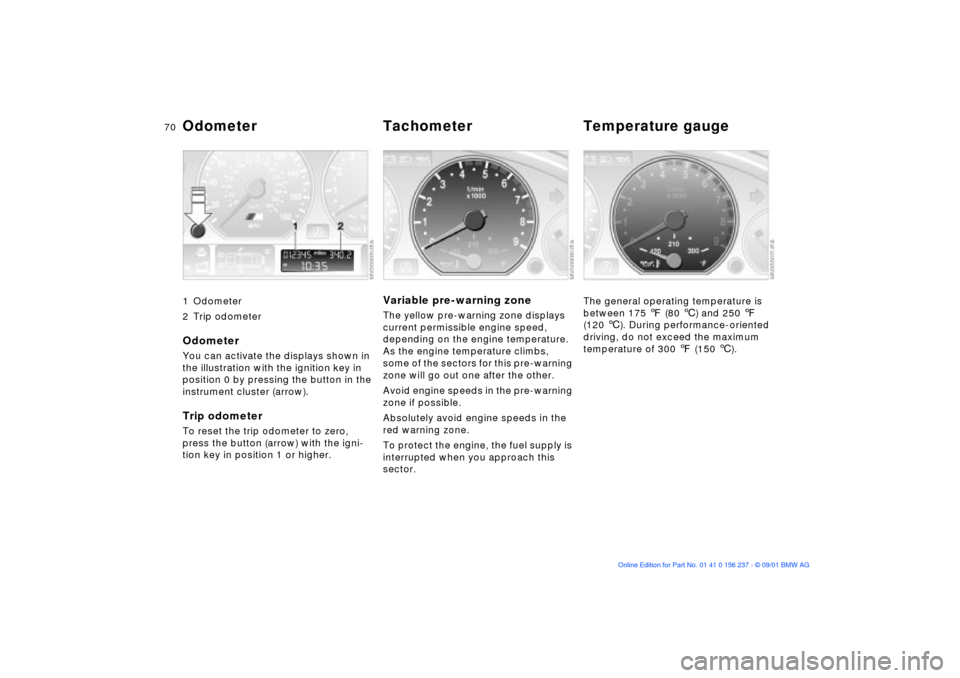
1 Odometer
2 Trip odometer
OdometerYou can activate the displays shown in
the illustration with the ignition key in
position 0 by pressing the button in the
instrument cluster (arrow).Trip odometerTo reset the trip odometer to zero,
press the button (arrow) with the igni-
tion key in position 1 or higher.
Variable pre-warning zoneThe yellow pre-warning zone displays
current permissible engine speed,
depending on the engine temperature.
As the engine temperature climbs,
some of the sectors for this pre-warning
zone will go out one after the other.
Avoid engine speeds in the pre-warning
zone if possible.
Absolutely avoid engine speeds in the
red warning zone.
To protect the engine, the fuel supply is
interrupted when you approach this
sector.
The general operating temperature is
between 175 7 (80 6) and 250 7
(120 6). During performance-oriented
driving, do not exceed the maximum
temperature of 300 7 (150 6).
Odometer Tachometer Temperature gauge
Page 71 of 151
71n
OverviewControlsMaintenanceRepairsDataIndex
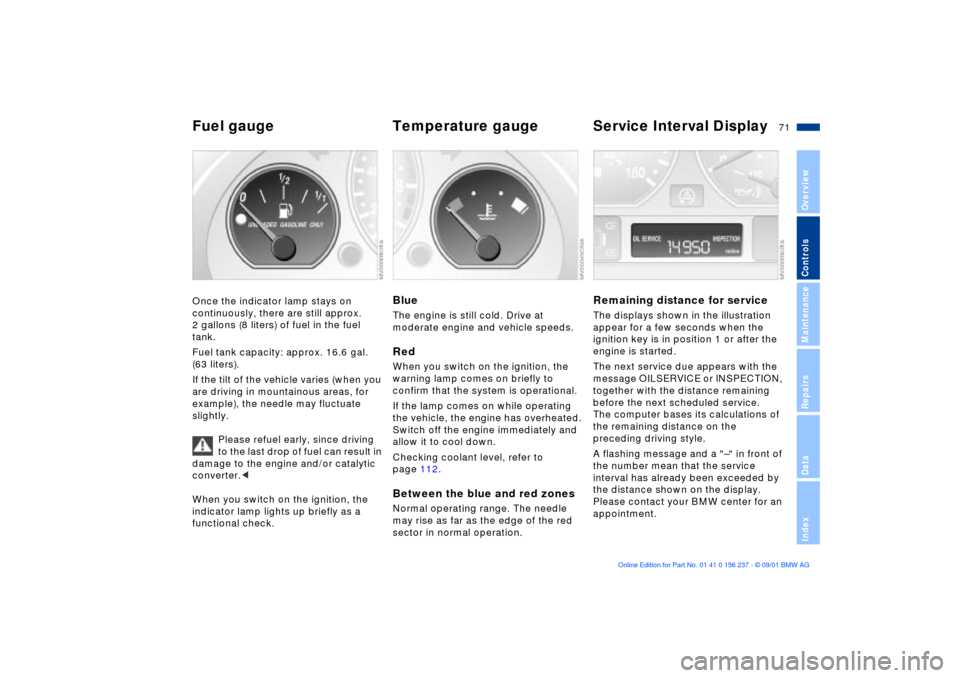
Fuel gauge Temperature gauge Service Interval Display Once the indicator lamp stays on
continuously, there are still approx.
2 gallons (8 liters) of fuel in the fuel
tank.
Fuel tank capacity: approx. 16.6 gal.
(63 liters).
If the tilt of the vehicle varies (when you
are driving in mountainous areas, for
example), the needle may fluctuate
slightly.
Please refuel early, since driving
to the last drop of fuel can result in
damage to the engine and/or catalytic
converter.<
When you switch on the ignition, the
indicator lamp lights up briefly as a
functional check.
BlueThe engine is still cold. Drive at
moderate engine and vehicle speeds. RedWhen you switch on the ignition, the
warning lamp comes on briefly to
confirm that the system is operational.
If the lamp comes on while operating
the vehicle, the engine has overheated.
Switch off the engine immediately and
allow it to cool down.
Checking coolant level, refer to
page 112.Between the blue and red zonesNormal operating range. The needle
may rise as far as the edge of the red
sector in normal operation.
Remaining distance for serviceThe displays shown in the illustration
appear for a few seconds when the
ignition key is in position 1 or after the
engine is started.
The next service due appears with the
message OILSERVICE or INSPECTION,
together with the distance remaining
before the next scheduled service.
The computer bases its calculations of
the remaining distance on the
preceding driving style.
A flashing message and a "Ð" in front of
the number mean that the service
interval has already been exceeded by
the distance shown on the display.
Please contact your BMW center for an
appointment.
Page 73 of 151
73n
OverviewControlsMaintenanceRepairsDataIndex
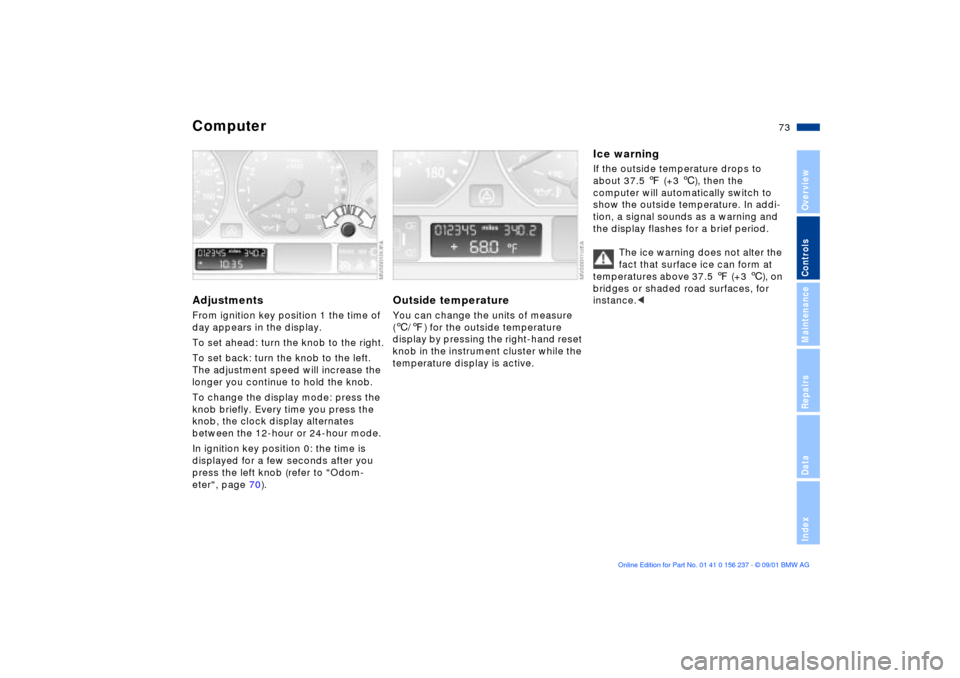
ComputerAdjustments From ignition key position 1 the time of
day appears in the display.
To set ahead: turn the knob to the right.
To set back: turn the knob to the left.
The adjustment speed will increase the
longer you continue to hold the knob.
To change the display mode: press the
knob briefly. Every time you press the
knob, the clock display alternates
between the 12-hour or 24-hour mode.
In ignition key position 0: the time is
displayed for a few seconds after you
press the left knob (refer to "Odom-
eter", page 70).
Outside temperature You can change the units of measure
(6/7) for the outside temperature
display by pressing the right-hand reset
knob in the instrument cluster while the
temperature display is active.
Ice warning If the outside temperature drops to
about 37.5 7 (+3 6), then the
computer will automatically switch to
show the outside temperature. In addi-
tion, a signal sounds as a warning and
the display flashes for a brief period.
The ice warning does not alter the
fact that surface ice can form at
temperatures above 37.5 7 (+3 6), on
bridges or shaded road surfaces, for
instance.<
Page 75 of 151
75n
OverviewControlsMaintenanceRepairsDataIndex
The conceptPDC provides extra safety and conve-
nience during parking maneuvers by
providing an acoustic signal to indicate
the distance to an object. To do this,
four ultrasonic sensors in the rear
bumper measure the distance to the
nearest object.The monitoring range for
the two rear sensors extends outward
roughly 2 ft (60 cm). The range for the
two center sensors is approx. 4.9 ft
(1.50 m) wide.
The system starts to operate automati-
cally about one second after you select
reverse with the ignition key in
position 2. PDC is deactivated when
you shift back out of reverse.
Acoustic signalsThe distance to the nearest object is
indicated by a tone sounding at various
intervals. As the distance between
vehicle and object decreases, the inter-
vals between the tones become
shorter. A continuous tone indicates the
presence of an object less than 1 ft
(30 cm) away.
The warning signal is canceled after
approx. three seconds if the distance to
the obstacle remains constant during
this time (if you are moving parallel to a
wall, for instance).
System malfunctions will be indicated
by a continuous high-pitched tone
when the system is activated the first
time. Please have your BMW center
resolve the problem.The PDC does not remove the
driver's personal responsibility
for evaluating the distance between the
vehicle and any obstacles. Even when
sensors are involved, there is a blind
spot in which objects cannot be
detected. This applies especially in
those cases where the system
approaches the physical limits of ultra-
sonic measurement, as occurs with tow
bars and trailer couplings, and in the
vicinity of thin or wedge-shaped
objects.
Certain sources of sound, such as a
loud radio, could drown the PDC signal
tone.<
Keep the sensors clean and free
of ice or snow in order to ensure
that they continue to operate effec-
tively.
Do not apply high pressure spray to the
sensors for a prolonged period of time.
Always maintain a distance of more
than 4 in (10 cm).<
Park Distance Control (PDC)
*
Page 77 of 151
77n
OverviewControlsMaintenanceRepairsDataIndex
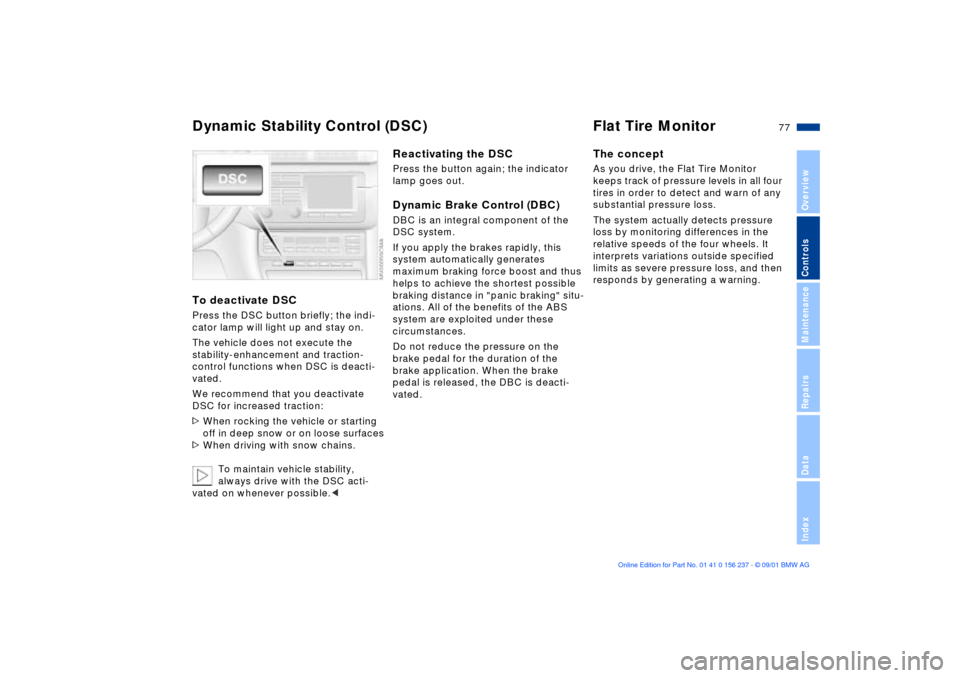
Dynamic Stability Control (DSC) Flat Tire MonitorTo deactivate DSCPress the DSC button briefly; the indi-
cator lamp will light up and stay on.
The vehicle does not execute the
stability-enhancement and traction-
control functions when DSC is deacti-
vated.
We recommend that you deactivate
DSC for increased traction:
>When rocking the vehicle or starting
off in deep snow or on loose surfaces
>When driving with snow chains.
To maintain vehicle stability,
always drive with the DSC acti-
vated on whenever possible.<
Reactivating the DSCPress the button again; the indicator
lamp goes out.Dynamic Brake Control (DBC)DBC is an integral component of the
DSC system.
If you apply the brakes rapidly, this
system automatically generates
maximum braking force boost and thus
helps to achieve the shortest possible
braking distance in "panic braking" situ-
ations. All of the benefits of the ABS
system are exploited under these
circumstances.
Do not reduce the pressure on the
brake pedal for the duration of the
brake application. When the brake
pedal is released, the DBC is deacti-
vated.
The conceptAs you drive, the Flat Tire Monitor
keeps track of pressure levels in all four
tires in order to detect and warn of any
substantial pressure loss.
The system actually detects pressure
loss by monitoring differences in the
relative speeds of the four wheels. It
interprets variations outside specified
limits as severe pressure loss, and then
responds by generating a warning.
Page 79 of 151
79n
OverviewControlsMaintenanceRepairsDataIndex
Flat Tire Monitor
M Engine dynamics control
In the event of a flat tire
The indicator lamp in the instru-
ment cluster will light up red in
the event of a flat tire with
ensuing loss in pressure. In addition, an
acoustic signal is sounded. To come to
an immediate stop, reduce speed, while
avoiding any sudden, jerky braking or
steering maneuvers.
Fix the flat tire using the M Mobility
system, refer to page 126.
Reset the indicator lamp: the red indi-
cator lamp has to be switched off
manually after putting on a new wheel.
At this point, hold the Flat Tire Monitor
button down until the indicator lamp
goes out. Reinitialize the system after-
ward.
The Flat Tire Monitor cannot alert
you to severe and sudden tire
damage caused by external factors.
Another factor which the Flat Tire
Monitor does not recognize is the
balanced and very gradual pressure
loss that takes place in all tires over an
extended period of time.<
Check the tire inflation pressure
on a regular basis and correct if
necessary, refer to page 24.
Under certain circumstances, there
may be false warnings or a delayed
detection of losses in pressure when
driving on snow-covered or slippery
road surfaces.
Performance-oriented driving (slip at
the drive wheels, high levels of lateral
acceleration) can also delay the
appearance of status reports in the Flat
Tire Monitor's display.<
System malfunctionAs long as there is still a malfunction,
the indicator lamp in the instrument
cluster will stay lit up yellow.
Please contact your BMW center for
additional information.
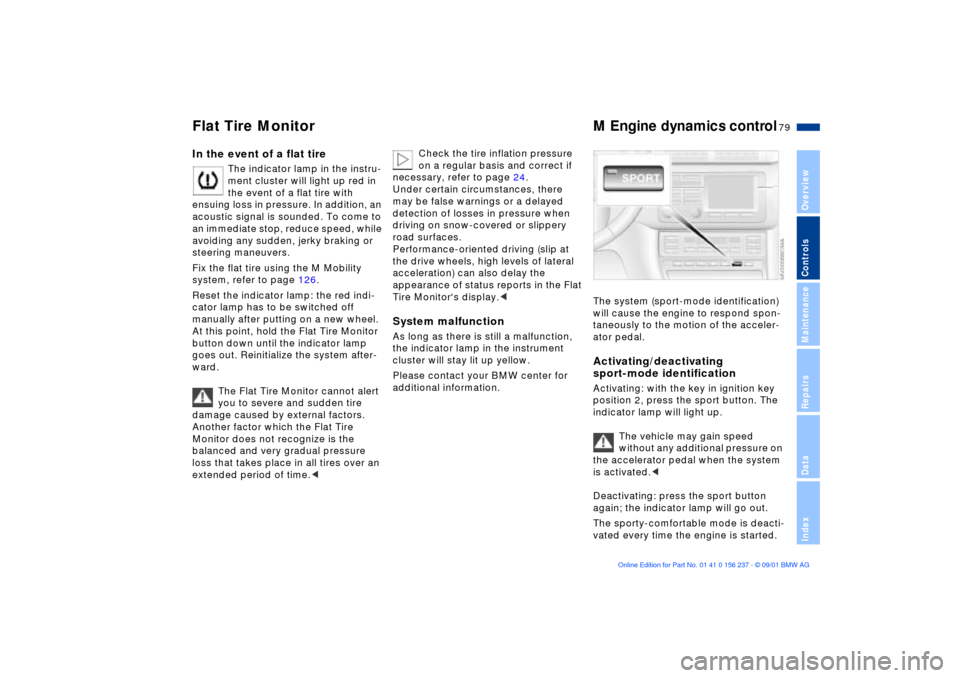
The system (sport-mode identification)
will cause the engine to respond spon-
taneously to the motion of the acceler-
ator pedal. Activating/deactivating
sport-mode identificationActivating: with the key in ignition key
position 2, press the sport button. The
indicator lamp will light up.
The vehicle may gain speed
without any additional pressure on
the accelerator pedal when the system
is activated.<
Deactivating: press the sport button
again; the indicator lamp will go out.
The sporty-comfortable mode is deacti-
vated every time the engine is started.