maintenance BMW M3 COUPE 2002 E46 Owner's Guide
[x] Cancel search | Manufacturer: BMW, Model Year: 2002, Model line: M3 COUPE, Model: BMW M3 COUPE 2002 E46Pages: 151, PDF Size: 2.14 MB
Page 39 of 151
39n
OverviewControlsMaintenanceRepairsDataIndex
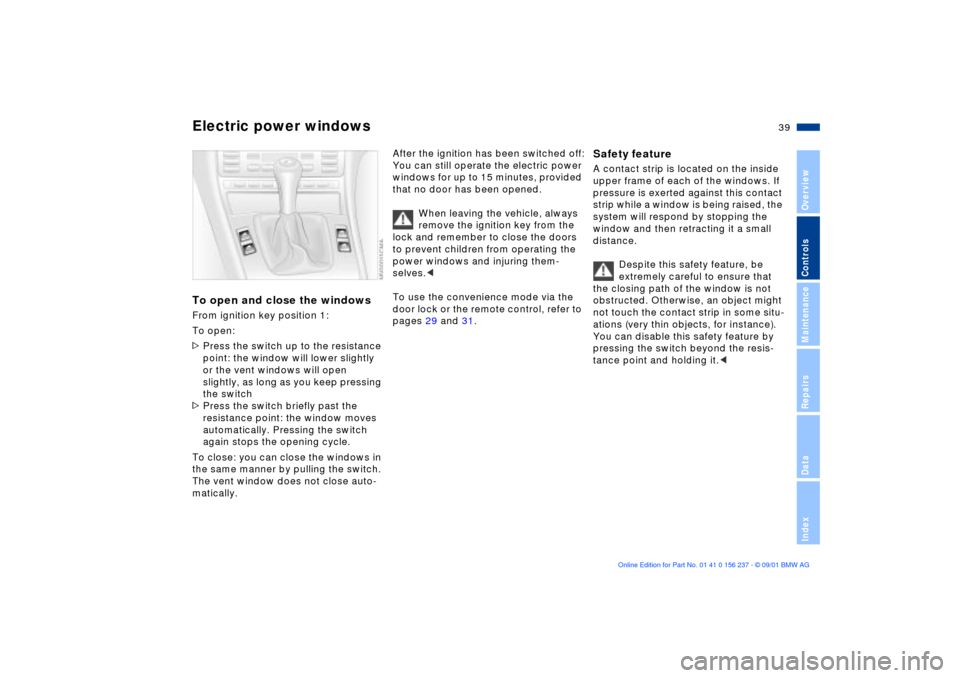
Electric power windowsTo open and close the windowsFrom ignition key position 1:
To open:
>Press the switch up to the resistance
point: the window will lower slightly
or the vent windows will open
slightly, as long as you keep pressing
the switch
>Press the switch briefly past the
resistance point: the window moves
automatically. Pressing the switch
again stops the opening cycle.
To close: you can close the windows in
the same manner by pulling the switch.
The vent window does not close auto-
matically.
After the ignition has been switched off:
You can still operate the electric power
windows for up to 15 minutes, provided
that no door has been opened.
When leaving the vehicle, always
remove the ignition key from the
lock and remember to close the doors
to prevent children from operating the
power windows and injuring them-
selves.<
To use the convenience mode via the
door lock or the remote control, refer to
pages 29 and 31.
Safety feature A contact strip is located on the inside
upper frame of each of the windows. If
pressure is exerted against this contact
strip while a window is being raised, the
system will respond by stopping the
window and then retracting it a small
distance.
Despite this safety feature, be
extremely careful to ensure that
the closing path of the window is not
obstructed. Otherwise, an object might
not touch the contact strip in some situ-
ations (very thin objects, for instance).
You can disable this safety feature by
pressing the switch beyond the resis-
tance point and holding it.<
Page 41 of 151
41n
OverviewControlsMaintenanceRepairsDataIndex
Sliding/tilt sunroof
*
Safety featureIf the sliding/tilt sunroof encounters
resistance
>when it is closing from the raised
position
>when it is closing from a point
roughly past the middle of its travel,
the closing cycle is interrupted and the
sliding/tilt sunroof will open again
slightly.
Despite this safety feature, be
extremely careful to ensure that
the closing path of the roof is not
obstructed. Otherwise, triggering the
closing-force limitation may not be
ensured in some situations (with very
thin objects, for instance).
You can disable this safety feature by
pressing the switch beyond the resis-
tance point and holding it.<
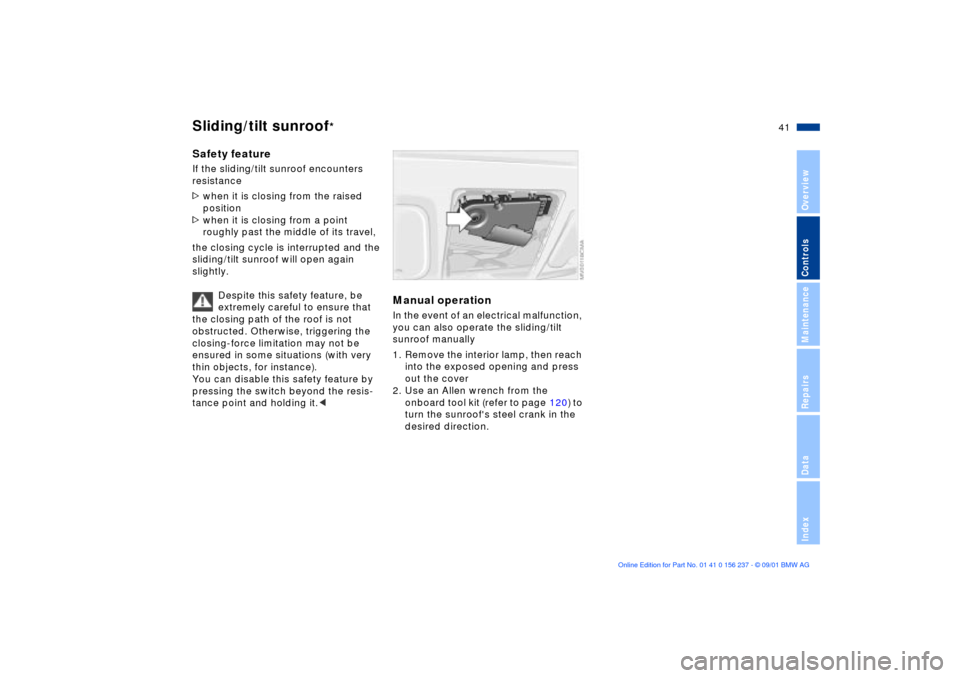
Manual operation In the event of an electrical malfunction,
you can also operate the sliding/tilt
sunroof manually
1. Remove the interior lamp, then reach
into the exposed opening and press
out the cover
2. Use an Allen wrench from the
onboard tool kit (refer to page 120) to
turn the sunroof's steel crank in the
desired direction.
Page 43 of 151
43n
OverviewControlsMaintenanceRepairsDataIndex
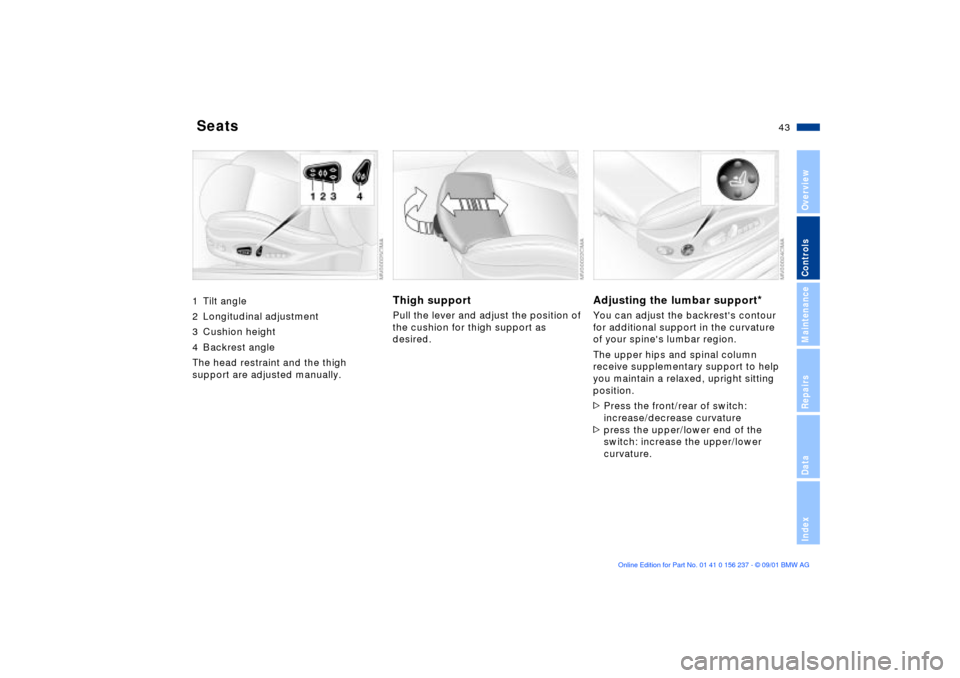
Seats1 Tilt angle
2 Longitudinal adjustment
3 Cushion height
4 Backrest angle
The head restraint and the thigh
support are adjusted manually.
Thigh support Pull the lever and adjust the position of
the cushion for thigh support as
desired.
Adjusting the lumbar support
*
You can adjust the backrest's contour
for additional support in the curvature
of your spine's lumbar region.
The upper hips and spinal column
receive supplementary support to help
you maintain a relaxed, upright sitting
position.
>Press the front/rear of switch:
increase/decrease curvature
>press the upper/lower end of the
switch: increase the upper/lower
curvature.
Page 45 of 151
45n
OverviewControlsMaintenanceRepairsDataIndex
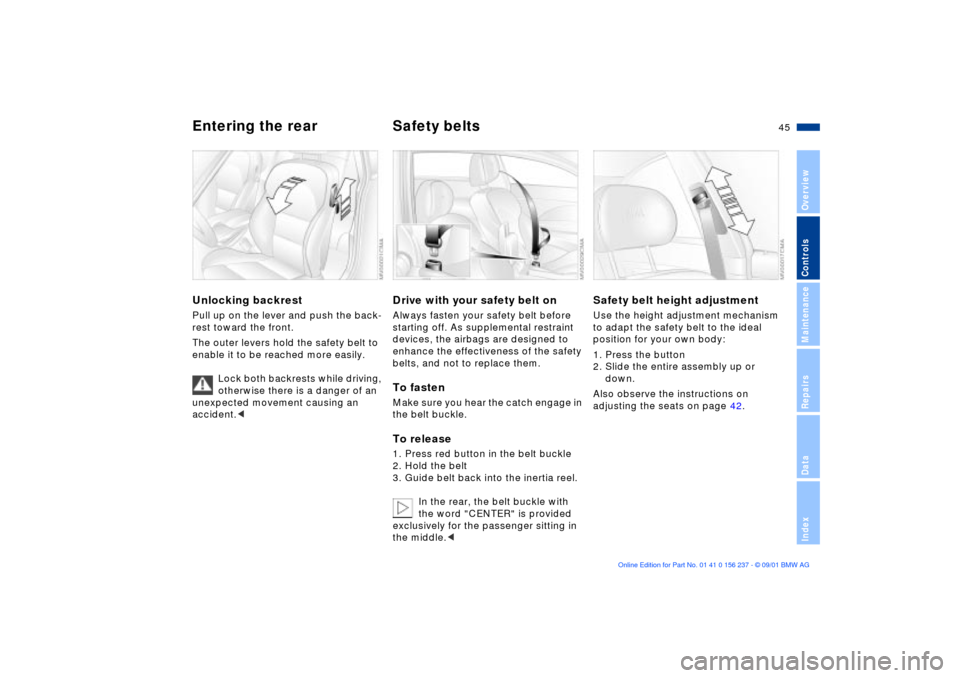
Entering the rear Safety belts Unlocking backrestPull up on the lever and push the back-
rest toward the front.
The outer levers hold the safety belt to
enable it to be reached more easily.
Lock both backrests while driving,
otherwise there is a danger of an
unexpected movement causing an
accident.<
Drive with your safety belt onAlways fasten your safety belt before
starting off. As supplemental restraint
devices, the airbags are designed to
enhance the effectiveness of the safety
belts, and not to replace them.To fastenMake sure you hear the catch engage in
the belt buckle. To release1. Press red button in the belt buckle
2. Hold the belt
3. Guide belt back into the inertia reel.
In the rear, the belt buckle with
the word "CENTER" is provided
exclusively for the passenger sitting in
the middle.<
Safety belt height adjustmentUse the height adjustment mechanism
to adapt the safety belt to the ideal
position for your own body:
1. Press the button
2. Slide the entire assembly up or
down.
Also observe the instructions on
adjusting the seats on page 42.
Page 47 of 151
47n
OverviewControlsMaintenanceRepairsDataIndex
Seat and mirror memory Seat heating
*
Steering wheel
Your BMW center can adjust your
vehicle's systems in such a
manner that your personalized settings
are automatically set for the seat and
exterior mirror positions when you
unlock the vehicle with your personal
remote control.<
Before activating the programmed
adjustment feature ensure that the
footwell behind the driver's seat is
empty and unobstructed. If you fail to
do so, any persons or objects behind
the seat could be injured or damaged
by a rearward movement of the seat.<
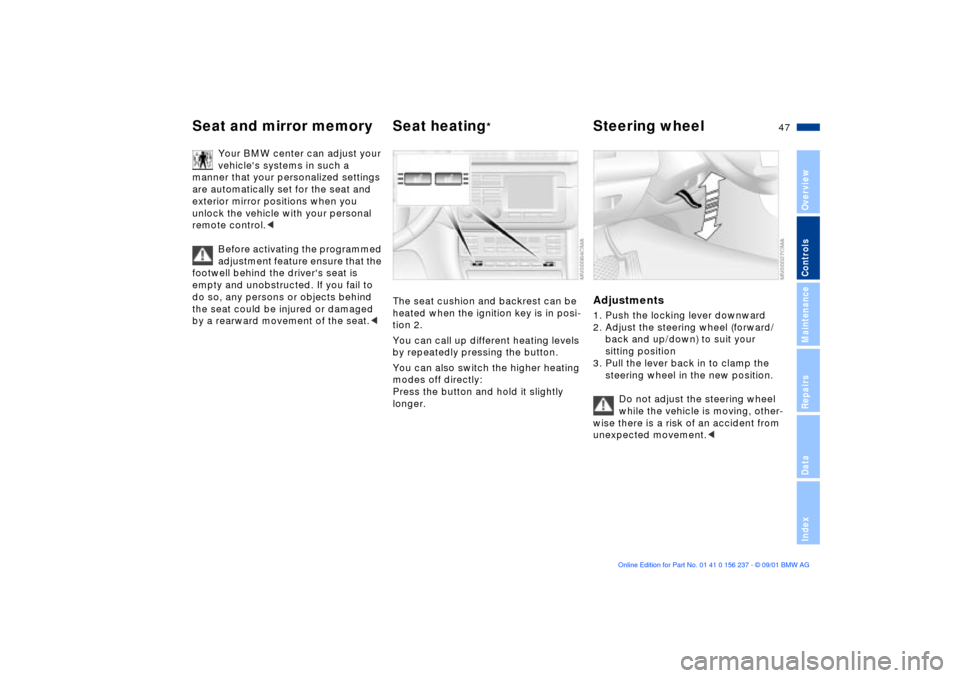
The seat cushion and backrest can be
heated when the ignition key is in posi-
tion 2.
You can call up different heating levels
by repeatedly pressing the button.
You can also switch the higher heating
modes off directly:
Press the button and hold it slightly
longer.
Adjustments1. Push the locking lever downward
2. Adjust the steering wheel (forward/
back and up/down) to suit your
sitting position
3. Pull the lever back in to clamp the
steering wheel in the new position.
Do not adjust the steering wheel
while the vehicle is moving, other-
wise there is a risk of an accident from
unexpected movement.<
Page 49 of 151
49n
OverviewControlsMaintenanceRepairsDataIndex
Mirrors Airbags Interior rearview mirror with
automatic dimming featureThis mirror automatically dims through
an infinitely variable range and switches
automatically to its clear, undimmed
mode whenever you engage reverse
gear.
There are two photocells for automatic
dimming. One photocell (arrow) is posi-
tioned in the mirror's frame, while the
other is slightly offset on the opposite
side of the mirror.
For the mirror to function perfectly,
keep the photocells clean and the area
between the inside rearview mirror and
the windshield free of any obstruction,
like stickers, etc.
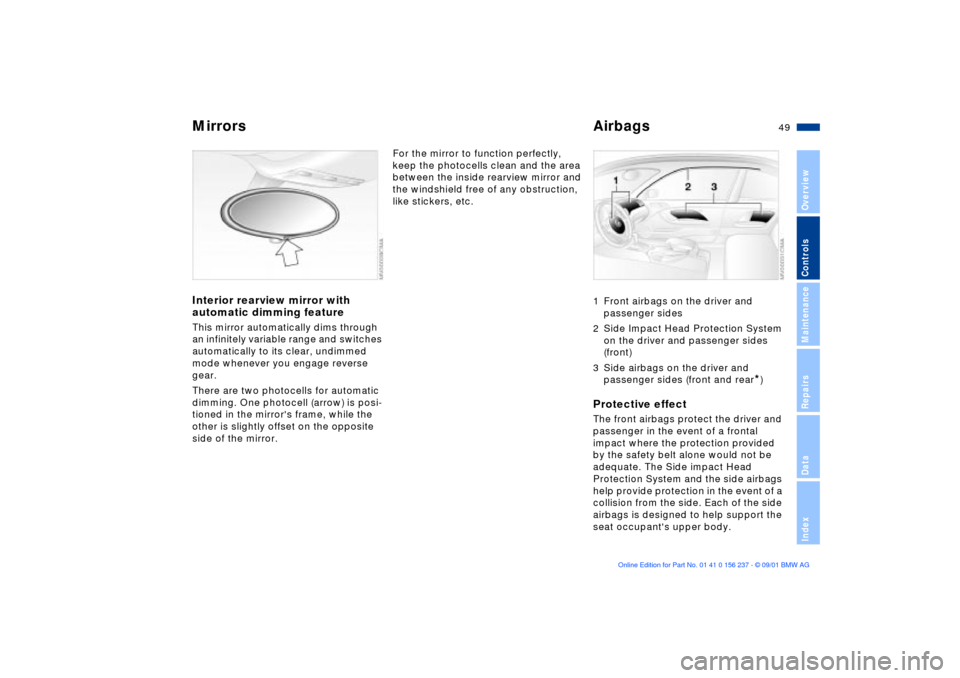
1 Front airbags on the driver and
passenger sides
2 Side Impact Head Protection System
on the driver and passenger sides
(front)
3 Side airbags on the driver and
passenger sides (front and rear
*)
Protective effectThe front airbags protect the driver and
passenger in the event of a frontal
impact where the protection provided
by the safety belt alone would not be
adequate. The Side impact Head
Protection System and the side airbags
help provide protection in the event of a
collision from the side. Each of the side
airbags is designed to help support the
seat occupant's upper body.
Page 51 of 151
51n
OverviewControlsMaintenanceRepairsDataIndex
AirbagsThe rear seat side airbags may already
have been deactivated, either at the
time of manufacture or by a BMW
center. Labels in the rear door opening
should indicate the status of your rear
seat side airbags. If you are uncertain of
their status, or wish to have the airbags
activated or deactivated, please
contact your BMW center.<
Even when all these guidelines are
followed, there is still a small residual
risk of injuries to the face, hands and
arms occurring from airbag deployment
in isolated instances. The ignition and
inflation noise may provoke a mild
temporary hearing loss in extremely
sensitive individuals.
Airbag warning information is also
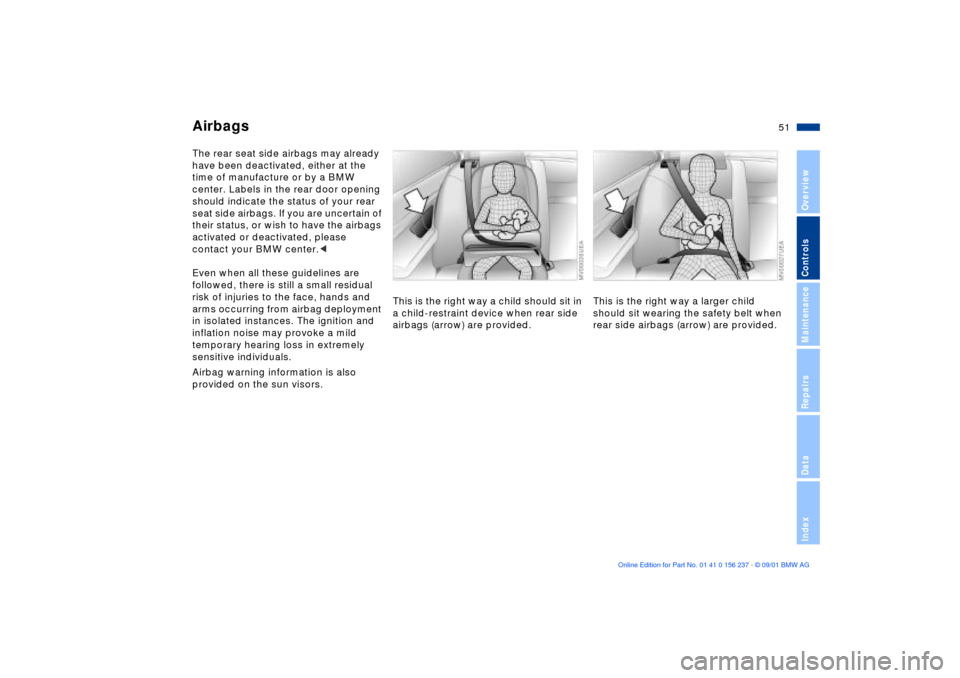
provided on the sun visors. This is the right way a child should sit in
a child-restraint device when rear side
airbags (arrow) are provided.
This is the right way a larger child
should sit wearing the safety belt when
rear side airbags (arrow) are provided.
Page 53 of 151
53n
OverviewControlsMaintenanceRepairsDataIndex
Transporting children safely
Before installing any child-
restraint device or child seat,
please read the following:
Never install a rearward-facing child-
restraint system in the front passenger
seat of this vehicle.
Your vehicle is equipped with an airbag
supplemental restraint system for the
front passenger. Because the backrest
on any rearward-facing child-restraint
system (of the kind designed for infants
under 1 year and 20 lbs/9 kg) would be
within the airbag's deployment range,
you should never mount such a device
in the front passenger seat, since the
impact of the airbag against the child
restraint's backrest could lead to
serious or fatal injuries.
If it is necessary for a child (not an
infant) to ride in the front seat, certain
precautions should be taken. First,
move the passenger seat as far away
from the instrument panel as possible.
This important precaution is intended to
maximize the distance between the
airbag and the child. Older children
should be tightly secured with the
safety belt.
Younger children should be secured in
an appropriate forward-facing child-
restraint system that has first been
properly secured with a safety belt.
Never install a rearward-facing child-
restraint system in the front passenger
seat.
We strongly urge you to carefully read
and observe the instructions for instal-
lation and use provided by the child-
restraint's manufacturer whenever you
use such a device.
Be sure that all occupants (of all ages)
remain properly and securely restrained
at all times.c
All rear seating positions in your vehicle
meet the recommendations of SAE
J1819, a industry recommended prac-
tice for securing child-restraint systems
in motor vehicles.
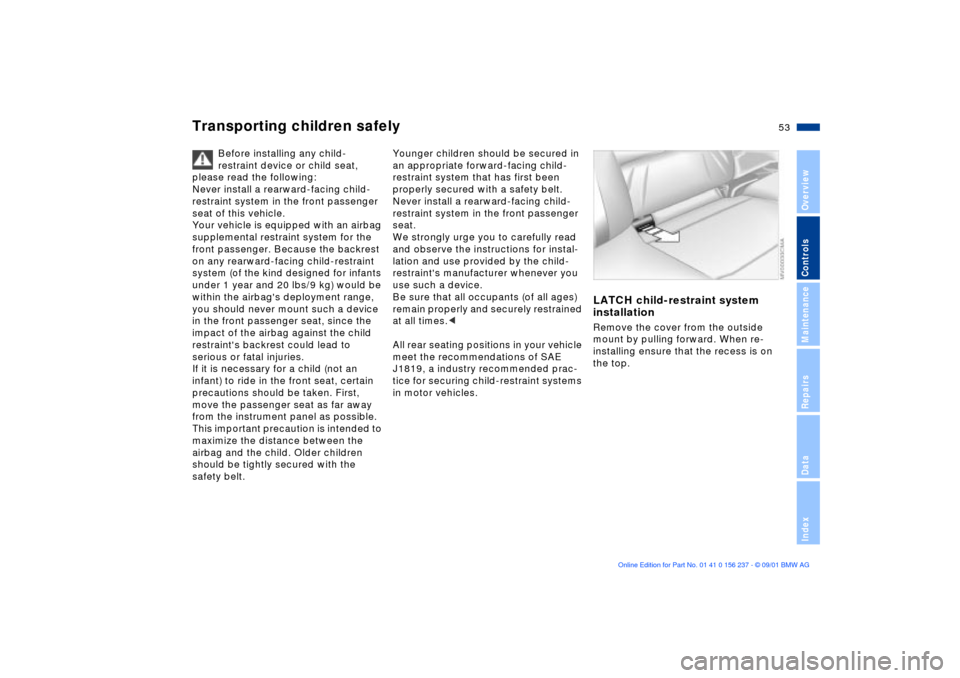
LATCH child-restraint system
installationRemove the cover from the outside
mount by pulling forward. When re-
installing ensure that the recess is on
the top.
Page 55 of 151
55n
OverviewControlsMaintenanceRepairsDataIndex
Vehicle Memory, Key Memory How the system functionsNo doubt you have reflected at one
time or another on how great it would
be if you could permanently configure
your vehicle's various features and
adjustments to mirror your own indi-
vidual preferences. In engineering your
vehicle, BMW has incorporated a
number of options for personal adjust-
ment that can be programmed into your
vehicle at your BMW center.
The available configuration data fall into
two categories, according to whether
their primary orientation is the vehicle
("Vehicle Memory") or the individual
("Key Memory"). Provided that each
person has a separate remote-control
key, you can have your BMW center
enter adjustment data for as many as
four different individuals into the
system.
The system then relies on a bilateral
data exchange to identify the individual
user and dial in the selected settings
whenever the remote control unit is
used to disengage the door locks.
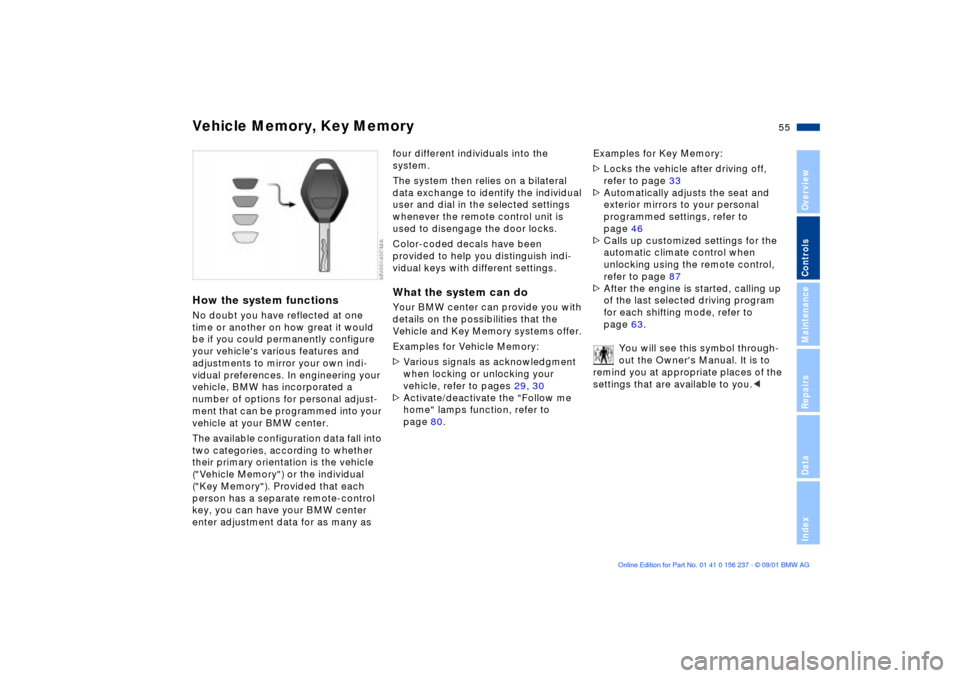
Color-coded decals have been
provided to help you distinguish indi-
vidual keys with different settings.What the system can doYour BMW center can provide you with
details on the possibilities that the
Vehicle and Key Memory systems offer.
Examples for Vehicle Memory:
>Various signals as acknowledgment
when locking or unlocking your
vehicle, refer to pages 29, 30
>Activate/deactivate the "Follow me
home" lamps function, refer to
page 80.Examples for Key Memory:
>Locks the vehicle after driving off,
refer to page 33
>Automatically adjusts the seat and
exterior mirrors to your personal
programmed settings, refer to
page 46
>Calls up customized settings for the
automatic climate control when
unlocking using the remote control,
refer to page 87
>After the engine is started, calling up
of the last selected driving program
for each shifting mode, refer to
page 63.
You will see this symbol through-
out the Owner's Manual. It is to
remind you at appropriate places of the
settings that are available to you.<
Page 57 of 151
57n
OverviewControlsMaintenanceRepairsDataIndex
Starting the engine Switching off the engine If the engine does not start on the first
attempt (the engine is very hot or cold,
for instance):
>Press the accelerator pedal halfway
down while engaging the starter.
Cold starts at very low temperatures,
starting at about +57 (Ð156) and at
high altitudes over 3,300 ft (over
1,000 m):
>On the first start attempt, engage the
starter for a longer period (approx.
10 seconds)
Extended starting attempts, char-
acterized by excessively frequent
or long periods with the starter
engaged, can lead to damage to the
catalytic converter.<
When driving, standing at idle,
and parking the vehicle, take care
to avoid contact between the exhaust
system and flammable materials (grass,
hay, leaves, etc.). Such contact could
lead to a fire, resulting in personal injury
and property damage.<
Engine idle speed is controlled by the
engine computer system. Increased
speeds at start-up are normal and
should decrease as the engine warms
up. If engine speed does not decrease,
service is required.
To prevent the battery from
discharging, always switch off electrical
devices that are not in use. Switch the
ignition off when the vehicle is not
being driven.Turn the ignition key to position 1 or 0.
Do not remove the ignition key
while the vehicle is still moving.
If you did so, the steering lock would
engage when the steering wheel is
turned.
When you leave the vehicle, always
remove the ignition key and engage the
steering lock.
Set the parking brake when parking on
steep hills, because under certain
conditions, putting the vehicle into first
or reverse gear may not be enough to
prevent it from rolling away.<
Vehicles with sequential M transmis-
sion
* SMG II: observe instructions on
page 60.