fuel BMW M3 COUPE 2003 E46 Owner's Manual
[x] Cancel search | Manufacturer: BMW, Model Year: 2003, Model line: M3 COUPE, Model: BMW M3 COUPE 2003 E46Pages: 158, PDF Size: 4.18 MB
Page 5 of 158
5
Notes
Status at time of printing
BMW pursues a policy of continuous,
ongoing development that is conceived
to ensure that our vehicles continue to
embody the highest quality and safety
standards combined with advanced,
state-of-the-art technology. For this
reason, the features described in this
Owner's Manual could differ from those
in your vehicle. Nor can errors and
omissions be entirely ruled out. You are
therefore asked to appreciate that no
claims can be recognized on the basis
of the data, illustrations or descriptions
in this Owner's Manual.
For your own safety
Use unleaded gasoline only. Fuels
containing up to and including
10 % ethanol or other oxygenates with
up to 2.8 % oxygen by weight – that is,
15 % MTBE or 3 % methanol plus an
equivalent amount of co-solvent – will
not void the applicable warranties
respecting defects in materials or work-
manship. Field experience has indi-
cated significant differences in fuel
quality – volatility, composition, addi-
tives, etc. among gasolines offered for
sale in the United States and Canada.
The use of poor quality fuels may result
in driveability, starting and stalling
problems especially under certain envi-
ronmental conditions, such as high
ambient temperature and high altitude.
Should you encounter driveability prob-
lems which you suspect could be
related to the fuel you are using, we
recommend that you respond by
switching to a recognized high-quality
brand.
Failure to comply with these recom-
mendations may result in unscheduled
maintenance.
Obey pertinent safety rules when you
are handling gasoline.
<
Important safety information!
For your own safety, use genuine
parts and accessories approved by
BMW.
When you purchase accessories tested
and approved by BMW and Original
BMW Parts, you simultaneously acquire
the assurance that they have been thor-
oughly tested by BMW to ensure opti-
mum performance when installed on
your vehicle.
BMW warrants these parts to be free
from defects in material and workman-
ship.
BMW will not accept any liability for
damages resulting from installation of
parts and accessories not approved by
BMW.
BMW cannot test every product made
by other manufacturers to verify if it can
be used on a BMW safely and without
risk to either the vehicle, its operation,
or its occupants.
Original BMW Parts, BMW Accessories
and other products approved by BMW,
together with professional advice on
using these items, are available from all
BMW centers.
Installation and operation of non-BMW
approved accessories such as alarms,
radios, amplifiers, radar detectors,
wheels, suspension components, brake
handbook.book Page 5 Saturday, July 27, 2002 1:12 PM
Page 8 of 158
Contents
Notes
About this Owner's Manual4
Symbols used4
Your individual vehicle4
Status at time of printing5
For your own safety5
Symbol on vehicle parts6
Service and warranty6
Reporting safety defects6
Overview
Cockpit14
Instrument cluster16
Indicator and warning lamps18
Steering wheel with multifunction
buttons22
Hazard warning triangle*23
First-aid kit*23
Refueling24
Fuel specifications25
Tire inflation pressure25
Controls and features
Opening and closing:
Keys30
Central locking system30
Opening and closing – via the
remote control31
Opening and closing – via the
door lock33
Opening and closing – from the
inside34
Luggage compartment lid35
Luggage compartment37
Alarm system*38
Electric power windows40
Sliding/tilt sunroof*40
To adjust:
Safe seating position43
Seats44
Manual seat adjustment44
Power seat adjustment*45
Head restraints46
Entering the rear47
Safety belts47
Seat and mirror memory*49
Seat heating*50
Steering wheel51
Mirrors51
Passenger safety systems:
Airbags53
Transporting children safely55
Vehicle Memory, Key
Memory59
handbook.book Page 8 Saturday, July 27, 2002 1:12 PM
Page 9 of 158
Contents
9
Driving:
Ignition lock60
Starting the engine and driving
off61
Switching off the engine63
Parking brake63
Manual transmission64
Sequential M gearbox
SMG II*65
Turn signal indicator/Headlamp
flasher70
Washer/wiper system/Rain
sensor*71
Cruise control72
Everything under control:
Odometer74
Tachometer74
Temperature gauge74
Fuel gauge75
Engine coolant temperature
gauge75
Service interval display76
Check Control76
Clock77
Computer78
Technology for safety and
driving convenience:
Park Distance Control (PDC)*80
Dynamic Stability Control
(DSC)81
Flat Tire Monitor82
M Engine dynamics control85
Lamps:
Parking lamps/Low beams86
Instrument lighting87
High beams/Standing lamps87
Fog lamps88
Interior lamps88
Controlling the climate for
pleasant driving:
Automatic climate control90
Roller sun blind*94
Interior conveniences:
Premium sound system*95
Glove compartment95
Storage compartments96
Cellular phone*97
Ashtray, front*98
Ashtray, rear*98
Clothes hooks99
Loading and transporting:
Through-loading system100
Ski bag*101
Cargo loading102
Roof-mounted luggage
rack*103
Controls and features
handbook.book Page 9 Saturday, July 27, 2002 1:12 PM
Page 17 of 158
17
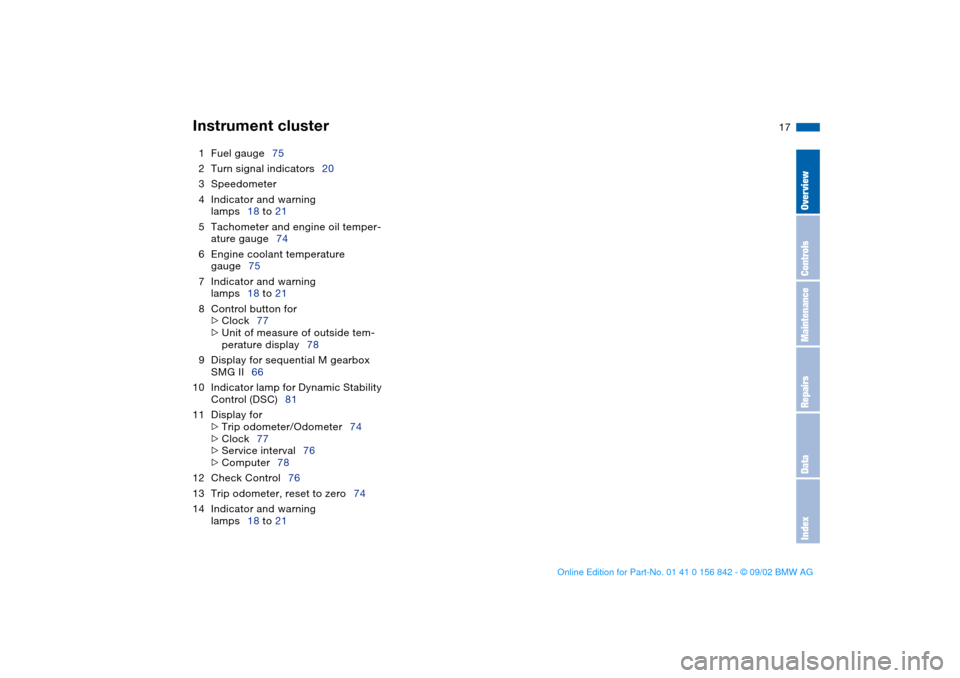
1Fuel gauge75
2Turn signal indicators20
3Speedometer
4Indicator and warning
lamps18 to 21
5Tachometer and engine oil temper-
ature gauge74
6Engine coolant temperature
gauge75
7Indicator and warning
lamps18 to 21
8Control button for
>
Clock77
>
Unit of measure of outside tem-
perature display78
9Display for sequential M gearbox
SMG II66
10 Indicator lamp for Dynamic Stability
Control (DSC)81
11 Display for
>
Trip odometer/Odometer74
>
Clock77
>
Service interval76
>
Computer78
12 Check Control76
13 Trip odometer, reset to zero74
14 Indicator and warning
lamps18 to 21
Instrument cluster
OverviewControlsMaintenanceRepairsDataIndex
handbook.book Page 17 Saturday, July 27, 2002 1:12 PM
Page 19 of 158
19
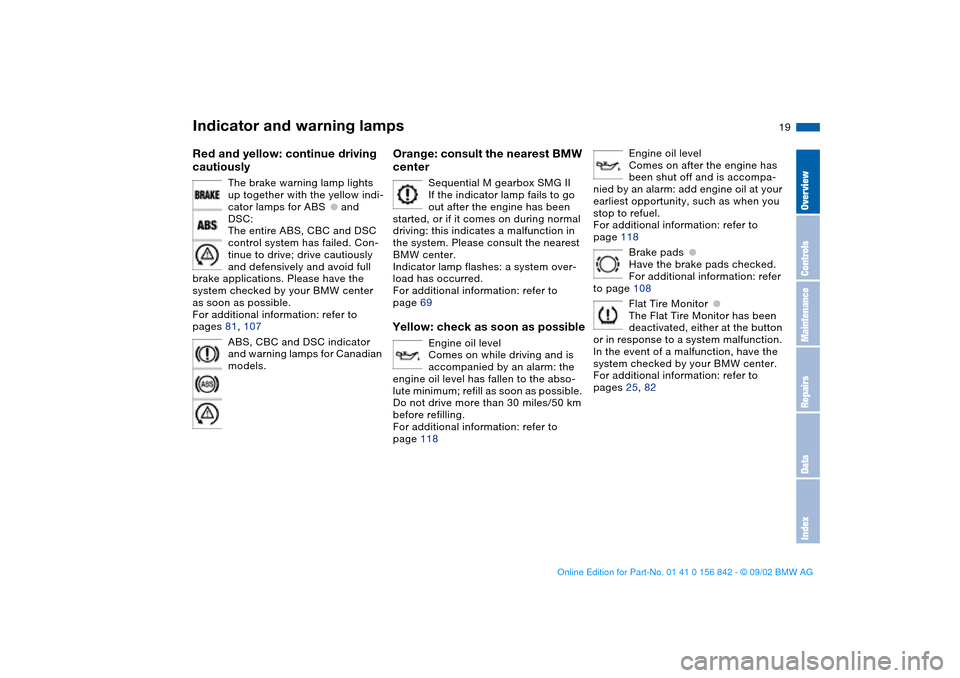
Red and yellow: continue driving
cautiously
The brake warning lamp lights
up together with the yellow indi-
cator lamps for ABS
●
and
DSC:
The entire ABS, CBC and DSC
control system has failed. Con-
tinue to drive; drive cautiously
and defensively and avoid full
brake applications. Please have the
system checked by your BMW center
as soon as possible.
For additional information: refer to
pages 81, 107
ABS, CBC and DSC indicator
and warning lamps for Canadian
models.
Orange: consult the nearest BMW
center
Sequential M gearbox SMG II
If the indicator lamp fails to go
out after the engine has been
started, or if it comes on during normal
driving: this indicates a malfunction in
the system. Please consult the nearest
BMW center.
Indicator lamp flashes: a system over-
load has occurred.
For additional information: refer to
page 69
Yellow: check as soon as possible
Engine oil level
Comes on while driving and is
accompanied by an alarm: the
engine oil level has fallen to the abso-
lute minimum; refill as soon as possible.
Do not drive more than 30 miles/50 km
before refilling.
For additional information: refer to
page 118
Engine oil level
Comes on after the engine has
been shut off and is accompa-
nied by an alarm: add engine oil at your
earliest opportunity, such as when you
stop to refuel.
For additional information: refer to
page 118
Brake pads
●
Have the brake pads checked.
For additional information: refer
to page 108
Flat Tire Monitor
●
The Flat Tire Monitor has been
deactivated, either at the button
or in response to a system malfunction.
In the event of a malfunction, have the
system checked by your BMW center.
For additional information: refer to
pages 25, 82
Indicator and warning lamps
OverviewControlsMaintenanceRepairsDataIndex
handbook.book Page 19 Saturday, July 27, 2002 1:12 PM
Page 20 of 158
20
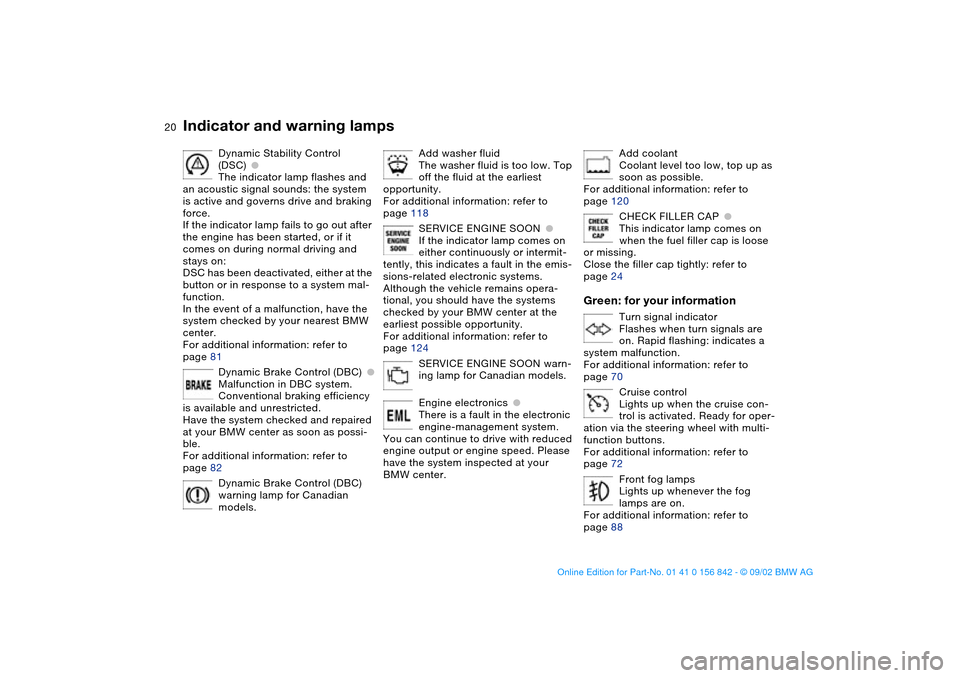
Dynamic Stability Control
(DSC)
●
The indicator lamp flashes and
an acoustic signal sounds: the system
is active and governs drive and braking
force.
If the indicator lamp fails to go out after
the engine has been started, or if it
comes on during normal driving and
stays on:
DSC has been deactivated, either at the
button or in response to a system mal-
function.
In the event of a malfunction, have the
system checked by your nearest BMW
center.
For additional information: refer to
page 81
Dynamic Brake Control (DBC)
●
Malfunction in DBC system.
Conventional braking efficiency
is available and unrestricted.
Have the system checked and repaired
at your BMW center as soon as possi-
ble.
For additional information: refer to
page 82
Dynamic Brake Control (DBC)
warning lamp for Canadian
models.
Add washer fluid
The washer fluid is too low. Top
off the fluid at the earliest
opportunity.
For additional information: refer to
page 118
SERVICE ENGINE SOON
●
If the indicator lamp comes on
either continuously or intermit-
tently, this indicates a fault in the emis-
sions-related electronic systems.
Although the vehicle remains opera-
tional, you should have the systems
checked by your BMW center at the
earliest possible opportunity.
For additional information: refer to
page 124
SERVICE ENGINE SOON warn-
ing lamp for Canadian models.
Engine electronics
●
There is a fault in the electronic
engine-management system.
You can continue to drive with reduced
engine output or engine speed. Please
have the system inspected at your
BMW center.
Add coolant
Coolant level too low, top up as
soon as possible.
For additional information: refer to
page 120
CHECK FILLER CAP
●
This indicator lamp comes on
when the fuel filler cap is loose
or missing.
Close the filler cap tightly: refer to
page 24
Green: for your information
Turn signal indicator
Flashes when turn signals are
on. Rapid flashing: indicates a
system malfunction.
For additional information: refer to
page 70
Cruise control
Lights up when the cruise con-
trol is activated. Ready for oper-
ation via the steering wheel with multi-
function buttons.
For additional information: refer to
page 72
Front fog lamps
Lights up whenever the fog
lamps are on.
For additional information: refer to
page 88
Indicator and warning lamps
handbook.book Page 20 Saturday, July 27, 2002 1:12 PM
Page 24 of 158
24
RefuelingFuel filler door
Always switch off the engine
before refueling, as it is not possi-
ble to add fuel with the engine running,
and attempts may also trigger the
SERVICE ENGINE SOON lamp.<
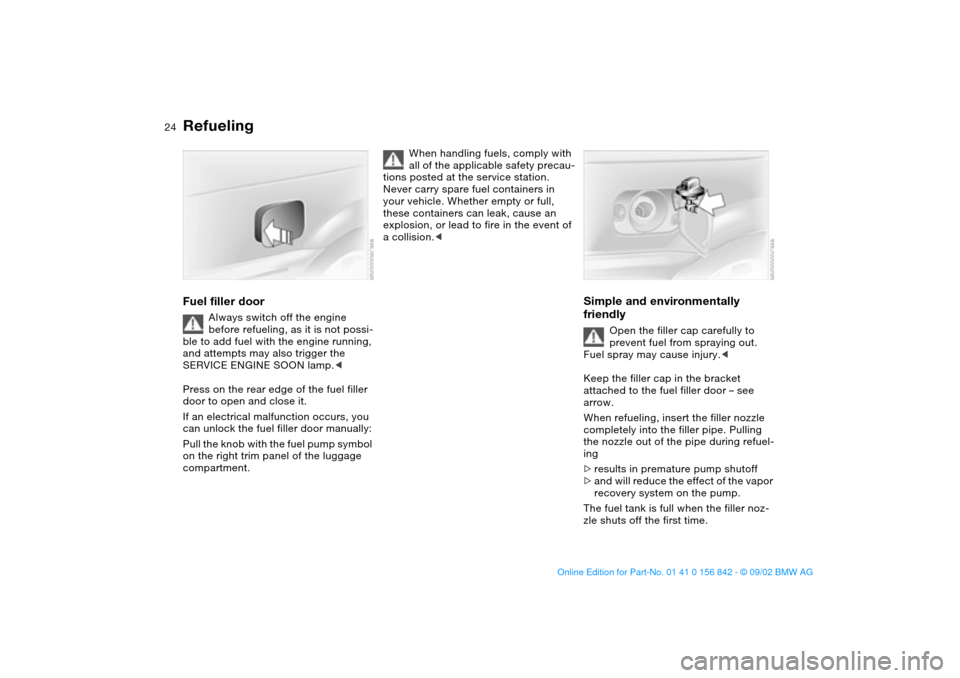
Press on the rear edge of the fuel filler
door to open and close it.
If an electrical malfunction occurs, you
can unlock the fuel filler door manually:
Pull the knob with the fuel pump symbol
on the right trim panel of the luggage
compartment.
When handling fuels, comply with
all of the applicable safety precau-
tions posted at the service station.
Never carry spare fuel containers in
your vehicle. Whether empty or full,
these containers can leak, cause an
explosion, or lead to fire in the event of
a collision.<
Simple and environmentally
friendly
Open the filler cap carefully to
prevent fuel from spraying out.
Fuel spray may cause injury.<
Keep the filler cap in the bracket
attached to the fuel filler door – see
arrow.
When refueling, insert the filler nozzle
completely into the filler pipe. Pulling
the nozzle out of the pipe during refuel-
ing
>results in premature pump shutoff
>and will reduce the effect of the vapor
recovery system on the pump.
The fuel tank is full when the filler noz-
zle shuts off the first time.
handbook.book Page 24 Saturday, July 27, 2002 1:12 PM
Page 25 of 158
25
Close the fuel filler cap carefully
after refueling until a click is
heard. While closing, be sure not to
squeeze the strap which is fastened to
the cap. A loose or missing cap will
activate the CHECK FILLER CAP
lamp.<
Fuel tank capacity>Approx. 16.6 gal./63 liters, of which
>approx. 2.1 gal./8 liters are reserve
capacity.
Do not drive to the last drop of
fuel. This can prevent the engine
from operating properly and result in
damage.<
Fuel specificationsUse unleaded gasolineThe engine uses lead-free gasoline
only.
Required fuel:
>Premium Unleaded Gasoline,
min. 91 AKI
AKI = Anti Knock Index
Never use leaded fuel, as it would
cause permanent and irreversible
damage to the oxygen sensor and the
catalytic converter.<
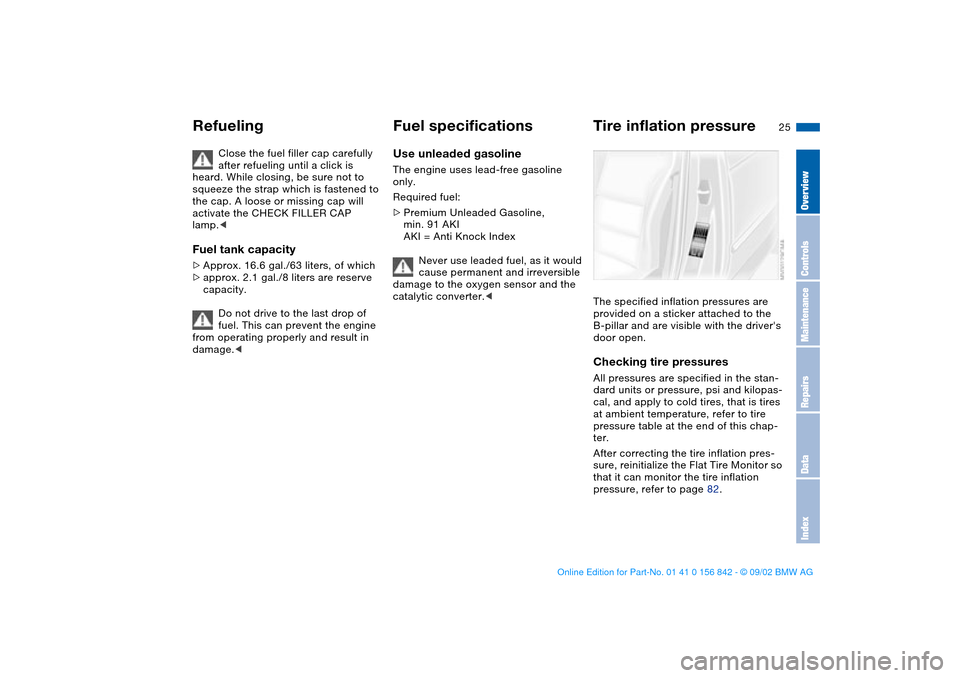
Tire inflation pressureThe specified inflation pressures are
provided on a sticker attached to the
B-pillar and are visible with the driver's
door open.Checking tire pressuresAll pressures are specified in the stan-
dard units or pressure, psi and kilopas-
cal, and apply to cold tires, that is tires
at ambient temperature, refer to tire
pressure table at the end of this chap-
ter.
After correcting the tire inflation pres-
sure, reinitialize the Flat Tire Monitor so
that it can monitor the tire inflation
pressure, refer to page 82.
Refueling
OverviewControlsMaintenanceRepairsDataIndex
handbook.book Page 25 Saturday, July 27, 2002 1:12 PM
Page 30 of 158
30Opening and closing
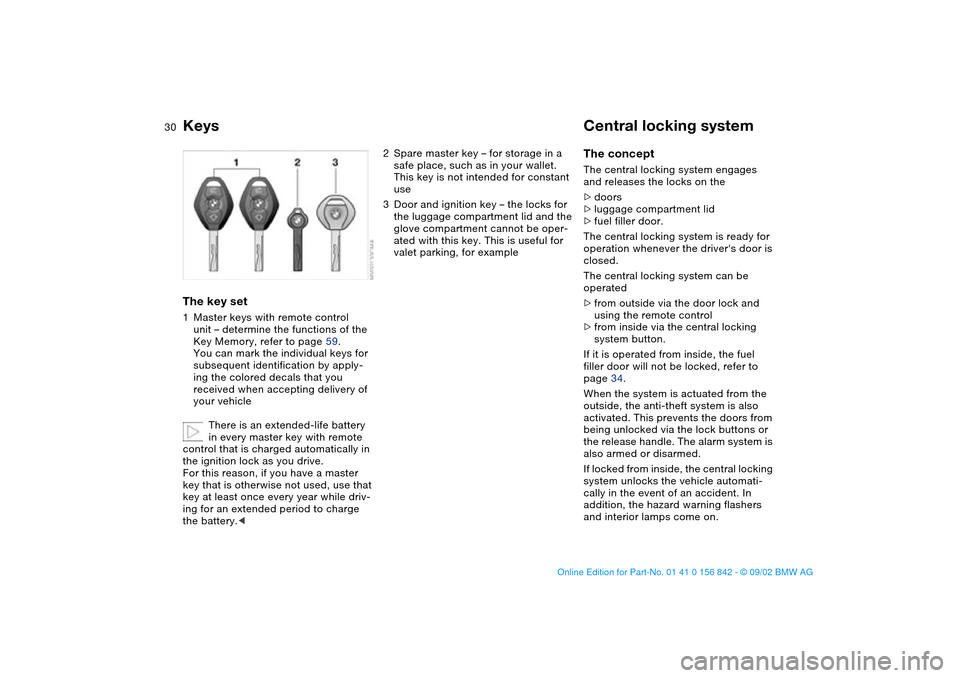
KeysThe key set1Master keys with remote control
unit – determine the functions of the
Key Memory, refer to page 59.
You can mark the individual keys for
subsequent identification by apply-
ing the colored decals that you
received when accepting delivery of
your vehicle
There is an extended-life battery
in every master key with remote
control that is charged automatically in
the ignition lock as you drive.
For this reason, if you have a master
key that is otherwise not used, use that
key at least once every year while driv-
ing for an extended period to charge
the battery.<
2Spare master key – for storage in a
safe place, such as in your wallet.
This key is not intended for constant
use
3Door and ignition key – the locks for
the luggage compartment lid and the
glove compartment cannot be oper-
ated with this key. This is useful for
valet parking, for example
Central locking systemThe conceptThe central locking system engages
and releases the locks on the
>doors
>luggage compartment lid
>fuel filler door.
The central locking system is ready for
operation whenever the driver's door is
closed.
The central locking system can be
operated
>from outside via the door lock and
using the remote control
>from inside via the central locking
system button.
If it is operated from inside, the fuel
filler door will not be locked, refer to
page 34.
When the system is actuated from the
outside, the anti-theft system is also
activated. This prevents the doors from
being unlocked via the lock buttons or
the release handle. The alarm system is
also armed or disarmed.
If locked from inside, the central locking
system unlocks the vehicle automati-
cally in the event of an accident. In
addition, the hazard warning flashers
and interior lamps come on.
handbook.book Page 30 Saturday, July 27, 2002 1:12 PM
Page 33 of 158
33
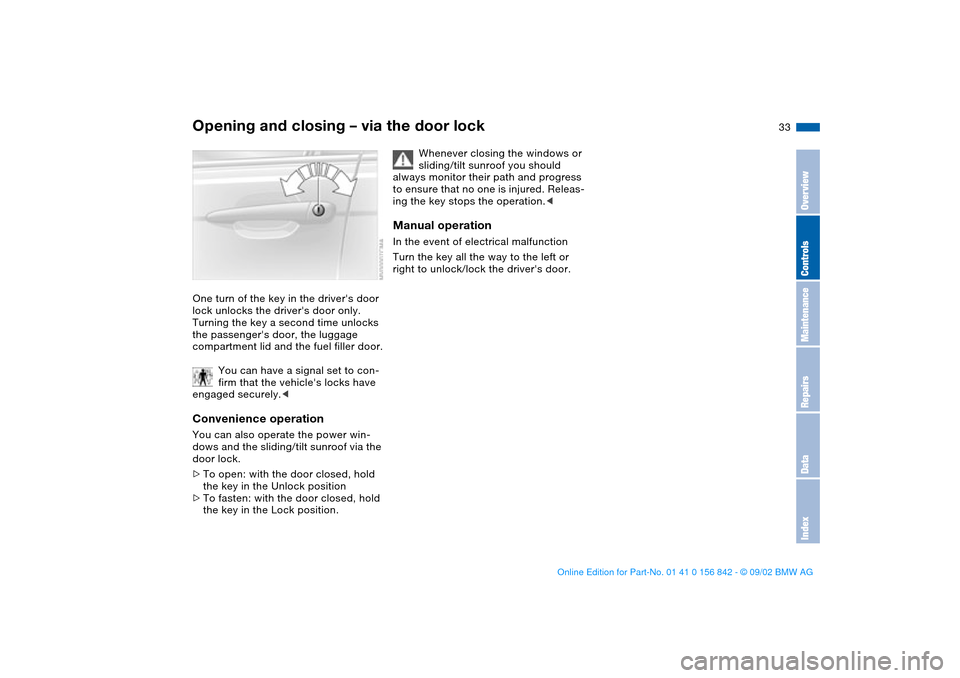
Opening and closing – via the door lockOne turn of the key in the driver's door
lock unlocks the driver's door only.
Turning the key a second time unlocks
the passenger's door, the luggage
compartment lid and the fuel filler door.
You can have a signal set to con-
firm that the vehicle's locks have
engaged securely.
door lock.
>To open: with the door closed, hold
the key in the Unlock position
>To fasten: with the door closed, hold
the key in the Lock position.
Whenever closing the windows or
sliding/tilt sunroof you should
always monitor their path and progress
to ensure that no one is injured. Releas-
ing the key stops the operation.<
Manual operationIn the event of electrical malfunction
Turn the key all the way to the left or
right to unlock/lock the driver's door.
OverviewControlsMaintenanceRepairsDataIndex
handbook.book Page 33 Saturday, July 27, 2002 1:12 PM