towing BMW M3 COUPE 2003 E46 Owner's Manual
[x] Cancel search | Manufacturer: BMW, Model Year: 2003, Model line: M3 COUPE, Model: BMW M3 COUPE 2003 E46Pages: 158, PDF Size: 4.18 MB
Page 10 of 158
Contents
Operation, maintenance
Special operating instructions:
Break-in procedures106
Driving notes107
Antilock Brake System
(ABS)107
Brake system108
Wheels and tires:
Tire inflation pressure109
Tire condition109
Tire replacement110
Wheel and tire
combinations112
Winter tires112
Snow chains*113
In the engine compartment:
Hood114
Engine compartment
essentials116
Washer fluids118
Engine oil118
Coolant120
Brake fluid121
Maintenance:
The BMW Maintenance
System122
Laws and regulations:
California Proposition 65
warning124
OBD interface socket124
Owner service procedures
Replacement procedures:
Onboard tool kit128
Windshield wiper blades128
Lamps and bulbs129
Repairing a flat tire133
Battery137
Fuses138
Giving and receiving
assistance:
Jump-starting139
Towing the vehicle140
Technical data
Engine data144
Dimensions145
Weights146
Capacities147
handbook.book Page 10 Saturday, July 27, 2002 1:12 PM
Page 102 of 158
102
Cargo loading
Always position and secure the
load correctly. If you do not, it can
endanger the passengers during brak-
ing or evasive maneuvers.
Do not exceed the approved gross
weight or the approved maximum axle
loads, refer to page 146. Otherwise the
vehicle's operating safety is no longer
assured and you are in violation of the
law
Do not stow heavy or hard objects in
the passenger compartment without
first securing them. Otherwise they
would be thrown around during braking
and evasive maneuvers and endanger
the occupants.<
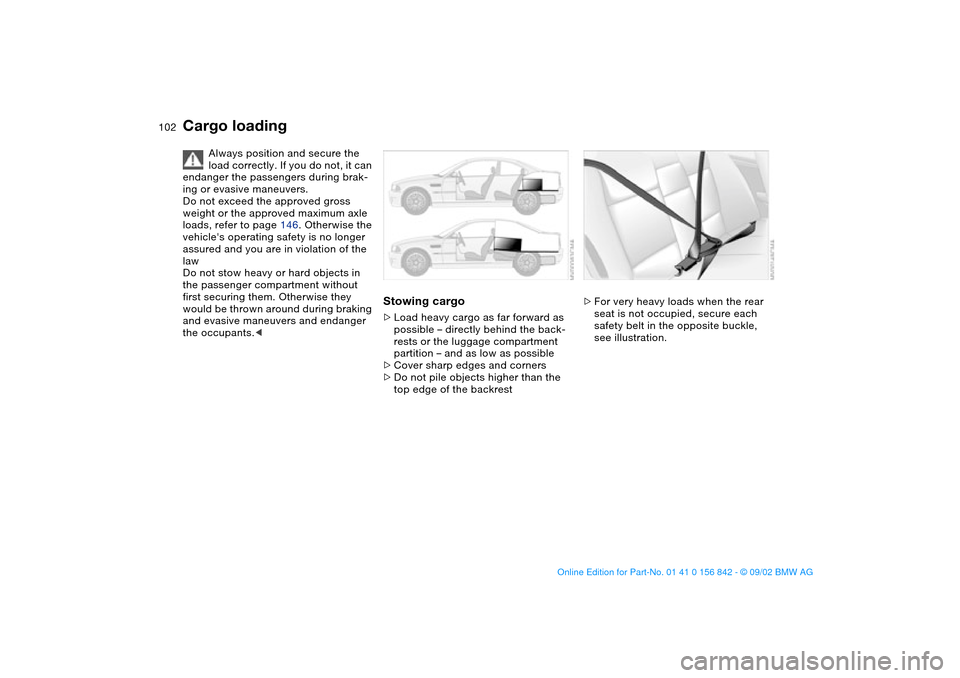
Stowing cargo>Load heavy cargo as far forward as
possible – directly behind the back-
rests or the luggage compartment
partition – and as low as possible
>Cover sharp edges and corners
>Do not pile objects higher than the
top edge of the backrest
>For very heavy loads when the rear
seat is not occupied, secure each
safety belt in the opposite buckle,
see illustration.
handbook.book Page 102 Saturday, July 27, 2002 1:12 PM
Page 128 of 158
128Replacement procedures
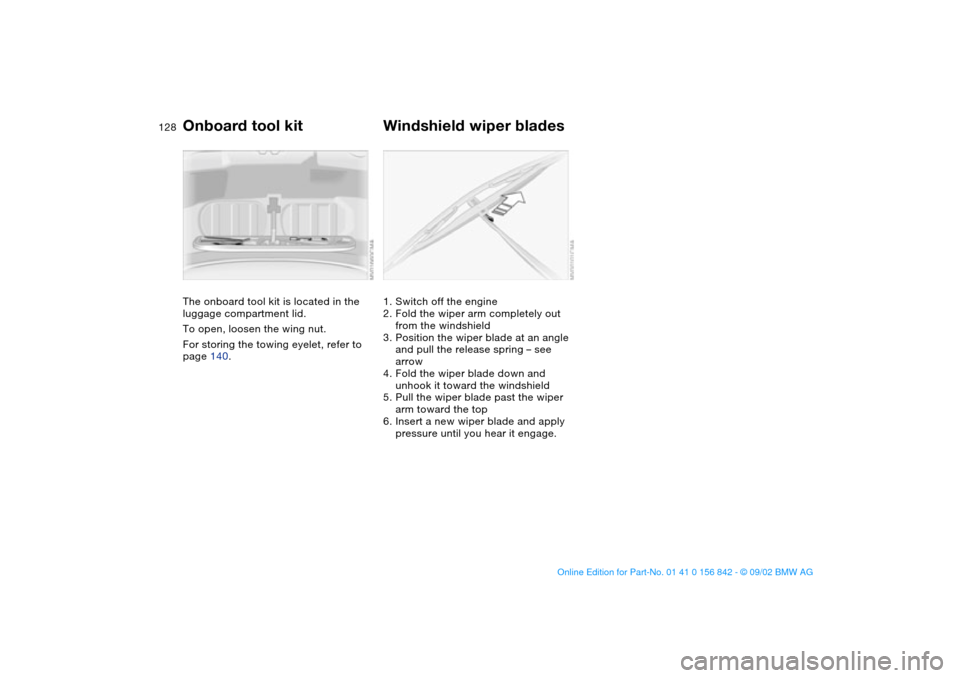
Onboard tool kitThe onboard tool kit is located in the
luggage compartment lid.
To open, loosen the wing nut.
For storing the towing eyelet, refer to
page 140.
Windshield wiper blades1. Switch off the engine
2. Fold the wiper arm completely out
from the windshield
3. Position the wiper blade at an angle
and pull the release spring – see
arrow
4. Fold the wiper blade down and
unhook it toward the windshield
5. Pull the wiper blade past the wiper
arm toward the top
6. Insert a new wiper blade and apply
pressure until you hear it engage.
handbook.book Page 128 Saturday, July 27, 2002 1:12 PM
Page 140 of 158
140
Towing the vehicleTowing eyeletThe towing eyelet, which can be
unscrewed, is in the luggage compart-
ment under the floor mat and must
remain in the vehicle. This eyelet is
designed for installation in the tow
sockets located at the front and rear of
the vehicle. It is intended for towing on
paved road surfaces only.
The towing eyelet should not be used
to pull a vehicle out of deep snow, mud,
sand, etc.
Comply with all applicable towing laws
and regulations at all times.
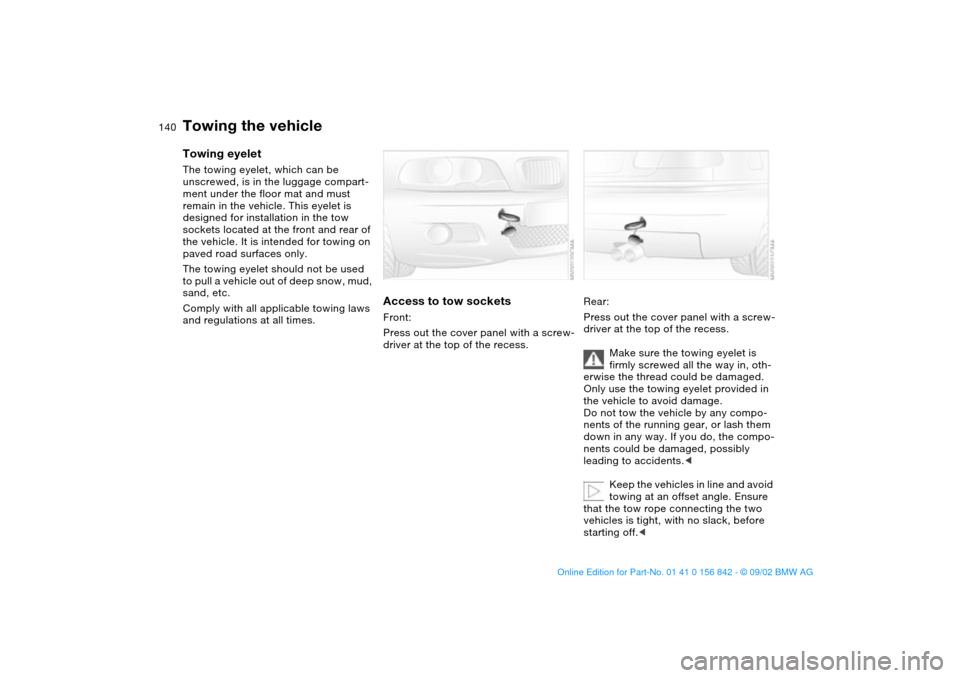
Access to tow socketsFront:
Press out the cover panel with a screw-
driver at the top of the recess.
Rear:
Press out the cover panel with a screw-
driver at the top of the recess.
Make sure the towing eyelet is
firmly screwed all the way in, oth-
erwise the thread could be damaged.
Only use the towing eyelet provided in
the vehicle to avoid damage.
Do not tow the vehicle by any compo-
nents of the running gear, or lash them
down in any way. If you do, the compo-
nents could be damaged, possibly
leading to accidents.<
Keep the vehicles in line and avoid
towing at an offset angle. Ensure
that the tow rope connecting the two
vehicles is tight, with no slack, before
starting off.<
handbook.book Page 140 Saturday, July 27, 2002 1:12 PM
Page 141 of 158
141
Use only a nylon towing strap to tow
the vehicle, since the inherent resil-
ience of this material helps protect both
vehicles from sudden jerking move-
ments.
The towed vehicle should always
be the lighter of the two vehicles.
If this is not the case, it will not be pos-
sible to control vehicle handling.
Never attempt to use your vehicle to
push another vehicle, since damage to
the energy-absorbing bumpers could
result.Towing a vehicle1. Gearshift lever in Neutral
2. Towing speed:
max. 45 mph / 70 km/h
3. Towing distance:
max. 95 miles/150 km
4. Leave the ignition key at position 1 to
ensure that the brake lamps, turn sig-
nal indicators, horn and windshield
wipers remain operative, and to pre-
vent the steering lock detent from
engaging
5. Switch on the hazard warning system
– observe applicable legal regula-
tions.
Find some means of identifying the
vehicle in tow, for instance, place a sign
or warning triangle in the rear window.
Make sure that the ignition key
remains in position 1 even when
the electrical system has failed to pre-
vent the steering lock from engaging.
The steering and brakes are without
power-assist when the engine is off.
This means that increased effort is
required for steering and braking.<
Vehicle with sequential M gearbox
SMG II:
To push or tow, engage selector lever
in position 0.
Never work on the vehicle with a
driving position engaged.<
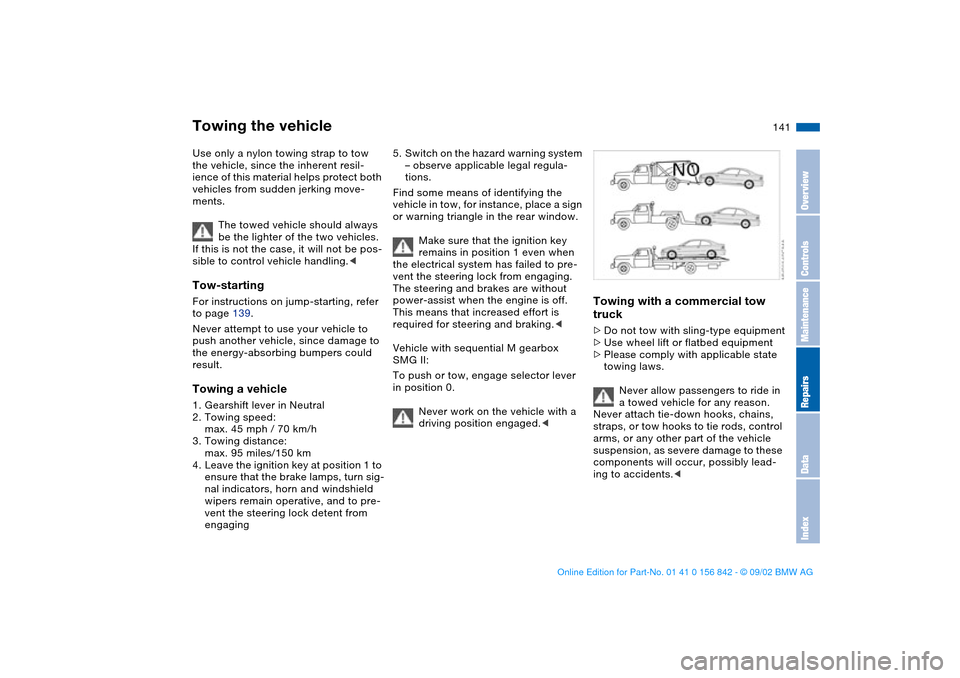
Towing with a commercial tow
truck>Do not tow with sling-type equipment
>Use wheel lift or flatbed equipment
>Please comply with applicable state
towing laws.
Never allow passengers to ride in
a towed vehicle for any reason.
Never attach tie-down hooks, chains,
straps, or tow hooks to tie rods, control
arms, or any other part of the vehicle
suspension, as severe damage to these
components will occur, possibly lead-
ing to accidents.<
Towing the vehicle
OverviewControlsMaintenanceRepairsDataIndex
handbook.book Page 141 Saturday, July 27, 2002 1:12 PM
Page 152 of 158
Everything from A to ZEngine speed 144
Entering the rear 47
Exterior mirrors 51
Eyelet, towing 140
F
False alarm, avoiding 39
Fault displays 76
First-aid kit 23
Flat tire 109
repairing 133
Flat Tire Monitor 82
indicator lamp 18, 19
Fog lamps 88
Folding rear backrest 100
Follow me home lamps 86
Footbrake 108
see Driving notes 107
Footwell lamps 88
Front fog lamps 88
indicator lamp 20
Front seat adjustment 44
Frost protection,
radiator 120
Fuel 25
Fuel consumption 79
display 75
Fuel filler door 24
release following an elec-
trical malfunction 24
Fuel gauge 75
Fuel specifications 25Fuel tank capacity 147
Fuel tank display 75
Fuel tank gauge 75
Fuel-injection system 144
Fuses 138
replacing 138
G
Gasoline 25
gauge 75
Gearbox, sequential 65
Gearshift lever 64
Glove compartment 95
Gradient assistance 68
Grills 90
Gross vehicle weight 146
H
Hands-free system 97
Harman Kardon premium
sound system 95
Hazard warning flashers 14
Hazard warning triangle 23
Head airbags 53
Head restraints 46
Headlamp 86
Headlamp cleaning system
116, 118, 147
Headlamp control 86
Headlamp flasher 70, 87
Heated mirror 51
Heated seats 50Heavy loads 102
High beams 70, 87
indicator lamps 21
Holder for beverages 96
Hood release 114
Horn 14
Hydroplaning 107, 109
I
Ice warning 78
Ignition key 30
positions 60
Ignition lock 60
Imprint 4
Indicator lamps 18
Individual settings
Vehicle Memory, Key
Memory 59
Inflation pressure 25, 109
INSPECTION 76
Instrument cluster 16
Instrument lighting 87
Instrument panel 14, 16
Interface socket for onboard
diagnostics (OBD) 124
Interior lamps 32, 88
remote control 32
Interior motion sensor 38
remote control 32
switching off 32, 39Interior rearview mirror
automatic dimming
feature 52
Interior temperature
adjusting 92
Intermittent mode 71
J
Jump-starting 139
K
Key Memory 59
Keys 30
L
Lamps
daytime driving lamps 86
fog lamps 88
footwell lamps 88
headlamp flasher 70, 87
high beams 87
instrument lighting 87
interior lamps 88
low beams 86
parking lamps 86
reading lamps 88
replacing 129
standing lamps 87
Lashing fittings 103
LATCH child-restraint
mounting system 57
handbook.book Page 152 Saturday, July 27, 2002 1:12 PM
Page 155 of 158
Everything from A to Z
155
Tire tread 109
Tools 128
Torque 144
Towing eyelet 140
Towing the vehicle 140
Track 145
Transmission 64
Transporting children
safely 55
Tread depth, tires 109
Tread wear indicator 109
Trip odometer 74
Trunk, see Luggage com-
partment 35
capacity 146
Trunk lid, see Luggage com-
partment lid 35
Turn signal indicator 70
indicator lamps 20
replacing bulb 130
Turning circle 145
U
Uniform Tire Quality
Grading 111
Upholstery care, refer to the
Caring for your vehicle
brochure
Used batteries 137V
Vacuum cleaner, connect-
ing 98
Variable pre-warning
zone 74
Vehicle
break-in procedures 106
starting 61
switching off 63
Vehicle battery 137
Vehicle Memory 59
Vehicle weight 146
Ventilation 90
draft-free 93
Viscosity 119
Voice Control System, refer
to the separate Owner's
Manual
Voice recognition 22
W
Warning lamp "Please fasten
safety belts" 18
Warning lamps 18
Warning messages 76
Warranty and Service Guide
Booklet 122
Warranty, refer also to sepa-
rate booklet 6
Washer fluid
adding 118, 147
Washer/wiper system 71Washing fluid
indicator lamp 19
Washing vehicle, refer to the
Caring for your vehicle
brochure
Water on roadways
deep water 107
Wear indicator for tires 109
Weights 146
Wheelbase 145
Wheels and tires 112
Wheelslip control, see
DSC 81
Width 145
Window condensation,
removing 92
Windows
convenience operation
31, 33
defrosting 92
remote control 31
Windshield washer reservoir
filling 118, 147
Windshield wiper blades,
replacing 128
Windshield wipers 71
Winter tires 112
Wiper blades, replacing 128
Work in the engine compart-
ment 114X
Xenon lamps 129
OverviewControlsMaintenanceRepairsDataIndex
handbook.book Page 155 Saturday, July 27, 2002 1:12 PM