electrical BMW M3 COUPE 2004 E46 Owner's Manual
[x] Cancel search | Manufacturer: BMW, Model Year: 2004, Model line: M3 COUPE, Model: BMW M3 COUPE 2004 E46Pages: 170, PDF Size: 2.62 MB
Page 24 of 170
24
RefuelingFuel filler door
Always switch off the engine
before refueling, as it is not possi-
ble to add fuel with the engine running,
and attempts may also trigger the
SERVICE ENGINE SOON lamp.<
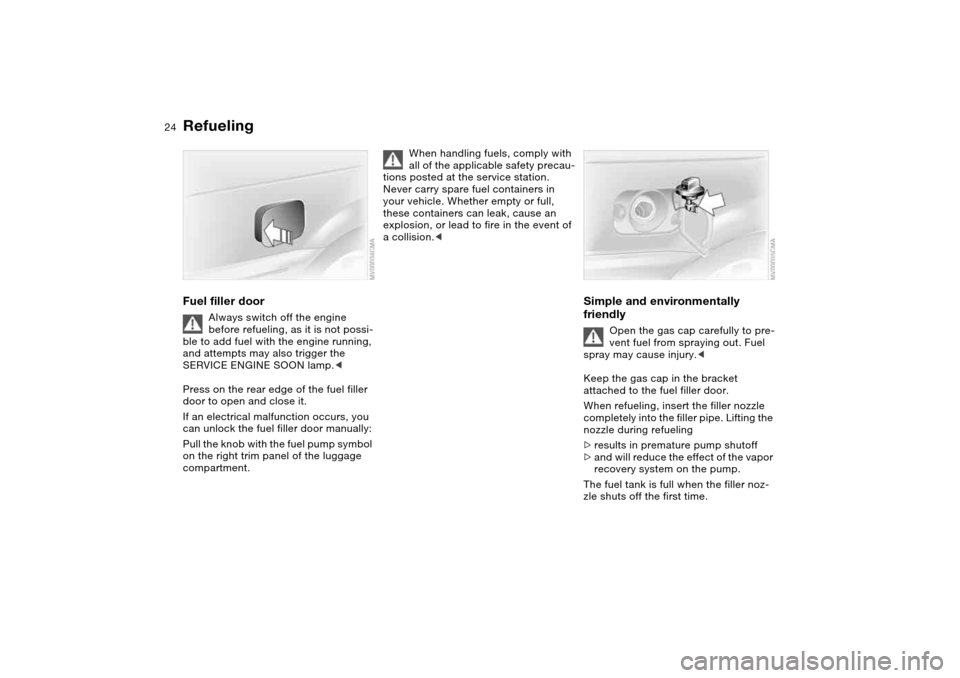
Press on the rear edge of the fuel filler
door to open and close it.
If an electrical malfunction occurs, you
can unlock the fuel filler door manually:
Pull the knob with the fuel pump symbol
on the right trim panel of the luggage
compartment.
When handling fuels, comply with
all of the applicable safety precau-
tions posted at the service station.
Never carry spare fuel containers in
your vehicle. Whether empty or full,
these containers can leak, cause an
explosion, or lead to fire in the event of
a collision.<
Simple and environmentally
friendly
Open the gas cap carefully to pre-
vent fuel from spraying out. Fuel
spray may cause injury.<
Keep the gas cap in the bracket
attached to the fuel filler door.
When refueling, insert the filler nozzle
completely into the filler pipe. Lifting the
nozzle during refueling
>results in premature pump shutoff
>and will reduce the effect of the vapor
recovery system on the pump.
The fuel tank is full when the filler noz-
zle shuts off the first time.
Page 33 of 170
33
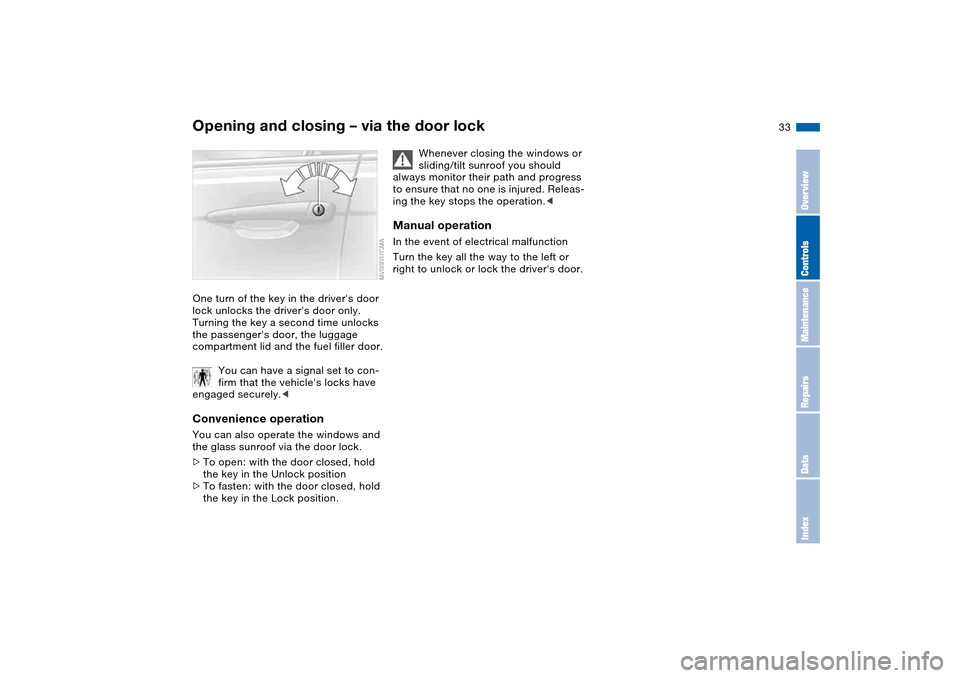
Opening and closing – via the door lockOne turn of the key in the driver's door
lock unlocks the driver's door only.
Turning the key a second time unlocks
the passenger's door, the luggage
compartment lid and the fuel filler door.
You can have a signal set to con-
firm that the vehicle's locks have
engaged securely.
>To open: with the door closed, hold
the key in the Unlock position
>To fasten: with the door closed, hold
the key in the Lock position.
Whenever closing the windows or
sliding/tilt sunroof you should
always monitor their path and progress
to ensure that no one is injured. Releas-
ing the key stops the operation.<
Manual operationIn the event of electrical malfunction
Turn the key all the way to the left or
right to unlock or lock the driver's door.
OverviewControlsMaintenanceRepairsDataIndex
Page 35 of 170
35
Luggage compartment lidThe lockOnly the master keys fit in the lock for
the luggage compartment lid, refer to
page 30.
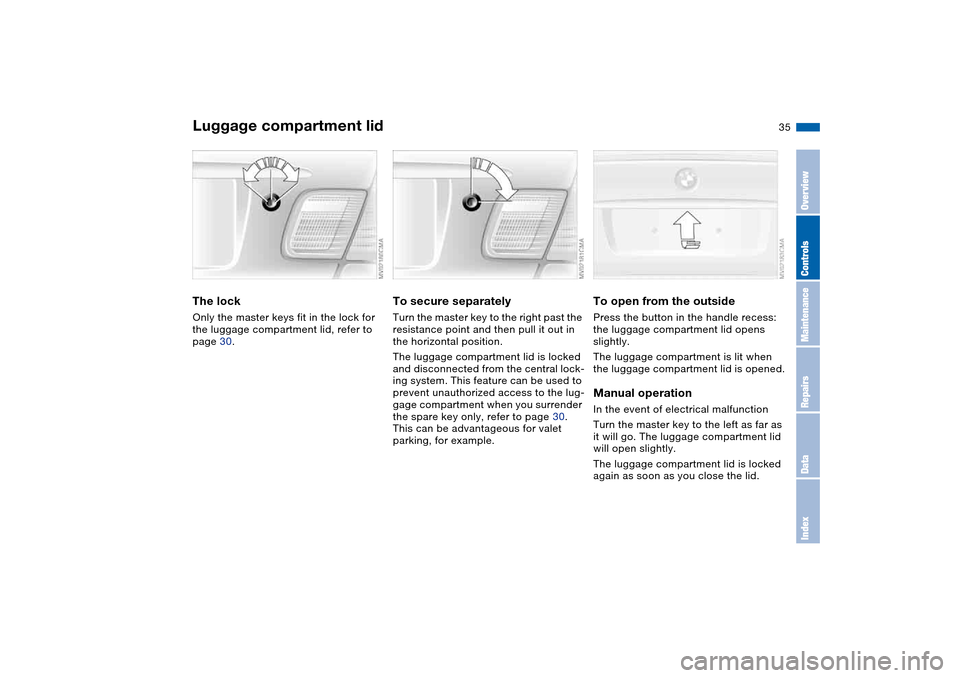
To secure separatelyTurn the master key to the right past the
resistance point and then pull it out in
the horizontal position.
The luggage compartment lid is locked
and disconnected from the central lock-
ing system. This feature can be used to
prevent unauthorized access to the lug-
gage compartment when you surrender
the spare key only, refer to page 30.
This can be advantageous for valet
parking, for example.
To open from the outsidePress the button in the handle recess:
the luggage compartment lid opens
slightly.
The luggage compartment is lit when
the luggage compartment lid is opened.Manual operationIn the event of electrical malfunction
Turn the master key to the left as far as
it will go. The luggage compartment lid
will open slightly.
The luggage compartment lid is locked
again as soon as you close the lid.
OverviewControlsMaintenanceRepairsDataIndex
Page 42 of 170
42
>when it is closing from a point
roughly past the middle of its travel,
the closing cycle is interrupted and the
glass sunroof will open again slightly.
Despite this safety feature, be
extremely careful that the travel
path of the glass sunroof is not
obstructed whenever it is closed.
Remember that the safety mechanism
may not be able to detect obstructions
under all circumstances – with very thin
objects, for instance.
You can override this safety feature by
pressing the switch beyond the pres-
sure point and holding it.<
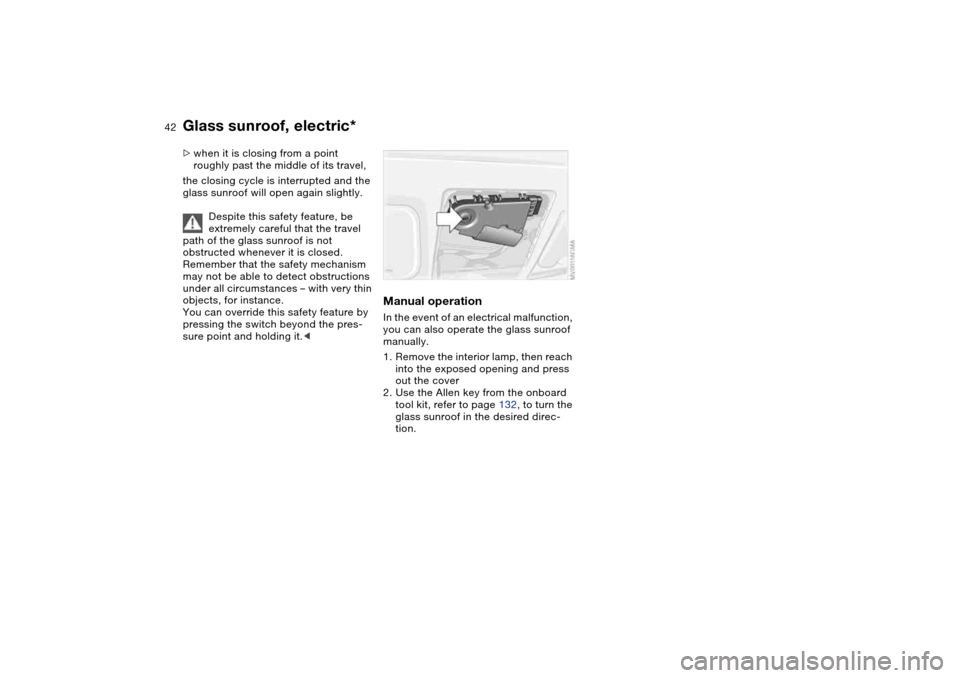
Manual operationIn the event of an electrical malfunction,
you can also operate the glass sunroof
manually.
1. Remove the interior lamp, then reach
into the exposed opening and press
out the cover
2. Use the Allen key from the onboard
tool kit, refer to page 132, to turn the
glass sunroof in the desired direc-
tion.
Glass sunroof, electric*
Page 62 of 170
62Driving
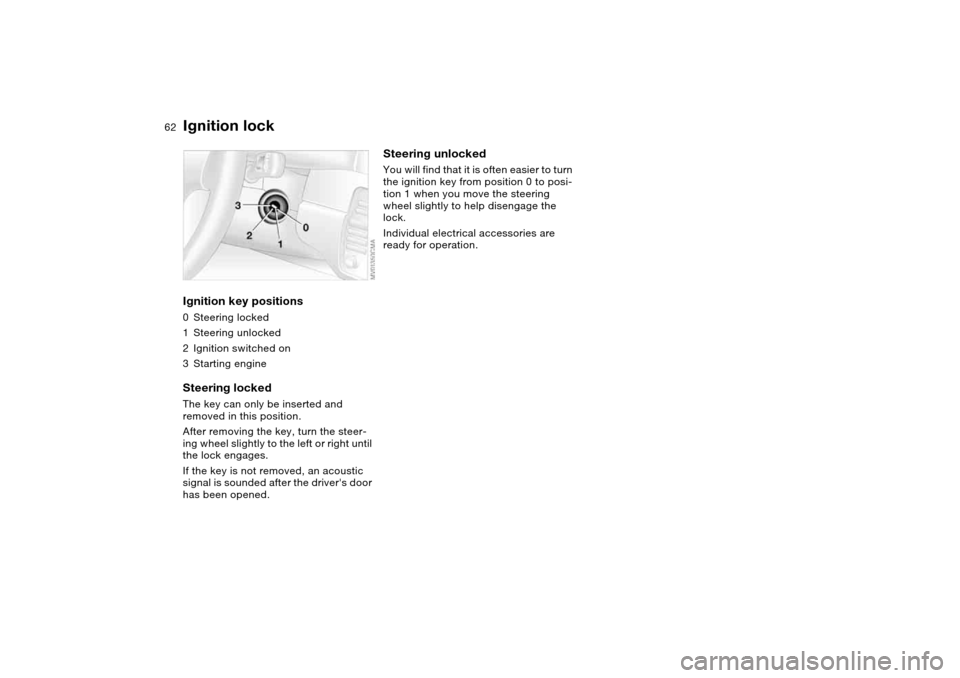
Ignition lockIgnition key positions0Steering locked
1Steering unlocked
2Ignition switched on
3Starting engineSteering lockedThe key can only be inserted and
removed in this position.
After removing the key, turn the steer-
ing wheel slightly to the left or right until
the lock engages.
If the key is not removed, an acoustic
signal is sounded after the driver's door
has been opened.
Steering unlockedYou will find that it is often easier to turn
the ignition key from position 0 to posi-
tion 1 when you move the steering
wheel slightly to help disengage the
lock.
Individual electrical accessories are
ready for operation.
Page 64 of 170
64
Before exiting the vehicle with the
engine running, move the selector
lever into position N and apply the
parking brake.
Never leave the vehicle unattended
with the engine running. An unat-
tended vehicle with a running engine
represents a safety hazard.<
Engine idle speed is controlled by the
engine computer system. Increased
speeds at start-up are normal and
should decrease as the engine warms
up. If engine speed does not decrease,
service is required.
To prevent the battery from discharg-
ing, always deactivate electrical
devices that are not in use. Switch the
ignition off when the vehicle is not
being driven.
Starting the engine and driving off
Page 111 of 170
111
General driving notes
Brakes: do not rest your foot on
the brake pedal while driving.
Even light but consistent pedal pres-
sure can lead to high temperatures,
brake wear and possibly even brake
failure.
Hydroplaning: when driving on wet or
slushy roads, reduce road speed. If you
do not, a wedge of water can form
between tires and road surface. This
phenomenon is referred to as hydro-
planing, and can lead to partial or com-
plete loss of traction, vehicle control
and braking effectiveness.
Driving through water: do not drive
through water on the road if it is deeper
than 1 ft/30 cm, and then only at walk-
ing speed. Otherwise, the vehicle's
engine, the electrical systems and the
transmission may be damaged.
Rear parcel tray: never use it to store
heavy or hard objects; otherwise, occu-
pants could be injured if the vehicle is
braked hard.
Clothes hooks: when suspending cloth-
ing from the hooks, be sure that they
will not obstruct the driver's vision. Do
not hang heavy objects on the hooks. If
you do so, they could cause personal
injury during braking or evasive maneu-
vers.<
Portable phone in the vehicleBMW recommends using mobile com-
munications devices, e.g. portable
phones, inside the vehicle with a suit-
able outside antenna. Otherwise, it can-
not be ruled out that the vehicle elec-
tronics and portable phone may
interfere with each other.
OverviewControlsMaintenanceRepairsDataIndex
Page 133 of 170
133
Lamps and bulbsThe lamps and bulbs make essential
contributions to the safety of your vehi-
cle. Therefore, proceed carefully when
handling bulbs. BMW recommends that
you have such work performed by your
BMW center if you are not familiar with
the procedures.
Do not touch the glass portion of
a new bulb with your bare hands
since even small amounts of impurities
burn in to the surface and reduce the
service life of the bulb. Use a clean
cloth, paper napkin, or a similar mate-
rial, or hold the bulb by its metallic
base.<
A replacement bulb set is available from
your BMW center.
Before working on the electrical
system, switch off the electrical
accessory you are working on or dis-
connect the cable from the negative
terminal of the battery. Failure to
observe this precaution could result in
short circuits.
To prevent injuries and damage when
changing a bulb, be sure to comply with
any instructions provided by the bulb
manufacturer.<
Low beams and high beams>Low beams: H7 bulb, 55 watts.
>High beams: H7 bulb, 55 watts.
The H7 bulb is pressurized. There-
fore, wear safety glasses and pro-
tective gloves. Failure to comply with
this precaution could lead to injury if the
bulb is damaged.<
Please contact a BMW center in case of
a malfunction.
When cleaning the headlamps, please
follow the instructions in the Caring for
your vehicle brochure.Parking lamps5 watt bulb
Please contact a BMW center in case of
a malfunction.Xenon lamps*The service life of these bulbs is very
long and the probability of a failure is
very low, provided that they are not
switched on and off an unusual number
of times. If one of these bulbs should
nevertheless fail, it is possible to con-
tinue driving with great caution using
the fog lamps, provided traffic laws in
your area do not prohibit this.
Because of the extremely high
voltages involved, any work on the
xenon lighting system, including bulb-
changing, should be carried out by
technically-qualified personnel only.
Otherwise, there is a risk of fatal
injury.<
OverviewControlsMaintenanceRepairsDataIndex
Page 143 of 170
143
Jump-startingWhen your battery is discharged, you
can use two jumper cables to start your
vehicle with power from the battery in a
second vehicle. You can also use the
same method to help start another
vehicle. Use only jumper cables with
fully insulated handles on the terminal
clamps.
Do not touch high-voltage wiring
and cables on a running engine.
Contact with components carrying high
voltage can be harmful or fatal.
Carefully observe the following instruc-
tions to avoid personal injury and/or
damage to one or both vehicles.
approximately the same capacity –
measured in Ah. This information is
provided on the battery
2. Stop the engine of the support vehi-
cle
3. Switch off all electrical components
in both vehicles.
Make absolutely certain that there
is no contact between the body-
work of the two vehicles, otherwise
there is a short circuit hazard.<
Connecting the jumper cables
Always adhere to this sequence
when connecting jumper cables;
failure to observe this procedure can
lead to sparks at the battery terminals
and pose an injury hazard.<
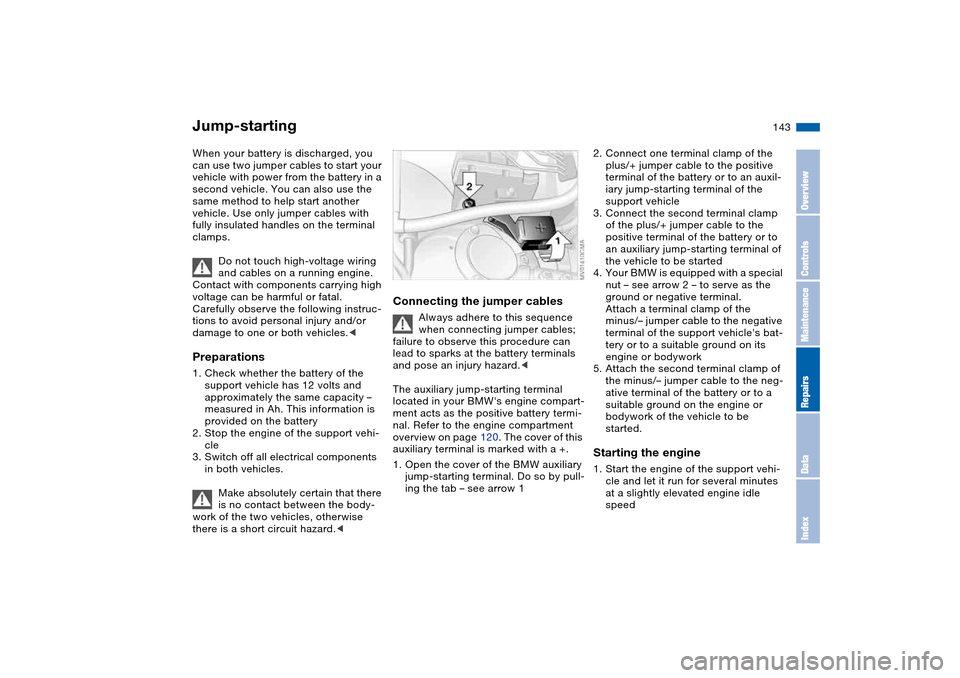
The auxiliary jump-starting terminal
located in your BMW's engine compart-
ment acts as the positive battery termi-
nal. Refer to the engine compartment
overview on page 120. The cover of this
auxiliary terminal is marked with a +.
1. Open the cover of the BMW auxiliary
jump-starting terminal. Do so by pull-
ing the tab – see arrow 1
2. Connect one terminal clamp of the
plus/+ jumper cable to the positive
terminal of the battery or to an auxil-
iary jump-starting terminal of the
support vehicle
3. Connect the second terminal clamp
of the plus/+ jumper cable to the
positive terminal of the battery or to
an auxiliary jump-starting terminal of
the vehicle to be started
4. Your BMW is equipped with a special
nut – see arrow 2 – to serve as the
ground or negative terminal.
Attach a terminal clamp of the
minus/– jumper cable to the negative
terminal of the support vehicle's bat-
tery or to a suitable ground on its
engine or bodywork
5. Attach the second terminal clamp of
the minus/– jumper cable to the neg-
ative terminal of the battery or to a
suitable ground on the engine or
bodywork of the vehicle to be
started.Starting the engine1. Start the engine of the support vehi-
cle and let it run for several minutes
at a slightly elevated engine idle
speed
OverviewControlsMaintenanceRepairsDataIndex
Page 159 of 170
Everything from A to Z
159
Electrical accessories, fail-
ure 141
Electrical malfunction
door lock 33
driver's door 33
fuel filler door 24
glass sunroof 42
luggage compartment
lid 35
Electronic Stability Program
(ESP), refer to Dynamic
Stability Control (DSC) 83
Emergency call 142
Emergency operation
doors 33
driver's door 33
fuel filler door 24
glass sunroof 42
Emergency release
luggage compartment lid
35, 37
Engine
breaking in 110
data 150
electronics 19
indicator lamp 19
speed 76, 150
starting 63
switching off 65
Engine compartment 120
Engine coolant 124
refilling 124Engine oil
adding 123
additives, refer to Adding
engine oil 123
alternative oils 123
capacity 153
consumption 122
indicator/warning lamp 19
quality 123
specified oils 123
temperature gauge 76
types 123
Engine oil level 19
check 122
indicator/warning lamp 18
Engine oil pressure
indicator/warning lamp 18
Engine oil temperature 76
Engine output, refer to
Engine data 150
Engine speed 76, 150
Entering the rear 47
Equipment range, refer to
the Service and Warranty
Information Booklet for US
models / Warranty and
Service Guide Booklet for
Canadian models
ESP Electronic Stability Pro-
gram, refer to Dynamic
Stability Control (DSC) 83
Exterior mirrors 51Eyeglasses compartment 99
Eyelet, towing 145
F
False alarm, refer to
Avoiding unintentional
alarms 39
Fastening the safety belts 47
Fault displays 78
Filling the windshield washer
reservoir 153
First aid, refer to First-aid
kit 23
First-aid kit 23
Flat tire 136
Flat Tire Monitor 84
Mobility system 136
repairing 136
Flat Tire Monitor 84
activating/deactivating 86
indicator lamp 18, 19, 86
Flat tire, refer to Tire condi-
tion 114
Fluid reservoir for washer
systems 122
Fog lamps 90
indicator/warning lamp 20
Folding rear backrest 102
Follow me home lamps 88
Footbrake, refer to General
driving notes 111
Front airbags 53Front center armrest 98
Front fog lamps 90
indicator/warning lamp 20
Fuel
display 77
specifications 25
volume 153
Fuel consumption
display 81
Fuel display, refer to Fuel
gauge 77
Fuel filler door 24
release following an elec-
trical malfunction 24
Fuel level indicator, refer to
Fuel gauge 77
Fuel mixture preparation 150
Fuel reserve indicator, refer
to Fuel gauge 77
Fuel tank capacity 153
Fuses 141
G
Gasoline consumption, refer
to Average fuel consump-
tion 81
Gasoline, refer to Fuel spec-
ifications 25
Gear indicator 68
Gearbox
manual transmission 66
OverviewControlsMaintenanceRepairsDataIndex