towing BMW M3 COUPE 2004 E46 Owner's Manual
[x] Cancel search | Manufacturer: BMW, Model Year: 2004, Model line: M3 COUPE, Model: BMW M3 COUPE 2004 E46Pages: 170, PDF Size: 2.62 MB
Page 10 of 170
Contents
Operation, maintenance
Special operating instructions:
Break-in procedures110
General driving notes111
Antilock Brake System
(ABS)112
Brake system112
Wheels and tires:
Tire inflation pressure114
Tire condition114
Tire replacement115
Wheel and tire
combinations117
Winter tires118
Snow chains*118
In the engine compartment:
Hood119
Engine compartment
essentials120
Washer fluids122
Engine oil122
Coolant124
Brake fluid125
Maintenance:
The BMW Maintenance
System126
Laws and regulations:
California Proposition 65
warning128
OBD interface socket128
Owner service procedures Replacement procedures: Onboard tool kit132
Windshield wiper blades132
Lamps and bulbs133
Repairing a flat tire136
Battery140
Fuses141 Giving and receiving
assistance: Receiving assistance142
Jump-starting143
Towing the vehicle144
Technical data
Engine data150
Dimensions151
Weights152
Capacities153
Page 104 of 170
104
Cargo loading
Avoid overloading the vehicle so
that the permitted load on the tires
is not exceeded. Overloading can lead
to overheating and internal tire damage.
This can result in a sudden loss of tire
inflation pressure.<
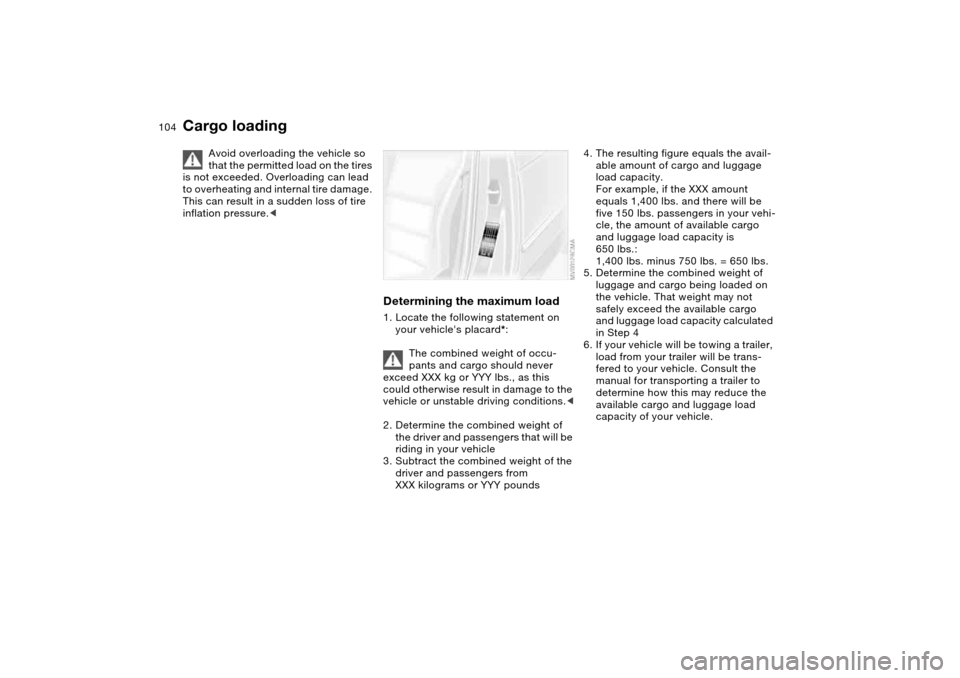
Determining the maximum load1. Locate the following statement on
your vehicle's placard*:
The combined weight of occu-
pants and cargo should never
exceed XXX kg or YYY lbs., as this
could otherwise result in damage to the
vehicle or unstable driving conditions.<
2. Determine the combined weight of
the driver and passengers that will be
riding in your vehicle
3. Subtract the combined weight of the
driver and passengers from
XXX kilograms or YYY pounds
4. The resulting figure equals the avail-
able amount of cargo and luggage
load capacity.
For example, if the XXX amount
equals 1,400 lbs. and there will be
five 150 lbs. passengers in your vehi-
cle, the amount of available cargo
and luggage load capacity is
650 lbs.:
1,400 lbs. minus 750 lbs. = 650 lbs.
5. Determine the combined weight of
luggage and cargo being loaded on
the vehicle. That weight may not
safely exceed the available cargo
and luggage load capacity calculated
in Step 4
6. If your vehicle will be towing a trailer,
load from your trailer will be trans-
fered to your vehicle. Consult the
manual for transporting a trailer to
determine how this may reduce the
available cargo and luggage load
capacity of your vehicle.
Page 105 of 170
105
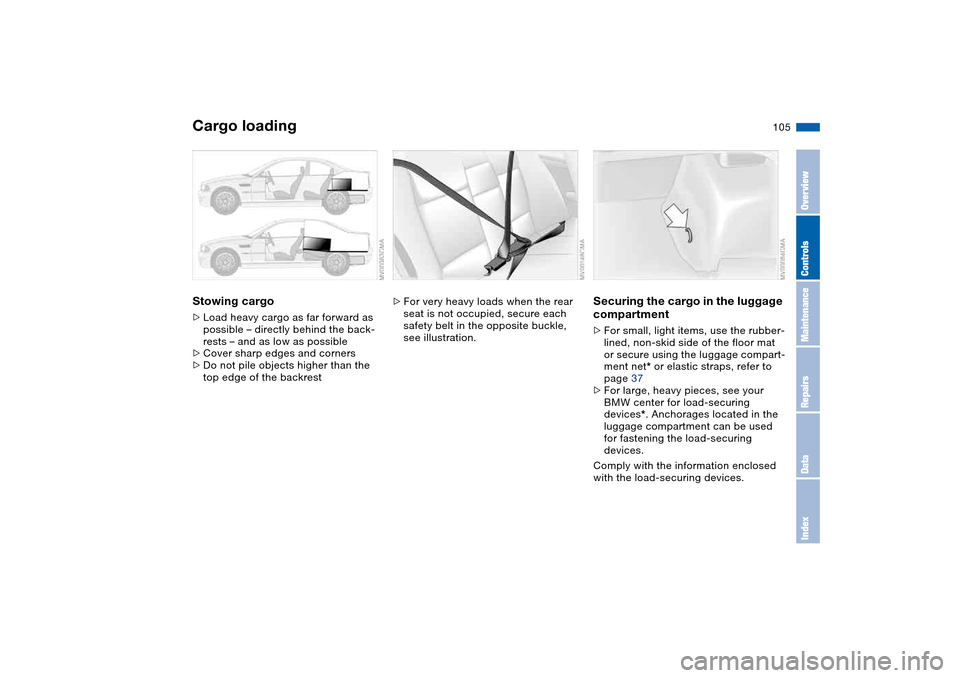
Stowing cargo>Load heavy cargo as far forward as
possible – directly behind the back-
rests – and as low as possible
>Cover sharp edges and corners
>Do not pile objects higher than the
top edge of the backrest
>For very heavy loads when the rear
seat is not occupied, secure each
safety belt in the opposite buckle,
see illustration.
Securing the cargo in the luggage
compartment >For small, light items, use the rubber-
lined, non-skid side of the floor mat
or secure using the luggage compart-
ment net* or elastic straps, refer to
page 37
>For large, heavy pieces, see your
BMW center for load-securing
devices*. Anchorages located in the
luggage compartment can be used
for fastening the load-securing
devices.
Comply with the information enclosed
with the load-securing devices.
Cargo loading
OverviewControlsMaintenanceRepairsDataIndex
Page 132 of 170
132Replacement procedures
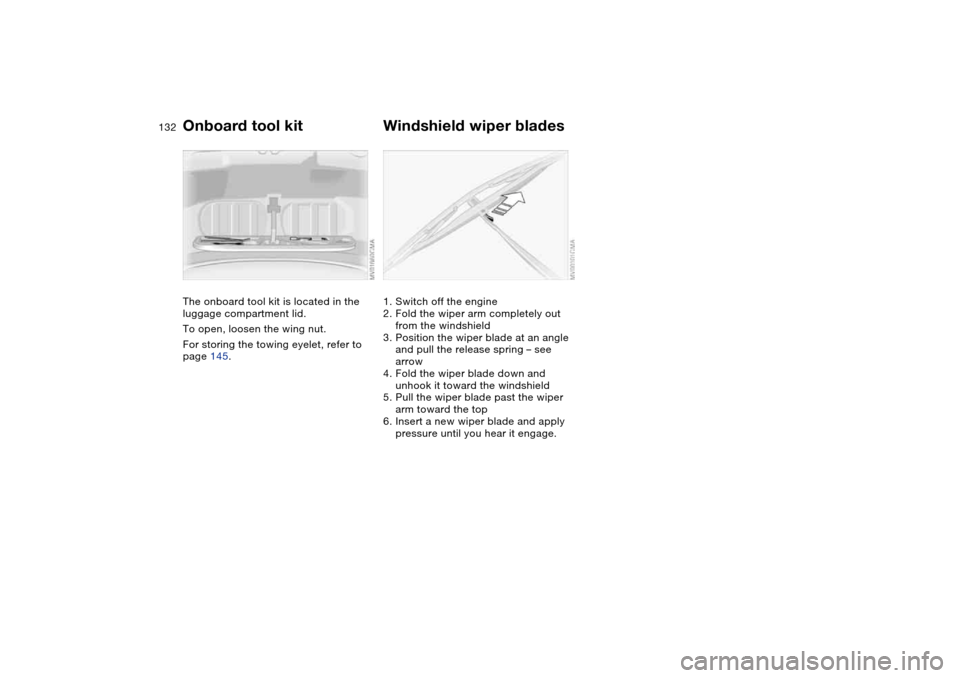
Onboard tool kitThe onboard tool kit is located in the
luggage compartment lid.
To open, loosen the wing nut.
For storing the towing eyelet, refer to
page 145.
Windshield wiper blades1. Switch off the engine
2. Fold the wiper arm completely out
from the windshield
3. Position the wiper blade at an angle
and pull the release spring – see
arrow
4. Fold the wiper blade down and
unhook it toward the windshield
5. Pull the wiper blade past the wiper
arm toward the top
6. Insert a new wiper blade and apply
pressure until you hear it engage.
Page 144 of 170
144
2. Start the engine of the other vehicle
as usual.
If the first start attempt is not suc-
cessful, wait a few minutes before
another attempt in order to allow the
discharged battery to recharge
3. Allow the engines to run for several
minutes
4. Disconnect the jumper cables in
reverse sequence.
Have the battery recharged at your
BMW center as required.
Do not use spray starter fluids to
start the engine.<
Towing the vehicle
Always observe all applicable
towing laws and regulations.<
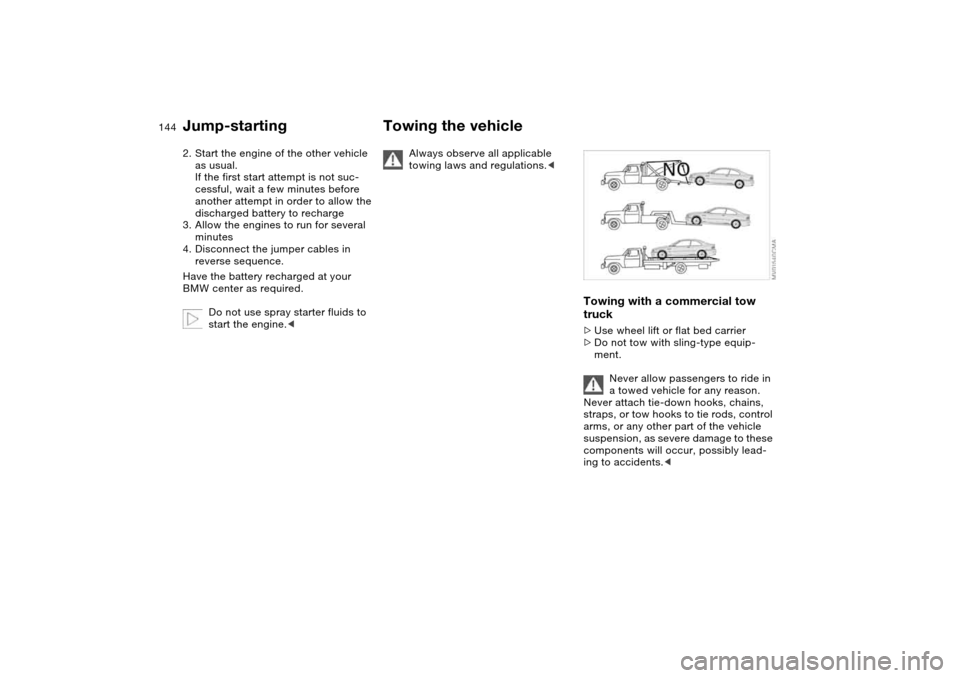
Towing with a commercial tow
truck>Use wheel lift or flat bed carrier
>Do not tow with sling-type equip-
ment.
Never allow passengers to ride in
a towed vehicle for any reason.
Never attach tie-down hooks, chains,
straps, or tow hooks to tie rods, control
arms, or any other part of the vehicle
suspension, as severe damage to these
components will occur, possibly lead-
ing to accidents.<
Jump-starting
Page 145 of 170
145
Towing the vehicle with the front
axle raisedVehicles with sequential manual gear-
box SMG:
With the ignition on, move the selector
lever to position N, then turn off the
ignition.Towing eyeletThe screw-in towing eyelet is stored in
the luggage compartment under the
floor mat and must remain in the vehi-
cle. It can be attached at the front or
rear of the vehicle.
The towing eyelet should not be used
to pull a vehicle out of deep snow, mud,
sand, etc.
Comply with all applicable towing laws
and regulations at all times.
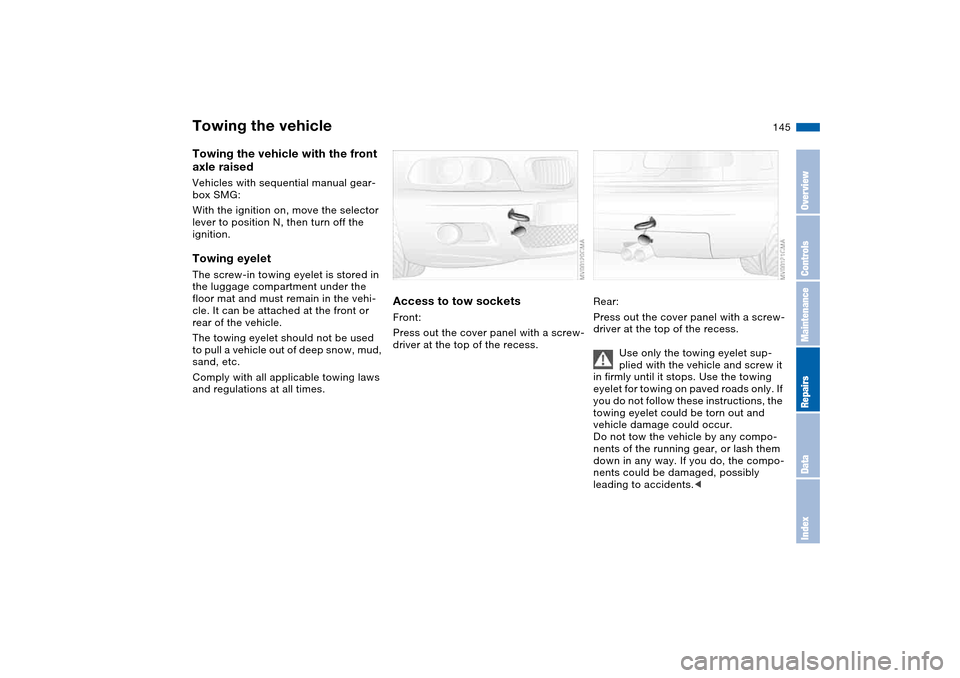
Access to tow socketsFront:
Press out the cover panel with a screw-
driver at the top of the recess.
Rear:
Press out the cover panel with a screw-
driver at the top of the recess.
Use only the towing eyelet sup-
plied with the vehicle and screw it
in firmly until it stops. Use the towing
eyelet for towing on paved roads only. If
you do not follow these instructions, the
towing eyelet could be torn out and
vehicle damage could occur.
Do not tow the vehicle by any compo-
nents of the running gear, or lash them
down in any way. If you do, the compo-
nents could be damaged, possibly
leading to accidents.<
Towing the vehicle
OverviewControlsMaintenanceRepairsDataIndex
Page 146 of 170
146
Keep the vehicles in line and avoid
towing at an offset angle. Ensure
that the towing strap connecting the
two vehicles is tight, with no slack,
before starting off.<
Use only a nylon towing strap to tow
the vehicle, since the inherent resil-
ience of this material helps protect both
vehicles from sudden jerking move-
ments.
The towed vehicle should always
be the lighter of the two vehicles.
If this is not the case, it will not be pos-
sible to control vehicle handling.<
Tow-startingFor instructions on jump-starting, refer
to page 143.
Never attempt to use your vehicle to
push another vehicle, since damage to
the energy-absorbing bumpers could
result.Towing the vehicle
Page 156 of 170
Everything from A to ZA
ABS Antilock Brake
System 112
indicator lamp 19
Accessories, refer to For
your own safety 5
Accident, refer to Emer-
gency call 142
Activated-charcoal filter 96
Adding brake fluid 125
Adding liquid sealant
Mobility system 138
Additional sources of infor-
mation 4
Air conditioning mode
automatic climate
control 94
Air distribution
automatic climate
control 94
Air distribution, individual 94
Air outlets, refer to Ventila-
tion 92
Air pressure, refer to Tire
inflation pressure 25, 114
Air recirculation, refer to
Recirculated-air mode 95
Air supply
automatic climate
control 94
Air, drying, refer to Air con-
ditioning mode 94Airbags 53
deactivating 53
indicator lamp 18, 55
sitting safely 43
Airing out, refer to Ventila-
tion 92
AKI, refer to Fuel specifica-
tions 25
Alarm system 38
avoiding unintentional
alarms 39
All-season tires, refer to
Winter tires 118
Alternative oil types 123
Antifreeze 124
coolant 124
washer fluid 122
Antilock Brake System
(ABS) 112
indicator lamp 19
Anti-theft system 30
Anti-theft warning system,
refer to Alarm system 38
Approved axle loads, refer
to Weights 152
Approved gross weight,
refer to Weights 152
Armrest
front 98
rear 99Artificial leather, refer to the
Caring for your vehicle
brochure
Ashtray
front 100
rear 100
Assistant systems, refer to
Dynamic Stability Control
(DSC) 83
AUC Automatic recircu-
lated-air control 95
AUTO program, refer
to Automatic air distribu-
tion 94
Automatic
air distribution 94
air supply 94
cruise control 74
headlamp control 88
Automatic car wash, refer to
the Caring for your vehicle
brochure
Automatic climate control 92
Automatic curb monitor 50
Automatic dimming, interior
rearview mirror 52
Automatic recirculated-air
control (AUC) 95
Automatic windshield
washer, refer to Rain sen-
sor 73Average fuel
consumption 81
Average speed 81
Avoiding unintentional
alarms 39
Axle loads, refer to
Weights 152
B
Backrest
adjusting 44
unlocking 47
width adjustment 46
Backrest, refer to Seat
adjustment 45
Backup lamps 66
bulb replacement 135
Bandages, refer to First-aid
kit 23
Bar, towing 145
Battery 140
charge 140
disposal 140
indicator lamp 18
jump-starting 143
remote control 30, 31
Battery charge current 18
Belts, refer to Safety
belts 47
Beverage holders 98, 99
Page 159 of 170
Everything from A to Z
159
Electrical accessories, fail-
ure 141
Electrical malfunction
door lock 33
driver's door 33
fuel filler door 24
glass sunroof 42
luggage compartment
lid 35
Electronic Stability Program
(ESP), refer to Dynamic
Stability Control (DSC) 83
Emergency call 142
Emergency operation
doors 33
driver's door 33
fuel filler door 24
glass sunroof 42
Emergency release
luggage compartment lid
35, 37
Engine
breaking in 110
data 150
electronics 19
indicator lamp 19
speed 76, 150
starting 63
switching off 65
Engine compartment 120
Engine coolant 124
refilling 124Engine oil
adding 123
additives, refer to Adding
engine oil 123
alternative oils 123
capacity 153
consumption 122
indicator/warning lamp 19
quality 123
specified oils 123
temperature gauge 76
types 123
Engine oil level 19
check 122
indicator/warning lamp 18
Engine oil pressure
indicator/warning lamp 18
Engine oil temperature 76
Engine output, refer to
Engine data 150
Engine speed 76, 150
Entering the rear 47
Equipment range, refer to
the Service and Warranty
Information Booklet for US
models / Warranty and
Service Guide Booklet for
Canadian models
ESP Electronic Stability Pro-
gram, refer to Dynamic
Stability Control (DSC) 83
Exterior mirrors 51Eyeglasses compartment 99
Eyelet, towing 145
F
False alarm, refer to
Avoiding unintentional
alarms 39
Fastening the safety belts 47
Fault displays 78
Filling the windshield washer
reservoir 153
First aid, refer to First-aid
kit 23
First-aid kit 23
Flat tire 136
Flat Tire Monitor 84
Mobility system 136
repairing 136
Flat Tire Monitor 84
activating/deactivating 86
indicator lamp 18, 19, 86
Flat tire, refer to Tire condi-
tion 114
Fluid reservoir for washer
systems 122
Fog lamps 90
indicator/warning lamp 20
Folding rear backrest 102
Follow me home lamps 88
Footbrake, refer to General
driving notes 111
Front airbags 53Front center armrest 98
Front fog lamps 90
indicator/warning lamp 20
Fuel
display 77
specifications 25
volume 153
Fuel consumption
display 81
Fuel display, refer to Fuel
gauge 77
Fuel filler door 24
release following an elec-
trical malfunction 24
Fuel level indicator, refer to
Fuel gauge 77
Fuel mixture preparation 150
Fuel reserve indicator, refer
to Fuel gauge 77
Fuel tank capacity 153
Fuses 141
G
Gasoline consumption, refer
to Average fuel consump-
tion 81
Gasoline, refer to Fuel spec-
ifications 25
Gear indicator 68
Gearbox
manual transmission 66
OverviewControlsMaintenanceRepairsDataIndex
Page 162 of 170
Everything from A to ZMaximum speed
with winter tires 118
MC operation, refer to the
Owner's Manual for
Radio/Onboard Computer
MD operation, refer to the
Owner's Manual for
Radio/Onboard Computer
Mechanical seats 44
Memory, refer to Seat and
mirror memory 49
Memory, refer to Vehicle
Memory, Key Memory 60
Microfilter
automatic climate
control 96
Microphone, refer to Cellular
phone 99
Mini disc operation, refer to
the Owner's Manual for
Radio/Onboard Computer
Mirrors 51
automatic curb monitor 50
heated 51
memory, refer to Seat and
mirror memory 49
Mobile Service 142
Mobility system 136
Modifications, technical,
refer to For your own
safety 5Multifunction steering
wheel 22
Multifunction switch
turn signal indicator/head-
lamp flasher 72
washer/wiper system 73
N
Navigation system, refer to
the Owner's Manual for
Radio/Onboard Computer
Neck restraints, refer to
Head restraints 46
Nets 98
Nozzles, refer to
Ventilation 92
Nylon rope, refer to Towing
the vehicle 145
O
OBD interface socket 128
Odometer 76
Oil
additives, refer to Adding
engine oil 123
alternative oils 123
capacity 153
dipstick 122
quality 123
specified engine oils 123Oil change interval, refer
to Service interval
display 126
Oil change intervals, refer to
the Service and Warranty
Information Booklet for US
models / Warranty and
Service Guide Booklet for
Canadian models
Oil filter change 153
Oil level
checking 122
indicator lamp 18
Oil pressure
indicator lamp 18
OIL SERVICE 78
Oil types 123
Old batteries, refer to Dis-
posal 140
Onboard computer 80
Onboard computer, refer to
the Owner's Manual for
Onboard Computer
Onboard tool kit 132
Opening and closing
from inside 34
from outside 31
via remote control 31
via the door lock 33
Outlets, ventilation 92Outside temperature dis-
play 80
changing unit of
measure 80
P
Paintwork care, refer to the
Caring for your vehicle
brochure
Panic mode, trigger
alarm 32
Park Distance Control
(PDC) 82
Parking aid, refer to Park
Distance Control (PDC) 82
Parking brake 65
indicator lamp 18
Parking lamps 88
bulb replacement 133
Parking lamps/Low
beams 88
Parts and accessories, refer
to Your individual vehicle 5
Passenger-side exterior mir-
ror tilt function 50
PDC Park Distance
Control 82
Pinch protection
glass sunroof 41
Plastic, refer to the Caring
for your vehicle brochure