maintenance BMW M3 COUPE 2006 E46 Manual PDF
[x] Cancel search | Manufacturer: BMW, Model Year: 2006, Model line: M3 COUPE, Model: BMW M3 COUPE 2006 E46Pages: 170, PDF Size: 2.63 MB
Page 139 of 170
139
Using the M Mobility systemTo repair a flat tire using the M Mobility
system, proceed as follows:
>Fill with sealant, refer to page 139
>Distribute the sealant, refer to
page 139
>Restore tire inflation pressure, refer
to page 139.
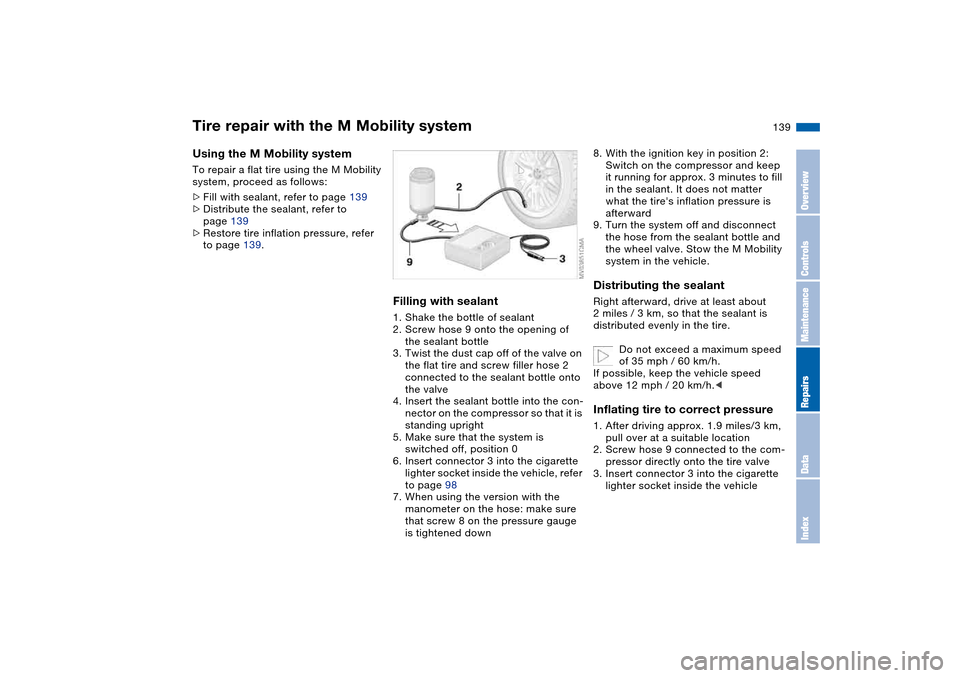
Filling with sealant1. Shake the bottle of sealant
2. Screw hose 9 onto the opening of
the sealant bottle
3. Twist the dust cap off of the valve on
the flat tire and screw filler hose 2
connected to the sealant bottle onto
the valve
4. Insert the sealant bottle into the con-
nector on the compressor so that it is
standing upright
5. Make sure that the system is
switched off, position 0
6. Insert connector 3 into the cigarette
lighter socket inside the vehicle, refer
to page 98
7. When using the version with the
manometer on the hose: make sure
that screw 8 on the pressure gauge
is tightened down
8. With the ignition key in position 2:
Switch on the compressor and keep
it running for approx. 3 minutes to fill
in the sealant. It does not matter
what the tire's inflation pressure is
afterward
9. Turn the system off and disconnect
the hose from the sealant bottle and
the wheel valve. Stow the M Mobility
system in the vehicle.Distributing the sealantRight afterward, drive at least about
2 miles / 3 km, so that the sealant is
distributed evenly in the tire.
Do not exceed a maximum speed
of 35 mph / 60 km/h.
If possible, keep the vehicle speed
above 12 mph / 20 km/h.
2. Screw hose 9 connected to the com-
pressor directly onto the tire valve
3. Insert connector 3 into the cigarette
lighter socket inside the vehicle
Tire repair with the M Mobility system
OverviewControlsMaintenanceRepairsDataIndex
Page 140 of 170
140
4. Adjust the tire inflation pressure to
29 psi / 200 kilopascal. For this pur-
pose, with the ignition key in
position 2:
>Increase the tire pressure: switch
on the compressor, position I. To
check the current inflation pres-
sure, turn off the device briefly
>Reduce the tire pressure: press
button 8, or turn screw 8 on the
manometer.
Do not run the compressor for
longer than 10 minutes, otherwise
the unit may overheat and be dam-
aged.<
If the tire fails to hold the pres-
sure, drive the vehicle again, see
Distributing the sealant. Then repeat
Steps 1 through 4 once.
The use of the M Mobility system may
be ineffective if the damaged area in
the tire is larger than approx. 1/8 in /
4 mm. If the tire cannot be temporarily
repaired with the M Mobility system,
please consult the nearest BMW cen-
ter, or a workshop that has appropri-
ately trained personnel working in
accordance with BMW specifications,<
The tire pressure must be at least
29 psi / 200 kilopascal. Otherwise,
do not continue driving.<
Driving on
Do not exceed the maximum
speed limit of 45 mph / 80 km/h;
otherwise, accidents may occur.<
Have the damaged tire replaced
as soon as possible. Reinitialize
the Flat Tire Monitor, and refer to
page 84 for further information.
Have the sealant bottle of the M Mobil-
ity system replaced.<
Battery
Battery posts, terminals, and
related accessories contain lead
and lead compounds. Wash hands after
handling.<
MaintenanceThe battery is completely maintenance-
free. This means that the original bat-
tery acid will normally last for the ser-
vice life of the battery under moderate
climate conditions. Your BMW center
will be glad to advise you if you have
any questions concerning the battery.
Please consult your BMW center
whenever you have any questions
concerning the battery.
connections provided in the engine
compartment. Terminals, refer to Jump-
starting, page 143.
Tire repair with the M Mobility system
Page 141 of 170
141
Disposal
After changing the battery, have
the old battery disposed of by
your BMW center or bring it to a recy-
cling point. Maintain the battery in an
upright position for transport and stor-
age. Secure the battery against tilting in
transit.<
Power lossAfter a temporary power loss, e.g. due
to a discharged battery, some equip-
ment will be limited in its use and will
have to be reinitialized. Individual set-
tings are also lost and must be reset:
>Seat and mirror memory
The position settings must be stored
again, refer to page 48
>Clock
must be reset, refer to page 78
>Radio
Stations must be reset, refer to the
Owner's Manual for Radio/Onboard
Computer
>Navigation system
The system will not be operable
immediately, refer to the Owner's
Manual for Radio/Onboard Com-
puter.
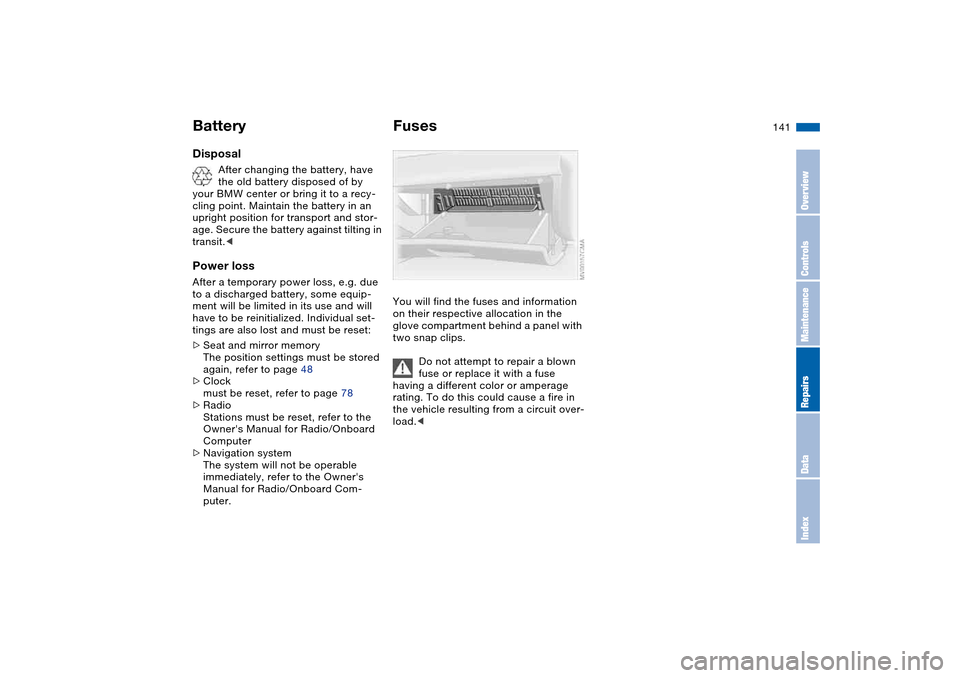
FusesYou will find the fuses and information
on their respective allocation in the
glove compartment behind a panel with
two snap clips.
Do not attempt to repair a blown
fuse or replace it with a fuse
having a different color or amperage
rating. To do this could cause a fire in
the vehicle resulting from a circuit over-
load.<
Battery
OverviewControlsMaintenanceRepairsDataIndex
Page 143 of 170
143
Mobile Service*To establish contact with the BMW
Group's Mobile Service:
Press button 2 for at least 2 seconds.
The indicator lamp above the buttons
lights up. As soon as a telephone con-
nection has been set up with the Mobile
Service, the indicator lamp flashes.
Depending on the country you are in,
your vehicle's current location will also
be transmitted if your vehicle is
equipped with an activated BMW Assist
function.
Jump-startingWhen your battery is discharged, you
can use two jumper cables to start your
vehicle with power from the battery in a
second vehicle. You can also use the
same method to help start another
vehicle. Use only jumper cables with
fully insulated handles on the terminal
clamps.
Do not touch high-voltage wiring
and cables on a running engine.
Contact with components carrying high
voltage can be harmful or fatal.
Carefully observe the following instruc-
tions to avoid personal injury and/or
damage to one or both vehicles.
approximately the same capacity –
measured in Ah. This information is
provided on the battery
2. Stop the engine of the support vehi-
cle
3. Switch off all consumers in both
vehicles.
Make absolutely certain that there
is no contact between the body-
work of the two vehicles, otherwise
there is a short circuit hazard.<
Connecting the jumper cables
Be sure to connect the jumper
cables in the right order; other-
wise there is a risk of injury due to
sparks being created near the battery.<
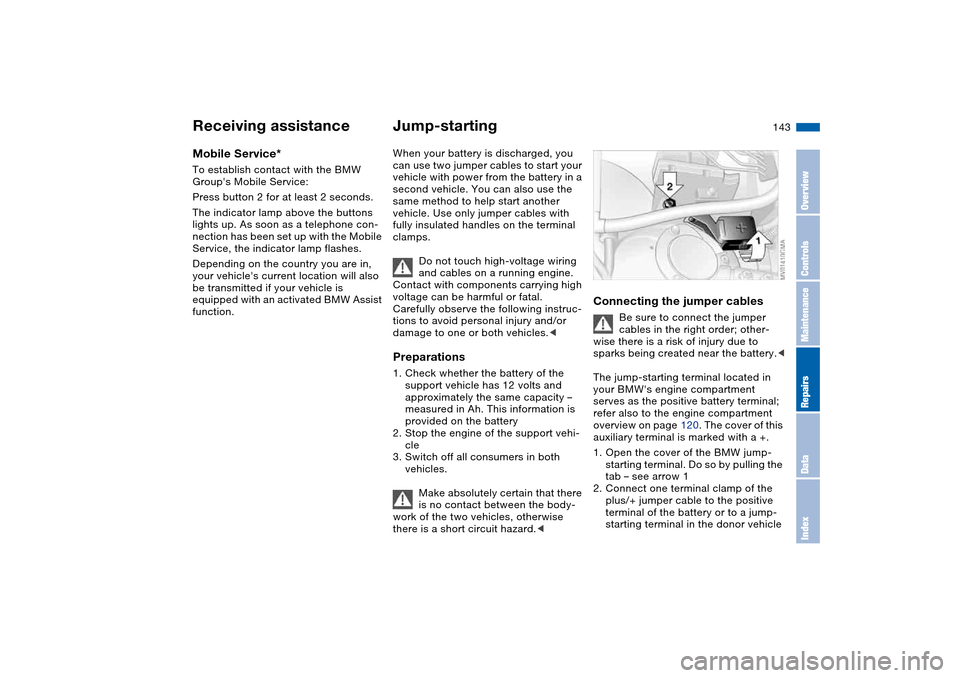
The jump-starting terminal located in
your BMW's engine compartment
serves as the positive battery terminal;
refer also to the engine compartment
overview on page 120. The cover of this
auxiliary terminal is marked with a +.
1. Open the cover of the BMW jump-
starting terminal. Do so by pulling the
tab – see arrow 1
2. Connect one terminal clamp of the
plus/+ jumper cable to the positive
terminal of the battery or to a jump-
starting terminal in the donor vehicle
Receiving assistance
OverviewControlsMaintenanceRepairsDataIndex
Page 145 of 170
145
Towing and tow-starting the vehicle
Always observe all applicable
towing laws and regulations.<
Using the towing eyeletThe screw-in towing eyelet is stored in
the luggage compartment under the
floor panel and must remain with the
vehicle at all times. It can be attached
at the front or rear of your BMW.
Observe the following instruc-
tions in order to avoid damaging
the towing eyelet or the vehicle: use
only the towing eyelet supplied with the
vehicle, and screw it in firmly until it
stops. Use the towing eyelet for towing
on paved roads only. Avoid subjecting
the towing eyelet to lateral loads, e.g.
do not lift the vehicle using the towing
eyelet.<
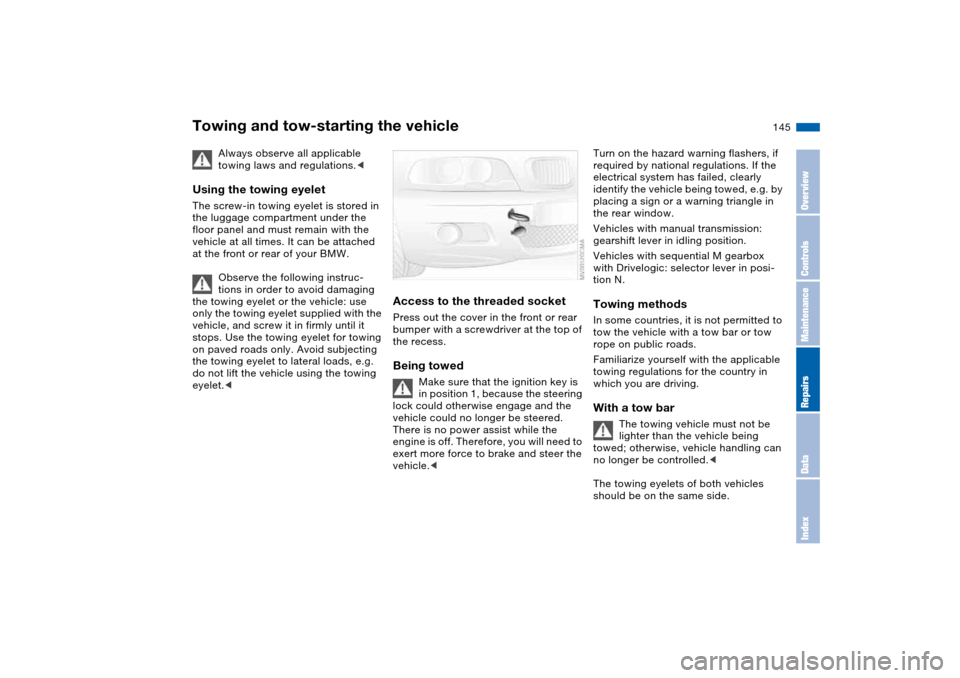
Access to the threaded socketPress out the cover in the front or rear
bumper with a screwdriver at the top of
the recess.Being towed
Make sure that the ignition key is
in position 1, because the steering
lock could otherwise engage and the
vehicle could no longer be steered.
There is no power assist while the
engine is off. Therefore, you will need to
exert more force to brake and steer the
vehicle.<
Turn on the hazard warning flashers, if
required by national regulations. If the
electrical system has failed, clearly
identify the vehicle being towed, e.g. by
placing a sign or a warning triangle in
the rear window.
Vehicles with manual transmission:
gearshift lever in idling position.
Vehicles with sequential M gearbox
with Drivelogic: selector lever in posi-
tion N.Towing methodsIn some countries, it is not permitted to
tow the vehicle with a tow bar or tow
rope on public roads.
Familiarize yourself with the applicable
towing regulations for the country in
which you are driving.With a tow bar
The towing vehicle must not be
lighter than the vehicle being
towed; otherwise, vehicle handling can
no longer be controlled.<
The towing eyelets of both vehicles
should be on the same side.
OverviewControlsMaintenanceRepairsDataIndex
Page 147 of 170

147
OverviewControlsMaintenanceRepairsDataIndex
Page 149 of 170
149
Overview
Controls and features
Operation, maintenance
Owner service procedures
Technical data
Index
OverviewControlsMaintenanceRepairsDataIndex
Page 151 of 170
151
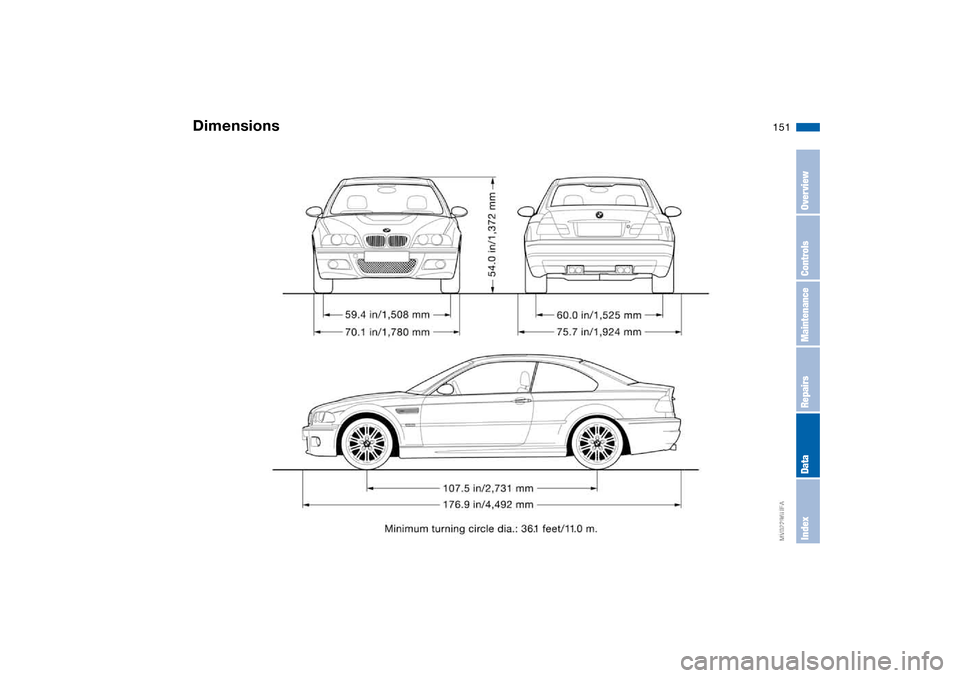
Dimensions
OverviewControlsMaintenanceRepairsDataIndex
Page 153 of 170
153
Capacities
Notes
Fuel tank
Reservegal./liters
gal./litersapprox. 16.6/approx. 63
approx. 2.1/approx. 8Fuel specification, refer to page 25
Windshield washer system/
Headlamp cleaning system quarts/liters approx. 5.6/approx. 5.3Specifications, refer to page 122
Engine with oil filter change quarts/liters approx. 5.8/approx. 5.5 Specifications, refer to page 123
Manual transmission quarts/liters approx. 1.9/approx. 1.8 Oil change during running-in check
and during each inspection II
Differential quarts/liters approx. 1.2/approx. 1.1 Oil change during running-in check
and during each inspection II
OverviewControlsMaintenanceRepairsDataIndex
Page 155 of 170
155
Overview
Controls and features
Operation, maintenance
Owner service procedures
Technical data
Index
OverviewControlsMaintenanceRepairsDataIndex