steering wheel BMW M3 COUPE 2008 E92 User Guide
[x] Cancel search | Manufacturer: BMW, Model Year: 2008, Model line: M3 COUPE, Model: BMW M3 COUPE 2008 E92Pages: 172, PDF Size: 5.29 MB
Page 74 of 172
Technology for driving comfort and safety
72 dling and stopping ability. Please note that the
TPMS is not a substitute for proper tire mainte-
nance, and it is the driver’s responsibility to
maintain correct tire pressure, even if underin-
flation has not reached the level at which the
TPMS low tire pressure telltale illuminates.
The TPMS malfunction indicator is combined
with the low tire pressure telltale. When the sys-
tem detects a malfunction, the telltale will flash
for approximately one minute and then remain
continuously lit. This sequence will continue
upon subsequent vehicle startups as long as
the malfunction exists. When the malfunction
indicator is illuminated, the system may not be
able to detect or signal low tire pressure as
intended. TPMS malfunctions may occur for a
variety of reasons, including the installation of
replacement or alternate tires or wheels on the
vehicle that prevent the TPMS from functioning
properly. Always check the TPMS malfunction
telltale after replacing one or more tires or
wheels on your vehicle to ensure that the
replacement or alternate tires and wheels allow
the TPMS to continue to function properly.
Servotronic
"Servotronic" varies the steering force required
to turn the wheels depending on the speed at
which you are driving.
At low speeds, steering is assisted strongly, i. e.
less effort is required to turn the vehicle. Steer-
ing assistance lessens with increasing speed.
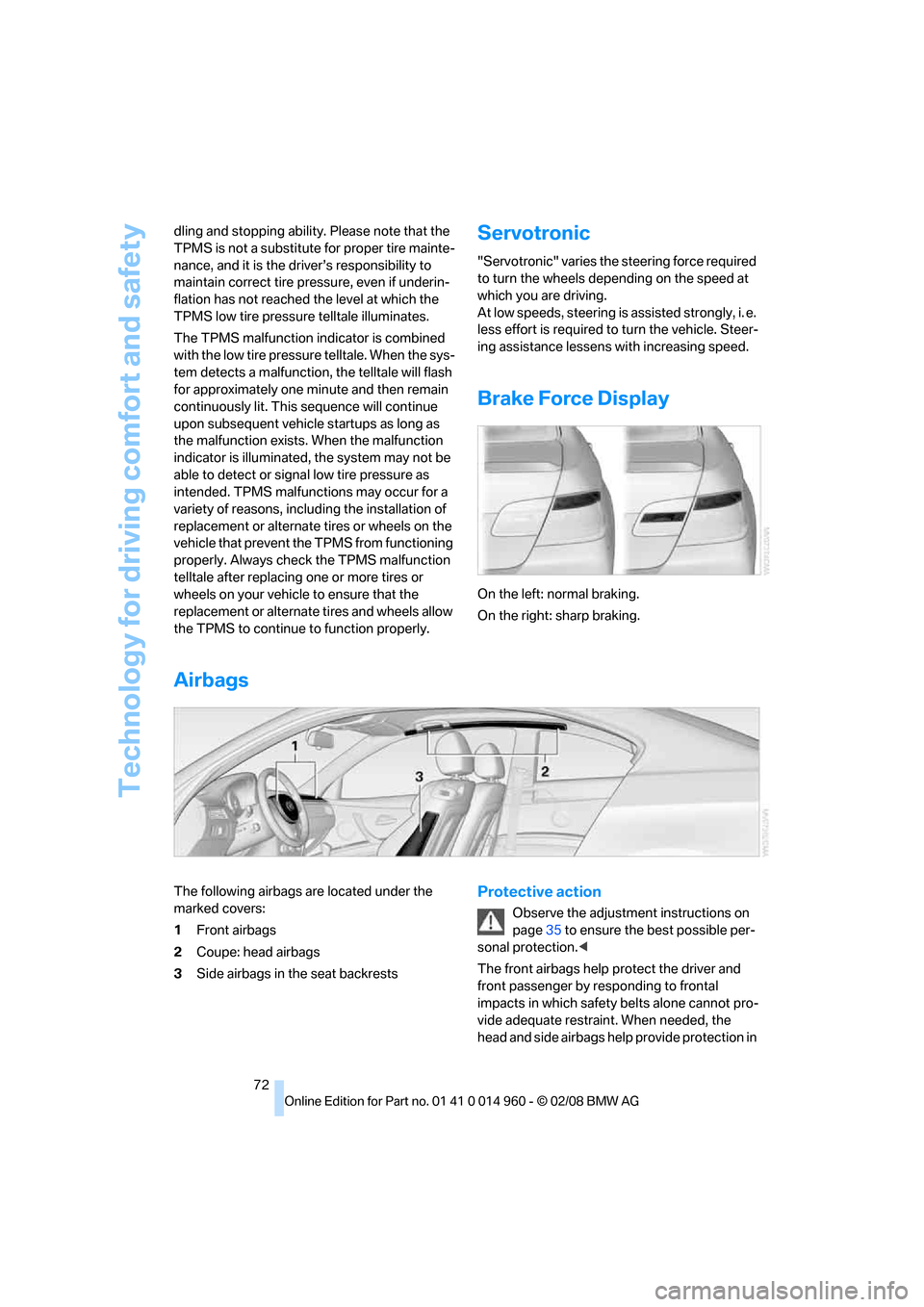
Brake Force Display
On the left: normal braking.
On the right: sharp braking.
Airbags
The following airbags are located under the
marked covers:
1Front airbags
2Coupe: head airbags
3Side airbags in the seat backrestsProtective action
Observe the adjustment instructions on
page35 to ensure the best possible per-
sonal protection.<
The front airbags help protect the driver and
front passenger by responding to frontal
impacts in which safety belts alone cannot pro-
vide adequate restraint. When needed, the
head and side airbags help provide protection in
Page 75 of 172
Reference
At a glance
Controls
Driving tips
Mobility
73
the event of side impact. The relevant side air-
bag supports the side upper body area. The
head air bag supports the head.
The airbags have been designed to not be trig-
gered in every collision situation, e.g. not in
minor accidents or rear-end collisions.
Do not apply adhesive materials to the
cover panels of the airbags, cover them or
modify them in any other way. Do not attach
seat covers, cushions or other objects not spe-
cifically approved for seats with integral side air-
bags to the front seats. Do not hang items of
clothing such as coats or jackets over the back-
rests. Do not attempt to remove the airbag
retention system from the vehicle. Do not mod-
ify the individual components of the system or
its wiring in any way. This includes the uphol-
stered covers on the steering wheel, instrument
panel, seats and roof posts, as well as the sides
of the roof lining. Do not attempt to remove or
dismantle the steering wheel.
Do not touch the individual components imme-
diately after the system has been triggered,
because there is a danger of burns.
In the event of malfunctions, deactivation or
triggering of the airbag restraint system, have
the testing, repair, removal and disposal of air-
bag generators executed only by a BMW center
or a workshop that works according to repair
procedures of BMW with correspondingly
trained personnel and that has the required
explosives licenses. Unprofessional attempts to
work on the system could lead to failure in an
emergency or to undesired airbag activation,
either of which could result in personal injury.<
Warning notices and information about the air-
bags can also be found on the sun visors.
Automatic deactivation of the front
passenger airbags
An analysis of the impression in the front pas-
senger seat cushion determines whether and
how the seat is occupied. The front and side air-
bags for the front passenger are activated or
deactivated by the system accordingly.
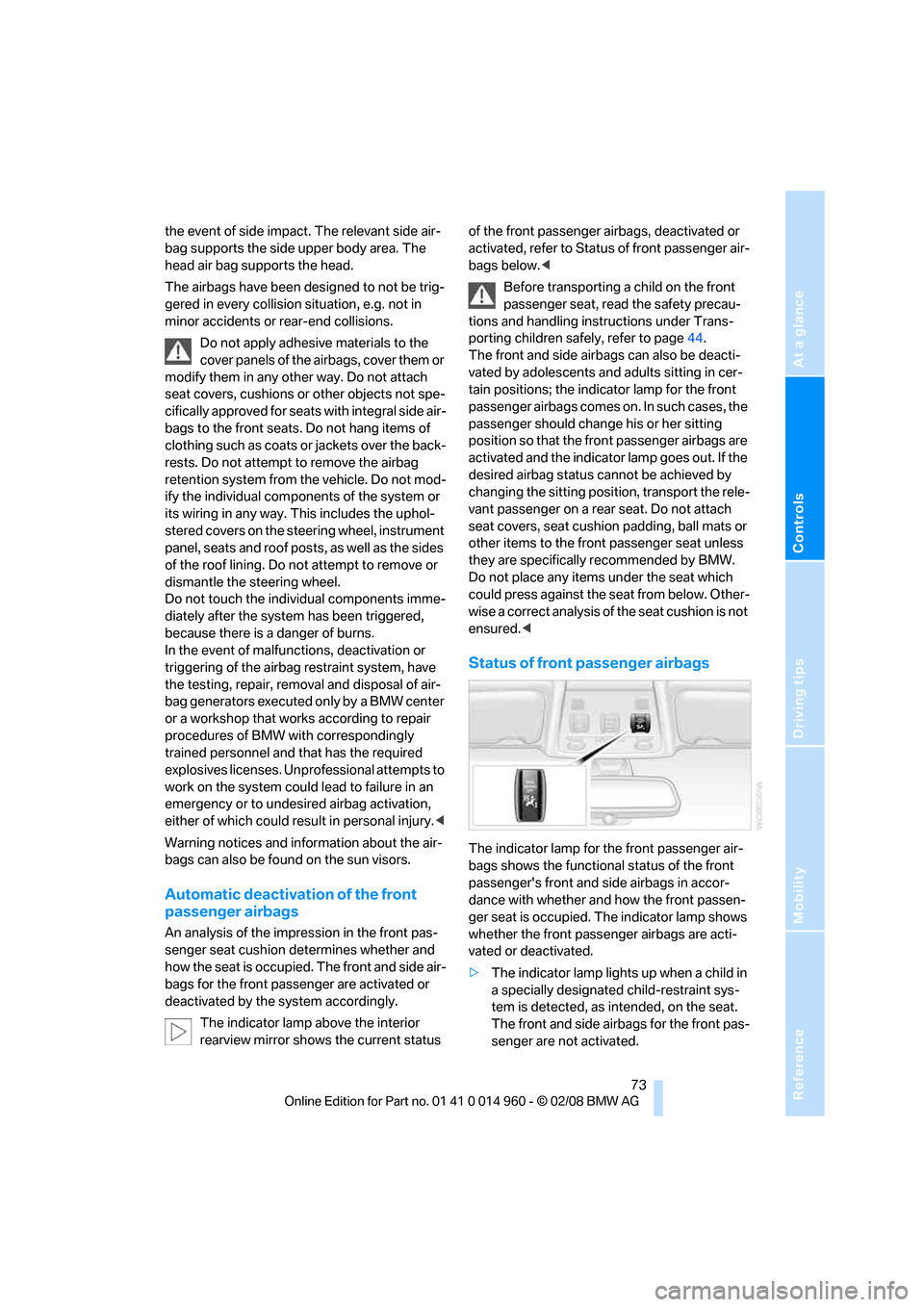
The indicator lamp above the interior
rearview mirror shows the current status of the front passenger airbags, deactivated or
activated, refer to Status of front passenger air-
bags below.<
Before transporting a child on the front
passenger seat, read the safety precau-
tions and handling instructions under Trans-
porting children safely, refer to page44.
The front and side airbags can also be deacti-
vated by adolescents and adults sitting in cer-
tain positions; the indicator lamp for the front
passenger airbags comes on. In such cases, the
passenger should change his or her sitting
position so that the front passenger airbags are
activated and the indicator lamp goes out. If the
desired airbag status cannot be achieved by
changing the sitting position, transport the rele-
vant passenger on a rear seat. Do not attach
seat covers, seat cushion padding, ball mats or
other items to the front passenger seat unless
they are specifically recommended by BMW.
Do not place any items under the seat which
could press against the seat from below. Other-
wise a correct analysis of the seat cushion is not
ensured.<
Status of front passenger airbags
The indicator lamp for the front passenger air-
bags shows the functional status of the front
passenger's front and side airbags in accor-
dance with whether and how the front passen-
ger seat is occupied. The indicator lamp shows
whether the front passenger airbags are acti-
vated or deactivated.
>The indicator lamp lights up when a child in
a specially designated child-restraint sys-
tem is detected, as intended, on the seat.
The front and side airbags for the front pas-
senger are not activated.
Page 80 of 172
Lamps
78 angle and other parameters, the light from the
headlamp follows the course of the road.
In tight curves at speeds up to 40 mph/70 km/h,
e.g. on mountainous roads or when turning, an
additional, corner-illuminating lamp is switched
on that lights up the inside area of the curve.
Activating Adaptive Head Light
With the ignition switched on, turn the light
switch to position 3, refer to page76.
The corner-illuminating lamp is switched on
automatically, depending on the steering wheel
angle or turn signal indicator.
To avoid blinding oncoming traffic, the Adaptive
Head Light directs light towards the front pas-
senger side when the vehicle is at a standstill.
When you are reversing, only the corner-illumi-
nating lamps are active and switched on on
both sides.
Malfunction
The LED next to the symbol for automatic head-
lamp control flashes. Adaptive Head Light is
malfunctioning or has failed. Have the system
checked as soon as possible.
High beams/roadside parking
lamps
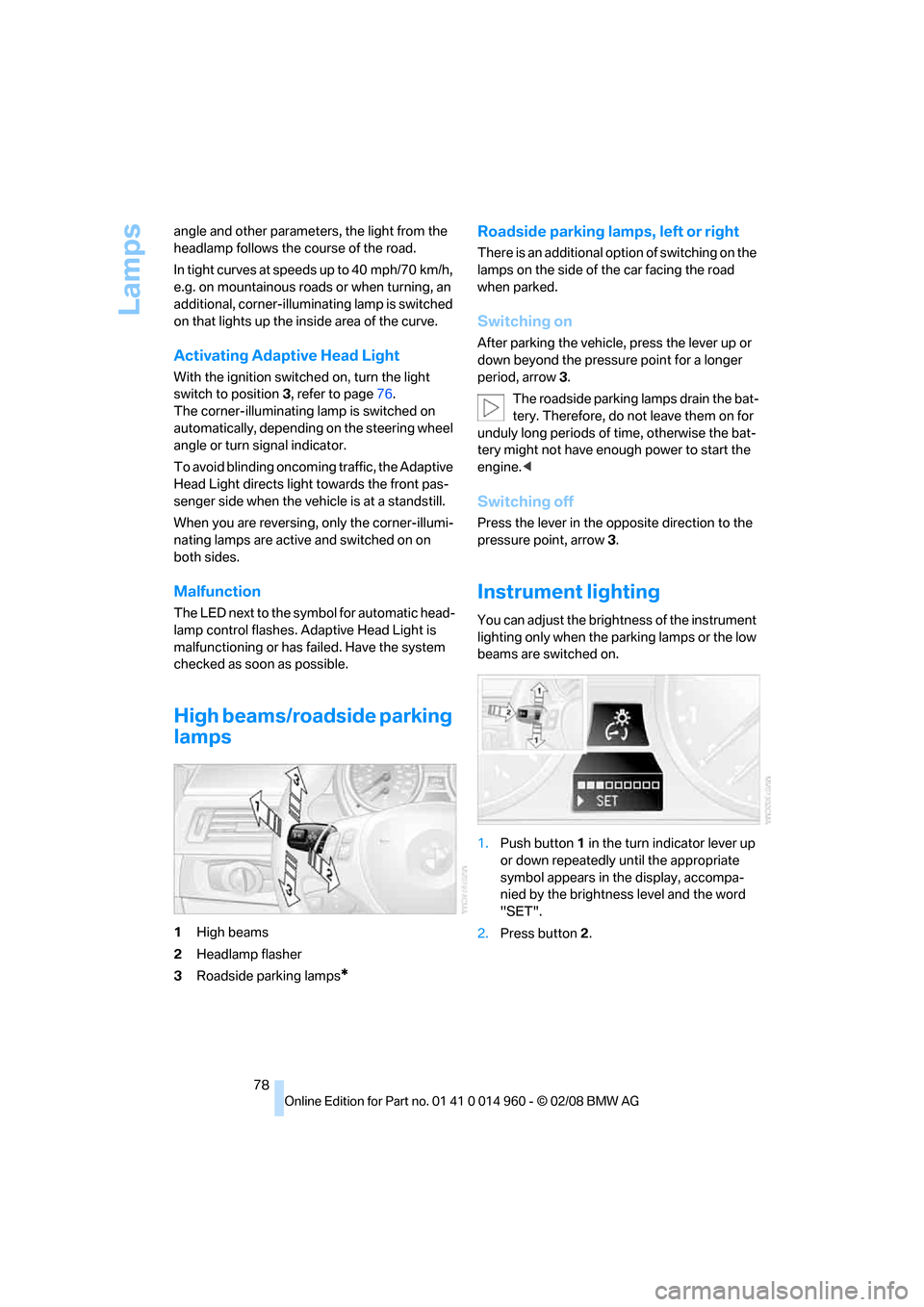
1High beams
2Headlamp flasher
3Roadside parking lamps
*
Roadside parking lamps, left or right
There is an additional option of switching on the
lamps on the side of the car facing the road
when parked.
Switching on
After parking the vehicle, press the lever up or
down beyond the pressure point for a longer
period, arrow 3.
The roadside parking lamps drain the bat-
tery. Therefore, do not leave them on for
unduly long periods of time, otherwise the bat-
tery might not have enough power to start the
engine.<
Switching off
Press the lever in the opposite direction to the
pressure point, arrow 3.
Instrument lighting
You can adjust the brightness of the instrument
lighting only when the parking lamps or the low
beams are switched on.
1.Push button 1 in the turn indicator lever up
or down repeatedly until the appropriate
symbol appears in the display, accompa-
nied by the brightness level and the word
"SET".
2.Press button 2.
Page 84 of 172
Climate
82
Automatic recirculated-air control
AUC/Recirculated-air mode
Switch on the desired operating
mode by pressing this button
repeatedly:
>LED off: outside air flows in continuously.
>Left-hand LED on, AUC mode: a sensor
detects pollutants in the outside air. If nec-
essary, the system blocks the supply of out-
side air and recirculates the inside air. As
soon as the concentration of pollutants in
the outside air has decreased sufficiently,
the system automatically switches back to
outside air supply.
>Right-hand LED on, recirculated-air mode:
the supply of outside air is permanently
shut off. The system then recirculates the
air currently within the vehicle.
If condensation starts to form on the
inside window surfaces during operation
in the recirculated-air mode, you should switch
it off while also increasing the air flow rate as
required.
The recirculated-air mode should not be used
continuously for lengthy periods, otherwise the
quality of the air inside the car will gradually
deteriorate.<
Via the button on the steering wheel
You can switch quickly between the recircu-
lated-air mode and the previous mode using a
button
on the steering wheel, refer to page11.
Residual heat
The heat stored in the engine is
used to heat the passenger com-
partment, e.g. while stopped at a
school to pick up a child.
The function can be switched on when the fol-
lowing conditions are met:
>Up to 15 minutes after the engine has been
switched off
>While the engine is at operating tempera-
ture
>As long as battery voltage is sufficient>At an outside temperature below 777/
256
The LED is lit when the function is on.
As of radio readiness, you can set the interior
temperature, the air flow rate and the air distri-
bution.
Defrosting windows and removing
condensation
Quickly removes ice and conden-
sation from the windshield and
front side windows.
Switch on the cooling function as well.
Switching cooling function on/off
The cooling function cools and
dehumidifies the incoming air
before reheating it as required,
according to the temperature setting. This
function is only available while the engine is
running.
The cooling function helps prevent condensa-
tion on the windows or removes it quickly.
Depending on the weather, the windshield may
fog over briefly when the engine is started.
The cooling function is automatically switched
on along with the AUTO program.
Rear window defroster
The defroster is switched off auto-
matically after a certain time.
Depending on your vehicle's
equipment, the upper wires serve as an antenna
and are not part of the rear window defroster.
Page 140 of 172
Giving and receiving assistance
138
Using a tow fitting
The screw-in tow fitting must always be carried
in the car. It can be screwed in at the front or
rear of the BMW.
Coupe: it is stored in the onboard tool kit under-
neath the cover on the right-hand side of the
cargo bay, refer to page127.
Convertible: it is stored in the onboard tool kit
underneath the cargo bay floor, refer to
page127.
Use only the tow fitting provided with the
vehicle and screw it all the way in. Use the
tow fitting for towing on paved roads only. Avoid
lateral loading of the tow fitting, e.g. do not lift
the vehicle by the tow fitting. Otherwise the tow
fitting and the vehicle could be damaged.<
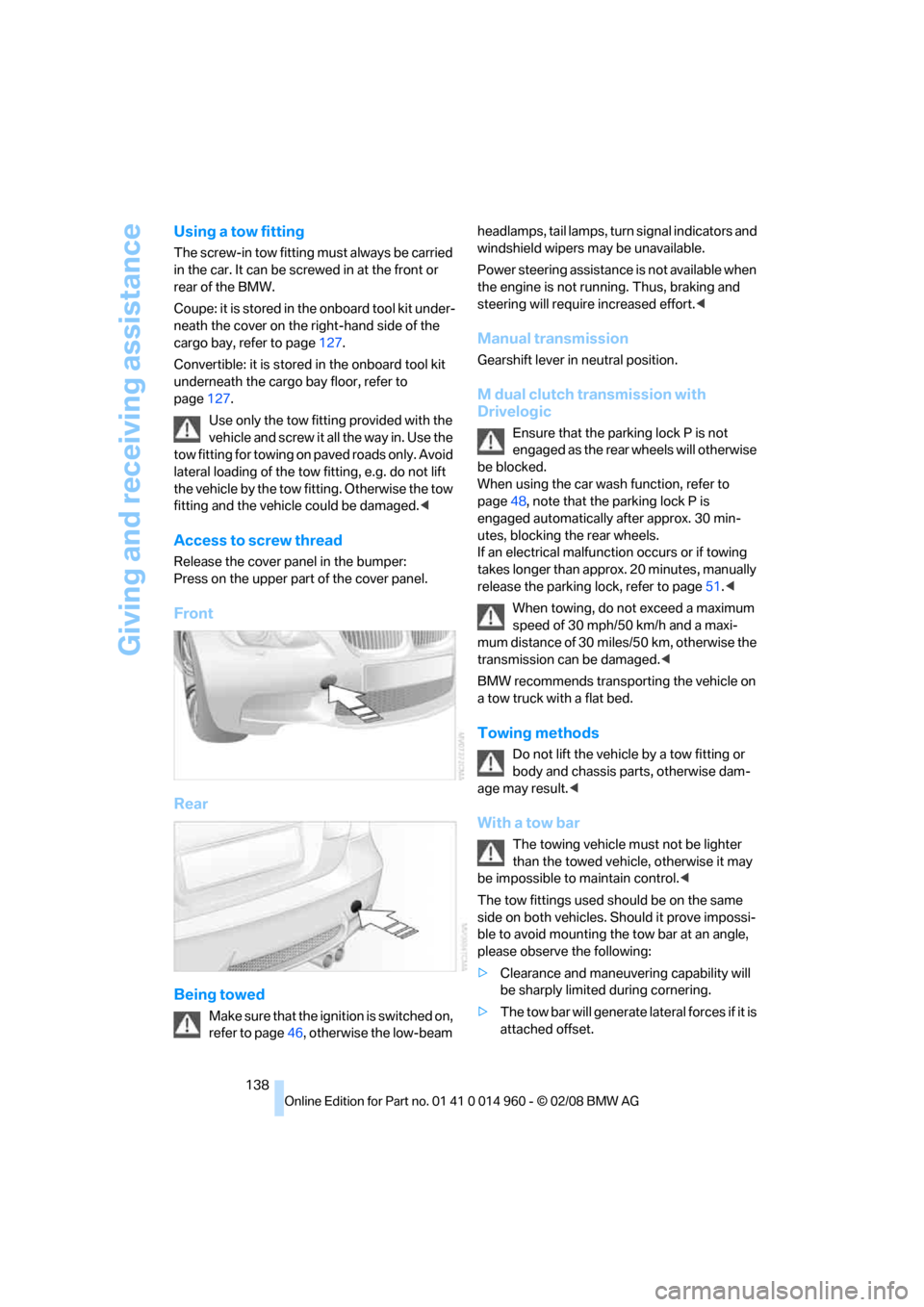
Access to screw thread
Release the cover panel in the bumper:
Press on the upper part of the cover panel.
Front
Rear
Being towed
Make sure that the ignition is switched on,
refer to page46, otherwise the low-beam headlamps, tail lamps, turn signal indicators and
windshield wipers may be unavailable.
Power steering assistance is not available when
the engine is not running. Thus, braking and
steering will require increased effort.<
Manual transmission
Gearshift lever in neutral position.
M dual clutch transmission with
Drivelogic
Ensure that the parking lock P is not
engaged as the rear wheels will otherwise
be blocked.
When using the car wash function, refer to
page48, note that the parking lock P is
engaged automatically after approx. 30 min-
utes, blocking the rear wheels.
If an electrical malfunction occurs or if towing
takes longer than approx. 20 minutes, manually
release the parking lock, refer to page51.<
When towing, do not exceed a maximum
speed of 30 mph/50 km/h and a maxi-
mum distance of 30 miles/50 km, otherwise the
transmission can be damaged.<
BMW recommends transporting the vehicle on
a tow truck with a flat bed.
Towing methods
Do not lift the vehicle by a tow fitting or
body and chassis parts, otherwise dam-
age may result.<
With a tow bar
The towing vehicle must not be lighter
than the towed vehicle, otherwise it may
be impossible to maintain control.<
The tow fittings used should be on the same
side on both vehicles. Should it prove impossi-
ble to avoid mounting the tow bar at an angle,
please observe the following:
>Clearance and maneuvering capability will
be sharply limited during cornering.
>The tow bar will generate lateral forces if it is
attached offset.
Page 159 of 172
Reference
At a glance
Controls
Driving tips
Mobility
157
Belt hand-over41
Belts, refer to Safety belts40
Belt tensioner, refer to Safety
belts40
Beverage holders, refer to
Cup holders89
Blinds, refer to Roller sun
blinds87
Blower, refer to Air flow
rate81
Bluetooth, refer to separate
Owner's Manual
BMW
– car shampoo125
BMW Homepage4
BMW Maintenance
System121
BMW webpage4
Bottle holders, refer to Cup
holders89
Brake assist68
Brake fluid, refer to Service
requirements63
Brake Force Display72
– bulb change130
Brake lamps
– replacing bulb129
– two-stage72
Brake pads98
– breaking in98
Brake rotors99
– brakes98
– breaking in98
Brakes
– ABS68
– BMW Maintenance
System121
– breaking in98
– parking brake48
– service requirements63
Brakes, refer to Braking
safely99
Brake system98
– BMW Maintenance
System121
– breaking in98
– disc brakes99
Breakdown services, refer to
Roadside Assistance135Breaking in the clutch98
Breaking in the differential,
refer to Engine and
differential98
Break-in period98
Bulb changing, refer to Lamps
and bulbs127
Button for starting the engine,
refer to Start/stop button46
Buttons on the steering
wheel11
C
California Proposition 65
warning6
Can holders, refer to Cup
holders89
Capacities155
Capacity of the cargo bay155
Car battery, refer to Vehicle
battery133
Car care, refer to Care123
Care123
– automatic car washes123
– care products123
– carpets125
– CD/DVD drives126
– chrome parts124
– displays125
– exterior123
– fine wood parts125
– headlamps124
– high-pressure washer123
– interior125
– leather125
– light-alloy wheels125
– paintwork124
– plastic parts125
– retractable hardtop124
– rubber seals124
– safety belts125
– sensors and cameras125
– upholstery and cloth
trim125
– washing the car
manually124
– windows124
– wiper blades124Cargo, securing101
Cargo bay
– capacity155
– convenient access27
– folding up the floor panel93
– lamp, refer to Interior
lamps79
– opening from inside24
– opening from outside24
Cargo loading
– securing cargo101
– stowing cargo101
– vehicle100
Car jack
– jacking points133
Car key, refer to Remote
control18
Car phone
– installation location, refer to
Center armrest88
– refer to separate Owner's
Manual
Car shampoo125
Car wash
– before driving into48
Catalytic converter, refer to
Hot exhaust system98
CBS Condition Based
Service121
Center armrest88
Center brake lamp
– replacing bulb131
Center console, refer to
Around the center
console14
Central locking
– from inside23
– from outside19
Central locking system19
– convenient access27
– hotel function25
Changes, technical, refer to
For your own safety5
Changing bulbs, refer to
Lamps and bulbs127
Changing wheels133
Chassis number, refer to
Engine compartment117
Check Control65
Page 161 of 172
Reference
At a glance
Controls
Driving tips
Mobility
159
Doors, emergency
operation22
DOT Quality Grades112
Draft-free ventilation83
Drinks holders, refer to Cup
holders89
Drivelogic52
Drive mode50
Drive-off assistance, refer to
Dynamic Stability Control
DSC68
Drive-off assistant69
Drive position, engaging, refer
to Selector lever
positions49
Drive programs, refer to
Drivelogic52
Driving lamps, refer to Parking
lamps/low beams76
Driving notes98
Driving off on hills, refer to
Drive-off assistant69
Driving stability control
systems67
Driving through water99
Driving tips, refer to Driving
notes98
Dry air, refer to Cooling
function82
DSC Dynamic Stability
Control68
Dynamic Stability Control
DSC
– indicator/warning lamp68
E
EDC, refer to Electronic
Damper Control68
Electric
– seat adjustment36
Electrical malfunction
– door lock22
– driver's door22
– fuel filler door108
– glass roof30
– luggage compartment lid24
– M dual clutch transmission
with Drivelogic51Electric seat36
Electric seat adjustment36
Electric steering wheel lock
– with convenient access27
Electronic brake-force
distribution68
Electronic Damper Control
EDC68
– "Comfort"69
– "Normal"69
– "Sport"69
Electronic oil level check117
Electronic Stability Program
ESP, refer to Dynamic
Stability Control DSC68
Emergency operation
– fuel filler door, manual
release108
Emergency operation, refer to
Closing manually
– glass roof30
Emergency operation, refer to
Manual operation
– door lock22
Emergency release
– luggage compartment lid
from inside25
Emergency Request135
Emergency services, refer to
Roadside Assistance135
Engine
– breaking in98
– data152
– overheated, refer to Coolant
temperature60
– speed152
– starting47
– starting, convenient
access27
– switching off47
Engine compartment117
Engine coolant, refer to
Coolant119Engine oil
– adding118
– BMW Maintenance
System121
– checking level117
– intervals between changes,
refer to Service
requirements63
– possible displays118
Engine output, refer to Engine
data152
Engine speed, refer to Engine
data152
Engine starting, refer to
Starting the engine47
Entry lamps, refer to Interior
lamps79
Error messages, refer to
Check Control65
Event data recorders122
Exhaust system, refer to Hot
exhaust system98
Exterior mirrors41
– adjusting41
– automatic dimming
feature42
– automatic heating42
– folding in and out41
External audio device88
Eyes
– for tow-starting and towing
away138
– for tying down loads101
F
Failure messages, refer to
Check Control65
Failure of an electrical
consumer133
False alarm
– avoiding unintentional
alarm26
– switching off an alarm26
Fastening safety belts, refer to
Safety belts40
Page 162 of 172
Everything from A to Z
160 Filter
– refer to Microfilter/activated-
charcoal filter for automatic
climate control83
First aid pouch136
Fixture for remote control,
refer to Ignition lock46
Flashlight, refer to LED hand
lamp88
Flash when locking/
unlocking21
Flat tire
– Tire Pressure Monitor
TPM70
Flat tire, repairing131
Flat Tire Monitor FTM69
– indicating a flat tire70
– indicator/warning lamp70
– initializing the system69
– malfunction70
– snow chains69,115
– system limits69
Flat tires, refer to Tire
condition113
Fluid reservoir, refer to
Washer fluid reservoir57
Folding in the mirrors, before
driving into a car wash41
Folding up the floor panel93
Footbrake, refer to Braking
safely99
Footwell lamps, refer to
Interior lamps79
Forward position, engaging,
refer to Selector lever
positions49
For your own safety5
Front airbags72
FTM, refer to Flat Tire
Monitor69
Fuel109
– average consumption61
– gauge60
– high-quality brands109
– quality109
– specifications109
– tank contents, refer to
Capacities155Fuel clock, refer to Fuel
gauge60
Fuel display, refer to Fuel
gauge60
Fuel filler door108
– releasing in the event of
electrical malfunction108
Fuses133
G
Garage door opener, refer to
Integrated universal remote
control84
Gasoline
– refer to Average
consumption61
Gasoline, refer to Required
fuel109
Gasoline display, refer to Fuel
gauge60
Gasoline engine, checking
engine oil level117
Gear
– neutral50
Gear change51
Gear display, refer to Displays
in the instrument cluster51
Gearshift lever
– manual transmission48
Gearshifts
– manual transmission48
General driving notes98
Glass roof, electric30
– closing after electrical
malfunction30
– convenient operation20,22
– initializing30
– opening, closing30
– operation with convenient
access27
– pinch protection system30
– power failure30
– raising30
– remote control20
Glove compartment87
– LED hand lamp88
Grills80Gross vehicle weight, refer to
Weights155
H
Handbrake, refer to Parking
brake48
Hand lamp, refer to LED hand
lamp88
Hands-free system14
Hazard warning flashers14
Head airbags72
Headlamp control,
automatic76
Headlamp flasher55
– indicator lamp11,14,140
Head restraints37
– front, removing37
– rear, removing38
– sitting safely35
Heated
– mirrors42
– rear window82
– seats38
Heating
– mirrors42
– rear window82
– residual heat82
– seats38
Heating and ventilation, refer
to Climate80
Heating while at a standstill,
refer to Using residual
heat82
Heavy loads, refer to Stowing
cargo101
Height, refer to
Dimensions153
Height adjustment
– seats36
– steering wheel42
High beams78
– headlamp flasher78
– indicator lamp140
High-pressure
washer123,124
High water, refer to Driving
through water99
Hills99
Page 164 of 172
Everything from A to Z
162 Luggage compartment lid24
– convenient access27
– emergency operation, refer
to Opening manually24
– emergency release25
– locking or unlocking
separately25
– opening from inside24
– opening from outside24
– opening manually24
– remote control20
Luggage rack, refer to Roof-
mounted luggage rack102
Lumbar support36
M
M+S tires, refer to Winter
tires114
Maintenance, refer to Service
Booklet
Maintenance system121
Malfunction
– luggage compartment lid24
– tires70
Malfunction warnings, refer to
Check Control65
Manual car wash124
Manual operation
– door lock22
– driver's door22
– fuel filler door108
– glass roof30
– luggage compartment lid24
– transmission lock51
Manual transmission48
– tow-starting139
Master key, refer to Remote
control18
Maximum cooling81
Maximum speed
– with winter tires114M dual clutch transmission
with Drivelogic49
– kick-down50
– Launch Control53
– neutral50
– reverse gear50
– sequential mode50
– Shift Lights52
– shiftlock50
– tow-starting139
– unlocking transmission lock
manually51
Measurements, refer to
Dimensions153
Memory, refer to Seat and
mirror memory39
M Engine Dynamics
Control54
Microfilter
– BMW Maintenance
System121
– for automatic climate
control83
Microfilter/activated-charcoal
filter
– BMW Maintenance
System121
Microphone
– telephone14
– voice input14
Mirror dimming feature42
Mirrors41
– automatic curb monitor42
– exterior mirrors41
– heating42
– interior rearview mirror42
– memory, refer to Seat and
mirror memory
39
M Mobility Set131
Mobile phone
– installation location, refer to
Center armrest88
– refer to separate Owner's
Manual
Mobile phone, installation
location, refer to Center
armrest88
Mobile phone, refer to the
separate Owner's ManualModifications, technical, refer
to For your own safety5
Monitoring system for tire
pressures, refer to Flat Tire
Monitor69
Multifunctional steering
wheel, refer to Buttons on
the steering wheel11
Multifunction switch
– refer to Turn signals/
headlamp flasher55
– refer to Wiper system56
N
Neck support, refer to Head
restraints37
Nets, refer to Storage
compartments89
Neutral50
New tires113
"Normal"54
"Normal" with EDC69
Nozzles80
Number of cylinders, refer to
Engine data152
Nylon rope, refer to Tow
rope139
O
OBD socket, refer to Socket
for On-Board Diagnosis122
Octane ratings, refer to Fuel
specifications109
Odometer59
Oil, refer to Engine oil117
Oil consumption117
Oil level117
Old batteries, refer to
Disposal133
Onboard tool kit127
Opening and closing
– convenient access27
– from inside23
– from outside19
– using the door lock22
– via the remote control19
Page 165 of 172
Reference
At a glance
Controls
Driving tips
Mobility
163
Outlets
– refer to Ventilation83
Output, refer to Engine
data152
Outside-air mode
– automatic climate control82
Outside temperature
display59
– changing units of
measure62
– in computer62
Outside temperature
warning59
Overheated engine, refer to
Coolant temperature60
P
Paintwork care124
Park assistant, refer to Park
Distance Control67
Park Distance Control PDC67
Parking
– vehicle47
Parking aid, refer to Park
Distance Control PDC67
Parking brake48
– indicator lamp48
Parking lamps76
Parking lamps/low beams76
Passenger-side mirror tilt
function42
Pathway lighting76
Personal Profile18
Pinch protection system
– glass roof, electric30
– windows29
Placing a call, refer to
telephone owner's manual
Polish125
Pollen
– refer to Microfilter/activated-
charcoal filter for automatic
climate control83
Power failure133
Power windows28
Power windows, refer to
Windows28
Pressure, tires110Pressure monitoring, tires69
– Flat Tire Monitor69
Pressure monitoring of tires,
refer to Tire Pressure
Monitor TPM70
Programmable buttons on the
steering wheel11
Protection function, refer to
Pinch protection system
– glass roof, electric30
– windows29
Providing medical assistance,
refer to First aid pouch136
Puncture
– Flat Tire Monitor69
R
Radio
– refer to separate Owner's
Manual
Radio-operated key, refer to
Remote control18
Radio position, refer to Radio
readiness46
Radio readiness46
– switched off47
– switched on46
Rain sensor56
Reading lamps79
Rear lamps, refer to Tail
lamps129
– replacing bulb129
Rear seats
– adjusting head restraints38
– folding down backrests91
Rear turn signals
– replacing bulb129
Rear ventilation83
Rearview mirror, refer to
Mirrors41
Rear window defroster82
Rear window roller blind, refer
to Roller sun blinds87
Recirculated-air mode82
Recirculation of air, refer to
Recirculated-air mode82
Reclining seat, refer to
Backrest36Refueling108
Releasing
– hood116
Remaining distance, refer to
Cruising range61
Remote control18
– battery renewal28
– convenient access27
– garage door opener84
– luggage compartment lid20
– malfunction22,28
– removing from the ignition
lock46
– service data121
Replacement remote
control18
Replacing bulbs, refer to
Lamps and bulbs127
Replacing tires113
Replacing tires, refer to New
wheels and tires113
Reporting safety defects6
Reserve warning, refer to Fuel
gauge60
Residual heat82
Restraint systems
– for children44
– refer to Safety belts40
Retractable hardtop31
– convenient operation
20
– opening and closing32
– remote control20
Reverse gear50
– manual transmission49
Roadside Assistance135
Roadside parking lamps78
Roadworthiness test, refer to
Service requirements63
Roller sun blinds87
Rollover protection system,
convertible74
– resetting74
Roof load capacity155
Roof-mounted luggage
rack102
Rope, refer to Tow-starting,
towing away139