EDC BMW M3 COUPE 2008 E92 Owner's Manual
[x] Cancel search | Manufacturer: BMW, Model Year: 2008, Model line: M3 COUPE, Model: BMW M3 COUPE 2008 E92Pages: 172, PDF Size: 5.29 MB
Page 17 of 172
At a glance
Controls
Driving tips
Mobility Reference
15
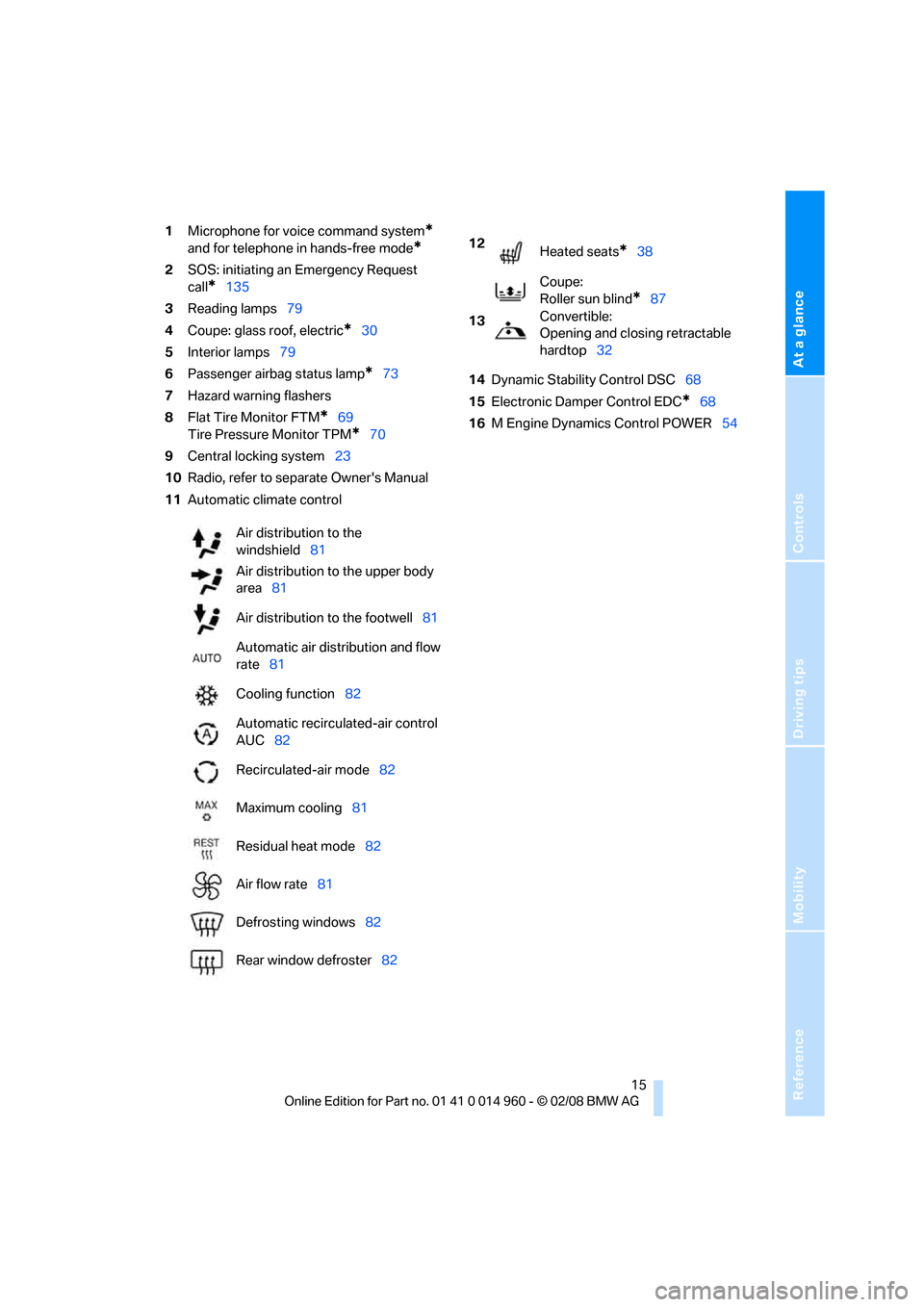
1Microphone for voice command system*
and for telephone in hands-free mode*
2SOS: initiating an Emergency Request
call
*135
3Reading lamps79
4Coupe: glass roof, electric
*30
5Interior lamps79
6Passenger airbag status lamp
*73
7Hazard warning flashers
8Flat Tire Monitor FTM
*69
Tire Pressure Monitor TPM
*70
9Central locking system23
10Radio, refer to separate Owner's Manual
11Automatic climate control14Dynamic Stability Control DSC68
15Electronic Damper Control EDC
*68
16M Engine Dynamics Control POWER54
Air distribution to the
windshield81
Air distribution to the upper body
area81
Air distribution to the footwell81
Automatic air distribution and flow
rate81
Cooling function82
Automatic recirculated-air control
AUC82
Recirculated-air mode82
Maximum cooling81
Residual heat mode82
Air flow rate81
Defrosting windows82
Rear window defroster82
12
Heated seats*38
Coupe:
Roller sun blind
*87
13Convertible:
Opening and closing retractable
hardtop32
Page 70 of 172
Technology for driving comfort and safety
68
Antilock Brake System ABS
ABS prevents locking of the wheels during
braking. Safe steering response is maintained
even during full braking. Active safety is thus
increased.
The ABS is operational every time you start the
engine. Braking safely, refer to page99.
Electronic brake-force distribution
The system controls the brake pressure in the
rear wheels to ensure stable braking behavior.
Brake assist
When you apply the brakes rapidly, this system
automatically produces the maximum braking
force boost and thus helps to achieve the short-
est possible braking distance during full brak-
ing. This system exploits all of the benefits pro-
vided by ABS.
Do not reduce the pressure on the brake for the
duration of the full braking application.
Dynamic Stability Control DSC
DSC optimizes driving stability and traction. In
addition, the system recognizes unstable driv-
ing situations such as understeering and over-
steering, and helps keep the vehicle on a safe
course within physical limits by reducing engine
power and applying the brakes on individual
wheels.
The laws of physics cannot be repealed,
even with DSC. An appropriate driving
style always remains the responsibility of the
driver. Therefore, do not reduce the additional
safety margin again by taking risks, as this could
result in an accident.<
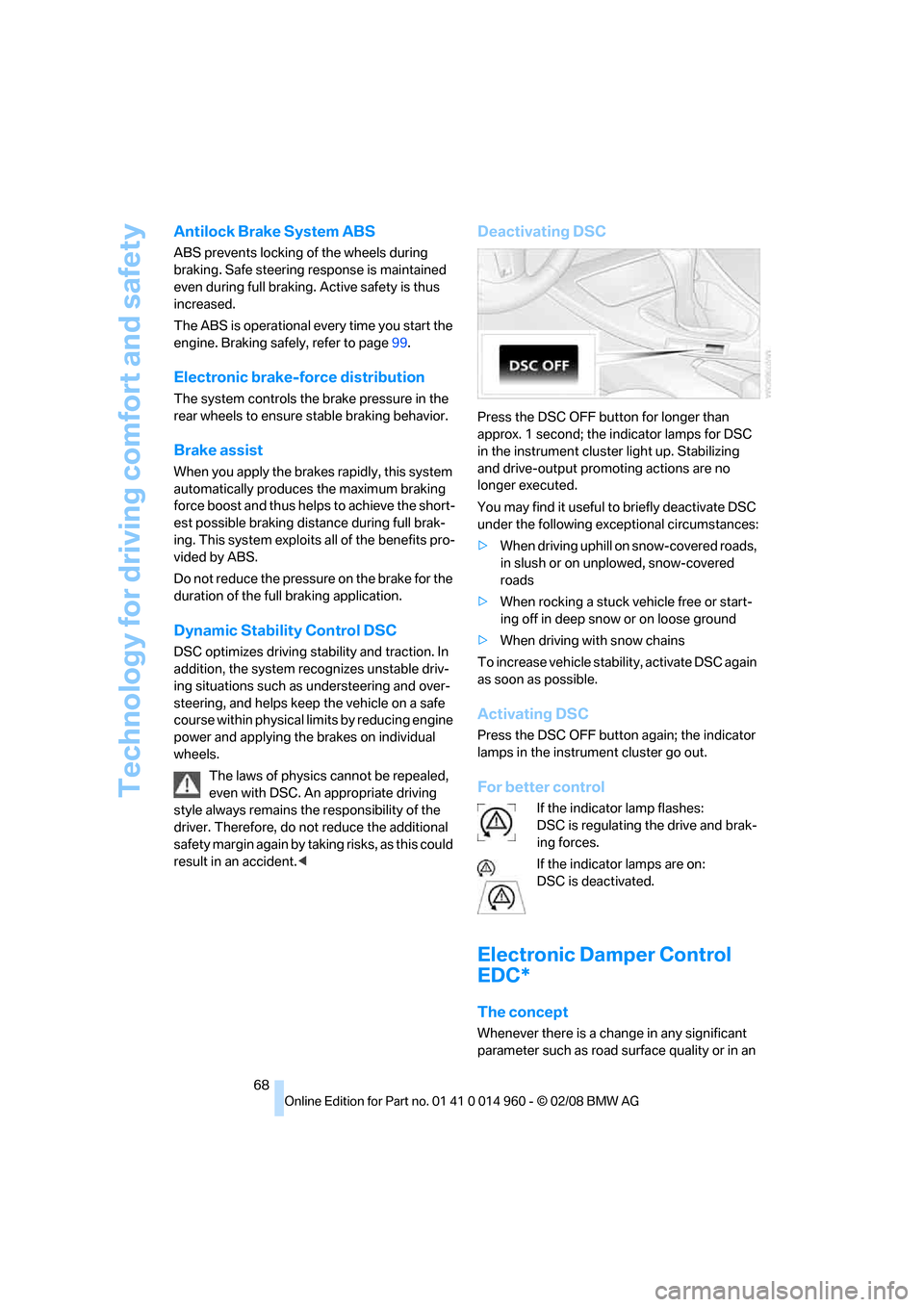
Deactivating DSC
Press the DSC OFF button for longer than
approx. 1 second; the indicator lamps for DSC
in the instrument cluster light up. Stabilizing
and drive-output promoting actions are no
longer executed.
You may find it useful to briefly deactivate DSC
under the following exceptional circumstances:
>When driving uphill on snow-covered roads,
in slush or on unplowed, snow-covered
roads
>When rocking a stuck vehicle free or start-
ing off in deep snow or on loose ground
>When driving with snow chains
To increase vehicle stability, activate DSC again
as soon as possible.
Activating DSC
Press the DSC OFF button again; the indicator
lamps in the instrument cluster go out.
For better control
If the indicator lamp flashes:
DSC is regulating the drive and brak-
ing forces.
If the indicator lamps are on:
DSC is deactivated.
Electronic Damper Control
EDC*
The concept
Whenever there is a change in any significant
parameter such as road surface quality or in an
Page 71 of 172
Reference
At a glance
Controls
Driving tips
Mobility
69
operating condition such as steering, braking,
etc., the damping automatically adjusts to the
new conditions in fractions of a second.
You can select between three programs.
"Comfort" program
Select the "Comfort" program if you want com-
fort-oriented control of the shock absorbers.
"Normal" program
The "Normal" program offers control that is bal-
anced between comfort and sportiness.
"Sport" program
Select the "Sport" program if you want consis-
tently sporty control of the shock absorbers.
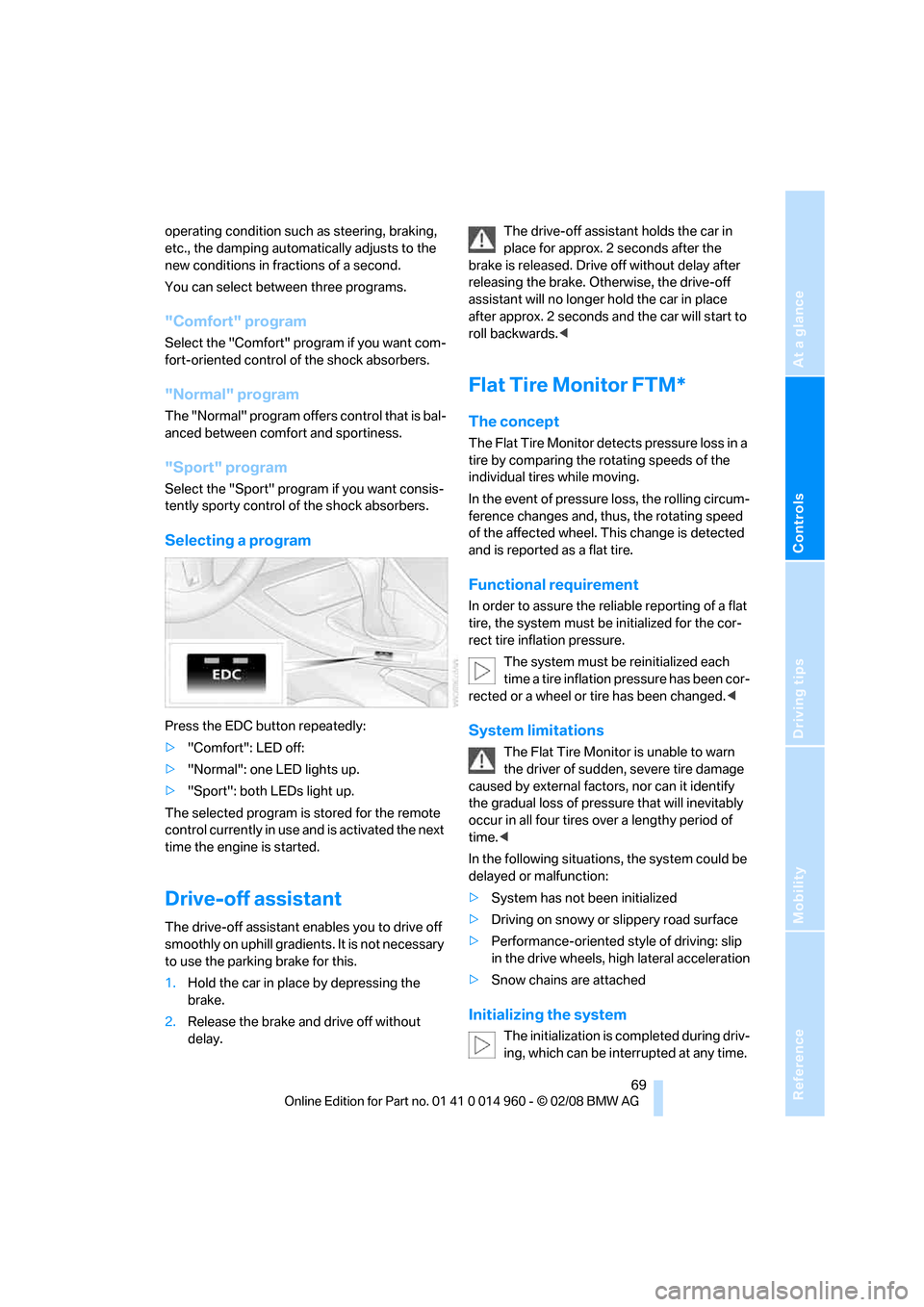
Selecting a program
Press the EDC button repeatedly:
>"Comfort": LED off:
>"Normal": one LED lights up.
>"Sport": both LEDs light up.
The selected program is stored for the remote
control currently in use and is activated the next
time the engine is started.
Drive-off assistant
The drive-off assistant enables you to drive off
smoothly on uphill gradients. It is not necessary
to use the parking brake for this.
1.Hold the car in place by depressing the
brake.
2.Release the brake and drive off without
delay.The drive-off assistant holds the car in
place for approx. 2 seconds after the
brake is released. Drive off without delay after
releasing the brake. Otherwise, the drive-off
assistant will no longer hold the car in place
after approx. 2 seconds and the car will start to
roll backwards.<
Flat Tire Monitor FTM*
The concept
The Flat Tire Monitor detects pressure loss in a
tire by comparing the rotating speeds of the
individual tires while moving.
In the event of pressure loss, the rolling circum-
ference changes and, thus, the rotating speed
of the affected wheel. This change is detected
and is reported as a flat tire.
Functional requirement
In order to assure the reliable reporting of a flat
tire, the system must be initialized for the cor-
rect tire inflation pressure.
The system must be reinitialized each
time a tire inflation pressure has been cor-
rected or a wheel or tire has been changed.<
System limitations
The Flat Tire Monitor is unable to warn
the driver of sudden, severe tire damage
caused by external factors, nor can it identify
the gradual loss of pressure that will inevitably
occur in all four tires over a lengthy period of
time.<
In the following situations, the system could be
delayed or malfunction:
>System has not been initialized
>Driving on snowy or slippery road surface
>Performance-oriented style of driving: slip
in the drive wheels, high lateral acceleration
>Snow chains are attached
Initializing the system
The initialization is completed during driv-
ing, which can be interrupted at any time.
Page 100 of 172
Things to remember when driving
98
Things to remember when driving
Break-in period
Moving parts need breaking-in time to adjust to
each other. Please follow the instructions below
in order to achieve the optimal service life and
economy of operation for your vehicle.
Engine and differential
Always obey all official speed limits.
Up to 1,200 miles/2,000 km
Drive at varying engine and road speeds, but do
not exceed an engine speed of 5,500 rpm or a
road speed of 105 mph/170 km/h.
Do not depress the accelerator all the way.
From 1,200 miles/2,000 km to
3,000 miles/5,000 km
Engine and road speeds can be increased grad-
ually up to a traveling speed of 135 mph/
220 km/h. Use the maximum speed only for
brief intervals, e. g. when passing.
Transmission
The transmission begins functioning at an opti-
mal level only after a distance of approx.
300 miles/500 km. Do not exceed engine
speeds of 5,500 rpm during this period.
Tires
Due to technical factors associated with their
manufacture, tires do not achieve their full trac-
tion potential until after an initial break-in
period. Therefore, drive cautiously during the
first 200 miles/300 km.
Brake system
Brakes require an initial break-in period of
approx. 300 miles/500 km to achieve optimized
contact and wear patterns between brake pads
and rotors. Drive cautiously during this break-in
period.
Clutch
The function of the clutch reaches its optimal
level only after a distance driven of approx.
300 miles/500 km. During this break-in period,
engage the clutch gently.
Following part replacement
The same break-in procedures should be
observed if any of the components mentioned
above have to be renewed in the course of the
vehicle's operating life.
General driving notes
Clearance
Mind the limited clearance of the BMW
M3, e. g. when driving into underground
parking garages or over obstacles. If equipped
with EDC
*, select the "Sport" program, refer to
page68, when driving off curbs to keep clear-
ance as even as possible. Otherwise the vehicle
may be damaged.<
Close the luggage compartment lid
Operate the vehicle only when the lug-
gage compartment lid is closed. Other-
wise, exhaust fumes could enter the interior of
the vehicle.<
If the vehicle must be driven with the luggage
compartment lid open:
1.Close all windows and the glass roof.
2.Greatly increase the air volume of the auto-
matic climate control system, refer to
page81.
Hot exhaust system
In all vehicles, extremely high tempera-
tures are generated in the exhaust sys-
tem. Do not remove the heat shields installed
adjacent to various sections of the exhaust sys-
tem, and never apply undercoating to them.
When driving, standing at idle and while park-
Page 160 of 172
Everything from A to Z
158 Child-restraint fixing system
LATCH45
Child-restraint systems44
Child seats, refer to
Transporting children
safely44
Chrome parts125
Chrome polish125
Cigarette lighter, refer to
Lighter90
Cleaning headlamps56
– washer fluid57
Cleaning your BMW, refer to
Care123
Clock59
– 12h/24h format62
– setting time64
Closing
– from inside23
– from outside19
Clothes hooks89
Cockpit10
Cold start, refer to Starting the
engine47
Combined instrument, refer to
Instrument cluster12
Comfort access, refer to
Convenient access27
Comfort area, refer to Around
the center console14
"Comfort" with EDC69
Compartment for remote
control, refer to Ignition
lock46
Compass86
Computer60
Condensation, refer to When
the vehicle is parked100
Condition Based Service
CBS121
Configuring settings, refer to
Personal Profile18
Confirmation signals for
locking/unlocking the
vehicle21
Connecting vacuum cleaner,
refer to Connecting
electrical appliances90Consumption, refer to
Average consumption61
Consumption indicator, refer
to Average consumption61
Controls and displays10
Convenient access27
– replacing the battery28
Convenient loading in
convertible21
Convenient operation
– glass roof20
– glass roof with convenient
access27
– retractable hardtop20
– windows20
– windows with convenient
access27
Convertible
– bag holder92
– convenient loading21
– enlarging cargo bay91
– folding down rear
backrest92
– retractable hardtop31
– rollover protection
system74
– securing cargo101
Coolant119
– checking level119
Coolant temperature60
Cooling, maximum81
Cooling fluid, refer to
Coolant119
Cooling system, refer to
Coolant119
Copyright2
Corner-illuminating lamps,
refer to Adaptive Head
Light77
Cornering lamps, refer to
Adaptive Head Light77
Correct tires114
Courtesy lamps, refer to
Interior lamps79
Cruise control57
Cruising range61
Cup holders89
Curb weight, refer to
Weights155
D
Dashboard, refer to
Cockpit10
Dashboard, refer to
Instrument cluster12
Dashboard lighting, refer to
Instrument lighting78
Data, technical152
– dimensions153
– engine152
– weights155
Date
– setting64
Daytime running lamps77
Deactivating front passenger
airbags73
Deadlocking, refer to
Locking20
Defect
– door lock22
– fuel filler door108
– glass roof30
Digital clock59
Digital compass86
Dimensions153
Directional indicators, refer to
Turn signals55
Displacement, refer to Engine
data152
Display lighting, refer to
Instrument lighting78
Displays, refer to Instrument
cluster12
Displays and controls10
Disposal
– coolant119
– remote control battery28
– vehicle battery133
Distance remaining to service,
refer to Service
requirements63
Distance warning, refer to
Park Distance Control
PDC67
Door key, refer to Remote
control18
Door lock22
Page 161 of 172
Reference
At a glance
Controls
Driving tips
Mobility
159
Doors, emergency
operation22
DOT Quality Grades112
Draft-free ventilation83
Drinks holders, refer to Cup
holders89
Drivelogic52
Drive mode50
Drive-off assistance, refer to
Dynamic Stability Control
DSC68
Drive-off assistant69
Drive position, engaging, refer
to Selector lever
positions49
Drive programs, refer to
Drivelogic52
Driving lamps, refer to Parking
lamps/low beams76
Driving notes98
Driving off on hills, refer to
Drive-off assistant69
Driving stability control
systems67
Driving through water99
Driving tips, refer to Driving
notes98
Dry air, refer to Cooling
function82
DSC Dynamic Stability
Control68
Dynamic Stability Control
DSC
– indicator/warning lamp68
E
EDC, refer to Electronic
Damper Control68
Electric
– seat adjustment36
Electrical malfunction
– door lock22
– driver's door22
– fuel filler door108
– glass roof30
– luggage compartment lid24
– M dual clutch transmission
with Drivelogic51Electric seat36
Electric seat adjustment36
Electric steering wheel lock
– with convenient access27
Electronic brake-force
distribution68
Electronic Damper Control
EDC68
– "Comfort"69
– "Normal"69
– "Sport"69
Electronic oil level check117
Electronic Stability Program
ESP, refer to Dynamic
Stability Control DSC68
Emergency operation
– fuel filler door, manual
release108
Emergency operation, refer to
Closing manually
– glass roof30
Emergency operation, refer to
Manual operation
– door lock22
Emergency release
– luggage compartment lid
from inside25
Emergency Request135
Emergency services, refer to
Roadside Assistance135
Engine
– breaking in98
– data152
– overheated, refer to Coolant
temperature60
– speed152
– starting47
– starting, convenient
access27
– switching off47
Engine compartment117
Engine coolant, refer to
Coolant119Engine oil
– adding118
– BMW Maintenance
System121
– checking level117
– intervals between changes,
refer to Service
requirements63
– possible displays118
Engine output, refer to Engine
data152
Engine speed, refer to Engine
data152
Engine starting, refer to
Starting the engine47
Entry lamps, refer to Interior
lamps79
Error messages, refer to
Check Control65
Event data recorders122
Exhaust system, refer to Hot
exhaust system98
Exterior mirrors41
– adjusting41
– automatic dimming
feature42
– automatic heating42
– folding in and out41
External audio device88
Eyes
– for tow-starting and towing
away138
– for tying down loads101
F
Failure messages, refer to
Check Control65
Failure of an electrical
consumer133
False alarm
– avoiding unintentional
alarm26
– switching off an alarm26
Fastening safety belts, refer to
Safety belts40
Page 164 of 172
Everything from A to Z
162 Luggage compartment lid24
– convenient access27
– emergency operation, refer
to Opening manually24
– emergency release25
– locking or unlocking
separately25
– opening from inside24
– opening from outside24
– opening manually24
– remote control20
Luggage rack, refer to Roof-
mounted luggage rack102
Lumbar support36
M
M+S tires, refer to Winter
tires114
Maintenance, refer to Service
Booklet
Maintenance system121
Malfunction
– luggage compartment lid24
– tires70
Malfunction warnings, refer to
Check Control65
Manual car wash124
Manual operation
– door lock22
– driver's door22
– fuel filler door108
– glass roof30
– luggage compartment lid24
– transmission lock51
Manual transmission48
– tow-starting139
Master key, refer to Remote
control18
Maximum cooling81
Maximum speed
– with winter tires114M dual clutch transmission
with Drivelogic49
– kick-down50
– Launch Control53
– neutral50
– reverse gear50
– sequential mode50
– Shift Lights52
– shiftlock50
– tow-starting139
– unlocking transmission lock
manually51
Measurements, refer to
Dimensions153
Memory, refer to Seat and
mirror memory39
M Engine Dynamics
Control54
Microfilter
– BMW Maintenance
System121
– for automatic climate
control83
Microfilter/activated-charcoal
filter
– BMW Maintenance
System121
Microphone
– telephone14
– voice input14
Mirror dimming feature42
Mirrors41
– automatic curb monitor42
– exterior mirrors41
– heating42
– interior rearview mirror42
– memory, refer to Seat and
mirror memory
39
M Mobility Set131
Mobile phone
– installation location, refer to
Center armrest88
– refer to separate Owner's
Manual
Mobile phone, installation
location, refer to Center
armrest88
Mobile phone, refer to the
separate Owner's ManualModifications, technical, refer
to For your own safety5
Monitoring system for tire
pressures, refer to Flat Tire
Monitor69
Multifunctional steering
wheel, refer to Buttons on
the steering wheel11
Multifunction switch
– refer to Turn signals/
headlamp flasher55
– refer to Wiper system56
N
Neck support, refer to Head
restraints37
Nets, refer to Storage
compartments89
Neutral50
New tires113
"Normal"54
"Normal" with EDC69
Nozzles80
Number of cylinders, refer to
Engine data152
Nylon rope, refer to Tow
rope139
O
OBD socket, refer to Socket
for On-Board Diagnosis122
Octane ratings, refer to Fuel
specifications109
Odometer59
Oil, refer to Engine oil117
Oil consumption117
Oil level117
Old batteries, refer to
Disposal133
Onboard tool kit127
Opening and closing
– convenient access27
– from inside23
– from outside19
– using the door lock22
– via the remote control19
Page 166 of 172
Everything from A to Z
164
S
Safety-belt height
adjustment40
Safety belts40
– belt hand-over41
– damage40
– indicator/warning lamp40
– reminder40
– sitting safely35
Safety systems
– airbags72
– Antilock Brake System
ABS67
– brake system68
– driving stability control
systems67
– Dynamic Stability Control
DSC68
– rollover protection system,
convertible74
– safety belts40
Screw thread for tow
fitting138
Sealant, filling132
Seat adjustment
– electric36
– mechanical36
Seat and mirror memory39
Seat belt reminder, refer to
'Fasten safety belts'
reminder40
Seat heating38
Seats35
– adjusting electrically36
– adjusting the seats36
– heating38
– memory, refer to Seat and
mirror memory39
– saving a setting, refer to Seat
and mirror memory39
– sitting safely35
Securing cargo93,95
Securing the vehicle
– from inside23
– from outside19
Selector lever positions49Sequential M Gearbox with
Drivelogic
– Drivelogic drive programs52
Sequential mode50
Service, refer to Roadside
Assistance135
Service car, refer to Roadside
Assistance135
Service data in the remote
control121
Service Interval Display, refer
to Condition Based Service
CBS121
Service requirement display,
refer to Condition Based
Service CBS121
Service requirements63
Settings
– clock, 12h/24h format62
Settings and information61
Shifting51
Shifting gears
– manual transmission48
Shift lever49
Shift Lights52
Shiftlock50
Shift paddles on steering
wheel51
Shift-up display, refer to Shift
Lights52
Shock absorber control, refer
to Electronic Damper
Control EDC68
Side airbags72
Side windows, refer to
Windows28
Signal horn, refer to
Horn10,11
Sitting safely35
– with airbags35
– with head restraint35
– with safety belts35
Ski bag93
Ski bag for convertible, refer to
Through-loading opening
with integrated transport
bag94
Sliding/tilt sunroof, refer to
Glass roof, electric30Slot for remote control46
Smokers' package, refer to
Ashtray90
Snap-in adapter, refer to
Center armrest storage
compartment88
Snow chains115
Socket, On-Board Diagnosis
OBD122
Socket, refer to Connecting
electrical appliances90
SOS, refer to Sending an
Emergency Request135
Spare fuses,133
Spare fuses, refer to
Fuses133
Speed
– with winter tires114
Speedometer12
"Sport"54
"Sport" with EDC69
Spray nozzles, refer to
Cleaning windshield and
headlamps56
Stability control, refer to
Driving stability control
systems67
Start/stop button46
– starting the engine47
– switching off the engine47
Starting, refer to Starting the
engine47
Starting assistance, refer to
Jump starting136
Starting difficulties
– jump starting136
Starting the engine
– start/stop button46
Status of this Owner's Manual
at time of printing5
Steam jet123,124
Steering wheel42
– adjustment42
– buttons on steering
wheel11
– lock46
– locking with convenient
access27
– shift paddles51