trunk BMW M4 2015 Owner's Manual
[x] Cancel search | Manufacturer: BMW, Model Year: 2015, Model line: M4, Model: BMW M4 2015Pages: 228, PDF Size: 4.87 MB
Page 172 of 228
RefuelingVehicle features and options
This chapter describes all standard, country-
specific and optional features offered with the
series. It also describes features that are not
necessarily available in your car, e. g., due to
the selected options or country versions. This
also applies to safety-related functions and
systems. The respectively applicable country
provisions must be observed when using the
respective features and systems.
Hints Observe the fuel recommendation, refer to
page 170, prior to refueling.
Refuel promptly
Refuel no later than at a range of
30 miles/50 km or engine operation might fail
and damage might occur.◀
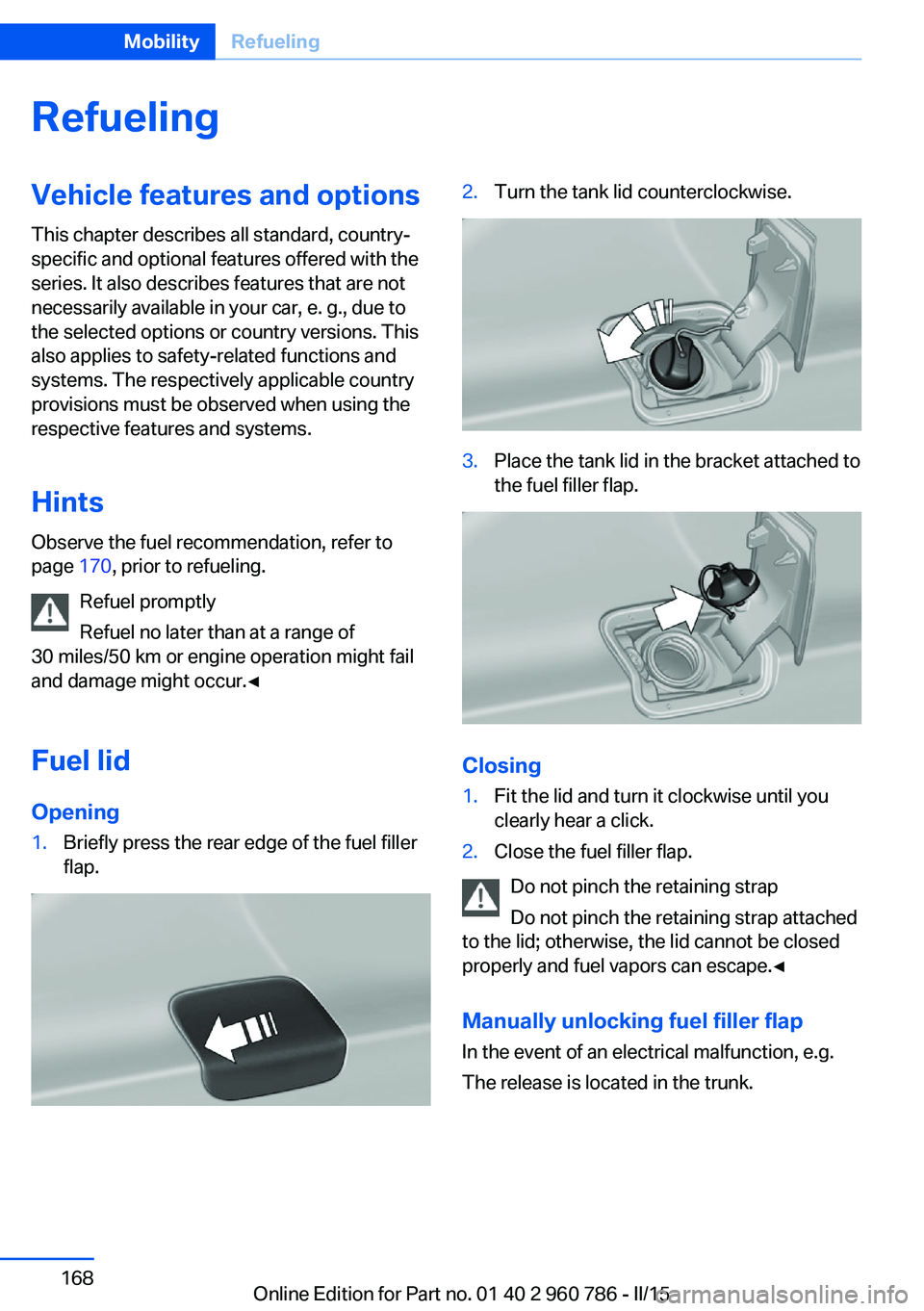
Fuel lid Opening1.Briefly press the rear edge of the fuel filler
flap.2.Turn the tank lid counterclockwise.3.Place the tank lid in the bracket attached to
the fuel filler flap.
Closing
1.Fit the lid and turn it clockwise until you
clearly hear a click.2.Close the fuel filler flap.
Do not pinch the retaining strap
Do not pinch the retaining strap attached
to the lid; otherwise, the lid cannot be closed
properly and fuel vapors can escape.◀
Manually unlocking fuel filler flap In the event of an electrical malfunction, e.g.
The release is located in the trunk.
Seite 168MobilityRefueling168
Online Edition for Part no. 01 40 2 960 786 - II/15
Page 194 of 228
Replacing componentsVehicle features and optionsThis chapter describes all standard, country-
specific and optional features offered with the
series. It also describes features that are not
necessarily available in your car, e. g., due to
the selected options or country versions. This
also applies to safety-related functions and
systems. The respectively applicable country
provisions must be observed when using the
respective features and systems.
Onboard vehicle tool kit
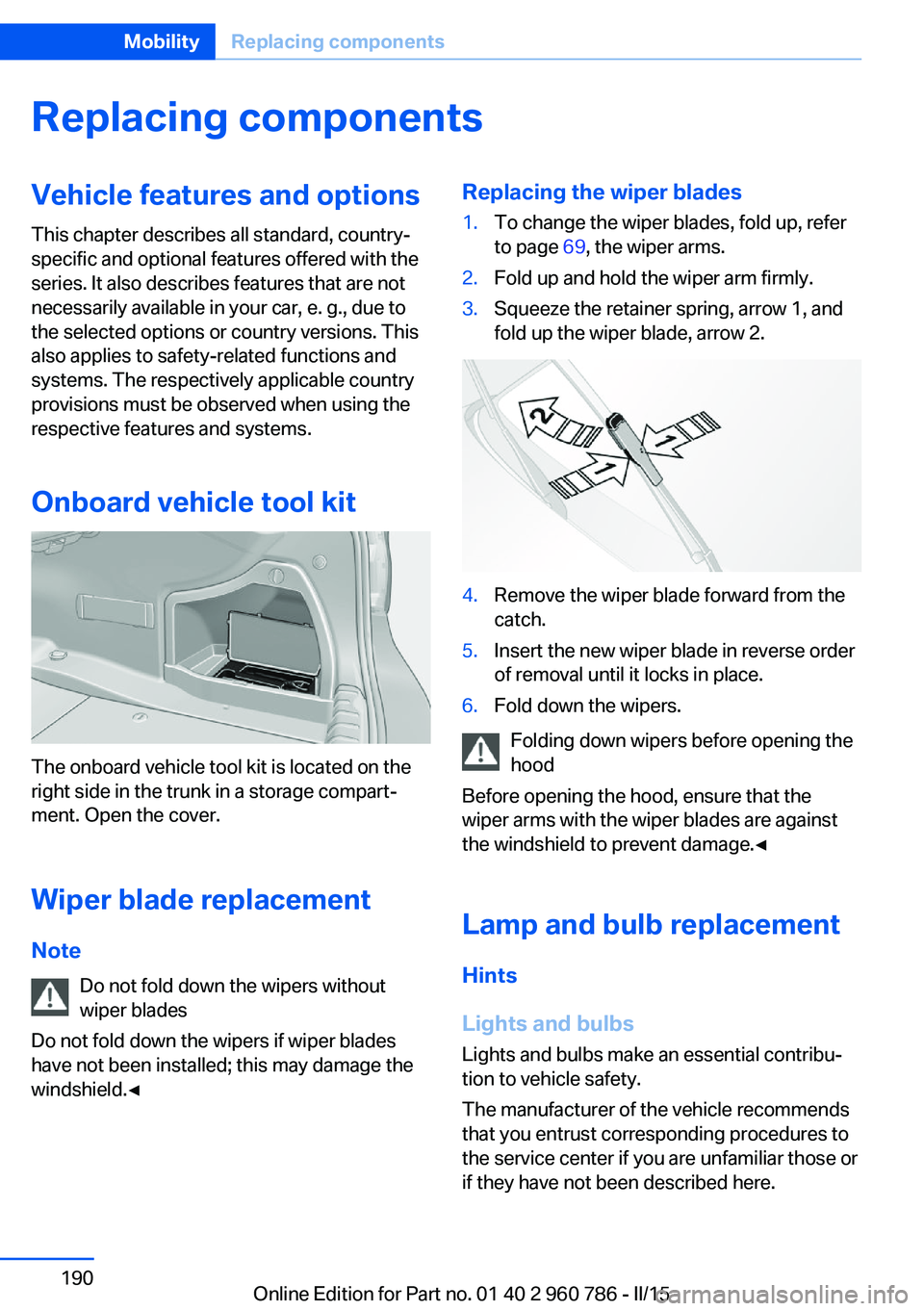
The onboard vehicle tool kit is located on the
right side in the trunk in a storage compart‐
ment. Open the cover.
Wiper blade replacement
Note Do not fold down the wipers without
wiper blades
Do not fold down the wipers if wiper blades
have not been installed; this may damage the
windshield.◀
Replacing the wiper blades1.To change the wiper blades, fold up, refer
to page 69, the wiper arms.2.Fold up and hold the wiper arm firmly.3.Squeeze the retainer spring, arrow 1, and
fold up the wiper blade, arrow 2.4.Remove the wiper blade forward from the
catch.5.Insert the new wiper blade in reverse order
of removal until it locks in place.6.Fold down the wipers.
Folding down wipers before opening the hood
Before opening the hood, ensure that the
wiper arms with the wiper blades are against
the windshield to prevent damage.◀
Lamp and bulb replacement
Hints
Lights and bulbs Lights and bulbs make an essential contribu‐
tion to vehicle safety.
The manufacturer of the vehicle recommends
that you entrust corresponding procedures to
the service center if you are unfamiliar those or
if they have not been described here.
Seite 190MobilityReplacing components190
Online Edition for Part no. 01 40 2 960 786 - II/15
Page 197 of 228
Contact your service center in the event of a
malfunction.
Turn signal in exterior mirrorFollow general instructions, refer to page 190.
The turn signals in the exterior mirrors feature
LED technology. Contact your service center in the event of a malfunction.
Tail lights, bulb replacement
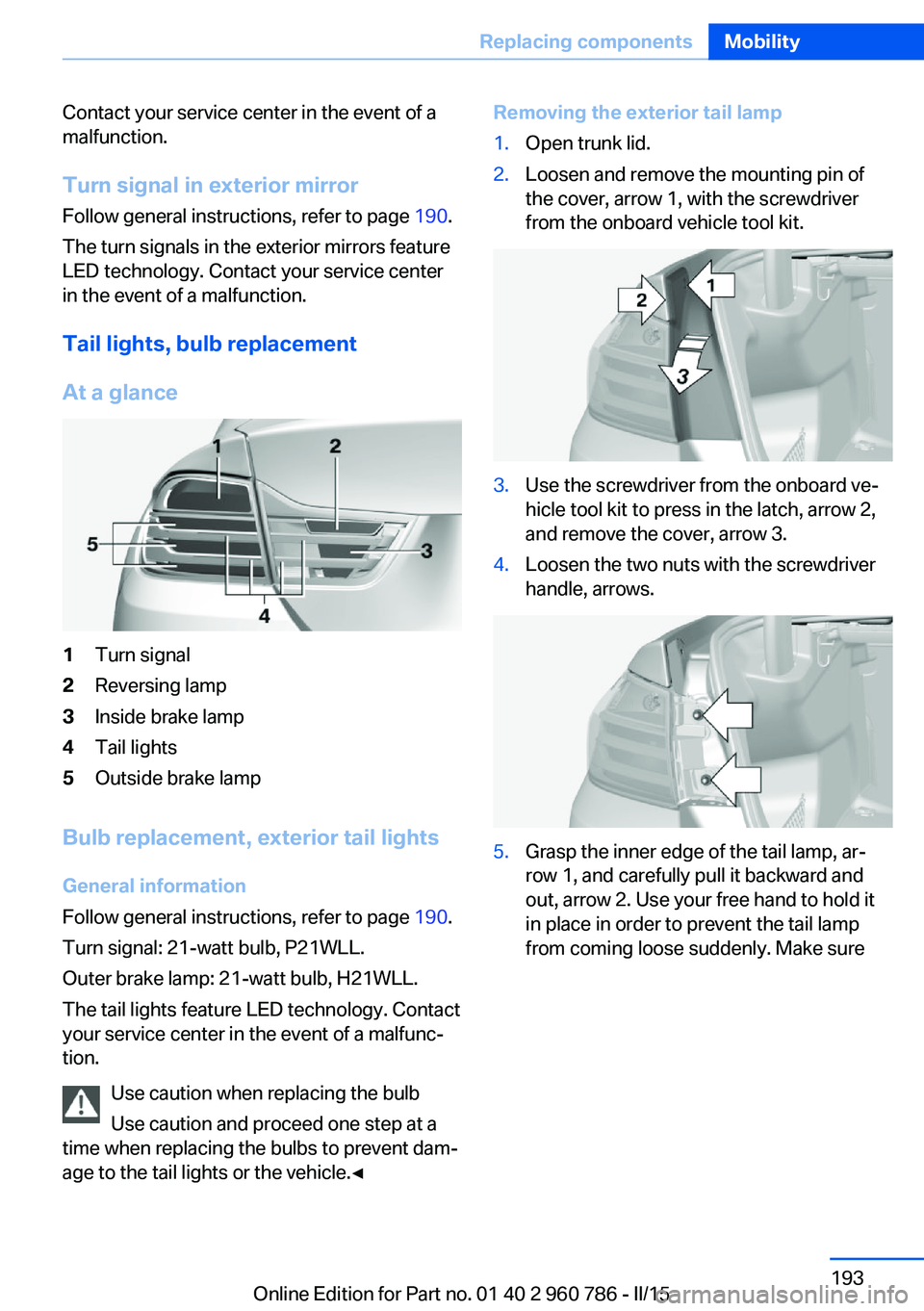
At a glance1Turn signal2Reversing lamp3Inside brake lamp4Tail lights5Outside brake lamp
Bulb replacement, exterior tail lights General information
Follow general instructions, refer to page 190.
Turn signal: 21-watt bulb, P21WLL.
Outer brake lamp: 21-watt bulb, H21WLL.
The tail lights feature LED technology. Contact
your service center in the event of a malfunc‐
tion.
Use caution when replacing the bulb
Use caution and proceed one step at a
time when replacing the bulbs to prevent dam‐
age to the tail lights or the vehicle.◀
Removing the exterior tail lamp1.Open trunk lid.2.Loosen and remove the mounting pin of
the cover, arrow 1, with the screwdriver
from the onboard vehicle tool kit.3.Use the screwdriver from the onboard ve‐
hicle tool kit to press in the latch, arrow 2,
and remove the cover, arrow 3.4.Loosen the two nuts with the screwdriver
handle, arrows.5.Grasp the inner edge of the tail lamp, ar‐
row 1, and carefully pull it backward and
out, arrow 2. Use your free hand to hold it
in place in order to prevent the tail lamp
from coming loose suddenly. Make sureSeite 193Replacing componentsMobility193
Online Edition for Part no. 01 40 2 960 786 - II/15
Page 198 of 228
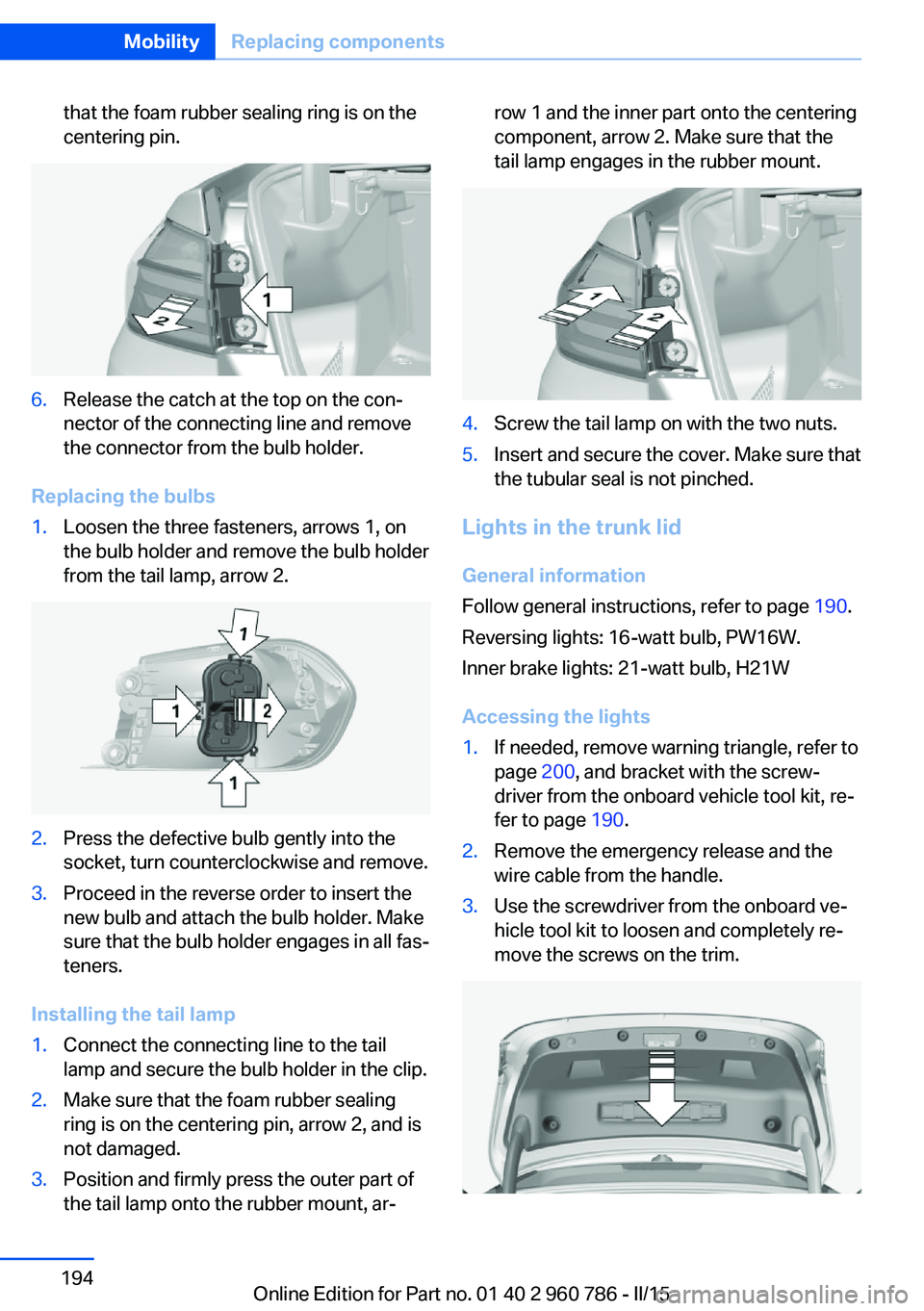
that the foam rubber sealing ring is on the
centering pin.6.Release the catch at the top on the con‐
nector of the connecting line and remove
the connector from the bulb holder.
Replacing the bulbs
1.Loosen the three fasteners, arrows 1, on
the bulb holder and remove the bulb holder
from the tail lamp, arrow 2.2.Press the defective bulb gently into the
socket, turn counterclockwise and remove.3.Proceed in the reverse order to insert the
new bulb and attach the bulb holder. Make
sure that the bulb holder engages in all fas‐
teners.
Installing the tail lamp
1.Connect the connecting line to the tail
lamp and secure the bulb holder in the clip.2.Make sure that the foam rubber sealing
ring is on the centering pin, arrow 2, and is
not damaged.3.Position and firmly press the outer part of
the tail lamp onto the rubber mount, ar‐row 1 and the inner part onto the centering
component, arrow 2. Make sure that the
tail lamp engages in the rubber mount.4.Screw the tail lamp on with the two nuts.5.Insert and secure the cover. Make sure that
the tubular seal is not pinched.
Lights in the trunk lid
General information
Follow general instructions, refer to page 190.
Reversing lights: 16-watt bulb, PW16W.
Inner brake lights: 21-watt bulb, H21W
Accessing the lights
1.If needed, remove warning triangle, refer to
page 200, and bracket with the screw‐
driver from the onboard vehicle tool kit, re‐
fer to page 190.2.Remove the emergency release and the
wire cable from the handle.3.Use the screwdriver from the onboard ve‐
hicle tool kit to loosen and completely re‐
move the screws on the trim.Seite 194MobilityReplacing components194
Online Edition for Part no. 01 40 2 960 786 - II/15
Page 199 of 228
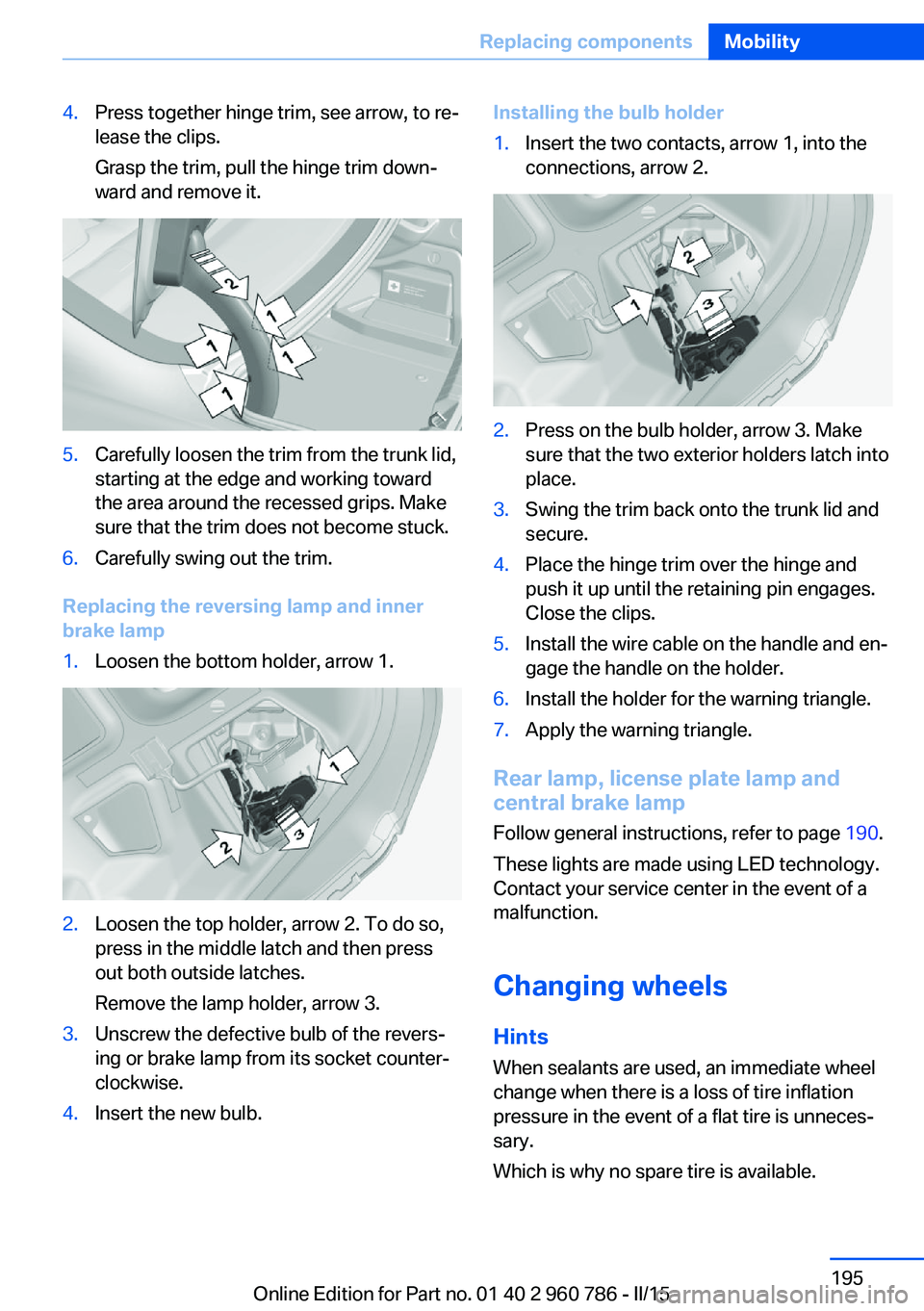
4.Press together hinge trim, see arrow, to re‐
lease the clips.
Grasp the trim, pull the hinge trim down‐
ward and remove it.5.Carefully loosen the trim from the trunk lid,
starting at the edge and working toward
the area around the recessed grips. Make
sure that the trim does not become stuck.6.Carefully swing out the trim.
Replacing the reversing lamp and inner
brake lamp
1.Loosen the bottom holder, arrow 1.2.Loosen the top holder, arrow 2. To do so,
press in the middle latch and then press
out both outside latches.
Remove the lamp holder, arrow 3.3.Unscrew the defective bulb of the revers‐
ing or brake lamp from its socket counter‐
clockwise.4.Insert the new bulb.Installing the bulb holder1.Insert the two contacts, arrow 1, into the
connections, arrow 2.2.Press on the bulb holder, arrow 3. Make
sure that the two exterior holders latch into
place.3.Swing the trim back onto the trunk lid and
secure.4.Place the hinge trim over the hinge and
push it up until the retaining pin engages.
Close the clips.5.Install the wire cable on the handle and en‐
gage the handle on the holder.6.Install the holder for the warning triangle.7.Apply the warning triangle.
Rear lamp, license plate lamp and
central brake lamp
Follow general instructions, refer to page 190.
These lights are made using LED technology.
Contact your service center in the event of a
malfunction.
Changing wheels
Hints When sealants are used, an immediate wheel
change when there is a loss of tire inflation
pressure in the event of a flat tire is unneces‐
sary.
Which is why no spare tire is available.
Seite 195Replacing componentsMobility195
Online Edition for Part no. 01 40 2 960 786 - II/15
Page 201 of 228
Disposing of old batteriesHave old batteries disposed of by your
service center or bring them to a recy‐
cling center.
Fuses Hints Replacing fuses
Never attempt to repair a blown fuse and
do not replace a defective fuse with a substi‐
tute of another color or amperage rating; this could lead to a circuit overload, ultimately re‐
sulting in a fire in the vehicle.◀
Plastic tweezers and information on the fuse
types and locations are stored in the fuse box
in the trunk.
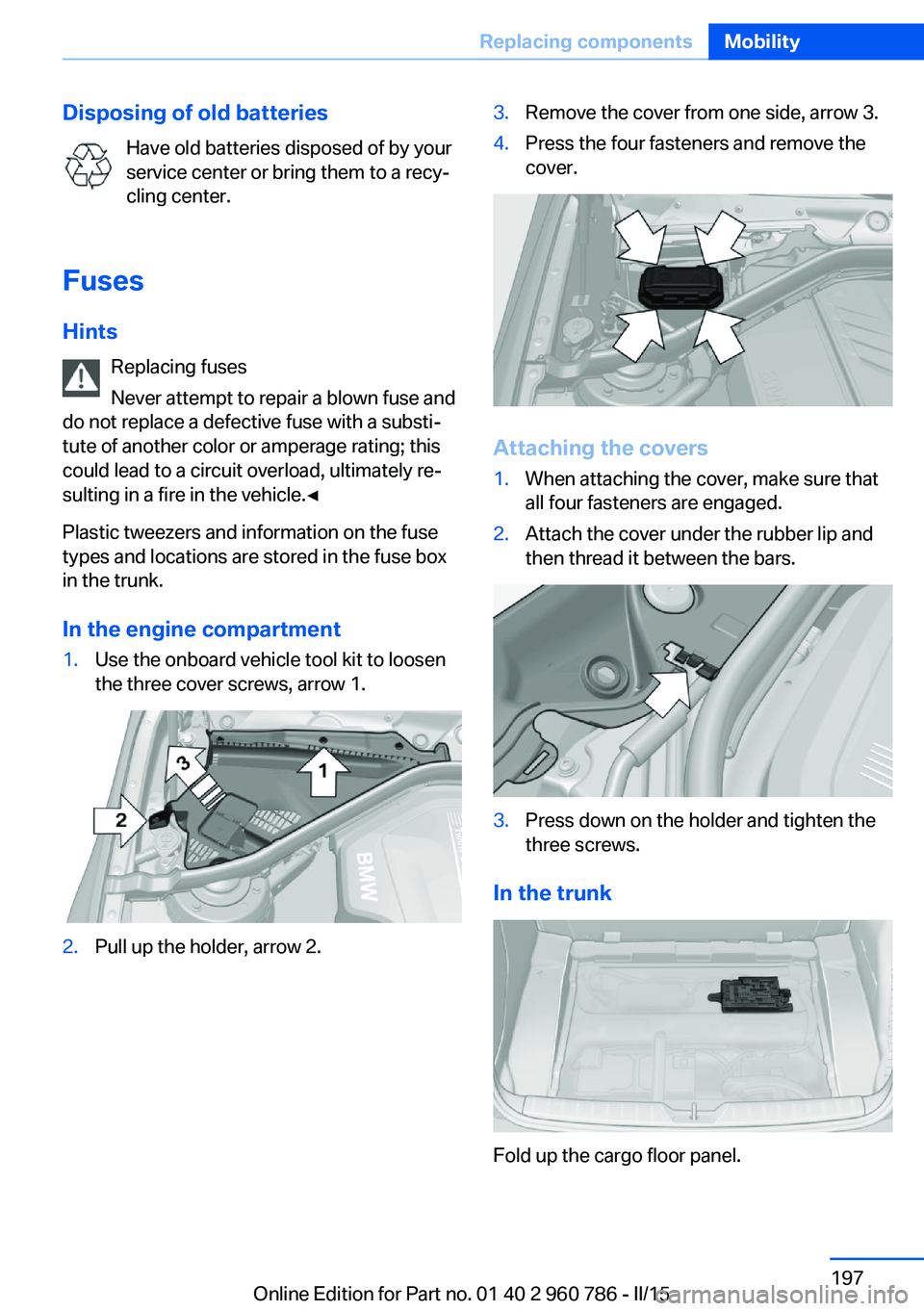
In the engine compartment1.Use the onboard vehicle tool kit to loosen
the three cover screws, arrow 1.2.Pull up the holder, arrow 2.3.Remove the cover from one side, arrow 3.4.Press the four fasteners and remove the
cover.
Attaching the covers
1.When attaching the cover, make sure that
all four fasteners are engaged.2.Attach the cover under the rubber lip and
then thread it between the bars.3.Press down on the holder and tighten the
three screws.
In the trunk
Fold up the cargo floor panel.
Seite 197Replacing componentsMobility197
Online Edition for Part no. 01 40 2 960 786 - II/15
Page 204 of 228
When the emergency request is received
at the BMW Response Center, the BMW
Response Center contacts you and takes
further steps to help you.
Even if you are unable to respond, the
BMW Response Center can take further
steps to help you under certain circum‐
stances.
For this, data are transmitted to the BMW
Response Center which serve to deter‐
mine the necessary rescue measures. E. g.
the current position of the vehicle, if it can
be established.▷If the LED is flashing green, but the BMW
Response Center can no longer be heard
via the speaker, you can nevertheless still
be heard at the BMW Response Center.
Initiating an Emergency Request
automatically
Under certain conditions, an Emergency Re‐
quest is automatically initiated immediately af‐
ter a severe accident. Automatic Collision Noti‐
fication is not affected by pressing the SOS
button.
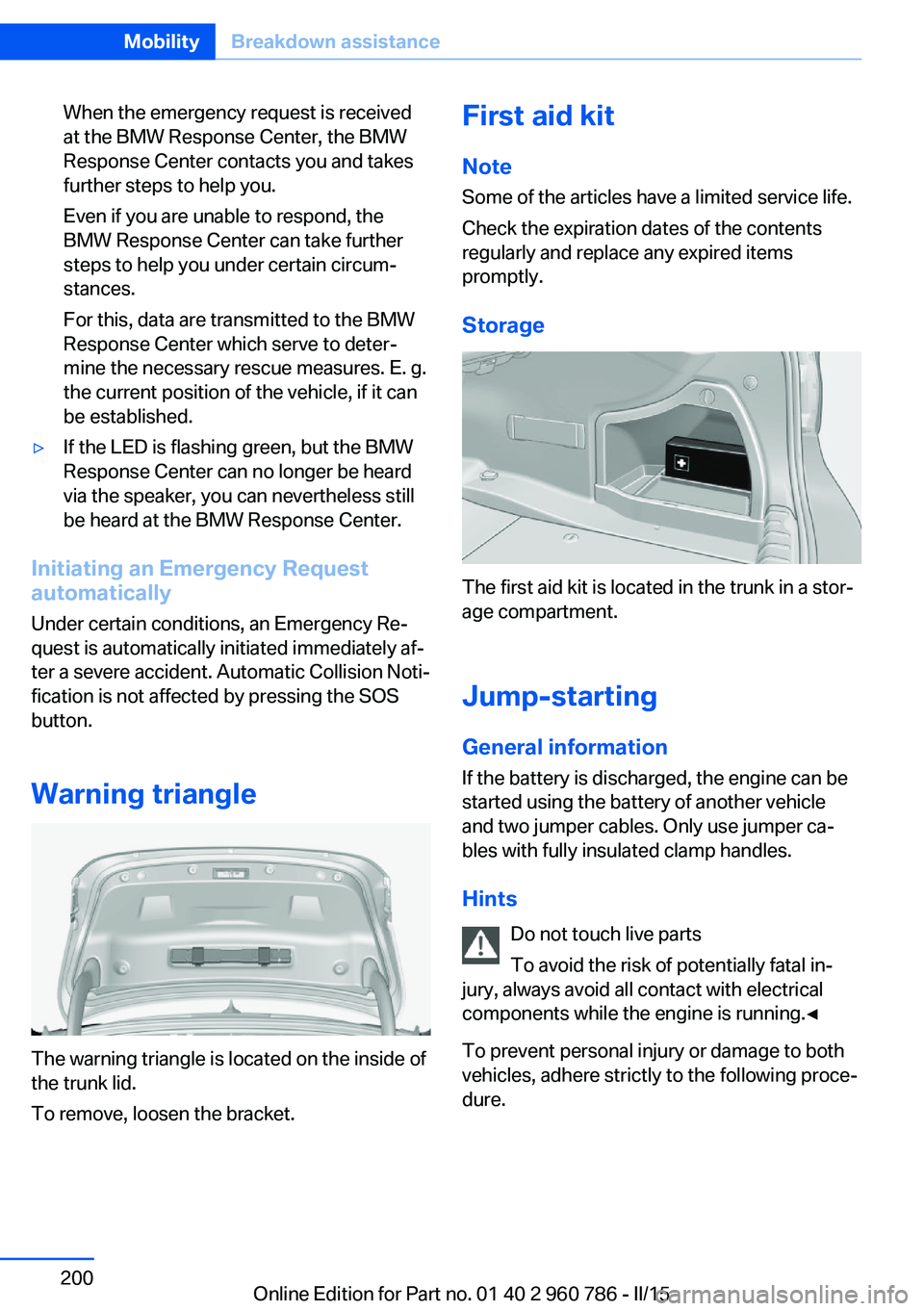
Warning triangle
The warning triangle is located on the inside of
the trunk lid.
To remove, loosen the bracket.
First aid kit
Note
Some of the articles have a limited service life.
Check the expiration dates of the contents
regularly and replace any expired items
promptly.
Storage
The first aid kit is located in the trunk in a stor‐
age compartment.
Jump-starting General information
If the battery is discharged, the engine can be
started using the battery of another vehicle
and two jumper cables. Only use jumper ca‐
bles with fully insulated clamp handles.
Hints Do not touch live parts
To avoid the risk of potentially fatal in‐
jury, always avoid all contact with electrical
components while the engine is running.◀
To prevent personal injury or damage to both
vehicles, adhere strictly to the following proce‐
dure.
Seite 200MobilityBreakdown assistance200
Online Edition for Part no. 01 40 2 960 786 - II/15
Page 207 of 228
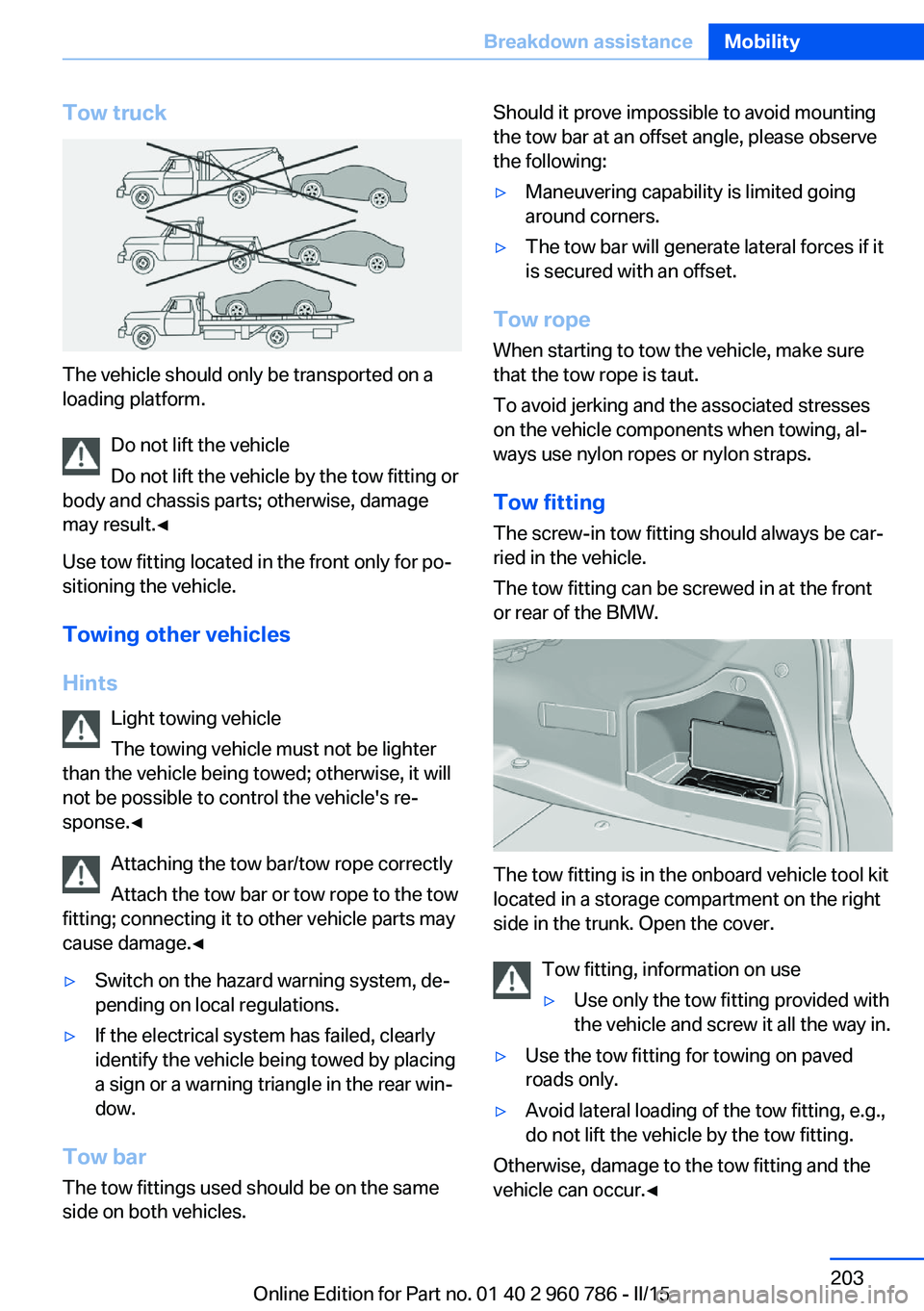
Tow truck
The vehicle should only be transported on a
loading platform.
Do not lift the vehicle
Do not lift the vehicle by the tow fitting or
body and chassis parts; otherwise, damage
may result.◀
Use tow fitting located in the front only for po‐
sitioning the vehicle.
Towing other vehicles
Hints Light towing vehicle
The towing vehicle must not be lighter
than the vehicle being towed; otherwise, it will
not be possible to control the vehicle's re‐
sponse.◀
Attaching the tow bar/tow rope correctly
Attach the tow bar or tow rope to the tow
fitting; connecting it to other vehicle parts may
cause damage.◀
▷Switch on the hazard warning system, de‐
pending on local regulations.▷If the electrical system has failed, clearly
identify the vehicle being towed by placing
a sign or a warning triangle in the rear win‐
dow.
Tow bar
The tow fittings used should be on the same
side on both vehicles.
Should it prove impossible to avoid mounting
the tow bar at an offset angle, please observe
the following:▷Maneuvering capability is limited going
around corners.▷The tow bar will generate lateral forces if it
is secured with an offset.
Tow rope
When starting to tow the vehicle, make sure
that the tow rope is taut.
To avoid jerking and the associated stresses
on the vehicle components when towing, al‐
ways use nylon ropes or nylon straps.
Tow fitting
The screw-in tow fitting should always be car‐
ried in the vehicle.
The tow fitting can be screwed in at the front
or rear of the BMW.
The tow fitting is in the onboard vehicle tool kit
located in a storage compartment on the right
side in the trunk. Open the cover.
Tow fitting, information on use
▷Use only the tow fitting provided with
the vehicle and screw it all the way in.▷Use the tow fitting for towing on paved
roads only.▷Avoid lateral loading of the tow fitting, e.g.,
do not lift the vehicle by the tow fitting.
Otherwise, damage to the tow fitting and the
vehicle can occur.◀
Seite 203Breakdown assistanceMobility203
Online Edition for Part no. 01 40 2 960 786 - II/15
Page 220 of 228
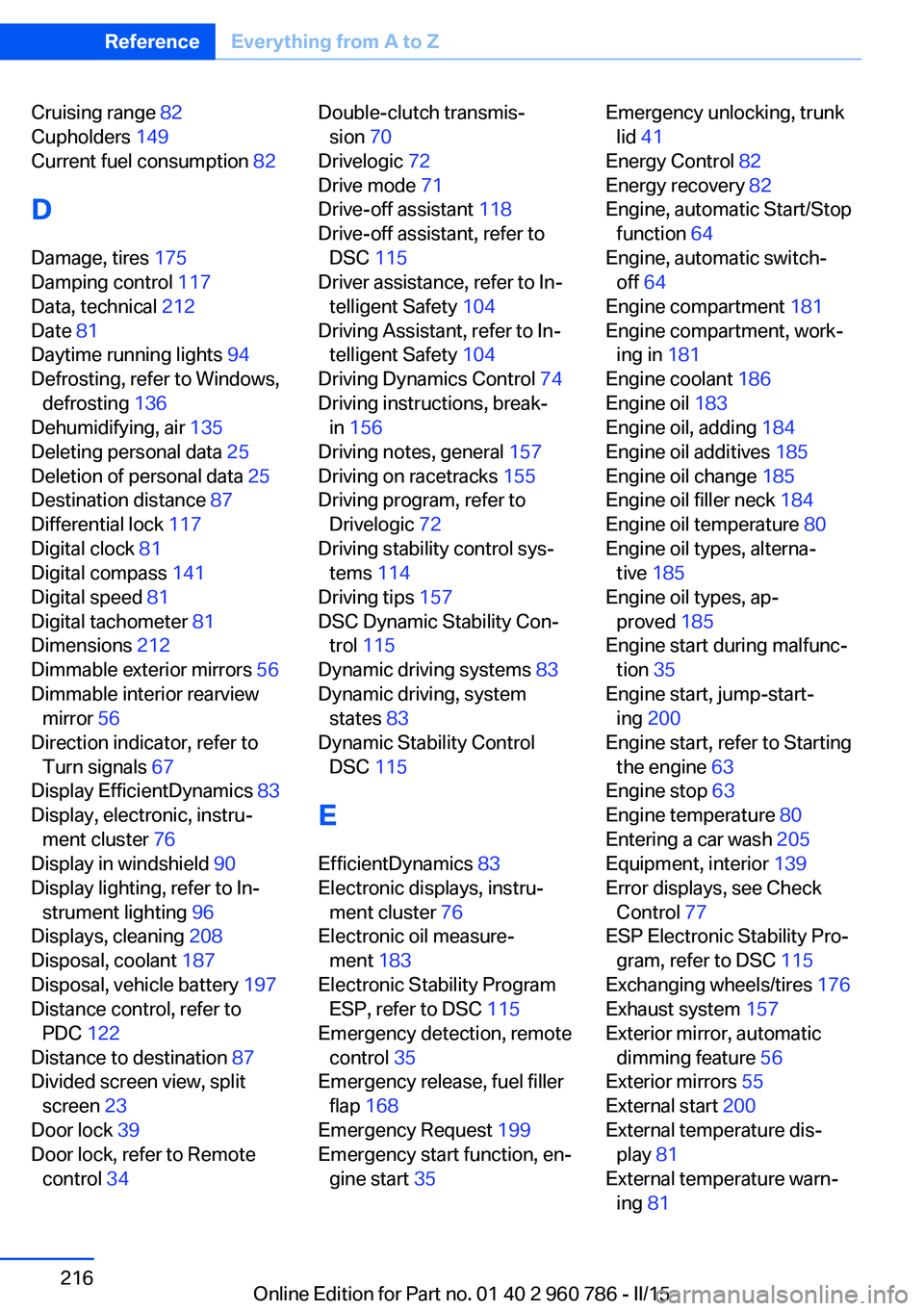
Cruising range 82
Cupholders 149
Current fuel consumption 82
D
Damage, tires 175
Damping control 117
Data, technical 212
Date 81
Daytime running lights 94
Defrosting, refer to Windows, defrosting 136
Dehumidifying, air 135
Deleting personal data 25
Deletion of personal data 25
Destination distance 87
Differential lock 117
Digital clock 81
Digital compass 141
Digital speed 81
Digital tachometer 81
Dimensions 212
Dimmable exterior mirrors 56
Dimmable interior rearview mirror 56
Direction indicator, refer to Turn signals 67
Display EfficientDynamics 83
Display, electronic, instru‐ ment cluster 76
Display in windshield 90
Display lighting, refer to In‐ strument lighting 96
Displays, cleaning 208
Disposal, coolant 187
Disposal, vehicle battery 197
Distance control, refer to PDC 122
Distance to destination 87
Divided screen view, split screen 23
Door lock 39
Door lock, refer to Remote control 34 Double-clutch transmis‐
sion 70
Drivelogic 72
Drive mode 71
Drive-off assistant 118
Drive-off assistant, refer to DSC 115
Driver assistance, refer to In‐ telligent Safety 104
Driving Assistant, refer to In‐ telligent Safety 104
Driving Dynamics Control 74
Driving instructions, break- in 156
Driving notes, general 157
Driving on racetracks 155
Driving program, refer to Drivelogic 72
Driving stability control sys‐ tems 114
Driving tips 157
DSC Dynamic Stability Con‐ trol 115
Dynamic driving systems 83
Dynamic driving, system states 83
Dynamic Stability Control DSC 115
E EfficientDynamics 83
Electronic displays, instru‐ ment cluster 76
Electronic oil measure‐ ment 183
Electronic Stability Program ESP, refer to DSC 115
Emergency detection, remote control 35
Emergency release, fuel filler flap 168
Emergency Request 199
Emergency start function, en‐ gine start 35 Emergency unlocking, trunk
lid 41
Energy Control 82
Energy recovery 82
Engine, automatic Start/Stop function 64
Engine, automatic switch- off 64
Engine compartment 181
Engine compartment, work‐ ing in 181
Engine coolant 186
Engine oil 183
Engine oil, adding 184
Engine oil additives 185
Engine oil change 185
Engine oil filler neck 184
Engine oil temperature 80
Engine oil types, alterna‐ tive 185
Engine oil types, ap‐ proved 185
Engine start during malfunc‐ tion 35
Engine start, jump-start‐ ing 200
Engine start, refer to Starting the engine 63
Engine stop 63
Engine temperature 80
Entering a car wash 205
Equipment, interior 139
Error displays, see Check Control 77
ESP Electronic Stability Pro‐ gram, refer to DSC 115
Exchanging wheels/tires 176
Exhaust system 157
Exterior mirror, automatic dimming feature 56
Exterior mirrors 55
External start 200
External temperature dis‐ play 81
External temperature warn‐ ing 81 Seite 216ReferenceEverything from A to Z216
Online Edition for Part no. 01 40 2 960 786 - II/15
Page 221 of 228
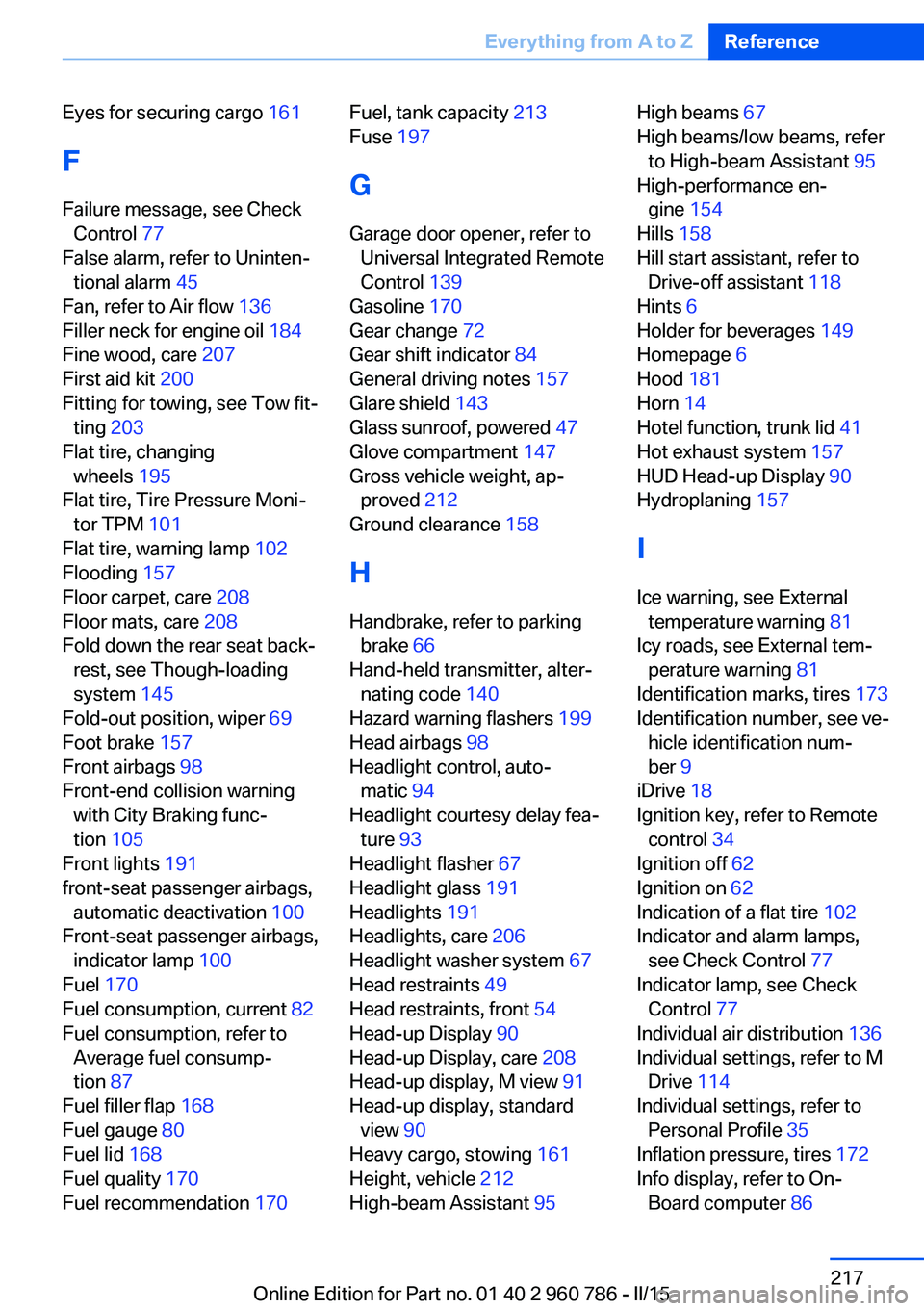
Eyes for securing cargo 161
F
Failure message, see Check Control 77
False alarm, refer to Uninten‐ tional alarm 45
Fan, refer to Air flow 136
Filler neck for engine oil 184
Fine wood, care 207
First aid kit 200
Fitting for towing, see Tow fit‐ ting 203
Flat tire, changing wheels 195
Flat tire, Tire Pressure Moni‐ tor TPM 101
Flat tire, warning lamp 102
Flooding 157
Floor carpet, care 208
Floor mats, care 208
Fold down the rear seat back‐ rest, see Though-loading
system 145
Fold-out position, wiper 69
Foot brake 157
Front airbags 98
Front-end collision warning with City Braking func‐
tion 105
Front lights 191
front-seat passenger airbags, automatic deactivation 100
Front-seat passenger airbags, indicator lamp 100
Fuel 170
Fuel consumption, current 82
Fuel consumption, refer to Average fuel consump‐
tion 87
Fuel filler flap 168
Fuel gauge 80
Fuel lid 168
Fuel quality 170
Fuel recommendation 170 Fuel, tank capacity 213
Fuse 197
G
Garage door opener, refer to Universal Integrated Remote
Control 139
Gasoline 170
Gear change 72
Gear shift indicator 84
General driving notes 157
Glare shield 143
Glass sunroof, powered 47
Glove compartment 147
Gross vehicle weight, ap‐ proved 212
Ground clearance 158
H
Handbrake, refer to parking brake 66
Hand-held transmitter, alter‐ nating code 140
Hazard warning flashers 199
Head airbags 98
Headlight control, auto‐ matic 94
Headlight courtesy delay fea‐ ture 93
Headlight flasher 67
Headlight glass 191
Headlights 191
Headlights, care 206
Headlight washer system 67
Head restraints 49
Head restraints, front 54
Head-up Display 90
Head-up Display, care 208
Head-up display, M view 91
Head-up display, standard view 90
Heavy cargo, stowing 161
Height, vehicle 212
High-beam Assistant 95 High beams 67
High beams/low beams, refer to High-beam Assistant 95
High-performance en‐ gine 154
Hills 158
Hill start assistant, refer to Drive-off assistant 118
Hints 6
Holder for beverages 149
Homepage 6
Hood 181
Horn 14
Hotel function, trunk lid 41
Hot exhaust system 157
HUD Head-up Display 90
Hydroplaning 157
I Ice warning, see External temperature warning 81
Icy roads, see External tem‐ perature warning 81
Identification marks, tires 173
Identification number, see ve‐ hicle identification num‐
ber 9
iDrive 18
Ignition key, refer to Remote control 34
Ignition off 62
Ignition on 62
Indication of a flat tire 102
Indicator and alarm lamps, see Check Control 77
Indicator lamp, see Check Control 77
Individual air distribution 136
Individual settings, refer to M Drive 114
Individual settings, refer to Personal Profile 35
Inflation pressure, tires 172
Info display, refer to On- Board computer 86 Seite 217Everything from A to ZReference217
Online Edition for Part no. 01 40 2 960 786 - II/15