tow BMW M5 SEDAN 2002 User Guide
[x] Cancel search | Manufacturer: BMW, Model Year: 2002, Model line: M5 SEDAN, Model: BMW M5 SEDAN 2002Pages: 154, PDF Size: 2.17 MB
Page 115 of 154
115n
OverviewControlsMaintenanceRepairsDataIndex
Washer fluids Engine oilHeadlamp and windshield
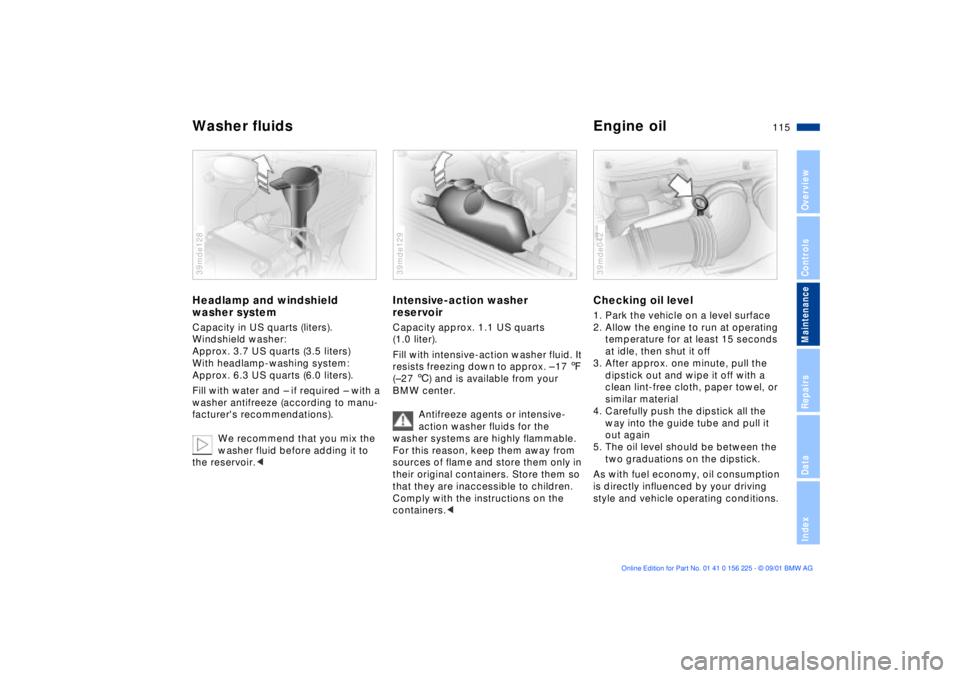
washer systemCapacity in US quarts (liters).
Windshield washer:
Approx. 3.7 US quarts (3.5 liters)
With headlamp-washing system:
Approx. 6.3 US quarts (6.0 liters).
Fill with water and Ð if required Ð with a
washer antifreeze (according to manu-
facturer's recommendations).
We recommend that you mix the
washer fluid before adding it to
the reservoir.< 39mde128
Intensive-action washer
reservoirCapacity approx. 1.1 US quarts
(1.0 liter).
Fill with intensive-action washer fluid. It
resists freezing down to approx. Ð 17 7
(Ð 27 6) and is available from your
BMW center.
Antifreeze agents or intensive-
action washer fluids for the
washer systems are highly flammable.
For this reason, keep them away from
sources of flame and store them only in
their original containers. Store them so
that they are inaccessible to children.
Comply with the instructions on the
containers.<39mde129
Checking oil level 1. Park the vehicle on a level surface
2. Allow the engine to run at operating
temperature for at least 15 seconds
at idle, then shut it off
3. After approx. one minute, pull the
dipstick out and wipe it off with a
clean lint-free cloth, paper towel, or
similar material
4. Carefully push the dipstick all the
way into the guide tube and pull it
out again
5. The oil level should be between the
two graduations on the dipstick.
As with fuel economy, oil consumption
is directly influenced by your driving
style and vehicle operating conditions. 39mde042
Page 124 of 154
124n
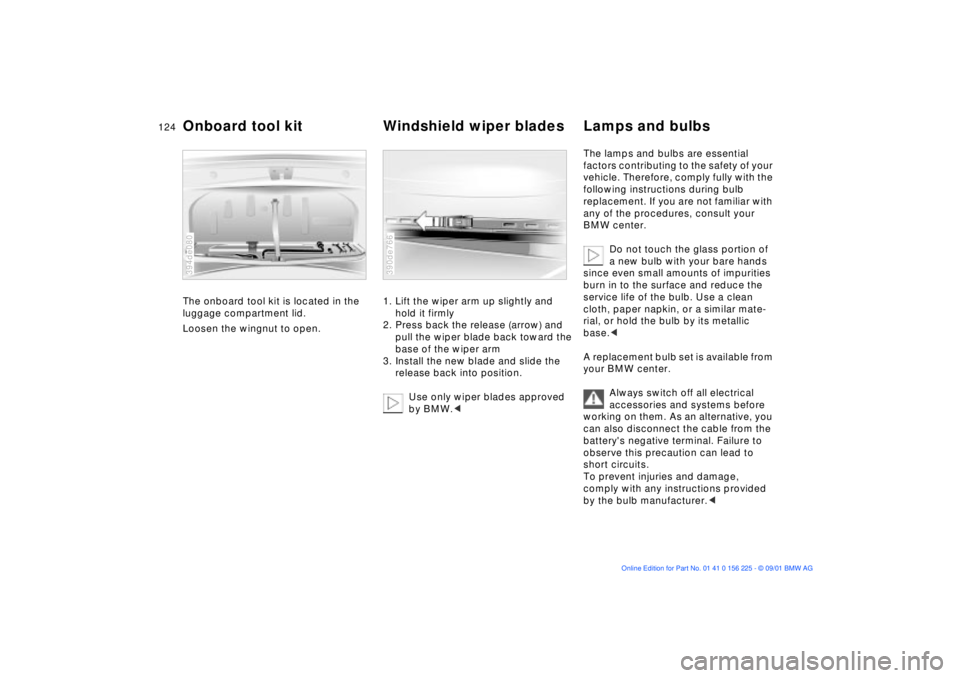
The onboard tool kit is located in the
luggage compartment lid.
Loosen the wingnut to open.
394de080
1. Lift the wiper arm up slightly and
hold it firmly
2. Press back the release (arrow) and
pull the wiper blade back toward the
base of the wiper arm
3. Install the new blade and slide the
release back into position.
Use only wiper blades approved
by BMW.< 390de766
The lamps and bulbs are essential
factors contributing to the safety of your
vehicle. Therefore, comply fully with the
following instructions during bulb
replacement. If you are not familiar with
any of the procedures, consult your
BMW center.
Do not touch the glass portion of
a new bulb with your bare hands
since even small amounts of impurities
burn in to the surface and reduce the
service life of the bulb. Use a clean
cloth, paper napkin, or a similar mate-
rial, or hold the bulb by its metallic
base.<
A replacement bulb set is available from
your BMW center.
Always switch off all electrical
accessories and systems before
working on them. As an alternative, you
can also disconnect the cable from the
battery's negative terminal. Failure to
observe this precaution can lead to
short circuits.
To prevent injuries and damage,
comply with any instructions provided
by the bulb manufacturer.<
Onboard tool kit Windshield wiper blades Lamps and bulbs
Page 130 of 154
130n
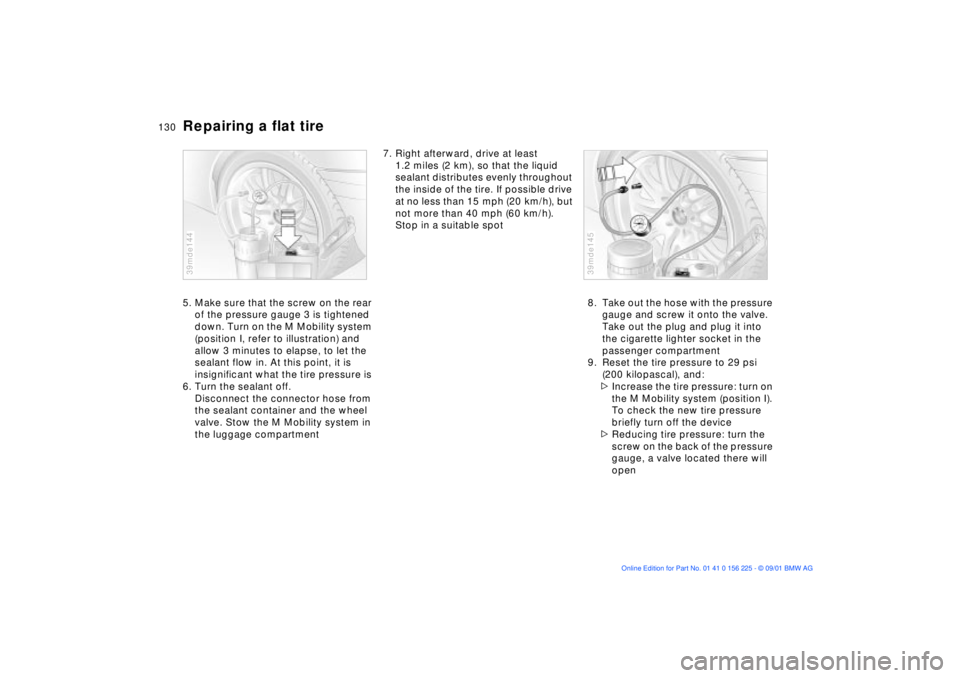
Repairing a flat tire5. Make sure that the screw on the rear
of the pressure gauge 3 is tightened
down. Turn on the M Mobility system
(position I, refer to illustration) and
allow 3 minutes to elapse, to let the
sealant flow in. At this point, it is
insignificant what the tire pressure is
6. Turn the sealant off.
Disconnect the connector hose from
the sealant container and the wheel
valve. Stow the M Mobility system in
the luggage compartment39mde144
7. Right afterward, drive at least
1.2 miles (2 km), so that the liquid
sealant distributes evenly throughout
the inside of the tire. If possible drive
at no less than 15 mph (20 km/h), but
not more than 40 mph (60 km/h).
Stop in a suitable spot
8. Take out the hose with the pressure
gauge and screw it onto the valve.
Take out the plug and plug it into
the cigarette lighter socket in the
passenger compartment
9. Reset the tire pressure to 29 psi
(200 kilopascal), and:
>Increase the tire pressure: turn on
the M Mobility system (position I).
To check the new tire pressure
briefly turn off the device
>Reducing tire pressure: turn the
screw on the back of the pressure
gauge, a valve located there will
open
39mde145
Page 131 of 154

131n
OverviewControlsMaintenanceRepairsDataIndex
Repairing a flat tire Battery
If the inflation pressure does not
hold, complete step 10 and then
repeat steps 7 through 10.
The use of the M Mobility system may
be ineffective if the damaged area in
the tire is larger than approx. 0.15 in
(4 mm). If it should prove impossible to
restore the tire to operational status
using the M Mobility system, please
contact the nearest BMW center or
BMW Roadside Assistance at
1-800-332-4269.<
10. Unscrew the hose from the valve
and stow the M Mobility system in
the luggage compartment. Screw
the cap back onto the valve stem.
When you start driving again, do not
exceed the permissible maximum
speed of 50 mph (80 km/h).
You will find corresponding instructions
for using the M Mobility system on the
device.
Replace the defective tire as soon as
possible and have the wheel and tire
balanced. Reactivate the Flat Tire
Monitor, for additional information refer
to page 82. Have the M Mobility system
recharged. Contact your BMW center
for this.
Protect valve stems and valves from dirt
using screw-on valve stem caps. Dirty
valve stems frequently lead to slow
pressure loss.Battery posts, terminals and
related accessories contain lead
and lead compounds. Wash hands after
handling.<
Battery careThe battery is completely maintenance-
free. That means that the original elec-
trolyte will normally last for the service
life of the battery under moderate
climatic conditions.
Please consult the staff at your
BMW center whenever you have
any questions concerning the battery.
The battery is completely maintenance-
free; the following section is provided
for your information only.<
Never disconnect the battery
when the engine is running; the
ensuing voltage surge would seriously
damage the vehicle's onboard elec-
tronic systems.<
Page 135 of 154
135n
OverviewControlsMaintenanceRepairsDataIndex
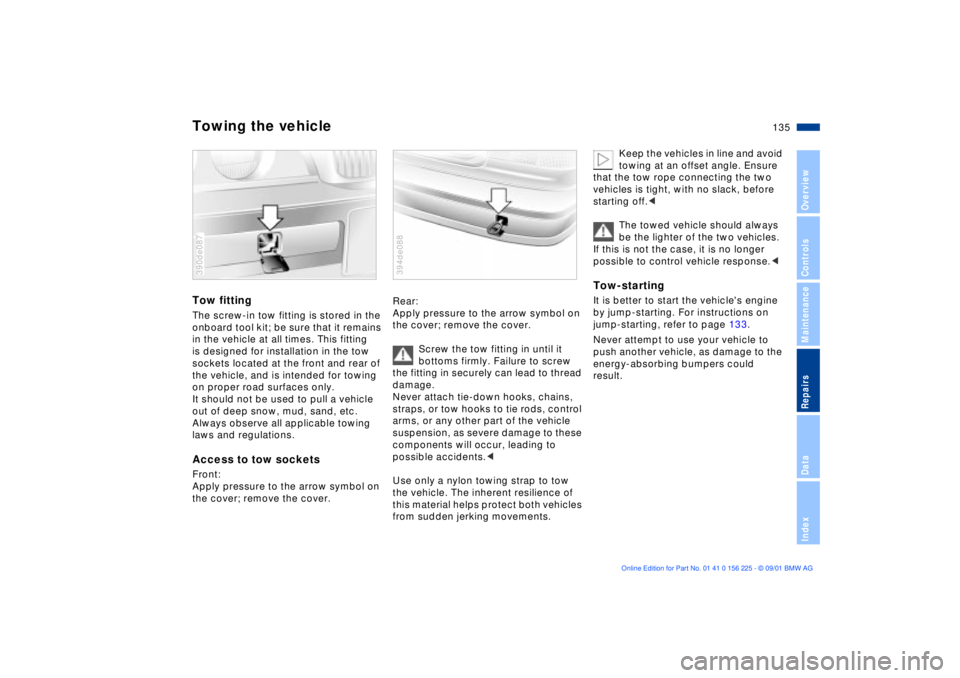
Towing the vehicleTow fittingThe screw-in tow fitting is stored in the
onboard tool kit; be sure that it remains
in the vehicle at all times. This fitting
is designed for installation in the tow
sockets located at the front and rear of
the vehicle, and is intended for towing
on proper road surfaces only.
It should not be used to pull a vehicle
out of deep snow, mud, sand, etc.
Always observe all applicable towing
laws and regulations.Access to tow sockets Front:
Apply pressure to the arrow symbol on
the cover; remove the cover.390de087
Rear:
Apply pressure to the arrow symbol on
the cover; remove the cover.
Screw the tow fitting in until it
bottoms firmly. Failure to screw
the fitting in securely can lead to thread
damage.
Never attach tie-down hooks, chains,
straps, or tow hooks to tie rods, control
arms, or any other part of the vehicle
suspension, as severe damage to these
components will occur, leading to
possible accidents.<
Use only a nylon towing strap to tow
the vehicle. The inherent resilience of
this material helps protect both vehicles
from sudden jerking movements.394de088
Keep the vehicles in line and avoid
towing at an offset angle. Ensure
that the tow rope connecting the two
vehicles is tight, with no slack, before
starting off.<
The towed vehicle should always
be the lighter of the two vehicles.
If this is not the case, it is no longer
possible to control vehicle response.<
Tow-startingIt is better to start the vehicle's engine
by jump-starting. For instructions on
jump-starting, refer to page 133.
Never attempt to use your vehicle to
push another vehicle, as damage to the
energy-absorbing bumpers could
result.
Page 136 of 154
136n
Towing the vehicleTowing a vehicle1. Shift lever in neutral
2. Towing speed:
Max. 45 mph (70 km/h)
3. Towing distance:
Max. 95 miles (150 km/h)
4. Leave the ignition key in position 1 to
ensure that the brake lamps, turn
signals, horn and windshield wipers
remain operative, and to prevent the
steering lock detent from engaging
5. Switch on the hazard-warning
system (comply with official regula-
tions).
Find some means of identifying the
vehicle in tow, for instance, place a sign
or warning triangle in the rear window.
Make sure that the ignition key
remains in position 1 even if the
electrical system has failed to prevent
the steering lock from engaging. The
steering and brakes are without power
assist when the engine is not running.
This means that increased effort is
required for steering and braking.<
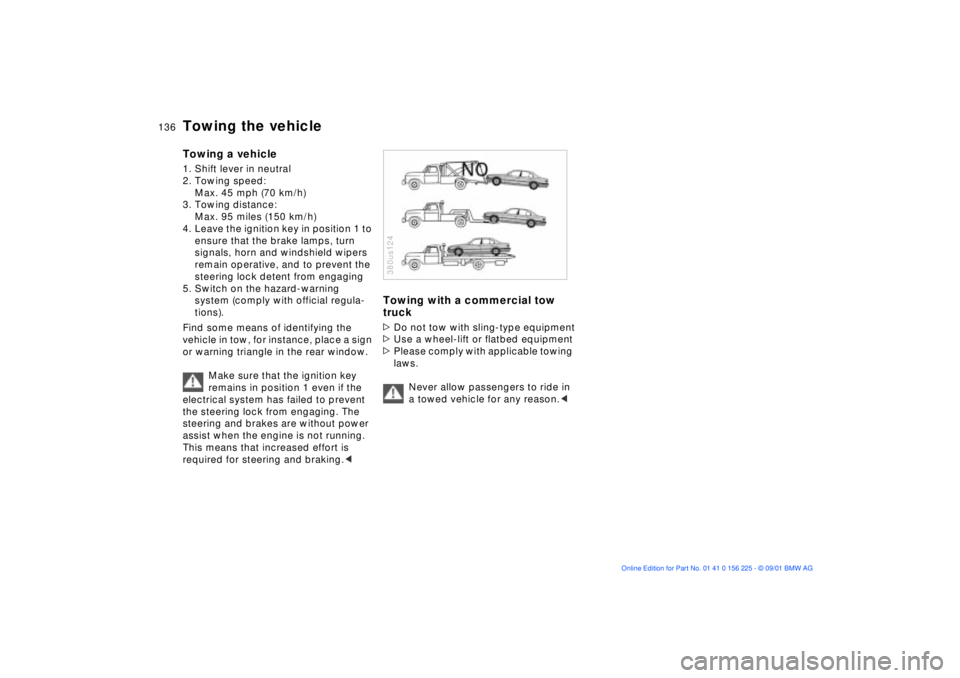
Towing with a commercial tow
truck>Do not tow with sling-type equipment
>Use a wheel-lift or flatbed equipment
>Please comply with applicable towing
laws.
Never allow passengers to ride in
a towed vehicle for any reason.<380us124
Page 148 of 154

Everything from A to ZEngine oil
checking level115
consumption115
dipstick115
disposal116
grades117
level16
pressure16
temperature gauge64
Engine performance140
Estimated time of arrival75
Exterior mirrors48
automatic dimming48
electrical heating48 F
Failure messages66
Filling capacities143
First-aid kit20
Fittings, tow starting and
towing135t
Flashlight96
Flat tire109
Flat Tire Monitor82
Fog lamps85
bulb replacement126t
Folding rear backrest99
Follow me home lamps84 Frost protection,
radiator118
Fuel consumption75
average75
Fuel filler door20
manual operation20t
Fuel gauge64
Fuel quality22
Fuel specifications22
Fuel tank capacity143
Fuse replacement132t
G
Gasoline gauge64
Gasoline quality22
Glove compartment96
Gross vehicle weight142 H
Handbrake17, 58
Hands-free system97
Hazard warning triangle20
Head protection airbags49
Head restraints43
adjusting43
Headlamp cover,
care125t
Headlamp flasher59
Headlamp washer
system115 Headlamp washers61
Headrests43
Heating with vehicle
stopped90
Heavy cargo102
Height141
Height adjustment
seats41
steering wheel47
High beams18, 59, 85
High Performance Synthetic
Oil117
High-mount brake lamp127
Holder for canned
beverages97
Hood113
release113t
Horn14
Hydraulic Braking Assistant,
refer to DBC17, 80
I
Ice warning63
Identification, tires111
Ignition key26
Ignition lock56
Imprint4
Indicator lamps16 Inflation
pressure22t, 109
INSPECTION65
Instrument cluster15
Instrument lighting85
Instrument panel15
Intensive cleaning
system115
Interface socket for Onboard
Diagnostics (OBD)121
Interior lamps86
Interior mirrors48
Interior motion sensor36
deactivate29
J
Jump-starting133t K
Key Memory55
Key with remote control26
Keys26 L
Lamps and bulbs124
Leather care, refer to the
"Caring for your vehicle"
manual
Page 151 of 154

Everything from A to Z
151n
OverviewControlsMaintenanceRepairsDataIndex
Time of arrival,
estimated75
Timer70
Tire
condition109
damage109t
inflation
pressure22t, 109
labeling111
pressure monitor82
tread109
Tire Quality Grading110
Tools124t
Torque140
Tow fittings135t
Towing the vehicle135t
Track141
Traction Control System
refer to DSC80
Transmitter key26
Tread depth, tires109
Tread wear indicator109
Trip odometer63
Trunk, refer to luggage
compartment32
Turn signal indicator18, 59
bulb replacement125t
Turning circle141
U
Uniform Tire Quality Grading
(UTQR)110
Universal Transmitter93
Use antifreeze,
radiator118t
Used batteries132 V
Vehicle battery131
Vehicle key26
Vehicle Memory55
Ventilation91
Ventilation in the rear91
Ventilation while parked92
activating72
refer also to the "Onboard
Computer Owner's
Manual"
Ventilation, draft-free91 W
Warm feet Ð cool head91
Warning lamps16
Warning messages66
Warning triangle20
Warranty and Service Guide
Booklet (Canadian
models)119 Washer fluids115t
Washer reservoir,
filling115t
Washer system60
Washing your vehicle, refer
to the "Caring for your
vehicle" manual
Water on the roads107
Wear indicator in the
tires109
Weights142
Wheel and tire
combinations111
Wheelbase141
Width141
Windows36
convenience operation27
defrosting89
Windshield washer60
reservoir, filling115t
Windshield wiper60
Winter tires112
Wiper system60
Work in the engine
compartment113t
X
Xenon lamp125