light BMW M5 SEDAN 2002 Owner's Guide
[x] Cancel search | Manufacturer: BMW, Model Year: 2002, Model line: M5 SEDAN, Model: BMW M5 SEDAN 2002Pages: 154, PDF Size: 2.17 MB
Page 107 of 154

107n
OverviewControlsMaintenanceRepairsDataIndex
Driving notes Antilock Brake System
Brakes:
Do not rest your foot on the brake
pedal while driving. Even light but
consistent pedal pressure can lead to
high temperatures, brake wear and
possibly even brake failure.
Aquaplaning:
When driving on wet or slushy roads,
reduce vehicle speed. If you do not, a
wedge of water may form between the
tires and the road surface. This
phenomenon is referred to as aqua-
planing, or hydroplaning, and can lead
to partial or complete loss of traction,
vehicle control and braking effective-
ness.
Driving through water:
When there is water on the roads, do
not drive in it if it is deeper than 1 ft
(30 cm). If the water is at that depth,
drive only at walking speed, otherwise
the vehicle can sustain damage to the
engine, the electrical systems and the
transmission.
Rear parcel tray:
Do not place heavy or hard objects on
the rear parcel tray. If you do so, they
could pose a danger to vehicle occu-
pants during a braking or evasive
maneuver.
Clothes hooks:
When suspending clothing from the
hooks, ensure that they will not obstruct
the driver's vision. Do not hang any
heavy objects on the hooks, otherwise,
passengers could be injured e.g. during
any hard braking or evasive maneuvers,
or during an accident.<
The conceptThe Antilock Brake System (ABS) keeps
the wheels from locking during braking,
thereby enhancing active driving safety.Braking with ABSIf you are in a situation that requires full
braking, you will exploit the full benefits
of the ABS system if you apply
maximum pedal pressure ("panic stop").
Since the vehicle maintains steering
responsiveness, you can avoid possible
obstacles with a minimum of steering
effort, despite the full brake application.
Pulsation at the brake pedal combined
with sounds from the hydraulic circuits
indicates to the driver that ABS is in its
active mode.
Page 108 of 154

108n
Brake systemBrake fluid level If the brake fluid level is too low and
brake pedal travel has become notice-
ably longer, there may be a defect in
one of the brake system's hydraulic
circuits.
Proceed to the nearest BMW
center. Higher brake application
pressure may be necessary under these
conditions, and the vehicle may exhibit
a slight tendency to pull to one side
when the brakes are applied. Braking
distances may also be longer. Please
remember to adapt your driving style
accordingly.<
Disc brakesLimited vehicle use, extended periods
with the vehicle parked or in storage,
and operating conditions in which
braking is restricted to gentle, low-
pressure applications will all increase
the tendency for corrosion to form on
the rotors; this is often accompanied by
a simultaneous accumulation of
contamination on the brake pads. The
pads must exert a certain minimal level
of pressure against the rotors for the
disc brakes' inherent self-cleaning
effect to remain effective; the pressure
available under the above conditions
may not provide adequate cleansing.
If the brake rotors are corroded, they
will tend to respond to braking with a
pulsating effect that even extended
brake applications will fail to cure.
When driving in heavy rain and on wet
roads it is a good idea to apply light
pressure to the brake pedal every few
miles. Monitor traffic conditions to
ensure that this maneuver does not
pose a hazard to you or to other road
users. The heat generated in this
process helps dry the pads and rotors
to ensure that your brake system will
respond with undiminished efficiency
when you need it.When descending steep hills and
extended grades, downshift to a gear
that will allow you to continue safely
with only a minimal amount of braking.
By minimizing the loads placed on the
brake system, this strategy helps
ensure that optimal brake system
response will remain available at all
times.
Do not coast with the clutch
depressed or with the transmis-
sion or selector lever in Neutral. Do not
coast with the engine shut off. The
engine provides no braking effect when
the clutch is depressed and there is no
power-assist for braking or steering
when the engine is not running.
Never allow floor mats, carpets or any
other objects to protrude into the area
around the accelerator, clutch and
brake pedals and obstruct their move-
ment.<
Brake pads
For your own safety: use only
brake pads that BMW has
approved for your particular vehicle
model. BMW cannot evaluate non-
approved brake pads to determine if
they are suited for use, and therefore
cannot ensure the operating safety of
the vehicle if they are installed.<
Page 111 of 154

111n
OverviewControlsMaintenanceRepairsDataIndex
Tire replacement Wheel and tire combinations
Do not use retreaded tires, since
driving safety may be impaired.
This is due to the possible variations in
casing structures and, in some cases,
to their extreme age, which can lead to
a decrease in their durability.<
Tire ageThe date on which the tire was manu-
factured is indicated by the code on the
sidewall:
DOT ... 3401 indicates that the tire was
manufactured in week 34 of the year
2001.
Although tires may have a theoretical
service life of up to 10 years, BMW
strongly recommends that you replace
all tires after an absolute maximum of
6 years.
The right choice
Never mount wheels and tires that
have not been specifically
approved by BMW for use on your
particular model. Although other wheels
and tires may theoretically have the
same dimensions, variations in factors
such as manufacturing tolerances can
result in contact between tire and body-
work, ultimately leading to serious acci-
dents. If non-approved wheels and tires
are used, BMW cannot evaluate their
suitability, and therefore cannot be held
liable for driving safety.<
BMW has tested certain tires for each
tire size, rated them according to road
safety and approved them. Your BMW
center can inform you which tires have
been tested in this way. Observe
possible national guidelines, e.g.
regarding entry into vehicle documents.
Because various systems on your
vehicle, such as ABS, DSC and
the Flat Tire Monitor, rely on the correct
combination of tires and wheels for
optimal operation, their operation may
be adversely affected if other tires and/
or wheels are mounted .
You should therefore ensure that tires
from a single manufacturer with the
same tread pattern are mounted at all
four wheels. After installing a spare in
response to a flat tire you should
always ensure that a tire of the original
specifications is remounted as soon as
possible.<
The use of rims and wheel bolts
that do not meet the specifica-
tions of the original factory-installed
equipment will affect the safe operation
of your vehicle and may cause an acci-
dent and personal injury.
Never mix tires of different design, such
as steel-belted radials with radial bias-
belted or bias-ply tires, etc. Mixing tire
types will adversely affect roadholding and can lead to loss of vehicle control.
possible. Protect the tires against
contact with oil, grease and fuel.
Page 118 of 154
118n
Coolant Brake fluidChecking coolant level and
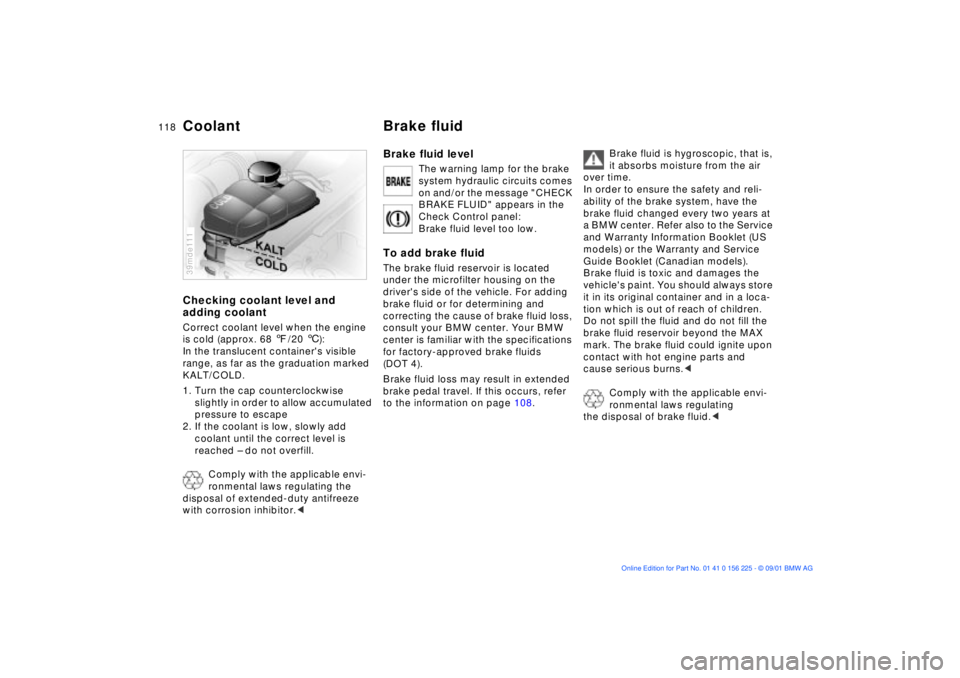
adding coolantCorrect coolant level when the engine
is cold (approx. 68 7/20 6):
In the translucent container's visible
range, as far as the graduation marked
KALT/COLD.
1. Turn the cap counterclockwise
slightly in order to allow accumulated
pressure to escape
2. If the coolant is low, slowly add
coolant until the correct level is
reached Ð do not overfill.
Comply with the applicable envi-
ronmental laws regulating the
disposal of extended-duty antifreeze
with corrosion inhibitor.<39mde111
Brake fluid level
The warning lamp for the brake
system hydraulic circuits comes
on and/or the message "CHECK
BRAKE FLUID" appears in the
Check Control panel:
Brake fluid level too low.
To add brake fluidThe brake fluid reservoir is located
under the microfilter housing on the
driver's side of the vehicle. For adding
brake fluid or for determining and
correcting the cause of brake fluid loss,
consult your BMW center. Your BMW
center is familiar with the specifications
for factory-approved brake fluids
(DOT 4).
Brake fluid loss may result in extended
brake pedal travel. If this occurs, refer
to the information on page 108.
Brake fluid is hygroscopic, that is,
it absorbs moisture from the air
over time.
In order to ensure the safety and reli-
ability of the brake system, have the
brake fluid changed every two years at
a BMW center. Refer also to the Service
and Warranty Information Booklet (US
models) or the Warranty and Service
Guide Booklet (Canadian models).
Brake fluid is toxic and damages the
vehicle's paint. You should always store
it in its original container and in a loca-
tion which is out of reach of children.
Do not spill the fluid and do not fill the
brake fluid reservoir beyond the MAX
mark. The brake fluid could ignite upon
contact with hot engine parts and
cause serious burns.<
Comply with the applicable envi-
ronmental laws regulating
the disposal of brake fluid.<
Page 120 of 154

120n
Technical modifications California Proposition 65 WarningLight-emitting diodes (LEDs)Light-emitting diodes installed behind
translucent lenses serve as the light
source for many of the controls and
displays in your vehicle. The concept
behind their operation is related to that
employed for lasers.
Do not remove the protective lens
and avoid staring directly at the
unfiltered beam for extended periods
(several hours), as inflammation of the
iris could result.<
California laws require us to state the
following warning:
Engine exhaust, some of its
constituents, and certain vehicle
components contain or emit chemicals
known to the State of California to
cause cancer and birth defects or other
reproductive harm.<
Page 124 of 154
124n
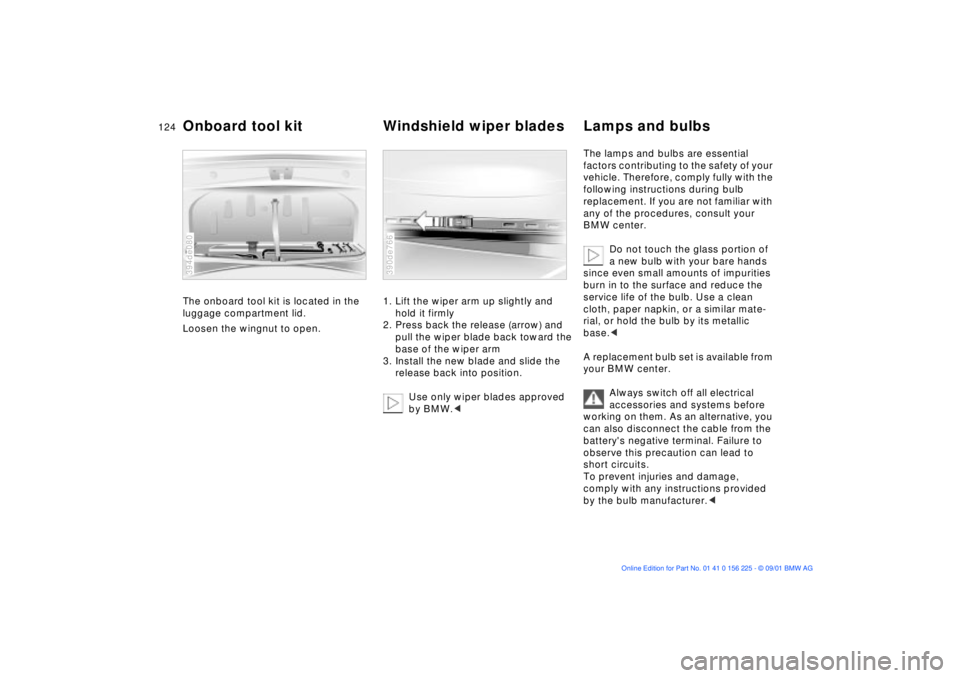
The onboard tool kit is located in the
luggage compartment lid.
Loosen the wingnut to open.
394de080
1. Lift the wiper arm up slightly and
hold it firmly
2. Press back the release (arrow) and
pull the wiper blade back toward the
base of the wiper arm
3. Install the new blade and slide the
release back into position.
Use only wiper blades approved
by BMW.< 390de766
The lamps and bulbs are essential
factors contributing to the safety of your
vehicle. Therefore, comply fully with the
following instructions during bulb
replacement. If you are not familiar with
any of the procedures, consult your
BMW center.
Do not touch the glass portion of
a new bulb with your bare hands
since even small amounts of impurities
burn in to the surface and reduce the
service life of the bulb. Use a clean
cloth, paper napkin, or a similar mate-
rial, or hold the bulb by its metallic
base.<
A replacement bulb set is available from
your BMW center.
Always switch off all electrical
accessories and systems before
working on them. As an alternative, you
can also disconnect the cable from the
battery's negative terminal. Failure to
observe this precaution can lead to
short circuits.
To prevent injuries and damage,
comply with any instructions provided
by the bulb manufacturer.<
Onboard tool kit Windshield wiper blades Lamps and bulbs
Page 126 of 154
126n
Lamps and bulbsSide-mounted turn signals5 watt bulb
1. Use finger pressure against the rear
end of the lens (arrow) to press it
forward for removal
2. Apply gentle pressure to the bulb
while turning it to the left to remove.390de768
Front fog lamps HB4, 51 watt bulb
The bulb is pressurized. There-
fore, wear safety glasses and
protective gloves. Failure to observe
these precautions can result in physical
injury if the bulb breaks.<
1. Pull the cover panel next to the head-
lamp forward to remove
2. Loosen the screw (arrow) and swing
the lamp assembly out
3. Release the spring on the back of the
lamp and turn the cover to the left
4. Release the clamp, remove the
contact base and replace the bulb.39mde104
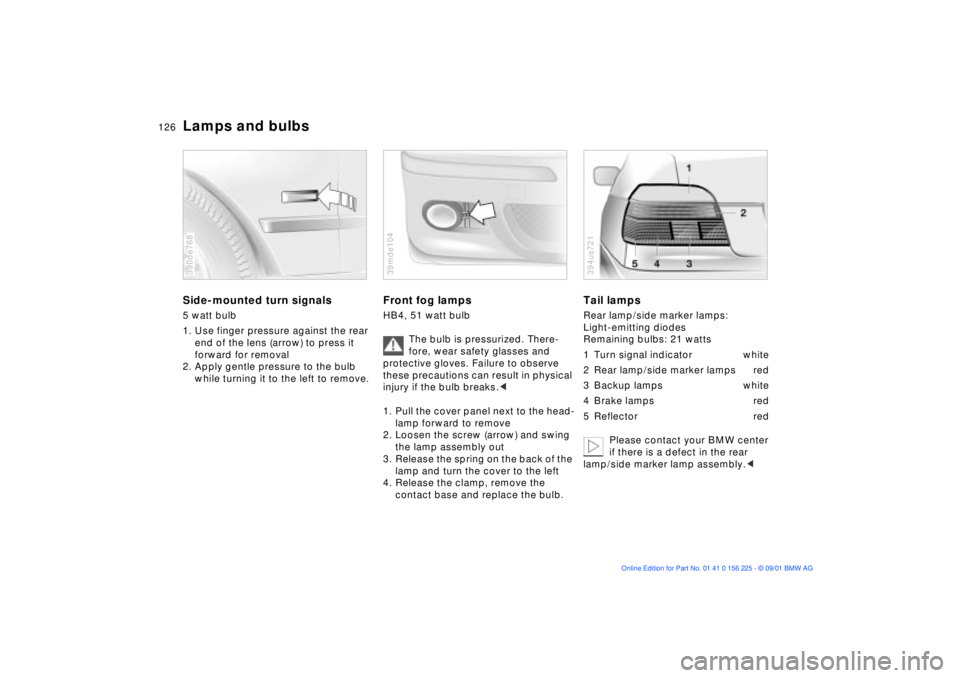
Tail lamps Rear lamp/side marker lamps:
Light-emitting diodes
Remaining bulbs: 21 watts
1 Turn signal indicator white
2 Rear lamp/side marker lamps red
3 Backup lamps white
4 Brake lamps red
5 Reflector red
Please contact your BMW center
if there is a defect in the rear
lamp/side marker lamp assembly.<394us721
Page 128 of 154
128n
Lamps and bulbs Repairing a flat tire
Precautions in case of a flat tire:
Stop the vehicle as far as possible
from passing traffic. Switch on the
hazard warning flashers.
Turn the steering wheel to the straight-
ahead position, remove the key and
engage the steering lock. Shift into 1st
or reverse and engage the parking
brake.
All passengers should be outside the
vehicle and well away from your imme-
diate working area (behind a guardrail,
for instance).
If necessary, set up your warning
triangle or portable hazard warning
lamp on the roadside at an appropriate
distance from the rear of the vehicle.
Comply with all safety guidelines and
regulations.<
M Mobility systemFor repairing a flat tire, you will find an
M Mobility system in the BMW M5. With
the aid of this system, you can apply a
liquid sealant to the inside of the tire,
thereby sealing off the damaged area,
and then continue driving.
The M Mobility system makes the trans-
port of a spare wheel superfluous and
minimizes the curb weight.
The M Mobility system is located in the
luggage compartment under the floor
mat:
1. Lift up the floor mat and then raise
the front cover panel
2. Loosen the M Mobility system from
its storage location.
Please note that the system's
sealant container must be
replaced every three years by your
BMW center if the device is not used.<39mde132
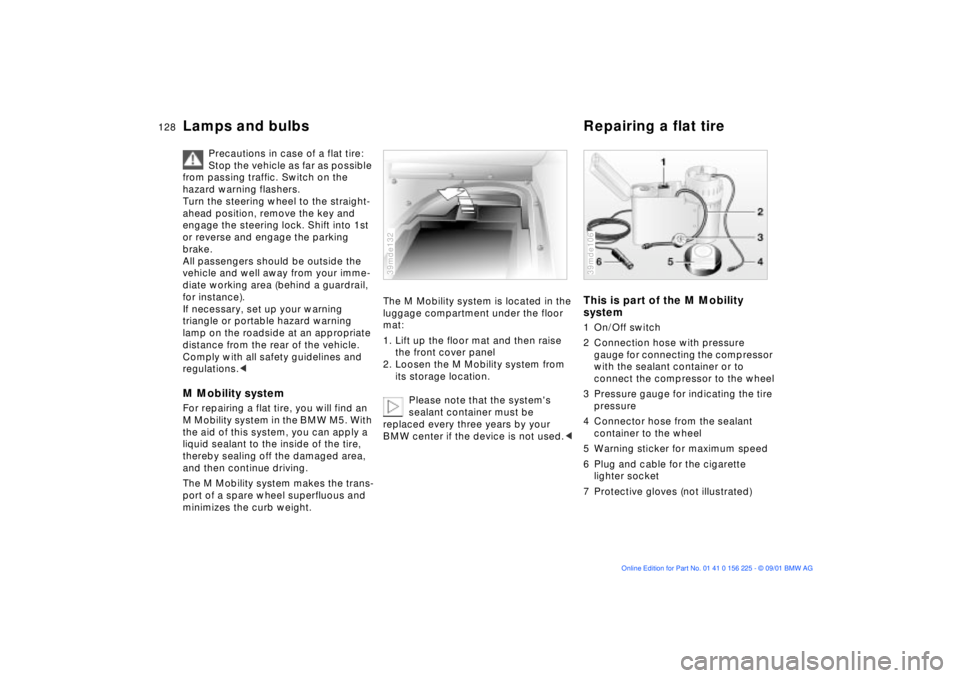
This is part of the M Mobility
system1 On/Off switch
2 Connection hose with pressure
gauge for connecting the compressor
with the sealant container or to
connect the compressor to the wheel
3 Pressure gauge for indicating the tire
pressure
4 Connector hose from the sealant
container to the wheel
5 Warning sticker for maximum speed
6 Plug and cable for the cigarette
lighter socket
7 Protective gloves (not illustrated)39mde106
Page 129 of 154
129n
OverviewControlsMaintenanceRepairsDataIndex
Repairing a flat tireUse the M Mobility system
If possible, leave the foreign
object in the tire.<
Do not exceed the maximum
speeds indicated below, as an
accident could result.
Before you use the M Mobility system,
read the warnings and danger notices
on the device carefully.<
1. Remove the warning sticker 5 for
maximum speed that is located on
top of the device and affix it to the
steering wheel
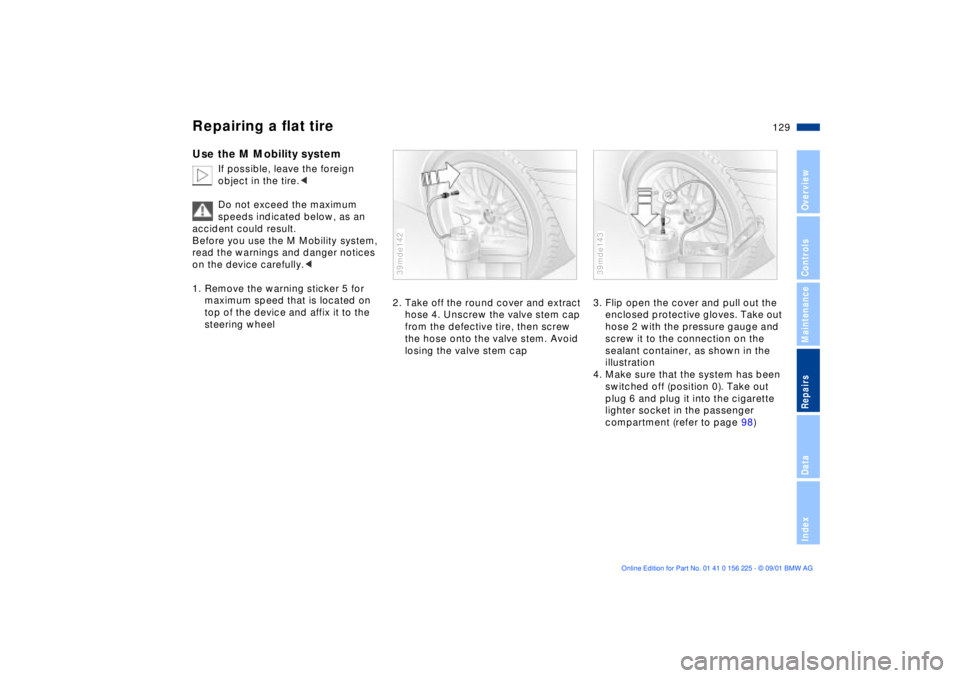
2. Take off the round cover and extract
hose 4. Unscrew the valve stem cap
from the defective tire, then screw
the hose onto the valve stem. Avoid
losing the valve stem cap39mde142
3. Flip open the cover and pull out the
enclosed protective gloves. Take out
hose 2 with the pressure gauge and
screw it to the connection on the
sealant container, as shown in the
illustration
4. Make sure that the system has been
switched off (position 0). Take out
plug 6 and plug it into the cigarette
lighter socket in the passenger
compartment (refer to page 98)39mde143
Page 130 of 154
130n
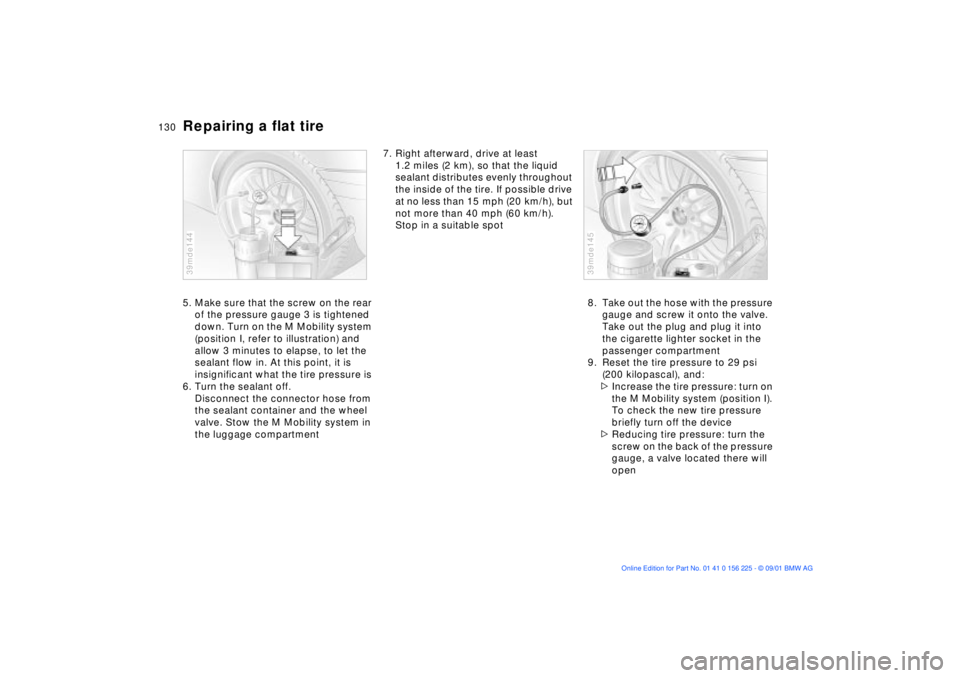
Repairing a flat tire5. Make sure that the screw on the rear
of the pressure gauge 3 is tightened
down. Turn on the M Mobility system
(position I, refer to illustration) and
allow 3 minutes to elapse, to let the
sealant flow in. At this point, it is
insignificant what the tire pressure is
6. Turn the sealant off.
Disconnect the connector hose from
the sealant container and the wheel
valve. Stow the M Mobility system in
the luggage compartment39mde144
7. Right afterward, drive at least
1.2 miles (2 km), so that the liquid
sealant distributes evenly throughout
the inside of the tire. If possible drive
at no less than 15 mph (20 km/h), but
not more than 40 mph (60 km/h).
Stop in a suitable spot
8. Take out the hose with the pressure
gauge and screw it onto the valve.
Take out the plug and plug it into
the cigarette lighter socket in the
passenger compartment
9. Reset the tire pressure to 29 psi
(200 kilopascal), and:
>Increase the tire pressure: turn on
the M Mobility system (position I).
To check the new tire pressure
briefly turn off the device
>Reducing tire pressure: turn the
screw on the back of the pressure
gauge, a valve located there will
open
39mde145