engine BMW M5 SEDAN 2002 Service Manual
[x] Cancel search | Manufacturer: BMW, Model Year: 2002, Model line: M5 SEDAN, Model: BMW M5 SEDAN 2002Pages: 154, PDF Size: 2.17 MB
Page 132 of 154
132n
Battery FusesCharging the battery Recharge the battery only with the
engine off, using the auxiliary terminals
provided in the engine compartment
(for information on these terminals refer
to "Jump-starting" on page 133).
Avoid environmental pollution
when disposing of old batteries.<
Return used batteries to a recy-
cling point or your BMW center.
Maintain the battery in an upright posi-
tion for transport and storage. Secure
the battery to prevent it from tilting
during transport.<
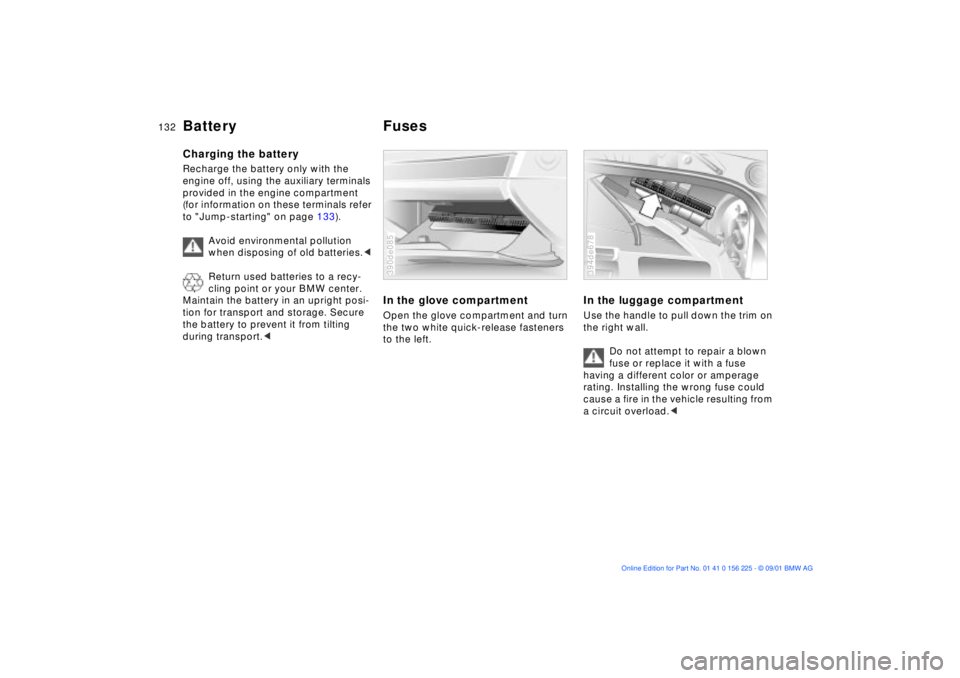
In the glove compartmentOpen the glove compartment and turn
the two white quick-release fasteners
to the left.390de085
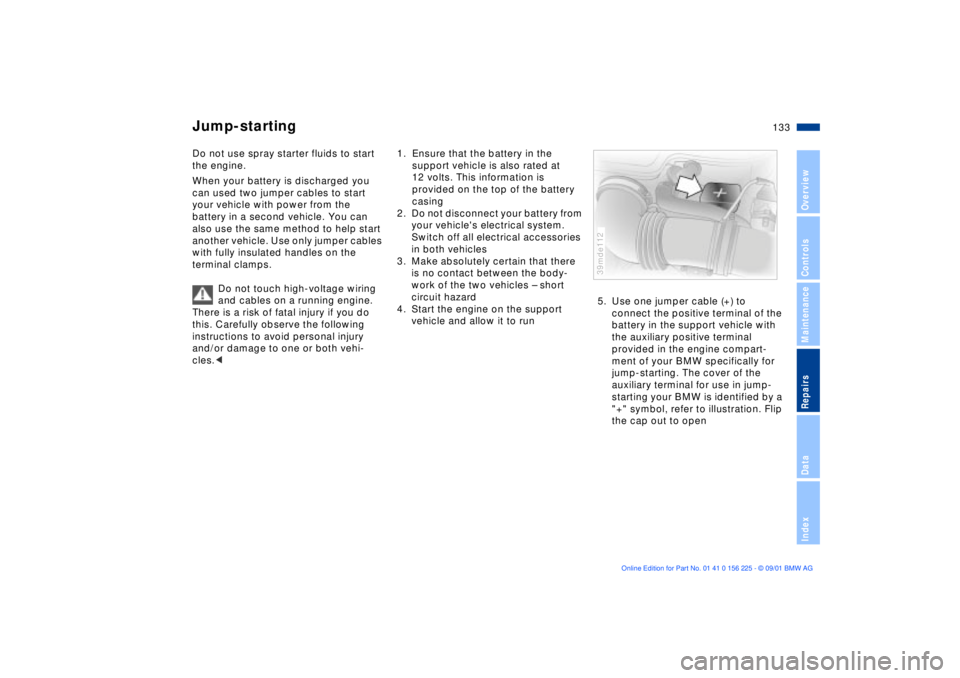
In the luggage compartmentUse the handle to pull down the trim on
the right wall.
Do not attempt to repair a blown
fuse or replace it with a fuse
having a different color or amperage
rating. Installing the wrong fuse could
cause a fire in the vehicle resulting from
a circuit overload.<394de678
Page 133 of 154
133n
OverviewControlsMaintenanceRepairsDataIndex
Do not use spray starter fluids to start
the engine.
When your battery is discharged you
can used two jumper cables to start
your vehicle with power from the
battery in a second vehicle. You can
also use the same method to help start
another vehicle. Use only jumper cables
with fully insulated handles on the
terminal clamps.
Do not touch high-voltage wiring
and cables on a running engine.
There is a risk of fatal injury if you do
this. Carefully observe the following
instructions to avoid personal injury
and/or damage to one or both vehi-
cles.<
1. Ensure that the battery in the
support vehicle is also rated at
12 volts. This information is
provided on the top of the battery
casing
2. Do not disconnect your battery from
your vehicle's electrical system.
Switch off all electrical accessories
in both vehicles
3. Make absolutely certain that there
is no contact between the body-
work of the two vehicles Ð short
circuit hazard
4. Start the engine on the support
vehicle and allow it to run5. Use one jumper cable (+) to
connect the positive terminal of the
battery in the support vehicle with
the auxiliary positive terminal
provided in the engine compart-
ment of your BMW specifically for
jump-starting. The cover of the
auxiliary terminal for use in jump-
starting your BMW is identified by a
"+" symbol, refer to illustration. Flip
the cap out to open
39mde112
Jump-starting
Page 134 of 154
134n
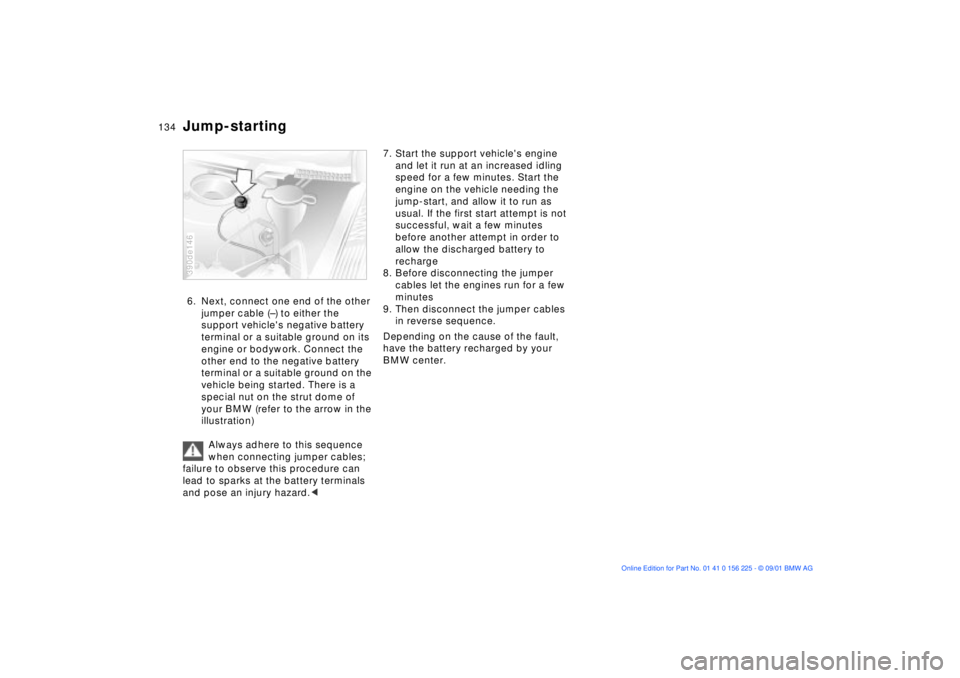
Jump-starting6. Next, connect one end of the other
jumper cable (Ð) to either the
support vehicle's negative battery
terminal or a suitable ground on its
engine or bodywork. Connect the
other end to the negative battery
terminal or a suitable ground on the
vehicle being started. There is a
special nut on the strut dome of
your BMW (refer to the arrow in the
illustration)
Always adhere to this sequence
when connecting jumper cables;
failure to observe this procedure can
lead to sparks at the battery terminals
and pose an injury hazard.<390de146
7. Start the support vehicle's engine
and let it run at an increased idling
speed for a few minutes. Start the
engine on the vehicle needing the
jump-start, and allow it to run as
usual. If the first start attempt is not
successful, wait a few minutes
before another attempt in order to
allow the discharged battery to
recharge
8. Before disconnecting the jumper
cables let the engines run for a few
minutes
9. Then disconnect the jumper cables
in reverse sequence.
Depending on the cause of the fault,
have the battery recharged by your
BMW center.
Page 135 of 154
135n
OverviewControlsMaintenanceRepairsDataIndex
Towing the vehicleTow fittingThe screw-in tow fitting is stored in the
onboard tool kit; be sure that it remains
in the vehicle at all times. This fitting
is designed for installation in the tow
sockets located at the front and rear of
the vehicle, and is intended for towing
on proper road surfaces only.
It should not be used to pull a vehicle
out of deep snow, mud, sand, etc.
Always observe all applicable towing
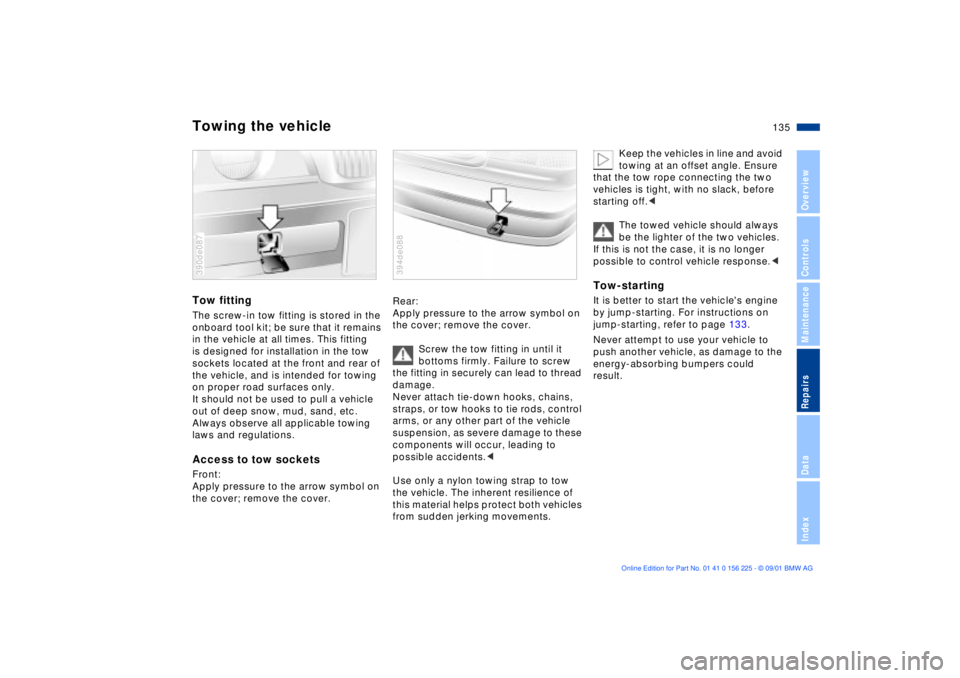
laws and regulations.Access to tow sockets Front:
Apply pressure to the arrow symbol on
the cover; remove the cover.390de087
Rear:
Apply pressure to the arrow symbol on
the cover; remove the cover.
Screw the tow fitting in until it
bottoms firmly. Failure to screw
the fitting in securely can lead to thread
damage.
Never attach tie-down hooks, chains,
straps, or tow hooks to tie rods, control
arms, or any other part of the vehicle
suspension, as severe damage to these
components will occur, leading to
possible accidents.<
Use only a nylon towing strap to tow
the vehicle. The inherent resilience of
this material helps protect both vehicles
from sudden jerking movements.394de088
Keep the vehicles in line and avoid
towing at an offset angle. Ensure
that the tow rope connecting the two
vehicles is tight, with no slack, before
starting off.<
The towed vehicle should always
be the lighter of the two vehicles.
If this is not the case, it is no longer
possible to control vehicle response.<
Tow-startingIt is better to start the vehicle's engine
by jump-starting. For instructions on
jump-starting, refer to page 133.
Never attempt to use your vehicle to
push another vehicle, as damage to the
energy-absorbing bumpers could
result.
Page 136 of 154
136n
Towing the vehicleTowing a vehicle1. Shift lever in neutral
2. Towing speed:
Max. 45 mph (70 km/h)
3. Towing distance:
Max. 95 miles (150 km/h)
4. Leave the ignition key in position 1 to
ensure that the brake lamps, turn
signals, horn and windshield wipers
remain operative, and to prevent the
steering lock detent from engaging
5. Switch on the hazard-warning
system (comply with official regula-
tions).
Find some means of identifying the
vehicle in tow, for instance, place a sign
or warning triangle in the rear window.
Make sure that the ignition key
remains in position 1 even if the
electrical system has failed to prevent
the steering lock from engaging. The
steering and brakes are without power
assist when the engine is not running.
This means that increased effort is
required for steering and braking.<
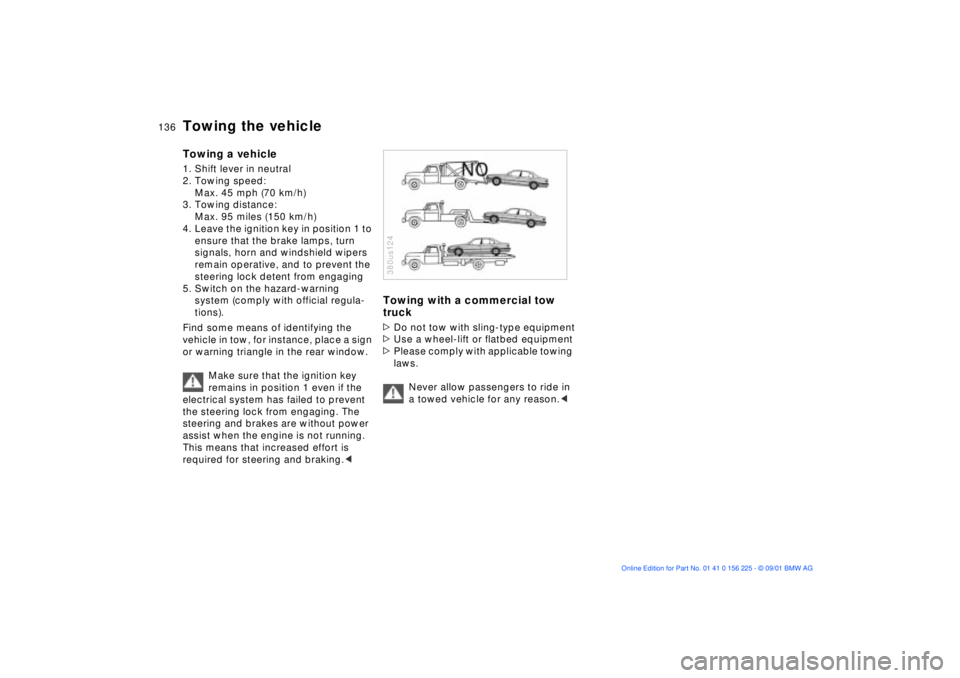
Towing with a commercial tow
truck>Do not tow with sling-type equipment
>Use a wheel-lift or flatbed equipment
>Please comply with applicable towing
laws.
Never allow passengers to ride in
a towed vehicle for any reason.<380us124
Page 140 of 154

140n
BMW M5
Displacement
Number of cylinders cu in (cm
3) 301.5 (4,941)
8
Maximum output
at engine speed hp
rpm 394
6,600
Maximum torque
at engine speedlb ft (Nm)
rpm 368 (500)
3,800
Compression ratioe
11.0
Stroke
Borein (mm)
in (mm)3.50 (89.0)
3.70 (94.0)
Fuel-injection system Digital electronic engine-management system
Engine data
Page 143 of 154
143n
OverviewControlsMaintenanceRepairsDataIndex
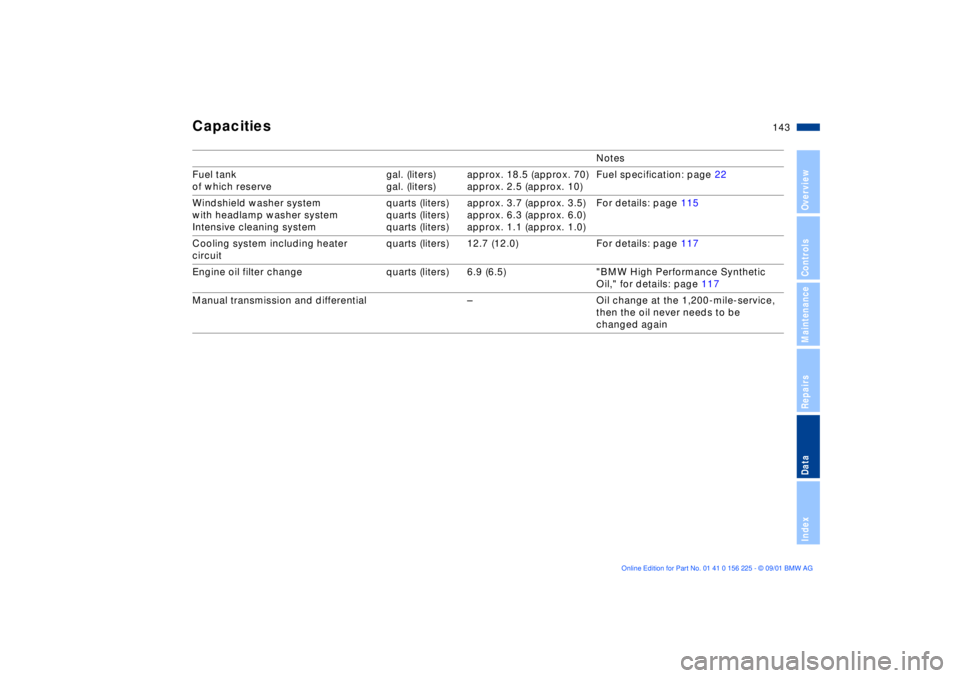
Capacities
Notes
Fuel tank
of which reserve gal. (liters)
gal. (liters)approx. 18.5 (approx. 70)
approx. 2.5 (approx. 10) Fuel specification: page 22
Windshield washer system
with headlamp washer system
Intensive cleaning systemquarts (liters)
quarts (liters)
quarts (liters)approx. 3.7 (approx. 3.5)
approx. 6.3 (approx. 6.0)
approx. 1.1 (approx. 1.0) For details: page 115
Cooling system including heater
circuitquarts (liters) 12.7 (12.0) For details: page 117
Engine oil filter change quarts (liters) 6.9 (6.5) "BMW High Performance Synthetic
Oil," for details: page 117
Manual transmission and differential Ð Oil change at the 1,200-mile-service,
then the oil never needs to be
changed again
Page 146 of 154

Everything from A to Z
A
ABS (Antilock Brake System) 17, 107
Activated-charcoal filter 91
Active seat 43
Adding brake fluid 118t
coolant 118t
engine coolant 118t
engine oil 115t
washer fluid 115t
Adjusting backrest 41
head restraints 43
mirrors 48
seats 40
steering wheel 47
temperature 89
Air distribution 89
Air pressure 22, 109
Air supply 89
Airbags 17, 49
Alarm system 35
Anchorages for attaching cargo straps 34, 102
Antifreeze 118
Antilock Brake System (ABS) 17, 107
Anti-theft alarm system 35
Aquaplaning 107, 109 Ashtray
front 97
rear 98
Attach vacuum cleaner 98
AUC (Automatic recircu- lated-air control) 90
Automatic climate control removing condensation on
the windows 89
Automatic cruise control 61
Automatic curb monitor 46
Automatic dimming exterior mirror 48
interior rearview mirror 48
Automatic recirculated-air control (AUC) 90
Automatic steering wheel adjustment 47
Automatic windshield washer 60
Average fuel consumption 75
Average speed 76
Avoid false alarms 36t
Axle loads 142 B
Backrest, adjusting 41
Backup lamps 59
bulb replacement 126t
Battery 131
care 131
charging 131
discharged 133t
Beverage holder 97
Blower 89
BMW active seat 43
BMW comfort seat 42
BMW High Performance Synthetic Oil 117
BMW M sport seat 41
BMW Maintenance System 119
BMW Universal Transmitter 93
Bottle holder, refer to beverage holder 97
Brake fluid 118
disposal 118
Brake hydraulic system, brake pads 16
Brake system 108
brake fluid level 108
brake linings 108
malfunctions 108t
Break-in procedures 106
Bulbs and lamps 124 C
California Proposition 65 Warning 120
Capacities 143
Car care, refer to the "Caring for your vehicle" manual
Car telephone 97
Car wash systems, refer to the "Caring for your
vehicle" manual
Care of paintwork, refer to the "Caring for your
vehicle" manual
Care of upholstery materials, refer to the "Caring for your
vehicle" manual
Cargo loading 102
Cellular phone 97
refer also to the separate
Owner's Manual 97
Center (high mount) brake lamp 127
Central locking system 26
key 31
Charging the battery 132t
Check air pressure 22t , 109
CHECK button 66
Page 147 of 154
Everything from A to Z
147n
OverviewControlsMaintenanceRepairsDataIndex
Check Control66
Check engine oil
level115t
Child seat safety53
Child seats52
Cigarette lighter98
Clock70
refer also to the "Onboard
Computer Owner's
Manual"
Cockpit14
Code76
activating76
deactivating76
refer also to the "Onboard
Computer Owner's
Manual"
selecting76
Comfort seat42
Compartments96
Computer73
refer also to the "Onboard
Computer Owner's
Manual"
remote control77
Configuring individual
adjustments55
Consumption75 Convenience operation of
windows and sliding/tilt
sunroof27
Coolant118
disposal118
Coolant temperature
gauge65
Cooling, maximum90
Copyright notice4
Cover, sun blinds92
Cruising range75
Cup holder97
Cup holder, refer to
beverage holder97
Curb weight142
D
Date
calling up70
changing70
refer also to the "Onboard
Computer Owner's
Manual"
Daytime driving lamps84
DBC (Dynamic Brake
Control)17, 80
Deactivating
alarm system tilt
sensor36t
the interior motion
sensor36t Deep water107
Defrosting position89
Defrosting the
windows89t
Digital clock70
refer also to the "Onboard
Computer Owner's
Manual"
Dimensions141
Disconnect the
battery133t
Displacement140
Display lighting85
Displays, instrument
panel15
Disposal
brake fluid118
coolant118
engine oil116
Distance from
destination74
Divided rear backrest99
Door key26
Doors
manual operation27
remote control28
unlocking and locking27
DOT Quality Grades110
Driving notes107 DSC (Dynamic Stability
Control)17, 80
Dynamic Brake Control
(DBC)17, 80
Dynamic Driving Control81
Dynamic Stability Control
(DSC)17, 80
E
Electric power windows36
Electrical heating, exterior
mirror48
Electrical malfunction
doors27t
fuel filler door20t
luggage compartment
lid32t
sliding/tilt sunroof39t
Elements of operation14
Emergency release of
luggage compartment lid
from luggage
compartment's interior34
Engine compartment114
Engine coolant118
Engine coolant temperature
gauge65
Engine data140
Page 148 of 154

Everything from A to ZEngine oil
checking level115
consumption115
dipstick115
disposal116
grades117
level16
pressure16
temperature gauge64
Engine performance140
Estimated time of arrival75
Exterior mirrors48
automatic dimming48
electrical heating48 F
Failure messages66
Filling capacities143
First-aid kit20
Fittings, tow starting and
towing135t
Flashlight96
Flat tire109
Flat Tire Monitor82
Fog lamps85
bulb replacement126t
Folding rear backrest99
Follow me home lamps84 Frost protection,
radiator118
Fuel consumption75
average75
Fuel filler door20
manual operation20t
Fuel gauge64
Fuel quality22
Fuel specifications22
Fuel tank capacity143
Fuse replacement132t
G
Gasoline gauge64
Gasoline quality22
Glove compartment96
Gross vehicle weight142 H
Handbrake17, 58
Hands-free system97
Hazard warning triangle20
Head protection airbags49
Head restraints43
adjusting43
Headlamp cover,
care125t
Headlamp flasher59
Headlamp washer
system115 Headlamp washers61
Headrests43
Heating with vehicle
stopped90
Heavy cargo102
Height141
Height adjustment
seats41
steering wheel47
High beams18, 59, 85
High Performance Synthetic
Oil117
High-mount brake lamp127
Holder for canned
beverages97
Hood113
release113t
Horn14
Hydraulic Braking Assistant,
refer to DBC17, 80
I
Ice warning63
Identification, tires111
Ignition key26
Ignition lock56
Imprint4
Indicator lamps16 Inflation
pressure22t, 109
INSPECTION65
Instrument cluster15
Instrument lighting85
Instrument panel15
Intensive cleaning
system115
Interface socket for Onboard
Diagnostics (OBD)121
Interior lamps86
Interior mirrors48
Interior motion sensor36
deactivate29
J
Jump-starting133t K
Key Memory55
Key with remote control26
Keys26 L
Lamps and bulbs124
Leather care, refer to the
"Caring for your vehicle"
manual