ECU BMW M5 SEDAN 2002 Owners Manual
[x] Cancel search | Manufacturer: BMW, Model Year: 2002, Model line: M5 SEDAN, Model: BMW M5 SEDAN 2002Pages: 154, PDF Size: 2.17 MB
Page 3 of 154

Congratulations, and thank you for choosing a BMW M5.
Thorough familiarity with your vehicle will provide you with enhanced control and
security when you drive it. We therefore have this request:
Please take the time to read this Owner's Manual and familiarize yourself with the
information that we have compiled for you before starting off in your new BMW. It
contains important data and instructions intended to assist you in gaining maximum
use and satisfaction from your BMW's unique range of technical features. This
manual also contains information on vehicle maintenance. This information is
intended to ensure optimal levels of operating safety while simultaneously helping
to maintain your BMW's value.
For more detailed information refer to the supplemental manuals.
This Owner's Manual should be considered a permanent part of this vehicle. It
should stay with the vehicle when sold to provide the next owner with important
operating, safety and maintenance information.
This manual is supplemented by a Service and Warranty Information Booklet
(US models) or a Warranty and Service Guide Booklet (Canadian models).
We recommend that you read this publication thoroughly.
Your BMW is covered by the following warranties:
>
New Vehicle Limited Warranty
>
Limited Rust Perforation Warranty
>
Federal Emissions System Defect Warranty
>
Federal Emissions Performance Warranty
>
California Emission Control System Limited Warranty
Detailed information on these warranties is listed in the Service and Warranty Infor-
mation Booklet (US models) or in the Warranty and Service Guide Booklet (Cana-
dian models).
We wish you an enjoyable driving experience.
BMW M
Preface
Page 28 of 154
28n
Opening and closing Ð via the remote control
The concept
The remote control gives you an excep-
tionally convenient method for
unlocking and locking your vehicle.
Furthermore, it provides two additional
functions that can only be executed by
means of the remote control:
>
To switch on interior lamps, refer to
page 29
With this function, you can also
"search for" your vehicle Ð when
parked in an underground garage, for
instance
>
To open the luggage compartment
lid, refer to page 29
The luggage compartment lid will
open slightly, regardless of whether it
was previously locked or unlocked
>
Panic mode, refer to page 29
In case of danger, you can trigger an
alarm.
When you unlock (lock) your vehicle the
system automatically deactivates (acti-
vates) the anti-theft system and disarms
(arms)
the alarm system while also
switching on (off) the interior lamps.
You can have a signal set as an
acknowledgment message that
the vehicle is closed correctly.
<
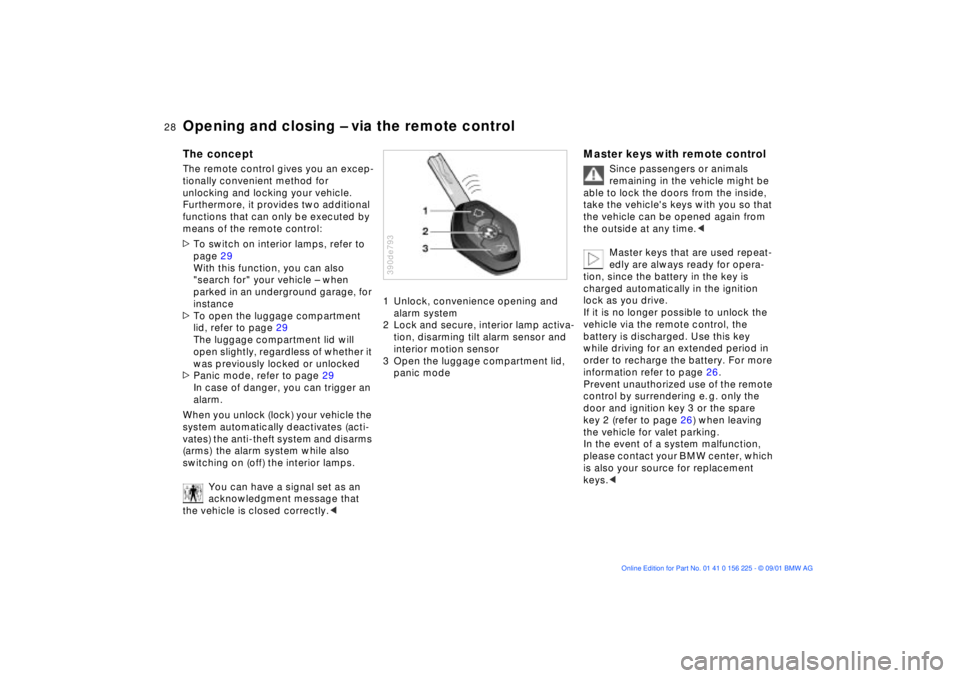
1 Unlock, convenience opening and
alarm system
2 Lock and secure, interior lamp activa-
tion, disarming tilt alarm sensor and
interior motion sensor
3 Open the luggage compartment lid,
panic mode390de793
Master keys with remote control
Since passengers or animals
remaining in the vehicle might be
able to lock the doors from the inside,
take the vehicle's keys with you so that
the vehicle can be opened again from
the outside at any time.
<
Master keys that are used repeat-
edly are always ready for opera-
tion, since the battery in the key is
charged automatically in the ignition
lock as you drive.
If it is no longer possible to unlock the
vehicle via the remote control, the
battery is discharged. Use this key
while driving for an extended period in
order to recharge the battery. For more
information refer to page 26.
Prevent unauthorized use of the remote
control by surrendering e. g. only the
door and ignition key 3 or the spare
key 2 (refer to page 26) when leaving
the vehicle for valet parking.
In the event of a system malfunction,
please contact your BMW center, which
is also your source for replacement
keys.
<
Page 29 of 154
29n
OverviewControlsMaintenanceRepairsDataIndex
Opening and closing Ð via the remote control To unlockPress button.
Press the button once to unlock the
driver's door only; press a second time
to unlock all remaining doors as well as
the luggage compartment lid and fuel
filler door.Convenience opening modePress and hold button to open the elec-
tric power windows and sliding/tilt
sunroof.
To lock and secure Press button.
Vehicles without armored glass:
Do not lock the vehicle if anyone
will be remaining inside, as it would
then be impossible for the occupant(s)
to disengage the locks from the
inside.< To deactivate the tilt alarm sensor
and the interior motion sensorPress button a second time immedi-
ately after locking.
For additional information, refer to
page 36.To switch on the interior lampsWith the vehicle locked, press button.
To open the luggage
compartment lidPress button.
The luggage compartment lid will open
slightly, regardless of whether the lid
was previously locked or unlocked.
Before and after a trip, be sure
that the luggage compartment lid
has not been opened unintentionally.
danger by holding down the button for
between two and five seconds.
To cancel alarm
Press button.
Page 32 of 154
32n
Luggage compartment lidThe lock Only the master key (refer to page 26)
fits in the lock for the luggage compart-
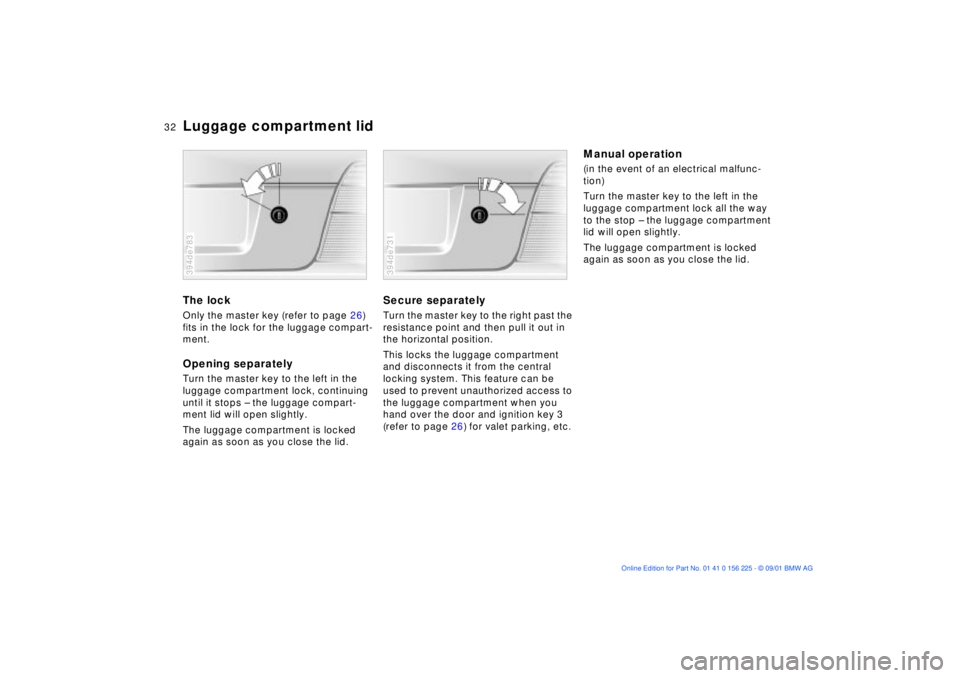
ment. Opening separatelyTurn the master key to the left in the
luggage compartment lock, continuing
until it stops Ð the luggage compart-
ment lid will open slightly.
The luggage compartment is locked
again as soon as you close the lid.394de783
Secure separatelyTurn the master key to the right past the
resistance point and then pull it out in
the horizontal position.
This locks the luggage compartment
and disconnects it from the central
locking system. This feature can be
used to prevent unauthorized access to
the luggage compartment when you
hand over the door and ignition key 3
(refer to page 26) for valet parking, etc. 394de731
Manual operation (in the event of an electrical malfunc-
tion)
Turn the master key to the left in the
luggage compartment lock all the way
to the stop Ð the luggage compartment
lid will open slightly.
The luggage compartment is locked
again as soon as you close the lid.
Page 34 of 154
34n
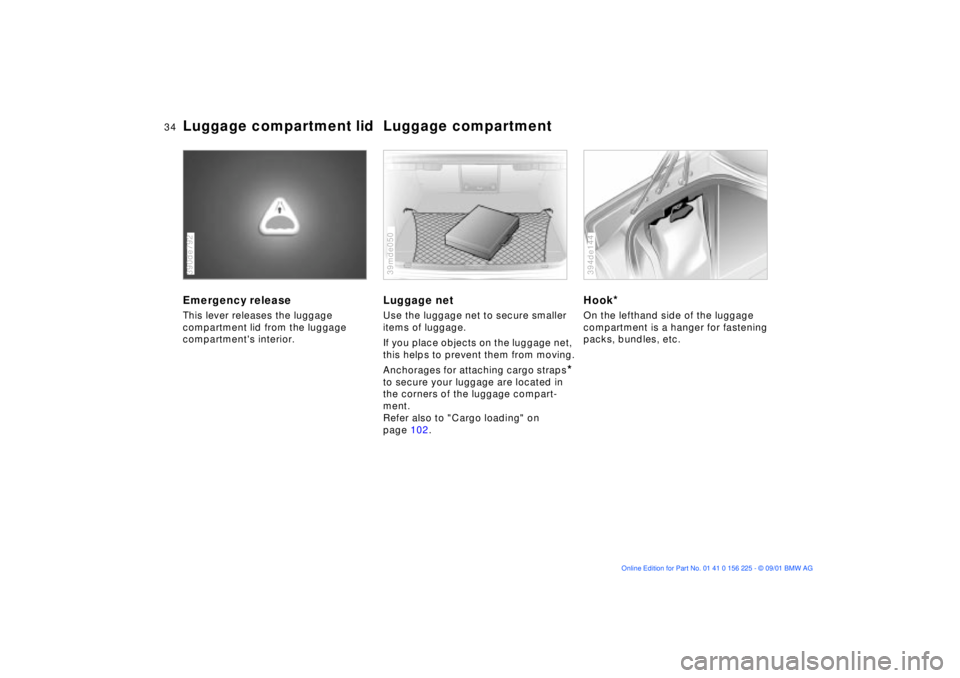
Luggage compartment lid Luggage compartmentEmergency releaseThis lever releases the luggage
compartment lid from the luggage
compartment's interior.390de792
Luggage netUse the luggage net to secure smaller
items of luggage.
If you place objects on the luggage net,
this helps to prevent them from moving.
Anchorages for attaching cargo straps
*
to secure your luggage are located in
the corners of the luggage compart-
ment.
Refer also to "Cargo loading" on
page 102.
39mde050
Hook
*
On the lefthand side of the luggage
compartment is a hanger for fastening
packs, bundles, etc. 394de144
Page 35 of 154
35n
OverviewControlsMaintenanceRepairsDataIndex
Alarm systemThe conceptThe vehicle alarm system responds:
>When a door, the hood or the
luggage compartment lid are opened
>To movement inside the vehicle (inte-
rior motion sensor)
>Variations in the vehicle's tilt angle of
the kind that occur during attempts to
steal the wheels or tow the vehicle
>To interruption of battery voltage.
The system responds to unauthorized
vehicle entry and attempted theft by
simultaneously activating the following:
>Sounding an acoustical alarm for
30 seconds
>The hazard warning flashers are acti-
vated for approx. five minutes
>The high beams flash on and off in
the same rhythm as the hazard
warning flashers.
To arm and disarm the
alarm systemWhen the vehicle is locked or unlocked
with the key or the remote control, the
alarm system is also simultaneously
armed or disarmed.
You can have different acknowl-
edgment messages set to confirm
arming and disarming.<
You can also open the luggage
compartment lid when the system is
armed by pressing the button on the
remote control (refer to page 29). When
you close the luggage compartment lid,
the luggage compartment is secured
again.
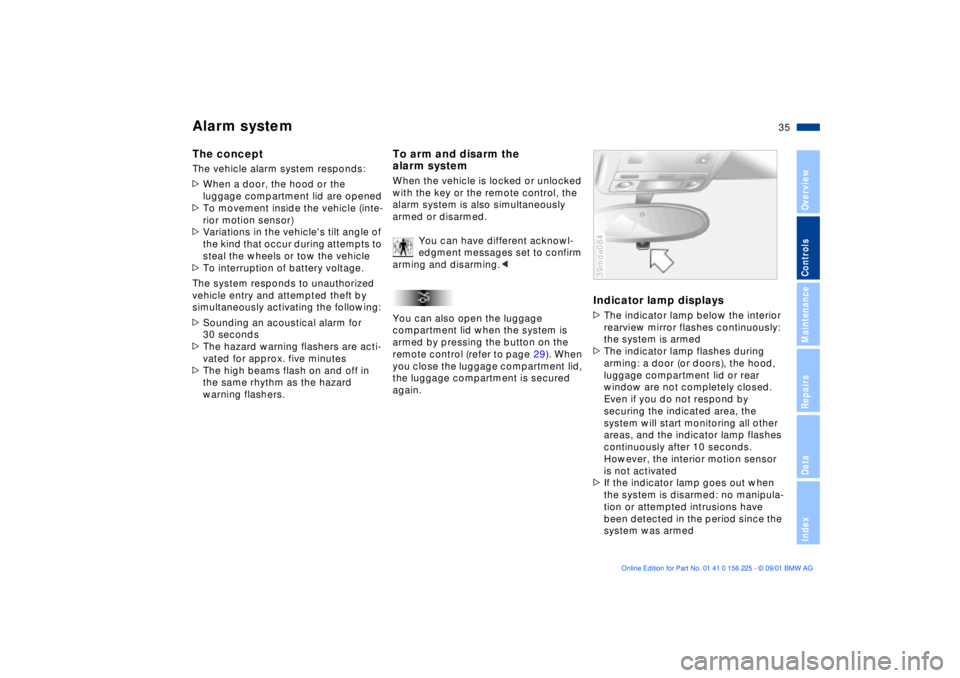
Indicator lamp displays>The indicator lamp below the interior
rearview mirror flashes continuously:
the system is armed
>The indicator lamp flashes during
arming: a door (or doors), the hood,
luggage compartment lid or rear
window are not completely closed.
Even if you do not respond by
securing the indicated area, the
system will start monitoring all other
areas, and the indicator lamp flashes
continuously after 10 seconds.
However, the interior motion sensor
is not activated
>If the indicator lamp goes out when
the system is disarmed: no manipula-
tion or attempted intrusions have
been detected in the period since the
system was armed39mde084
Page 45 of 154
45n
OverviewControlsMaintenanceRepairsDataIndex
Seat, mirror and steering wheel memory
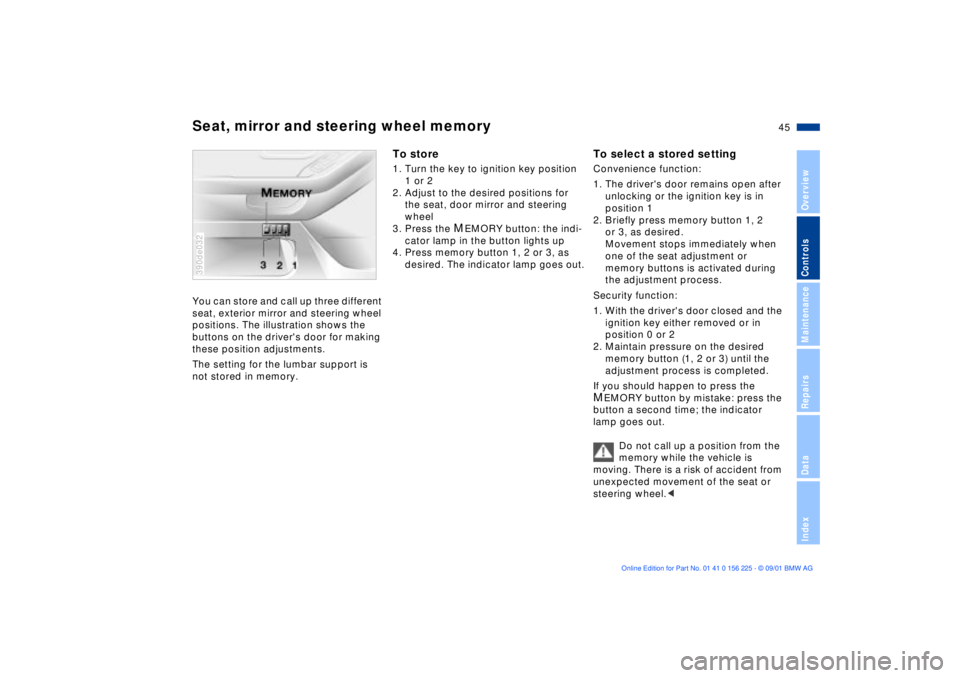
You can store and call up three different
seat, exterior mirror and steering wheel
positions. The illustration shows the
buttons on the driver's door for making
these position adjustments.
The setting for the lumbar support is
not stored in memory. 390de032
To store1. Turn the key to ignition key position
1 or 2
2. Adjust to the desired positions for
the seat, door mirror and steering
wheel
3. Press the
MEMORY button: the indi-
cator lamp in the button lights up
4. Press memory button 1, 2 or 3, as
desired. The indicator lamp goes out.
To select a stored settingConvenience function:
1. The driver's door remains open after
unlocking or the ignition key is in
position 1
2. Briefly press memory button 1, 2
or 3, as desired.
Movement stops immediately when
one of the seat adjustment or
memory buttons is activated during
the adjustment process.
Security function:
1. With the driver's door closed and the
ignition key either removed or in
position 0 or 2
2. Maintain pressure on the desired
memory button (1, 2 or 3) until the
adjustment process is completed.
If you should happen to press the MEMORY button by mistake: press the
button a second time; the indicator
lamp goes out.
Do not call up a position from the
memory while the vehicle is
moving. There is a risk of accident from
unexpected movement of the seat or
steering wheel.<
Page 52 of 154
52n
Transporting children safelyCommercially-available child-restraint
systems are designed to be secured
with a lap belt or with the lap belt
portion of a combination lap/shoulder
belt. Improperly or inadequately
installed restraint systems can increase
the risk of injury to children. Always
read and follow the instructions that
come with the system.
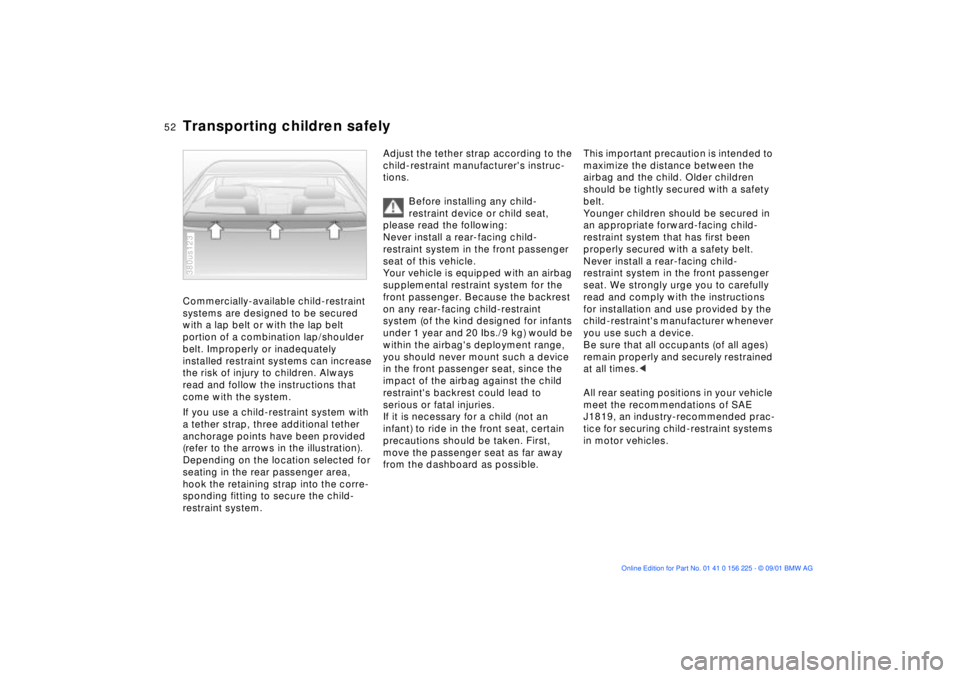
If you use a child-restraint system with
a tether strap, three additional tether
anchorage points have been provided
(refer to the arrows in the illustration).
Depending on the location selected for
seating in the rear passenger area,
hook the retaining strap into the corre-
sponding fitting to secure the child-
restraint system.380us123
Adjust the tether strap according to the
child-restraint manufacturer's instruc-
tions.
Before installing any child-
restraint device or child seat,
please read the following:
Never install a rear-facing child-
restraint system in the front passenger
seat of this vehicle.
Your vehicle is equipped with an airbag
supplemental restraint system for the
front passenger. Because the backrest
on any rear-facing child-restraint
system (of the kind designed for infants
under 1 year and 20 Ibs./9 kg) would be
within the airbag's deployment range,
you should never mount such a device
in the front passenger seat, since the
impact of the airbag against the child
restraint's backrest could lead to
serious or fatal injuries.
If it is necessary for a child (not an
infant) to ride in the front seat, certain
precautions should be taken. First,
move the passenger seat as far away
from the dashboard as possible.
This important precaution is intended to
maximize the distance between the
airbag and the child. Older children
should be tightly secured with a safety
belt.
Younger children should be secured in
an appropriate forward-facing child-
restraint system that has first been
properly secured with a safety belt.
Never install a rear-facing child-
restraint system in the front passenger
seat. We strongly urge you to carefully
read and comply with the instructions
for installation and use provided by the
child-restraint's manufacturer whenever
you use such a device.
Be sure that all occupants (of all ages)
remain properly and securely restrained
at all times.<
All rear seating positions in your vehicle
meet the recommendations of SAE
J1819, an industry-recommended prac-
tice for securing child-restraint systems
in motor vehicles.
Page 53 of 154
53n
OverviewControlsMaintenanceRepairsDataIndex
Transporting children safelyChild seat securityAll of the rear belt retractors and the
front passenger's safety belt can be
locked for mounting and securing child-
restraint systems.
A label with the appropriate instructions
is located in the immediate vicinity of
the buckle latch of each safety belt.To lock the beltExtract the entire length of the belt from
the belt retractor. Allow the reel to
retract the belt somewhat and engage
the buckle, then tighten the belt against
the child-restraint system. The retrac-
tion mechanism is now locked.365us146
To release the beltRelease the buckle, remove the child-
restraint device and allow the belt
retractor to reel the belt completely in.
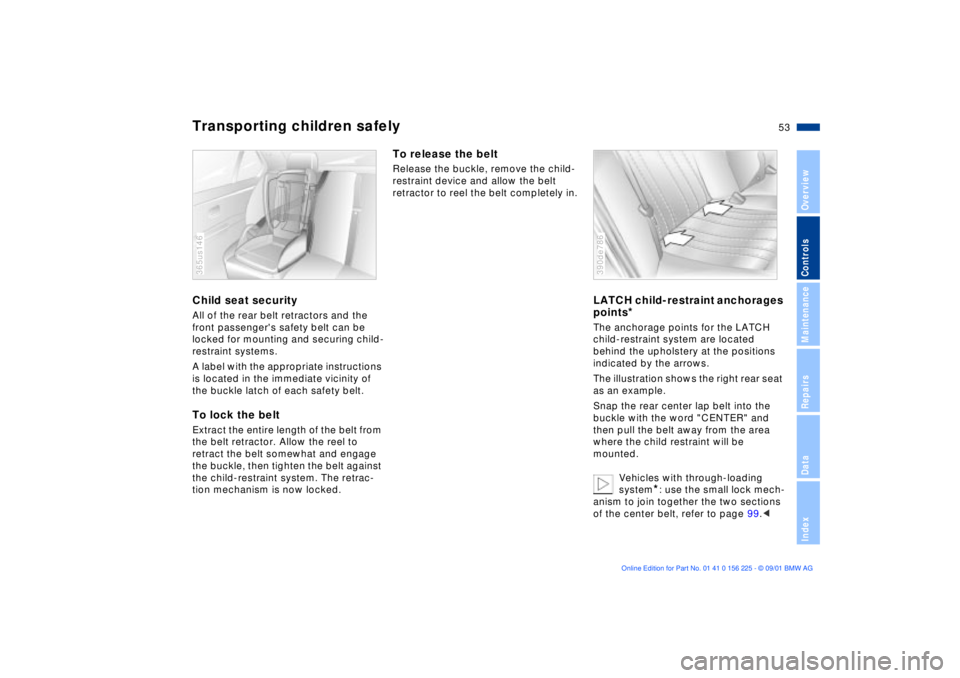
LATCH child-restraint anchorages
points
*
The anchorage points for the LATCH
child-restraint system are located
behind the upholstery at the positions
indicated by the arrows.
The illustration shows the right rear seat
as an example.
Snap the rear center lap belt into the
buckle with the word "CENTER" and
then pull the belt away from the area
where the child restraint will be
mounted.
Vehicles with through-loading
system
*: use the small lock mech-
anism to join together the two sections
of the center belt, refer to page 99.<
390de786
Page 58 of 154
58n
Parking brake Manual transmission The parking brake is designed primarily
to prevent the vehicle from rolling when
it is parked. It operates at the rear
wheels.To engageThe lever engages automatically when
it is pulled up, and the "PARK BRAKE"
(in Canada "P") indicator lamp comes
on in the instrument cluster in ignition
key position 2. Refer to page 17. To releasePull up slightly on the lever, press the
button and lower the lever.390de714
If, in exceptional circumstances, it
should be necessary to engage
the parking brake while the vehicle is in
motion, do not pull it with excessive
pressure. Keep your thumb pressed
against the release button while care-
fully pulling the lever up to apply
moderate pressure.
Excessive pressure can lead to over-
braking and loss of traction (fishtailing)
at the rear axle.
The brake lamps do not come on when
the parking brake is applied. Always
engage the parking brake when parking
on hills and inclined surfaces, as even
first gear or reverse may not provide
adequate resistance to rolling.<
You can help prevent corrosion and
maintain balanced braking by periodi-
cally pulling up the parking brake lever
gently while coasting to a stop at a
traffic light. Always check traffic condi-
tions first to avoid posing a hazard to
yourself or other road users.
When shifting gears, always depress
the clutch pedal all the way to the end
of its travel, then move the shift lever
until it engages securely in the desired
gear.
You will also need to depress the clutch
when starting the engine, as an auto-
matic lockout prevents the starter from
operating when the clutch is engaged.
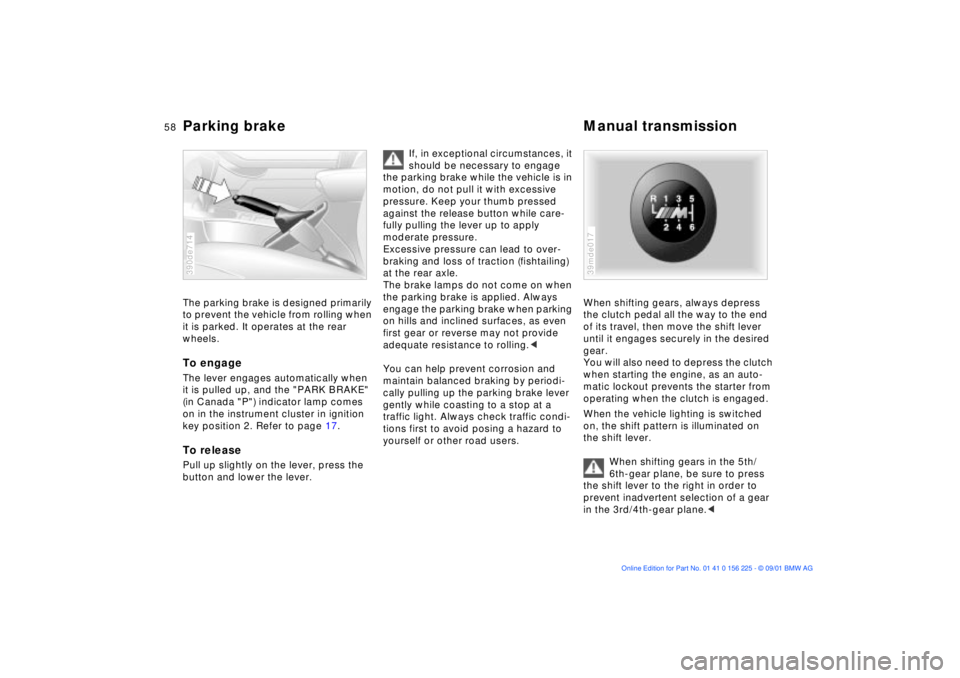
When the vehicle lighting is switched
on, the shift pattern is illuminated on
the shift lever.
When shifting gears in the 5th/
6th-gear plane, be sure to press
the shift lever to the right in order to
prevent inadvertent selection of a gear
in the 3rd/4th-gear plane.<39mde017