oil BMW M5 SEDAN 2002 Owners Manual
[x] Cancel search | Manufacturer: BMW, Model Year: 2002, Model line: M5 SEDAN, Model: BMW M5 SEDAN 2002Pages: 154, PDF Size: 2.17 MB
Page 4 of 154

Contents
© 2001 BMW M GmbH
Munich, Germany
Reprinting, including excerpts, only with the
written consent of BMW AG, Munich.
Order no. 01 41 0 156 225
US English VIII/01
Printed in Germany
Printed on environmentally friendly paper
(bleached without chlorine, suitable for recycling).
Overview
Controls and features
Cockpit14
Instrument cluster15
Indicator and warning lamps16
Steering wheel with multifunction
buttons19
Warning triangle20
First-aid kit20
Refueling20
Fuel specifications22
Tire inflation pressure22
Opening and closing:
Keys26
Central locking system26
Opening and closing Ð via the
door lock27
Opening and closing Ð via the
remote control28
Opening and closing Ð
from the inside31
Luggage compartment lid32
Luggage compartment34
Alarm system35
Electric power windows36
Sliding/tilt sunroof38
Adjustments:
Correct sitting posture40
Seats40
BMW M sport seat41
BMW comfort seat42
Head restraints43
BMW active seat43
Safety belts44
Seat, mirror and
steering wheel memory45
Seat heating46
Steering wheel47
Mirrors48
Passenger safety systems:
Airbags49
Transporting children safely52
Vehicle Memory, Key
Memory55
Driving:
Steering/Ignition lock56
Starting the engine56
Switching off the engine57
Parking brake58
Manual transmission58
Turn signal/Headlamp flasher59
Washer/Wiper system/Rain
sensor60
Cruise control61
Everything under control:
Odometer, outside temperature
display63
Tachometer64
Engine oil temperature64
Fuel gauge64
Temperature gauge65
Service Interval Display65
Check Control66
Multi-Information Display
(MID)69
Digital clock70
Computer73
Contents
Page 6 of 154

Contents Operation, maintenance
Owner service procedures
Technical data
In the engine compartment:
Hood113
Engine compartment
essentials114
Washer fluids115
Engine oil115
Coolant117
Brake fluid118 Maintenance: The BMW Maintenance
System119 Laws and regulations: Technical modifications120
California Proposition
65 Warning120
OBD interface socket121
Replacement procedures:
Onboard tool kit124
Windshield wiper blades124
Lamps and bulbs124
Repairing a flat tire128
Battery131
Fuses132
Assistance, giving and
receiving:
Jump-starting133
Towing the vehicle135Engine data140
Dimensions141
Weights142
Capacities143
Page 15 of 154
15n
OverviewControlsMaintenanceRepairsDataIndex
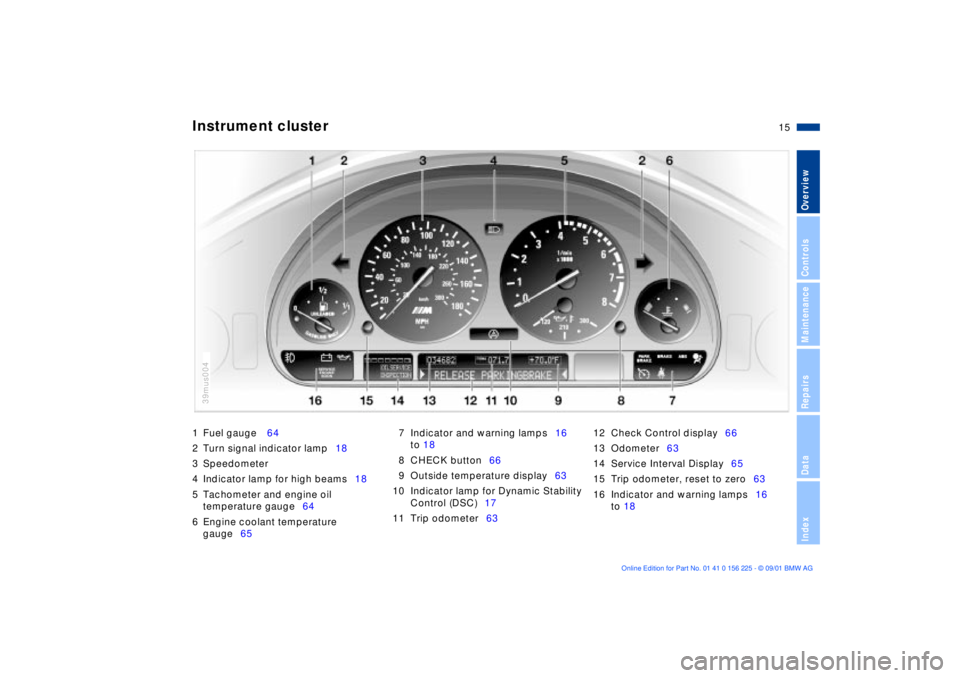
1 Fuel gauge 64
2 Turn signal indicator lamp18
3 Speedometer
4 Indicator lamp for high beams18
5 Tachometer and engine oil
temperature gauge64
6 Engine coolant temperature
gauge657 Indicator and warning lamps16
to 18
8 CHECK button66
9 Outside temperature display63
10 Indicator lamp for Dynamic Stability
Control (DSC)17
11 Trip odometer6312 Check Control display66
13 Odometer63
14 Service Interval Display65
15 Trip odometer, reset to zero63
16 Indicator and warning lamps16
to 18
Instrument cluster
39mus004
Page 16 of 154
16n
Indicator and warning lamps
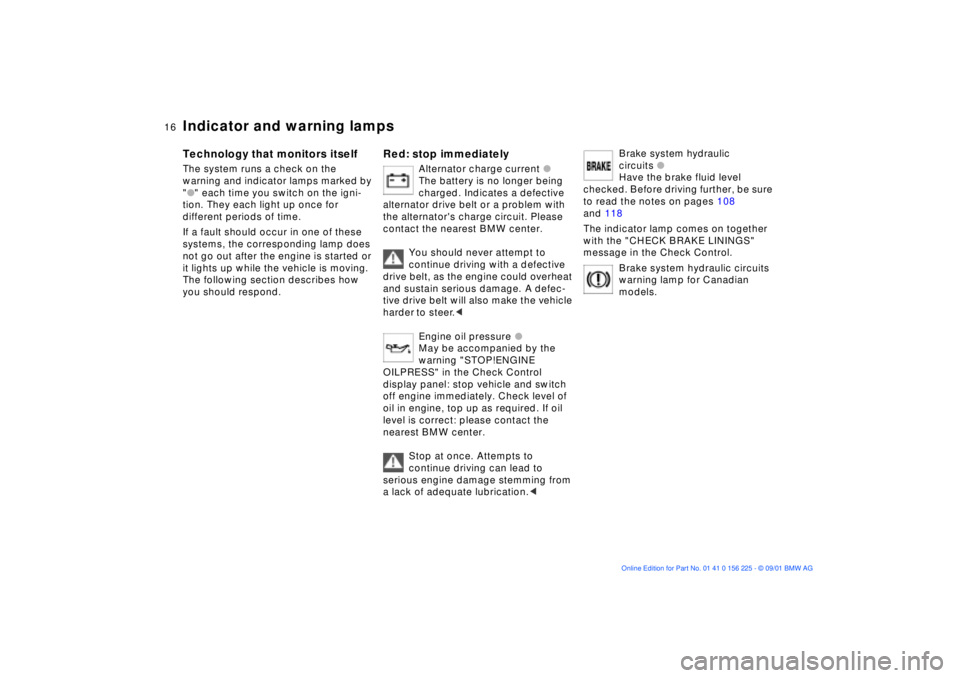
Technology that monitors itself
The system runs a check on the
warning and indicator lamps marked by
"
l
" each time you switch on the igni-
tion. They each light up once for
different periods of time.
If a fault should occur in one of these
systems, the corresponding lamp does
not go out after the engine is started or
it lights up while the vehicle is moving.
The following section describes how
you should respond.
Red: stop immediately
Alternator charge current
l
The battery is no longer being
charged. Indicates a defective
alternator drive belt or a problem with
the alternator's charge circuit. Please
contact the nearest BMW center.
You should never attempt to
continue driving with a defective
drive belt, as the engine could overheat
and sustain serious damage. A defec-
tive drive belt will also make the vehicle
harder to steer.
<
Engine oil pressure
l
May be accompanied by the
warning "STOP!ENGINE
OILPRESS" in the Check Control
display panel: stop vehicle and switch
off engine immediately. Check level of
oil in engine, top up as required. If oil
level is correct: please contact the
nearest BMW center.
Stop at once. Attempts to
continue driving can lead to
serious engine damage stemming from
a lack of adequate lubrication.
<
Brake system hydraulic
circuits
l
Have the brake fluid level
checked. Before driving further, be sure
to read the notes on pages 108
and 118
The indicator lamp comes on together
with the "CHECK BRAKE LININGS"
message in the Check Control.
Brake system hydraulic circuits
warning lamp for Canadian
models.
Page 64 of 154
64n
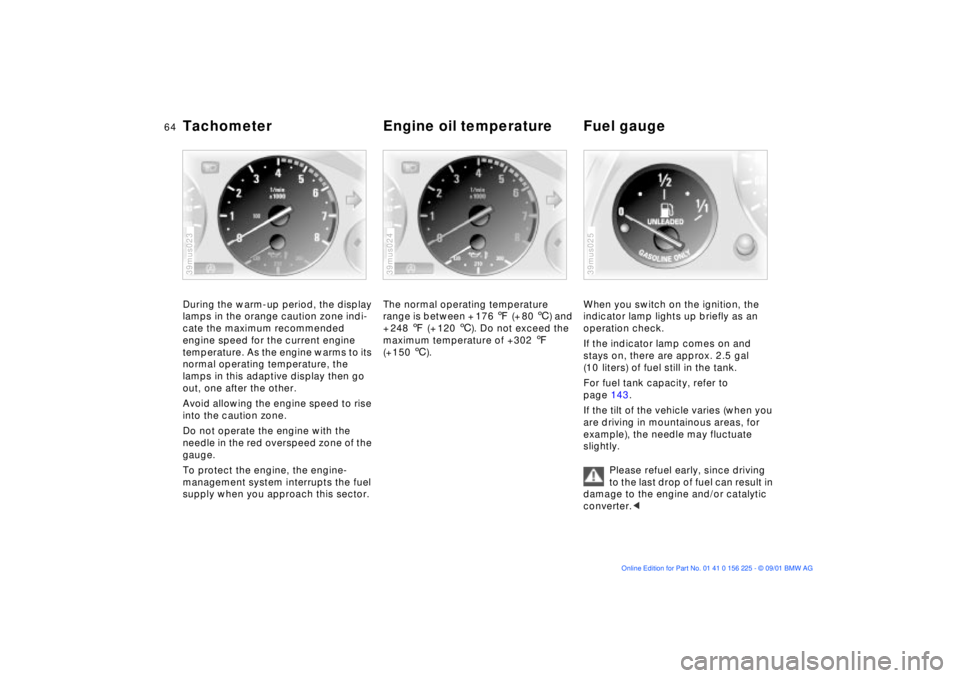
Tachometer Engine oil temperature Fuel gauge During the warm-up period, the display
lamps in the orange caution zone indi-
cate the maximum recommended
engine speed for the current engine
temperature. As the engine warms to its
normal operating temperature, the
lamps in this adaptive display then go
out, one after the other.
Avoid allowing the engine speed to rise
into the caution zone.
Do not operate the engine with the
needle in the red overspeed zone of the
gauge.
To protect the engine, the engine-
management system interrupts the fuel
supply when you approach this sector.39mus023
The normal operating temperature
range is between + 176 7 (+ 80 6) and
+ 248 7 (+ 120 6). Do not exceed the
maximum temperature of +302 7
(+150 6). 39mus024
When you switch on the ignition, the
indicator lamp lights up briefly as an
operation check.
If the indicator lamp comes on and
stays on, there are approx. 2.5 gal
(10 liters) of fuel still in the tank.
For fuel tank capacity, refer to
page 143.
If the tilt of the vehicle varies (when you
are driving in mountainous areas, for
example), the needle may fluctuate
slightly.
Please refuel early, since driving
to the last drop of fuel can result in
damage to the engine and/or catalytic
converter.<39mus025
Page 65 of 154
65n
OverviewControlsMaintenanceRepairsDataIndex
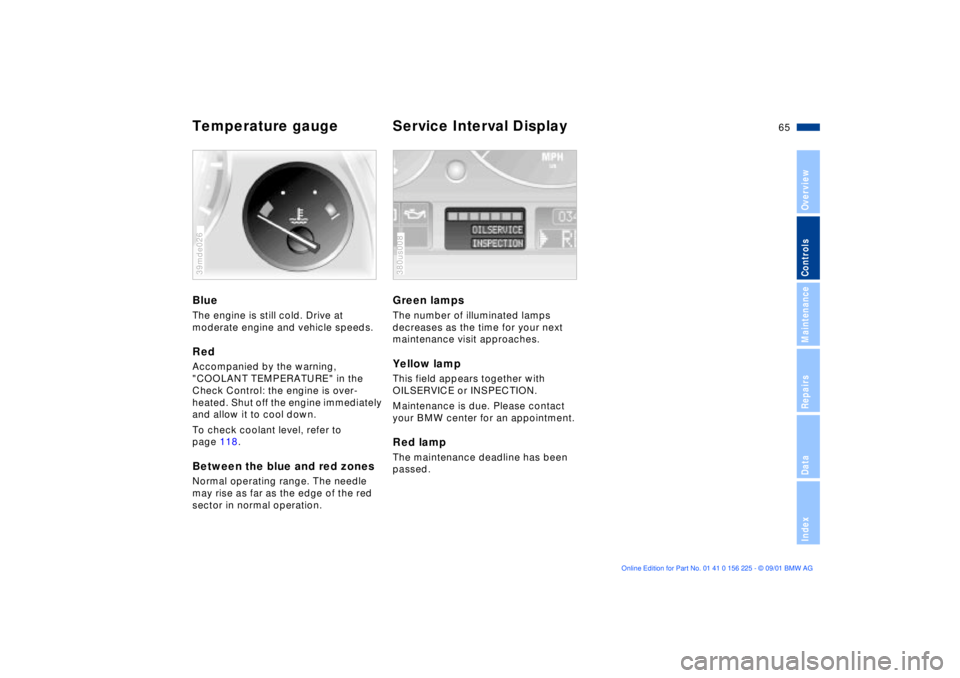
Temperature gauge Service Interval Display BlueThe engine is still cold. Drive at
moderate engine and vehicle speeds.RedAccompanied by the warning,
"COOLANT TEMPERATURE" in the
Check Control: the engine is over-
heated. Shut off the engine immediately
and allow it to cool down.
To check coolant level, refer to
page 118.Between the blue and red zonesNormal operating range. The needle
may rise as far as the edge of the red
sector in normal operation. 39mde026
Green lampsThe number of illuminated lamps
decreases as the time for your next
maintenance visit approaches.Yellow lampThis field appears together with
OILSERVICE or INSPECTION.
Maintenance is due. Please contact
your BMW center for an appointment. Red lampThe maintenance deadline has been
passed.380us008
Page 66 of 154
66n
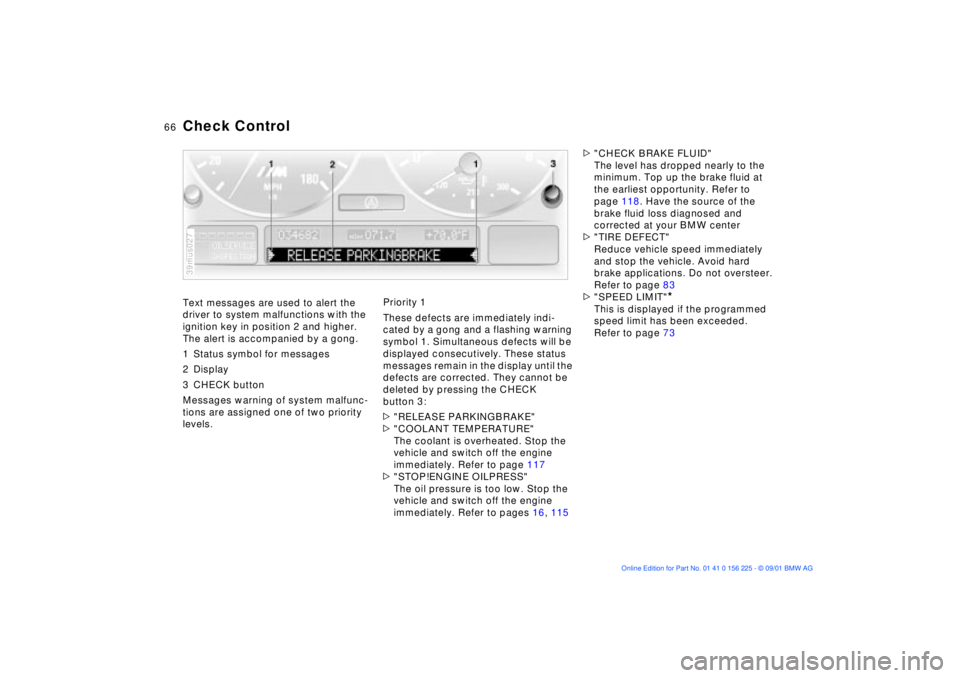
Text messages are used to alert the
driver to system malfunctions with the
ignition key in position 2 and higher.
The alert is accompanied by a gong.
1 Status symbol for messages
2 Display
3 CHECK button
Messages warning of system malfunc-
tions are assigned one of two priority
levels.
39mus027
Priority 1
These defects are immediately indi-
cated by a gong and a flashing warning
symbol 1. Simultaneous defects will be
displayed consecutively. These status
messages remain in the display until the
defects are corrected. They cannot be
deleted by pressing the CHECK
button 3:
>"RELEASE PARKINGBRAKE"
>"COOLANT TEMPERATURE"
The coolant is overheated. Stop the
vehicle and switch off the engine
immediately. Refer to page 117
>"STOP!ENGINE OILPRESS"
The oil pressure is too low. Stop the
vehicle and switch off the engine
immediately. Refer to pages 16, 115>"CHECK BRAKE FLUID"
The level has dropped nearly to the
minimum. Top up the brake fluid at
the earliest opportunity. Refer to
page 118. Have the source of the
brake fluid loss diagnosed and
corrected at your BMW center
>"TIRE DEFECT"
Reduce vehicle speed immediately
and stop the vehicle. Avoid hard
brake applications. Do not oversteer.
Refer to page 83
>"SPEED LIMIT"
*
This is displayed if the programmed
speed limit has been exceeded.
Refer to page 73
Check Control
Page 67 of 154

67n
OverviewControlsMaintenanceRepairsDataIndex
Check Control Priority 2
These displays appear for 20 seconds
with the ignition key in position 2. The
warning symbols remain after the
message disappears. The messages
can be recalled again with Check
button 3.
>"TRUNKLID OPEN"
This message appears only when you
initially begin a trip
>"DOOR OPEN"
This message appears after a defined
road speed has been exceeded
>"FASTEN SEAT BELTS"
*
In addition to this message, an indi-
cator lamp with the safety belt icon
appears and an acoustic signal is
sounded
>"WASHER FLUID LOW"
Too low; top up fluid at the next
opportunity. Refer to page 115
>"CHECK ENGINE OIL LEV"
The oil level is at the absolute
minimum, so add engine oil as soon
as possible. Refer to page 115. Until
then, do not drive more than approx.
30 miles (50 km)>"SET TIRE PRESSURE"
The Flat Tire Monitor has adopted the
tires' current inflation pressures as its
reference levels. Refer to page 82
>"TIRECONTROL INACTIVE"
Transient malfunctions and system
errors in the Flat Tire Monitor. Refer
to page 83
>"CHECK BRAKE LIGHTS"
A lamp has failed or the electrical
circuit has a fault. Refer to page 126
and 132 or consult a BMW center
>"CHECK LOWBEAM LIGHTS"
"CHECK SIDE LIGHTS"
"CHECK REAR LIGHTS"
"CHECK FRONT FOGLAMPS"
"CHECK LICPLATE LIGHT"
"CHECK HIGHBEAM LIGHT"
"CHECK BACK UP LIGHTS"
Defective bulb or circuit. Refer to
page 124 ff. and 132 or consult a
BMW center>"CHECK BRAKE LININGS"
Have the brake pads checked at your
BMW center. Refer to page 108
>"CHECK COOLANT LEVEL"
The coolant level is too low; top off at
the next opportunity. Refer to
page 118
>"CHECK FILLER CAP"
Check to see whether the fuel filler
cap has been properly closed. Refer
to page 20. An improperly closed fuel
filler cap will activate the Service
Engine Soon lamp
>"ENGINE FAILSAFE PROG"
Indicates a malfunction in the elec-
tronic engine-management system,
which then reverts to an emergency
default program allowing continued
operation at reduced power and
lower engine speeds.
Please have the system inspected by
your BMW center
>
"Outside temperature 24 7 (Ð 5.0 6)"This temperature display is only an
example. The current temperature is
displayed at outside temperatures of
37.5 7 (+3 6) and below. Refer also
to page 63.
Page 68 of 154

68n
Check ControlDisplays after completion of a tripAll of the malfunctions registered during
the trip appear consecutively when the
key is turned to position 0.
The following displays will appear when
appropriate:
>"LIGHTS ON"
This display appears when you open
the driver's door after parking the
vehicle
>"KEY IN IGNITION LOCK"
>"CHECK ENGINE OIL LEV"
Check the engine oil at the earliest
opportunity (next stop for fuel). Refer
to page 115.
Status messages remain available for a
period of approx. three minutes after
the display goes out and the key is
removed from the ignition. Press the
CHECK button 3 to display these
messages. If there were multiple
messages, press the CHECK button
repeatedly to view them all in
sequence.
To check the Check ControlPress the CHECK button 3 with the
ignition key in position 2:
CHECK CONTROL OK appears in the
display.
There are no faults in the monitored
systems.ComputerYou can find descriptions of the
computer starting on page 73 and in
the "Onboard Computer Owner's
Manual."
You can have the Check Control
and computer messages
displayed in a different language.<
Page 111 of 154

111n
OverviewControlsMaintenanceRepairsDataIndex
Tire replacement Wheel and tire combinations
Do not use retreaded tires, since
driving safety may be impaired.
This is due to the possible variations in
casing structures and, in some cases,
to their extreme age, which can lead to
a decrease in their durability.<
Tire ageThe date on which the tire was manu-
factured is indicated by the code on the
sidewall:
DOT ... 3401 indicates that the tire was
manufactured in week 34 of the year
2001.
Although tires may have a theoretical
service life of up to 10 years, BMW
strongly recommends that you replace
all tires after an absolute maximum of
6 years.
The right choice
Never mount wheels and tires that
have not been specifically
approved by BMW for use on your
particular model. Although other wheels
and tires may theoretically have the
same dimensions, variations in factors
such as manufacturing tolerances can
result in contact between tire and body-
work, ultimately leading to serious acci-
dents. If non-approved wheels and tires
are used, BMW cannot evaluate their
suitability, and therefore cannot be held
liable for driving safety.<
BMW has tested certain tires for each
tire size, rated them according to road
safety and approved them. Your BMW
center can inform you which tires have
been tested in this way. Observe
possible national guidelines, e.g.
regarding entry into vehicle documents.
Because various systems on your
vehicle, such as ABS, DSC and
the Flat Tire Monitor, rely on the correct
combination of tires and wheels for
optimal operation, their operation may
be adversely affected if other tires and/
or wheels are mounted .
You should therefore ensure that tires
from a single manufacturer with the
same tread pattern are mounted at all
four wheels. After installing a spare in
response to a flat tire you should
always ensure that a tire of the original
specifications is remounted as soon as
possible.<
The use of rims and wheel bolts
that do not meet the specifica-
tions of the original factory-installed
equipment will affect the safe operation
of your vehicle and may cause an acci-
dent and personal injury.
Never mix tires of different design, such
as steel-belted radials with radial bias-
belted or bias-ply tires, etc. Mixing tire
types will adversely affect roadholding and can lead to loss of vehicle control.
possible. Protect the tires against
contact with oil, grease and fuel.