seat adjustment BMW M5 SEDAN 2002 Owners Manual
[x] Cancel search | Manufacturer: BMW, Model Year: 2002, Model line: M5 SEDAN, Model: BMW M5 SEDAN 2002Pages: 154, PDF Size: 2.17 MB
Page 4 of 154

Contents
© 2001 BMW M GmbH
Munich, Germany
Reprinting, including excerpts, only with the
written consent of BMW AG, Munich.
Order no. 01 41 0 156 225
US English VIII/01
Printed in Germany
Printed on environmentally friendly paper
(bleached without chlorine, suitable for recycling).
Overview
Controls and features
Cockpit14
Instrument cluster15
Indicator and warning lamps16
Steering wheel with multifunction
buttons19
Warning triangle20
First-aid kit20
Refueling20
Fuel specifications22
Tire inflation pressure22
Opening and closing:
Keys26
Central locking system26
Opening and closing Ð via the
door lock27
Opening and closing Ð via the
remote control28
Opening and closing Ð
from the inside31
Luggage compartment lid32
Luggage compartment34
Alarm system35
Electric power windows36
Sliding/tilt sunroof38
Adjustments:
Correct sitting posture40
Seats40
BMW M sport seat41
BMW comfort seat42
Head restraints43
BMW active seat43
Safety belts44
Seat, mirror and
steering wheel memory45
Seat heating46
Steering wheel47
Mirrors48
Passenger safety systems:
Airbags49
Transporting children safely52
Vehicle Memory, Key
Memory55
Driving:
Steering/Ignition lock56
Starting the engine56
Switching off the engine57
Parking brake58
Manual transmission58
Turn signal/Headlamp flasher59
Washer/Wiper system/Rain
sensor60
Cruise control61
Everything under control:
Odometer, outside temperature
display63
Tachometer64
Engine oil temperature64
Fuel gauge64
Temperature gauge65
Service Interval Display65
Check Control66
Multi-Information Display
(MID)69
Digital clock70
Computer73
Contents
Page 40 of 154

40n
For relaxed and fatigue-free driving you
should select a sitting position that
reflects your personal requirements.
Correct posture combines with safety
belts and airbags to enhance occupant
safety in the event of an accident. To
ensure that the vehicle's safety systems
provide you with optimal protection, we
request that you direct your careful
attention to the following section.
For additional information on trans-
porting children, refer to page 52.
Sitting correctly with airbags
Always maintain an adequate
distance between yourself and the
airbags. Always hold the steering wheel
by the rim to keep any chance of injury
to hands or arms to an absolute
minimum should the airbag be
deployed. Never allow any objects,
individuals or animals to obstruct the
areas between passengers and airbags.
Never use the front airbag's cover as a
storage tray or support for objects of
any kind. Never allow front passengers
to rest their feet or legs on the airbag
cover.<
For airbag locations and additional
information on airbags refer to page 49.
Safe with safety belts
Never allow more than one person
to wear a single safety belt. Never
allow infants or small children to ride in
a passenger's lap. Avoid twisting the
belt while routing it firmly across the
pelvis and shoulder, wear it as snugly
against your body as possible. Do not
allow the belt to rest against hard or
fragile objects in your pockets. Do not
route the belt across your neck, or run it
across sharp edges. Avoid wearing
bulky clothing and pull on the lap belt
periodically to retension it over your
shoulders. In the event of a frontal
impact, a loose lap belt could slide over
the hips, leading to abdominal injury. In
addition, the safety belt's restraint
effectiveness is reduced if it is worn
loosely. Expectant mothers should
always wear their safety belts, taking
care to position the lap belt against the
lower hips, where it will not exert pres-
sure against the abdominal area.<
For information on using the safety
belts refer to page 44.
When adjusting your seat, always
observe the following precautions
Never try to adjust your seat while
operating the vehicle. The seat
could respond with an unexpected
movement, and the ensuing loss of
vehicle control could lead to an acci-
dent. Never ride with the backrest
reclined to an extreme horizontal angle
(important for front passengers to
remember), otherwise, there is a risk
that you will slide under the safety belt
in an accident, thus negating the
protection the safety belt provides.
Do not move the seats to the rear when
the vehicle is at an extreme angle (on
garage ramps or steep slopes, for
example). If you do so, the automatic
safety belt height adjustment can be
disengaged.<
Seat adjustment>BMW M sport seat, refer to page 41
>BMW comfort seat, refer to page 42
>Head restraints, refer to page 43
>BMW active seat, refer to page 43
Correct sitting posture Seats
Page 41 of 154
41n
OverviewControlsMaintenanceRepairsDataIndex
BMW M sport seat
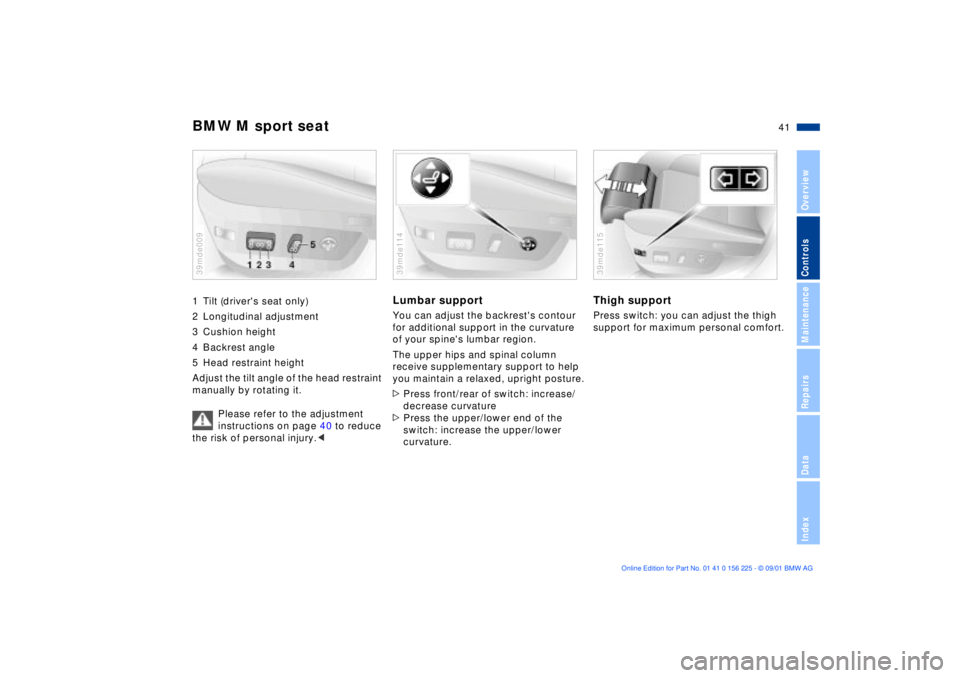
1 Tilt (driver's seat only)
2 Longitudinal adjustment
3 Cushion height
4 Backrest angle
5 Head restraint height
Adjust the tilt angle of the head restraint
manually by rotating it.
Please refer to the adjustment
instructions on page 40 to reduce
the risk of personal injury.<39mde009
Lumbar support You can adjust the backrest's contour
for additional support in the curvature
of your spine's lumbar region.
The upper hips and spinal column
receive supplementary support to help
you maintain a relaxed, upright posture.
>Press front/rear of switch: increase/
decrease curvature
>Press the upper/lower end of the
switch: increase the upper/lower
curvature.39mde114
Thigh support Press switch: you can adjust the thigh
support for maximum personal comfort.39mde115
Page 42 of 154
42n
BMW comfort seat
*
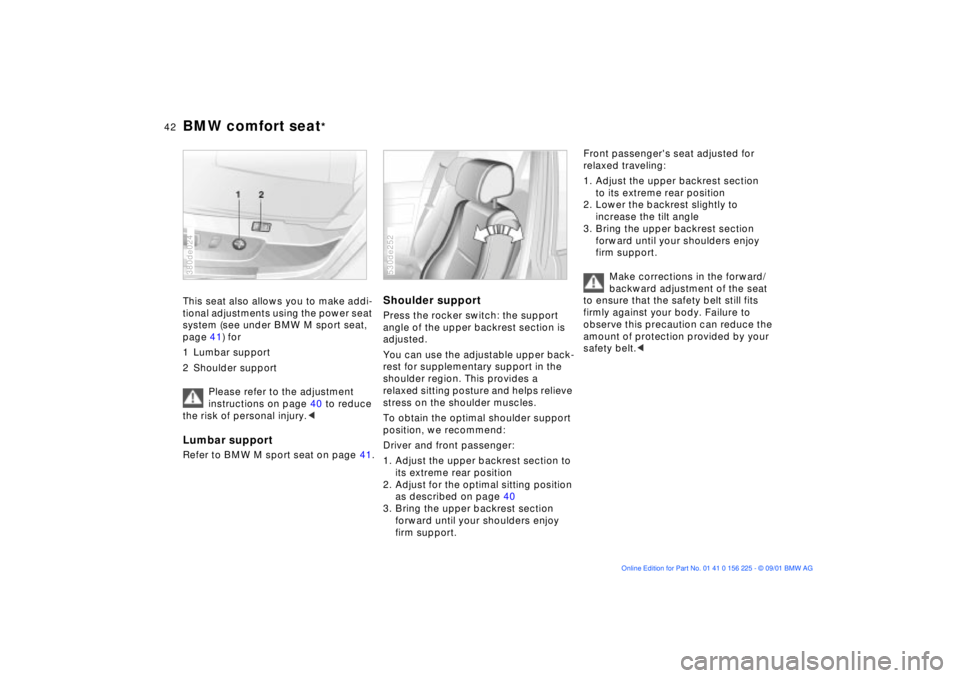
This seat also allows you to make addi-
tional adjustments using the power seat
system (see under BMW M sport seat,
page 41) for
1 Lumbar support
2 Shoulder support
Please refer to the adjustment
instructions on page 40 to reduce
the risk of personal injury.
angle of the upper backrest section is
adjusted.
You can use the adjustable upper back-
rest for supplementary support in the
shoulder region. This provides a
relaxed sitting posture and helps relieve
stress on the shoulder muscles.
To obtain the optimal shoulder support
position, we recommend:
Driver and front passenger:
1. Adjust the upper backrest section to
its extreme rear position
2. Adjust for the optimal sitting position
as described on page 40
3. Bring the upper backrest section
forward until your shoulders enjoy
firm support.530de252
Front passenger's seat adjusted for
relaxed traveling:
1. Adjust the upper backrest section
to its extreme rear position
2. Lower the backrest slightly to
increase the tilt angle
3. Bring the upper backrest section
forward until your shoulders enjoy
firm support.
Make corrections in the forward/
backward adjustment of the seat
to ensure that the safety belt still fits
firmly against your body. Failure to
observe this precaution can reduce the
amount of protection provided by your
safety belt.<
Page 45 of 154
45n
OverviewControlsMaintenanceRepairsDataIndex
Seat, mirror and steering wheel memory
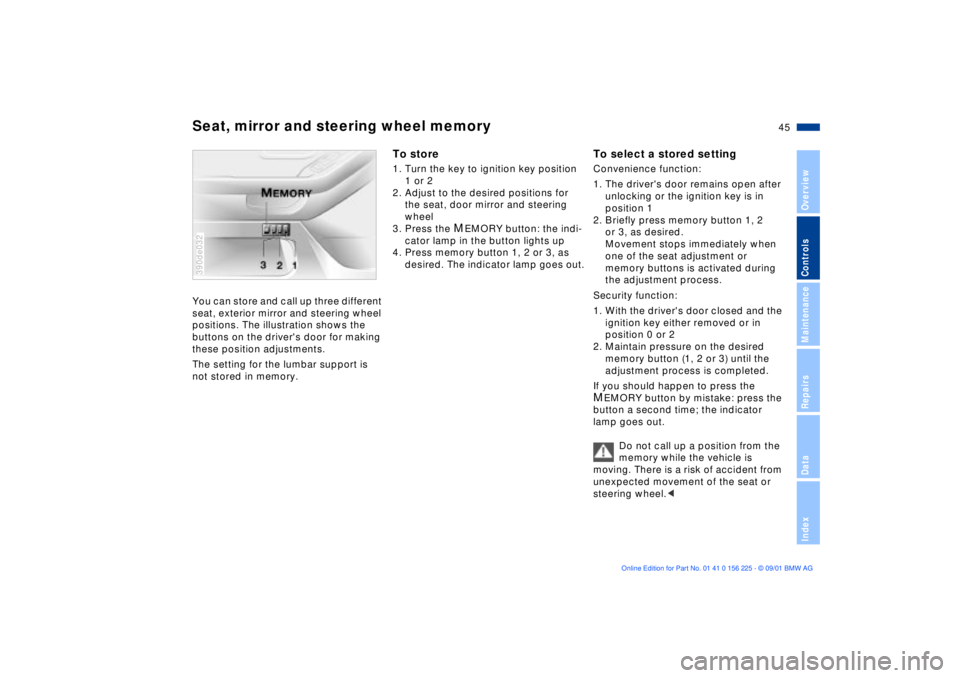
You can store and call up three different
seat, exterior mirror and steering wheel
positions. The illustration shows the
buttons on the driver's door for making
these position adjustments.
The setting for the lumbar support is
not stored in memory. 390de032
To store1. Turn the key to ignition key position
1 or 2
2. Adjust to the desired positions for
the seat, door mirror and steering
wheel
3. Press the
MEMORY button: the indi-
cator lamp in the button lights up
4. Press memory button 1, 2 or 3, as
desired. The indicator lamp goes out.
To select a stored settingConvenience function:
1. The driver's door remains open after
unlocking or the ignition key is in
position 1
2. Briefly press memory button 1, 2
or 3, as desired.
Movement stops immediately when
one of the seat adjustment or
memory buttons is activated during
the adjustment process.
Security function:
1. With the driver's door closed and the
ignition key either removed or in
position 0 or 2
2. Maintain pressure on the desired
memory button (1, 2 or 3) until the
adjustment process is completed.
If you should happen to press the MEMORY button by mistake: press the
button a second time; the indicator
lamp goes out.
Do not call up a position from the
memory while the vehicle is
moving. There is a risk of accident from
unexpected movement of the seat or
steering wheel.<
Page 47 of 154
47n
OverviewControlsMaintenanceRepairsDataIndex
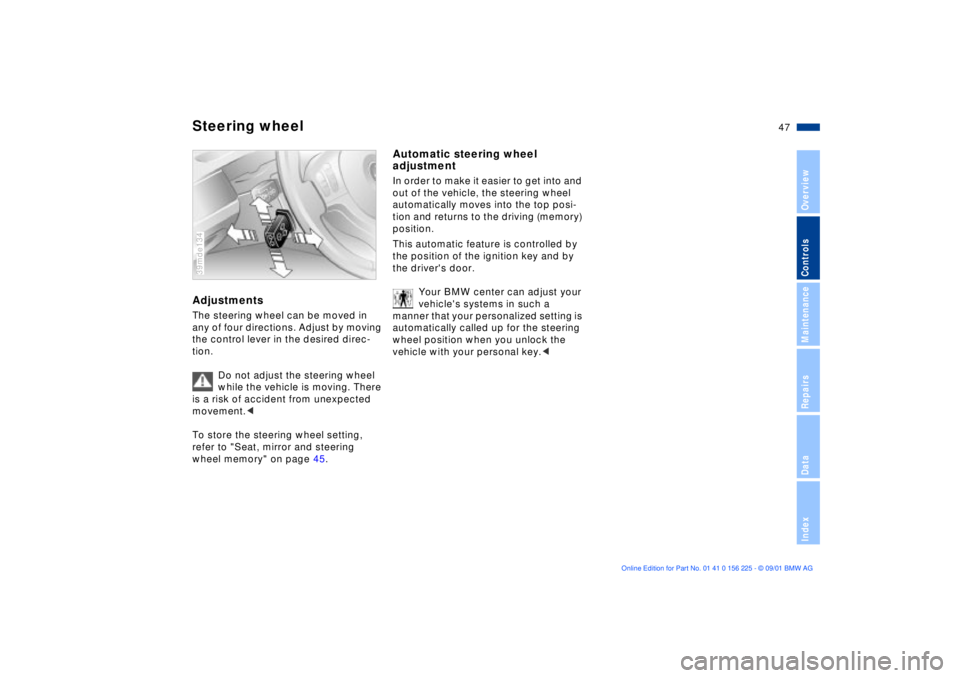
Steering wheelAdjustmentsThe steering wheel can be moved in
any of four directions. Adjust by moving
the control lever in the desired direc-
tion.
Do not adjust the steering wheel
while the vehicle is moving. There
is a risk of accident from unexpected
movement.<
To store the steering wheel setting,
refer to "Seat, mirror and steering
wheel memory" on page 45.39mde134
Automatic steering wheel
adjustmentIn order to make it easier to get into and
out of the vehicle, the steering wheel
automatically moves into the top posi-
tion and returns to the driving (memory)
position.
This automatic feature is controlled by
the position of the ignition key and by
the driver's door.
Your BMW center can adjust your
vehicle's systems in such a
manner that your personalized setting is
automatically called up for the steering
wheel position when you unlock the
vehicle with your personal key.<
Page 48 of 154
48n
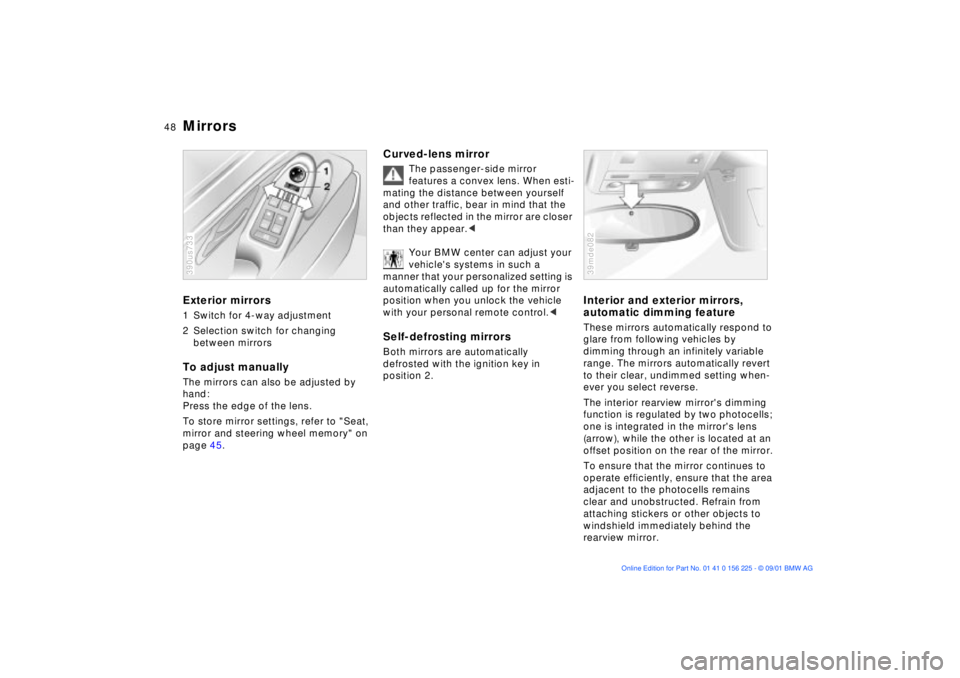
Mirrors Exterior mirrors1 Switch for 4-way adjustment
2 Selection switch for changing
between mirrorsTo adjust manuallyThe mirrors can also be adjusted by
hand:
Press the edge of the lens.
To store mirror settings, refer to "Seat,
mirror and steering wheel memory" on
page 45.390us733
Curved-lens mirror
The passenger-side mirror
features a convex lens. When esti-
mating the distance between yourself
and other traffic, bear in mind that the
objects reflected in the mirror are closer
than they appear.<
Your BMW center can adjust your
vehicle's systems in such a
manner that your personalized setting is
automatically called up for the mirror
position when you unlock the vehicle
with your personal remote control.<
Self-defrosting mirrors Both mirrors are automatically
defrosted with the ignition key in
position 2.
Interior and exterior mirrors,
automatic dimming feature These mirrors automatically respond to
glare from following vehicles by
dimming through an infinitely variable
range. The mirrors automatically revert
to their clear, undimmed setting when-
ever you select reverse.
The interior rearview mirror's dimming
function is regulated by two photocells;
one is integrated in the mirror's lens
(arrow), while the other is located at an
offset position on the rear of the mirror.
To ensure that the mirror continues to
operate efficiently, ensure that the area
adjacent to the photocells remains
clear and unobstructed. Refrain from
attaching stickers or other objects to
windshield immediately behind the
rearview mirror.39mde082
Page 55 of 154
55n
OverviewControlsMaintenanceRepairsDataIndex
Vehicle Memory, Key Memory How the system functionsNo doubt you have reflected at one
time or another on how great it would
be if you could permanently configure
your vehicle's various features and
adjustments to mirror your own indi-
vidual preferences. In engineering your
vehicle, BMW has incorporated a
number of options for personal adjust-
ment that can be programmed into your
vehicle at your BMW center.
The available configuration data fall into
two categories, according to whether
their primary orientation is the vehicle
("Vehicle Memory") or the individual
("Key Memory"). Provided that each
person has a separate remote-control
key, you can have your BMW center
enter two personal adjustments for two
different individuals into the system.463de029
When your vehicle is unlocked with the
remote control, the vehicle recognizes
the individual user by means of a data
exchange with the key, and makes
adjustments accordingly.
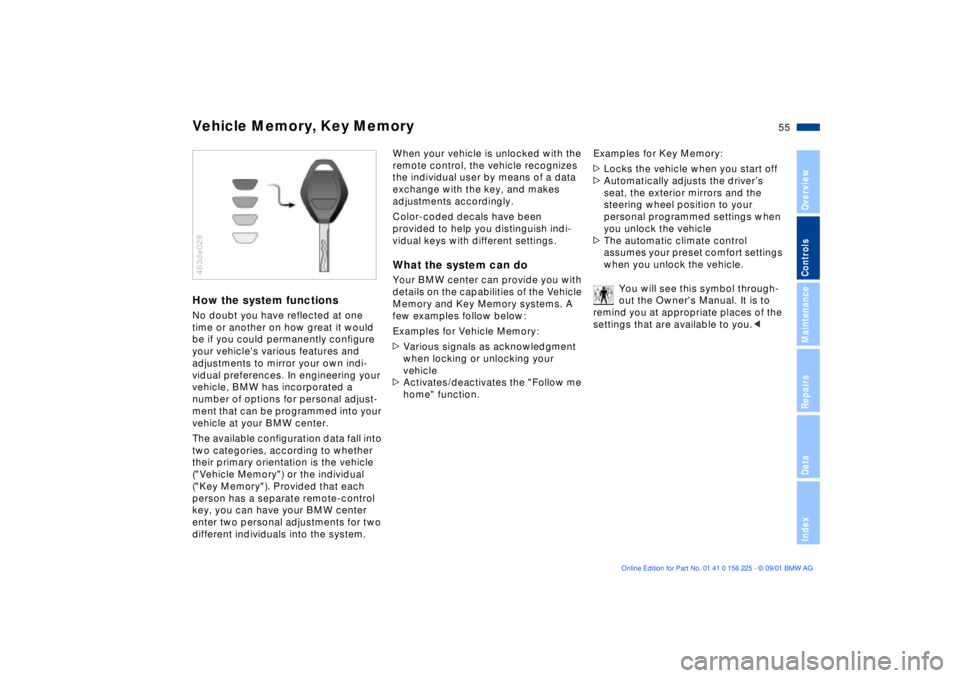
Color-coded decals have been
provided to help you distinguish indi-
vidual keys with different settings.What the system can doYour BMW center can provide you with
details on the capabilities of the Vehicle
Memory and Key Memory systems. A
few examples follow below:
Examples for Vehicle Memory:
>Various signals as acknowledgment
when locking or unlocking your
vehicle
>Activates/deactivates the "Follow me
home" function.Examples for Key Memory:
>Locks the vehicle when you start off
>Automatically adjusts the driverÕs
seat, the exterior mirrors and the
steering wheel position to your
personal programmed settings when
you unlock the vehicle
>The automatic climate control
assumes your preset comfort settings
when you unlock the vehicle.
You will see this symbol through-
out the Owner's Manual. It is to
remind you at appropriate places of the
settings that are available to you.<
Page 146 of 154

Everything from A to Z
A
ABS (Antilock Brake System) 17, 107
Activated-charcoal filter 91
Active seat 43
Adding brake fluid 118t
coolant 118t
engine coolant 118t
engine oil 115t
washer fluid 115t
Adjusting backrest 41
head restraints 43
mirrors 48
seats 40
steering wheel 47
temperature 89
Air distribution 89
Air pressure 22, 109
Air supply 89
Airbags 17, 49
Alarm system 35
Anchorages for attaching cargo straps 34, 102
Antifreeze 118
Antilock Brake System (ABS) 17, 107
Anti-theft alarm system 35
Aquaplaning 107, 109 Ashtray
front 97
rear 98
Attach vacuum cleaner 98
AUC (Automatic recircu- lated-air control) 90
Automatic climate control removing condensation on
the windows 89
Automatic cruise control 61
Automatic curb monitor 46
Automatic dimming exterior mirror 48
interior rearview mirror 48
Automatic recirculated-air control (AUC) 90
Automatic steering wheel adjustment 47
Automatic windshield washer 60
Average fuel consumption 75
Average speed 76
Avoid false alarms 36t
Axle loads 142 B
Backrest, adjusting 41
Backup lamps 59
bulb replacement 126t
Battery 131
care 131
charging 131
discharged 133t
Beverage holder 97
Blower 89
BMW active seat 43
BMW comfort seat 42
BMW High Performance Synthetic Oil 117
BMW M sport seat 41
BMW Maintenance System 119
BMW Universal Transmitter 93
Bottle holder, refer to beverage holder 97
Brake fluid 118
disposal 118
Brake hydraulic system, brake pads 16
Brake system 108
brake fluid level 108
brake linings 108
malfunctions 108t
Break-in procedures 106
Bulbs and lamps 124 C
California Proposition 65 Warning 120
Capacities 143
Car care, refer to the "Caring for your vehicle" manual
Car telephone 97
Car wash systems, refer to the "Caring for your
vehicle" manual
Care of paintwork, refer to the "Caring for your
vehicle" manual
Care of upholstery materials, refer to the "Caring for your
vehicle" manual
Cargo loading 102
Cellular phone 97
refer also to the separate
Owner's Manual 97
Center (high mount) brake lamp 127
Central locking system 26
key 31
Charging the battery 132t
Check air pressure 22t , 109
CHECK button 66
Page 147 of 154
Everything from A to Z
147n
OverviewControlsMaintenanceRepairsDataIndex
Check Control66
Check engine oil
level115t
Child seat safety53
Child seats52
Cigarette lighter98
Clock70
refer also to the "Onboard
Computer Owner's
Manual"
Cockpit14
Code76
activating76
deactivating76
refer also to the "Onboard
Computer Owner's
Manual"
selecting76
Comfort seat42
Compartments96
Computer73
refer also to the "Onboard
Computer Owner's
Manual"
remote control77
Configuring individual
adjustments55
Consumption75 Convenience operation of
windows and sliding/tilt
sunroof27
Coolant118
disposal118
Coolant temperature
gauge65
Cooling, maximum90
Copyright notice4
Cover, sun blinds92
Cruising range75
Cup holder97
Cup holder, refer to
beverage holder97
Curb weight142
D
Date
calling up70
changing70
refer also to the "Onboard
Computer Owner's
Manual"
Daytime driving lamps84
DBC (Dynamic Brake
Control)17, 80
Deactivating
alarm system tilt
sensor36t
the interior motion
sensor36t Deep water107
Defrosting position89
Defrosting the
windows89t
Digital clock70
refer also to the "Onboard
Computer Owner's
Manual"
Dimensions141
Disconnect the
battery133t
Displacement140
Display lighting85
Displays, instrument
panel15
Disposal
brake fluid118
coolant118
engine oil116
Distance from
destination74
Divided rear backrest99
Door key26
Doors
manual operation27
remote control28
unlocking and locking27
DOT Quality Grades110
Driving notes107 DSC (Dynamic Stability
Control)17, 80
Dynamic Brake Control
(DBC)17, 80
Dynamic Driving Control81
Dynamic Stability Control
(DSC)17, 80
E
Electric power windows36
Electrical heating, exterior
mirror48
Electrical malfunction
doors27t
fuel filler door20t
luggage compartment
lid32t
sliding/tilt sunroof39t
Elements of operation14
Emergency release of
luggage compartment lid
from luggage
compartment's interior34
Engine compartment114
Engine coolant118
Engine coolant temperature
gauge65
Engine data140