engine oil BMW M5 SEDAN 2003 User Guide
[x] Cancel search | Manufacturer: BMW, Model Year: 2003, Model line: M5 SEDAN, Model: BMW M5 SEDAN 2003Pages: 155, PDF Size: 1.87 MB
Page 115 of 155
115n
OverviewControlsMaintenanceRepairsDataIndex
Washer fluids Engine oilHeadlamp and windshield
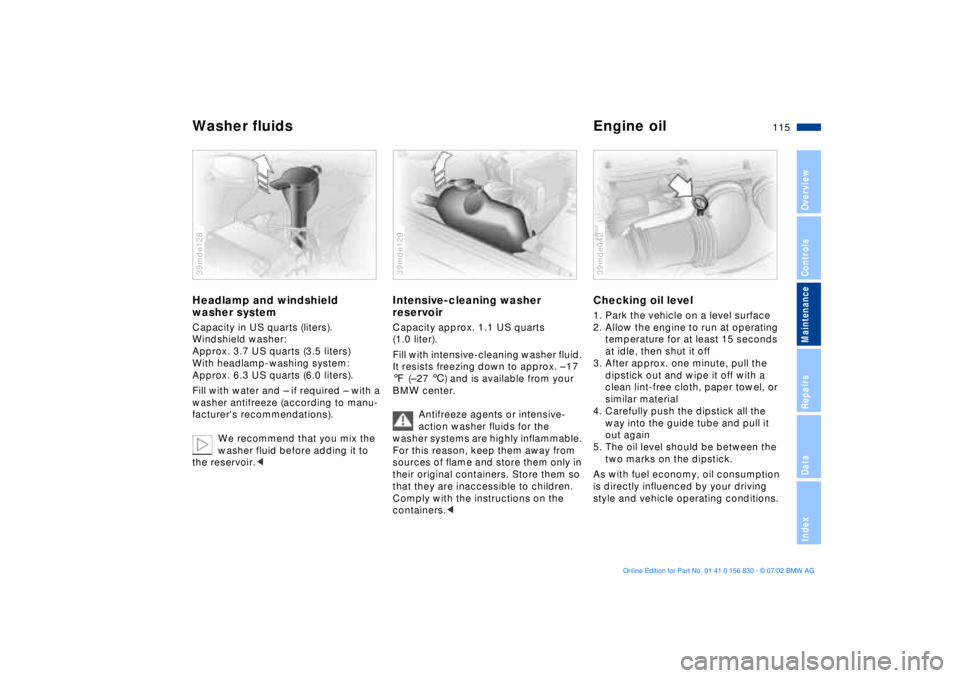
washer systemCapacity in US quarts (liters).
Windshield washer:
Approx. 3.7 US quarts (3.5 liters)
With headlamp-washing system:
Approx. 6.3 US quarts (6.0 liters).
Fill with water and Ð if required Ð with a
washer antifreeze (according to manu-
facturer's recommendations).
We recommend that you mix the
washer fluid before adding it to
the reservoir.< 39mde128
Intensive-cleaning washer
reservoirCapacity approx. 1.1 US quarts
(1.0 liter).
Fill with intensive-cleaning washer fluid.
It resists freezing down to approx. Ð 17
7 (Ð 27 6) and is available from your
BMW center.
Antifreeze agents or intensive-
action washer fluids for the
washer systems are highly inflammable.
For this reason, keep them away from
sources of flame and store them only in
their original containers. Store them so
that they are inaccessible to children.
Comply with the instructions on the
containers.<39mde129
Checking oil level 1. Park the vehicle on a level surface
2. Allow the engine to run at operating
temperature for at least 15 seconds
at idle, then shut it off
3. After approx. one minute, pull the
dipstick out and wipe it off with a
clean lint-free cloth, paper towel, or
similar material
4. Carefully push the dipstick all the
way into the guide tube and pull it
out again
5. The oil level should be between the
two marks on the dipstick.
As with fuel economy, oil consumption
is directly influenced by your driving
style and vehicle operating conditions. 39mde042
Page 116 of 155
116n
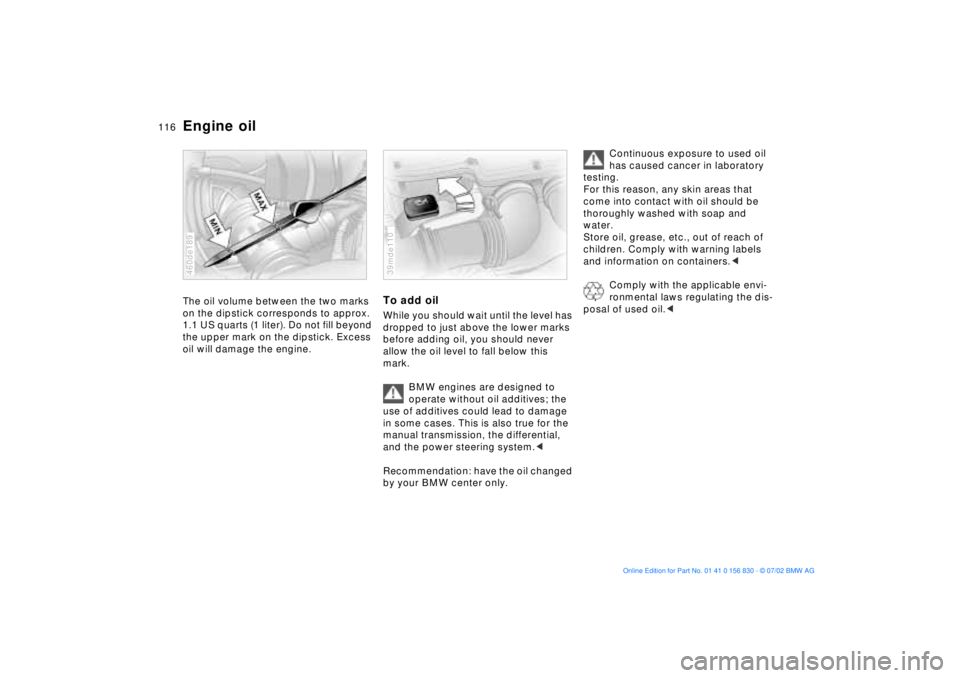
Engine oilThe oil volume between the two marks
on the dipstick corresponds to approx.
1.1 US quarts (1 liter). Do not fill beyond
the upper mark on the dipstick. Excess
oil will damage the engine. 460de189
To add oil While you should wait until the level has
dropped to just above the lower marks
before adding oil, you should never
allow the oil level to fall below this
mark.
BMW engines are designed to
operate without oil additives; the
use of additives could lead to damage
in some cases. This is also true for the
manual transmission, the differential,
and the power steering system.<
Recommendation: have the oil changed
by your BMW center only.39mde110
Continuous exposure to used oil
has caused cancer in laboratory
testing.
For this reason, any skin areas that
come into contact with oil should be
thoroughly washed with soap and
water.
Store oil, grease, etc., out of reach of
children. Comply with warning labels
and information on containers.<
Comply with the applicable envi-
ronmental laws regulating the dis-
posal of used oil.<
Page 117 of 155
117n
OverviewControlsMaintenanceRepairsDataIndex
Engine oil CoolantSpecified engine oils The quality of the engine oil is
extremely important for the function
and service life of an engine. Based on
extensive testing, BMW approves only
certain grades of engine oil.
Use only approved "BMW High Perfor-
mance Synthetic Oil."
If you are unable to obtain "BMW High
Performance Synthetic Oil," you can
add small amounts of synthetic oil in
between oil changes. Only use oils with
the API SH specification or higher.
Ask your BMW center for details
concerning the specific "BMW
High Performance Synthetic Oil" or
"special oils" which have been
approved.<
You can also call BMW of North
America at 1-800-831-1117 or visit this
website: www.bmwusa.com to obtain
this information.
Viscosity ratings Viscosity is the oil flow rating as estab-
lished in SAE classes.
The selection of the correct SAE class
depends on the climatic conditions in
the area where you typically drive your
BMW.
Approved oils are in SAE classes
5W-40 and 5W-30.<
These oils may be used for driving in all
ambient temperatures.
Do not add coolant to the cooling
system when the engine is hot.
If you attempt to do so, escaping
coolant can cause scalds. To avoid the
possibility of secondary damage, never
use anything other than factory-
approved, nitrite and amino-free
extended-duty antifreeze with corrosion
inhibitor. Your BMW center is familiar
with these specifications.
Antifreeze and anti-corrosion agents
are hazardous to health. You should
always store them in their original con-
tainers and in a location which is out of
reach of children. For this reason, do
not spill antifreeze with corrosion inhib-
itor on hot engine parts. It could ignite
and cause burns.<
Page 119 of 155
119n
OverviewControlsMaintenanceRepairsDataIndex
The BMW Maintenance System has
been designed as a reliable means of
providing maximum driving and oper-
ating safety Ð and as cost-effectively as
possible for you.
Please keep in mind that regular main-
tenance is not only necessary for the
safety of your vehicle, but also plays a
significant role in maintaining its resale
value. 380us008
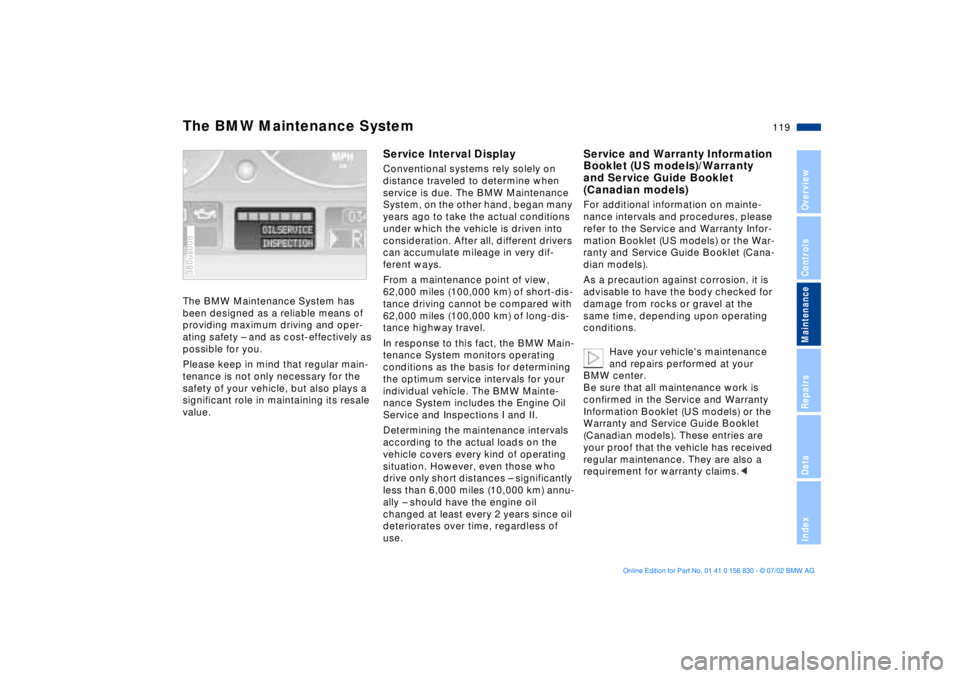
Service Interval DisplayConventional systems rely solely on
distance traveled to determine when
service is due. The BMW Maintenance
System, on the other hand, began many
years ago to take the actual conditions
under which the vehicle is driven into
consideration. After all, different drivers
can accumulate mileage in very dif-
ferent ways.
From a maintenance point of view,
62,000 miles (100,000 km) of short-dis-
tance driving cannot be compared with
62,000 miles (100,000 km) of long-dis-
tance highway travel.
In response to this fact, the BMW Main-
tenance System monitors operating
conditions as the basis for determining
the optimum service intervals for your
individual vehicle. The BMW Mainte-
nance System includes the Engine Oil
Service and Inspections I and II.
Determining the maintenance intervals
according to the actual loads on the
vehicle covers every kind of operating
situation. However, even those who
drive only short distances Ð significantly
less than 6,000 miles (10,000 km) annu-
ally Ð should have the engine oil
changed at least every 2 years since oil
deteriorates over time, regardless of
use.
Service and Warranty Information
Booklet (US models)/Warranty
and Service Guide Booklet
(Canadian models)For additional information on mainte-
nance intervals and procedures, please
refer to the Service and Warranty Infor-
mation Booklet (US models) or the War-
ranty and Service Guide Booklet (Cana-
dian models).
As a precaution against corrosion, it is
advisable to have the body checked for
damage from rocks or gravel at the
same time, depending upon operating
conditions.
Have your vehicle's maintenance
and repairs performed at your
BMW center.
Be sure that all maintenance work is
confirmed in the Service and Warranty
Information Booklet (US models) or the
Warranty and Service Guide Booklet
(Canadian models). These entries are
your proof that the vehicle has received
regular maintenance. They are also a
requirement for warranty claims.<
The BMW Maintenance System
Page 120 of 155

120n
Technical modifications California Proposition 65 WarningLight-emitting diodes (LEDs)Light-emitting diodes installed behind
translucent lenses serve as the light
source for many of the controls and dis-
plays in your vehicle. The concept
behind their operation is related to that
employed for lasers.
Do not remove the protective lens
and avoid staring directly at the
unfiltered beam for extended periods
(several hours), as inflammation of the
iris could result.<
California laws require us to state the
following warning:
Engine exhaust, some of its con-
stituents, and certain vehicle com-
ponents contain or emit chemicals
known to the State of California to
cause cancer and birth defects and
reproductive harm. In addition, certain
fluids contained in vehicles and certain
products of component wear contain or
emit chemicals known to the State of
California to cause cancer and birth
defects or other reproductive harm.
Battery posts, terminals and related
accessories contain lead and lead
compounds. Wash your hands after
handling.
Used engine oil contains chemicals that
have caused cancer in laboratory ani-
mals. Always protect your skin by
washing thoroughly with soap and
water.<
Page 143 of 155
143n
OverviewControlsMaintenanceRepairsDataIndex
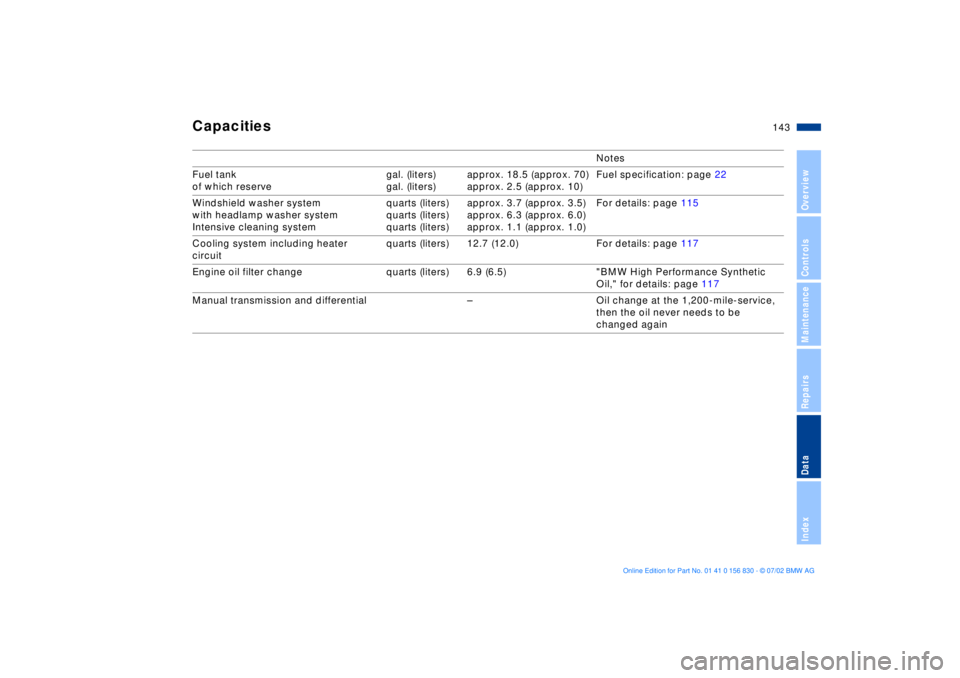
Capacities
Notes
Fuel tank
of which reserve gal. (liters)
gal. (liters)approx. 18.5 (approx. 70)
approx. 2.5 (approx. 10) Fuel specification: page 22
Windshield washer system
with headlamp washer system
Intensive cleaning systemquarts (liters)
quarts (liters)
quarts (liters)approx. 3.7 (approx. 3.5)
approx. 6.3 (approx. 6.0)
approx. 1.1 (approx. 1.0) For details: page 115
Cooling system including heater
circuitquarts (liters) 12.7 (12.0) For details: page 117
Engine oil filter change quarts (liters) 6.9 (6.5) "BMW High Performance Synthetic
Oil," for details: page 117
Manual transmission and differential Ð Oil change at the 1,200-mile-service,
then the oil never needs to be
changed again
Page 146 of 155

Everything from A to ZA
ABS (Antilock Brake
System)17, 107
Activated-charcoal filter91
Active seat43
Adding
brake fluid118t
engine coolant118t
engine oil116t
washer fluid115t
Adjusting
backrest41
head restraints43
mirrors48
seats40
steering wheel47
temperature89
Air conditioning90
Air distribution89
Air pressure, tires22, 109
Air supply89
Airbags17, 49
Alarm system35
Anchorage points
child-restraint system with
tether strap52
Antifreeze118
Antilock Brake System
(ABS)17, 107
Aquaplaning107, 109 Ashtray
front97
rear98
Attach vacuum cleaner98
AUC (Automatic recircu-
lated-air control)90
Automatic climate
control87
removing condensation
from the windows89
Automatic cruise control61
Automatic curb monitor46
Automatic dimming
exterior mirror48
interior rearview mirror48
Automatic recirculated-air
control (AUC)90
Automatic steering wheel
adjustment47
Automatic windshield
washer60
Average fuel
consumption75
Average speed76
Avoiding unintentional
alarms36
Axle loads142
B
Backrest, adjusting41
Backup lamps59
bulb replacement126t
Battery131
care131
charging131
discharged133t
Belts44
Beverage holder97
Blower89
BMW active seat43
BMW comfort seat42
BMW High Performance
Synthetic Oil117
BMW M sport seat41
BMW Maintenance
System119
BMW Universal
Transmitter93
Bottle holder, refer to
Beverage holder97
Brake fluid118
disposal118
Brake hydraulic system,
brake pads16
Brake system108
brake fluid level108
brake linings108
malfunctions108t
Break-in procedures106 Bulbs and lamps124
C
California Proposition
65 Warning120
Capacities143
Car telephone97
Cargo loading102
Cellular phone97
refer also to the separate
Owner's Manual97
Center (high mount) brake
lamp127
Central locking system26
key31
Charging the battery132t
CHECK button66
Check Control66
Check engine oil
level115t
Check tire inflation
pressure22t, 109
Child seats51
Child-restraint
installation53
Child-restraint system with
tether strap52
Cigarette lighter98
Clock70
refer also to the "Owner's
Manual for Onboard
Computer"
Page 147 of 155
Everything from A to Z
147n
OverviewControlsMaintenanceRepairsDataIndex
Cockpit14
Code76
activating76
deactivating76
refer also to the "Owner's
Manual for Onboard
Computer"
selecting76
Comfort seat42
Compartments96
Computer73
refer also to the "Owner's
Manual for Onboard
Computer"
remote control77
Configuring individual
settings55
Consumption75
Convenience operation of
windows and sliding/tilt
sunroof27
Coolant117
disposal118
Coolant temperature
gauge65
Cooling, maximum90
Copyright4
Cover, roller sun blinds92
Cruise control61
Cruising range75 Cup holder, refer to
Beverage holder97
Curb weight142
D
Date
calling up70
changing70
refer also to the "Owner's
Manual for Onboard
Computer"
Daytime driving lamps84
DBC (Dynamic Brake
Control)17, 80
Deactivating
interior motion sensor36
tilt alarm sensor36
Deep water107
Defrosting position89
Defrosting the
windows89t
Digital clock70
refer also to the "Owner's
Manual for Onboard
Computer"
Dimensions141
Disconnecting the
battery133t
Displacement140
Display lighting85 Displays, instrument
cluster15
Disposal
brake fluid118
coolant118
engine oil116
Distance from
destination74
Divided rear backrest99
Door key26
Doors
manual operation27
remote control28
unlocking and locking27
DOT Quality Grades110
Driving notes107
DSC (Dynamic Stability
Control)17, 80
Dynamic Brake Control
(DBC)17, 80
Dynamic Driving Control81
Dynamic Stability Control
(DSC)17, 80
E
Electric power windows36
Electrical heating, exterior
mirror48 Electrical malfunction
doors27t
fuel filler door20t
luggage compartment
lid32t
sliding/tilt sunroof39t
Elements of operation14
Emergency release of
luggage compartment
lid from luggage
compartment's interior34
Engine compartment114
Engine coolant118
temperature gauge65
Engine data140
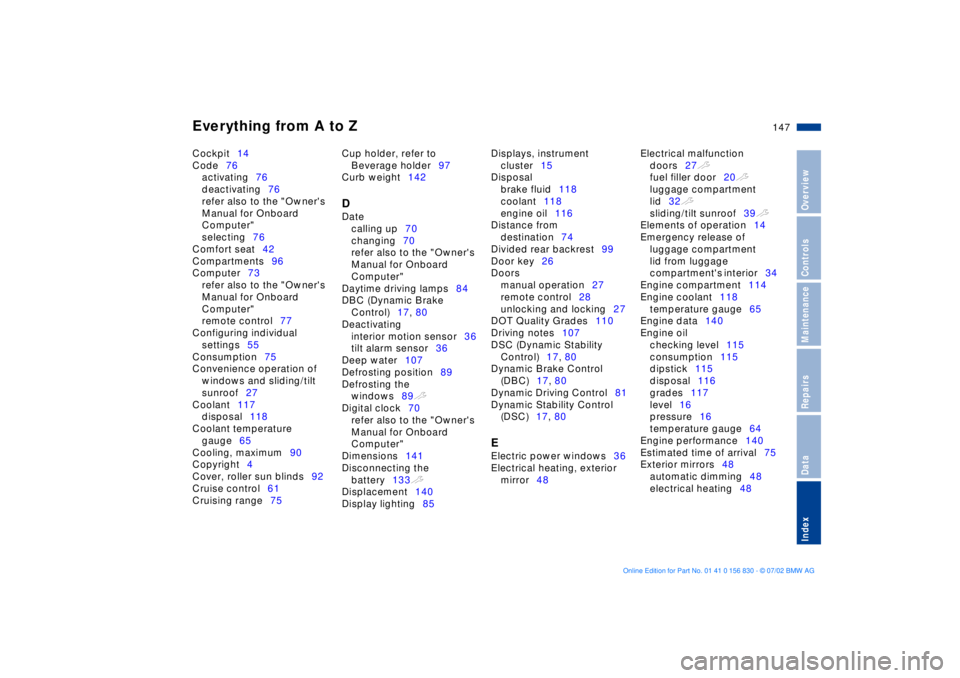
Engine oil
checking level115
consumption115
dipstick115
disposal116
grades117
level16
pressure16
temperature gauge64
Engine performance140
Estimated time of arrival75
Exterior mirrors48
automatic dimming48
electrical heating48
Page 150 of 155

Everything from A to ZReleasing the fuel filler door
after an electrical
malfunction20t
Reminder signal (Memo)71
Remote control28, 77
Remote control key26
Removing condensation
from windows89t
Repairing flat tire128
Replacement key26t
Replacement of lamps and
bulbs124t
Replacement of windshield
wiper blades124t
Reporting safety defects10
Reservoir, washer
system115t
Residual heating mode90
Roller sun blinds92
Roof load capacity142
Roof-mounted luggage
rack103 S
Safety belts44
Safety buttons31
Safety defects, reporting10
Safety switch for power
windows37
Seat heating46 Seats40
adjusting40
heating46
position adjustment
memory45
Securing cargo34, 102
Service and Warranty10
Service and Warranty Infor-
mation Booklet (US
models)119
Service Interval
Display65, 119
Setting alarm in an
emergency77
Side airbags49
Side Impact Head Protection
System49
Side-marker lamps84
Sitting safely40
with airbags40
with safety belt40
Ski bag100
Sliding/tilt sunroof38
closing after an electrical
malfunction39t
convenience operation27
power loss or
malfunction39t
Snow chains112 Socket for attaching power
supplies98
Spare key26
Speakers97
Special characteristics of
winter tires112
Special oils117
Specified engine oils117
Speed76
average76
Speed limit73
Speedometer15
Sport seat41
Standing lamps14, 85
Starting the engine56
assistance133t
problems57, 133t
Starting, vehicle56
Steering wheel47
automatic adjustment47
lock56
position adjustment
memory45
Steering wheel with multi-
function buttons19
Stopwatch71
refer also to the "Owner's
Manual for Onboard
Computer"
Storage compartments96 Summer tires111
Switching off the engine57
Symbols8
T
Tachometer64
Tail lamps126
bulb replacement126t
Tank capacity143
Technical
modifications120
Telephone preparation97
Temperature display
engine coolant65
engine oil64
outside temperature63
Temperature gauge
coolant65
engine oil64
Temperature layering91
Tether strap52
child-restraint system52
Thigh support
adjustment41
Third brake light127
Through-loading system99
Tilt alarm sensor36
deactivate29
Tilt function, passenger-side
mirror46
Page 153 of 155
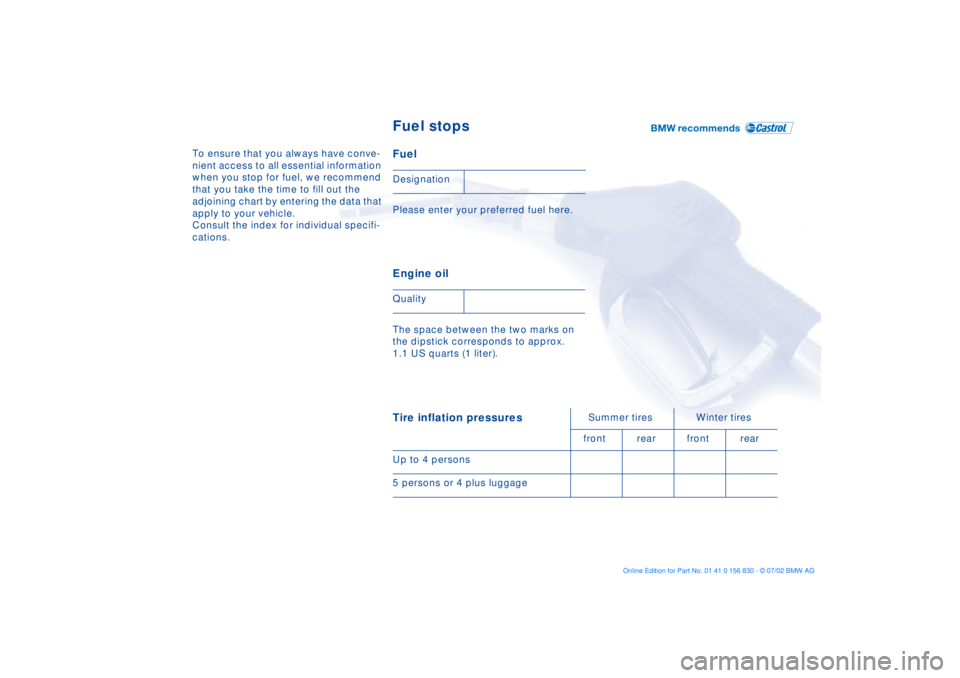
To ensure that you always have conve-
nient access to all essential information
when you stop for fuel, we recommend
that you take the time to fill out the
adjoining chart by entering the data that
apply to your vehicle.
Consult the index for individual specifi-
cations.
Fuel Please enter your preferred fuel here. Engine oil The space between the two marks on
the dipstick corresponds to approx.
1.1 US quarts (1 liter). Designation
QualityTire inflation pressures
Summer tires Winter tires
front rear front rear
Up to 4 persons
5 persons or 4 plus luggage
Fuel stops