roof BMW M5 SEDAN 2003 Owners Manual
[x] Cancel search | Manufacturer: BMW, Model Year: 2003, Model line: M5 SEDAN, Model: BMW M5 SEDAN 2003Pages: 155, PDF Size: 1.87 MB
Page 4 of 155

Contents
© 2002 BMW M GmbH
Munich, Germany
Reprinting, including excerpts,
only with the written consent of
BMW AG, Munich.
Order no. 01 41 0 156 830
US English IX/02
Printed in Germany
Printed on environmentally friendly paper
Ð bleached without chlorine, suitable for recycling.
Notes
Overview
Controls and features
About this Owner's Manual8
Symbols used8
Your individual vehicle8
Status at time of printing9
For your own safety9
Symbol on vehicle parts10
Service and Warranty10
Reporting safety defects10Cockpit14
Instrument cluster15
Indicator and warning lamps16
Steering wheel with multifunction
buttons19
Warning triangle20
First-aid kit20
Refueling20
Fuel specifications22
Tire inflation pressure22
Opening and closing:
Keys26
Central locking system26
Opening and closing Ð
via the door lock27
Opening and closing Ð
via the remote control28
Opening and closing Ð
from the inside31
Luggage compartment lid32
Luggage compartment34
Alarm system35
Electric power windows36
Sliding/tilt sunroof38
Adjustments:
Sitting safely40
Seats40
BMW M sport seat41
BMW comfort seat42
Head restraints43
BMW active seat43
Safety belts44
Seat, mirror and
steering wheel memory45
Seat heating46
Steering wheel47
Mirrors48
Contents
Page 5 of 155

5n
OverviewControlsMaintenanceRepairsDataIndex
Controls and features
Passenger safety systems:
Airbags49
Transporting children safely51
Vehicle Memory, Key
Memory55
Driving:
Steering/Ignition lock56
Starting the engine56
Switching off the engine57
Parking brake58
Manual transmission58
Turn signal/Headlamp flasher59
Washer/Wiper system/
Rain sensor60
Cruise control61
Everything under control:
Odometer, outside temperature
display63
Tachometer64
Engine oil temperature64
Fuel gauge64
Coolant temperature gauge65
Service Interval Display65
Check Control66
Multi-Information Display
(MID)69
Digital clock70
Computer73
Technology for safety and
driving convenience:
Park Distance Control (PDC)78
Dynamic Stability Control
(DSC)80
M Dynamic Driving Control81
Flat Tire Monitor82
Lamps:
Parking lamps/Low beams84
Instrument lighting85
High beams/Standing lamps85
Fog lamps85
Interior lamps86
Reading lamps86
Controlling the climate for
pleasant driving:
Automatic climate control87
Roller sun blind92
Parked-car ventilation92
Interior conveniences:
BMW Universal Transmitter93
Glove compartment96
Storage compartments96
Cellular phone97
Beverage holder97
Ashtray, front97
Cigarette lighter98
Ashtray, rear98
Loading and transporting
cargo:
Through-loading system99
Ski bag100
Cargo loading102
Roof-mounted luggage rack103
Page 27 of 155
27n
OverviewControlsMaintenanceRepairsDataIndex
Central locking system Opening and closing Ð via the door lockWhen you use the central locking
system to lock the doors from inside
the vehicle, it will automatically disen-
gage the locks if an accident occurs,
except on doors that have been locked
individually using the lock buttons, refer
to page 31. The accident response rou-
tine also includes automatic activation
of the hazard warning flashers and the
interior lamps.
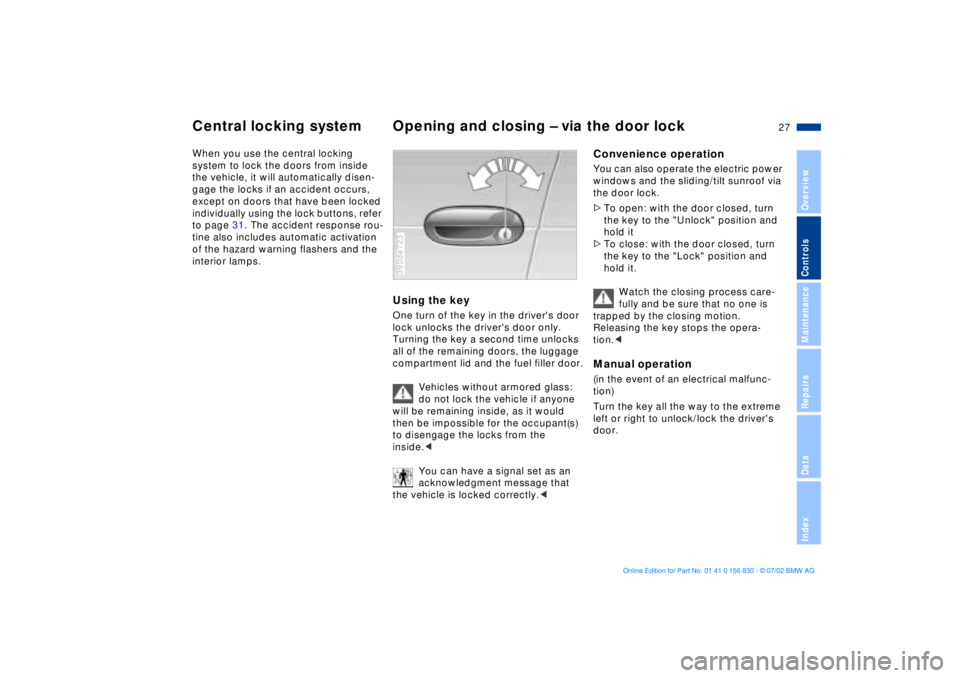
Using the key One turn of the key in the driver's door
lock unlocks the driver's door only.
Turning the key a second time unlocks
all of the remaining doors, the luggage
compartment lid and the fuel filler door.
Vehicles without armored glass:
do not lock the vehicle if anyone
will be remaining inside, as it would
then be impossible for the occupant(s)
to disengage the locks from the
inside.<
You can have a signal set as an
acknowledgment message that
the vehicle is locked correctly.<390de723
Convenience operationYou can also operate the electric power
windows and the sliding/tilt sunroof via
the door lock.
>To open: with the door closed, turn
the key to the "Unlock" position and
hold it
>To close: with the door closed, turn
the key to the "Lock" position and
hold it.
Watch the closing process care-
fully and be sure that no one is
trapped by the closing motion.
Releasing the key stops the opera-
tion.< Manual operation (in the event of an electrical malfunc-
tion)
Turn the key all the way to the extreme
left or right to unlock/lock the driver's
door.
Page 29 of 155
29n
OverviewControlsMaintenanceRepairsDataIndex
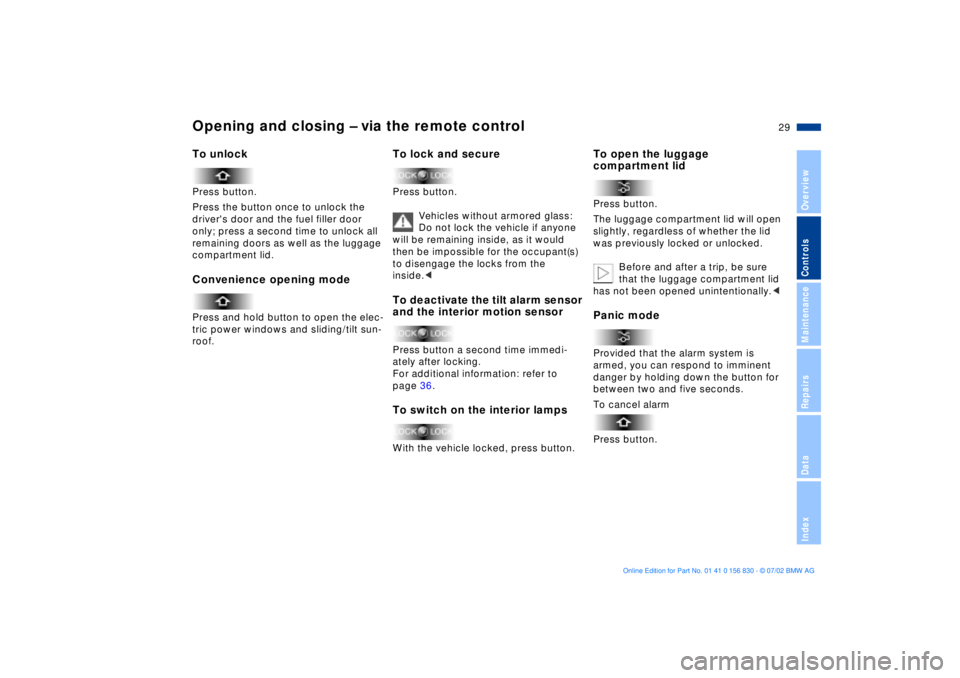
Opening and closing Ð via the remote control To unlockPress button.
Press the button once to unlock the
driver's door and the fuel filler door
only; press a second time to unlock all
remaining doors as well as the luggage
compartment lid.Convenience opening modePress and hold button to open the elec-
tric power windows and sliding/tilt sun-
roof.
To lock and secure Press button.
Vehicles without armored glass:
Do not lock the vehicle if anyone
will be remaining inside, as it would
then be impossible for the occupant(s)
to disengage the locks from the
inside.< To deactivate the tilt alarm sensor
and the interior motion sensorPress button a second time immedi-
ately after locking.
For additional information: refer to
page 36.To switch on the interior lampsWith the vehicle locked, press button.
To open the luggage
compartment lidPress button.
The luggage compartment lid will open
slightly, regardless of whether the lid
was previously locked or unlocked.
Before and after a trip, be sure
that the luggage compartment lid
has not been opened unintentionally.
danger by holding down the button for
between two and five seconds.
To cancel alarm
Press button.
Page 33 of 155
33n
OverviewControlsMaintenanceRepairsDataIndex
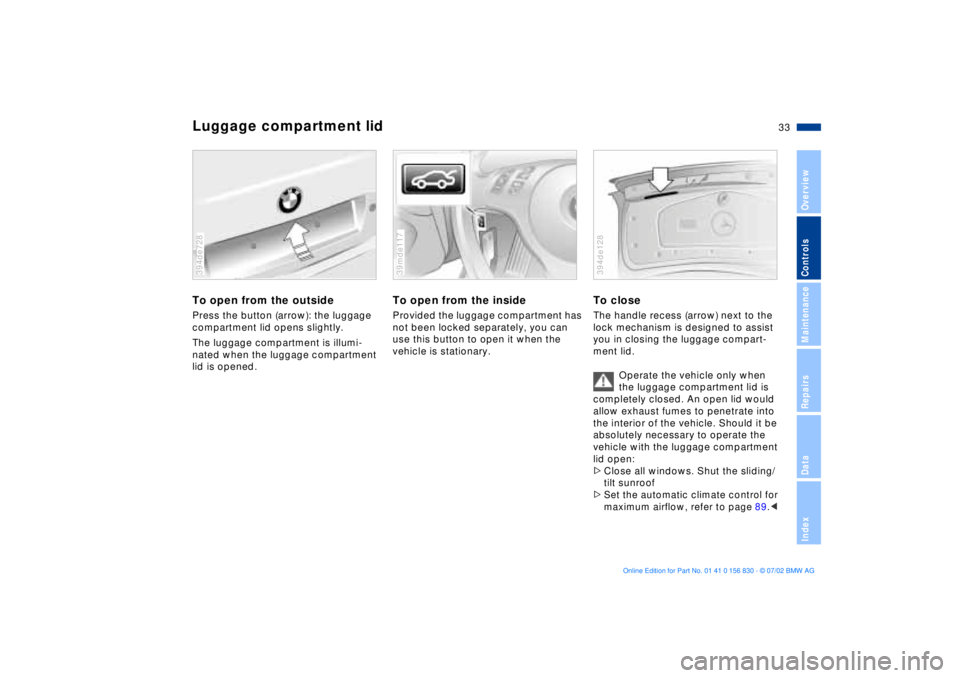
Luggage compartment lidTo open from the outsidePress the button (arrow): the luggage
compartment lid opens slightly.
The luggage compartment is illumi-
nated when the luggage compartment
lid is opened. 394de728
To open from the insideProvided the luggage compartment has
not been locked separately, you can
use this button to open it when the
vehicle is stationary. 39mde117
To closeThe handle recess (arrow) next to the
lock mechanism is designed to assist
you in closing the luggage compart-
ment lid.
Operate the vehicle only when
the luggage compartment lid is
completely closed. An open lid would
allow exhaust fumes to penetrate into
the interior of the vehicle. Should it be
absolutely necessary to operate the
vehicle with the luggage compartment
lid open:
>Close all windows. Shut the sliding/
tilt sunroof>Set the automatic climate control for
maximum airflow, refer to page 89.
<
394de128
Page 36 of 155
36n
Alarm system Electric power windows>If the indicator lamp flashes for
10 seconds when the system is dis-
armed: an attempted entry has been
detected in the period since the
system was armed.
Following triggering of an alarm, the
indicator lamp will flash continuously.Avoiding unintentional alarms The tilt alarm sensor and interior motion
sensor may be switched off at the same
time. You can do this to prevent an
unintentional alarm from being trig-
gered (in garages with elevator ramps,
for instance), or when the vehicle is
transported by trailer or train:
Actuate the lock (= arm the system)
twice; in other words, press button 2 of
the remote control twice in succession
(refer to page 29). You may also actuate
the locks twice with the key (refer to
page 27).
The indicator lamp lights up briefly and
then flashes continuously. The tilt alarm
sensor and the interior motion sensor
are deactivated as long as the system is
armed.
Interior motion sensorIn order for the interior motion sensor to
function properly, the windows and
sliding/tilt sunroof must be completely
closed.
Nevertheless, you should deactivate
the interior motion sensor (refer to
"Avoiding unintentional alarms") if
>children or animals are left in the
vehicle
>the windows or the sliding/tilt sunroof
are being left open.
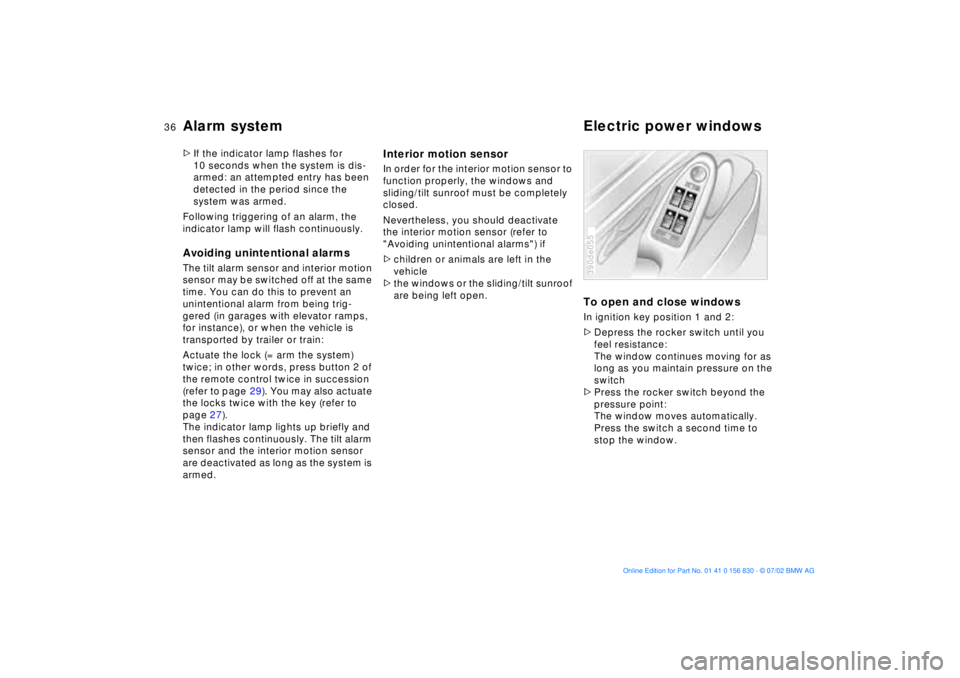
To open and close windowsIn ignition key position 1 and 2:
>Depress the rocker switch until you
feel resistance:
The window continues moving for as
long as you maintain pressure on the
switch
>Press the rocker switch beyond the
pressure point:
The window moves automatically.
Press the switch a second time to
stop the window.390de055
Page 38 of 155
38n
Sliding/tilt sunroof
*
To prevent injuries, exercise
care when closing the sliding/tilt
sunroof and keep it in your field of
vision until it is shut.
Before leaving the vehicle, switch off
the electric sunroof mechanism by
removing the ignition key. Do not leave
children unattended in the vehicle with
access to vehicle keys. The key can be
used to start the engine and to operate
vehicle systems such as the power sun-
roof, etc. Unsupervised use of these
systems can result in serious personal
injury.<
For convenience operation via the door
lock or remote control, refer to page 27
or 29.
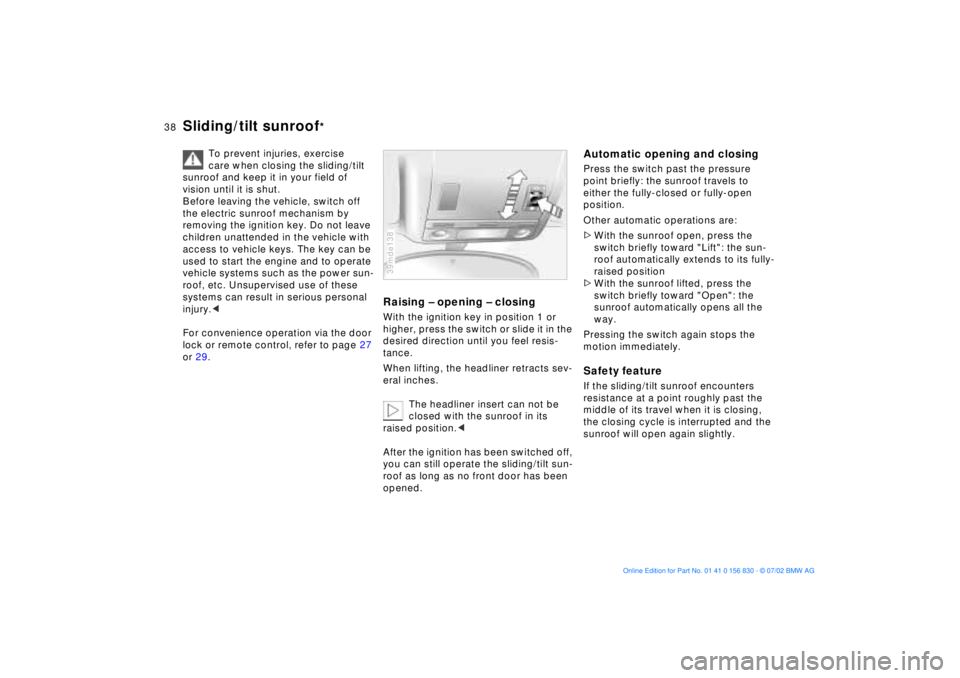
Raising Ð opening Ð closingWith the ignition key in position 1 or
higher, press the switch or slide it in the
desired direction until you feel resis-
tance.
When lifting, the headliner retracts sev-
eral inches.
The headliner insert can not be
closed with the sunroof in its
raised position.<
After the ignition has been switched off,
you can still operate the sliding/tilt sun-
roof as long as no front door has been
opened.39mde138
Automatic opening and closingPress the switch past the pressure
point briefly: the sunroof travels to
either the fully-closed or fully-open
position.
Other automatic operations are:
>With the sunroof open, press the
switch briefly toward "Lift": the sun-
roof automatically extends to its fully-
raised position
>With the sunroof lifted, press the
switch briefly toward "Open": the
sunroof automatically opens all the
way.
Pressing the switch again stops the
motion immediately.Safety featureIf the sliding/tilt sunroof encounters
resistance at a point roughly past the
middle of its travel when it is closing,
the closing cycle is interrupted and the
sunroof will open again slightly.
Page 39 of 155
39n
OverviewControlsMaintenanceRepairsDataIndex
Sliding/tilt sunroof
*
Despite this safety feature, be
extremely careful to ensure that
the closing path of the roof is not
obstructed. Remember that the safety
mechanism may not be able to detect
every kind of potential obstruction (very
thin objects, for instance). You can dis-
able this safety feature by pressing the
switch beyond the pressure point and
holding it.<
Sliding/tilt sunroof with glass
moonroof insert
*
The options and control procedures are
essentially the same as those previ-
ously described for the sliding/tilt sun-
roof. In order to open the raised roof,
press the control switch towards
"Open" and maintain pressure until the
roof has reached the desired position.
The headliner insert slides back some-
what when you raise the sunroof, and
retracts along with the sunroof panel
when you slide it back. The insert then
remains open, and you can slide it back
and forth to adjust it whenever the sun-
roof is not fully retracted.
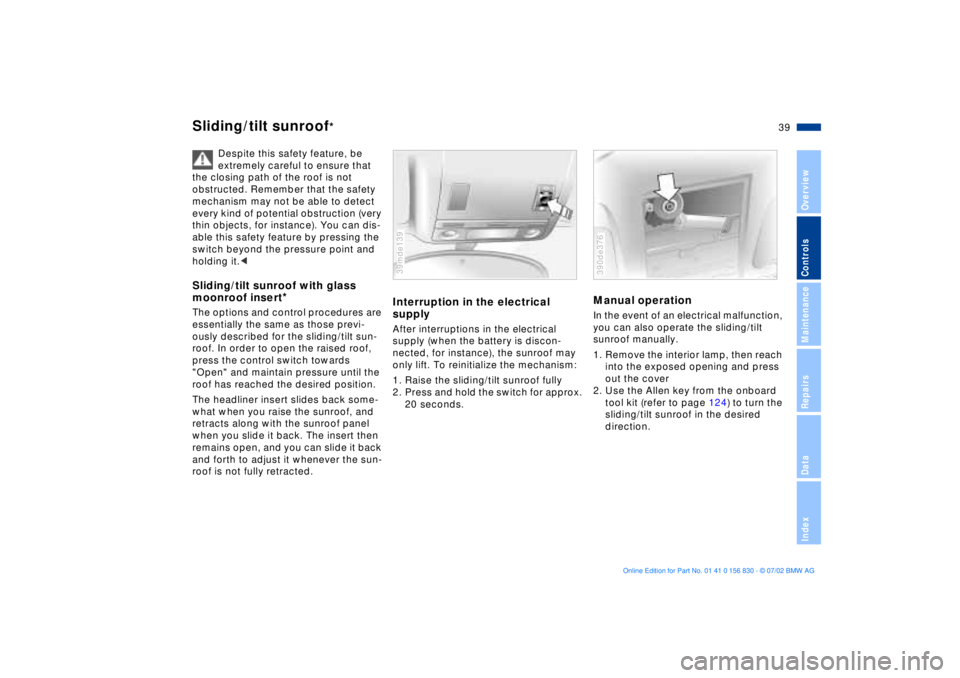
Interruption in the electrical
supplyAfter interruptions in the electrical
supply (when the battery is discon-
nected, for instance), the sunroof may
only lift. To reinitialize the mechanism:
1. Raise the sliding/tilt sunroof fully
2. Press and hold the switch for approx.
20 seconds.39mde139
Manual operation In the event of an electrical malfunction,
you can also operate the sliding/tilt
sunroof manually.
1. Remove the interior lamp, then reach
into the exposed opening and press
out the cover
2. Use the Allen key from the onboard
tool kit (refer to page 124) to turn the
sliding/tilt sunroof in the desired
direction. 390de376
Page 49 of 155
49n
OverviewControlsMaintenanceRepairsDataIndex
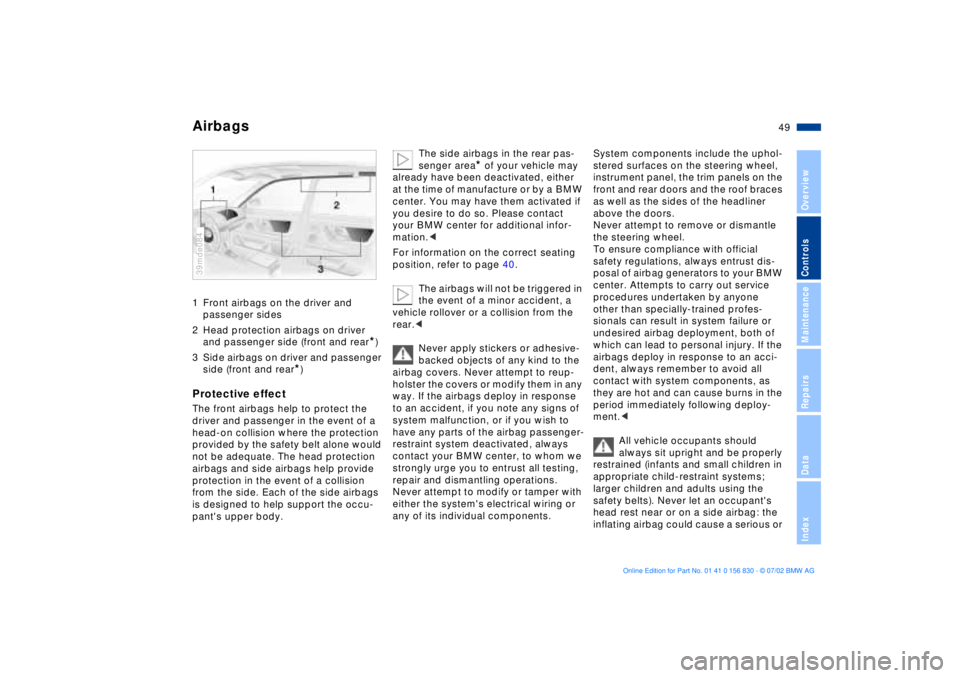
Airbags1 Front airbags on the driver and
passenger sides
2 Head protection airbags on driver
and passenger side (front and rear
*)
3 Side airbags on driver and passenger
side (front and rear
*)
Protective effectThe front airbags help to protect the
driver and passenger in the event of a
head-on collision where the protection
provided by the safety belt alone would
not be adequate. The head protection
airbags and side airbags help provide
protection in the event of a collision
from the side. Each of the side airbags
is designed to help support the occu-
pant's upper body.39mde084
The side airbags in the rear pas-
senger area
* of your vehicle may
already have been deactivated, either
at the time of manufacture or by a BMW
center. You may have them activated if
you desire to do so. Please contact
your BMW center for additional infor-
mation.<
For information on the correct seating
position, refer to page 40.
The airbags will not be triggered in
the event of a minor accident, a
vehicle rollover or a collision from the
rear.<
Never apply stickers or adhesive-
backed objects of any kind to the
airbag covers. Never attempt to reup-
holster the covers or modify them in any
way. If the airbags deploy in response
to an accident, if you note any signs of
system malfunction, or if you wish to
have any parts of the airbag passenger-
restraint system deactivated, always
contact your BMW center, to whom we
strongly urge you to entrust all testing,
repair and dismantling operations.
Never attempt to modify or tamper with
either the system's electrical wiring or
any of its individual components.
System components include the uphol-
stered surfaces on the steering wheel,
instrument panel, the trim panels on the
front and rear doors and the roof braces
as well as the sides of the headliner
above the doors.
Never attempt to remove or dismantle
the steering wheel.
To ensure compliance with official
safety regulations, always entrust dis-
posal of airbag generators to your BMW
center. Attempts to carry out service
procedures undertaken by anyone
other than specially-trained profes-
sionals can result in system failure or
undesired airbag deployment, both of
which can lead to personal injury. If the
airbags deploy in response to an acci-
dent, always remember to avoid all
contact with system components, as
they are hot and can cause burns in the
period immediately following deploy-
ment.<
All vehicle occupants should
always sit upright and be properly
restrained (infants and small children in
appropriate child-restraint systems;
larger children and adults using the
safety belts). Never let an occupant's
head rest near or on a side airbag: the
inflating airbag could cause a serious or
Page 103 of 155
103n
OverviewControlsMaintenanceRepairsDataIndex
Cargo loading Roof-mounted luggage rack
*
Always position and secure the
load correctly. If you do not, it can
endanger the passengers during
braking or evasive maneuvers.
Never exceed either the approved
gross vehicle weight or the approved
loads for either of the axles (refer to
page 142), as overloading the vehicle
beyond the legally approved levels can
severely compromise its operating
safety.
Do not carry hard or heavy objects
unsecured in the passenger compart-
ment. If you do so, they may be pro-
jected through the air during braking
and evasive maneuvers, thus endan-
gering vehicle occupants.<
A special roof-rack system is available
as an optional extra for your BMW.
Please observe the precautions
included with the installation instruc-
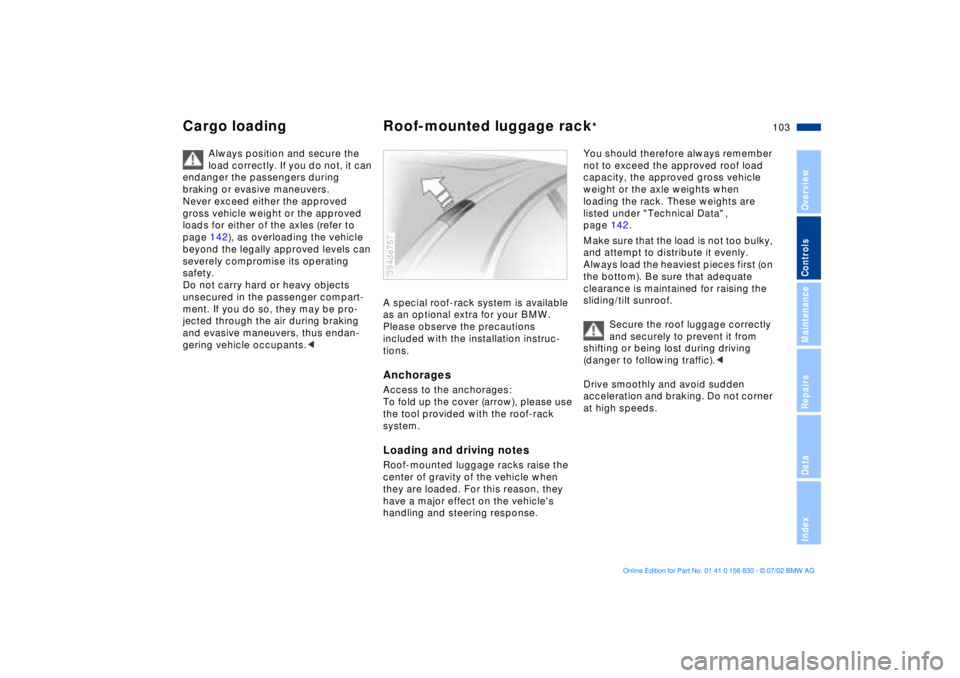
tions.AnchoragesAccess to the anchorages:
To fold up the cover (arrow), please use
the tool provided with the roof-rack
system.Loading and driving notesRoof-mounted luggage racks raise the
center of gravity of the vehicle when
they are loaded. For this reason, they
have a major effect on the vehicle's
handling and steering response.394de757
You should therefore always remember
not to exceed the approved roof load
capacity, the approved gross vehicle
weight or the axle weights when
loading the rack. These weights are
listed under "Technical Data" ,
page 142.
Make sure that the load is not too bulky,
and attempt to distribute it evenly.
Always load the heaviest pieces first (on
the bottom). Be sure that adequate
clearance is maintained for raising the
sliding/tilt sunroof.
Secure the roof luggage correctly
and securely to prevent it from
shifting or being lost during driving
(danger to following traffic).<
Drive smoothly and avoid sudden
acceleration and braking. Do not corner
at high speeds.