flat tire BMW M6 CONVERTIBLE 2012 User Guide
[x] Cancel search | Manufacturer: BMW, Model Year: 2012, Model line: M6 CONVERTIBLE, Model: BMW M6 CONVERTIBLE 2012Pages: 297, PDF Size: 12.09 MB
Page 242 of 297
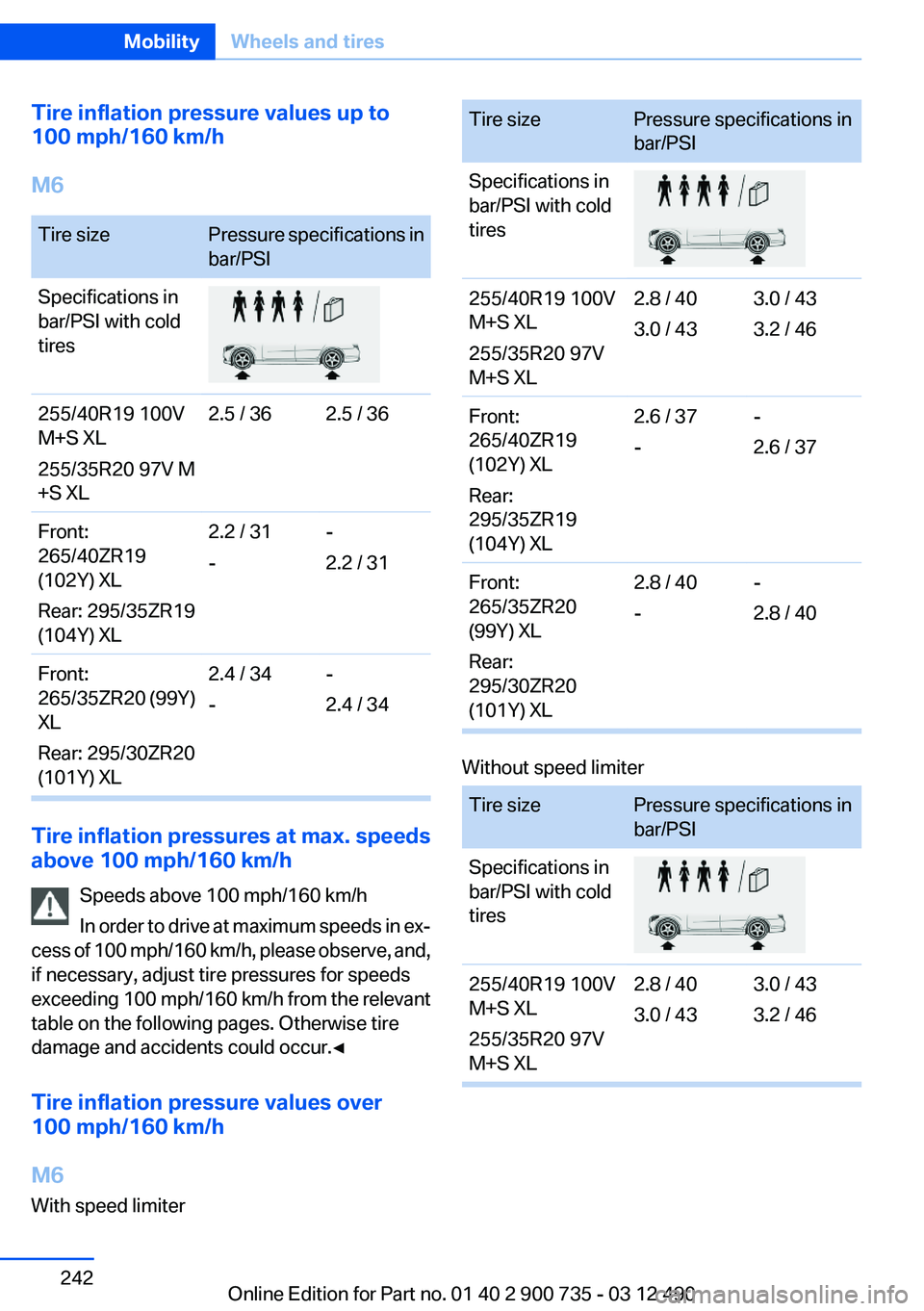
Tire inflation pressure values up to
100 mph/160 km/h
M6Tire sizePressure specifications in
bar/PSISpecifications in
bar/PSI with cold
tires255/40R19 100V
M+S XL
255/35R20 97V M
+S XL2.5 / 362.5 / 36Front:
265/40ZR19
(102Y) XL
Rear: 295/35ZR19
(104Y) XL2.2 / 31
--
2.2 / 31Front:
265/35ZR20 (99Y)
XL
Rear: 295/30ZR20
(101Y) XL2.4 / 34
--
2.4 / 34
Tire inflation pressures at max. speeds
above 100 mph/160 km/h
Speeds above 100 mph/160 km/h
In order to drive at maximum speeds in ex‐
cess of 100 mph/160 km/h, please observe, and,
if necessary, adjust tire pressures for speeds
exceeding 100 mph/160 km/h from the relevant
table on the following pages. Otherwise tire
damage and accidents could occur.◀
Tire inflation pressure values over
100 mph/160 km/h
M6
With speed limiter
Tire sizePressure specifications in
bar/PSISpecifications in
bar/PSI with cold
tires255/40R19 100V
M+S XL
255/35R20 97V
M+S XL2.8 / 40
3.0 / 433.0 / 43
3.2 / 46Front:
265/40ZR19
(102Y) XL
Rear:
295/35ZR19
(104Y) XL2.6 / 37
--
2.6 / 37Front:
265/35ZR20
(99Y) XL
Rear:
295/30ZR20
(101Y) XL2.8 / 40
--
2.8 / 40
Without speed limiter
Tire sizePressure specifications in
bar/PSISpecifications in
bar/PSI with cold
tires255/40R19 100V
M+S XL
255/35R20 97V
M+S XL2.8 / 40
3.0 / 433.0 / 43
3.2 / 46Seite 242MobilityWheels and tires242
Online Edition for Part no. 01 40 2 900 735 - 03 12 490
Page 244 of 297
Those grades represent the tire's ability to stop
on wet pavement as measured under controlled
conditions on specified government test surfa‐
ces of asphalt and concrete. A tire marked C may
have poor traction performance.
The traction grade assigned to this tire is based
on straight-ahead braking traction tests, and
does not include acceleration, cornering, hydro‐
planing, or peak traction characteristics.
Temperature
The temperature grades are A, the highest, B,
and C, representing the tire's resistance to the
generation of heat and its ability to dissipate
heat when tested under controlled conditions
on a specified indoor laboratory test wheel. Sus‐
tained high temperature can cause the material
of the tire to degenerate and reduce tire life, and
excessive temperature can lead to sudden tire
failure. The grade C corresponds to a level of
performance which all passenger car tires must
meet under the Federal Motor Vehicle Safety
Standard No. 109. Grades Band A represent
higher levels of performance on the laboratory
test wheel than the minimum required by law.
Temperature grade for this tire
The temperature grade for this tire is es‐
tablished for a tire that is properly inflated and
not overloaded. Excessive speed, underinfla‐
tion, or excessive loading, either separately or in
combination, can cause heat buildup and pos‐
sible tire failure.
If necessary, have the vehicle towed.◀
M+S
Winter and all-season tires with better cold
weather performance than summer tires.
Tire tread
Summer tires
Do not drive with a tire tread depth of less than
0.12 in/3 mm.There is an increased danger of hydroplaning if
the tread depth is less than 0.12 in/3 mm.
Winter tires
Do not drive with a tire tread depth of less than
0.16 in/4 mm.
Below a tread depth of 0.16 in/4 mm, tires are
less suitable for winter operation.
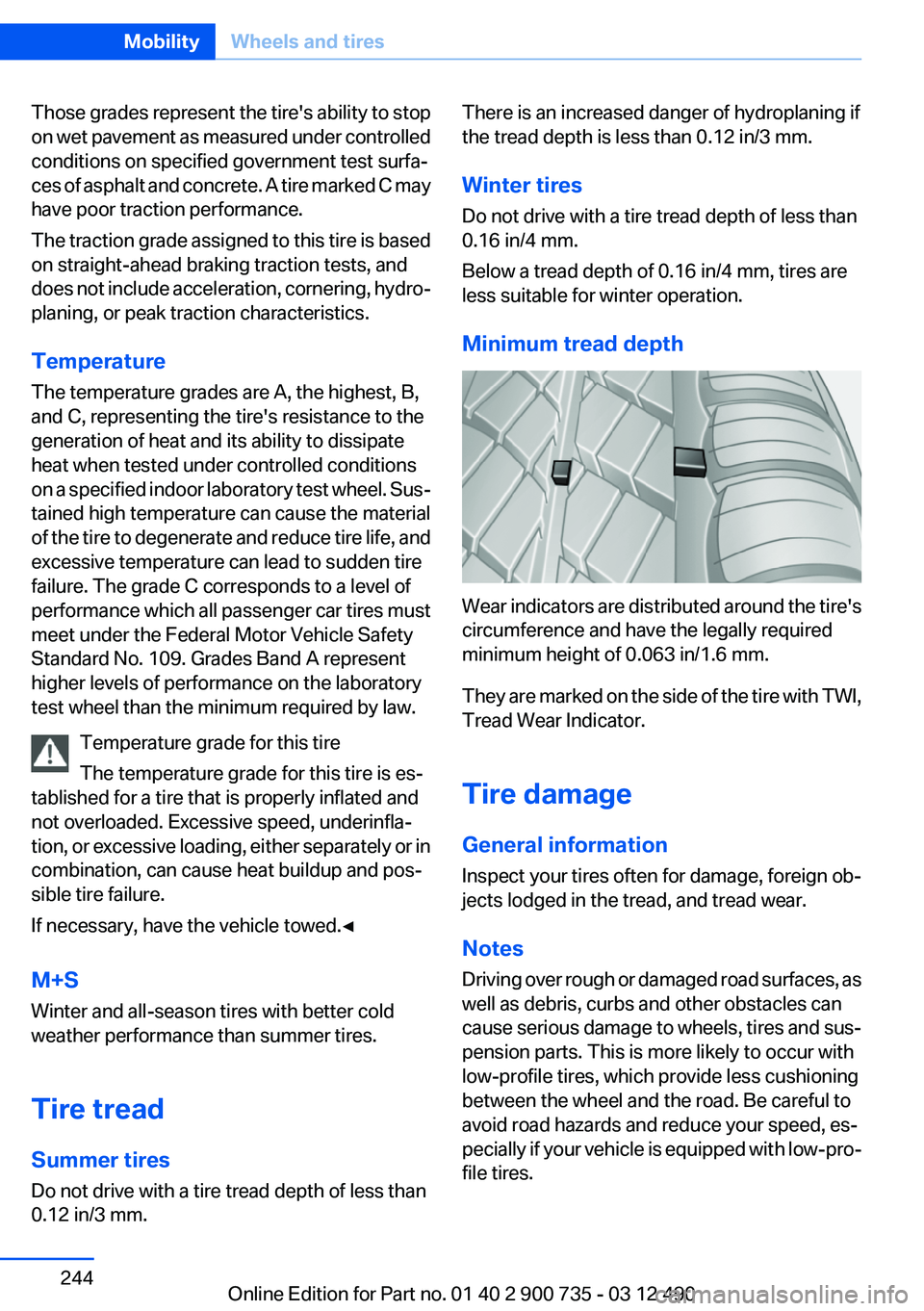
Minimum tread depth
Wear indicators are distributed around the tire's
circumference and have the legally required
minimum height of 0.063 in/1.6 mm.
They are marked on the side of the tire with TWI,
Tread Wear Indicator.
Tire damage
General information
Inspect your tires often for damage, foreign ob‐
jects lodged in the tread, and tread wear.
Notes
Driving over rough or damaged road surfaces, as
well as debris, curbs and other obstacles can
cause serious damage to wheels, tires and sus‐
pension parts. This is more likely to occur with
low-profile tires, which provide less cushioning
between the wheel and the road. Be careful to
avoid road hazards and reduce your speed, es‐
pecially if your vehicle is equipped with low-pro‐
file tires.
Seite 244MobilityWheels and tires244
Online Edition for Part no. 01 40 2 900 735 - 03 12 490
Page 246 of 297
tion potential until after an initial breaking-in pe‐
riod.
Drive conservatively for the first
200 miles/300 km.
Retreaded tires
The manufacturer of your vehicle does not rec‐
ommend the use of retreaded tires.
Retreaded tires
Possibly substantial variations in the de‐
sign and age of the tire casing structures can
limit service life and have a negative impact on
road safety.◀
Winter tires
The manufacturer of your vehicle recommends
winter tires for winter roads or at temperatures
below +45 ℉/+7 ℃.
Although so-called all-season M+S tires do pro‐
vide better winter traction than summer tires,
they do not provide the same level of perform‐
ance as winter tires.
Maximum speed of winter tires
If the maximum speed of the vehicle is higher
than the permissible speed for the winter tires,
then display a corresponding sign in the field of
vision. You can obtain this sign from the tire spe‐
cialist or from your service center.
Maximum speed for winter tires
Do not exceed the maximum speed for the
winter tires; otherwise, tire damage and acci‐
dents can occur.◀
Rotating wheels between axles
The manufacturer of your vehicle advises
against swapping wheels between the front and
rear axles.
This can impair the handling characteristics.
Rotating the tires is not permissible when using
different types of tires.Storage
Store wheels and tires in a cool, dry place with
as little exposure to light as possible.
Always protect tires against all contact with oil,
grease and fuels.
Do not exceed the maximum tire inflation pres‐
sure indicated on the side wall of the tire.
Repairing a flat tire Safety measures in case of a breakdown
Park the vehicle as far away as possible
from passing traffic and on solid ground.
Switch on the hazard warning system.
Turn the steering wheel until the front wheels
are in the straight-ahead position and engage
the steering wheel lock.
Secure vehicle against rolling away by setting
the parking brake and switching off the ignition.
Have all vehicle occupants get out of the vehicle
and ensure that they remain outside the imme‐
diate area in a safe place, such as behind a
guardrail.
If necessary, set up a warning triangle at an ap‐
propriate distance.
Comply with all safety guidelines and regula‐
tions.◀
Mobility System
Notes▷Follow the instructions on using the Mobility
System found on the compressor and seal‐
ant bottle.▷Use of the Mobility System may be ineffec‐
tive if the tire puncture measures approx.
1/8 in/4 mm or more.▷Contact the nearest service center if the tire
cannot be made drivable.Seite 246MobilityWheels and tires246
Online Edition for Part no. 01 40 2 900 735 - 03 12 490
Page 247 of 297
▷If possible, do not remove foreign bodies
that have penetrated the tire.▷Pull the speed limit sticker off the sealant
bottle and apply it to the steering wheel.
Storage
The Mobility System is located under the floor
panel in the cargo area.
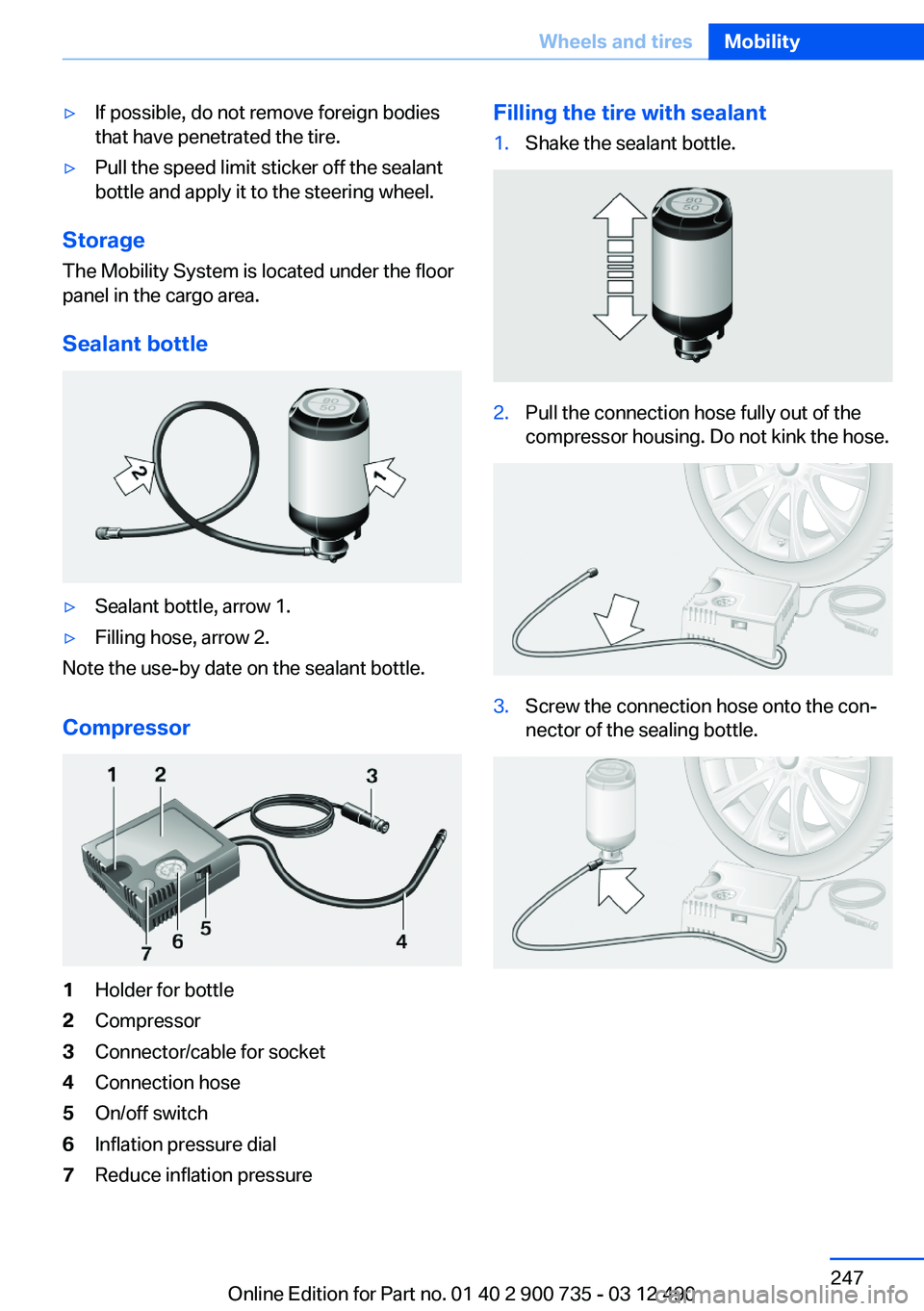
Sealant bottle
▷Sealant bottle, arrow 1.▷Filling hose, arrow 2.
Note the use-by date on the sealant bottle.
Compressor
1Holder for bottle2Compressor3Connector/cable for socket4Connection hose5On/off switch6Inflation pressure dial7Reduce inflation pressureFilling the tire with sealant1.Shake the sealant bottle.2.Pull the connection hose fully out of the
compressor housing. Do not kink the hose.3.Screw the connection hose onto the con‐
nector of the sealing bottle.Seite 247Wheels and tiresMobility247
Online Edition for Part no. 01 40 2 900 735 - 03 12 490
Page 248 of 297
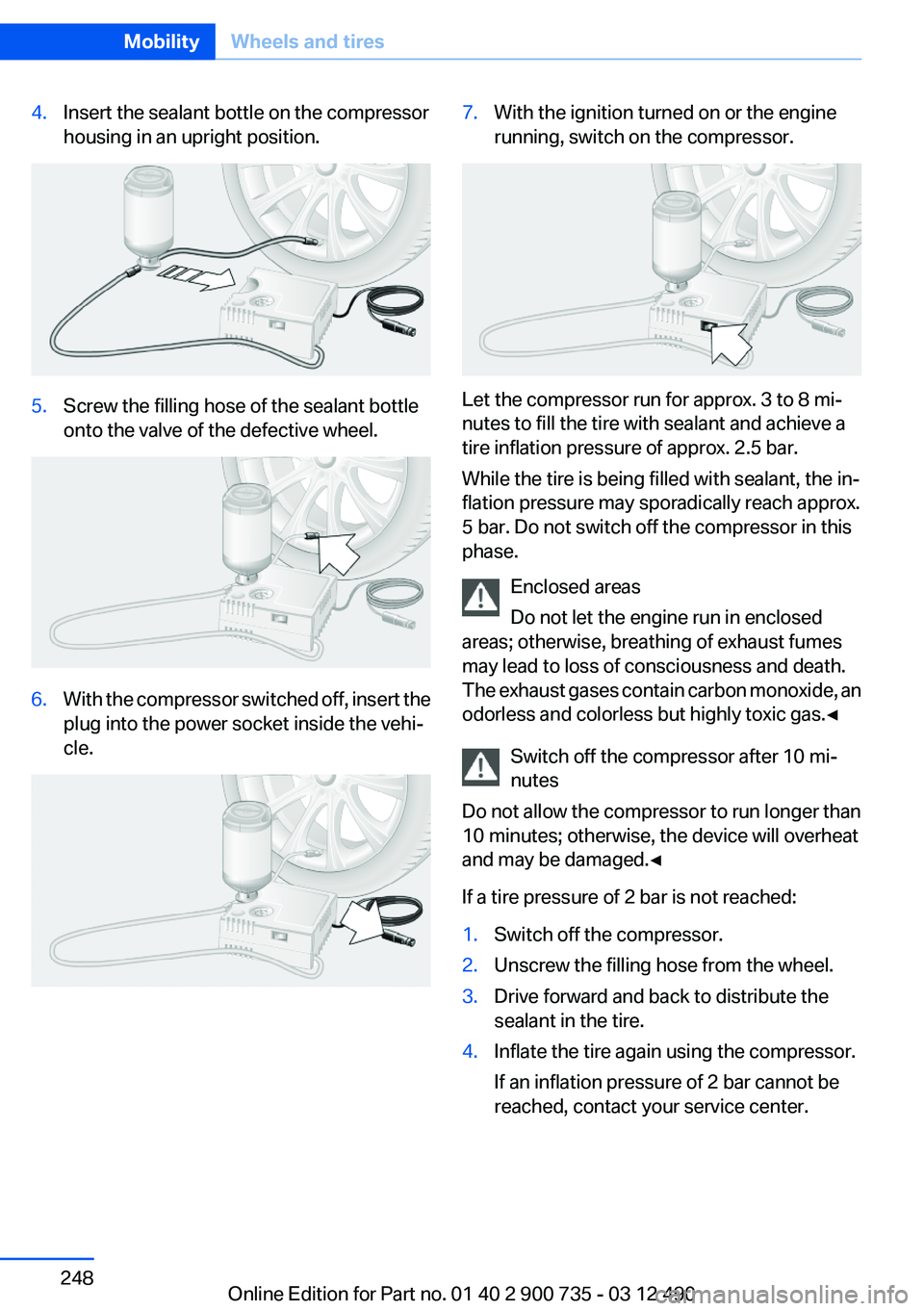
4.Insert the sealant bottle on the compressor
housing in an upright position.5.Screw the filling hose of the sealant bottle
onto the valve of the defective wheel.6.With the compressor switched off, insert the
plug into the power socket inside the vehi‐
cle.7.With the ignition turned on or the engine
running, switch on the compressor.
Let the compressor run for approx. 3 to 8 mi‐
nutes to fill the tire with sealant and achieve a
tire inflation pressure of approx. 2.5 bar.
While the tire is being filled with sealant, the in‐
flation pressure may sporadically reach approx.
5 bar. Do not switch off the compressor in this
phase.
Enclosed areas
Do not let the engine run in enclosed
areas; otherwise, breathing of exhaust fumes
may lead to loss of consciousness and death.
The exhaust gases contain carbon monoxide, an
odorless and colorless but highly toxic gas.◀
Switch off the compressor after 10 mi‐
nutes
Do not allow the compressor to run longer than
10 minutes; otherwise, the device will overheat
and may be damaged.◀
If a tire pressure of 2 bar is not reached:
1.Switch off the compressor.2.Unscrew the filling hose from the wheel.3.Drive forward and back to distribute the
sealant in the tire.4.Inflate the tire again using the compressor.
If an inflation pressure of 2 bar cannot be
reached, contact your service center.Seite 248MobilityWheels and tires248
Online Edition for Part no. 01 40 2 900 735 - 03 12 490
Page 249 of 297
Stowing the Mobility System1.Unscrew the filling hose of the sealant bottle
from the wheel.2.Unscrew the compressor connection hose
from the sealant bottle.3.Connect the sealant bottle filling hose that
was previously connected to the valve to the
vacant connector on the sealant bottle.
This prevents left-over sealant from escap‐
ing from the bottle.4.Wrap the empty sealant bottle in suitable
material to avoid dirtying the cargo area.5.Stow the Mobility System back in the vehi‐
cle.
Distributing the sealant
Immediately drive approx. to ensure that the
sealant is evenly distributed in the tire.
Do not exceed a speed of .
Do not drop below if possible.
Correcting the tire inflation pressure
1.Stop at a suitable location.2.Screw the connection hose of the compres‐
sor directly onto the tire valve.3.Insert the connector into the power socket
in the vehicle interior.4.Correct the tire inflation pressure to 2.5 bar.▷Increase pressure: with the ignition
turned on or the engine running, switch
on the compressor.▷To reduce the pressure: press the but‐
ton on the compressor.
Continuing the trip
Do not exceed the maximum permissible speed
of 50 mph/80 km/h.
Reinitialize the Flat Tire Monitor, refer to
page 101.
Reinitialize the Tire Pressure Monitor, refer to
page 99.
Replace the defective tire and the sealant bottle
of the Mobility System as soon as possible.
Snow chains
Fine-link snow chains
Only certain types of fine-link snow chains have
been tested by the manufacturer of your vehicle,
classified as road-safe and recommended.
Consult your service center for more informa‐
tion.
Use
Use only in pairs on the rear wheels, equipped
with the tires of the following size:
255/40 R 19
Follow the chain manufacturer's instructions.
Make sure that the snow chains are always suf‐
ficiently tight. Retighten as needed according to
the chain manufacturer's instructions.
Do not initialize the Flat Tire Monitor after
mounting snow chains, as doing so may result
in incorrect readings.
Do not initialize the Tire Pressure Monitor after
mounting snow chains, as doing so may result
in incorrect readings.
When driving with snow chains, if necessary
briefly activate M Dynamic Mode.
Maximum speed with snow chains
Do not exceed a speed of 30 mph/50 km/h when
using snow chains.Seite 249Wheels and tiresMobility249
Online Edition for Part no. 01 40 2 900 735 - 03 12 490
Page 260 of 297
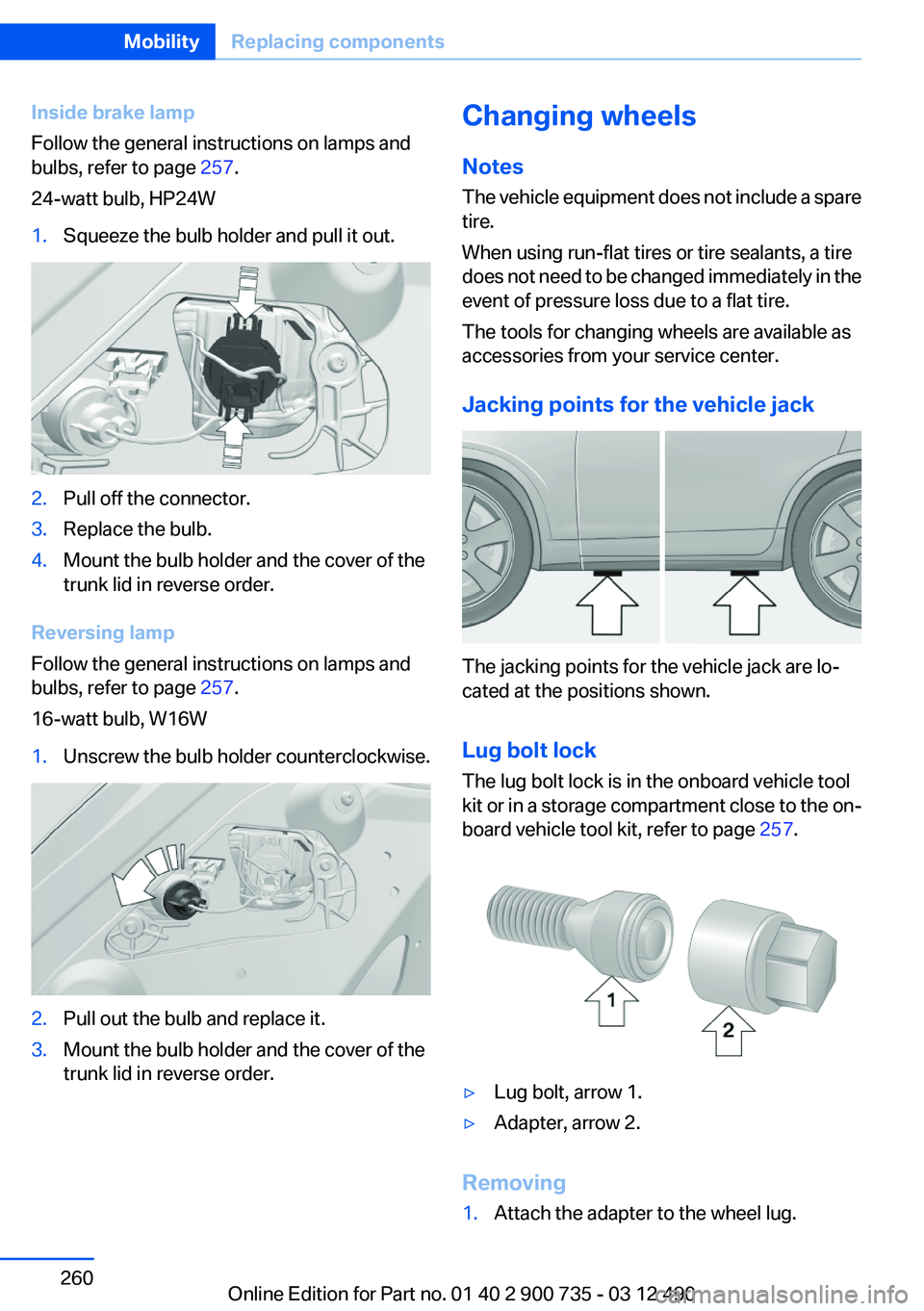
Inside brake lamp
Follow the general instructions on lamps and
bulbs, refer to page 257.
24-watt bulb, HP24W1.Squeeze the bulb holder and pull it out.2.Pull off the connector.3.Replace the bulb.4.Mount the bulb holder and the cover of the
trunk lid in reverse order.
Reversing lamp
Follow the general instructions on lamps and
bulbs, refer to page 257.
16-watt bulb, W16W
1.Unscrew the bulb holder counterclockwise.2.Pull out the bulb and replace it.3.Mount the bulb holder and the cover of the
trunk lid in reverse order.Changing wheels
Notes
The vehicle equipment does not include a spare
tire.
When using run-flat tires or tire sealants, a tire
does not need to be changed immediately in the
event of pressure loss due to a flat tire.
The tools for changing wheels are available as
accessories from your service center.
Jacking points for the vehicle jack
The jacking points for the vehicle jack are lo‐
cated at the positions shown.
Lug bolt lock
The lug bolt lock is in the onboard vehicle tool
kit or in a storage compartment close to the on‐
board vehicle tool kit, refer to page 257.
▷Lug bolt, arrow 1.▷Adapter, arrow 2.
Removing
1.Attach the adapter to the wheel lug.Seite 260MobilityReplacing components260
Online Edition for Part no. 01 40 2 900 735 - 03 12 490
Page 289 of 297
Engine oil types, alterna‐tive 253
Engine oil types, ap‐ proved 253
Engine start during malfunc‐ tion 31
Engine start, jump-start‐ ing 265
Engine start, refer to Starting the engine 65
Engine stop 65
Engine temperature 81
Entering/exiting vehicle, assis‐ tance, steering wheel 59
Entering a car wash 268
Equalizer 172
Equipment, interior 130
ESP Electronic Stability Pro‐ gram, refer to DSC 106
Exchanging wheels/tires 245
Exhaust system 143
Exterior mirror, automatic dim‐ ming feature 58
Exterior mirrors 57
External devices 195
External start 265
External temperature dis‐ play 81
External temperature warn‐ ing 81
Eyes for securing cargo 146
F
Fader 172
Failure message, refer to Check Control 78
False alarm, refer to Uninten‐ tional alarm 42
Fan, refer to Air volume 126
Fault displays, refer to Check Control 78
Filler neck for engine oil 252
Fine wood, care 271
First aid kit 264 Fitting for towing, refer to Tow
fitting 267
Flat tire, changing wheels 260
Flat Tire Monitor FTM 101
Flat tire, repairing 246
Flat tire, Tire Pressure Monitor TPM 99
Flat tire, warning lamp 100, 102
Flooding 143
Floor carpet, care 271
Floor mats, care 271
FM/AM station 175
Fold-out position, windshield wipers 76
Foot brake 143
Front airbags 95
Front center armrest 136
Front lamps 258
Front passenger airbags, au‐ tomatic deactivation 96
Front passenger airbags, indi‐ cator lamp 97
Front seats 51
FTM Flat Tire Monitor 101
Fuel cap 238
Fuel consumption, current 83
Fuel consumption, refer to Average fuel consump‐
tion 85
Fuel filler flap 238
Fuel gauge 81
Fuel quality 240
Fuel, tank capacity 276
Fuse 261
G
Garage door opener, refer to Integrated universal remote
control 130
Gas station recommenda‐ tion 162
Gear change 70
General driving notes 142
Glove compartment 135 Gong, volume equaliza‐
tion 173
GPS navigation 152
Gray display of the map 166
Gross vehicle weight, ap‐ proved 275
Ground clearance 144
H
Handbrake, refer to Parking brake 67
Hand-held transmitter, alter‐ nating code 131
Hazard warning flashers 263
HD Radio 176
Headlamp control, auto‐ matic 91
Headlamp courtesy delay fea‐ ture 91
Headlamp courtesy delay fea‐ ture via remote control 35
Headlamp flasher 74
Headlamp glass 258
Headlamps 258
Headlamps, care 269
Headlamp washer system 74
Head restraints 51
Head restraints, front 55
Head-Up Display 122
Head-up Display, care 271
Head-up Display, M view 123
Head-up Display, standard view 123
Heavy cargo, stowing 146
Height, seats 51
Height, vehicle 274
High-beam Assistant 92
High beams 74
High beams/low beams, refer to High-beam Assistant 92
Hills 144
Hill Start Assistant 108
Hill start assistant, refer to Drive-off assistant 106
Hints 6 Seite 289Everything from A to ZReference289
Online Edition for Part no. 01 40 2 900 735 - 03 12 490
Page 290 of 297
Holder for beverages 136
Homepage 6
Hood 250
Horn 12
Hotel function, trunk lid 39
Hot exhaust system 143
House number, entering for navigation 153
HUD Head-Up Display 122
Hydroplaning 143
I
Ice warning, refer to External temperature warning 81
Icy roads, refer to External temperature warning 81
Identification marks, tires 243
Identification number, refer to Important in the engine com‐
partment 250
iDrive 16
Ignition key, refer to Remote control 30
Ignition off 64
Ignition on 64
Indication of a flat tire 100 , 102
Individual air distribution 126
Individual settings, refer to M Drive 59
Individual settings, refer to Personal Profile 31
Inflation pressure, tires 241
Inflation pressure warning FTM, tires 101
Info display, refer to Com‐ puter 85
Information on the navigation data 167
Initialize, Tire Pressure Moni‐ tor TPM 100
Initializing, Flat Tire Monitor FTM 102
Instrument cluster 77 Instrument cluster, electronic
displays 78
Instrument lighting 93
Integrated key 30
Integrated universal remote control 130
Intensity, AUTO program 126
Interactive map 157
Interior equipment 130
Interior lamps 93
Interior lamps via remote con‐ trol 35
Interior motion sensor 42
Interior rearview mirror, auto‐ matic dimming feature 58
Intermediate destinations 159
Internet page 6
Intersection, entering for navi‐ gation 153
Interval display, service re‐ quirements 83
iPod/iPhone 195
J
Jacking points for the vehicle jack 260
Jack, refer to Vehicle jack 260
Jump-starting 265
K
Key/remote control 30
Keyless Go, refer to Comfort Access 39
Key Memory, refer to Personal Profile 31
Knee airbag 95
L
Lamp replacement 257
Lamp replacement, front 258
Lamp replacement, rear 259
Lamps 90
Lamps and bulbs 257 Lane departure warning 102
Lane margin, warning 102
Language on Control Dis‐ play 88
Lashing eyes, securing cargo 146
LATCH child restraint fixing system 62
Launch Control 71
Leather, care 270
LED headlamps 258
LEDs, light-emitting di‐ odes 258
Length, vehicle 275
Letters and numbers, enter‐ ing 21
License plate lamp, bulb re‐ placement 259
Light-alloy wheels, care 270
Light control 92
Light-emitting diodes, LEDs 258
Lighting 90
Lighting, speaker 173
Lighting via remote control 35
Light switch 90
Load 145
Loading 145
Lock, door 37
Locking/unlocking from in‐ side 37
Locking/unlocking via door lock 37
Locking/unlocking with re‐ mote control 34
Locking, automatic 38
Locking, central 33
Locking via trunk lid 39
Low beams 90
Low beams, automatic, refer to High-beam Assistant 92
Lower back support 52
Low Speed Assistant 72
Lug bolt lock 260
Lumbar support 52 Seite 290ReferenceEverything from A to Z290
Online Edition for Part no. 01 40 2 900 735 - 03 12 490
Page 293 of 297
Sequential mode 69
Service and warranty 7
Service requirements, Condi‐ tion Based Service CBS 255
Service requirements, dis‐ play 83
Service, Roadside Assis‐ tance 264
Servotronic 109
Settings, M Drive 59
Settings on Control Dis‐ play 87
Settings, storing for seat, mir‐ rors, steering wheel 56
Shift Lights 72
Short commands 277
Shoulder support 53
Side airbags 95
Side View 118
Signaling, horn 12
Signals when unlocking 36
Sitting safely 51
Size 274
Ski bag 133
Smallest turning circle 275
Smoker's package 132
Snap-in adapter, mobile phone 216
Snow chains 249
Socket 132
Socket, OBD Onboard Diag‐ nostics 256
Software applications, iPhone 233
Software update 202
Spare fuse 261
Speaker lighting 173
Special destinations, naviga‐ tion 155
Specified engine oil types 253
Speed, average 86
Speed limit in the com‐ puter 86
Speed Volume, volume equal‐ ization 173 Split screen 20
Split screen map settings 164
Spoken instructions, naviga‐ tion 162
Stability control systems 106
Standard view, Head-up Dis‐ play 123
Start/stop, automatic func‐ tion 65
Start/Stop button 64
Start function during malfunc‐ tion 31
Starting the engine 65
State/province, selecting for navigation 152
Stations, stored 181
Station, storing 175
Status display, tires 99
Status information, iDrive 19
Status of Owner's Manual 6
Steering assistance 109
Steering wheel, adjusting 59
Steering wheel heating 59
Steering wheel memory 56
Stopping the engine 65
Storage compartments 135
Storage compartments, loca‐ tions 135
Storage, tires 246
Storing the vehicle 271
Street, entering for naviga‐ tion 153
Summer tires, tread 244
Supplementary text mes‐ sage 80
Surround View 114
Switch-on times, parked-car ventilation 129
Switch, refer to Cockpit 12
Symbols 6
System states of the driving dynamics 83
T
Tachometer 81 Tail and brake lamps 259
Tailgate 38
Tailgate via remote control 35
Tail lamps 259
Tail lamps, bulb replace‐ ment 259
Tasks 224
Technical changes, refer to Safety 6
Technical data 274
Technology, BMW M 0
TeleServices 230
Temperature, automatic cli‐ mate control 126
Temperature display, external temperature 81
Temperature, engine oil 81
Terminal, jump-starting 265
Text messages 221
Text message, supplemen‐ tary 80
Theft alarm system, refer to Alarm system 41
Theft protection, lug bolts 260
Theft protection, refer to Cen‐ tral locking system 33
Thermal camera, refer to Night Vision 119
Thigh support 52
Tilt alarm sensor 42
Tilt, seats 51
Time of arrival 86
Tire damage 244
Tire identification marks 243
Tire inflation pressure 241
Tire inflation pressure monitor, refer to FTM 101
Tire Pressure Monitor TPM 99
Tires, changing 245
Tire sealant 246
Tires, everything on wheels and tires 241
Tire tread 244
Toll roads, route 160 Seite 293Everything from A to ZReference293
Online Edition for Part no. 01 40 2 900 735 - 03 12 490