park assist BMW M6 CONVERTIBLE 2013 F12 User Guide
[x] Cancel search | Manufacturer: BMW, Model Year: 2013, Model line: M6 CONVERTIBLE, Model: BMW M6 CONVERTIBLE 2013 F12Pages: 222, PDF Size: 7.3 MB
Page 196 of 222
Roadside Assistance can be established di‐
rectly.
Jump-starting
Notes If the battery is discharged, an engine can be
started using the battery of another vehicle
and two jumper cables. Only use jumper ca‐
bles with fully insulated clamp handles.
To prevent personal injury or damage to both
vehicles, adhere strictly to the following proce‐
dure.
Do not touch live parts
To avoid the risk of potentially fatal in‐
jury, always avoid all contact with electrical
components while the engine is running.◀
Preparation1.Check whether the battery of the other ve‐
hicle has a voltage of 12 volts. This infor‐
mation can be found on the battery.2.Switch off the engine of the assisting vehi‐
cle.3.Switch off any electronic systems/power
consumers in both vehicles.
Bodywork contact between vehicles
Make sure that there is no contact be‐
tween the bodywork of the two vehicles; other‐
wise, there is the danger of short circuits.◀
Starting aid terminals Connecting order
Connect the jumper cables in the correct
order; otherwise, there is the danger of injury
from sparking.◀
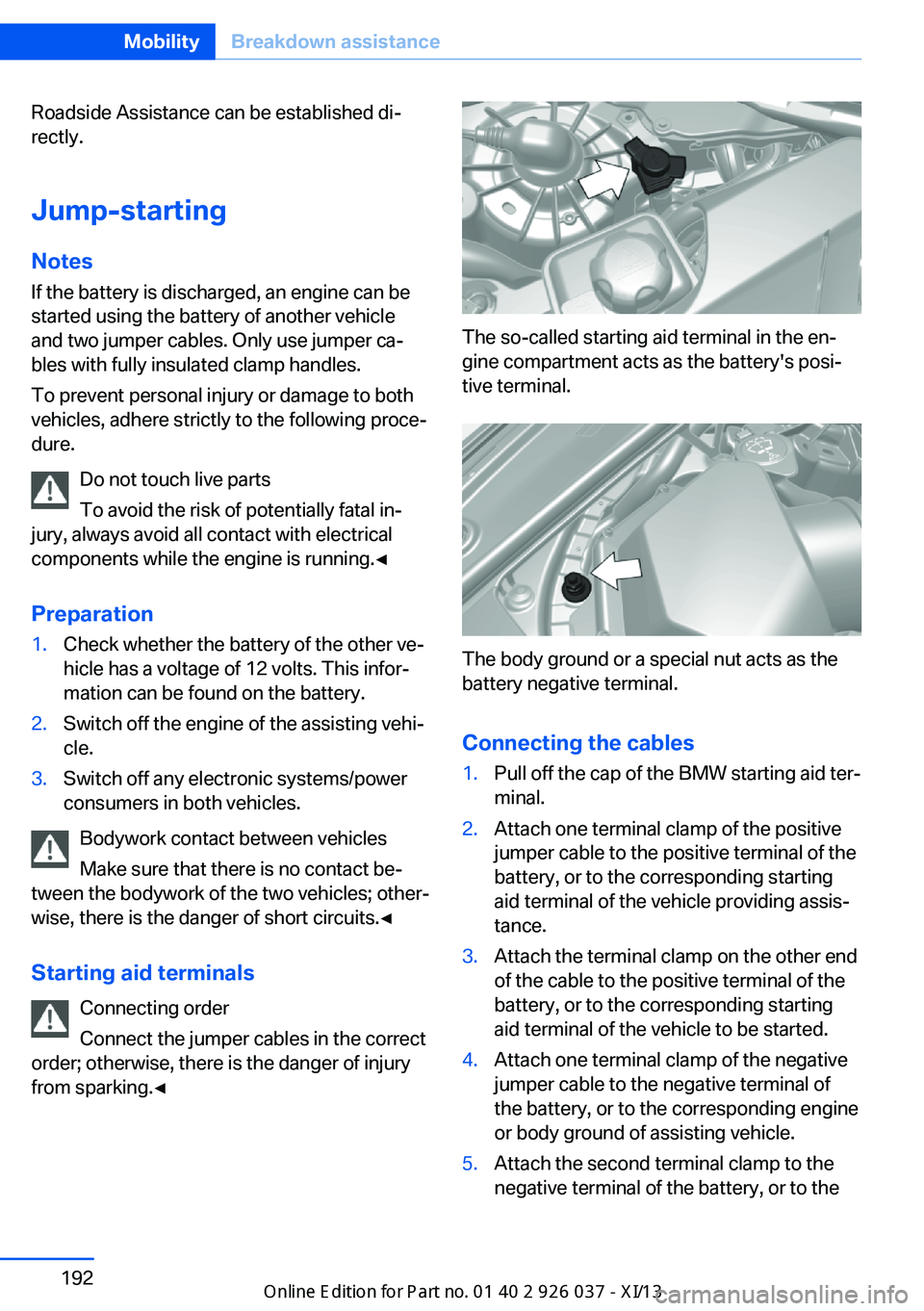
The so-called starting aid terminal in the en‐
gine compartment acts as the battery's posi‐
tive terminal.
The body ground or a special nut acts as the
battery negative terminal.
Connecting the cables
1.Pull off the cap of the BMW starting aid ter‐
minal.2.Attach one terminal clamp of the positive
jumper cable to the positive terminal of the
battery, or to the corresponding starting
aid terminal of the vehicle providing assis‐
tance.3.Attach the terminal clamp on the other end
of the cable to the positive terminal of the
battery, or to the corresponding starting
aid terminal of the vehicle to be started.4.Attach one terminal clamp of the negative
jumper cable to the negative terminal of
the battery, or to the corresponding engine
or body ground of assisting vehicle.5.Attach the second terminal clamp to the
negative terminal of the battery, or to theSeite 192MobilityBreakdown assistance192
Online Edition for Part no. 01 40 2 910 746 - VI/13
Page 197 of 222
corresponding engine or body ground of
the vehicle to be started.
Starting the engine
Never use spray fluids to start the engine.
1.Start the engine of the assisting vehicle
and let it run for several minutes at an in‐
creased idle speed.2.Start the engine of the vehicle being
started in the usual way.
If the first starting attempt is not success‐
ful, wait a few minutes before making an‐
other attempt in order to allow the dis‐
charged battery to recharge.3.Let both engines run for several minutes.4.Disconnect the jumper cables in the re‐
verse order.
Check the battery and recharge if necessary.
Tow-starting and towing Manual transmission
Observe before towing your vehicle
Gearshift lever in neutral position.
Towing When the parking brake is blocked
The parking brake cannot be released
manually.
Do not tow the vehicle with the parking brake
blocked, or the vehicle can be damaged.
Contact your service center.◀
Follow the towing instructions
Follow all towing instructions; otherwise,
vehicle damage or accidents may occur.◀
▷Make sure that the ignition is switched on;
otherwise, the low beams, tail lamps, turn
signals, and windshield wipers may be un‐
available.▷Do not tow the vehicle with the rear axle
tilted, as the front wheels could turn.▷When the engine is stopped, there is no
power assist. Consequently, more force
needs to be applied when braking and
steering.▷Larger steering wheel movements are re‐
quired.▷The towing vehicle must not be lighter
than the vehicle being towed; otherwise,
it will not be possible to control the vehicle
response.
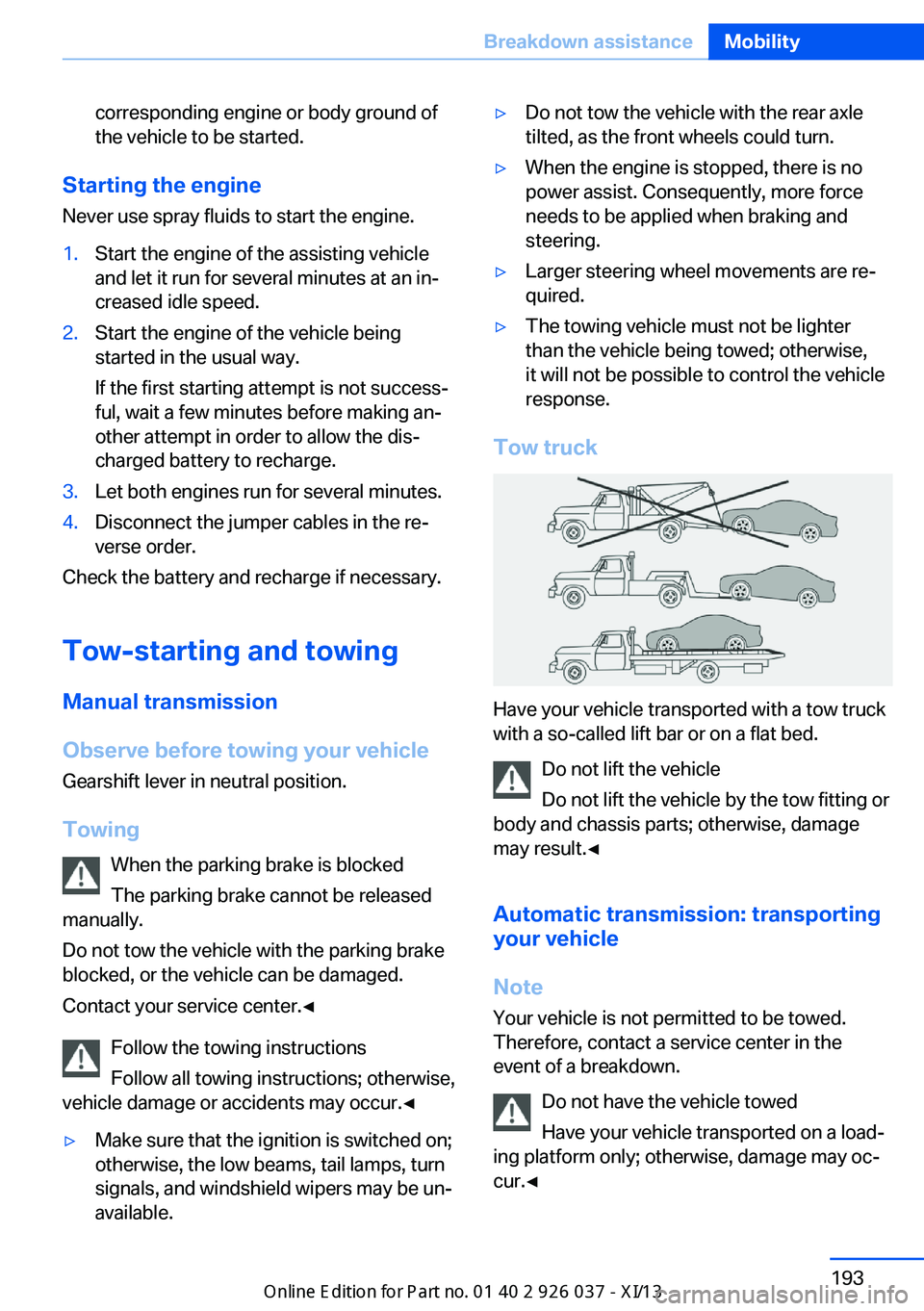
Tow truck
Have your vehicle transported with a tow truck
with a so-called lift bar or on a flat bed.
Do not lift the vehicle
Do not lift the vehicle by the tow fitting or
body and chassis parts; otherwise, damage
may result.◀
Automatic transmission: transporting
your vehicle
Note Your vehicle is not permitted to be towed.
Therefore, contact a service center in the
event of a breakdown.
Do not have the vehicle towed
Have your vehicle transported on a load‐
ing platform only; otherwise, damage may oc‐
cur.◀
Seite 193Breakdown assistanceMobility193
Online Edition for Part no. 01 40 2 910 746 - VI/13
Page 214 of 222
Coolant 181
Coolant temperature 83
Cooling function 138
Cooling, maximum 138
Cooling system 181
Corrosion on brake discs 156
Cruise control 123
Cruising range 84
Cupholder 148
Current fuel consumption 84
D
Damage, tires 170
Damper control 121
Damper Control, Elec‐ tronic 121
Data, technical 204
Date 83
Daytime running lights 94
Defrosting, refer to Windows, defrosting 138
Departure time, parked-car ventilation 140
Destination distance 89
Differential lock 121
Digital clock 83
Digital speed 83
Digital tachometer 83
Dimensions 204
Dimmable exterior mirrors 58
Dimmable interior rearview mirror 58
Direction indicator, refer to Turn signals 75
Display in windshield 133
Display lighting, refer to In‐ strument lighting 96
Displays 79
Displays, cleaning 200
Disposal, coolant 181
Disposal, vehicle battery 188
Distance control, refer to PDC 125
Distance to destination 89 Divided screen view, split
screen 20
Door lock, refer to Remote control 30
Doors, Automatic Soft Clos‐ ing 37
Double-clutch transmis‐ sion 70
Drivelogic 72
Drive mode 71
Drive-off assistant 119
Drive-off assistant, refer to DSC 119
Driver assistance, see Intelli‐ gent Safety 105
Driving Assistant, see Intelli‐ gent Safety 105
Driving Dynamics Control 74
Driving Dynamics System 85
Driving dynamics, system states 85
Driving instructions, breaking in 154
Driving notes, general 155
Driving on racetracks 153
Driving program, refer to Drivelogic 72
Driving stability control sys‐ tems 119
Driving tips 155
DSC Dynamic Stability Con‐ trol 119
Dynamic Stability Control DSC 119
E EDC, Electronic Damper Con‐ trol 121
EfficientDynamics 85
EfficientDynamics display 85
EfficientDynamics menu 85
Electronic Damper Control EDC 121
Electronic displays, instru‐ ment cluster 80 Electronic Stability Program
ESP, refer to DSC 119
Emergency detection, remote control 31
Emergency operation, convertible top 46
Emergency release, door lock 36
Emergency release, fuel filler flap 164
Emergency Request 190
Emergency service, refer to Roadside Assistance 191
Emergency start function, en‐ gine start 31
Emergency unlocking, trunk lid 38
Energy Control 84
Energy recovery 84
Engine, automatic Start/Stop function 66
Engine, automatic switch- off 66
Engine compartment 176
Engine compartment, work‐ ing in 176
Engine coolant 181
Engine oil 178
Engine oil, adding 179
Engine oil additives 179
Engine oil change 180
Engine oil filler neck 179
Engine oil temperature 82
Engine oil types, alterna‐ tive 179
Engine oil types, ap‐ proved 179
Engine start during malfunc‐ tion 31
Engine start, jump-start‐ ing 192
Engine start, refer to Starting the engine 65
Engine stop 66
Engine temperature 82 Seite 210ReferenceEverything from A to Z210
Online Edition for Part no. 01 40 2 910 746 - VI/13
Page 215 of 222
Entering/exiting vehicle, as‐sistance, steering wheel 59
Entering a car wash 196
Equipment, interior 141
ESP Electronic Stability Pro‐ gram, refer to DSC 119
Exchanging wheels/tires 171
Exhaust system 155
Exterior mirror, automatic dimming feature 58
Exterior mirrors 57
External start 192
External temperature dis‐ play 83
External temperature warn‐ ing 83
Eyes for securing cargo 159
F
Failure message, refer to Check Control 80
False alarm, refer to Uninten‐ tional alarm 41
Fan, refer to Air flow 137
Fault displays, refer to Check Control 80
Filler neck for engine oil 179
Fine wood, care 199
First aid kit 191
Fitting for towing, refer to Tow fitting 194
Flat tire, changing wheels 187
Flat Tire Monitor FTM 104
Flat tire, repairing 172
Flat tire, Tire Pressure Moni‐ tor TPM 102
Flat tire, warning lamp 103, 105
Flooding 156
Floor carpet, care 199
Floor mats, care 199
Fold-out position, windshield wipers 77
Foot brake 156 Front airbags 98
Front center armrest 147
Front lamps 184
Front passenger airbags, au‐ tomatic deactivation 100
Front passenger airbags, indi‐ cator lamp 100
Front seats 51
Front turn signals, refer to Light-emitting diodes,
LEDs 185
FTM Flat Tire Monitor 104
Fuel 166
Fuel cap 164
Fuel consumption, current 84
Fuel consumption, refer to Average fuel consump‐
tion 89
Fuel filler flap 164
Fuel gauge 82
Fuel quality 166
Fuel recommendation 166
Fuel, tank capacity 206
Fuse 188
G
Garage door opener, refer to Integrated universal remote
control 141
Gasoline 166
Gasoline quality 166
Gear change 71
Gear shift indicator 86
General driving notes 155
Glove compartment 146
Gross vehicle weight, ap‐ proved 205
Gross weight, permissible for trailer towing 205
Ground clearance 157
H
Handbrake, refer to Parking brake 68 Hand-held transmitter, alter‐
nating code 142
Hazard warning flashers 190
Headlamp control, auto‐ matic 94
Headlamp courtesy delay fea‐ ture 93
Headlamp courtesy delay fea‐ ture via remote control 35
Headlamp flasher 76
Headlamp glass 185
Headlamps 184
Headlamps, care 197
Headlamp washer system 76
Head restraints 51
Head restraints, front 55
Head-Up Display 133
Head-up Display, care 200
Head-up display, M view 134
Head-up display, standard view 134
Heavy cargo, stowing 159
Height, seats 51
Height, vehicle 204
High-beam Assistant 95
High beams 76
High beams/low beams, refer to High-beam Assistant 95
Higher speed range 157
Hills 156
Hill Start Assistant 121
Hill start assistant, refer to Drive-off assistant 119
Hints 6
Holder for beverages 148
Homepage 6
Hood 176
Horn 12
Hotel function, trunk lid 37
Hot exhaust system 155
HUD Head-Up Display 133
Hydroplaning 155 Seite 211Everything from A to ZReference211
Online Edition for Part no. 01 40 2 910 746 - VI/13