brakes BMW MOTORRAD K 1200 GT 2006 Rider's Manual (in English)
[x] Cancel search | Manufacturer: BMW MOTORRAD, Model Year: 2006, Model line: K 1200 GT, Model: BMW MOTORRAD K 1200 GT 2006Pages: 172, PDF Size: 1.98 MB
Page 89 of 172
out). Attempted burn-outs
can result in damage to the
rear brake and the clutch.
Do not attempt burn-outs.How does ABS work?The amount of braking force
that can be transferred to
the road depends on factors
hat include the coefficient of
friction of the road surface.
Loose stones, ice and snow
or a wet road all have much
lower coefficients of friction
than a clean, dry asphalt sur-
face. The lower the coeffi-
cient of friction, the longer the
braking distance.
If the rider increases braking
pressure to the extent that
braking force exceeds the
maximum transferrable limit,
the wheels start to lock and
the motorcycle loses its dir-
ectional stability; a fall is im-
minent. Before this situationcan occur, ABS intervenes
and adapts braking pressure
to the maximum transferrable
braking force, so the wheels
continue to turn and direc-
tional stability is maintained
irrespective of the condition of
the road surface.
What are the effects of
surface irregularities?Humps and surface irregu-
larities can cause the wheels
to lose contact temporarily
with the road surface; if this
happens the braking force
that can be transmitted to
the road can drop to zero.
If the brakes are applied un-
der these circumstances the
ABS has to reduce braking
force to ensure that direc-
tional stability is maintained
when the wheels regain con-
tact with the road surface.
At this instant the BMW Mo-
torrad Integral ABS must as-
sume an extremely low coef-
ficient of friction, so that the
wheels will continue to rotate
under all imaginable circum-
stances, because this is the
precondition for ensuring dir-
ectional stability. As soon as
is registers the actual circum-
stances, the system reacts
instantly and adjusts braking
force accordingly to achieve
optimum braking.
What feedback does the
rider receive from the
BMW Motorrad Integral
ABS?If the ABS system has to re-
duce braking force on ac-
count of the circumstances
described above, vibration is
perceptible through the hand-
brake lever.
When the handbrake lever is
pulled, brake pressure is also
587zRiding
Page 90 of 172
built up at the rear wheel by
the integral function. If the
brake pedal is depressed
after the handbrake lever is
pulled, the brake pressure
built up beforehand is per-
ceptible as counter-pressure
sooner than is the case when
the brake pedal is depressed
either before or at the same
time as the brake lever is
pulled.How can stopping
distance be minimised?Each time the brakes are
applied, a load distribution
shift takes place with the
load shifting forward from
the rear to the front wheel.
The sharper the motorcycle
decelerates, the more load
is shifted to the front wheel.
The higher the wheel load, the
more braking force can betransmitted without the wheel
locking.
To optimise stopping dis-
tance, apply the front brakes
rapidly and keep on increas-
ing the force you apply to the
brake lever. This makes the
best possible use of the dy-
namic increase in load at the
front wheel. Remember to
pull the clutch at the same
time. In the "panic braking
situations" that are trained so
frequently braking force is ap-
plied as rapidly as possible
and with the rider's full force
applied to the brake levers;
under these circumstances
the dynamic shift in load dis-
tribution cannot keep pace
with the increase in decel-
eration and the tyres cannot
transmit the full braking force
to the surface of the road.
ABS has to intervene to keep
the front wheel from locking;this increases stopping dis-
tance.
Rear wheel liftEven under severe braking,
a high level of tyre grip can
mean that the front wheel
does not lock up until very
late, if at all. Consequently,
ABS does not intervene until
very late, if at all. Under these
circumstances the rear wheel
can lift off the ground, and the
outcome can be a highsiding
situation in which the motor-
cycle can flip over.
Severe braking can
cause the rear wheel to
lift off the ground.
When you brake, bear in mind
that ABS control cannot be
relied on in all circumstances
to prevent the rear wheel from
lifting clear of the ground.
588zRiding
Page 92 of 172
Take care when cornering.
When you apply the brakes
on a corner, the motorcycle's
weight and momentum take
over and even BMW Motor-
rad Integral ABS is unable to
counteract their effects.Electronic engine
management with
BMW Motorrad ASC
OE
How does BMW
Motorrad ASC work?The BMW Motorrad ASC
compares the speed of rota-
tion of the front wheel and the
rear wheel. The differential
is used to compute slip as
a measure of the reserves
of stability available at the
rear wheel. If slip exceeds
a certain limit the electronic
engine management system
intervenes, adapting engine
torque accordingly.
What is the design
baseline for BMW
Motorrad ASC?BMW Motorrad ASC is de-
signed as an assistant system
for the rider and for use on
public roads. The extent to
which the rider affects ASC
control can be considerable
(weight shifts when cornering,
items of luggage loose on the
motorcycle), especially when
style of riding takes rider and
machine close to the limits
imposed by physics. The sys-
tem is not optimised for spe-
cial requirements that apply
under extreme competitive
situations off-road or on the
track. You have the option
of deactivating the BMW Mo-
torrad ASC for these circum-
stances.
Special situationsIn accordance with the laws
of physics, the ability to ac-
celerate is restricted more
and more as the angle of heel
increases. Consequently,
there can be a perceptible
lag in acceleration out of very
tight bends.
The speeds of the front and
rear wheels are compared
as one means of detecting a
wheel's incipient tendency to
lock. If the system registers
implausible values for a
lengthy period the ASC
function is deactivated
for safety reasons and
an ASC fault message is
issued. Self-diagnosis has
to complete before fault
messages can be issued.
The BMW Motorrad ASC can
shut down automatically un-
590zRiding
Page 107 of 172
If the oil level is above the
MAX mark:Have the oil level corrected
by a specialist workshop,
preferably an authorised
BMW Motorrad dealer.
Install the front seat ( 66)Top up the engine oilChecking engine oil level
( 103)
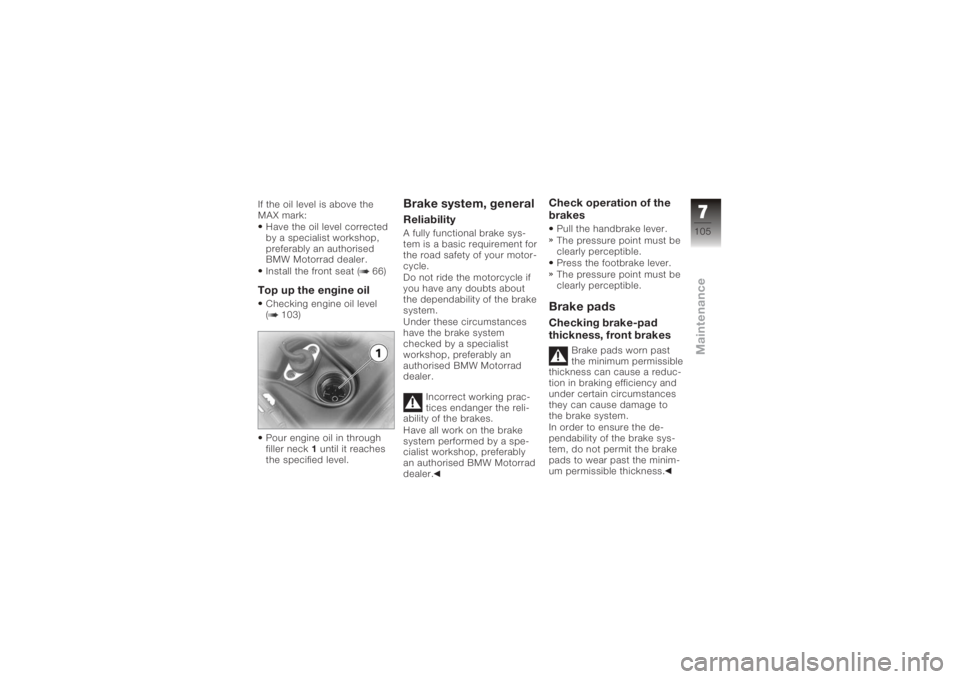
Pour engine oil in through
filler neck 1until it reaches
the specified level.
Brake system, generalReliabilityA fully functional brake sys-
tem is a basic requirement for
the road safety of your motor-
cycle.
Do not ride the motorcycle if
you have any doubts about
the dependability of the brake
system.
Under these circumstances
have the brake system
checked by a specialist
workshop, preferably an
authorised BMW Motorrad
dealer.
Incorrect working prac-
tices endanger the reli-
ability of the brakes.
Have all work on the brake
system performed by a spe-
cialist workshop, preferably
an authorised BMW Motorrad
dealer.
Check operation of the
brakesPull the handbrake lever.
The pressure point must be
clearly perceptible.
Press the footbrake lever.
The pressure point must be
clearly perceptible.Brake padsChecking brake-pad
thickness, front brakes
Brake pads worn past
the minimum permissible
thickness can cause a reduc-
tion in braking efficiency and
under certain circumstances
they can cause damage to
the brake system.
In order to ensure the de-
pendability of the brake sys-
tem, do not permit the brake
pads to wear past the minim-
um permissible thickness.
7105zMaintenance
Page 108 of 172
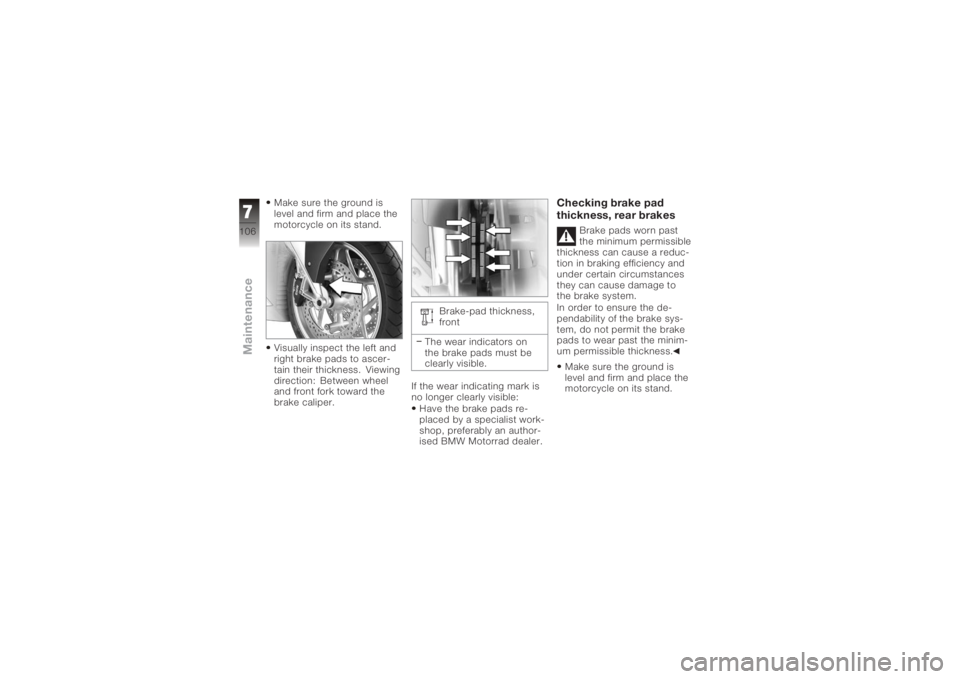
Make sure the ground is
level and firm and place the
motorcycle on its stand.
Visually inspect the left and
right brake pads to ascer-
tain their thickness. Viewing
direction: Between wheel
and front fork toward the
brake caliper.Brake-pad thickness,
front
The wear indicators on
the brake pads must be
clearly visible.
If the wear indicating mark is
no longer clearly visible: Have the brake pads re-
placed by a specialist work-
shop, preferably an author-
ised BMW Motorrad dealer.
Checking brake pad
thickness, rear brakes
Brake pads worn past
the minimum permissible
thickness can cause a reduc-
tion in braking efficiency and
under certain circumstances
they can cause damage to
the brake system.
In order to ensure the de-
pendability of the brake sys-
tem, do not permit the brake
pads to wear past the minim-
um permissible thickness.
Make sure the ground is
level and firm and place the
motorcycle on its stand.
7106zMaintenance
Page 109 of 172
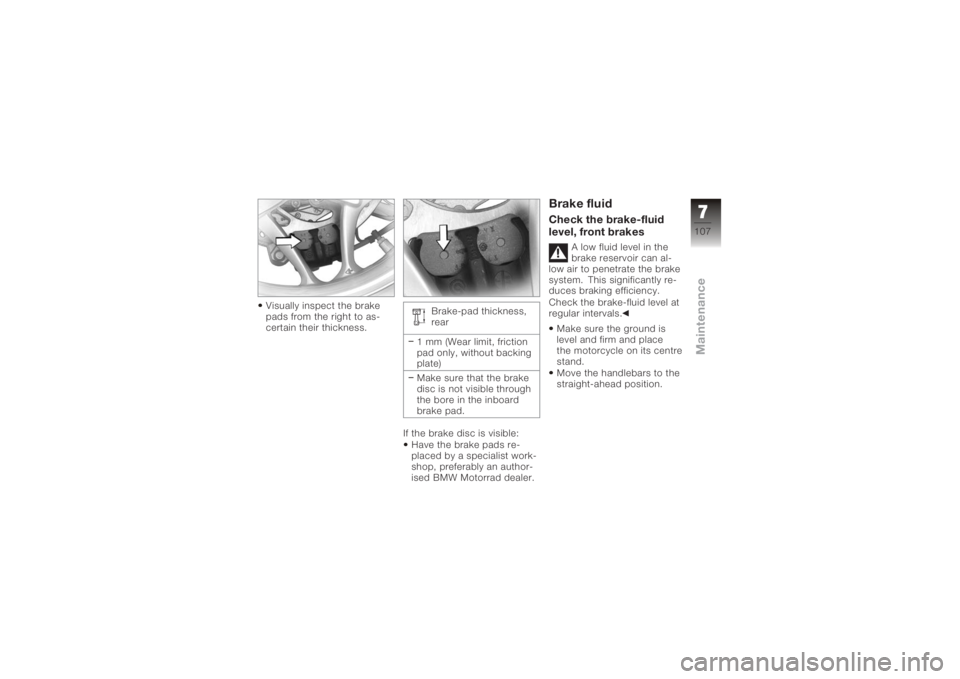
Visually inspect the brake
pads from the right to as-
certain their thickness.Brake-pad thickness,
rear
1 mm (Wear limit, friction
pad only, without backing
plate)
Make sure that the brake
disc is not visible through
the bore in the inboard
brake pad.
If the brake disc is visible: Have the brake pads re-
placed by a specialist work-
shop, preferably an author-
ised BMW Motorrad dealer.
Brake fluidCheck the brake-fluid
level, front brakes
A low fluid level in the
brake reservoir can al-
low air to penetrate the brake
system. This significantly re-
duces braking efficiency.
Check the brake-fluid level at
regular intervals.
Make sure the ground is
level and firm and place
the motorcycle on its centre
stand.
Move the handlebars to the
straight-ahead position.
7107zMaintenance
Page 110 of 172
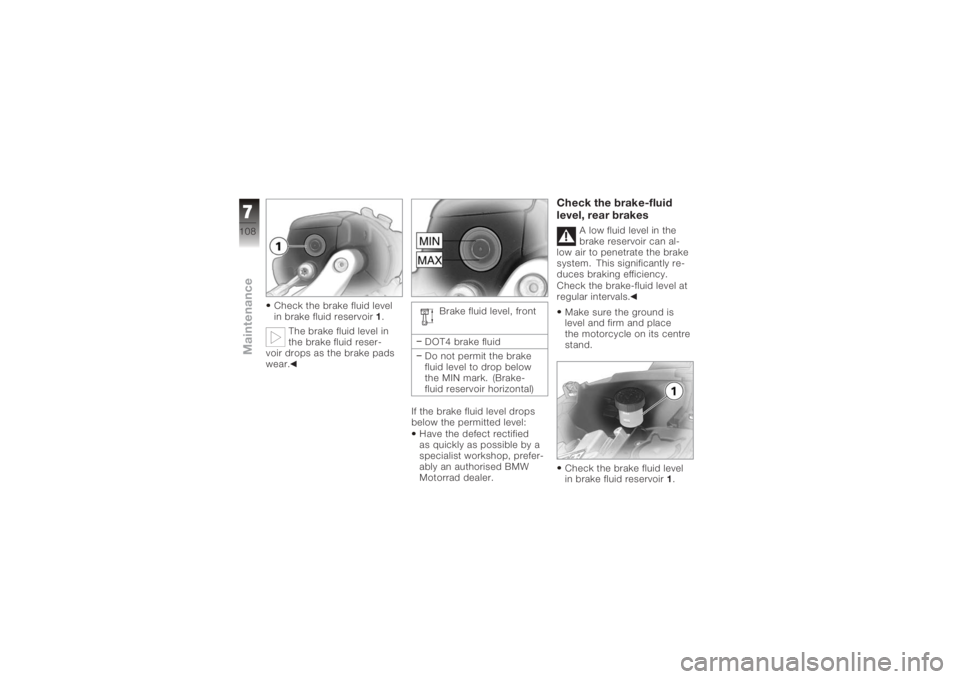
Check the brake fluid level
in brake fluid reservoir1.
The brake fluid level in
the brake fluid reser-
voir drops as the brake pads
wear. Brake fluid level, front
DOT4 brake fluid
Do not permit the brake
fluid level to drop below
the MIN mark. (Brake-
fluid reservoir horizontal)
If the brake fluid level drops
below the permitted level: Have the defect rectified
as quickly as possible by a
specialist workshop, prefer-
ably an authorised BMW
Motorrad dealer.
Check the brake-fluid
level, rear brakes
A low fluid level in the
brake reservoir can al-
low air to penetrate the brake
system. This significantly re-
duces braking efficiency.
Check the brake-fluid level at
regular intervals.
Make sure the ground is
level and firm and place
the motorcycle on its centre
stand.
Check the brake fluid level
in brake fluid reservoir 1.
7108zMaintenance
Page 136 of 172
Care productsWe recommend that you
use the cleaning and care
products you can obtain
from your authorised BMW
Motorrad dealer. The
substances in BMW Care
Products have been tested in
laboratories and in practice;
they provide optimised
care and protection for the
materials used in your vehicle.The use of unsuitable
cleaning and care
products can damage vehicle
components.
Do not use solvents such as
cellulose thinners, cold clean-
ers, fuel or the like, and do
not use cleaning products
that contain alcohol.
Washing motorcycleWe recommend that you
use BMW insect remover to
soften and wash off insects
and resilient dirt on painted
parts prior to washing the
motorcycle.
To prevent stains, do
not wash the motorcycle
immediately after it has been
exposed to strong sunlight
and do not wash it in the sun.
Make sure that the motor-
cycle is washed frequently,
especially during the winter
months.
To remove road salt, clean
the motorcycle with cold wa-
ter immediately after every
trip.
After the motorcycle has
been washed, ridden
through water or ridden in
the rain, the brake discs and
pads might be wet and the brakes might not take effect
immediately.
Apply the brakes in good time
until the brakes have dried
out.
Warm water intensifies
the effect of salt.
Use only cold water to wash
off road salt.
The high pressure of
steam cleaners can
damage seals, the hydraulic
brake system, the electrical
system, and the seat.
Do not use a steam jet or
high-pressure cleaning
equipment.
8134zCare
Page 141 of 172

Technical data
Troubleshooting chart . . . . . . . . 140
Threaded fasteners . . . . . . . . . . . 141
Engine . . . . . . . . . . . . . . . . . . . . . . . 142
Riding specifications . . . . . . . . . 145
Clutch . . . . . . . . . . . . . . . . . . . . . . . 145
Transmission . . . . . . . . . . . . . . . . . 145
Final drive . . . . . . . . . . . . . . . . . . . . 147
Running gear . . . . . . . . . . . . . . . . . 147
Brakes . . . . . . . . . . . . . . . . . . . . . . . 148
Wheels and tyres . . . . . . . . . . . . . 148
Electrics . . . . . . . . . . . . . . . . . . . . . 149
Frame . . . . . . . . . . . . . . . . . . . . . . . 151
Dimensions . . . . . . . . . . . . . . . . . . 151
Weights . . . . . . . . . . . . . . . . . . . . . . 152
9139zTechnical data
Page 150 of 172
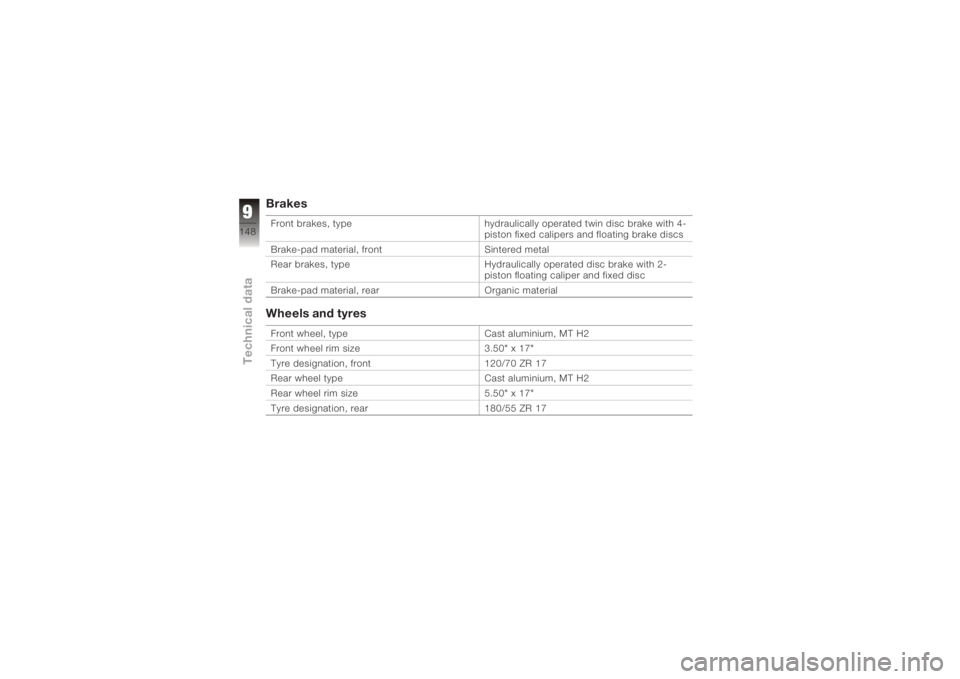
BrakesFront brakes, typehydraulically operated twin disc brake with 4-
piston fixed calipers and floating brake discs
Brake-pad material, front Sintered metal
Rear brakes, type Hydraulically operated disc brake with 2-
piston floating caliper and fixed disc
Brake-pad material, rear Organic materialWheels and tyresFront wheel, typeCast aluminium, MT H2
Front wheel rim size 3.50" x 17"
Tyre designation, front 120/70 ZR 17
Rear wheel type Cast aluminium, MT H2
Rear wheel rim size 5.50" x 17"
Tyre designation, rear 180/55 ZR 17
9148zTechnical data