clutch BMW MOTORRAD K 1200 S 2005 Rider's Manual (in English)
[x] Cancel search | Manufacturer: BMW MOTORRAD, Model Year: 2005, Model line: K 1200 S, Model: BMW MOTORRAD K 1200 S 2005Pages: 165, PDF Size: 2.01 MB
Page 130 of 165
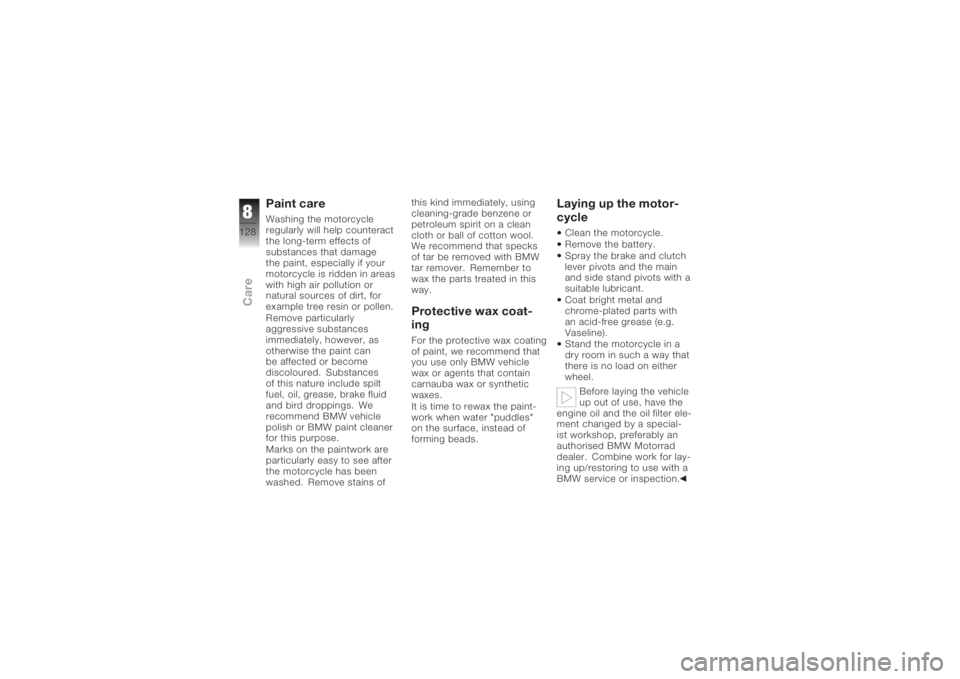
Paint careWashing the motorcycle
regularly will help counteract
the long-term effects of
substances that damage
the paint, especially if your
motorcycle is ridden in areas
with high air pollution or
natural sources of dirt, for
example tree resin or pollen.
Remove particularly
aggressive substances
immediately, however, as
otherwise the paint can
be affected or become
discoloured. Substances
of this nature include spilt
fuel, oil, grease, brake fluid
and bird droppings. We
recommend BMW vehicle
polish or BMW paint cleaner
for this purpose.
Marks on the paintwork are
particularly easy to see after
the motorcycle has been
washed. Remove stains ofthis kind immediately, using
cleaning-grade benzene or
petroleum spirit on a clean
cloth or ball of cotton wool.
We recommend that specks
of tar be removed with BMW
tar remover. Remember to
wax the parts treated in this
way.
Protective wax coat-
ingFor the protective wax coating
of paint, we recommend that
you use only BMW vehicle
wax or agents that contain
carnauba wax or synthetic
waxes.
It is time to rewax the paint-
work when water "puddles"
on the surface, instead of
forming beads.
Laying up the motor-
cycleClean the motorcycle.
Remove the battery.
Spray the brake and clutch
lever pivots and the main
and side stand pivots with a
suitable lubricant.
Coat bright metal and
chrome-plated parts with
an acid-free grease (e.g.
Vaseline).
Stand the motorcycle in a
dry room in such a way that
there is no load on either
wheel.
Before laying the vehicle
up out of use, have the
engine oil and the oil filter ele-
ment changed by a special-
ist workshop, preferably an
authorised BMW Motorrad
dealer. Combine work for lay-
ing up/restoring to use with a
BMW service or inspection.
8128zCare
Page 133 of 165
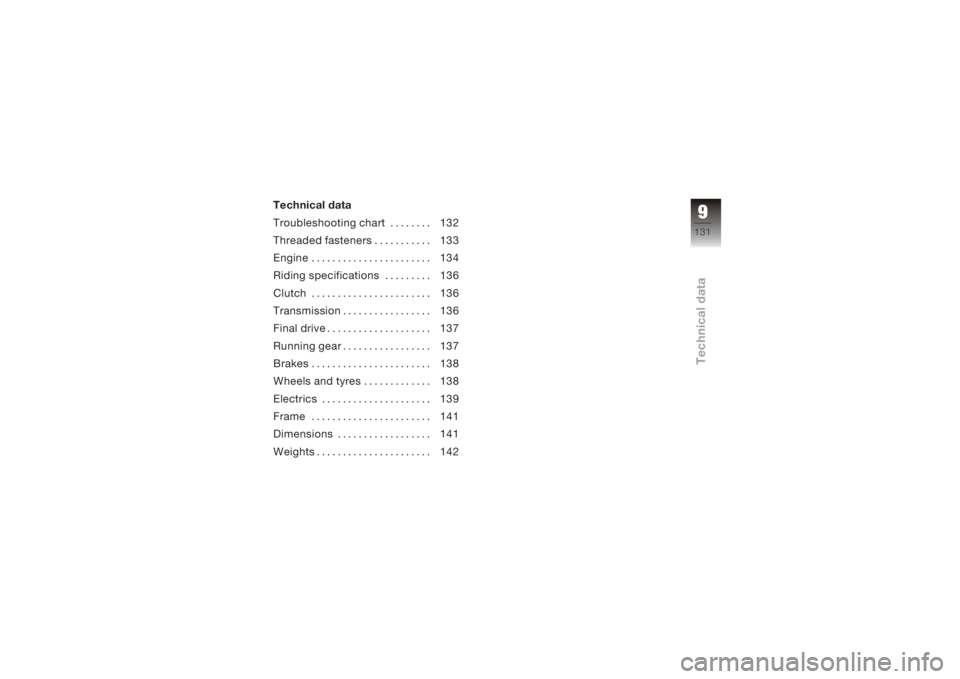
Technical data
Troubleshooting chart........ 132
Threaded fasteners . . . ........ 133
Engine ....................... 134
Riding specifications . ........ 136
Clutch ....................... 136
Transmission . . . .............. 136
Final drive . ................... 137
Running gear . . . .............. 137
Brakes ....................... 138
Wheels and tyres ............. 138
Electrics . . ................... 139
Frame ....................... 141
Dimensions .................. 141
Weights . . . ................... 142
9131zTechnical data
Page 134 of 165
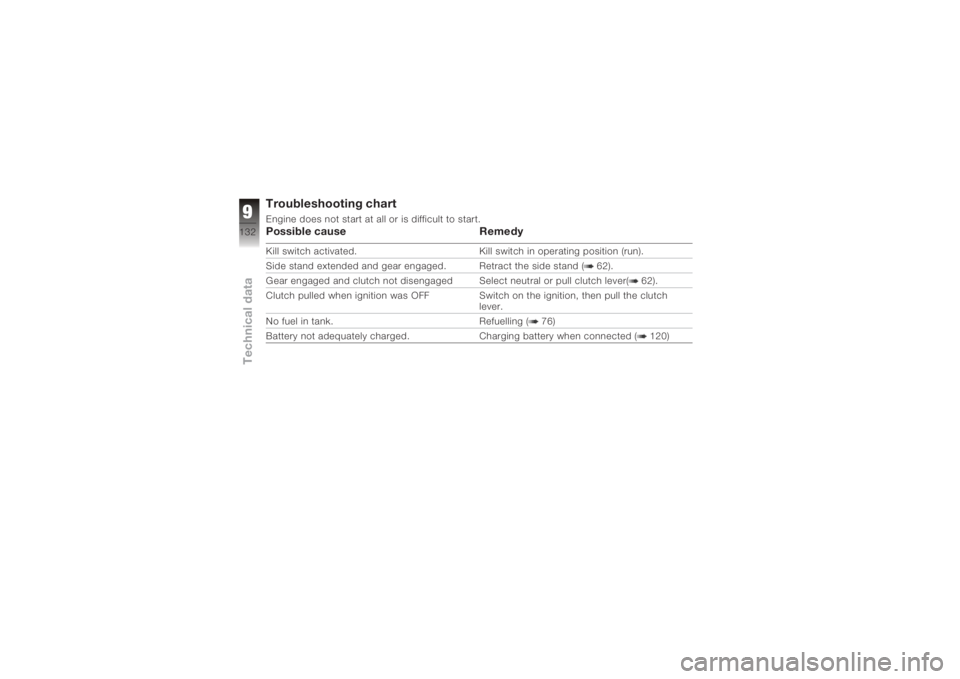
Troubleshooting chartEngine does not start at all or is difficult to start.Possible causeRemedyKill switch activated. Kill switch in operating position (run).
Side stand extended and gear engaged. Retract the side stand ( 62).
Gear engaged and clutch not disengaged Select neutral or pull clutch lever( 62).
Clutch pulled when ignition was OFF Switch on the ignition, then pull the clutch
lever.
No fuel in tank. Refuelling ( 76)
Battery not adequately charged. Charging battery when connected ( 120)
9132zTechnical data
Page 137 of 165
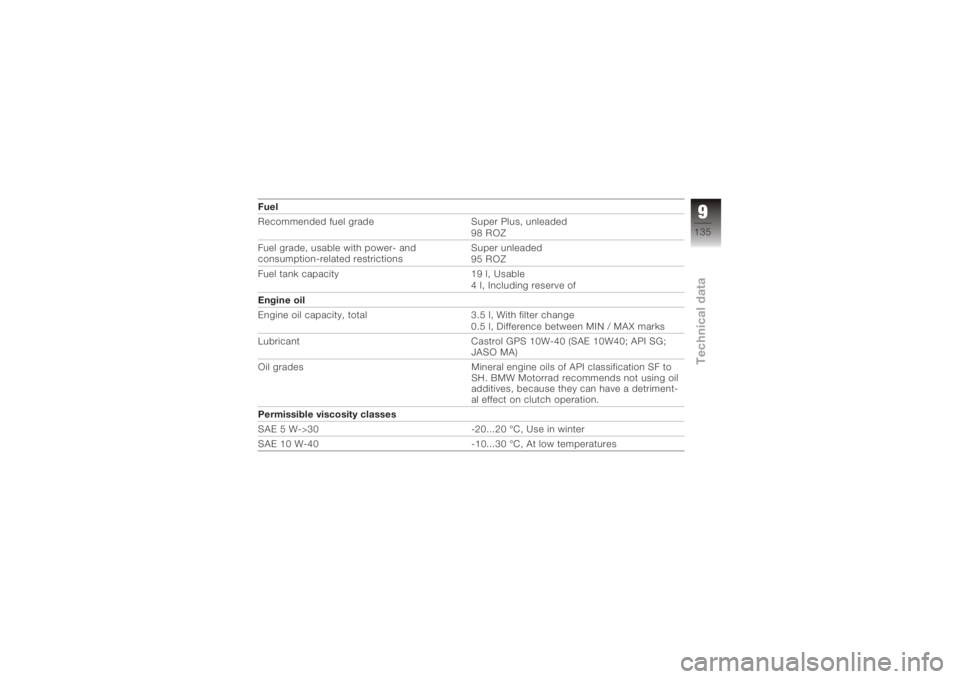
Fuel
Recommended fuel gradeSuper Plus, unleaded
98 ROZ
Fuel grade, usable with power- and
consumption-related restrictions Super unleaded
95 ROZ
Fuel tank capacity 19 l, Usable
4 l, Including reserve of
Engine oil
Engine oil capacity, total 3.5 l, With filter change
0.5 l, Difference between MIN / MAX marks
Lubricant Castrol GPS 10W-40 (SAE 10W40; API SG;
JASO MA)
Oil grades Mineral engine oils of API classification SF to
SH. BMW Motorrad recommends not using oil
additives, because they can have a detriment-
al effect on clutch operation.
Permissible viscosity classes
SAE 5 W->30 -20...20 °C, Use in winter
SAE 10 W-40 -10...30 °C, At low temperatures
9135zTechnical data
Page 138 of 165
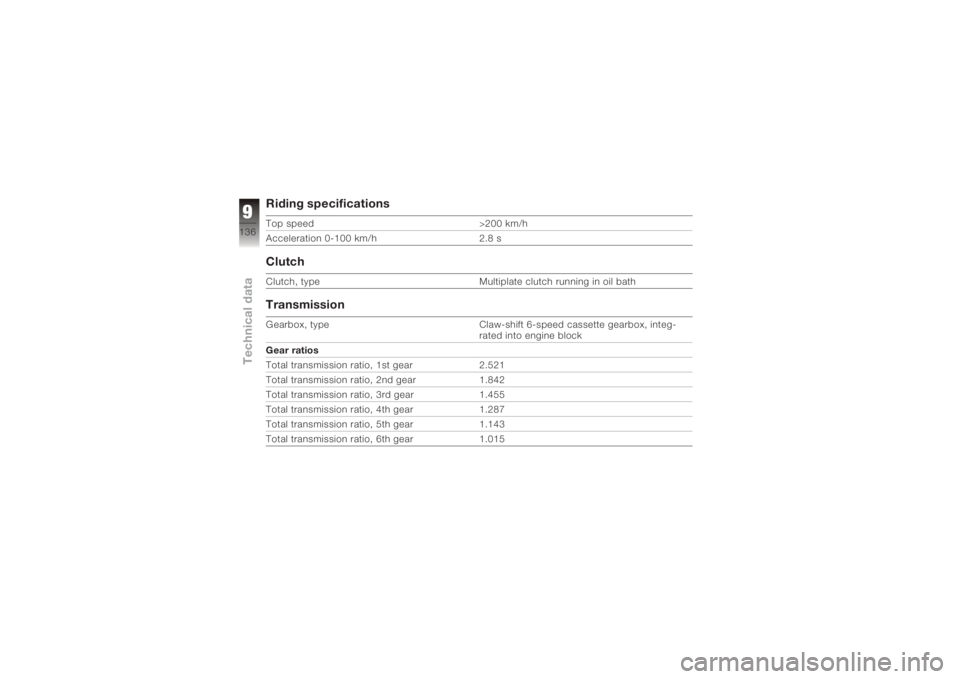
Riding specificationsTop speed>200 km/h
Acceleration 0-100 km/h 2.8 sClutchClutch, typeMultiplate clutch running in oil bathTransmissionGearbox, typeClaw-shift 6-speed cassette gearbox, integ-
rated into engine block
Gear ratios
Total transmission ratio, 1st gear 2.521
Total transmission ratio, 2nd gear 1.842
Total transmission ratio, 3rd gear 1.455
Total transmission ratio, 4th gear 1.287
Total transmission ratio, 5th gear 1.143
Total transmission ratio, 6th gear 1.015
9136zTechnical data
Page 156 of 165
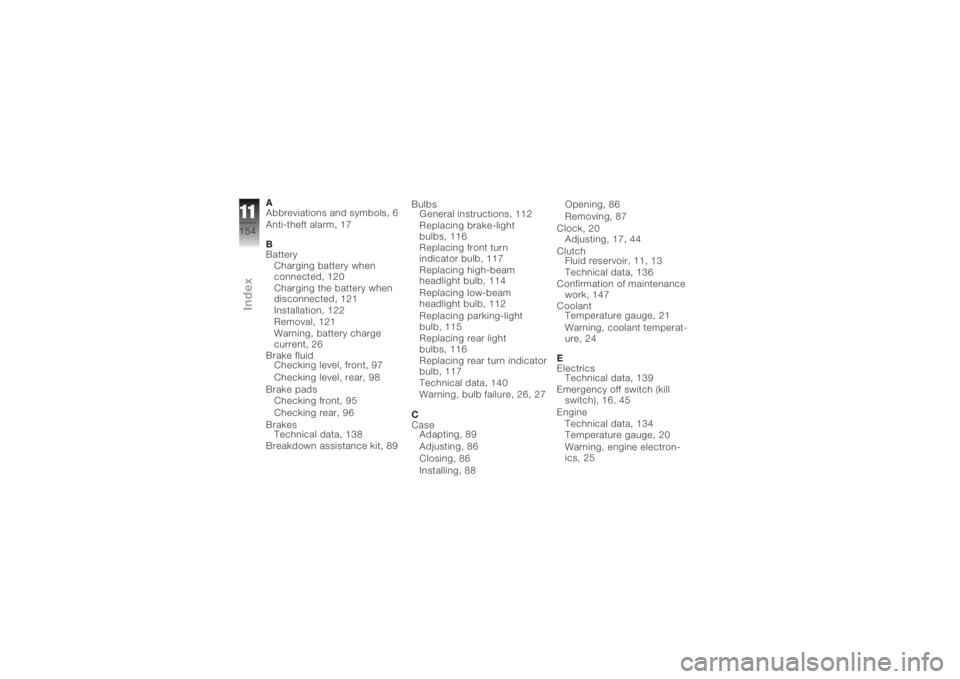
A
Abbreviations and symbols, 6
Anti-theft alarm, 17
B
BatteryCharging battery when
connected, 120
Charging the battery when
disconnected, 121
Installation, 122
Removal, 121
Warning, battery charge
current, 26
Brake fluid Checking level, front, 97
Checking level, rear, 98
Brake pads Checking front, 95
Checking rear, 96
Brakes Technical data, 138
Breakdown assistance kit, 89 Bulbs
General instructions, 112
Replacing brake-light
bulbs, 116
Replacing front turn
indicator bulb, 117
Replacing high-beam
headlight bulb, 114
Replacing low-beam
headlight bulb, 112
Replacing parking-light
bulb, 115
Replacing rear light
bulbs, 116
Replacing rear turn indicator
bulb, 117
Technical data, 140
Warning, bulb failure, 26, 27
C
Case Adapting, 89
Adjusting, 86
Closing, 86
Installing, 88 Opening, 86
Removing, 87
Clock, 20 Adjusting, 17, 44
Clutch Fluid reservoir, 11, 13
Technical data, 136
Confirmation of maintenance work, 147
Coolant Temperature gauge, 21
Warning, coolant temperat-
ure, 24
E
Electrics Technical data, 139
Emergency off switch (kill switch), 16, 45
Engine Technical data, 134
Temperature gauge, 20
Warning, engine electron-
ics, 25
11154zIndex
Page 158 of 165
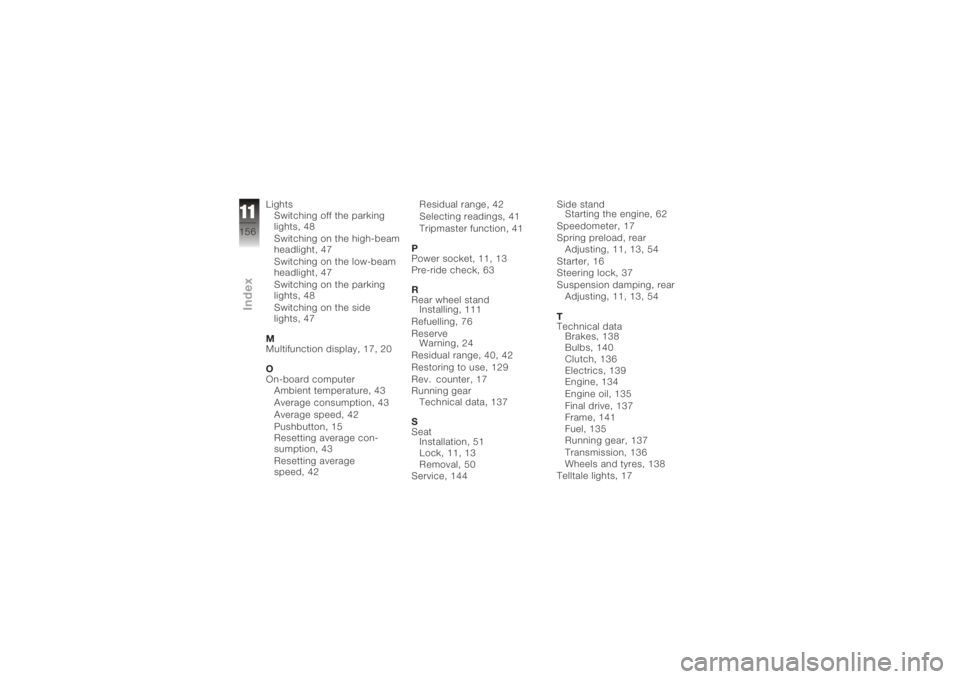
LightsSwitching off the parking
lights, 48
Switching on the high-beam
headlight, 47
Switching on the low-beam
headlight, 47
Switching on the parking
lights, 48
Switching on the side
lights, 47
M
Multifunction display, 17, 20
O
On-board computer Ambient temperature, 43
Average consumption, 43
Average speed, 42
Pushbutton, 15
Resetting average con-
sumption, 43
Resetting average
speed, 42 Residual range, 42
Selecting readings, 41
Tripmaster function, 41
P
Power socket, 11, 13
Pre-ride check, 63
R
Rear wheel stand Installing, 111
Refuelling, 76
Reserve Warning, 24
Residual range, 40, 42
Restoring to use, 129
Rev. counter, 17
Running gear Technical data, 137
S
Seat Installation, 51
Lock, 11, 13
Removal, 50
Service, 144 Side stand
Starting the engine, 62
Speedometer, 17
Spring preload, rear Adjusting, 11, 13, 54
Starter, 16
Steering lock, 37
Suspension damping, rear Adjusting, 11, 13, 54
T
Technical data Brakes, 138
Bulbs, 140
Clutch, 136
Electrics, 139
Engine, 134
Engine oil, 135
Final drive, 137
Frame, 141
Fuel, 135
Running gear, 137
Transmission, 136
Wheels and tyres, 138
Telltale lights, 17
11156zIndex
Page 164 of 165
E3BMW Motorrad Integral ABS
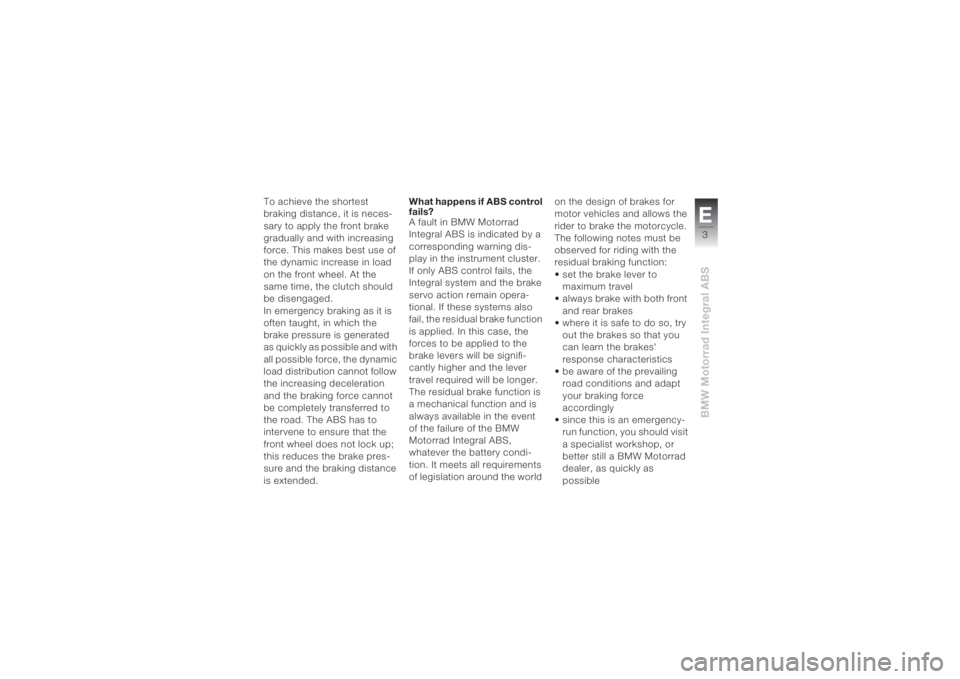
To achieve the shortest
braking distance, it is neces-
sary to apply the front brake
gradually and with increasing
force. This makes best use of
the dynamic increase in load
on the front wheel. At the
same time, the clutch should
be disengaged.
In emergency braking as it is
often taught, in which the
brake pressure is generated
as quickly as possible and with
all possible force, the dynamic
load distribution cannot follow
the increasing deceleration
and the braking force cannot
be completely transferred to
the road. The ABS has to
intervene to ensure that the
front wheel does not lock up;
this reduces the brake pres-
sure and the braking distance
is extended.What happens if ABS control
fails?
A fault in BMW Motorrad
Integral ABS is indicated by a
corresponding warning dis-
play in the instrument cluster.
If only ABS control fails, the
Integral system and the brake
servo action remain opera-
tional. If these systems also
fail, the residual brake function
is applied. In this case, the
forces to be applied to the
brake levers will be signifi-
cantly higher and the lever
travel required will be longer.
The residual brake function is
a mechanical function and is
always available in the event
of the failure of the BMW
Motorrad Integral ABS,
whatever the battery condi-
tion. It meets all requirements
of legislation around the world on the design of brakes for
motor vehicles and allows the
rider to brake the motorcycle.
The following notes must be
observed for riding with the
residual braking function:
• set the brake lever to
maximum travel
• always brake with both front
and rear brakes
• where it is safe to do so, try
out the brakes so that you
can learn the brakes'
response characteristics
• be aware of the prevailing
road conditions and adapt
your braking force
accordingly
• since this is an emergency-
run function, you should visit
a specialist workshop, or
better still a BMW Motorrad
dealer, as quickly as
possibleInfo_I_ABS_en_xx.fm Seite 3 Dienstag, 19. Juli 2005 2:48 14