transmission BMW SPORT WAGON 2001 Owner's Manual
[x] Cancel search | Manufacturer: BMW, Model Year: 2001, Model line: SPORT WAGON, Model: BMW SPORT WAGON 2001Pages: 238, PDF Size: 2.44 MB
Page 148 of 238

148nWinter operation Power steering Level control system*
Skid control
Release the accelerator pedal and
depress the clutch pedal. Countersteer
carefully and attempt to regain control
of the vehicle.
Parking
Engage 1st or reverse gear. If your
vehicle is equipped with an automatic
transmission, place the selector lever in
"Park." On vehicles with manual trans-
mission, also apply the parking brake
when parking on inclined surfaces. In
order to prevent the parking brake pads
from locking due to frost or corrosion,
dry them by gently applying the parking
brake as the vehicle is coming to a
stop. Make sure that following traffic is
not endangered.
The brake lamps do not come on
when the parking brake is
applied. <
If there is a change in steering behavior,
for instance greater steering effort or if
steering becomes lighter as speed
increases in vehicles equipped with
Servotronic
*:
Contact your BMW center for an
inspection.
If the power steering fails,
increased effort will be required
to steer the vehicle. <
The warning lamp for the level
control system comes on, or the
message "LEVEL CONTROL
INACTIVE" appears in the Check
Control
*: there is a malfunction in the
level control system.
Stop and inspect the vehicle. If it is
riding significantly lower in the rear than
in the front, or if it is sitting at an incline
(left rear compared to right rear),
consult the nearest authorized BMW
center. Drive with appropriate caution
in the meantime. The vehicle has
reduced ground clearance or driving
comfort is noticeably reduced.
Even if the attitude of the vehicle is
normal, you should consult the nearest
BMW center if the warning lamp indi-
cates a system fault.
Page 165 of 238
Index
Data
Technology
Repairs
Car care
Controls
Overview
165nEngine oil
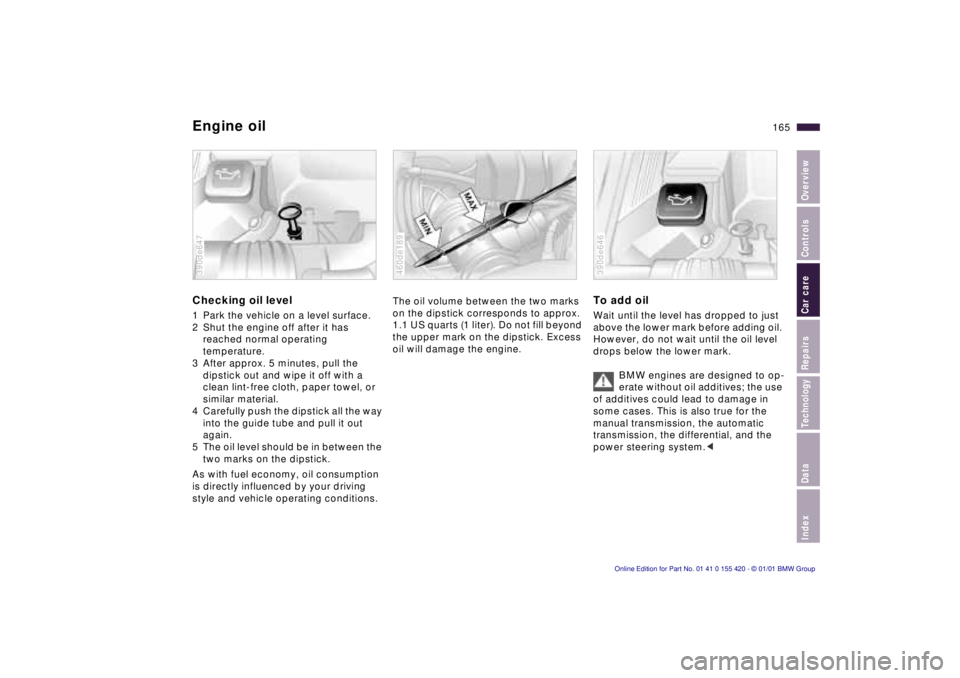
Checking oil level
1 Park the vehicle on a level surface.
2 Shut the engine off after it has
reached normal operating
temperature.
3 After approx. 5 minutes, pull the dipstick out and wipe it off with a
clean lint-free cloth, paper towel, or
similar material.
4 Carefully push the dipstick all the way into the guide tube and pull it out
again.
5 The oil level should be in between the
two marks on the dipstick.
As with fuel economy, oil consumption
is directly influenced by your driving
style and vehicle operating conditions.
390de647
The oil volume between the two marks
on the dipstick corresponds to approx.
1.1 US quarts (1 liter). Do not fill beyond
the upper mark on the dipstick. Excess
oil will damage the engine.
460de189
To add oil
Wait until the level has dropped to just
above the lower mark before adding oil.
However, do not wait until the oil level
drops below the lower mark.
BMW engines are designed to op-
erate without oil additives; the use
of additives could lead to damage in
some cases. This is also true for the
manual transmission, the automatic
transmission, the differential, and the
power steering system. <
390de646
Page 190 of 238
190nChanging a wheel
Safety measures in the event of a
flat tire or wheel change:
Stop the vehicle as far as possible from
passing traffic. Park on a firm, flat,
surface. Switch on the hazard warning
flashers.
Turn the steering wheel to the straight-
ahead position, remove the key and
engage the steering lock. Shift into 1st
or reverse (selector lever in Park with
automatic transmission) and engage
the parking brake.
All passengers should be outside the
vehicle and well away from your imme-
diate working area (behind a guardrail,
for instance).
If necessary, set up your warning trian-
gle or portable hazard warning lamp on
the roadside at an appropriate distance
from the rear of the vehicle. Comply
with all safety guidelines and regula-
tions.
Change the wheel only on a level, firm
surface which is not slippery. Avoid
jacking the vehicle on a soft or slippery
support surface (snow, ice, loose
gravel, etc.), since it could slide side-
ways.Position the jack on a firm support
surface.
Do not place wooden blocks or similar
objects under the jack. If this is done,
the jack might not be able to reach its
full support capacity because of the
limited height.
Do not lie under the vehicle or start the
engine when the vehicle is supported
by the jack – risk of fatal injury. <
What you will need
In order to avoid rattling noises later,
note the position of the tools when you
remove them and return them to their
original position when you are through
using them.
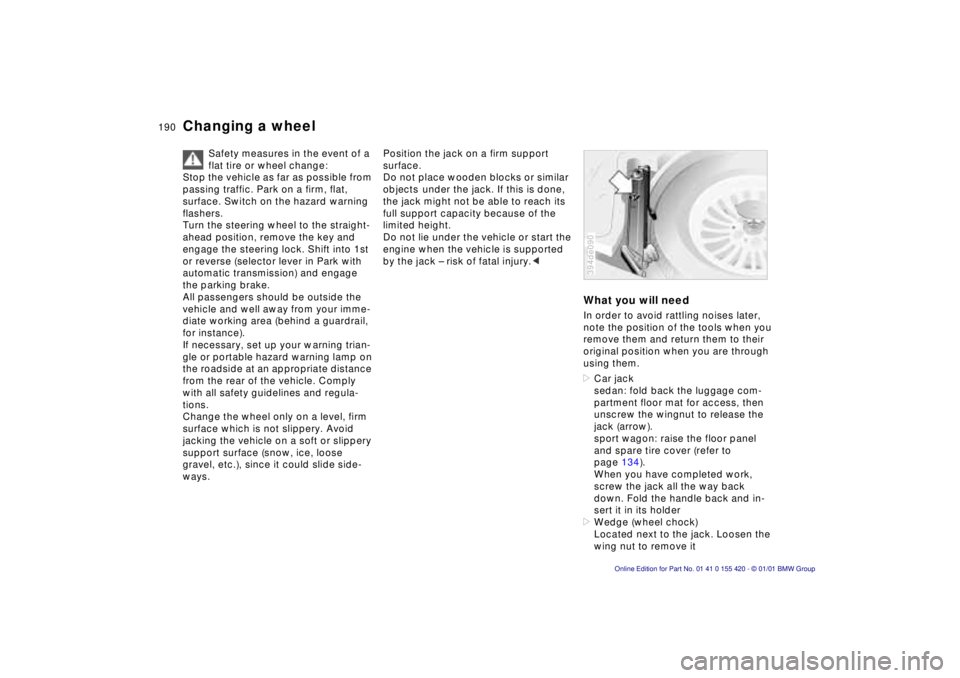
> Car jack
sedan: fold back the luggage com-
partment floor mat for access, then
unscrew the wingnut to release the
jack (arrow).
sport wagon: raise the floor panel
and spare tire cover (refer to
page 134).
When you have completed work,
screw the jack all the way back
down. Fold the handle back and in-
sert it in its holder
> Wedge (wheel chock)
Located next to the jack. Loosen the
wing nut to remove it
394de090
Page 202 of 238
202nTowing the vehicle
The towed vehicle should always
be the lighter of the two vehicles.
If this is not the case, it is no longer
possible to control vehicle response. <
Tow-starting
It is not possible to start the engine of
vehicles equipped with an automatic
transmission by towing or pushing.
For instructions on jump starting, refer
to page 200.
Never attempt to use your vehicle to
push another vehicle, since damage to
the energy-absorbing bumpers could
result.
Towing a vehicle with automatic
transmission
1 Place the selector lever in position N.
2 Towing speed: Max. 45 mph (70 km/h).
3 Towing distance: Max. 95 miles (150 km).
4 Leave the ignition key in position 1 to ensure that the brake lamps, turn sig-
nals, horn and windshield wipers re-
main operative, and to prevent the
steering lock detent from engaging.
5 Switch on the hazard warning flash- ers (observe country-specific regula-
tions).
Find some means of identifying the ve-
hicle in tow, for instance, place a sign
or warning triangle in the rear window.
Make sure that the ignition key
remains in position 1 even when
the electrical system has failed to pre-
vent the steering lock from engaging.
The steering and brakes are without
power assist when the engine is off.
This means that increased effort is
required for steering and braking. <
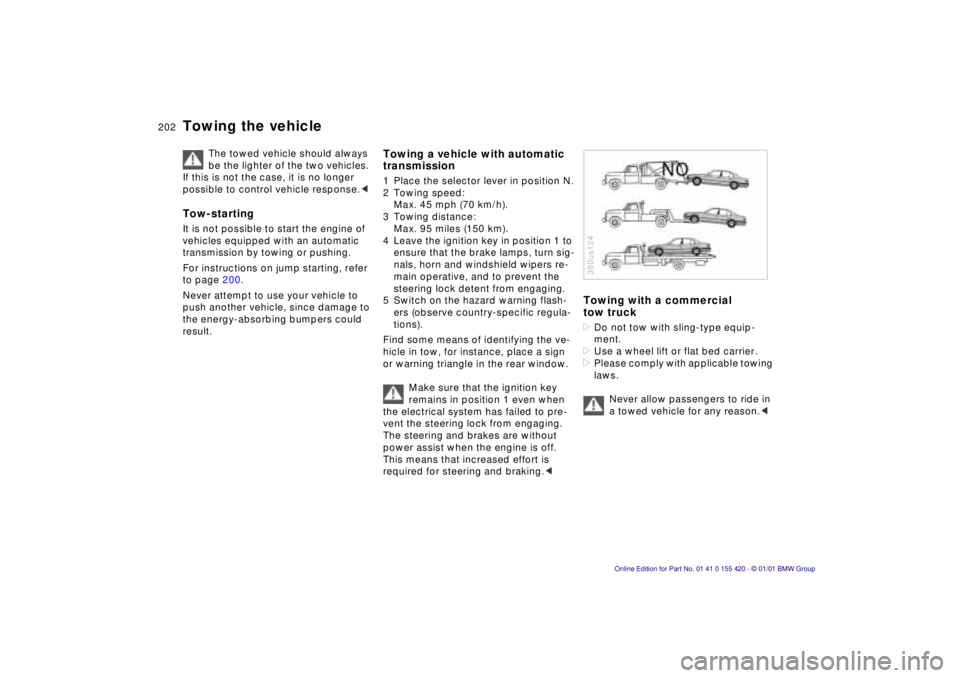
Towing with a commercial
tow truck
> Do not tow with sling-type equip-
ment.
> Use a wheel lift or flat bed carrier.
> Please comply with applicable towing
laws.
Never allow passengers to ride in
a towed vehicle for any reason. <
380us124
Page 205 of 238
Index
Data
Technology
Repairs
Car care
Controls
Overview
Overview
Controls and features Operation, care
and maintenance
Owner service procedures
Technical dataIndex
Advanced technology
205
n
Airbags 206
Adaptive Transmission Control (ATC) 207
Automatic Stability Control plus Traction (ASC+T)/Dynamic
Stability Control (DSC) 208
BMW active seat 210
Safety belt tensioner 210
DSP sound system 211
Mirrors with automatic dimmer 211
Rain sensor 212
Tire Pressure Control (RDC) 213
Integrated rear suspension 214
Level control system 214
Xenon lamps 215
Page 207 of 238
Index
Data
Technology
Repairs
Car care
Controls
Overview
207n
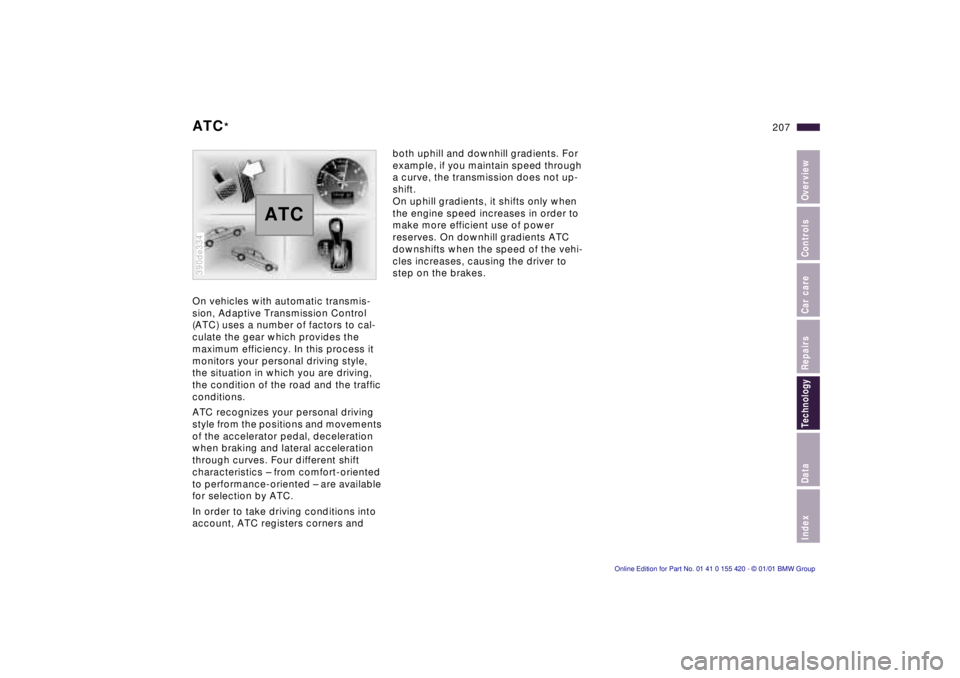
On vehicles with automatic transmis-
sion, Adaptive Transmission Control
(ATC) uses a number of factors to cal-
culate the gear which provides the
maximum efficiency. In this process it
monitors your personal driving style,
the situation in which you are driving,
the condition of the road and the traffic
conditions.
ATC recognizes your personal driving
style from the positions and movements
of the accelerator pedal, deceleration
when braking and lateral acceleration
through curves. Four different shift
characteristics – from comfort-oriented
to performance-oriented – are available
for selection by ATC.
In order to take driving conditions into
account, ATC registers corners and
390de334
ATC
both uphill and downhill gradients. For
example, if you maintain speed through
a curve, the transmission does not up-
shift.
On uphill gradients, it shifts only when
the engine speed increases in order to
make more efficient use of power
reserves. On downhill gradients ATC
downshifts when the speed of the vehi-
cles increases, causing the driver to
step on the brakes.
ATC*
Page 213 of 238
Index
Data
Technology
Repairs
Car care
Controls
Overview
213nTire Pressure Control (RDC)*
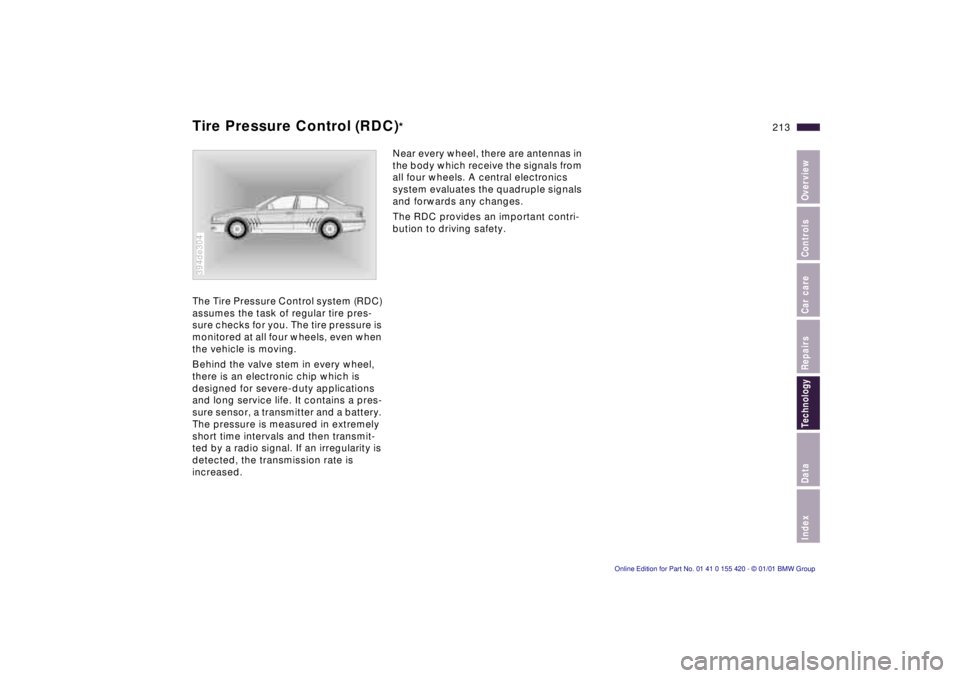
The Tire Pressure Control system (RDC)
assumes the task of regular tire pres-
sure checks for you. The tire pressure is
monitored at all four wheels, even when
the vehicle is moving.
Behind the valve stem in every wheel,
there is an electronic chip which is
designed for severe-duty applications
and long service life. It contains a pres-
sure sensor, a transmitter and a battery.
The pressure is measured in extremely
short time intervals and then transmit-
ted by a radio signal. If an irregularity is
detected, the transmission rate is
increased.
394de304
Near every wheel, there are antennas in
the body which receive the signals from
all four wheels. A central electronics
system evaluates the quadruple signals
and forwards any changes.
The RDC provides an important contri-
bution to driving safety.
Page 221 of 238
")
Index
Data
Technology
Repairs
Car care
Controls
Overview
221nWeights – sedan
BMW 525i BMW 530i BMW 540i
Curb weight (with one person, ready for operation, full tank of fuel, o\
ptions not included)
with manual transmission
with automatic transmission lbs. (kg)
lbs. (kg)3,450 (1,565)
3,505 (1,590)3,494 (1,585)
3,549 (1,610) 3,748 (1,700)
3,803 (1,725)
Approved gross vehicle weight
with manual transmission
with automatic transmission lbs. (kg)
lbs. (kg)4,464 (2,025)
4,520 (2,050)4,509 (2,045)
4,563 (2,070) 4,762 (2,160)
4,817 (2,185)
Approved front axle weight lbs. (kg) 2,116 (960)2,138 (970) 2,381 (1,080)
Approved rear axle weight lbs. (kg) 2,579 (1,170) 2,579 (1,170) 2,635 (1,195)
Approved roof load capacity lbs. (kg) 220 (100) 220 (100) 220 (100)
Approved axle loads and approved gross vehicle weight may not be exceede\
d.
Luggage compartment capacity cu ft (l) 16.2 (460) 16.2 (460) 16.2 (460)
Page 222 of 238

with manual transmission
with automatic transmission lbs (k")
222nWeights – sport wagon
BMW 525i BMW 540i
Curb weight (with one person, ready for operation, full tank of fuel, o\
ptions not included)
with manual transmission
with automatic transmission lbs (kg)
lbs (kg)3,682 (1,670)
3,736 (1,695) –
4,056 (1,840)
Approved gross vehicle weight
with manual transmission
with automatic transmission lbs (kg)
lbs (kg)4,773 (2,165)
4,828 (2,190) –
5,093 (2,310)
Approved front axle weight lbs (kg) 2,116 (960)2,381 (1,080)
Approved rear axle weight lbs (kg) 2,844 (1,290) 2,910 (1,320)
Approved roof load capacity lbs (kg) 220 (100) 220 (100)
Approved axle loads and approved gross vehicle weight may not be exceede\
d.
Luggage compartment capacity cu ft (l) 14.5 – 53.9 (410 – 1,525) 14.5 – 53.9 (410 – 1,525)
Page 223 of 238

Index
Data
Technology
Repairs
Car care
Controls
Overview
223nCapacities
Notes
Fuel tank
Reserve gal. (liters)
gal. (liters)approx. 18.5 (approx. 70)
approx. 2.0 (approx. 8) – BMW 525i,
530i
approx. 2.5 (approx. 10) – BMW 540i Fuel specification: page
29
Windshield washer system
with headlamp washer system
Intensive cleaning system quarts (liters)
quarts (liters)
quarts (liters)approx. 3.7 (approx. 3.5)
approx. 6.3 (approx 6.0)
approx. 1.1 (approx 1.0) For details: page
164
Cooling system including heater
circuit quarts (liters) 11.1 (10.5) – BMW 525i, 530i
12.7 (12.0) – BMW 540i For details: page
167
Engine with oil filter change quarts (liters) 6.9 (6.5) – BMW 525i, 530i 7.9 (7.5) – BMW 540i"BMW High Performance
Synthetic Oil."
For details: page
167
Manual transmission, automatic
transmission and differential – – Lifetime fluid, no fluid
change required