warning BMW SPORT WAGON 2001 Owner's Manual
[x] Cancel search | Manufacturer: BMW, Model Year: 2001, Model line: SPORT WAGON, Model: BMW SPORT WAGON 2001Pages: 238, PDF Size: 2.44 MB
Page 139 of 238
Index
Data
Technology
Repairs
Car care
Controls
Overview
Overview
Controls and features Operation, care
and maintenance
Owner service procedures
Technical dataIndex
Advanced technology
139
n
Special operating instructions:
Break-in procedure 140
Driving notes 141
Catalytic converter 142
Antilock Brake System (ABS) 143
Disc brakes 144
Brake system 146
Winter operation 146
Power steering 148
Level control system 148
Cellular phone 149
Radio reception 149
Wheels and tires:
Tire inflation pressure 150
Tire condition 150
Tire replacement 151
Tire rotation 152
Wheel and tire combinations 153
Winter tires 154
Snow chains 155
Approved wheel and tire specifications 156 Under the hood:
Hood
159
Engine compartment 160
Washer fluids 164
Washer nozzles 164
Engine oil 165
Coolant 167
Brake fluid 168
Vehicle Identification Number 169
Care and maintenance:
The BMW Maintenance System 170
Caring for your car 171
Airbags 176
Vehicle storage 176
Laws and regulations:
Technical modifications 177
California Proposition 65 Warning 177
OBD interface socket 178
Page 144 of 238

144nAntilock Brake System (ABS) Disc brakes
Information for your safety
Not even ABS can suspend the laws of
physics. The consequences of brake
applications with inadequate safety
clearances between vehicles, exces-
sive speed or if aquaplaning occurs are
always the responsibility of the driver.
You should never allow the added
safety margin of ABS to mislead you
into taking risks of any kind.
Do not make any modifications to
the ABS system.
Service procedures on ABS are to be
performed by authorized technicians
only. <
In the event of a fault
The ABS warning lamp in the in-
strument cluster comes on, refer
to page 23. The brake system
then reverts to conventional op-
eration as on vehicles without
ABS. However, have the brake
system checked by your BMW center
as soon as possible. To prevent unde-
tected defects and cumulative faults
from adversely affecting the brake sys-
tem, refer any problems to your BMW
center at the earliest opportunity.
Disc brakes furnish optimum decelera-
tion and braking control and greater
fade resistance under heavy use.
When the vehicle is driven only occa-
sionally, during extended periods when
the vehicle is not used at all, and in
operating conditions where brake appli-
cations are less frequent, there is an
increased tendency for corrosion of the
rotors and accumulation of contamina-
tion on the brake pads. This occurs
because the minimal pressure which
must be exerted by the pads during
brake applications to clean the rotors is
not reached.
If the brake rotors are corroded, they
will tend to respond to braking with a
pulsating effect which even extended
application will fail to cure.
For your own safety: use only
brake pads that BMW has
approved for your specific vehicle
model. BMW cannot evaluate non-
approved brake pads to determine if
they are suited for use, and therefore
cannot ensure the operating safety of
the vehicle if they are installed. <
Page 145 of 238

Index
Data
Technology
Repairs
Car care
Controls
Overview
145nDisc brakes
Driving notes
When driving in wet conditions and in
heavy rain, it is effective to apply light
pressure to the brake pedal every few
miles (kilometers). Watch traffic condi-
tions to ensure that this maneuver does
not endanger other road users. The
heat which is generated by the brake
applications helps to dry the brake
pads and rotors.
Maximum braking force is obtained
while the wheels continue to rotate,
peaking when the wheels remain on the
verge of locking without actually doing
so. ABS maintains this state automati-
cally. If the ABS fails, you should revert
to the staggered braking technique
described below (refer to page 147).
Extended or steep mountain descents
should be driven in the gear in which
only minimal periodic brake applica-
tions is required. This avoids excessive
strain on the brakes and possible im-
pairment of the braking effect.
The braking effect of the engine can be
further increased by downshifting, into
first gear, if necessary. In the manual
mode of the automatic transmission,
you can also downshift into first gear.
Refer to page 76. Should engine braking prove inade-
quate, you should still avoid extended,
continuous braking. Instead of main-
taining low to moderate pressure over
an extended period of time, you should
decelerate by applying more substantial
pressure to the brake pedal (watch for
following traffic!), then releasing the
pedal, then repeating the application.
This staggered braking technique
allows the brakes to cool in the intervals
between active braking phases,
preventing overheating and ensuring
that full braking capacity remains avail-
able at all times.
Do not coast with the clutch de-
pressed or with the transmission
or selector lever in Neutral. Do not
coast with the engine shut off. The
engine provides no braking effect when
the clutch is depressed or the transmis-
sion is in neutral, and there is no
power-assist for braking or steering
when the engine is not running.
Never allow floor mats, carpets or any
other objects to protrude into the area
around the accelerator, clutch and
brake pedals and obstruct their move-
ment. <
Dynamic Brake Control (DBC)*
If you apply the brakes rapidly, this
system automatically produces the
maximum braking force boost and thus
helps to achieve the shortest possible
braking distance during "panic stops."
All of the benefits of the ABS system
are exploited under these circum-
stances.
Do not reduce the pressure on the
brake pedal for the duration of the
brake application. When the brake
pedal is released, the DBC is deacti-
vated.
In the event of a malfunction, the yellow
warning lamp comes on. Conventional
braking efficiency is available without
limitations.
Have the system checked and repaired
at your BMW center as soon as possi-
ble.
For "Information for your safety"
covering the ABS system, refer to
page 144. This information also gener-
ally applies for DBC. <
Page 146 of 238

146nBrake system Winter operation
Brake fluid level
The warning lamp for the brake
hydraulic system comes on, or
the "CHECK BRAKE FLUID"
message appears in the Check
Control.
The brake fluid level is too low in the
reservoir (refer to page 168).
If the brake fluid level is too low and
brake pedal travel has become notice-
ably longer, there may be a defect in
one of the brake system's hydraulic
circuits.
Proceed to the nearest BMW
center. Higher brake application
pressure may be necessary under these
conditions, and brake pedal travel may
be significantly longer. Please remem-
ber to adapt your driving style accord-
ingly. <
The warning lamp comes on together
with the "CHECK BRAKE PADS" mes-
sage in the Check Control.
Brake pads
The warning lamp for the brake
pads comes on, or the "CHECK
BRAKE LININGS" message
appears in the Check Control:
The brake pads have reached their
minimum pad thickness. Proceed to the
nearest BMW center as soon as possi-
ble to have the pads replaced.
For your own safety: use only
brake pads that BMW has
approved for your specific vehicle
model. BMW cannot evaluate non-
approved brake pads to determine if
they are suited for use, and therefore
cannot ensure the operating safety of
the vehicle if they are installed. <
The onset of winter is often accompa-
nied by rapid changes in weather.
Adaptations in driving style should be
accompanied by preparations on the
vehicle itself to ensure that your vehicle
operation through the winter remains
safe and trouble-free.
Coolant
Ensure that the coolant mixture con-
tains the year-round ratio of 50: 50 of
water and antifreeze/corrosion inhibitor.
This mixture provides protection
against freezing down to approx. -34 7
(-37 6). Replace the coolant every four
years.
Locks
BMW door lock deicer can be used to
free the locks if they are frozen. This
deicer also contains lubricant.
After using deicer, treatment with BMW
lock barrel grease is recommended.
Page 148 of 238

148nWinter operation Power steering Level control system*
Skid control
Release the accelerator pedal and
depress the clutch pedal. Countersteer
carefully and attempt to regain control
of the vehicle.
Parking
Engage 1st or reverse gear. If your
vehicle is equipped with an automatic
transmission, place the selector lever in
"Park." On vehicles with manual trans-
mission, also apply the parking brake
when parking on inclined surfaces. In
order to prevent the parking brake pads
from locking due to frost or corrosion,
dry them by gently applying the parking
brake as the vehicle is coming to a
stop. Make sure that following traffic is
not endangered.
The brake lamps do not come on
when the parking brake is
applied. <
If there is a change in steering behavior,
for instance greater steering effort or if
steering becomes lighter as speed
increases in vehicles equipped with
Servotronic
*:
Contact your BMW center for an
inspection.
If the power steering fails,
increased effort will be required
to steer the vehicle. <
The warning lamp for the level
control system comes on, or the
message "LEVEL CONTROL
INACTIVE" appears in the Check
Control
*: there is a malfunction in the
level control system.
Stop and inspect the vehicle. If it is
riding significantly lower in the rear than
in the front, or if it is sitting at an incline
(left rear compared to right rear),
consult the nearest authorized BMW
center. Drive with appropriate caution
in the meantime. The vehicle has
reduced ground clearance or driving
comfort is noticeably reduced.
Even if the attitude of the vehicle is
normal, you should consult the nearest
BMW center if the warning lamp indi-
cates a system fault.
Page 159 of 238
Index
Data
Technology
Repairs
Car care
Controls
Overview
159nHood
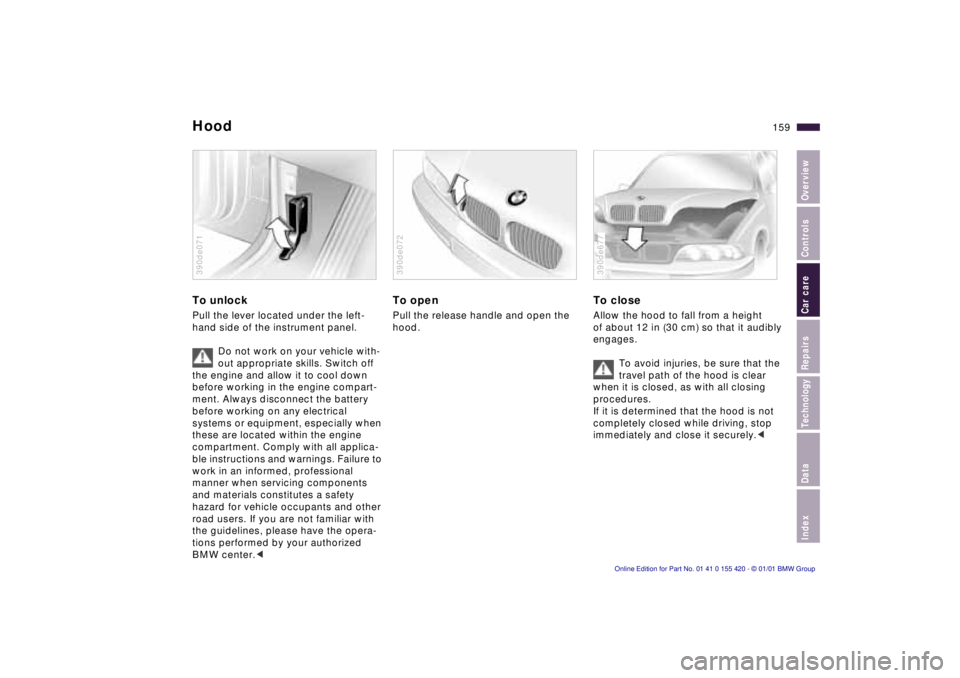
To unlock
Pull the lever located under the left-
hand side of the instrument panel.
Do not work on your vehicle with-
out appropriate skills. Switch off
the engine and allow it to cool down
before working in the engine compart-
ment. Always disconnect the battery
before working on any electrical
systems or equipment, especially when
these are located within the engine
compartment. Comply with all applica-
ble instructions and warnings. Failure to
work in an informed, professional
manner when servicing components
and materials constitutes a safety
hazard for vehicle occupants and other
road users. If you are not familiar with
the guidelines, please have the opera-
tions performed by your authorized
BMW center. <
390de071
To open
Pull the release handle and open the
hood.
390de072
To close
Allow the hood to fall from a height
of about 12 in (30 cm) so that it audibly
engages.
To avoid injuries, be sure that the
travel path of the hood is clear
when it is closed, as with all closing
procedures.
If it is determined that the hood is not
completely closed while driving, stop
immediately and close it securely. <
390de677
Page 168 of 238

168nCoolant Brake fluid
Adding coolant
Wait until the engine cools before
removing the cap from the expansion
tank. The needle of the coolant temper-
ature gauge in the instrument cluster
must be located in the blue zone; other-
wise, there is a danger of scalding.
1 Start by turning the cap counter-
clockwise. Pause to allow any
accumulated pressure to escape,
then open.
2 If the coolant is low, slowly add coolant until the correct level is
reached – do not overfill.
The coolant is a mixture of water and
extended-duty antifreeze with corrosion
inhibitor. Always maintain the pre-
scribed all-season 50:50 mixture ratio
for year-round protection against inter-
nal corrosion. No other additives are re-
quired.
Replace the coolant every four years.
If the indicator lamp for the
brake hydraulic system comes
on or if the "CHECK BRAKE
FLUID" warning appears in the
Check Control
*: the brake fluid
level is too low in the reservoir.
The brake fluid reservoir is located
under the microfilter housing on the
driver's side of the car. Should you de-
termine that the brake fluid is low, refer
the problem to your BMW center, who
can trace and rectify any sources of
leakage when refilling the reservoir.
Your BMW center is familiar with the
specifications for approved brake
fluids (DOT 4).
Brake fluid loss results in extended
pedal travel. For this situation, refer to
the notes on page 146.
Brake fluid is hygroscopic, that is,
it absorbs moisture from the air
over time.
In order to ensure the safety and
reliability of the brake system, have
the brake fluid changed every two years
by an BMW center. Refer also to the
Service and Warranty Information
Booklet (US models) or to the Warranty
and Service Guide Booklet (Canadian
models).
Brake fluid is toxic and damages the
vehicle's paint. You should always store
it in its original container and in a loca-
tion which is out of reach of children.
Do not spill the fluid and do not fill the
brake fluid reservoir beyond the "MAX"
mark. The brake fluid could ignite upon
contact with hot engine parts and
cause serious burns. <
Comply with the applicable
environmental laws regulating the
disposal of brake fluid. <
Page 175 of 238

Index
Data
Technology
Repairs
Car care
Controls
Overview
175nCaring for your car
Leather care
The leather* upholstery used by BMW
is a natural product of the highest qual-
ity, processed using state-of-the-art
methods to ensure that it will maintain
its high quality for years to come, pro-
vided that it is properly cared for.
Because this product is manufactured
using natural materials, you must make
allowance for its special characteristics
as well as for the peculiarities of its use
and care.
Regular periodic cleaning and care are
essential, as dust and road dirt act as
abrasives in the pores and creases of
the material. This leads to wear spots
and premature brittleness on the sur-
face of the leather. We therefore sug-
gest that you clean the leather with a
vacuum cleaner or dust cloth at fre-
quent intervals.
For cleaning, use BMW leather cleaning
foam.
Since dirt and grease gradually affect
the protective surface layer of the
leather, the cleaned surfaces should be
treated with a BMW leather care agent.
This also acts as an antistatic agent. For protection against dampness or
moisture, treat the leather with a BMW
impregnating agent.
We recommend that you perform this
procedure twice a year on leather ex-
posed to normal use.
Spills should be wiped up immediately.
Remove grease and oil stains without
rubbing, but rather by dabbing with
spot remover.
If the upholstery is to be exposed to in-
tense sunlight or if the vehicle is to be
stored for an extended period, cover all
leather surfaces (or, better yet, the win-
dows) to prevent fading.
Use cleaning and car-care
products that you can obtain
at your BMW center. <
Cleaning agents can contain sub-
stances that are dangerous or
pose health risks. Therefore, always
comply with the warnings and danger
notices on the package.
Open the doors or windows on your ve-
hicle before cleaning the interior. Never
clean your vehicle with cleaning agents
(or solvents) not specifically intended
for this purpose. <
Page 177 of 238

Index
Data
Technology
Repairs
Car care
Controls
Overview
177n
Any BMW center will be glad to inform
you of the advisability, legal require-
ments and factory recommendations
with regard to technical modifications
on the car. For this purpose, the center
requires the Vehicle Identification Num-
ber and, in some cases, also the engine
number.
Light-Emitting Diodes (LEDs)
Light-emitting diodes installed behind
translucent lenses serve as the light
source for many of the controls and dis-
plays in your vehicle. The concept be-
hind their operation is related to that
employed for lasers, and they are offi-
cially designated as Class 1 light-emit-
ting diodes. Do not remove the protective lens
and avoid staring directly at the
unfiltered beam for extended periods
(several hours), as inflammation of the
iris could result. <
California laws require us to state the
following warning:
Engine exhaust, some of its con-
stituents, and certain vehicle com-
ponents contain or emit chemicals
known to the State of California to
cause cancer and birth defects or other
reproductive harm. <
Technical modifications California Proposition 65 Warning
Page 178 of 238
178nOBD interface socket
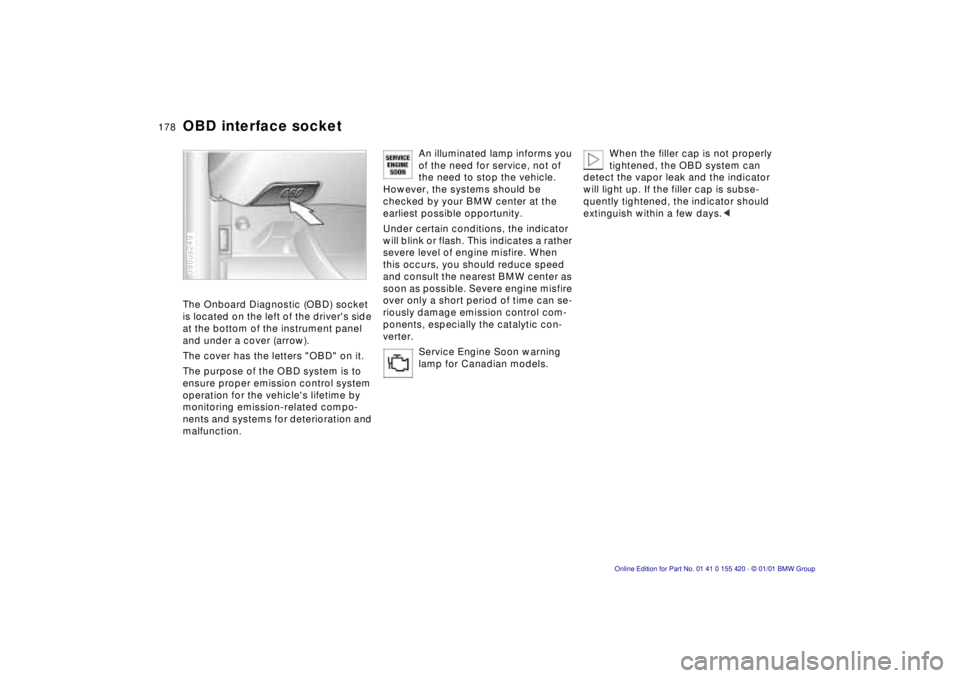
The Onboard Diagnostic (OBD) socket
is located on the left of the driver's side
at the bottom of the instrument panel
and under a cover (arrow).
The cover has the letters "OBD" on it.
The purpose of the OBD system is to
ensure proper emission control system
operation for the vehicle's lifetime by
monitoring emission-related compo-
nents and systems for deterioration and
malfunction.
390us249
An illuminated lamp informs you
of the need for service, not of
the need to stop the vehicle.
However, the systems should be
checked by your BMW center at the
earliest possible opportunity.
Under certain conditions, the indicator
will blink or flash. This indicates a rather
severe level of engine misfire. When
this occurs, you should reduce speed
and consult the nearest BMW center as
soon as possible. Severe engine misfire
over only a short period of time can se-
riously damage emission control com-
ponents, especially the catalytic con-
verter.
Service Engine Soon warning
lamp for Canadian models.When the filler cap is not properly
tightened, the OBD system can
detect the vapor leak and the indicator
will light up. If the filler cap is subse-
quently tightened, the indicator should
extinguish within a few days. <